Introduction
Ventilation tube or grommet insertion is a common procedure in children, most often performed for otitis media with effusion. The procedure is also carried out in adults for various aetiologies. The majority of children will have grommets inserted at a crucial stage of development, at a young age. The benefits of grommet insertion on speech, language and behaviour development are well described. This period of growth also coincides with the development of important life skills, including being able to swim.
Advice given to parents and patients with a ventilation tube or grommet about water precautions varies from clinician to clinician, and can range from total avoidance of water, to waterproofing, to no precautions at all. The advice given to divers with grommets has been to waterproof the ears at any depth, as mounting pressure could induce water contamination with subsequent caloric effects on the vestibular system, which can be dangerous at depth.
The most common complication following grommet insertion is otorrhoea. Water contamination of the middle ear following grommet insertion is thought to contribute to infection and subsequent otorrhoea. Some consider the ventilation tube too small to allow any significant water contamination and therefore do not advise against water precautions.
This study aimed to determine at what depth, if any, water contamination will occur through a grommet, assessed using an experimental submersion model.
Materials and methods
This study was an experimental laboratory based investigation. No animal or human contact was required. Ethical approval from our institution was therefore not undertaken.
A middle-ear model was designed using a transparent plastic tube, a pseudo tympanic membrane and an effervescent solid employed as an indicator of water contamination. The transparent tube used was the tubing for a Shepard grommet, as supplied by Medasil Surgical, Leeds, UK. The dimensions of these tubes are 44 mm in height and 9 mm in inner diameter. The pseudo tympanic membrane was constructed using toughened dental modelling wax, as supplied by Anutex®. The dental wax was heated with a dry heat gun until it became malleable. A needle was then used to bore an opening in the wax to simulate a myringotomy through which the grommet could be introduced. The edges around the grommet were then sealed while the wax was still malleable. Effervescent zinc and vitamin C tablets, as sold commercially by Valeo Healthcare, Dublin, Ireland, were crushed and small pieces of the solid were inserted into the tubing. The warmed wax was then pressed onto the open end of the tube to ensure a watertight seal.
A 6 l container was filled with fresh water at room temperature and placed on a level surface. The middle-ear model was attached to a graduated ruler, in a horizontal plane to the surface of the water, and submerged 1 mm at a time. A second investigator observed for effervescence and increased gas formation that manifested as gas bubbles emanating from the grommet. This event was used to reflect the depth of water contamination. Between each submersion, the tubing was cleaned out and dried thoroughly. The grommet was also cleaned of any retained water or effervescent material prior to reconstruction of the model and subsequent submersion.
The procedure was conducted with Shepard grommets, titanium grommets and T-tubes, to simulate submersion with a variety of tubes.
The water pressure required to cause middle-ear contamination was deduced using the formula : P = ρgh, where P = pressure, ρ = mass density (997.0474 kg/m3), g = acceleration of gravity (9.80665 m/s2) and h = depth.
The middle-ear model is depicted in Figure 1, and demonstrates the various grommets used.
The middle-ear model with Shepard, titanium and T-tube grommets embedded through dental wax. The effervescent solid can be seen in the tube.

Results
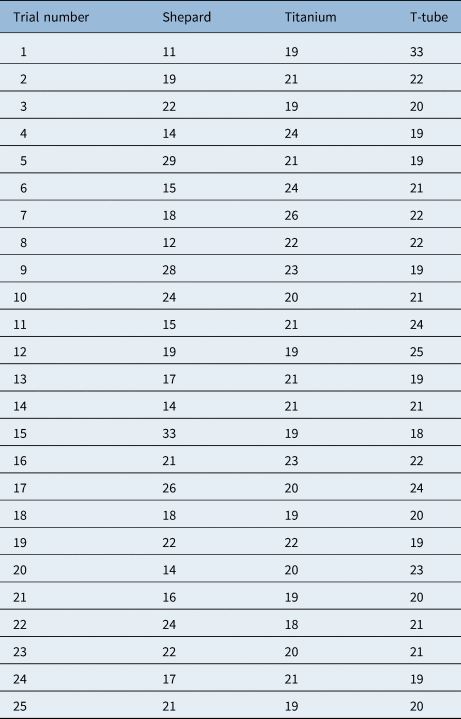
Each type of grommet was submerged, as described above, on 25 separate occasions. Table 1 details the depth of effervescence activation for each submersion.
Depth of water contamination with each grommet type

All data reflect depth of effervescence activation, in millimetres
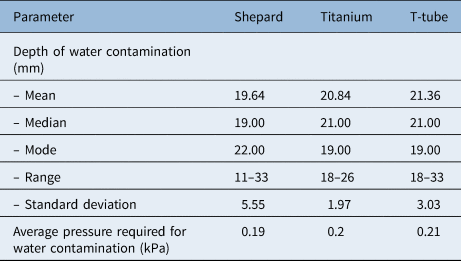
The Shepard grommet allowed water contamination at a mean depth of 19.64 mm (standard deviation = 5.55 mm), with a range of 11–33 mm. The average pressure for water contamination in fresh water to occur was 0.19 kPa.
The titanium grommet demonstrated effervescent activation at a mean depth of 20.84 mm (standard deviation = 1.97 mm), with a range of 18–26 mm. The average water pressure required for contamination of the middle-ear model was 0.2 kPa.
The trials with the T-tube grommet demonstrated water contamination at an average depth of 21.36 mm (standard deviation = 3.03 mm), with a range of 18–33 mm. The average pressure required for the influx of water was 0.21 kPa. These findings are summarised in Table 2.
Measures of central tendency for each grommet type and water contamination

Discussion
Advice following grommet insertion varies between centres and clinicians. A survey carried out in the UK comparing consultant's post-operative instructions found that 95.6 per cent permitted swimming, with 32.9 per cent insisting on ear plugs and 61.6 per cent advising the avoidance of diving activities.Reference Basu, Georgalas, Sen and Bhattacharyya1 The practice of limiting water exposure stems from the belief that water bearing bacteria, entering the middle ear through the grommet, will cause otorrhoea and middle-ear infection. This is at odds with a Cochrane review on the topic, which, based on two included studies, found that the findings for participants who waterproofed their ears versus those who did not were comparable. Furthermore, the second included study demonstrated no significant difference in otorrhoea in patients who avoided water entirely versus those who bathed with no precautions.Reference Moualed, Masterson, Kumar and Donnelly2
This topic is clearly still of considerable interest owing to the frequency of grommet insertions and the number of randomised, controlled trials carried out since this review. Most of these randomised, controlled trials conclude with similar results to the Cochrane review, with minor differences. In one study comparing auricular protection versus no protection, patients who had protection had a reduced risk of otorrhoea in the first month, but this equalised between groups after the first post-operative month.Reference Miyake, Tateno, Cançado, Miyake, Tincani and Sousa3 In a similarly designed study, otorrhoea was only found to be related to water exposure in 37 per cent of the water precaution group and in 36 per cent in the non-protected group; moreover, 56 per cent and 52 per cent of cases, respectively, were in the context of upper respiratory tract infections.Reference Subtil, Jardim, Araujo, Moreira, Eça and McMillan4 It would therefore appear that water penetration does not influence the occurrence of otorrhoea following grommet insertion.
Our results show that water contamination of the middle ear is highly likely in depths as low as 1 cm, and certainly greater than 3 cm, regardless of the type of grommet tube used. Previous studies in this area have demonstrated that various constitutions of water, including sea water, chlorinated water and soapy water, all have the ability to penetrate an in vitro middle ear. In these studies, soapy water demonstrated the lowest hydrostatic head to penetrate grommets.Reference Ricks, Easto and Reddy5,Reference Ibrahim, Fram, Hughes, Phillips and Owens6 These studies measured the water volume required for penetration, rather than depth of submersion. The grommet tube models were instilled with the tube face in an upright position, and the pressure of water penetration through the tubes during water contamination was determined. Our study differed in that our model adopted a more anatomically consistent orientation, and the depth of submersion in a large body of water was investigated, which may be more consistent with the context of regular water exposure. Contamination at such low depths and pressure negated the need to conduct further experimentation into various kinds of water consistency; this did not seem practical given the likelihood that various water densities would lead to water contamination with minimal difference to clinical utility.
As in previous studies, the titanium grommet appeared to provide the most consistent measurement with the smallest standard deviation. We suspect that the rigid structure of the titanium grommet is not influenced by the surrounding pressure in the same manner as the more flexible Shepard grommet and T-tube. As previously noted, this may be a desired effect if topical aural solutions are required to enter the middle ear, albeit with the aid of tragal pressure.Reference Hebert, Vick, King and Bent7
One of the study's weaknesses is the lack of clinical data; however, we set out to determine whether water contamination was a possibility, not to determine what the clinical sequelae of water contamination would be. This question has been very well answered in previous high-quality reviews.Reference Moualed, Masterson, Kumar and Donnelly2 Another weakness of our middle-ear model was the lack of an external auditory canal, which may make a difference to middle-ear contamination. Furthermore, we tested our model in the horizontal plane only. Pressure dispersion is likely to be higher in various planes; for example, if the grommet face is horizontal with the water's surface. Similarly, head movement while swimming in water is very unlikely to be static, as in our model. We chose fresh water for convenience, but this also allows us to deduce the results for various densities of water by substituting the value for ρ; such results are not likely to have any clinically significant impact on how deep swimmers or divers can descend without waterproofing their ears.
• Clinicians’ advice to patients regarding water protection following grommet insertion varies
• Evidence can be found to support either total water avoidance or liberal water exposure
• This study demonstrates that submersion to depths as low as 11 mm can result in middle-ear water contamination
• Titanium grommets demonstrated the most consistent water contamination at depth
• Surface-based water activities are acceptable, but diving may incur higher risk and patients should be counselled accordingly
• Our novel middle-ear model, mirroring realistic conditions, is the first to demonstrate water contamination at depth
Regardless of these limitations, our goal was to determine the depth at which water contamination occurred. The clinical significance of these findings is plain – any amount of water penetration is possible and water is likely to enter the middle ear. For surface-based swimming, this does not appear to have any clinically significant impact; however, we would recommend waterproofing the ears when diving or during submersion activities owing to high possibility of water contamination at higher pressures.
Conclusion
Mounting evidence suggests that the avoidance of water when grommet tubes are in situ is not necessary. As our study shows, it is highly likely that contamination of the middle ear will take place with minimal submersion. When considered alongside the results of previous in vitro studies, it is likely that any kind of water, be it soapy, salt water or medicinal suspension, will have similar results. At this juncture, most clinicians agree that surface-based water activities are acceptable. Diving activities should not be discouraged, but ear protection in these instances is warranted owing to the high likelihood of increased pressures and subsequent middle-ear contamination.
Competing interests
None declared