Introduction
Trauma experienced during childhood is associated with increased risk for depression (Kessler & Magee, Reference Kessler and Magee1993; Fergusson et al. Reference Fergusson, Horwood and Lynskey1996; Kessler et al. Reference Kessler, Davis and Kendler1997; Felitti et al. Reference Felitti, Anda, Nordenberg, Williamson, Spitz, Edwards, Koss and Marks1998; Kendler et al. Reference Kendler, Bulik, Silberg, Hettema, Myers and Prescott2000, Reference Kendler, Gardner and Prescott2002, Reference Kendler, Gardner and Prescott2006; Jaffee et al. Reference Jaffee, Moffitt, Caspi, Fombonne, Poulton and Martin2002; Nelson et al. Reference Nelson, Heath, Madden, Cooper, Dinwiddie, Bucholz, Glowinski, McLaughlin, Dunne, Statham and Martin2002; Dube et al. Reference Dube, Felitti, Dong, Giles and Anda2003; Maercker et al. Reference Maercker, Michael, Fehm, Becker and Margraf2004) and an early age at onset (Spatz-Widom et al. Reference Spatz-Widom, DuMont and Czaja2007). The greater aggregation of depression observed in families of early-onset cases has been interpreted as evidence for higher genetic risk associated with early-onset versus adult-onset depression (Todd et al. Reference Todd, Neuman, Geller, Fox and Hickok1993; Williamson et al. Reference Williamson, Ryan, Birmaher, Dahl, Kaufman, Rao and Puig-Antich1995; Kovacs et al. Reference Kovacs, Devlin, Pollock, Richards and Mukerji1997; Wickramaratne et al. Reference Wickramaratne, Greenwald and Weissman2000) but increased aggregation of childhood trauma in some families may also contribute. Twin designs have been used within diathesis-stress frameworks (Meehl, Reference Meehl1989; Monroe & Simons, Reference Monroe and Simons1991) to examine the contributions of trauma and genetic vulnerability to risk for depression. Twin studies that include only stressors that occur within 1 year of the onset of depression (Kendler et al. Reference Kendler, Kessler, Walters, MacLean, Neale, Heath and Eaves1995, Reference Kendler, Karkowski and Prescott1999; Kendler & Karkowski-Shuman, Reference Kendler and Karkowski-Shuman1997; Sullivan et al. Reference Sullivan, Prescott and Kendler2002) permit a closer approximation of causation than would be possible when using temporally distant events, but are inconsistent with evidence that childhood trauma can have long-lasting effects (Fergusson et al. Reference Fergusson, Horwood and Lynskey1996; Kessler et al. Reference Kessler, Davis and Kendler1997; Felitti et al. Reference Felitti, Anda, Nordenberg, Williamson, Spitz, Edwards, Koss and Marks1998; Nelson et al. Reference Nelson, Heath, Madden, Cooper, Dinwiddie, Bucholz, Glowinski, McLaughlin, Dunne, Statham and Martin2002; Dube et al. Reference Dube, Felitti, Dong, Giles and Anda2003). Twin studies that examine the association of temporally distant events with risk for lifetime depression (Dinwiddie et al. Reference Dinwiddie, Heath, Dunne, Bucholz, Madden, Slutske, Bierut, Statham and Martin2000; Kendler et al. Reference Kendler, Bulik, Silberg, Hettema, Myers and Prescott2000; Nelson et al. Reference Nelson, Heath, Madden, Cooper, Dinwiddie, Bucholz, Glowinski, McLaughlin, Dunne, Statham and Martin2002) often focus on individual events, such as childhood sexual abuse, and do not examine the influence of a range of traumatic events experienced at different developmental periods. As many individuals who experience one traumatic event experience additional events during their lifetimes (Kessler et al. Reference Kessler, Sonnega, Bromet, Hughes and Nelson1995, Reference Kovacs, Devlin, Pollock, Richards and Mukerji1997; Breslau et al. Reference Breslau, Kessler, Chilcoat, Schultz, Davis and Andreski1998, Reference Breslau, Chilcoat, Kessler and Davis1999), examination of events in isolation may overestimate their influence on risk for depression, which may be correlated with other events in a broader context (Kessler et al. Reference Kessler, Davis and Kendler1997). Differences in risk due to type and timing of events have been examined in relation to post-traumatic stress disorder (PTSD), and can guide similar explorations of trauma and depression. Assaultive events, such as rape, that occur during childhood have been found to increase risk for PTSD in adults after subsequent trauma, but risk from non-assaultive events such as accidents decays over time (Breslau et al. Reference Breslau, Chilcoat, Kessler and Davis1999).
The present study used a twin sample to examine how the age at occurrence of nine distinct traumatic events influenced risk for major depressive disorder. The aims of this analysis were to examine: (i) the lifetime prevalence, by gender, of assaultive and non-assaultive trauma in a volunteer twin sample from the general population, (ii) the accumulation of trauma over time, (iii) differences in risk for depression according to age at trauma occurrence, and (iv) the contributions of assaultive trauma, non-assaultive trauma, and familial effects to risk for depression.
Method
Participants
Subjects were members of the young adult cohort of the Australian Twin Register, a volunteer twin panel, born in 1964–1971 (Nelson et al. Reference Nelson, Heath, Madden, Cooper, Dinwiddie, Bucholz, Glowinski, McLaughlin, Dunne, Statham and Martin2002; Lynskey et al. Reference Lynskey, Glowinski, Todorov, Bucholz, Madden, Nelson, Statham, Martin and Heath2004). Almost all twins were registered by their parents in response to approaches through the school systems or mass media appeals. The data presented here are derived from a structured diagnostic interview (Bucholz et al. Reference Bucholz, Cadoret, Cloninger, Dinwiddie, Hesselbrock, Nurnberger, Reich, Schmidt and Schuckit1994) adapted for telephone administration from 1996 to 2000. The institutional review boards of Washington University (St Louis, MO, USA) and the Queensland Institute of Medical Research (Brisbane, Australia) approved the informed consent procedure. Of 4010 pairs that could be traced, interviews were completed with both members of 2765 pairs (69% pairwise response rate) and one member of another 735 pairs (78% individual response rate). Details about sample recruitment, composition and non-response are available in previous studies (Heath et al. Reference Heath, Bucholz, Madden, Dinwiddie, Slutske, Bierut, Statham, Dunne, Whitfield and Martin1997, Reference Heath, Howells, Kirk, Madden, Bucholz, Nelson, Slutske, Statham and Martin2001). Individuals with complete data on depression, trauma and age at onset (84% of interviewed subjects, n=5266 individuals) were selected for our sample [672 monozygotic (MZ) female pairs, 476 MZ male pairs, 481 dizygotic (DZ) female pairs, 375 DZ male pairs, 629 DZ opposite-sex pairs]. The sample was 55.7% female and the mean (s.d.) age at the time of interview was 29.9 (2.4) years with a range of 24 to 36 years. Twins excluded from the sample, compared to the analysis sample, were more likely to be from DZ pairs, had a higher prevalence of adult-onset depression and greater endorsement of childhood neglect and physical abuse, rape before age 18, physical assault after age 17, and being threatened with a weapon or kidnapped at any age.
Assessments
A version of the Semi-Structured Assessment for the Genetics of Alcoholism (SSAGA; Bucholz et al. Reference Bucholz, Cadoret, Cloninger, Dinwiddie, Hesselbrock, Nurnberger, Reich, Schmidt and Schuckit1994; Hesselbrock et al. Reference Hesselbrock, Easton, Bucholz, Schuckit and Hesselbrock1999), a diagnostic interview, was adapted for telephone use in Australia and administered by trained lay interviewers. The interview incorporates items from validated instruments, including the Diagnostic Interview Schedule (DIS; Robins et al. Reference Robins, Helzer, Croughan and Ratcliff1981), the Composite International Diagnostic Interview – Substance Abuse Module (CIDI-SAM; Cottler et al. Reference Cottler, Robins and Helzer1989), the Structured Clinical Interview for DSM-III-R (SCID; Spitzer et al. Reference Spitzer, Williams, Gibbon and First1992; Williams et al. Reference Williams, Gibbon, First, Spitzer, Davies, Borus, Howes, Kane, Pope, Rounsaville and Wittchen1992), and the Home Environment Interview (Robins et al. Reference Robins, Schoenberg, Holmes, Ratcliff, Benham and Works1985; Holmes & Robins, Reference Holmes and Robins1987, Reference Holmes and Robins1988), and has good reliability for assessing depression (Bucholz et al. Reference Bucholz, Cadoret, Cloninger, Dinwiddie, Hesselbrock, Nurnberger, Reich, Schmidt and Schuckit1994). The interview assessed lifetime history of DSM-IV (APA, 1994) depression and experience of traumatic events. Telephone assessments of depression have been found to have good inter-rater agreement with face-to-face interviews (Rohde et al. Reference Rohde, Lewinsohn and Seeley1997; Aziz & Kenford, Reference Aziz and Kenford2004).
History of traumatic events was based on items from the National Comorbidity Survey (NCS; Kessler et al. Reference Kessler, McGonagle, Zhao, Nelson, Hughes, Eshleman, Wittchen and Kendler1994, Reference Kessler, Sonnega, Bromet, Hughes and Nelson1995), which queried 12 events and experiences that qualified as traumatic events according to DSM-III-R criteria for PTSD. Details about trauma questions are available elsewhere (Kessler et al. Reference Kessler, Sonnega, Bromet, Hughes and Nelson1995). Respondents who endorsed an event reported their age at first and last occurrence. Participants were asked to report each event only once, so that, for example, serious physical assault by a parent would not also be reported as childhood physical abuse. The sexual molestation variable incorporates data about early sexual experience inside and outside the home, elicited in a separate section of the interview, in addition to the single question about sexual molestation from the NCS items.
To check whether mood at the time of interview influenced reporting of traumatic events, we compared trauma endorsement of individuals with current versus lifetime depression. Endorsement of neglect was greater among the currently depressed [4% v. 1%, odds ratio (OR) 3.2, p=0.04], but there were no other differences. To check for recall bias associated with time since interview, we tested for interactions of trauma with age at assessment in predicting depression, but found none for assaultive trauma, with a single significant interaction only with disaster [hazard ratio (HR) 1.1, p=0.02], which may reflect historical reality (i.e. the timing of a major disaster in Australia that would have impacted some respondents).
Statistical analysis
Cox regression with time-varying covariates was used because it takes into account the temporal ordering of trauma with depression, so that only traumatic events that pre-date depression onset contribute to risk. The association of trauma with depression was modeled to detect variation in risk as a function of timing in two ways: (i) differences in risk based on the developmental age at first trauma occurrence and (ii) variation in risk as a function of time since trauma occurrence.
Age categories were defined to distinguish childhood (ages 0–12), adolescent (ages 13–17) and adult (ages 18 and older) occurrence of first trauma and first depressive episode. Differences in risk by age at trauma occurrence were investigated by subdividing each individual event variable into three dummy variables representing childhood, adolescent and adult age groups, based on age at first experience of the event. In addition to investigating events individually, three trauma categories were formed based on the distinction between childhood/assaultive events and non-assaultive traumatic events (Breslau et al. Reference Breslau, Chilcoat, Kessler and Davis1999). These categories were: (i) no trauma (reference group), (ii) non-assaultive trauma only (life-threatening accident; witnessing injury or killing; fire, flood, or natural disaster), and (iii) childhood/assaultive trauma (childhood physical abuse, childhood neglect, rape, sexual molestation, severe physical assault, being threatened with a weapon or kidnapped). Although childhood neglect is not by definition an assaultive event, its strong co-occurrence with childhood physical and sexual abuse (Dong et al. Reference Dong, Anda, Felitti, Dube, Williamson, Thompson, Loo and Giles2004) warrants its inclusion in this category.
To detect differences in risk according to the age at which specific traumatic events occurred, we entered the three age-defined dummy variables into a regression analysis with age at onset of depression as the outcome. Wald χ2 tests, corrected for familial clustering, were used to determine differences in risk by first event occurrence during childhood, adolescence or adulthood. Where statistically significant (p⩽0.05) differences between the dummy variables were not observed, they were combined to represent broader age categories.
Variations in risk for depression over time were detected by testing the assumption of proportional hazards using the Stata (Stata Corporation, 2004) statistical program for survival analysis. The Cox model assumes that the hazard for each level of a nominal covariate is proportional over time, so that, for example, individuals who are assaulted may have greater risk for depression than those who are not, but the hazards are roughly parallel over time. One way to check the assumption of proportional hazards uses Schoenfeld residuals (Grambsch & Therneau, Reference Grambsch and Therneau1994) to test the null hypothesis that the ratio of hazards is constant over time (Cleves et al. Reference Cleves, Gould and Gutierrez2004). When the hazards are not proportional, interactions of time with the variable are created such that hazards are comparable within each time strata. The model makes no assumptions about the shape of the hazard over time, thus allowing that the increase in risk associated with early trauma may be greater for early-onset than for adult-onset depression. In our study, when the proportional hazards assumption was not satisfied for a given variable, we created interaction terms of the variable with age groups representing childhood, adolescent or adult periods. Interaction terms that did not differ significantly based on Wald tests were recombined until the simplest model satisfying the proportional hazards assumption was found.
Genetic effects on risk for depression were modeled as the interaction between twin zygosity (MZ or DZ) and co-twin lifetime status for depression. The age at onset of first depressive episode in the co-twin was used to define three mutually exclusive categories of familial risk for the respondent: childhood, adolescent, and adult. Co-twin status on depression was not coded as time varying but was always coded either ‘0’ or ‘1’, providing a constant level of familial risk as a counterpoint against which to examine the contribution of the respondent's trauma experience to risk.
The final model including familial effects was determined by first testing a model with the trauma categories and the interaction terms for genetic risk. After the simplest model satisfying the proportional hazards assumption was found, the results were reparameterized using an equivalent model (same number of parameters) to reflect familial risk by zygosity, enabling direct comparison of hazard ratios for MZ and DZ twins. Gender was included as a covariate in all regressions. Interactions of gender with each trauma term and with genetic terms were tested. Interactions with a trend (p⩽0.10) were reparameterized and reported separately for men and women.
Descriptive statistics and person-year data were created using SAS version 9 statistical software (SAS Institute, 2004). All regressions were performed using the Stata (Stata Corporation, 2004) statistical program and standard errors were adjusted for the non-independence of observations in twin data. Confidence intervals (CIs) for the final regression model were estimated using bootstrapping to correct for the non-independence of person-year data on twin pairs.
Results
Lifetime prevalence of trauma exposure
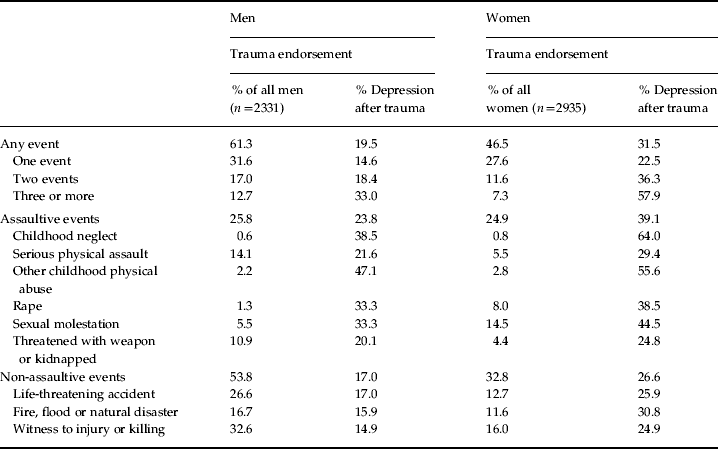
Endorsement rates of traumatic events by gender are presented in Table 1, with the percentage of individuals exposed to trauma who had a first onset of depression subsequent to trauma exposure. Fifty-three per cent of the sample overall reported experiencing at least one traumatic event. Women were less likely than men to endorse any event (OR 0.55, 95% CI 0.49–0.62), a difference specific to non-assaultive events (OR 0.41, 95% CI 0.37–0.47). Men and women did not differ in endorsement of childhood and assaultive events overall (OR 0.96, 95% CI 0.84–1.09), although there were gender differences in endorsement of individual events.
Lifetime prevalence of traumatic events and post-trauma depression, by gender

Associations of individual events with depression
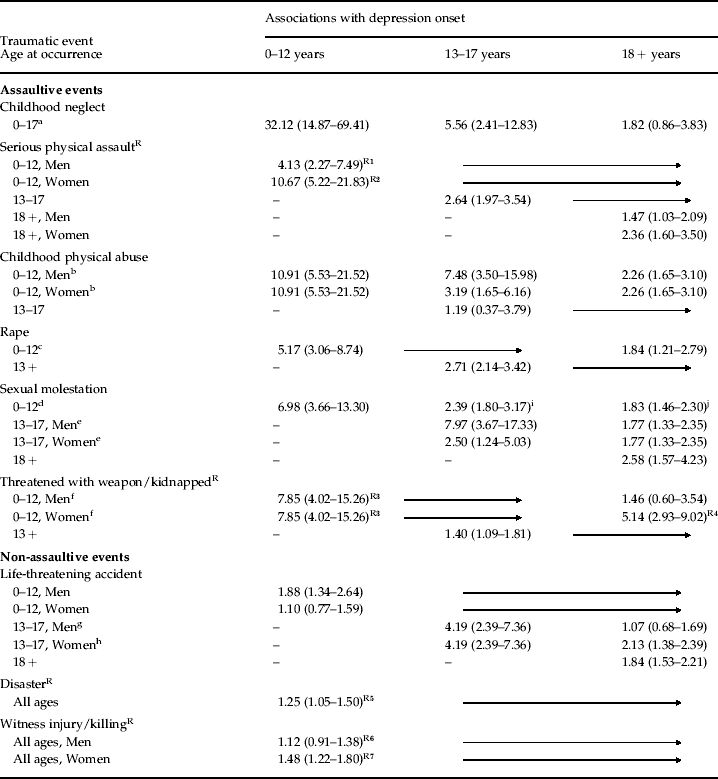
Twenty-seven per cent of the sample (n=1405) met lifetime criteria for depression (men 21.4%, women 30.8%). Of these, 6.4% were currently depressed, and 4.1% reported their first depressive episode during childhood, 15.0% during adolescence, and the remainder after age 17. Table 2 shows associations of individual traumatic events with depression risk, by age at event occurrence, with hazard ratios reported separately by age period or by gender, in cases where significant interactions were found. Three general trends are apparent regarding the difference between assaultive and non-assaultive events. First, assaultive events, including neglect, are associated with greater risk for depression onset than are non-assaultive events. Second, younger age at occurrence of assaultive events is associated with greater risk than later occurrence. Third, risk from assaultive events (excepting physical assault) varies over time, whereas the risk from non-assaultive events (excepting life-threatening accident) remains constant. The influence of trauma on risk for depression differs by gender for all events except childhood neglect, rape, and disaster. Including event recency as a covariate substantially increases the risk attributable to childhood experience of physical assault or being threatened with a weapon or kidnapped, and slightly decreases the risk from first experience of a disaster and of witnessing an injury or killing (see footnotes to Table 2).
Associations of individual traumatic events with depression, and their variation as a function of age and of age at trauma occurrence

Data are given as hazard ratio (HR) with 95% confidence interval (CI) in parentheses.
Arrows indicate continuation of HR into subsequent age period(s), i.e. risk from event occurrence does not decrease over the time indicated by arrows.
Associations prior to modeling age interactions, HR (95% CI):
a 3.66 (2.15–6.25), b 2.97 (2.26–3.91), c 2.54 (1.79–3.60), d 2.16 (1.82–2.58), e 2.02 (1.56–2.61), f 3.60 (2.31–5.61), g 1.37 (0.91–2.04), h 2.32 (1.57–3.43).
Age different from column indicators:
i ages 13–20, j ages 21+.
R Controlling for event recency (event occurring in later time period) for events where multiple occurrence significant. Associations unadjusted for event recency, HR (95% CI): R1 3.09 (1.73–5.49), R2 5.45 (2.43–12.21), R3 6.85 (3.53–13.31), R4 3.75 (1.91–7.36), R5 1.36 (1.15–1.59), R6 1.20 (0.98–1.46), R7 1.55 (1.28–1.87).
Accumulation of trauma over time
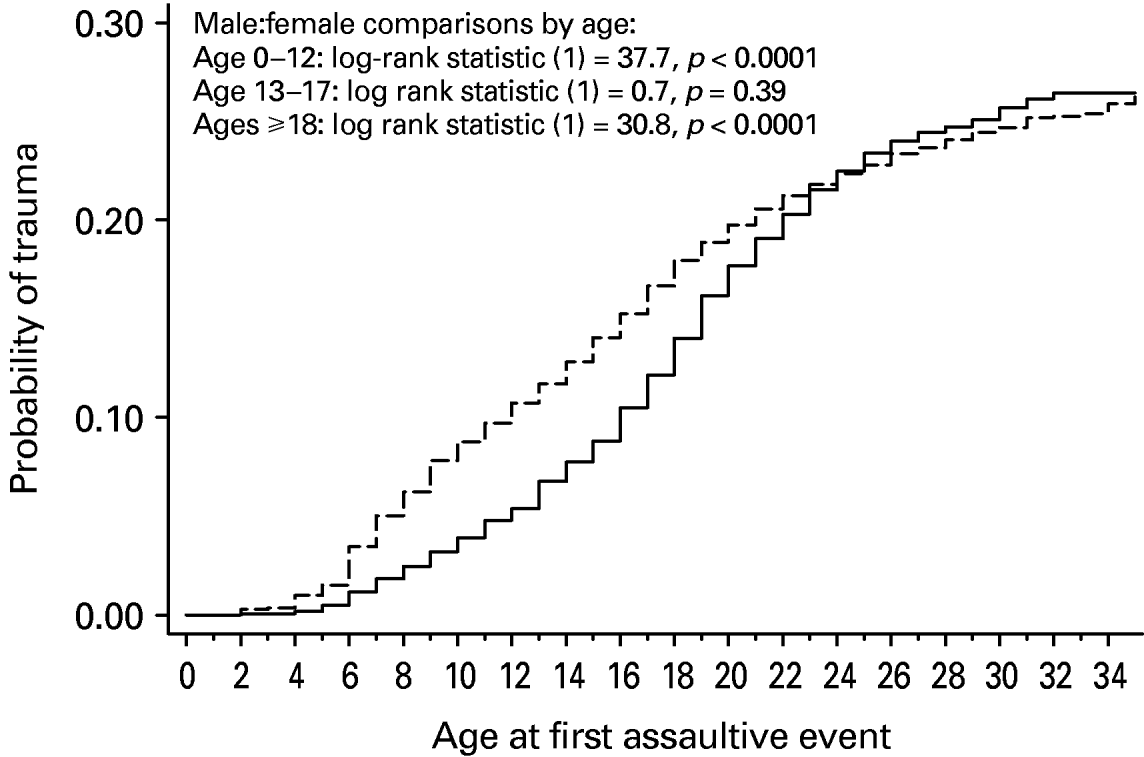
Although lifetime endorsement of assaultive events is equal by gender, women comprise the majority of the assaultive trauma category until age 22 (Fig. 1). Women are more likely than men to report assaultive trauma before age 13, risk is equal by gender from ages 13 to 17, and men are more likely than women to report assaultive trauma from age 18 on. Non-assaultive events have a greater accumulation among men than women through all periods of risk [log rank statistic (1)=238.83, p<0.0001].
Cumulative incidence of assaultive trauma by gender (—, male; - - -, female) (n=5266 subjects, n=162 691 observations in person-year data).

Associations of assaultive and non-assaultive trauma with depression
The cumulative incidence of first-onset depression is highest in the assaultive trauma category for both men [log rank statistic (2)=71.68, p<0.0001] and women [log rank statistic (2)=198.06, p<0.0001]. In a model including only the trauma categories and gender (not shown), the risk for depression associated with assaultive trauma history attenuated with age, with greatest risk before age 13 (HR 13.16, 95% CI 7.48–23.16), less between ages 13 and 17 (HR 3.70, 95% CI 2.76–4.98), and less again after age 17 (HR 2.28, 95% CI 1.99–2.61). Non-assaultive trauma history carried a more moderate risk for depression (HR 1.53, 95% CI 1.33–1.76) that did not vary with age.
Associations of trauma and familial effects with depression
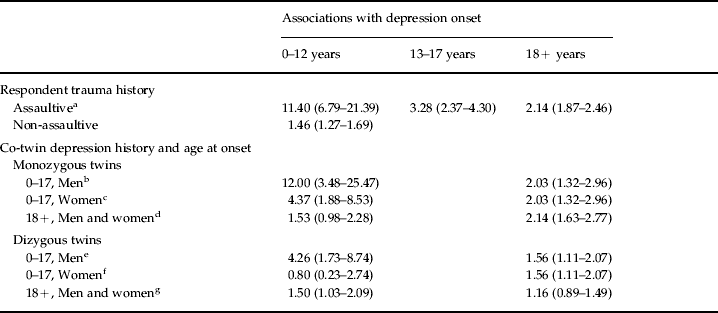
Controlling for trauma history, risks of respondent depression onset associated with co-twin childhood and adolescent onset could be pooled [χ2(1)=0.5, p=0.48], and were the same across the respondent's childhood and adolescent periods [χ2(1)=0.3, p=0.57]. Likewise, respondent risk of depression onset associated with co-twin adult-onset depression was the same across childhood and adolescent periods [χ2(1)=2.7, p=0.10]. We hereafter refer to the pooled childhood/adolescent onset category as early-onset. Table 3 summarizes respondent risk of depression onset, by developmental period, as a function of own trauma history and co-twin's depression history, with the latter categorized by twin pair zygosity and by the age of co-twin depression onset. It thus summarizes the combined effects of genetic risk (contrasting risk associated with MZ versus DZ exposure) and trauma exposure across developmental periods. No significant genotype-by-environment interaction effects were found, nor did we find significant interactions of trauma with gender.
Effects of history and timing of trauma and co-twin depression on risk for respondent first-onset depression, by age

Data are given as hazard ratio (HR) with 95% confidence interval (CI) in parentheses.
Adjusted for zygosity and gender. Confidence intervals are bootstrapped, bias-corrected, and stratified by twin zygosity, except for dizygous childhood and adolescent females, where data were too sparse to permit bootstrapped estimates.
Associations prior to modeling interactions with respondent age, HR (95% CI):
a 2.43 (2.15–2.75), b 4.51 (2.18–9.35), c 2.62 (1.72–3.99), d 2.03 (1.61–2.55), e 1.65 (1.02–2.67), f 1.67 (1.17–2.38), g 1.22 (0.99–1.51).
Five notable findings illustrate the contributions of genetic effects and trauma to risk for depression (Table 3). (i) Assaultive trauma history has a potent effect on risk, especially during childhood. Its association with risk for childhood-onset depression is comparable to the risk associated with having a male [HRs=11.4 v. 12.0, χ2(1)=0.0, p=0.93] or female [11.4 v. 4.4, χ2(1)=3.6, p=0.06] MZ co-twin with early depression onset, and greater than the risk associated with having a male [11.4 v. 4.3, χ2(1)=4.2, p=0.04] or female [11.4 v. 0.8, χ2(1)=13.5, p<0.01] DZ co-twin with early depression onset. The association of assaultive trauma history with adult-onset depression, though reduced, is nonetheless equal to the risk associated with having an MZ co-twin with adult-onset depression [2.1 v. 2.1, χ2(1)=0.0, p=1.0], and greater than that associated with having a DZ co-twin with adult-onset depression [2.1 v. 1.2, χ2(1)=17.7, p<0.01]. (ii) Non-assaultive trauma history is associated with a modest increase in risk for depression that does not vary by age. (iii) Comparison of HRs for MZ and DZ twins reveals significant genetic effects on early depression onset in women. The association of co-twin early-onset depression with respondent risk for early-onset is stronger for MZ than DZ twins among women [4.37 v. 0.80, χ2(1)=5.9, p=0.01], with a similar trend among men [12.00 v. 4.26, χ2(1)=3.5, p=0.06]. (iv) The effect of co-twin adult-onset depression on respondent adult-onset is also stronger among MZ than DZ twins in both genders [HRs=2.14 v. 1.16, χ2(1)=11.9, p<0.01]. Finally, there is a lack of evidence for genetic contributions in pairs concordant for depression but discordant for early- versus adult-onset, raising the possibility that, even after adjustment for trauma history, family environmental mechanisms are important for this subgroup. Specifically, the association of co-twin adult-onset depression with risk for early-onset depression in the respondent does not vary by zygosity [HRs=1.53 v. 1.50, χ2(1)=0.0, p=0.94]. Similarly, the association of co-twin early-onset depression with risk for respondent adult-onset depression does not vary significantly by zygosity [2.03 v. 1.56, χ2(1)=1.0, p=0.32].
Discussion
The present study found that early assaultive trauma increased risk for early-onset depression and had an enduring influence on risk for adult-onset depression, independent of familial effects. All early assaultive events and childhood neglect were associated with heightened risk during childhood and into adulthood, suggesting that focusing on individual events, such as childhood sexual abuse, may obscure a general vulnerability that is associated with exposure to any interpersonal assaultive trauma during early development.
The co-occurrence of depression with PTSD is well documented (Breslau et al. Reference Breslau, Davis, Andreski and Peterson1991; Kessler et al. Reference Kessler, Sonnega, Bromet, Hughes and Nelson1995; North et al. Reference North, Smith and Spitznagel1997, Reference North, Nixon, Shariat, Mallonee, McMillen, Spitznagel and Smith1999; Creamer et al. Reference Creamer, Burgess and McFarlane2001; O'Donnell et al. Reference O'Donnell, Creamer and Pattison2004), but as PTSD was not assessed in this sample we cannot address the possibility that our findings for depression are limited to individuals with co-occurring PTSD. Nonetheless, differences in risk for depression according to the type and timing of trauma are similar to findings regarding PTSD. Breslau et al. (Reference Breslau, Kessler, Chilcoat, Schultz, Davis and Andreski1998, Reference Breslau, Chilcoat, Kessler and Davis1999) found greater risk for PTSD following assaultive events compared to non-assaultive events. Early exposure to assaultive violence increased risk for PTSD following subsequent trauma among individuals who developed PTSD after the initial trauma (Breslau et al. Reference Breslau, Chilcoat, Kessler and Davis1999, Reference Breslau, Peterson and Schultz2008). Recent findings from prospective studies are similar. Copeland et al. (Reference Copeland, Keeler, Angold and Costello2007) found that traumatic events reported by age 13 were associated with increased risk for PTSD symptoms and with depressive and anxiety disorders by age 16. Childhood trauma has been found to carry greater risk for depression than adolescent trauma, given endorsement of a PTSD-qualifying event (Maercker et al. Reference Maercker, Michael, Fehm, Becker and Margraf2004). An enduring risk for depression was found among adults with court-documented histories of physical abuse and neglect that occurred before age 11 (Spatz-Widom et al. Reference Spatz-Widom, DuMont and Czaja2007). These findings of strong effects of early trauma with risk for depression, combined with the possibility that PTSD–depression co-morbidity following trauma exposure represents a shared vulnerability rather than distinct liabilities (O'Donnell et al. Reference O'Donnell, Creamer and Pattison2004), suggest that exposure to early trauma increases vulnerability to stress across the lifespan. Although we were unable to examine PTSD, our findings are consistent with these earlier studies and, furthermore, specify the particular influence of individual events.
Our study extends earlier findings regarding trauma by including familial effects, as did another recent study. Zimmerman et al. (Reference Zimmermann, Bruckl, Lieb, Nocon, Ising, Beesdo and Wittchen2008) included familial effects in their examination of the influence of various adversities on a first onset of depression over a 10-year period. They defined familial liability as a history of at least subthreshold parental depression, and history of traumatic events was determined using items similar to those in our analysis. They found that a history of trauma predicted increased risk for depression among individuals with familial liability but not those without (Zimmermann et al. Reference Zimmermann, Bruckl, Lieb, Nocon, Ising, Beesdo and Wittchen2008). We found no evidence in our study that sensitivity to the effects of trauma was greater among individuals with familial liability to depression, as would have been indicated by gene–environment interactions. Our findings are similar, however, in that we found independent effects of trauma and familial liability and evidence for long-term associations of early trauma with risk for a first onset of depression. The similarity of our findings, based on retrospective data, with findings from a prospective study increases our confidence that our data provide valid results.
Our examination of a range of traumatic events suggests that the type and timing of trauma are important considerations in research that examines the interplay of environmental and genetic factors across the lifespan. In the present study, the influence of early assaultive trauma on risk for childhood-onset depression was equal to familial effects for MZ twins and greater than familial effects for DZ twins; substantial influence on risk for adolescent and adult-onset depression was also observed. By contrast, non-assaultive trauma had a moderate association with risk, contributing less than either assaultive trauma or familial effects. The results also challenge the assumption that early-onset depression in a relative is necessarily associated with increased genetic risk for adult-onset depression because we failed to find higher MZ than DZ concordance in pairs concordant for depression but discordant for early versus adult-onset.
In the present study, as in the NCS (Kessler et al. Reference Kessler, Sonnega, Bromet, Hughes and Nelson1995), women endorsed more rape and sexual molestation than men, events associated with strong risk for childhood- and adolescent-onset depression (Swanston et al. Reference Swanston, Plunkett, O'Toole, Shrimpton, Parkinson and Oates2003). The finding in this study that rates of assaultive trauma history are similar by gender differs from studies of trauma in relation to PTSD, which find that men have greater exposure to assaultive violence than do women (Breslau et al. Reference Breslau, Kessler, Chilcoat, Schultz, Davis and Andreski1998, Reference Breslau, Wilcox, Storr, Lucia and Anthony2004). However, those studies did not directly inquire about childhood rape, molestation, or physical abuse, and this difference alone may account for the discrepancy in male-to-female ratios of assaultive trauma between studies.
The marked gender difference in the timing of assaultive trauma, with women reporting assaultive events at earlier ages, warrants investigation of possible gender differences in the effects of early trauma on development, which may influence lifetime risk for depression. One twin study found that women with histories of childhood sexual abuse, compared to those without such histories, were indeed more sensitive to the effects of recent stress, and more likely to experience current depression (Kendler et al. Reference Kendler, Kuhn and Prescott2004). If, as recent evidence suggests, early deprivation and adversity can influence the development of the stress response system (Heim et al. Reference Heim, Newport, Heit, Graham, Wilcox, Bonsall, Miller and Nemeroff2000, Reference Heim, Newport, Bonsall, Miller and Nemeroff2001; Penza et al. Reference Penza, Heim and Nemeroff2003) and the brain (De Bellis et al. Reference De Bellis, Keshavan, Shifflett, Iyengar, Beers, Hall and Moritz2002; De Bellis & Keshavan, Reference De Bellis and Keshavan2003; Teicher et al. Reference Teicher, Dumont, Ito, Vaituzis, Giedd and Andersen2004; De Bellis & Kuchibhatla, Reference De Bellis and Kuchibhatla2006), which in turn may increase risk for depression, then evidence that women experience assaultive trauma at earlier ages than men is an important consideration for research on depression. Although gene–environment interactions have been found to account for some of the variation in risk for depression following adversity (Caspi et al. Reference Caspi, Sugden, Moffitt, Taylor, Craig, Harrington, McClay, Mill, Martin, Braithwaite and Poulton2003; Eley et al. Reference Eley, Sugden, Corsico, Gregory, Sham, McGuffin, Plomin and Craig2004; Kaufman et al. Reference Kaufman, Yang, Douglas-Palumberi, Houshyar, Lipschitz, Krystal and Gelernter2004; Kendler et al. Reference Kendler, Kuhn, Vittum, Prescott and Riley2005; Wilhelm et al. Reference Wilhelm, Mitchell, Niven, Finch, Wedgwood, Scimone, Blair, Parker and Schofield2006), there may be important gender differences in risk as a function of the timing of exposure that should be considered within a developmental framework.
This report has several limitations. It is a cross-sectional study based on retrospective recall of lifetime trauma, depressive episodes, and their ages at occurrence. We cannot rule out the possibility that adult subjects may forget early depression or trauma or misreport their ages at occurrence, or that current depression might influence recall. Caution must be used in interpretation of findings on neglect, given its low endorsement and the broad confidence intervals around the estimate. The same informant was used for both the dependent and independent variables, which may result in recall bias and inflated effects of the trauma variables on risk for depression, for example through misspecification of the temporal relationship between trauma occurrence and first onset of depression. The group excluded from analysis due to missing data had a greater endorsement of early assaultive trauma and depression than the analysis group. However, we found strong associations of early assaultive trauma with increased risk for depression despite their exclusion. In our final analysis, we collapsed all assaultive events and neglect into a single category, which may mask differential effects of different events. Finally, using a person-year design in these data afforded a closer approximation of causality than lifetime status variables; nonetheless, direction of causality is best determined using truly prospective data. Despite these limitations, these findings help to clarify the association between depression and trauma in ways that can inform future investigations into etiology and treatment in trauma-exposed individuals.
The current study found that experiencing assaultive trauma in the first decade of life influences risk for depression into adulthood. This extended period of risk provides a window of opportunity for prevention and intervention in individuals exposed to early trauma. It is possible that a history of early assaultive trauma might signal a type of depression that is etiologically distinct from depression in individuals with no early trauma history, regardless of level of genetic risk. A study of treatment outcome among patients with chronic depression found that patients with a history of early childhood trauma responded better to psychotherapy than to antidepressant treatment, in contrast to patients with no early trauma history, who responded equally well to either treatment (Nemeroff et al. Reference Nemeroff, Heim, Thase, Klein, Rush, Schatzberg, Ninan, McCullough, Weiss, Dunner, Rothbaum, Kornstein, Keitner and Keller2003). Knowledge about the type and timing of trauma thus may enable clinicians to specify treatment options with greater precision, and may help clinical researchers to specify developmental periods when preventive interventions can be most fruitful.
Acknowledgements
This work was supported by grants AA07728, AA10240, AA11998, 5 T32 MH19960-08, T32 AA07580, AA12640, and F31 MH071039-01. We thank the Australian Twin Registry and the twins for participating in this research.
Declaration of Interest
None.