




No CrossRef data available.
Article contents
Neuropsychological deficits associated with driving performance in Parkinson's and Alzheimer's disease
Published online by Cambridge University Press: 21 October 2005
Abstract
Neuropsychological and motor deficits in Parkinson's disease that may contribute to driving impairment were examined in a cohort study comparing patients with Parkinson's disease (PD) to patients with Alzheimer's disease (AD) and to healthy elderly controls. Nondemented individuals with Parkinson's disease [Hoehn & Yahr (H&Y) stage I–III], patients with Alzheimer's disease [Clinical Demetia Rating scale (CDR) range 0–1], and elderly controls, who were actively driving, completed a neuropsychological battery and a standardized road test administered by a professional driving instructor. On-road driving ability was rated on number of driving errors and a global rating of safe, marginal, or unsafe. Overall, Alzheimer's patients were more impaired drivers than Parkinson's patients. Parkinson's patients distinguished themselves from other drivers by a head-turning deficiency. Drivers with neuropsychological impairment were more likely to be unsafe drivers in both disease groups compared to controls. Compared to controls, unsafe drivers with Alzheimer's disease were impaired across all neuropsychological measures except finger tapping. Driving performance in Parkinson's patients was related to disease severity (H&Y), neuropsychological measures [Rey Osterreith Complex Figure (ROCF), Trails B, Hopkins Verbal List Learning Test (HVLT)-delay], and specific motor symptoms (axial rigidity, postural instability), but not to the Unified Parkinson Disease Rating Scale (UPDRS) motor score. Multifactorial measures (ROCF, Trails B) were useful in distinguishing safe from unsafe drivers in both patient groups. (JINS, 2005, 11, 766–775.)
Information
- Type
- Research Article
- Information
- Journal of the International Neuropsychological Society , Volume 11 , Issue 6 , October 2005 , pp. 766 - 775
- Copyright
- © 2005 The International Neuropsychological Society
INTRODUCTION
Intact perceptual, motor, and cognitive functions are all necessary for safe driving performance, and declines in any of these areas may account for increased risk of serious accidents and fatalities in the elderly (Withaar et al., 2000). The pronounced cognitive impairment seen in neurodegenerative disorders such as Alzheimer's disease (AD), for example, may lead to increased risk of hazardous driving. In a recent review of the impact of dementia on driving, Brown and Ott (2004) found that dementia severity, male gender, family report, and performance on certain neuropsychological tests including visual attention/perception and executive functioning are factors most related to impaired driving. Individuals with Parkinson's disease (PD) may be particularly at increased risk of driving impairment due not only to progressive deterioration in motor functions essential to driving, but also to progressive deterioration in driving-related cognitive functions such as attention, executive control, memory encoding and retrieval, visuoperception, reaction time, and speed of information processing (Heikkila et al., 1998).
The relationship between Parkinson's disease severity and driving performance has previously been examined in several studies. Dubinsky and colleagues (Dubinsky et al., 1991) found that although self-reported accidents were more common among PD patients with moderately severe disease (Hoehn & Yahr III) compared to mild disease (Hoehn & Yahr I) or elderly controls, disease severity scales did not reliably predict inability to drive. However, Zesiewicz and colleagues (Zesiewicz et al., 2002) found that crash frequency in individuals with PD was in fact related both to Hoehn & Yahr (H&Y) stage (Hoehn & Yahr, 1967) and to Unified Parkinson Disease Rating Scale (UPDRS) motor score (Fahn et al., 1987). Consistent with these latter findings, Madeley et al. (1990) found a correlation between PD severity on Webster's rating scale (a 10 item scale of Parkinsonian motor symptoms) and simulated driving reaction time and steering accuracy, and Radford et al. (2004) found that the Webster's rating scale, but not cognitive measures, differentiated between safe and unsafe driving on a road test. On the other hand, two more recent studies found that (1) on-road driving performance in PD patients was related to visual processing speed, levodopa dosage, and age, rather than to the Webster's scale (Heikkila et al., 1998); and (2) that although PD drivers were less safe compared to controls on a road test, standard clinical disease markers (i.e., H&Y, UPDRS) did not reliably predict driving performance, suggesting that other measures are necessary to predict driving safety in PD (Wood et al., 2005).
In summary, although several studies have identified factors contributing to driving performance in PD patients, the relative contribution of motor and cognitive deficits to unsafe driving in this population has yet to be resolved. Moreover, to our knowledge, no direct comparison of the neuropsychological factors contributing to driving performance in PD, AD, and healthy elderly drivers has been conducted to date. In this study, we sought to compare how motor and cognitive function relates to on-road driving performance in individuals with PD or AD. We expected that type of neurodegenerative disease (PD or AD) would differentially impact driving performance. Specifically, we hypothesized that because of the presence of dementia, the AD group would have more unsafe drivers and would make more driving errors when compared to the nondemented PD group and a group of healthy elders. In the PD group, we anticipated that motor impairment would contribute to unsafe driving status. Finally, we expected that while some cognitive tests may be sensitive to driving status regardless of the type of neurodegenerative disease, other cognitive tests may be particularly sensitive to driving status only in the AD group or the PD group.
METHODS
Research Participants
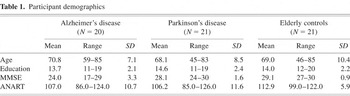
A total of 21 nondemented patients with mild to moderate PD (14 men, 7 women), 21 patients with mild AD (12 men, 8 women), and 21 healthy elderly control (EC) participants (10 men, 11 women) participated in this study. The demographic characteristics of the participants are summarized in Table 1. All participants in the AD and EC groups, and 19 of the PD participants identified their ethnicity as Caucasian. One PD participant identified himself as African American.
Participant demographics

All participants were currently driving and had valid driver's licenses. Exclusion criteria included reversible causes of dementia, and physical, ophthalmologic, neurological, or psychiatric disorders other than their primary diagnosis (AD or PD) that might impair driving abilities. Depression was allowed if it was controlled with medication. Cholinesterase inhibitors, antipsychotic, and anxiolytic medications were permitted, but dosages were required to be stable for at least six weeks prior to study enrollment. AD patients with a history of at-fault motor vehicle accidents (MVAs) since dementia diagnosis were excluded from the study, given concerns about their safety to operate a motor vehicle.
The PD participants, drawn consecutively from a hospital-based movement disorders clinic, were diagnosed with idiopathic PD by a senior neurologist. Another neurologist, experienced in diagnosis of dementia in PD, screened participants for dementia prior to enrollment in the study. Based on DSM-IV criteria for diagnosis of Dementia Due to PD, only nondemented patients with PD were enrolled [Mini Mental State Exam (MMSE) ≥ 24; no cognition-related functional impairment reported by participant or informant, see Table 1]. Hoehn and Yahr (H&Y) staging (mode = 2, range = 1–3) and the motor section of the UPDRS (M = 28.4, SD = 7.7) were conducted at the time of the neuropsychological evaluation. Fourteen PD patients were taking carbidopa/levodopa; eight were taking carbidopa/levodopa and a dopamine agonist (pramipexole, n = 3; pergolide, n = 1; ropinorole, n = 3); six were treated only with a dopamine agonist (pramipexole, n = 5; pergolide, n = 1); and one participant was not taking antiparkinsonian medication. PD participants had a mean disease duration of 7.10 years (SD = 7.44).
The AD participants were recruited through a hospital-based memory disorders clinic. Based on a complete diagnostic evaluation by a senior neurologist, diagnosis of probable AD was made according to NINCDS-ADRDA criteria (McKhann et al., 1984). Measures of dementia severity in the AD group included the Clinical Dementia Rating scale (CDR) (Hughes et al.,1982; mode = 0.5, range = 0–1) and Mini Mental State Exam (MMSE; Folstein et al., 1975) (see Table 1). The CDRs indicated mild dementia severity in the AD sample. AD patients had a mean dementia duration of 2.69 years (SD = 1.68). The age and education matched control participants (EC) were community volunteers or nondemented spouses of AD patients (see Table 1).
One-way analyses of variance (ANOVAs) indicated that the AD, PD, and EC groups were comparable in terms of age [F(2,59) = 0.50, p = .61], education [F(2,59) = 0.96, p = .39], and estimated premorbid intellectual level [American National Adult Reading Test (ANART)] [F(2,59) = 2.93, p = .06]. As expected, the groups differed in MMSE score [F(2,59) = 32.32, p = .001], with post hoc t tests confirming that the AD group had significantly lower MMSE scores than either the PD [t(39) = 5.10, p = .001] or EC [t(39) = 6.86, p = .001] group, and that the PD group had significantly lower MMSE scores than the EC group [t(40) = 2.64, p = .01].
Procedure and Measures
Driving measures
All participants were administered an on-road driving test by a professional driving instructor, who was blind to diagnosis, during daylight hours under good road conditions. This test was conducted within two weeks of the neuropsychological assessment. The driving test was based on the Washington University Road Test, a standardized driving measure with previously established reliability (Hunt et al., 1997) and was adapted for use on comparable streets in Rhode Island (see Brown et al., 2005a for a detailed description). Based on the instructor's rating for safe completion of each driving maneuver, a total score was calculated, ranging from 0 (best) to 108 (worst). The instructor also made a trichotomous global rating of the participant's driving ability: “safe,” “marginal,” or “unsafe.” This rating was based on the instructor's overall impression of the participant's driving safety. The global rating and total errors score were significantly correlated [r = .75, p < .001].
Additional measures of driving status included number of miles driven per week and number of driving trips per week. All participants also were interviewed about their history of moving violations and motor vehicle accidents (MVA) over the past three years. PD and EC participants provided this information directly, whereas with the AD participants, the patient and the informant provided this information.
Cognitive and motor measures
Participants were administered a brief, focused battery of neuropsychological tests to examine which cognitive abilities were likely to impact driving skills. The cognitive domains of memory, visuospatial skills, executive function, and psychomotor speed were specifically examined because previous studies have found a relationship between these cognitive abilities and driving performance (Brown et al., 2005b; Marcotte et al., 1999; Reger et al., 2004). All tests were administered and scored by a neuropsychologist according to standardized procedures outlined in test manuals. The neuropsychological test battery included the following measures.
Hopkins Verbal List Learning Test–Revised (HVLT-R) (Benedict, 1998), a 12 word-list learning task using a summary score of total learning across the three trials (HVLT learning), delayed free recall (HVLT delay), and discriminability (correct hits minus false positive errors on recognition testing-HVLT discrimination).
Rey-Osterrieth Complex Figure (ROCF) scored with the Boston Qualitative Scoring System (BQSS) (Stern et al., 1999) using summary scores BQSS Presence (measuring visuospatial/constructional accuracy) and BQSS Organization (measuring executive abilities, e.g., planning).
Neuropsychological Assessment Battery (NAB) Driving Scenes test (Stern & White, 2004), consisting of the sequential presentation of six driving scenes (from the perspective of the driver); participants identify everything that is new or missing in the current scene relative to the previous scene. One point is awarded for each new or missing detail correctly identified [score range 0 (worst) to 70 (best)].
Trail Making Test (TMT) (Reitan & Wolfson, 1993). TMT A is a timed measure of psychomotor speed and visual search and TMT B additionally measures executive functioning (set shifting).
Computerized Mazes (MazeMaster 1.01, 1992, Flatirons Group). Five different mazes are completed by the participants on an 18-inch touch-screen monitor, using a rubber tipped stylus. Measures were the sum of time spent actively drawing during each maze (Draw Time) and the sum of time spent thinking/planning how to complete each maze (Planning Time), calculated by subtracting Draw Time from the total time required to complete the maze.
Finger Tapping Test (Reitan & Wolfson, 1993) measures fine motor speed using average number of taps per trial across the dominant and nondominant hands.
RESULTS
Driving History
The AD, PD, and EC groups were found to differ significantly in miles driven per week [F(2,58) = 8.28, p = .001; AD: M = 60.6, SD = 74.0; PD: M = 87.8, SD = 63.7; EC: M = 172.6, SD = 123.7]. Post hoc t tests indicated that the EC group drove more miles than the AD group (p = .001) and the PD group (p = .008), but that the AD and PD group did not differ in miles driven per week (p = .22). The groups also differed significantly in driving trips per week [F(2,58) = 6.45, p = .003; AD: M = 7.3, SD = 4.0; PD: M = 15.1, SD = 11.3; EC: M = 21.0, SD = 16.8]. Post hoc t tests revealed that the AD participants made significantly fewer driving trips than the EC group (p = .001) and the PD group (p = .007), but no differences between the PD and EC groups (p = .19) were observed.
Moving violations and MVAs over the course of the past three years were infrequently reported. None of the AD patients or caregiver informants reported a history of moving violations. Prior to AD diagnosis, three AD participants were involved in an MVA (1 rear end, 2 side impact). In one case the AD driver was found to be at fault. Two PD participants had a history of a moving violation (both for speeding). Two PD participants had been involved in an MVA (both rear end accidents). In neither case was the PD driver found to be at fault. Three EC participants had a history of moving violations (2 for speeding and 1 for running a stop sign). Four EC participants had been involved in MVAs (1 rear end, 1 parking, 1 side impact, 1 hit a parked car). In three cases the EC participant was at fault.
Road Test Performance
The AD, PD, and EC groups differed significantly in global ratings of driving safety performance on the road test (χ2 = 17.4, df = 4, p = .002; AD: 9 safe, 9 marginally safe, 2 unsafe; PD: 14 safe, 7 marginally safe; EC: 21 safe). The majority of PD drivers were safe drivers (67 %) in comparison to a minority of the AD drivers being deemed to be safe drivers (45%). To be noted in the cognitive results section, marginal PD drivers were relabeled as unsafe drivers for the purpose of comparison with the AD group. Furthermore, three PD drivers were eliminated from the analysis of cognitive tasks due to missing data.
The groups also differed significantly on the total score of the road test [F(2,59) = 17.99, p = .001, η2 = .38]. AD participants had a mean total score of 13.9 errors (SD = 8.2), the PD group had a mean of 7.6 errors (SD = 4.2), and EC group had a mean of 3.7 errors (SD = 2.7). Post hoc Bonferoni t tests revealed that the AD drivers made significantly more errors than the EC group (p = .001), and the PD group (p = .003), and that the PD group made significantly more errors than the EC group (p = .001).
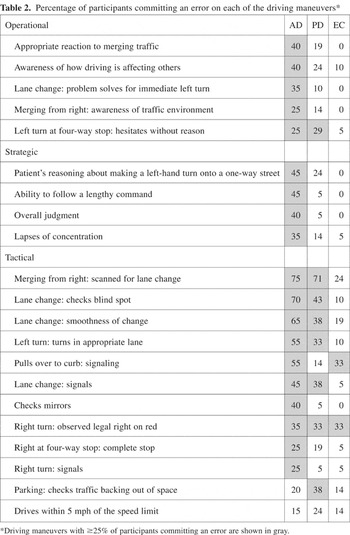
Specific errors made on the road test were examined by calculating the percentage of participants who committed an error on each of the driving maneuvers. Only driving errors that were committed by more than 25% of partici-pants within a group are listed in Table 2. Using a face validity approach to classify error types, the driving errors were sorted into three categories (operational, strategic, and tactical) based on previous studies of driving performance in patients who had suffered a traumatic brain injury (see Whithaar et al., 2000 for a review). Operational errors refer to mistakes related to timing of reactions to the changing driving environment and the position of the car. Strategic errors refer to errors in reasoning, judgment, attention, or mistakes in the patient's cognitive reactions to the general driving environment. Tactical errors focus on obeying rules of the road, choice of traveling speed, and basic driving maneuvers.
Percentage of participants committing an error on each of the driving maneuvers*

The AD participants frequently committed driving errors in all three error categories (i.e., operational, strategic, and tactical), with the greatest frequency of errors occurring in the tactical category. Over half of the AD participants, for example, were found to commit several tactical errors associated with lane changes (i.e., merging from the right; checking blind spot; smoothness of change), left turns, as well as with pulling over to the curb appropriately. The PD participants, like the AD participants, also frequently committed tactical driving errors such as scanning for lane changes. Unlike the AD participants, however, the PD participants made relatively few operational or strategic judgment errors. Finally, the EC participants made relatively few errors in any of the three categories.
Cognitive Function
For comparison purposes, the AD and PD participants were classified as unsafe drivers if they received a global rating of either “marginal” or “unsafe” on the driving test. Table 3 summarizes the neuropsychological test performance of the subgroups of PD and AD participants who were classified as either safe or unsafe drivers, along with the performance of the intact EC group. Three PD patients were eliminated due to missing neuropsychological test data.
Means and ANOVA comparison of safe and unsafe drivers on cognitive measures

The safe and unsafe drivers within each of the two patient groups did not differ on any demographic variable [i.e., age (AD safe: M = 70.11, SD = 5.86; AD unsafe: M = 71.36, SD = 8.24; PD safe: M = 65.93, SD = 9.51; PD unsafe: M = 72.43, SD = 3.15); education (AD safe: M = 14.0, SD = 2.65; AD unsafe: M = 13.36, SD = 1.69; PD safe: M = 14.36, SD = 2.62; PD unsafe: M = 15.14, SD = 2.12); estimated premorbid intelligence—ANART (AD safe: M = 107.25, SD = 10.51; AD unsafe: M = 106.80, SD = 11.33; PD safe: M = 105.73, SD = 13.10; PD unsafe: M = 107.00, SD = 9.27), ps > .10] or in global mental status—MMSE total score (AD safe: M =24.11, SD = 4.26; AD unsafe: M = 23.91, SD = 2.51; PD safe: M = 28.07, SD = 1.64; PD unsafe: M = 28.14, SD = 1.57, ps > .90). The safe and unsafe AD driving groups additionally did not differ in dementia severity (CDR, p = .90).
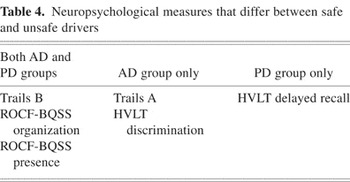
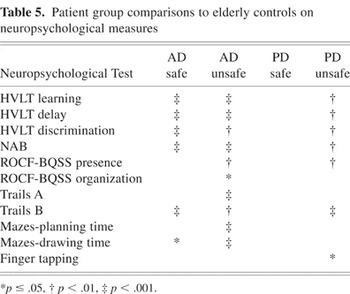
To determine whether the neuropsychological profiles of safe and unsafe drivers differed between the AD and PD groups, two-way analyses of variance (ANOVAs) with patient group (AD vs. PD) and driving status (safe vs. unsafe) as factors were conducted for each of the neuropsychological test measures. A summary of the main findings of the two-way ANOVAs (described in detail later) is presented in Table 4. Finally, Dunnett t tests were conducted following one-way ANOVAs (see Table 3 for F values) to compare the performances of the four patient groups (AD safe drivers, AD unsafe drivers, PD safe drivers, PD unsafe drivers) to the EC group. A summary of the main findings of the Dunnett tests is presented in Table 5.
Neuropsychological measures that differ between safe and unsafe drivers

Patient group comparisons to elderly controls on neuropsychological measures

Hopkins Verbal Learning Test
The two-way ANOVAs for the three HVLT measures all revealed significant main effects of patient group, [Learning: F(1,34) = 11.13, p = .002, ηp2 = .25; Delay: F(1,34) = 26.82, p = .001, ηp2 = .44; and Discrimination: F(1,33) = 5.74, p = .02, ηp2 = .15]. As expected, the AD group demonstrated greater overall impairment than the PD group on these memory measures. The main effect of patient group was qualified, however, by the presence of significant interactions between patient group and driving status for both Delay [F(1,34) = 9.32, p = .004, ηp2 = .22] and Discrimination [F(1,33) = 8.00, p = .008, ηp2 = .20], indicating that the two patient groups differed in the degree to which safe and unsafe drivers displayed different performance on these measures. Follow-up pairwise comparison indicated that safe and unsafe drivers in the PD group, but not the AD group, differed significantly on Delay [t(16) = 2.74, p = .01, η2 = .32]. By contrast, the safe and unsafe drivers in the AD group, but not the PD group, differed significantly on Discrimination [t(17) = 2.54, p = .02, η2 = .28].
Consistent with the findings from the two-way ANOVAs, Dunnett t tests following one-way ANOVAs revealed that whereas both safe and unsafe AD drivers were significantly impaired relative to the EC group on all HVLT memory measures [ps < .005, η2s > .40], only the unsafe PD drivers demonstrated significant impairment relative to the EC drivers on these measures [ps < .01, η2s > .26]. Taken together, these findings confirm that the HVLT memory measures were most useful in distinguishing between safe and unsafe drivers in the PD group, but not in the AD group.
Neuropsychological Assessment Battery driving scenes
The two-way ANOVA revealed only a significant main effect of patient group [F(1,34) = 8.18, p = .007, ηp2 = .20], with the AD group being more impaired than the PD group overall at correctly identifying missing or new details in the NAB driving scenes. There was no significant effect for driving status and no significant interaction of patient group with driving status (ps > .15, η2s < .06). Dunnett t tests indicated that while the PD safe drivers and the EC participants were similar in their NAB performance, the PD unsafe drivers and both the safe and unsafe AD drivers performed significantly worse than the EC participants on the NAB (ps < .01, η2s > .27). However, the absence of either a main effect of driving status or an interaction of this factor with patient group in the two-way ANOVA suggests that, while the NAB may be an informative measure regarding cognitive status of the patient groups, it does not appear to be an informative measure regarding driving status.
Rey-Osterreith Complex Figure
The two-way ANOVAs for both the BQSS Presence and Organization measures, revealed significant main effects of driving status [F(1,34) = 8.27, p = .007, ηp2 = .20 and F(1,34) = 11.62, p = .002, ηp2 = .26, respectively], but no significant main effects of patient group (ps > .35, ηp2s < .03) or significant interactions between patient group and driving status (ps > .28, ηp2s < .03). These results indicate that unsafe drivers, regardless of disease status, showed poor visuoconstruction accuracy, as well as poor planning and organization in their ROCF copies. Dunnett t tests further indicated that safe drivers in both the PD group and the AD group performed similarly to the EC group on the two Rey-Osterreith measures. By contrast, unsafe drivers in both patient groups were significantly impaired relative to the EC group on the BQSS Presence measures (ps < .01, η2s > .33), and unsafe AD drivers were also significantly impaired on the BQSS Organization measure (p = .02, η2s = .27). Taken together, these results suggest that the ROCF is a useful measure of driving status in both patient groups when compared to healthy elders.
Trail Making Test
The two-way ANOVA for Trails A revealed no main effect of patient group. There was a significant main effect of driving status (F(1,34) = 9.04, p = .005, ηp2 = .21) indicating that the unsafe drivers were slower overall than the safe drivers, as well as a significant interaction between patient group and driving status [F(1,34) = 6.70, p = .01, ηp2 = .17] indicating that the degree to which completion times were affected by driving status differed across the patients groups. Pairwise comparison confirmed that completion times for safe and unsafe drivers differed significantly for the AD group (p = .004, η2 = .38), but not for the PD group (p = .66, η2 = .01). Dunnett t tests further revealed that only the unsafe AD group (p = .001, η2 = .56) was significantly impaired relative to the EC group, indicating that performance on Trails A was sensitive to driving status only in the AD group.
The two-way ANOVA for Trails B revealed significant main effects of driving status [F(1,34) = 13.05, p = .001, ηp2 = .28] and patient group [F(1,34) = 5.71, p = .02, ηp2 = .14], but no interaction between patient group and driving status, indicating that while the AD patients were slower overall than the PD patients to complete the task, both patient groups showed a similar pattern of slowing as a function of driving status. Dunnett t tests further indicated that, because of their overall greater impairment on this task, both safe (p = .005, η2 = .28) and unsafe (p = .001, η2 = .79) AD drivers were impaired relative to the EC group, whereas only the unsafe PD drivers (p = .001, η2 = .41) demonstrated significant impairment relative to the EC group. Taken together, these results indicate that performance on Trails B is sensitive to driving status in both groups. However, given that safe and unsafe AD drivers are both impaired relative to the EC group, Trails B may prove to be a more sensitive measure of driving status in the PD group.
Computerized mazes
The two-way ANOVAs for both Draw Time and Planning Time revealed significant main effects of patient group [F(1,33) = 8.65, p = .006, ηp2 = .21 and F(1,33) = 6.87, p = .01, ηp2 = .17, respectively], with the AD group performing worse than the PD group. For both ANOVAs, there was no significant effect for driving status and no significant interaction of patient group with driving status [ps > .10, ηp2s < .08]. Dunnett t tests indicated that both the safe and unsafe PD drivers were similar in their Draw Time and Planning Time performances to the EC group. By contrast, both the safe and unsafe AD drivers performed significantly worse than the EC group in Draw Time [ps < .04, η2s > .35], and the unsafe AD drivers were also impaired relative to the EC group on Planning Time (p = .001, η2 = .45). These results indicate that although AD performance on the maze task is impaired, performance on this task does not relate to driving status in either patient group.
Finger tapping
The two-way ANOVA revealed a significant main effect of patient group on finger tapping [F(1,33) = 24.35, p < .001, ηp2 = .43] with the PD group overall displaying slower fine motor speed than the AD group. There was no significant effect of driving status and no significant interaction between patient group and driving status (ps > .30, ηp2s < .04). Dunnett t tests, however, indicated that only the unsafe PD drivers demonstrated significant tapping impairment relative to the EC group (p = .05, η2 = .17). Taken together, these results suggest that although tapping performance may be worse in unsafe than safe PD drivers compared to the EC group, this difference is not sufficiently large to differentiate between safe and unsafe PD drivers.
Unified Parkinson Disease Rating Scale and Hoehn and Yahr Scale
The UPDRS motor scale was used to specifically measure motor function in the PD group. Marginal PD drivers were found to be no more impaired than safe PD drivers on the UPDRS motor scale [t(19) = −1.38, p = .18, η2 = .09]. However, some items from the UPDRS did correlate significantly with driving status: postural stability (Spearman's rho = .49, p = .04), speech (rho = .60, p = .004), facial expression (rho = .68, p = .001), and neck rigidity (rho = .46, p = .04). All of these items may relate to head turning while driving. Disease severity as measured by Hoehn and Yahr stage was significantly related to marginal driving performance (χ2 = 4.68, df = 1, p = 0.03) in PD patients.
DISCUSSION
Our study found that neuropsychological test performance was reduced in both AD and PD participants who were unsafe drivers compared to safe AD and PD drivers and elderly controls. Not surprisingly, our hypothesis that the AD group would have more unsafe drivers and make more driving errors compared to the nondemented PD and healthy elderly groups was confirmed. Mild stage AD drivers were more impaired than PD or EC drivers, and PD drivers showed a level of driving impairment between AD and control groups. The majority of PD drivers were safe drivers, unlike AD in which a minority of the drivers were deemed safe. Overall, PD safe drivers made a comparable number of driving errors on the road test compared to healthy elders, whereas AD drivers made significantly more errors than both the PD and EC groups.
Furthermore, both AD and PD groups drove fewer miles per week than the healthy elders, but the PD group made a comparable number of driving trips per week compared to the EC group. These findings suggest that individuals with neurodegenerative diseases adjust their driving habits to accommodate the disease, either on their own or with family encouragement. This is consistent with previous work, which found that half of the individuals with AD would relinquish driving by three years after disease onset (Drachman & Swearer, 1993).
Driving performance also differed qualitatively between the two neurodegenerative disease groups. Our study found that the AD group frequently made operational errors such as hesitant driving and diminished awareness of the traffic environment; tactical errors such as problems with changing lanes smoothly; and most strikingly, strategic judgment errors such as making a turn into a one way street. These observations coincide well with those of previous investigations of driving in early AD that also found significant declines in qualitative judgments, awareness of how driving affects others, and speed control (Duchek et al., 2003; Fitten et al.,1995).
By contrast to AD drivers, the EC and PD drivers rarely made operational or strategic judgment errors. The EC drivers were prone to making some tactical errors such as not signaling. The PD drivers made tactical errors requiring head turning such as such as not scanning when pulling out into traffic or checking blind spots. Similar to our findings of tactical errors in PD, Radford et al. (2004) and Wood et al. (2005) both noted that PD patients showed specific driving errors including a lack of observation at intersections, poor road positioning, and difficulty in roundabouts. The tactical errors seen in the PD group suggests that interventions may help ameliorate some of their problems with driving. Interventions may not be so feasible in the AD group because of the broader range of their driving errors.
A major finding of this study was that unsafe driving status across both patient groups was related to performance on multifactorial cognitive measures, that is, measures that involve visuospatial and executive components. This finding is consistent with previous studies, which have found that tests of executive and visouspatial function are most helpful in identifying at-risk drivers (Marcotte et al., 1999; Reger et al., 2004, Whelihan et al., 2005). Of note, in our study, the two tests most strongly related to driving status (Trail Making Test and Rey-Osterreith Complex Figure) are tests that are not time consuming to administer and are highly portable.
As we predicted, the cognitive tests that most strongly related to driving status differed between the AD and PD groups. PD safe drivers were comparable to the EC group on neuropsychological performance, whereas the AD safe drivers generally were not. An interesting finding in the AD group was that their severe memory impairment did not relate to poor driving. In fact, the AD safe drivers had greater memory impairment than the AD unsafe drivers. Both safe and unsafe AD drivers showed severe memory impairment typical of cortical dementia (i.e., impaired learning, retrieval, and recognition memory). The opposite finding is true for the PD group. Driving performance was related to memory retrieval performance, a type of memory impairment that is characteristic of subcortical compromise. As Duff et al. (2005) have noted, tests of memory and executive functioning share up to 50% of variance. Word list tasks like the HVLT have a large executive component, as they require use of learning and retrieval strategies to enhance performance (Tremont et al., 2000). Thus, the memory impairment observed in the unsafe PD group, with impaired retrieval but relatively preserved recognition, may reflect the influence executive dysfunction has on memory. While the use of neuropsychological tests as the only indicator to recommend driving cessation is not warranted, this study suggests that attention to emerging memory and executive problems in PD and executive problems in AD may be helpful in combination with other information about disease progression in deciding when to refer someone for an on-road driving assessment.
Some neuropsychological tests that have been moderately correlated with unsafe driving in previous studies (e.g., NAB and Mazes; Brown et al., 2005b; Whelihan et al., 2005) did not relate to driving status in this comparison study. Findings from this study suggest that these tests may relate most strongly to severity of cognitive impairment rather than being specifically predictive of driving status. Alternatively, our small sample size may have limited our ability to detect relationships between these tests and driving safety.
Because of the small sample size in this study, these results should be regarded as preliminary observations that need confirmation in larger studies. Another limitation of our study is that we included a restricted range of PD severity. The decision to limit subjects to H&Y stages 1–3, was based on concerns about driving safety for more impaired PD drivers. Since none of our PD subjects failed the road test, it seems reasonable to examine more severely impaired PD subjects in future research to more clearly define the quantitative and qualitative cognitive and motor impairments that may be associated with unsafe driving in PD.
In the PD group, we anticipated that motor impairment would contribute to unsafe driving status. While PD safe and unsafe drivers differed across a range of neuropsychological tasks, differences in their motor deficits were more restricted. Many PD related motor symptoms such as fine motor bradykinesia or tremor, did not necessarily relate to unsafe driving. Rather, PD stage-related impairment, such as postural instability, in combination with neuropsychological impairment, was related to unsafe driving in the PD group.
The unsafe PD group had more advanced H&Y stage but did not differ from the safe PD group on UPDRS-motor scale performance. This finding was unexpected since the two measures are closely related to disease severity. However, specific items from the UPDRS (postural instability, speech, facial expression, and neck rigidity) did correlate with driving status. This suggests that axial rigidity and postural instability, the latter of which is characteristic of H&Y stage 3, are critical PD motor symptoms to monitor in regard to driving safety. Interventions could compensate for problems with head turning, such as parabolic mirrors; also accessory extensions could reduce the range of motion required to manage controls such as windows, heat, or radio.
Finally, our data suggest that examining visuospatial and executive abilities with neuropsychological testing may play an important role in assessing driving safety for PD patients as well as for AD patients. Further validation of this observation should include longitudinal studies examining actual crash rates and traffic violations in a large number of PD patients with and without cognitive deficits.
ACKNOWLEDGMENTS
This research was partially supported by grant RO1#AG16335 from the National Institute on Aging to Dr. Ott. We would like to acknowledge the participation of the following individuals in this grant supported research program: Deborah Cahn-Weiner, Joseph H. Friedman, Charleen Maxwell, Rebecca E. Ready, Timothy Souza, and Robert A. Stern. Portions of this article were presented at the 2005 meeting of the International Neuropsychological Society, St. Louis, MO.
References
REFERENCES
Benedict, R.
(1998).
Hopkins Verbal Learning Test–Revised.
Lutz, FL:
Psychological Assessment Resources.
Brown, L.B. &
Ott, B.R.
(2004).
Driving and dementia: A review of the literature.
Journal of Geriatric Psychiatry & Neurology,
17,
232–240.Google Scholar
Brown, L.B.,
Ott, B.R.,
Papandonatos, G.D.,
Sui, Y.,
Ready, R.E., &
Morris, J.C.
(2005a).
Prediction of on-road driving performance in patients with early
Alzheimer's disease.
Journal of the American Geriatrics Society,
53,
94–98.Google Scholar
Brown, L.B.,
Stern, R.A.,
Cahn-Weiner, D.A.,
Rogers, B.,
Messer, M.A.,
Lannon, M.C.,
Maxell, C.,
Souza, T.,
White, T., &
Ott, B.R.
(2005b).
Driving Scenes test of the Neuropsychological Assessment Battery
(NAB) and on-road driving performance in aging and very mild
dementia.
Archives of Clinical Neuropsychology,
20,
209–216.Google Scholar
Drachman, D.A. &
Swearer, J.M.
(1993).
Driving and Alzheimer's disease: The risk of crashes.
Neurology,
43,
2448–2456.Google Scholar
Dubinsky, R.M.,
Gray, C.,
Husted, D.,
Busenbark, K.,
Vetere-Overfield, B.,
Wiltfong, D.,
Parrish, D., &
Koller, W.C.
(1991).
Driving in Parkinson's disease.
Neurology,
41,
517–520.Google Scholar
Duchek, J.M.,
Carr, D.B.,
Hun, L.,
Roe, C.M.,
Xiong, C.,
Shah, K., &
Morris, J.C.
(2003).
Longitudinal driving performance in early-stage dementia of the
Alzheimer's type.
Journal of the American Geriatrics Society,
51,
1342–1347.Google Scholar
Duff, K.,
Shoenberg, M.R.,
Scott, J.G., &
Adams, R.L.
(2005).
The relationship between executive functioning and verbal and visual
learning and memory.
Archives of Clinical Neuropsychology,
20,
111–122.Google Scholar
Fahn, S.,
Elton, R.L., &
Members of the UPDRS Development Committee.
(1987).
Unified Parkinson's Disease Rating Scale. In
S. Fahn,
C.D. Marsden,
M. Goldstein,
D.B. Calne, (Eds.),
Recent Developments in Parkinson's Disease, Vol. 2, (pp.
153–163, 293–304).
Florham Park, NJ:
Macmillan Healthcare Information.
Fitten, L.J.,
Perryman, K.M.,
Wilkinson, C.J.,
Little, R.J.,
Burns, M.M.,
Pachana, N.,
Mervis, J.R.,
Malmgren, R.,
Siembieda, D.W., &
Ganzell, S.
(1995).
Alzheimer and vascular dementias and driving.
Journal of the American Medical Association,
273,
1360–1365.Google Scholar
Folstein, M.F.,
Folstein, S.E., &
McHugh, P.R.
(1975).
“Mini-Mental State”—A practical method for grading
the cognitive state of patients for the clinician.
Journal of Psychiatric Research.
12,
189–198.Google Scholar
Heikkila, V.M.,
Turkka, J.,
Korpelainen, J.,
Kallanranta, T., &
Summala, H.
(1998).
Decreased driving ability in people with Parkinson's
disease.
Journal of Neurology, Neurosurgery & Psychiatry,
64,
325–330.Google Scholar
Hoehn, M.M. &
Yahr, M.D.
(1967).
Parkinsonism: Onset, progression, and mortality.
Neurology,
17,
427–442.Google Scholar
Hughes, C.P,
Berg, L.,
Danziger, W.L.,
Coben, L.A., &
Martin, R.L.
(1982).
A new clinical scale for the staging of dementia.
British Journal of Psychiatry,
140,
566–572.Google Scholar
Hunt, L.A.,
Murphy, C.F.,
Carr, D.,
Duchek, J.M.,
Buckles, V., &
Morris, J.C.
(1997).
Reliability of the Washington University Road Test.
Archives of Neurology,
54,
707–712.Google Scholar
Madeley, P.,
Hulley, J.L.,
Wildgust, H., &
Mindham, R.H.S.
(1990).
Parkinson's disease and driving ability.
Journal of Neurology, Neurosurgery & Psychiatry,
53,
580–582.CrossRefGoogle Scholar
Marcotte, T.D.,
Heaton, R.K.,
Wolfson, T.,
Taylor, M.J.,
Alhassoon, O.,
Arfaa, K.,
Grant, I., &
the HNRC Group
(1999).
The impact of HIV-related neuropsychological dysfunction on driving
behavior.
Journal of the International Neuropsychological Society,
5,
579–592.Google Scholar
Maze Master
(Version 1.01)
(1992).
Computerized Mazes.
Boulder, CO:
The Flatirons Group.
McKhann, G.,
Drachman, D.,
Folstein, M.,
Price, D., &
Stadlan, E.
(1984).
Clinical diagnosis of Alzheimer's disease: Report of the
NINCDS-ADRDA Work Group under the auspices of the Department of Health and
Human Services Task Force on Alzheimer's disease.
Neurology,
34,
939–944.Google Scholar
Radford, K.A.,
Lincoln, N.B., &
Lennox, G.
(2004).
The effects of cognitive abilities on driving in people with
Parkinson's disease.
Disability Rehabilitation,
26(2),
65–70.Google Scholar
Reger, M.A.,
Welsh, R.K.,
Watson, G.S.,
Cholerton, B.,
Baker, L.D., &
Craft, S.
(2004).
The relationship between neuropsychological functioning and driving
ability in dementia: A meta-analysis.
Neuropsychology,
18,
85–93.Google Scholar
Reitan, R.M. &
Wolfson, D.
(1985).
The Halstead-Reitan Neuropsychological Test Battery.
Tucson, AZ:
Neuropsychological Press.
Reitan, R.M. &
Wolfson, D.
(1993).
The Halstead-Reitan Neuropsychological Test Battery: Theory and
clinical interpretation,
(2nd ed.).
South Tucson, AZ:
Neuropsychology Press.
Stern, R.A.,
Javorsky, D.J.,
Singer, E.A.,
Harris, N.G.,
Somerville, J.A.,
Duke, L.M.,
Thompson, J.A., &
Kaplan, E.
(1999).
Boston Qualitative Scoring System of the Rey-Osterreith Complex
Figure.
Odessa, FL:
Psychological Assessment Resources.
Stern, R.A. &
White, T.
(2004).
Neuropsychological Assessment Battery (NAB).
Lutz, FL:
Psychological Assessment Resources.
Tremont, G.,
Halpert, S.,
Javorsky, D.J., &
Stern, R.A.
(2000).
Differential impact of executive dysfunction on verbal list learning
and story recall.
The Clinical Neuropsychologist,
14,
295–302.Google Scholar
Whelihan, W.W.,
DiCarlo, M.A., &
Paul, R.H.
(2005).
The relationship of neuropsychological functioning to driving
competence in older persons with early cognitive decline.
Archives of Clinical Neuropsychology,
20,
217–228.Google Scholar
Whithaar, F.K.,
Brouwer, W.H., &
Van Zomeran, A.H.
(2000).
Fitness to drive in older drivers with cognitive impairment.
Journal of the International Neuropsychological Society,
6,
480–490.Google Scholar
Wood, J.M.,
Warringham, C.,
Kerr, G.,
Mallon, K., &
Silburn, P.
(2005).
Quantitative assessment of driving performance in Parkinson's
disease.
Journal of Neurology, Neurosurgery & Psychiatry,
76,
176–180.Google Scholar
Zesiewicz, T.A.,
Cimino, C.R.,
Malek, A.R.,
Gardner, N.,
Leaverton, P.L.,
Dunne, P.B., &
Hauser, R.A.
(2002).
Driving safety in Parkinson's disease.
Neurology,
59,
1787–1788.Google Scholar
Participant demographics
Percentage of participants committing an error on each of the driving maneuvers*

Means and ANOVA comparison of safe and unsafe drivers on cognitive measures
Neuropsychological measures that differ between safe and unsafe drivers
Patient group comparisons to elderly controls on neuropsychological measures
 You have
Access
- 118
- Cited by