Introduction
The involvement of non-state actors (NSAs) in global governance initiatives both in the context of inter-state regimes and organisations and through the development of non-state governance schemes is increasingly taking on an institutionally acknowledged and legitimate standing. This development has resulted in an increasing array of governance functions taking place away from the territorial cradle of political authority, the nation-state. In recent years new research has examined the role of NSAs in the design and creation of the institutional and regulatory framework of global governance.Footnote 1 In the context of this literature, a particularly interesting approach to examining the governance role increasingly assumed by non-state actors has been the introduction of the concept of private authority.Footnote 2 The concept of private authority refers to a situation where ‘an individual or organization has decision-making power over a particular issue area and is regarded as exercising that power legitimately’.Footnote 3 Moreover, ‘such authority does not necessarily have to be associated with government institutions’.Footnote 4
This addition to the global governance vocabulary has been a positive development, because authority embodies both a political and a normative dimension. Using the concept of authority may help us to identify and analyse with greater accuracy and consistency the political/institutional aspects of the shift of authoritative governance from the public and the national, to the private and transnational arenas, while allowing us to also address the normative implications of this shift. However, it should be said that the literature on private authority is still in its initial stages and significant work remains to be done, especially when one takes into account the inherent analytical problems associated with the concept of authority.
More specifically, I believe that the first wave of the literature on private authority exhibits an analytical inconsistency that has not been adequately addressed, and as a result, a variety of non-state governance arrangements are treated as authoritative even when they lack the particular attributes of authoritative governance. Consequently, we often observe a failure to distinguish adequately between cases of private authority, power, or influence, as well as between cases of authority limited to a private setting, of authoritative knowledge and expertise, and of authoritative non-state governance of areas of public life and activity. This tendency confuses rather than clarifies the institutional and political characteristics of various non-state governance arrangements and obscures the clarity of the concept of private authority. To address this problem, an analytically consistent typology of non-state authoritative governance schemes is needed, based on criteria soundly anchored to the concept and analytical attributes of authority.
This article aims to contribute to this objective. This is done first, by outlining the main characteristics of authority and identifying instances of inconsistent and loose application of these characteristics in the private authority literature. Secondly, the article aims to offer a starting point for an analytically consistent typology of non-state authority. More specifically, I try to identify and describe the strongest manifestation of non-state authority, that of authoritative governance of issue-areas at a global level, which is arguably the most novel and consequential aspect of non-state authority. As we saw above, this is also the phenomenon that the literature on private authority has been aiming to examine as well.
Contrary to the literature however, I define this authority in a more specific way by identifying it as in authority. In authority derives from rules and offices created by rules, and is different from either expertise (an authority) or simply power to change or influence the behaviour of others. It is only those in authority that issue and apply rules and commands which entail obligations to act. Following from this definition I locate non-state in authority in the amalgamation of public political authority with private power in the context of non-state governance structures. In this sense, this article offers a conceptualisation of non-state authority that is quite different from that found in most of the private authority literature, by positing as a pre-requisite for the emergence of non-state authority, the explicit delegation of, or endorsement by public (state or inter-state) authority.
This approach admittedly places significant limitations on the concept of non-state authority, and excludes instances of non-state governance that many would be willing to categorise as authoritative. Nonetheless, I believe that this approach moves the analysis in the right direction as the delineation and demarcation of the concept of private authority is what is needed before our understanding of this phenomenon can progress. It should be noted that this approach is not in any way meant to diminish the importance of other types of non-state governance. By linking in authority with the state, I do not intend to somehow reassert the dominance of the state as the only significant actor, or to dispense with private actors. On the contrary, the engagement with private authority begins with the acknowledgment that the international and transnational structures and mechanisms that have emerged in recent years in response to a growing demand for governance are increasingly characterised by processes of pluralisation and privatisation.Footnote 5 This does not mean however, that all instances of non-state governance are equally important or that they have the same political and normative implications. The failure to adequately distinguish between different types of non-state governance can actually hinder the research objective of identifying and illuminating the role of NSAs in global governance, as consequential non-state structures are effectively treated in the same way as less important and innovative non-state governance arrangements. By focusing on a specific type of governance which involves both state and non-state actors we can identify more readily non-state organisations that play a significant role in global governance, because the presence of state authority usually means that the work of these governance arrangements has acknowledged legal implications (with varying degrees of obligation). Prominent cases of such governance schemes are for example the work of the International Accounting Standards Board (IASB) or that of the Internet Corporation for Assigned Names and Numbers (ICANN).Footnote 6 This focus on legal consequences does not mean that other types of voluntary or soft law arrangements are unimportant or necessarily less effective;Footnote 7 however I do believe that an analytical distinction is necessary between non-state governance schemes that generate formal legal results and those that do not, since the former are clearly associated with institutional, political, and symbolic transformations that the latter do not necessarily invoke.
Authority
The identification and analysis of instances of non-state authority has to begin with a clarification of the concept of authority. Authority is a very complex concept and different approaches have been competing to establish their own definition of authority.Footnote 8 Despite the differences however, there are some characteristics which are commonly accepted as essential constitutive features of authority by most scholars.
First, we should distinguish between authority and power. Authority is usually called legitimate power, the main difference being that authority has to be viewed as legitimate by the people that are subject to it. Authority therefore entails the obligation of its subject to conform to its rules and commands, while the acceptance of power does not result in a comparable obligation to yield to it. This sense of obligation also distinguishes authority from persuasion. This is because authority is not founded on the exercise of rational calculation and the exchange of argument, but rests on the fact that the person or organisation that issue a pronouncement or a command warrant acceptance solely on the basis of their authoritative status. Authority is not obeyed because people consider its individual commands and pronouncements to be in their individual interest but due to a sense of obligation and an acknowledgement of the legitimate right of authority to issue commands and pronouncements.
By differentiating authority from both persuasion and coercion and therefore the rational calculation of both interests and threats, we are left with what has been characterised as a central element of authority, the ‘surrender of private judgment’. While the surrender of private judgment is considered central to the concept of authority, there is no general agreement on exactly how much judgment people are supposed to surrender. At a minimum, the subjects of authority have to exercise their judgement in order to decide whether a command is indeed authoritative and therefore warrants their obedience as such.Footnote 9 To do this, they use certain criteria, usually referred to as the ‘mark of authority’. These criteria can be specific procedures, uniforms, insignia or even social attributes such as wealth. These criteria offer a public verification of the authoritativeness of the source that makes a pronouncement.
Moreover, the subjects of authority have to exercise their judgement to identify the type of authority being employed. A basic distinction is commonly made between ‘an’ and ‘in’ authority. An authority ‘is based on, is possessed by virtue of, demonstrated knowledge, skill, or expertise concerning a subject matter or activity’, while in authority ‘is a property of rules and offices created by rules. Individuals possess it by virtue of holding an office in an organization, such as a state, a corporation, a university or a trade union that is (partially) governed by more or less formalized or codified rules’.Footnote 10 This distinction is crucial because the surrender of private judgment is not equally important for both in and an authority. Indeed, in the case of an authority often there needs to be no surrender of individual judgment at all. This is ironic given that an authority is founded on the fact that some individuals know more about certain issues than others. This inequality is the source of an authority; it is antecedent to the authority relation, since an authority is based on the fact that ‘it is because of the superior insight of some person that he should be acknowledged as “an authority” by others: the deference relation is thus supposed to reflect the antecedent concrete “personal” differences between the parties’.Footnote 11 Therefore, someone who is an authority can make a statement that carries his or her authority as an expert and for that reason people can give such a statement added weight compared to other statements or factors in order to make a judgment. By doing so however, people do not necessarily surrender their judgment for that of the expert (although often they do so) but can actually exercise their individual judgment to both weigh the expert view against other views, and after considering all views, to reach a judgment of their own.
Things are quite different with in authority however. Contrary to an authority, in authority is based on a premise of equality, not inequality; it is a subtle type of equality: ‘the assumption is not that nobody actually knows more than anyone else, that no one is wiser, better or superior; but rather that no one can “persuade” the others that his judgment is superior, such as to justify deference’.Footnote 12 It is because of the difficulty to reach collectively agreed decisions therefore that in authority is established as the remedy to collective action problems. The authority relationship then appears as an agreement at the procedural level in the face of disagreement at the substantive level, by defining whose judgment is to count as authoritative and whose not.Footnote 13 The substantive content of commands or pronouncements issued by authority is irrelevant because people obey a command solely on the basis that it is authoritative.Footnote 14 Nonetheless, the surrender of private judgment even in this extreme sense, does not entail surrendering judgment altogether. People may judge and disagree with the content of a specific pronouncement or command but they will obey it nonetheless; in this sense ‘what is suspended is not judgment but choice: the subject desists from acting on his own judgment, even though he may “privately” dissent from the authoritative utterance’.Footnote 15
The distinction between an and in authority has important implications for our purposes. As we saw, in authority requires the surrender of private judgment because it is created to design and enforce rules necessary for the community that perhaps would not otherwise exist given the problematic nature of collective action. If people acted on their own judgments about substantive issues, even if that meant disobeying the rules of the established authority, then there would be no point in having such an authority. Individuals have to obey the utterances of in authority; it has to be obligatory to be meaningful. This is why in authority is usually accompanied by the ability to use sanctions to enforce its rules. It follows therefore that obligation is a feature associated with in authority. An authority on the other hand, does not require the surrender of private judgment; while people take seriously an expert opinion its pronouncements need not be obligatory. Having said this, a note of caution is in order. The fact that an authority does not entail an obligation to submit to its pronouncements does not negate its significance in conditioning human or institutional behaviour. A basic tenet of constructivist thought is that ideas can shape the interests and even the identities of actors, including states.Footnote 16 Therefore, it is possible that based on its expert knowledge, an authority, can redefine the interests of actors in a way that they may view its pronouncements as obligatory. Indeed, it has been argued that expert knowledge can even claim a type of moral authority over its subjects.Footnote 17 The distinction between an and in authority advocated here, is not intended to deny the validity of this claim. However, I do believe that there is an analytical distinction between the two types of authority that is consequential, namely that in authority is based on specific rules and procedures, and it derives from a procedural agreement.
This conceptualisation of in authority in a polity means that, at least in liberal democratic states, public in authority resides with a democratically elected government which operates according to certain prescribed and agreed upon constitutional rules. It follows therefore, that in such states, without this public procedural agreement, this public mandate, neither expert knowledge alone, nor brute force or charisma, are adequate for an actor or institution to legitimately assume a governance role that entails an unequivocal obligation to obey.Footnote 18 This does not mean that public authority always takes into account the opinions of all the subjects of its authority, neither that all these subjects are in a position to voice their views, however it does mean that public authority is both bound to act in the public interest and authorised to do so by society at large. The public mandate of in authority creates the overarching authority of government that will decide on the substantive aspects of the regulation of the various issue-areas and activities. Given the dominance of the state as the political structure for the organisation of human life (today), this overarching authority is embodied in the state mechanism. That means that private actors cannot just assume the governance of an issue-area on their own initiative, at least not in an authoritative way, without the participation or at least consent of the state, because even when they claim to be an authorities acting in the public interest, they do not possess a comparable public mandate.
Private authority in global governance
Having identified the central elements of authority, we can now move on to the concept of private authority as used in the literature on global economic governance. According to Cutler, Haufler and Porter authority exists when an individual or organisation has decision-making power over a particular issue-area and is regarded as exercising that power legitimately. Such power need not be associated exclusively with government institutions; however, it needs to be binding to be considered authoritative.
While capturing much of the essence of non-state authority, these characteristics do not adequately distinguish between in and an authority. By failing to distinguish analytically between the two aspects of authority, the authors attribute to private an authority characteristics that are not necessarily associated with it. Thus while the authors note that obligation is an essential element of authority and link this obligation, rightly so, with the ‘right to rule’,Footnote 19 they then go on to ascribe this right to rule to both in and an authority. As noted earlier however, this right to rule is a feature associated primarily with in authority, not an authority.
The omission to adequately distinguish between private an and in authority leads to an exaggeration of private authority's novelty and significance for global governance and obscures analytical work. Thus, while the involvement of both civil society Non-Governmental Organisations (NGOs) and private sector actors in most international organisations has increased dramatically in recent years, this development by itself does not constitute a qualitatively new phenomenon in the area of international governance, to the degree that these actors still perform the traditional consultative and lobbying roles of non-state actors. A distinction should be made between these traditional roles that constitute the bulk of NSAs’ involvement in international organisations, and instances of institutionalised and acknowledged delegation of specific governance functions to NSAs in the context of their involvement with international organisations’ work. I would argue that in the context of this delegation, NSAs may have the right to perform certain functions that invoke an obligation of obedience. However, this delegated authority has to be in authority since it has to flow and operate according to rules that spell out its purpose, its scope and its mode of operation.
This kind of ambiguity is encountered in other aspects of the analytical work underpinning the concept of private authority as well. To illustrate the point let us look at the way Cutler, Haufler and Porter try to address the conceptual and theoretical obstacles inherent to the notion of private authority.Footnote 20 The authors identify at least two obstacles to theorising about private authority: a) conceptualising international authority in conditions of anarchy, and b) conceptualising private action as authoritative. Here, we will concentrate on the second obstacle since it is that which deals directly with the concept of private authority, while the first obstacle will be addressed later. The authors admit that the common understanding of public governance is associated with the concept of in authority, which in turn depends on rules and procedures according to constitutions that guarantee the representativeness and accountability of government.Footnote 21 Under this view, private judgement in contrast is non-authoritative: it is not accountable to democratic institutions.
However, they argue that this obstacle of the established conceptualisation of authority is only convincing if one accepts that the normative argument, that private power ‘ought’ not be regarded as legitimate and binding, and is enough to validate the empirical statement that in fact private power is non-authoritative and legitimate. The public dimension of authority is only an obstacle if one accepts that private power does not in fact operate in an obligatory and legitimate way. The authors thus argue that it is only a normative statement that prevents us from conceptualising private authority. Moreover, the authors argue that this conceptual obstacle is only convincing if one limits rules to commands and directives. They acknowledge that private actors lack the authority to enforce and prescribe domestic laws of general application unless such authority is delegated to them by governments and that the rules most relevant to private authority are those called ‘soft law’, characterised as mutually consensual.Footnote 22 They assert however, that the instruments of ‘soft law’, while not law proper, do in effect govern relations among a variety of actors and therefore the obstacle of conceptualising private authority can be overcome.
I would argue that this thesis is somewhat ambiguous. First, it is not only a hypothetical normative argument that stands in the way of acknowledging private authority. The fact is that in many of the cases that the authors have in mind, the private organisations that attempt to regulate an issue-area do not have an explicit or implicit mandate from the parties that are affected by their rules, that is, there exists no procedural agreement that establishes the authority of these organisations. These organisations represent only the parties that are involved in their work and not the totality of the people and institutions that would be affected by their rules. As noted previously, public authority does not guarantee the effective representation of all interested or affected parties either. However, it has a legitimate public mandate to engage in governance functions in the service of the public interest. Therefore, the argument that private rules ‘ought’ not to be considered authoritative is not only a normative argument, but derives from an empirical fact, their unaccountability, that is, their failure to satisfy the conditions of public in authority. Interestingly, many of the analysts of private authority ‘raise explicit concerns about the limited degree (or virtual absence) of accountability of private authority’.Footnote 23 Secondly, the identification and acknowledgement of authority is itself a normative process; it depends on the inter-subjective values and norms shared among the subjects of authority. Shared beliefs and values are necessary not just for the practical operation and identification of authority, but for its very existence. The common acknowledgement of these beliefs and values ‘[…] posits acceptance of some set of propositions according to which it is right or proper that there be authority at all and that such authority be established, lodged, distributed, exercised and so on in this or that manner’.Footnote 24 The question of whether a rule is authoritative or not, cannot be considered apart from the question of whether it is legitimate or ‘ought’ to be considered as legitimate. If people see private power as unaccountable and undemocratic then by definition they do not consider it legitimate and thus authoritative. The very nature of authority, the necessity of a sense of obligation and legitimacy, makes the issue of identifying and acknowledging authority an inescapably normative one.
The argument concerning the obligatory nature of private rules also deserves detailed examination. The authors’ agreement with Kratochwil on the characterisation of soft law’ as mutually consensual and their acknowledgement of the uncertainty of the exact nature of these instruments which are not ‘strictly binding norms of law’,Footnote 25 underlines the fact that the essence of these instruments is their mutual, voluntary adoption by the participating actors. The voluntary nature of soft law instruments is not by itself a reason for disqualifying them as authoritative. Indeed, all authority is ultimately voluntary for if it was not, then we would be talking about coercion not authority. As we saw however, and as the authors themselves note, in authority explicitly involves obligation.
This obligation can take two forms:Footnote 26 a) legal obligation, defined strictly as an obligation to conform to certain rules. Failure to do so can result in the use of (legitimate) force to bring about obedience with the rules, and b) ‘moral’ obligation, defined as the voluntary acceptance of authority as legitimate which produces a voluntary decision to consider the commands of authority as binding on one's self. The former cannot exist without the latter. Moral obligation is necessary to maintain obedience to authority even when the content of its commands is not popular. Without it, authority would not be effective. While, initially this might not be a problem, eventually the continuous use of force to impose the rules of authority would lead to its discredit and collapse, since people would judge that it is not anymore serving the objectives of its creation and that the use of force has become abusive and eventually coercive.
Non-state soft law instruments do not invoke legal obligation and there are no legal sanctions that usually emanate from disobeying or ignoring them. What is more, I would argue that soft law arrangements in the private sector do not exhibit signs of moral obligation necessary for public in authority. The reason is that the organisations that produce such rules are explicitly instrumental. This means that they address specific regulatory needs of the participating parties. In that sense they represent one of the strongest manifestations of an ‘enterprise association’.Footnote 27 The crucial element that distinguishes such an association is its purpose. The members of these associations may have some rules that can be considered authoritative in the sense of in authority, which establish the association and determine its procedural mode of operation. However, ‘these rules are not to be confused with the managerial decisions, agreements, etc., which constitute the pursuit of the purpose’.Footnote 28 These managerial decisions are the most important distinctive element of the association, not the procedural rules that establish it, because it is the former that are decisive for the pursuit of the common objective. It follows then that ‘even a denial of the authority of these rules would not itself be an act of dissociation, as it would be if the terms of association were the rules themselves’.Footnote 29
Therefore, the procedural agreement to establish a private ‘regulatory’ organisation does not define the organisation, but acts only as a facilitating factor. The reason behind the creation of such an organisation is not to have an authority which can then decide which rules are appropriate. The procedural rules that establish and define the structure and operation of the organisation do not create an authority that can claim surrender of the judgement of the participating actors irrespective of the content of its proposals. In contrast, in the case of public in authority the procedural rules which establish it are the very source of authority.Footnote 30 It is exactly because of the legitimacy of the procedural rules that parties believe the substantive rules to be authoritative. It is therefore the authority of the procedure that creates the moral obligation on the subjects of authority to abide by its rules even when they disagree with it. In non-state regulatory organisations, the participating parties do not feel this kind of moral obligation towards the rules that establish the organisation and its decision-making body.Footnote 31
This becomes more evident when we consider that in such organisations the parties subject to the ‘authority’ of the organisation are not adequately separate from it. They are the ones that really create the rules through a continuous process of bargaining and negotiation that represents their conflicting interests. Such organisations resemble more a meeting place, an agreed procedural and institutional context within which the interested parties meet to deliberate and decide upon mutually agreed norms, rules and standards, through processes of negotiation, bargaining and power politics. The operation of such organisations does not reflect a mutual deference of authoritative decision making over the activities of interested parties to an organisation that enjoys some degree of autonomy from its foundational members.Footnote 32 Compliance with the rules is dependent upon the continuous rational calculation of interests by the participating parties, which may very well decide to depart from the informal agreement to uphold these norms and rules if they deem that these no longer serve their interests.Footnote 33
These analytical problems can lead to a deceptive diagnosis of reality. It is not surprising therefore, that we often see in the literature cases of private authority that at best refer only to an authority and at worst exhibit no features of authority at all. It is thus inaccurate to characterise the endorsement and adoption of the Trade Related Intellectual Property Rights (TRIPS) agreement as an instance of private authority because of the influential role of the Intellectual Property Committee (IPC), a private organisation representing the interests of the American industry.Footnote 34 The TRIPS agreement was an intergovernmental agreement in the context of the WTO, an intergovernmental organisation. The significant, even decisive influence of private sector lobbying, is not a case of private authority, it is a case of private power and influence that was able to persuade the US government to adopt its cause in this international negotiation.
Similarly, knowledge-based network oligopolies do not govern authoritatively their industries.Footnote 35 Such networks may be able to extend beyond territorial boundaries, redefine the structure of particular industries, generate new knowledge or even control the generation of new knowledge.Footnote 36 They may even be able to use their control over knowledge to erect barriers to entry.Footnote 37 These activities however are not a testament to authority but rather to private power: the ability to use financial and other corporate assets to gain control over valued resources, such as knowledge, in order to manipulate the market structure and rip abnormal profits. Changing the way business is done in an industry, may affect the regulatory framework that governs that industry, but does not in itself constitute an assumption of authoritative regulatory powers. At best it confers a competitive advantage to the pioneering firms and potentially, a temporary loosening of regulatory control due to the emergence of new, previously unanticipated consequences of economic activity.
Finally, perhaps the most telling example of overstretching and therefore misapplying the concept of private authority can be found in Hall and Biersteker's proposed typology, which includes, along with market authority, private moral authority and even illicit authority.Footnote 38 In the first type of market authority, the authors include a form of normative market authority which ‘refers to the general acceptance of the more abstract idea that markets should determine decision-making over important issues’.Footnote 39 However, such abstract ideas about the role of the market in the governance of economic activity do not automatically create the authority of the market. Such ideas are very important for the emergence of non-state authority; however, they operate primarily by changing the set of inter-subjective values and norms upon which authority rests. They may be changing the normative criteria for judging the legitimacy of authority and thus contribute to the emergence of a new type of non-state authority, but they do not constitute by themselves an authoritative mechanism in the sense of in authority. Even more confusing are the examples of private moral authority which includes the authority of transnational religious terrorist networks,Footnote 40 and of illicit authority which includes transnational organised crime.Footnote 41 The application of the concept of private authority to describe religious terrorist groups or mafias, is very difficult to be justified not only as a form of in authority, but rather as authority more generally, since it ignores or confuses basic elements of authority, such as legitimacy, moral obligation and surrender of judgement. Indeed, even some of the authors themselves doubt whether these cases can be viewed as private authority.Footnote 42 Such an application of the concept, by effectively substituting for concepts better suited to such cases, such as coercion, domination, power and ideology, stretches its analytical foundation to such lengths that eventually renders it ineffective as an analytical concept, turning it into a blanket-concept that can be used to describe everything and anything.
Non-state in authority
From the previous discussion it is evident that we need a more precise and analytically consistent conceptualisation of private authority. The aim here is not simply to identify instances of private in authority.Footnote 43 The type of private in authority that we seek needs to be able to provide governance for a whole industry, issue-area or sphere of economic activity; in other words it needs to be public. However, as we have seen, public in authority needs to be based on rules and constitutions that are founded on a mandate by society and non-state actors lacking such a mandate, cannot just assume the governance of an issue-area on their own initiative, at least not in an authoritative way, without the participation or at least consent of the state.
To illustrate this point, we can turn to the literature on regulation in domestic economies and societies. Regulation scholars have long acknowledged the dominance of the state in the domain of regulation; one of the most common definitions of regulation is ‘all state initiatives to intervene in the economy’.Footnote 44 However, the centrality of the state for the conceptualisation of regulation does not mean that the state has to regulate itself all aspects of public life. It does not preclude the possibility of non-state regulation. It does mean however that non-state regulation needs the explicit or implicit acknowledgement of state authority in order to be considered legitimate and therefore authoritative. A good illustration of how this can actually happen is provided by the concept of self-regulation. Contrary to the widely-held notion that self-regulation is an instance of regulation without the state, the fact is that self-regulatory schemes are never entirely independent and free of public scrutiny and state involvement. Indeed, regulation analysts see the relation between self-regulation and state regulation as an important, mutually constitutive element of both these mechanisms. Public regulation and self-regulation are always interconnected and interpenetrated.Footnote 45 More specifically there are four different types of relation between self-regulation and the state: a) mandated self-regulation; b) sanctioned self-regulation; c) coerced self-regulation, and d) voluntary self-regulation.Footnote 46 It becomes obvious from this typology that while self-regulation is a pervasive and significant feature of public regulation, the consent of the state is needed for the legitimate existence of self-regulatory schemes. The state either promotes actively self-regulation (enforced, sanctioned, mandated) or at least allows it to exist (voluntary), usually under some form of indirect supervision or monitoring.Footnote 47
It is in this same sense that private in authority can acquire a public dimension. This type of authority is neither entirely private nor entirely state, yet it is backed by formal state authority and therefore is able to govern public social and economic space. This is why it would be more appropriate to call it non-state in authority rather than private in authority. Therefore, we could define non-state in authority, as the type of in authority that resides with a governance mechanism in a sphere of activity, which functions not only effectively, but also authoritatively, due to the partial participation or endorsement of the state which lends it formal authority, but which due to the participation of non-state actors cannot be considered as part of government.
Transnational inauthority
We can now address the question of whether non-state in authority can be reproduced at the transnational level. The task of conceptualising non-state in authority at the transnational level presents even more complications. As we saw earlier, Cutler, Haufler and Porter identified the lack of international government as one of two main obstacles that stand in the way of conceptualising private authority. The difficulty here is not limited to the issue of trying to combine private power and public authority, but extends to the difficulty of identifying instances of any type of in authority, in an international system comprised of nominally equal and sovereign states.
Obviously this difficulty does not extent to an authority. Both international and transnational (non-state) an authority are not difficult to find. An authority is a feature of individuals and organisations. Therefore, we could say that an authority is essentially a non-state type of authority. Hence, there is no a priori reason why international or transnational organisations or individuals acting in a transnational or transgovernmental capacity should not be able to hold considerable authority as experts.
However, things are more complicated for in authority. In the previous section we saw that non-state in authority presupposes the presence of state authority (or more precisely political authority). This presents an obstacle for conceptualising non-state in authority at the transnational level because there is no overarching international government that exercises political authority at that level. Part of the problem lies with the now entrenched notion that political authority is synonymous with the state. Although we previously acknowledged the primacy of the state as the dominant political structure today, and accepted that in most countries political authority (public in authority) resides with the state, we also noted earlier that this does not mean that political authority and the state are the same thing, nor does it mean that there can be no political authority without a state. Indeed, as analysts have observed while the nation-state is currently the dominant form of political organisation, it is not the only possibility.Footnote 48 Monarchy, feudalism, theocracy and classical democracy have been some of the dominant forms of political organisation in different places at different times. While they all had an administrative mechanism, unlike the modern nation-state, this mechanism was not always organised along the principles of territoriality and hierarchical centralisation as is evident from the examples of feudalism and classical democracy where personal or lineage allegiance and polyarchy replaced territoriality and hierarchy respectively. It follows therefore, that the existence of an overarching hierarchical or territorial state is necessary neither for the existence nor for the exercise of political authority. There should be no a priori reason therefore, why decentralised loci of political authority cannot arise to provide governance for specific issue-areas and spheres of activity in the realm of international relations, where no procedural agreement among states for a single overarching authority exists.
The question arises then, whether there are any institutions that exhibit the features of in authority in the international system. One example is the institution of sovereignty which enjoys almost universal acceptance as an authoritative institution among states.Footnote 49 Sovereignty is an overarching principle that manifests itself in more concrete rules and norms such as non-intervention and mutual recognition among states. Sovereignty, and the rules of conduct that follow from it are authoritative because they are seen by states as legitimate and obligatory; states feel obliged to abide by these rules even when their interests seem to run against them or rather because ‘[…] their interests […] have been conditioned by a community standard that delimits the acceptable [territorial] reach of state sovereignty’.Footnote 50 Such authority is not to be found only in fundamental rules and principles like sovereignty that could perhaps be dismissed as exceptional since they lay the basic framework for any type of communication among states. Many countries for example, even those considered dominant economic powers, routinely abide by the rulings of the World Trade Organization (WTO) on trade-related issues, even if that means having to reverse or cancel policies agreed at the national level.Footnote 51 Indeed, many similar examples can be found in other issue-areas, where the rules of international organisations are considered authoritative and are obeyed as such by states.
Despite these examples of international authority, sceptics could still dispute them as a definite proof of authority. A traditional realist argument could be levelled against them: such governance mechanisms are not really authoritative because states can ultimately exit agreements and leave international organisations. Consequently, they are not obliged to follow the international rules they have adhered to. In principle, the argument that states can ultimately exit these organisations and agreements is correct, but is this enough to dismiss the authoritative status of these institutions? It is inaccurate to characterise such arrangements as non-authoritative because of this possibility. As was argued previously, authority is voluntary by definition: people choose to consider it obligatory. It follows therefore, that just as people are free to choose to acknowledge and obey authority they are equally free to abandon it. Indeed, even in a domestic society individuals may place themselves outside the rule of authority and refuse to recognise its power over them. Such an action however should not be considered as proof that authority does not exist in that society. As we have seen, authority presupposes the existence of inter-subjective values and norms that establish, among other things, the necessity of authority itself. Obviously no human society can exhibit a complete consensus of values, norms and principles. As long as the authority that stems out of this inter-subjective framework is accepted by the majority of the people in a society, then the concept of authority should not be rejected when a few individuals choose to place themselves outside its sphere of influence. Indeed, depending on their behaviour, these individuals are often treated as abnormal and potentially dangerous by the rest of society. The same applies for the international society of states. Hurd makes a similar observation about states that decide to reject the institution of sovereignty:
Those states that do question such fundamentals [the institution of sovereignty] are regarded with horror by the other actors in the system. The fact that these states are so few, and thus so notable, is what allows the rest to define them as ‘rogues’ in contrast to the bulk of the population of states, who take the institution for granted.Footnote 52
As long as a significant number of states consider the power of these institutions legitimate and obligatory, and abide by their decisions and rules even when they do not agree with them, then these institutions should be considered authoritative.
Still, the examples that were given above refer only to inter-state and inter-governmental institutions. What about non-state in authority? First of all we should acknowledge that there exists a significant variety of non-state governance schemes. Many of them do not aspire to provide governance and regulation but rather guidance and assistance. However, there are organisations at the transnational level that explicitly aim to provide governance for a whole industry, sphere of activity or issue-area. These organisations obviously aspire to achieving authoritative status as ‘regulators’. Despite their ambition however I do not believe that their governance can be considered authoritative in the sense of in authority. First of all, these organisations are subject to the same criticism that was developed previously with regard to the potential for private in authority. Like voluntary associations at the domestic level, non-state transnational organisations cannot just assume governance of an area of public life even if it is dominated by activities of a transnational nature. The reason is that every economic actor whose behaviour these organisations aim to regulate is legally anchored in one (or many) national, legal jurisdictions.Footnote 53 Moreover, those actors’ overseas economic activities also have to take place within the boundaries of a national legal jurisdiction. Within these jurisdictions, the regulation of the issue-areas that these economic actors engage in is already undertaken by local regulatory authorities. Issues pertaining to individuals or private organisations in a transnational capacity are addressed by private international law, which usually treats them as issues between different national legal jurisdictions, a conflict of laws, since private organisations or individuals always operate under the rules of a national jurisdiction.Footnote 54 Therefore, in the absence of transnational legal space, in order to characterise any rules as binding, they need to be applied in some national jurisdiction and be incorporated in its legal or regulatory structure. Non-state transnational organisations cannot do that; states are needed for the incorporation of transnational non-state rules in the body of domestic law or regulation.
The example of the IASB, which is one of the most celebrated cases of successful non-state governance, can illustrate the point. The International Accounting Standards Committee (IASC), the IASB's predecessor, has existed since the early 1970s. For the first two decades of its existence and despite its success in producing a significant number of accounting standards the actual impact of the IASC on national accounting regulatory frameworks was quite limited.Footnote 55 It was only the 1995 agreement with the International Organization of Securities Commissions (IOSCO) to develop a set of core standards for cross-border listing purposesFootnote 56 that produced some limited voluntary adoption by a few large European companies, and most significantly, the EU's decision to adopt IASC's standards as legally bindingFootnote 57 that changed the status of the IASC/IASB and catalysed the subsequent changes in policies and cooperation between the IASB and other significant national regulators and standard-setters. Without the endorsement of such regulatory authorities the IASB standards would still have a very limited (if any) impact on accounting practices around the world.
Moreover, as was argued previously, members of private governance organisations also lack the sense of moral obligation that would make them regard the rules of the association as obligatory and therefore surrender their private judgement to its authority. One could argue that international organisations could similarly be conceived as instrumental organisations, where likewise, negotiation and bargaining are taking place and therefore they should not be considered authoritative. I believe that this is not the case. It is possible to argue that international organisations are primarily self-sufficient associations. That is, like political authority at the domestic arena, they do not have an explicit substantive purpose. Obviously, they are created to provide governance for a sphere of activity. However, they are created to provide governance according to some procedural rules that establish the authoritative nature of their substantive decisions, and this authority also grants them a degree of autonomy from their state-members.Footnote 58 When the organisation is established fierce negotiations and bargaining will ensue, but once an agreement has been reached and a decision has been made the authority of the organisation will make this agreement obligatory on its members and they will see it as such. Indeed, the most common criticism of international organisations is that they are not productive enough; they do not produce an adequate number of sufficiently detailed and up-to-date rules to provide much needed governance at the international and transnational levels. This happens because states negotiate fiercely at the preparatory stage exactly because they know that once they have signed an international agreement its authority makes it very difficult to renege on their obligations.
Finally, transnational organisations also face a considerable problem of external legitimacy. They often represent only a small part of the actors, national or transnational, that would be affected by their rules if these were obligatory. To a greater extent than domestic non-state associations, these organisations cannot be said to be truly representative of, and accountable to the actors active in their industries or sphere of activity. This impression is made worse by the fact that the power differential among their participants is much greater than in the case of domestic organisations. Indeed, the very participation in these organisations often entails costs that cannot be afforded by many small actors who could nevertheless be affected by their rules. Moreover, the absence of an international overarching authority means that these organisations are not endorsed or supervised by a public authority according to a minimum set of rules regarding participation, transparency and accountability, as is usually the case with mandated or sanctioned domestic self-regulatory organisations, which makes their accountability deficit even more serious.
The rules of transnational non-state organisations should not therefore be considered authoritative in the strict sense of in authority. Lack of legitimacy, legal and moral obligation, and the ultimately state-based legal character of the activities they aim to regulate, make the governance of such organisations non-authoritative. Non-state in authority at the transnational level needs political authority to infuse it with obligation and legitimacy. As we saw however, political authority at the international level is fragmented and decentralised. Therefore, this political authority can come from two different sources: a) from international organisations that already enjoy such authority in an issue-area, and b) from the consent of a sufficient number of states, or at least of a number of sufficiently significant states in an issue-area or activity, to make the rules of these organisations authoritative at the international level.
The anatomy of transnational in authority
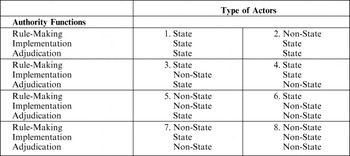
There can be a variety of ways that non-state actors can come together in an authoritative structure with public authorities. To identify these different modes of blending private power with state authority we need to take a step back and examine the variety of functions that in authority performs in any structure of governance and therefore government as well: creating rules, implementing them and adjudicating the disputes that arise from them. Non-state in authority emerges when one or more of these functions are undertaken by non-state actors while the remaining functions are performed by state authorities. Table 1 exhibits all the possible modes of combining state and non-state actors in the performance of these governance functions. We see that there are eight possible combinations of non-state and state actors that produce different governance structures. Evidently, group one represents pure state governance, in other words government at the domestic level, or inter-state governance at the international level. At the opposite end we have group eight, which represents what Rosenau calls governance without government.Footnote 59 Here we find the majority of transnational non-state governance schemes, where various types of regulatory mechanisms operate on a voluntary basis among participating parties. Between these two extremes we can find a number of possible combinations of state and non-state actors which render the resulting governance structure into an authoritative mechanism.
Variations of non-state in authority

To review the simplest cases where non-state actors assume only one of these functions, we could have a state agency deciding the rules for an issue-area and referring any disputes about them to public courts, while the actual implementation of the rules is taking place through the actions and procedures of a non-state organisation such as a self-regulatory agency. At the transnational level, a comparable situation has been encountered increasingly in recent years, when inter-state organisations delegate the implementation of policies decided at the international level to non-state actors and organisations. This is a very interesting development in the context of global governance and undoubtedly this delegation confers, to some degree, public in authority to the specified non-state organisations.Footnote 60 These organisations have the authority to implement on the ground the decisions agreed at the international level; they are the embodiment of inter-state authority at the local level where the implementation of policies takes place. Alternatively, we can have a situation where non-state actors have undertaken not the implementation but the adjudication of disputes relating to a specific set of rules which have been drawn by state authorities or the legislature. This is an increasingly recurrent phenomenon in commercial disputes, especially in transnational disputes, and it is known as private commercial arbitration.Footnote 61 The rules to be used are usually drawn from a specific national, legal jurisdiction, commonly agreed by the parties as most relevant for the dispute at hand. Likewise, the implementation of the decisions of such tribunals takes place through the public courts and authorities of the jurisdiction in question.Footnote 62 Finally, there can be a situation where the rules regulating an issue-area, sphere of activity or industry are designed by non-state actors but implemented by state authorities and adjudicated by public courts.
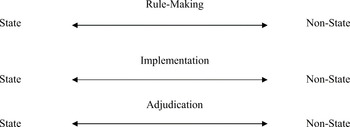
However, these are not the only modes of governance that can result from the cooperation of state and non-state actors. It may be the case that state and non-state actors share not only different functions in the governance structure of an issue-area but that they also share different parts or stages of the same function. Figure 1 demonstrates how each function can be jointly performed by both state and non-state actors. In this case, all different modes of governance collapse to the same basic format which can exhibit a high degree of variation depending on the balance between state and non-state actors within any single function. The exact configuration of non-state in authority becomes a matter of degree, as the balance between state and non-state actors often shifts along a continuum rather than taking discrete positions. This depends to a large extent on the nature of the issue-area which may allow or even require that different parts or stages of the same function are performed by different actors.
Same function variations of non-state in authority

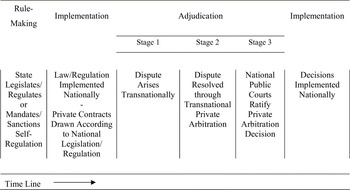
Therefore, considering again the examples we reviewed above, we may have NGOs implementing only part of a particular project authorised by an inter-state organisation, while the remainder is carried out by the executive organs of that inter-state organisation or perhaps by local governmental agencies. Similarly, in the case of adjudication, private commercial arbitration forms only the initial part of the adjudication process, since the decision reached through the arbitration process has to be implemented in a specific national, legal jurisdiction, and therefore requires ratification by the local, public courts (see Figure 2). Finally, state and non-state actors could assume different parts of the legislative process. It is thus common, state supervisory agencies or ministries to set the general guidelines or principles that form the foundation of governance in an issue-area, while the day-to-day, detailed regulation and governance of that issue-area is assigned to a non-state organisation.Footnote 63
An example of same function variation: fragmented adjudication in private transnational commercial arbitration

Conclusion
The purpose of this article has been to delineate the concept of non-state authority in the context of global governance. In the course of this process the somewhat loose and inconsistent use of the term in the literature on private authority in global governance was criticised, and a more thoroughly defined and analytically consistent concept of transnational in authority was presented. This concept represents a type of governing authority where non-state transnational governance schemes are endorsed by states or inter-state organisations, thus bestowing on them public in authority, and allowing them to exercise not only effective but also authoritative governance of an issue-area. The concept of transnational in authority can hopefully help us distinguish between cases of authority limited to the private sector, authoritative knowledge and expertise, and authoritative non-state governance of areas of public life and activity. This distinction is significant because it is the latter case of non-state authority that is the most novel and consequential development in the context of global governance.
Focusing on non-state governance schemes endowed with public in authority promotes the research agenda of non-state authority in a number of ways. First, it allows us to differentiate among the increasing array of non-state governance organisations, and bring to light NSAs that can have a significant impact on global governance, and which produce regulatory instruments enjoying formal legality. As noted earlier, the aim is not to favour the compliance or enforcement capacity of hard law over soft law instruments, but to illuminate the political and institutional transformations needed for the emergence of transnational in authority. Thus, this focus on formal authority and legal results provides us with an opportunity to trace and analyse the increasing institutionalisation and legitimisation of non-state actors in the context of the domestic political authority's apparatus. In this context it is possible to examine transnational in authority as a potent example of the process of denationalisation,Footnote 64 and thus explore more systematically the changes of domestic regulatory/governance institutions that have to take place in order to accommodate transnational governance structures which produce legal results intended to be implemented nationally. In addition and related to this, the focus on transnational in authority brings the state's role in non-state governance much more sharply and clearly into focus. Analysts have often tended to treat states as unwilling or unable to provide adequate governance in a continuously globalising world; in view of this governance deficit, NSAs are increasingly stepping in and assuming this role.Footnote 65 This ‘inability/unwillingness of the state’ thesis attributes to state actors a passive role. Contrary to this tendency and without denying the constraints that globalisation poses on state autonomy, transnational in authority offers a way into the exploration of state's role in multi-level global governance, since its emergence begs the question: why and under what conditions have states attributed legal obligation to regulation produced by transnational non-state institutions? Finally, this conceptualisation of non-state authority offers an insight into the nature and workings of political authority itself. Given that the research literature on private authority falls within the wider research agenda of the transformation of such basic concepts as the state, authority, and sovereignty in an era of globalising forces, an analytical construct that explicitly links non-state and state authority into a complex transnational structure, has potentially a lot to offer to our understanding of such transformations.
These concerns become more significant when we consider that transnational non-state governance and consequently transnational in authority are not likely to be ephemeral phenomena. There is a web of institutions and interactions being developed, whereby governance functions performed by some organisations are increasingly dependent on the work done by other organisations. This makes a reversal of the transnationalisation of global governance unlikely. To the degree that transnational in authority embeds transnational non-state structures in domestic political economies through institutionalisation and legalisation, it makes such a reversal even less probable.