In his essay on Anton Webern's landscape composition Im Sommerwind (1904), Derrick Puffett lamented Webern's decision shortly after the work's completion to take up compositional studies with Arnold Schoenberg:
Obviously it would be absurd to ‘blame’ Schoenberg for everything that ‘went wrong’ in Webern's development after 1904 (just as he should not be given all the credit for what went ‘right’). As with Berg, it is hard to imagine what Webern would have turned out like as a composer if he had not studied with Schoenberg [. . .]. Yet the fact remains that as Webern's compositional technique matured – largely under Schoenberg's guidance – so his expressive range, and range of musical sympathies, narrowed, leaving him with a set of relatively abstract preoccupations such as ‘unity’, ‘synthesis’ and ‘logic’. [. . .] ‘History’ triumphed again.Footnote 1
Any attempt to think through such ‘what if’ considerations is most certainly otiose and may be subject to the criticism which Julian Johnson, indirectly reproaching Puffett, felicitously put as follows: ‘To regret that Webern did not go on to write more expansive works in the style of Im Sommerwind is simply to regret that Webern wrote the music he did.’Footnote 2 This being said, while in general I share Johnson's critical objection, the potential immanent to the historical subjunctive Puffett raises should not go unrecognized. Pointing out the historical contingency (rather than the historico-immanent inevitability) of Webern's decision to step under Schoenberg's wings in the autumn of 1904, Puffett – and this is how I would suggest his regret may be turned into a productive perspective – sensitizes us to the inconsistencies inherent in Webern's later self-historiographical account as put forward in his 1932–33 lectures on The Path to the New Music, where the composer aimed at bringing his entire musical development into a coherent narrative. As a corollary of this, Webern neglected precisely those strands of early modernist musical thinking which despite having had great impact on his early development had later proven themselves subordinate to a certain ‘historical state of musical material’ (Materialstand) which he by then considered himself to embody.
Within this field of tensions, Webern's String Quartet (1905) may provide a particular point of interest. Composed during his summer break at the Preglhof in 1905 outside of the usual teaching context (though possibly intended as a direct response to Schoenberg's D minor Quartet, Op. 7),Footnote 3 Webern's quartet has received considerable scholarly attention as the supposed turning point at which the composer deliberately began to cultivate the elaborated chromatic idiom which would ultimately become the ‘master signifier’Footnote 4 of what he himself later famously described as his ‘path’ to the New Music. Deeply indebted to an orthodox understanding of Theodor W. Adorno's historical dialectic of musical material and the notion of progress that springs from this (Materialfortschritt), Heinz-Klaus Metzger took this mode of reception to the furthest extreme when he argued, based upon Webern's quartet, that music historians need to date the beginning of atonality earlier than hitherto posited. Aiming to rectify the historiographical picture, he contended that it was not Schoenberg but in fact Webern who for the first time transferred the ‘emancipation of dissonance’ into the realm of atonality.Footnote 5 This reception still inspires a broad consensus, as may be discerned, for example, by Allen Forte's study on The Atonal Music of Anton Webern. Aligning himself completely with Metzger's assessment of the work's historical significance, Forte reasoned that ‘the harmonic vocabulary to which the opening music [of the string quartet] refers [. . .] strongly suggests that of Schoenberg's atonal music, although of course the date of composition anticipates by some three years the emergence of Schoenberg's own fully atonal music.’Footnote 6 While both Metzger and Forte, basing themselves on the work's chromaticism, implicitly reinforce Webern's self-historiographical narrative, I argue that the formal organization of the work – needless to say an expressive device in its own right – is of no less importance to the discussion of the way the work engages with, and is interwoven by, modernist thought, and that it is precisely through this perspective that we can cast the work's engagement with modernism in a very different light.
Since the discovery of Webern's quartet by Moldenhauer in 1965, the work's formal organization has proven to be something of an ongoing conundrum in Webern scholarship. Most commentators have chosen to explain the apparently freely improvized or episodic formal structure in the programmatic light of Giovanni Segantini's Trittico della natura (albeit in quite vague and at times obscure terms) which, as evidenced by a formal draft found in the sketches, served as Webern's initial inspiration. In particular, it is the work's supposed tripartite structure that has been considered to correlate with Segantini's triptych.Footnote 7 Yet this take on the work's formal organization is somewhat unsatisfying; by merely ‘mapping’ Segantini's triptych onto the quartet's formal structure this approach all too readily avoids grappling with the work's ‘inner form’ and the Formprobleme therein articulated. In critical distance to such a ‘heteronomous’ understanding of the quartet's form, I shall argue that just as one does not need to be aware of the private programme which inspired Schoenberg's D minor Quartet in order to make sense of its formal structure, so too can the ‘autonomous side’ of Webern's quartet surely be conceived of in its own terms. As I shall put forward in the first part of this article, through the lens of rotational theory we can understand Webern's quartet as entering into a complex dialogue with the sonata paradigm. Based on this reading, I will suggest that the quartet can be situated in the context of early modernist sonata deformation, as opposed to Metzger and Forte's historiographical interpretations of the work as a crucial precursor to ‘high modernism’. Renegotiating the heuristic value of the work's initial programme with reference to some of Webern's manuscripts and sketches archived at the Paul Sacher Foundation, in the second part of this article I shall argue that Webern's programmatic concern did not lie in actually representing Segantini's triptych as such (despite the suggestions of most commentators) but in the possibilities that this offered Webern to position himself within what had crystallized towards the end of the nineteenth century as the Zarathustra trope. This argument will be substantiated with recourse to a composer who – albeit esteemed by the young Webern as one of the most prolific voices of the musikalische Moderne – was later in Webern's The Path to the New Music deprived of any historiographical significance: Richard Strauss.Footnote 8
Analysis of the rotational form
Rotational theory has been proven to be a powerful tool with which we may come to grips with turn-of-the-century sonata deformation, enabling us to account for the usually strophe-like formal idiosyncrasies of the individual work while still remaining sensitized to its generic components. Precisely in those works where the sonata paradigm seems somewhat ‘unhinged’ or ‘de-constructed’ as it were, rotational theory encourages us first of all to identify the erstwhile constitutive sonata elements and the power they once had to generate ‘sonata activity’, and then in a practice of music-analytical hermeneutics to finally bring them into a new context of meaning and functionality (Sinn- und Funktionszusammenhang).Footnote 9 Here lies the great potential of rotational theory as a method to contend with the complex form of Webern's string quartet. If we take the stance, which I shall later substantiate, that the initial programmatic reference to Segantini's triptych from the formal draft has only little significance for our understanding of the work's formal structure, we may come to expect that in this piece Webern, in one way or another, engaged with sonata thought. Carl Dahlhaus's appeal that ‘a movement is to be interpreted, within sensible limits, as a variant of the form characteristic of the genre, and not as exemplifying another schema unusual for the genre’Footnote 10 may serve here as our guiding premise.
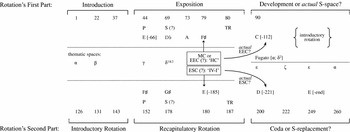
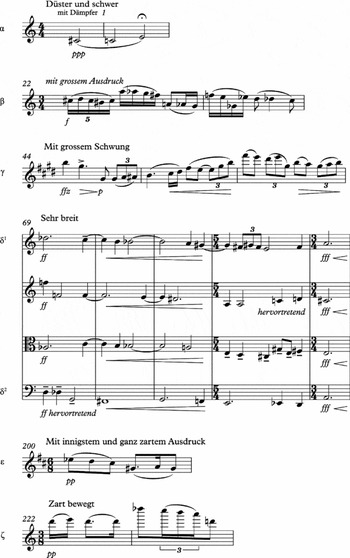
To my knowledge there has hitherto been only a single attempt to understand Webern's string quartet in terms of ‘autonomous music’ in any profound way, that of Reinhard Gerlach; thus it seems appropriate, first of all, to begin by critically engaging with his analysis. The quintessence of Gerlach's reading is that he sees the quartet as being divided into the following sonata spaces: exposition (bb. 1–79), development (bb. 80–125), recapitulation (bb. 126–85), and coda (bb. 186–279).Footnote 11 The crucial peg from which he hangs this interpretation is the varied recurrence of the three-note motive in b. 126, which for this reason he implicitly designates as functioning as the primary space. While I believe that he is right to sense that generic sonata components pervade the quartet, his sonata form reading comes across as rather forced – something which he himself allows in his quite surprising concession that the work is not explicitly interwoven by sonata traces after all.Footnote 12 This inconsistency is borne out by the mixed success he has in reconciling some of the work's formal parts with the sonata paradigm. It is precisely in this that the proton pseudos of Gerlach's approach becomes evident: primarily concerned with the positivistic analytical inquiry into whether the quartet is ‘in’ sonata form, he takes a perspective on its formal organization all too evidently informed by a petrified conception of ‘the’ sonata form (as usually inherited from A. B. Marx's reading of the middle-period Beethoven) that is ultimately too rigid, too narrowly conceived to be actually able to account for the quartet's formal discourse in its own terms. What Gerlach identified with b. 126 as the (varied) beginning of the recapitulation is, as Figure 1 suggests, more felicitously understood in terms of the work's fundamental rotational structure, or what I shall refer to as its ‘macro rotation’. The motivic-thematic spaces are shown, in accordance with Gerlach's analysis, in Example 1.Footnote 13
Webern, String Quartet (1905): ‘macro-rotation’.

Webern, String Quartet (1905): motivic-thematic chart.

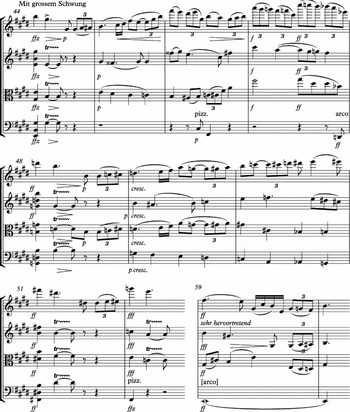
Unlike Gerlach, I see the first impression of a primary theme crystallizing with the onset of the thematic space γ in b. 44 (P), corroborated by the instruction Mit grossem Schwung (see Example 2). This is also the first passage where E major sticks out as the ‘tonic’ (established via the harmonic progression I–♭III–V64–[. . .]–I),Footnote 14 clearly indicating that the two preceding motivic-thematic spaces, α (bb. 1–21) and β (bb. 22–43), serve an introductory function due to their segueing dynamic and tonal instability.
Webern, String Quartet (1905): bb. 44–60 (bb. 53–8 omitted).
By Anton Webern/Arranged by James Beale
Copyright © 1965 by Carl Fischer, Inc.
All rights assigned to Carl Fischer, LLC. All rights reserved. Used with permission.

The identification of b. 44 as the onset of P reveals the actual formal problem of the quartet understood in terms of the sonata paradigm: the identification of the secondary thematic space (S). The situation is complex and most certainly cannot simply be ‘solved’ in any positivistic sense; it strikes me that only by the problematization of the issue may we near any ‘solution’. With this in mind, in the following I provide a detailed discussion of what makes the status of S throughout the work so problematic.
The set of problems begins to unfold with bb. 69–79 (labelled in Example 1 as δ), which Gerlach, while identifying this to be a new motivic-thematic entity, nonetheless does not consider to function as S. Indeed, the role of δ as a potential S remains critically underdetermined given that it is not preceded by a medial caesura (MC) – which is, as James Hepokoski and Warren Darcy point out, an indispensable requirement for the establishment of S.Footnote 15 In fact any notion of a rhetorical caesura associated with the MC is fully undercut: δ is arrived at as the climax of a Steigerungsform, breaking through in b. 69 with the instruction Sehr breit, which arguably lends this entire passage a character somewhat reminiscent of a codetta or coda theme. (Notably, Sehr breit is precisely the instruction which Webern used in the Langsamer Satz in order to mark the beginning of the coda section, completed only a couple of weeks before composing the quartet.) What makes the candidacy of δ as a function of S even more problematic is the fact that it signifies an extensive cadence: it knocks the harmonic pillar of D♭ major (b. 69) into the chromatic realm, immediately followed by an A major chord (b. 73), before subtly dipping into F♯ major (bb. 76–7), which finally lends the last chord of C♯ major (b. 79) a half cadence-like quality. This cadential articulation leaves us with a set of formal problems: is this passage functioning as the essential expositional closure (EEC) which would, despite all reservations mentioned above, be a clear indication of δ serving as S (and then most plausibly associated with the secondary key area of C♯ major which is conveniently the submediant to the key associated with P); or is this rather the much-anticipated MC setting up the new key F♯ major?
If we were to understand b. 79 as the MC, this might suggest the possibility that the fugato section beginning in b. 90 serves as some kind of stand-in for S, which at least from a rhetorical point of view is plausible given that the fugato neatly corresponds with the conventional expectations that we may have of a secondary theme. Besides the fact that it is contrastive to γ in textural terms, its tempo is notably rather slow (furthermore we may note the accompanying instructions weich and sehr zart, played mit Dämpfer in pp and ppp); moreover, it gives rise to an authentic cadence in C major (bb. 104–11) which, albeit being the flattened submediant of E major, nonetheless would still form a secondary key area barely less plausible than the C♯ major associated with δ. And yet the fugato is not a persuasive stand-in for S after all. Not only does it not take up the key area of F♯ major set up in b. 79, but this cadence is also immediately followed by a conspicuous transition (bb. 80–9). This suggests that the fugato marks the onset of the development section, a notion which can be further substantiated by the fact that the fugato refers back to the three-note rhetoric substance provided by α and δ2. Moreover, there is a long tradition of fugatos constituting the development section, perhaps most notably in ‘Mephistopheles’ from Franz Liszt's Faust Symphony or the beginning of the Von der Wissenschaft section in Strauss's Also sprach Zarathustra, Op. 30 (the latter of which I shall go on to argue may serve us as a fruitful ‘hermeneutic window’Footnote 16 for Webern's quartet).Footnote 17 An understanding of the fugato's overall formal function as the development section has far-reaching implications: it would mean that the exposition has not simply failed because both δ and the fugato have been unable to fulfil the generic expectations of a secondary theme but in a more fundamental sense because the exposition has actually failed to produce any S in the first place and thus remains essentially incomplete.
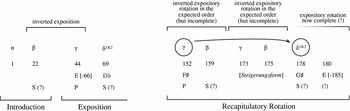
Indeed, in the recapitulatory rotation we are presented with a strategy of compensation for the underdeterminacy of S. With the consequence that the dichotomy suggested on the ‘macro-rotational’ level between ‘introduction’ and ‘expositon’ de facto disintegrates; as Figure 2 suggests, on a quasi-‘sub-rotational’ level β could be considered to incrementally take over the supposed S-function of δ in the recapitulatory rotation, as if the actual expository space was to be understood as an ‘inverted exposition’.
Webern, String Quartet (1905): ‘sub-rotations’.

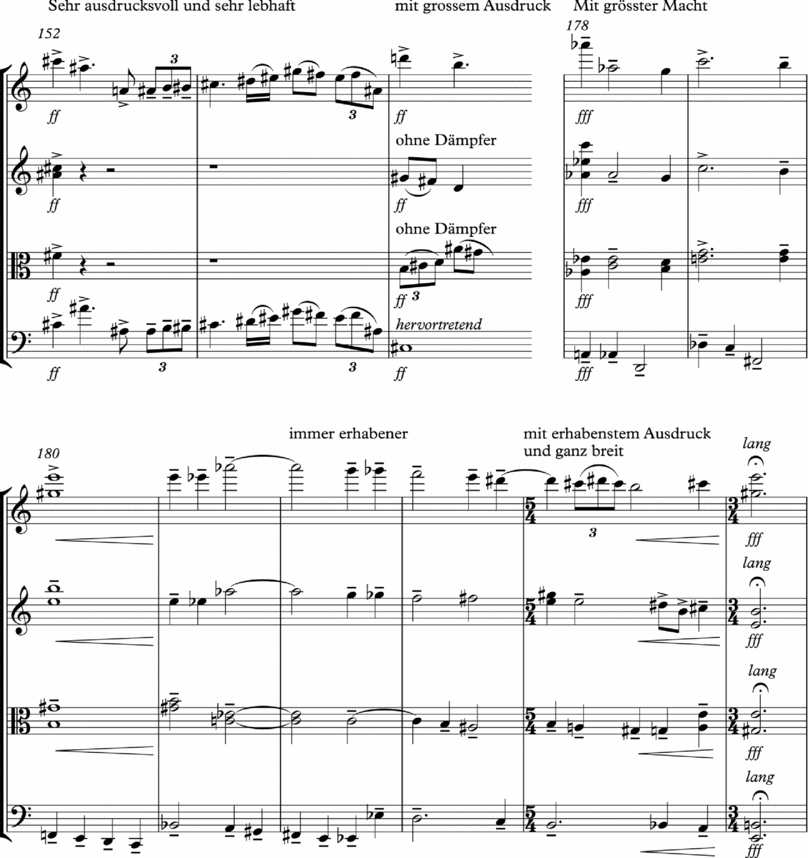
What brings the possibility of an ‘inverted exposition’ into play is the fact that the recurrence of γ (b. 152), despite being presented in F♯ major instead of E major clearly suggestive of the onset of the recapitulatory rotation, is followed by β (b. 159), not δ. This seems to suggest a reading of β (bb. 159–72) as a stand-in for the lack of S. But β does not settle in any key area and hence does not result in an essential structural closure (ESC), which would complete the recapitulatory rotation. Instead, γ is relaunched in b. 173 which, followed by a brief restatement of β once more, turns into a Steigerungsform that surprisingly culminates in b. 178 in δ (note, mit grösster Macht and mit erhabenstem Ausdruck und ganz breit), first stated in G♯ major before finally yielding to a cadence in E major. It is as if in b. 178 we were invited to hear δ claiming to have (re)gained the status of a proper secondary theme – as if it had been the real secondary theme all along. The effect that results from this is a massively protracted recapitulation: it is only in bb. 180–5 that one realizes that the entire recapitulation has in fact been repressed all along (Example 3).
Webern, String Quartet (1905): bb. 152–85 (bb. 155–77 omitted).Footnote 18
By Anton Webern/Arranged by James Beale
Copyright © 1965 by Carl Fischer, Inc.
All rights assigned to Carl Fischer, LLC. All rights reserved. Used with permission.
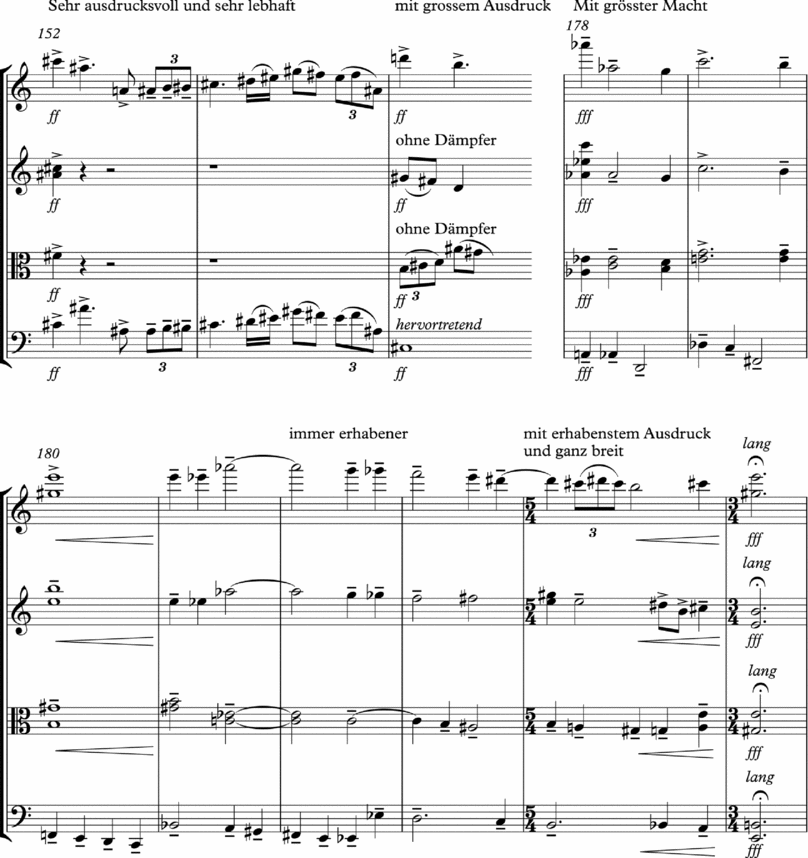
Having said this, what is deeply troubling in the recapitulatory rotation is the fact that it does not produce an ESC in any conventional sense: the E major chord in b. 185 is arrived at by a plagal cadence, not a PAC. (One may consider this event to have been foreshadowed by the A major chord in b. 73.) The undermining of the ESC mirrors the MC/EEC-ambivalence initiated in b. 79 (an association which is at least rhetorically suggested by the shared lang chords), keeping the under-determinacy of S in limbo. Indeed, it is only in the thematic space of ε that we get an authentic cadence (bb. 207–21), complementary to the cadential articulation towards the end of the fugato section (bb. 104–12), but in the ‘wrong key’ of D major. This ambivalence is complicit with the function of ε as both mirroring the supposed fugato stand-in for S as some kind of S-replacement in the recapitulatory rotation, while also marking the onset of the coda section which entails the return of the ‘tonic’ E major in which the piece finally concludes.
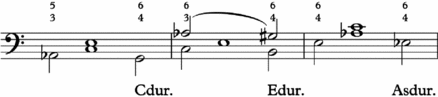
The ingenuity and subtlety by which the harmonic development facilitates the settling of the quartet's generic sonata form strata while at the same time setting up an immanent logic that exists in its own terms is a fundamental characteristic of the work which is crucial for understanding it as entering into a dialogue with the sonata paradigm. The harmonic development of the whole movement is encapsulated in b. 3, where the three-note motive ‘c♯–c♮–e’ from the upbeat and the first bar (with a fermata) ‘resolves’ to the augmented triad ‘c–e–g♯’ (note, again with a fermata). Operating as a Zentralklang (or ‘harmonic motive’) which exists as a sonority in its own right and which resurfaces in various local instances (e.g. notably amidst P, b. 50),Footnote 19 this chord foreshadows the logic upon which the ‘harmonic pillars’ of the large-scale structure arise.Footnote 20 Based on the twenty-four possible ways of resolving the augmented triad as discussed in detail by Carl Friedrich Weitzmann in his 1853 study on The Augmented Triad, on the large-scale level Webern's quartet consistently applies Weitzmann's first rule. According to this, ‘[e]ach voice of an augmented triad or one of its inversions can fall a half step, while the two other voices sustain, by which means the resolution is achieved to a major triad or to one of its inversions. The moving voice falls in the process to the fifth of that major triad.’Footnote 21 Applying this rule to the augmented triad ‘c–e–g♯’, Webern obtained the three major chords which we are nowadays familiar with as the hexatonic cycle ‘H0’ (or what Richard Cohn calls the ‘Northern cycle’): C major, E major, and A♭ major (or when enharmonically reinterpreted, G♯ major) (Example 4).Footnote 22
Weitzmann, Der übermäßige Dreiklang: reproduction of Example, 15 (1853).
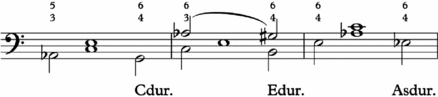
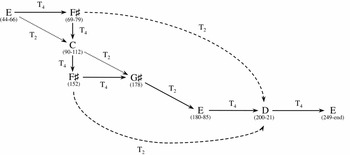
These three chords crystallize as the ‘harmonic pillars’ of the whole movement. Organized in ‘hexatonic space’ (where triadic uniformity is assumed), the harmonic consistency of the work can be illustrated along the lines of Figure 3. The distances within triadic space are exclusively either T2 (in the case at hand, as Gegenterzschritt (PL)) or T4 (either as Ganztonschritt (LRLR, RLRP, RPRL), Gegenganztonschritt (LRPR, PRLR, RLRL), or Tritonusschritt (PRPR, RPRP)). While F♯ major is not part of the ‘Northern cycle’ itself, it nonetheless further advances the whole-tone quality of the large-scale harmonic development by following or being followed by E major, C major, and G♯ major respectively. In conjunction with D major, F♯ major forms the complementary (albeit incomplete) hexatonic cycle to the ‘Northern’ one: the ‘Southern cycle’ (‘H2’), which extends the three roots of the six chords integral to the ‘Northern cycle’ to the whole-tone pentachord ‘c–d–e–f♯–g♯’ (in which notably ‘e’, representative of the ‘tonic’ E major, is framed).
Webern, String Quartet (1905): hexatonic space.

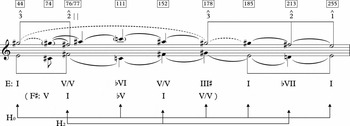
Without meaning to suggest that the harmonic development of the quartet can be bent into orthodox Schenkerian terms, Example 5 aims at illustrating one possible interpretation of how the notion of the Urlinie is conveyed by means of the underlying ‘bi-hexatonic cycling’ identified above. As this graph illustrates, the harmonic-motivic coherence obtained in this piece arguably lies precisely in the dialectical relationship between the hexatonic cycling on the one hand and the Urlinienterzzug paradigm on the other.Footnote 23 Arguably Webern's quartet is indeed a particularly pertinent case in point to think through what J. P. E. Harper-Scott most recently anticipated as a ‘dialectical method of analysing twentieth-century tonality’, mediating ‘on the one hand, the orthodox, diatonic, prolongation of the tonic triad, and on the other hand constructions of musical space which tend to cut against diatonic prolongation’.Footnote 24 The effect obtained in Webern's quartet through this ‘mediation’ is complex. In a way, one could understand the whole harmonic development following the ‘lack of S’ in the key of F♯ major as collapsing into the rest of the work. The tonicization of the S-space frustrated F♯ major infiltrates into the recapitulatory rotation. And when finally in b. 185 the recapitulatory rotation is clearly marked (to recall, E major posited by δ), the Urlinie is still at the third scale-step and thus requires ongoing unfolding in order to actually conclude the work, which is then finally redeemed by ε. This suggests that the sonata form strata evoked by the divided Urlinie paradigm and its underpinning hexatonic practice are not simply ‘synthesized’ but in a truly dialectical sense constitute an immanent logic of disintegration (to speak with Adorno's early philosophical agenda). But when taking this perspective, the initial formal ‘problems’ are no longer what they initially appeared to be. It is integral to the work's ‘sonata deformation’ (in the sense of a second form) that what erstwhile appeared in Gerlach's analysis to be irreconcilable with the sonata paradigm (in the sense of a first form) is transcended, annulled, and preserved all at the same time – in short, in the complex sense of the term, aufgehoben (sublated).
Webern, String Quartet (1905): Urlinie unfolding by means of H0 {E+; C+; G♯+} and H2 {F♯+; D+}. Full slurs (unconventionally) indicate whole-tone relationships.

Webern and the Zarathustra trope
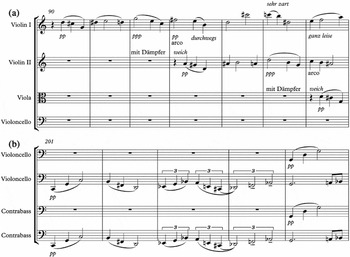
Our analysis of the rotational form has revealed the quartet's strong links to the discourse on musical form current among those composers whom Hepokoski has described as the ‘first generation to come of age in a post-Lisztian/post-Wagnerian world’.Footnote 25 Given the historical scope of rotational form of that time, any attempt to pinpoint those strands of Webern's musical socialization which saw this principle become an integral part of his musical language may prove otiose. Yet I wish in the following to venture the suggestion that Strauss's Also sprach Zarathustra may have served Webern as a substantive case of reference. As Example 6 illustrates, in both works each ‘development section’ is introduced by a fugato, the primary material of which – again in both cases a three-note subject – refers back to the very beginning: in Also sprach Zarathustra to the famous introductory ‘nature’ motive; in Webern's string quartet to the opening motive ‘c♯–c♮–e’.Footnote 26
Comparison of the three-note fugal subjects in (a) Webern, String Quartet (1905), bb. 90–6; and (b) Richard Strauss, Also sprach Zarathustra, op. 30, bb. 201–5.
(a) By Anton Webern / Arranged by James Beale
Copyright © 1965 by Carl Fischer, Inc.
All rights assigned to Carl Fischer, LLC
All rights reserved. Used with permission.
(b) Extract from Also sprach Zarathustra, op. 30 by Richard Strauss
© Copyright by C. F. Peters, Leipzig
Reproduced by kind permission of Edition Peters, London

With this reference we may contemplate a number of speculative questions. Did Webern intend the listener to perceive formal analogies to Strauss's work in his quartet? Indeed, just as in Webern's quartet the S-space remains underdetermined, so can the exposition of Also sprach Zarathustra be considered, following Hepokoski, to have been ‘aborted’. Although the thematic space entitled Von den Freuden- und Leidenschaften ‘sounds much like the onset of a sonata exposition’,Footnote 27 its complementary rotation fails to produce a secondary theme after all. Instead the Sehnsuchts-Thema, initially found within the complementary part of the introductory's second rotation, gains the upper hand in the course of the work, to the extent that Hepokoski considers ‘Strauss [to have] invite[d] us to imagine that the Longing theme [Sehnsuchts-Thema], in its disparate and its scattered placements earlier in the work, has been aspiring to become a secondary theme within a sonata form.’Footnote 28 Likewise identifying the underdeterminacy of the S-space as a crucial formal problem but interpreting the situation in different terms, Charles Youmans argues that ‘“Von den Freuden- und Leidenschaften” and “Von den Hinterweltlern” assume the character of primary and secondary themes in almost stereotypical fashion, but they appear in reverse order’, concluding that Strauss has ‘inverted’ the sonata expositionFootnote 29 – a formal strategy, as we have seen above, which is also conceivable in the terms of Webern's quartet.Footnote 30 Seeing Webern's three-note fugato within this context, could it be possible that Webern intended to provide the listener with the means of finding some sort of an orientation within the work's complex form?
My impression is that Webern's reception of Strauss in this period was much more multi-layered and complex than could be exhaustively accounted for merely by seeing Webern as having appropriated here a certain set of expressive formal means and devices (Formsprache). I read the fugato rather as an attempt to construct Strauss's Also sprach Zarathustra as a ‘paratext’ intended to make the philosophical authority of Strauss's tone poem reverberate in his own quartet. Thus Strauss's work offered Webern the possibility to buy himself, arguably in line with Alexander Zemlinsky and Schoenberg, into what had crystallized towards the end of the nineteenth century as the Zarathustra trope.Footnote 31 As the paragon of a pantheistic worldview in which, in Kevin Karnes's words, redemption was attainable through the individual's realization of the ‘essential relatedness, even oneness, of humanity and the natural world’, the Zarathustra trope owes its place right at the centre of turn-of-the-century musical modernism, not least due to its famous antipodal constellation to Schopenhauer's and Wagner's vision of redemption ‘grounded in metaphysical transcendence of one's physical being, and that were literally attainable only through asceticism or the destruction of the subject in death’.Footnote 32 That Webern, though we do not know whether he was aware of this debate or would have been willing to take sides, was familiar with an image of Strauss that saw his modernism reflected not only in terms of ‘musical material’ but also in the philosophical content of his music can be evidenced by a newspaper article from the Grazer Tagespost, following a performance of Strauss's Don Juan, Op. 20, in Graz on 26 January 1900, which Webern copied into his diary in its entirety. This article celebrates Strauss as ‘the most modern of the modernists’ and as the ‘most shining sun on the horizon of contemporary German music culture’ precisely because, citing the commentary on Also sprach Zarathustra, Strauss ‘explores music's potential to express even metaphysical issues’.Footnote 33 Thus in order to establish himself as a composer who stood directly upon the beating arteries of the musikalische Moderne, in 1905 this meant for Webern not only adopting Strauss's compositional idioms but also the philosophical themes that Strauss addressed in his own works.
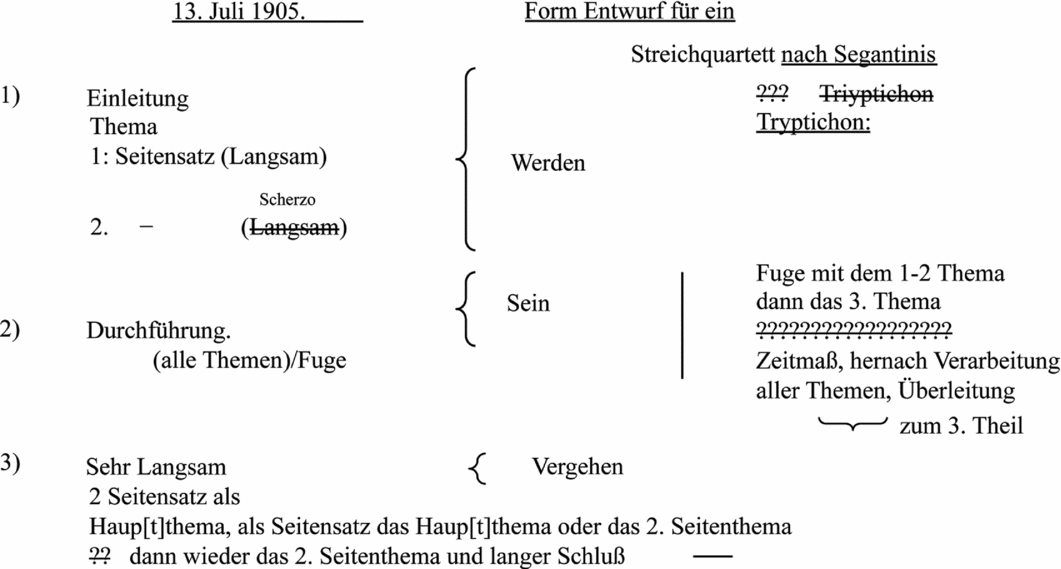
Webern, sketch (formal draft) of the String Quartet (1905), Paul Sacher Foundation, Basle, Anton Webern Collection; my transcription.Footnote 34
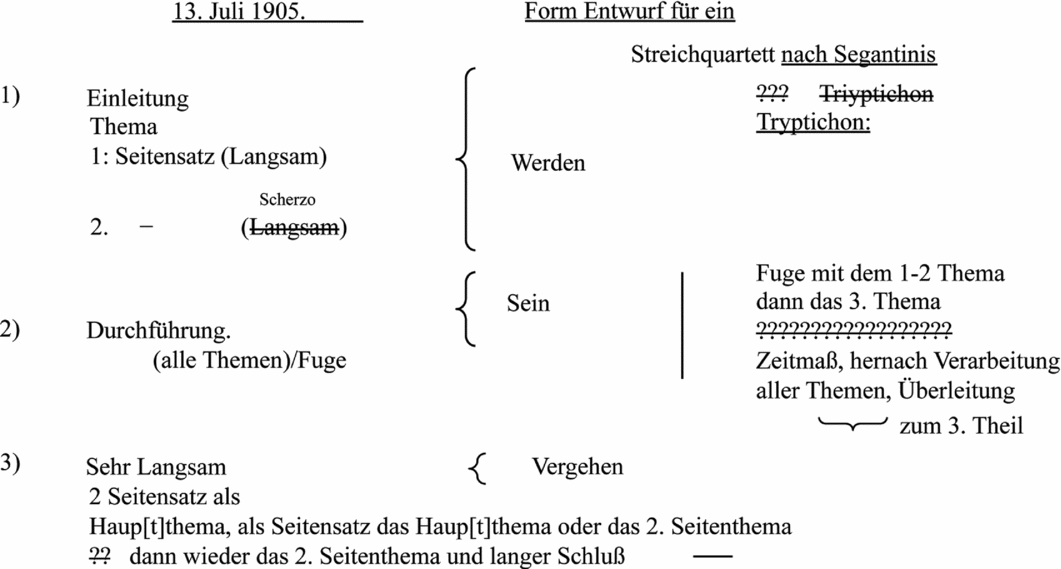
It is, as I wish to venture, against this background that Segantini's triptych appealed to Webern as his initial programmatic point of departure, as is evidenced by a formal draft from 13 July 1905 (see Example 7).Footnote 35 That Nietzsche's Zarathustra had some crucial impact on Segantini echoed throughout the reception history of the painter's work,Footnote 36 and was in particular advanced with regard to his painting L’annunciazione del nuovo verbo, completed in 1896 just before he began producing the triptych. On a more general level, the way nature was transfigured in Segantini's late work as a whole is often considered to reflect Nietzsche's pantheistic vision of redemption. Both Luigi Villari and Franz Servaes, the authors of the first extensive monographs on the painter, broadly adumbrated Segantini's late work as the synthesis of his early period concern for the mimetic or pictorial representation of nature with the fantastical and at times disturbing dream-like worlds from his middle period. Villari wrote:
From the point of view of his art his [sc. Segantini’s] religion may be [. . .] divided into three periods. In the first, he paints religion as he sees it in others, in the peasants of the Brianza. In the second, he passes through a phase of purely natural studies and of nature worship, in which outward religion is somewhat less prominent. He paints nature in a realistic manner without giving much thought to the power by whom she is ruled. But love of nature was too deep for him to forego for long inquiring into her laws and moving causes, and from the worship of nature he returns to religion, but to a higher and more spiritual religion than before, for it is now subjective and not merely external.Footnote 37
In the triptych these interspersions were considered to balance each other out particularly well. Villari again: ‘[The three panels of the triptych] contain all that is best in his [sc. Segantini’s] symbolism, without any of those too fantastic flights of imagination which alarmed and bewildered even his most devoted admirers. It also contains some of his most perfect realism.’Footnote 38 Crucial to Villari's interpretation are (i) Segantini's overdrawn realism of natural objects; (ii) the fact that in La Natura, the mother holding her child while sitting underneath a pine tree (which indeed is the only element which surmounts the painting's frame, and also recurs in La Vita) has a clear Madonna and child symbolism; as well as (iii) the unfinished lunettes of all three paintings, which feature the Christian symbolism of angels as mediators between life and death, elevating from the mundane the seemingly everyday situations depicted in the painting.Footnote 39 Hence the triptych – and this was emphasized already by contemporary commentators of the work – goes far beyond a mere pictorial representation of landscape. Villari conceived of this seemingly paradoxical situation as follows: ‘He [sc. Segantini] was a symbolist, but his symbolism lies in the harmony of his landscapes and his figures, which together suggest the abstract idea.’Footnote 40 This ‘abstract idea’, the harmony between nature and humankind (and which, for example, induced Jensen to consider the triptych as ‘commentaries on nature and man's role in it’Footnote 41), gives contour to the pivotal aesthetic concern by which Nietzsche's concept of redemption could be considered to have been redeemed in Segantini's late work.
Indeed, we have good reason to argue that it was the ‘Zarathustrian’ impress associated with Segantini, rather than an intention to actually represent Segantini's triptych as such, which fuelled Webern's primary programmatic concern. This perspective has been opened up by Johnson who, in distance to those commentators who have aimed at showing the congruencies that apparently exist between Segantini's triptych and the quartet's formal structure, instead sensed that ‘Webern's quartet bears little resemblance to the painting whose detailed content it makes no attempt to illustrate musically.’ Rather it seemed to him that Webern was concerned with the ‘ideas expressed in each part of the triptych’ – that is, the general temporal notion of the circle of life.Footnote 42 In this respect, in the Wittgensteinian sense, the formal draft was no more than the ladder which Webern was ultimately to push away from once he had redeemed the ideas there expounded (just as was Schoenberg's initial programme for his D minor Quartet which Ethan Haimo has argued served the composer ‘more [as] an aide-mémoire than a detailed blueprint’Footnote 43).
That Webern right from the start was concerned with redeeming the supposedly ‘Zarathustrian’ qualities which could be perceived in Segantini's work is most apparent in the rather odd German translations of the original titles of the triptych, La Natura, La Vita, La Morte, which are translated in Webern's formal draft as ‘Werden’, ‘Sein’, ‘Vergehen’, and not as we might expect the more literal ‘Die Natur’, ‘Das Leben’, ‘Der Tod’.Footnote 44 Quite possibly, Webern took this peculiar rendering from the catalogue initiated on the occasion of the IX. Exhibition of the Vereinigung Bildender Künstler Österreichs Secession, or from the local press.Footnote 45 This suggests that Webern did not derive the idea of the circle of life from Segantini's triptych directly, but presumably from secondary commentaries which cast the triptych as unmistakably inspired by what Nietzsche himself identified as the fundamental idea of Also sprach Zarathustra: the philosophical conception of Eternal Recurrence (Ewige-Wiederkunfts-Gedanke).Footnote 46
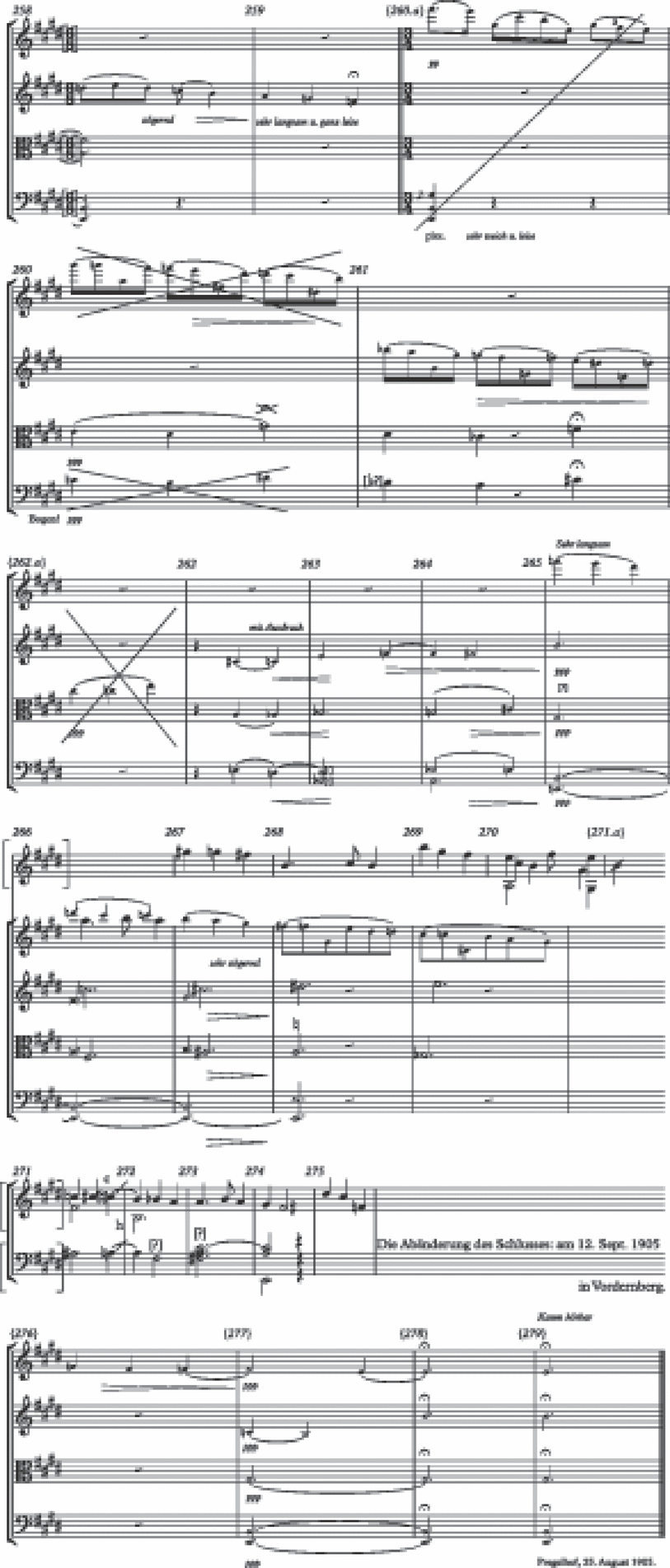
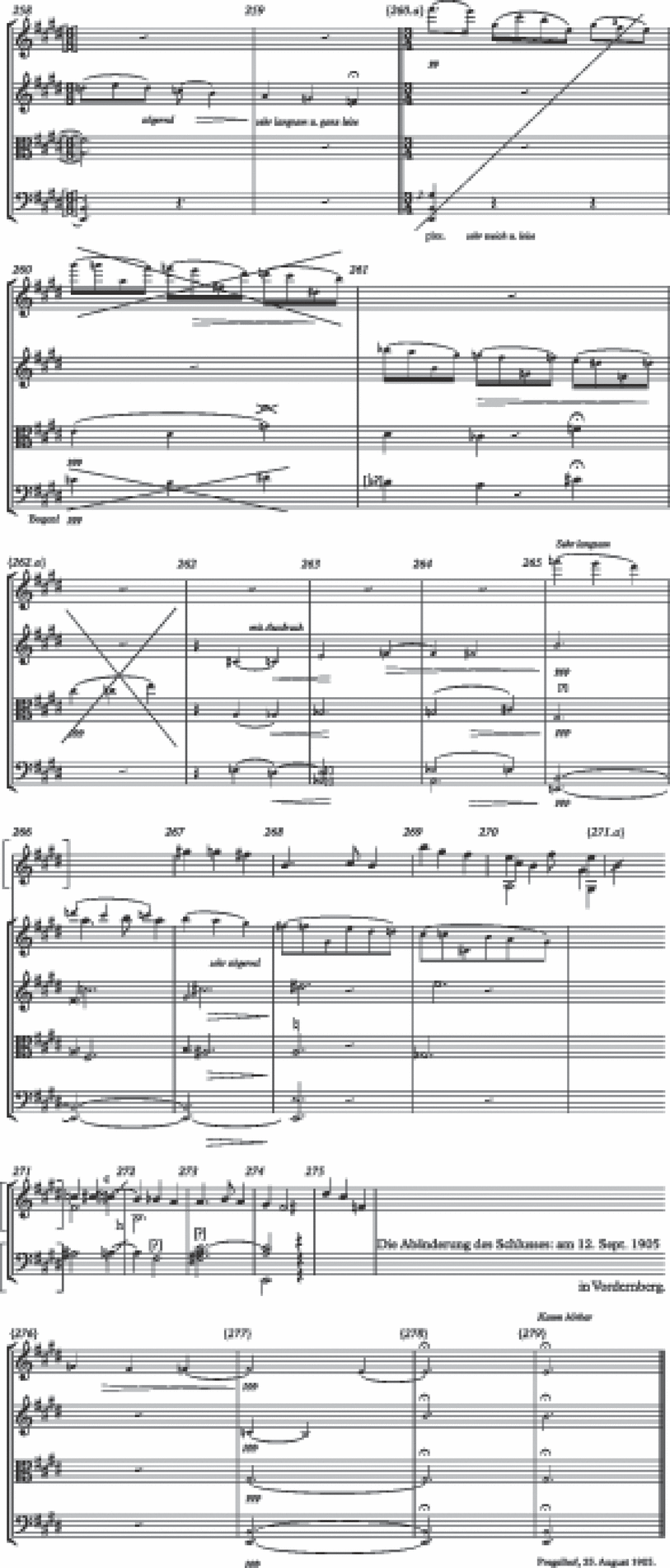
Webern's heavy reliance upon this particular interpretation of the triptych suggested by the buzz words ‘Werden’, ‘Sein’, and ‘Vergehen’, can be exemplified by the way he set out the quartet's third part, ‘Vergehen’. Webern evokes the notion of return and circularity which was apparent already in the formal draft by prominently restating α both in the transition (bb. 187–99) and in the closing section (bb. 256 to the end). In fact, as the sketches suggest, Webern was all too concerned with providing this framing effect; he revised the ending as originally laid down on the final page of the Reinschrift, in an attempt to advance more conspicuously the three-note motive from the opening bars. Curiously enough, based on these revisions Webern wrote the final page of the Reinschrift anew and replaced the older version. This revision now forms part of the complete Reinschrift which is archived at the Library of Congress, Washington, and which formed the basis for James Beale's print version of the score; the previous final page is archived at the Paul Sacher Foundation, Basle. A full transcription of this first version of the ending is provided in Example 8.
Webern, sketch of the String Quartet (1905), Paul Sacher Foundation, Basle, Anton Webern Collection; my transcription. The Reinschrift, written with ink, originally dates back to the 25 August 1905; the revision, written with pencil directly onto this page, bears the date 12 September 1905. Ink is presented in small size, pencil is presented in normal size; non-bracketed bar numbers correspond to the bars of the revised final page of the Reinschrift.
That in the course of the compositional process Webern changed his strategies to translate the abstract concepts of ‘Werden’, ‘Sein’, and ‘Vergehen’ altogether, ultimately rendering the heuristic value or Erkenntnispotenzial of the formal draft highly problematic, can be further exemplified with reference to the gestation of the fugato section. As the formal draft shows, Webern's initial idea was to compose a fugue to serve the function of the development section – and indeed, in the sketches archived at the Paul Sacher Foundation we find a lengthy sketch of a fugue evidently from an early stage of the compositional process, presumably the one initially planned in the formal draft to constitute the ‘Sein’ section (the sketch is transcribed in Example 9). Here while sketching this fugal section, Webern stumbled upon the three-note motive which would later form the famous introduction to the piece apparently en passant.
Webern, sketch of the String Quartet (1905), Paul Sacher Foundation, Basle, Anton Webern Collection; my transcription.

This sketch shows that an accompaniment with the chordal layering of ‘f♯, f♮, a’ joins the restatement of the fugal subject in the lower register (bb. 9ff.), precisely the intervallic content that corresponds to the opening motive (down a semitone and up a major third). Possibly Webern found the main overall harmonic idea encapsulated in this intervallic structure: the juxtaposition of the diatonic scale with the whole-tone scale in a given short melodic space. Webern, then, seems to have considered this accompanying material to be potentially fruitful, as is indicated by his enclosing of this group of notes with square brackets, before completely isolating it from the fugal subject; bb. 27–8 finally show the three-note motive as this would later crystallize into the first two bars of the Reinschrift, just as some of the three-note layers that he toyed around with in this sketch (bb. 35ff.) correspond to bb. 8–12 in the final version. Surprisingly enough, Webern ultimately discarded this fugal sketching in its entirety and only saved the three-note motive. Finally, Webern replaced this earlier contrapuntal sketch in favour of precisely the fugato that we now know from the final version (bb. 90ff.). That there is no evidence whatsoever that Webern had sketched the fugato before writing down the Reinschrift corresponds well with the fact that this part bears, in comparison to most of the other parts which had been subject to previous sketching, considerably more ad hoc corrections.Footnote 47
This is something of a philological pitfall for all those commentators who have aimed at interpreting the fugato in the light of the formal draft. While the initial plan of the ‘outer form’ is maintained, each fugue is constitutive of a different coherence of significance and function within the work's ‘inner form’. This is already foregrounded by the rather static characteristic of the three-note fugato whereas the fugue initially sketched clearly had the momentum of an organic unfolding, an aesthetic understanding of the fugue all too familiar from Schoenberg's D minor Quartet.Footnote 48 The contents of the ‘Sein’ section, it turns out, are thus refurnished to the extent that we may even consider Webern to have fundamentally changed his conception of this in its entirety.
It may be due to Webern's extensive change of strategies to translate what he believed to be the triptych's headings ‘Werden’, ‘Sein’, and ‘Vergehen’ to music, which ultimately led him to produce a work which was barely charged with Segantini's triptych in any concrete-programmatic sense after all. In fact the final version, the Reinschrift, no longer bears any reference to Segantini's triptych; he assigned a mysterious quote from the Christian theosophist Jacobus Boehme (1575–1624) to the Reinschrift instead, which notably encapsulates the notion of circularity and the ongoing spirit in a single short paragraph: ‘The sense of Triumph that prevailed within my Spirit I cannot write nor speak about; it can with naught be compared, save only where, in the midst of Death, Life is born, like unto the Resurrection of the Dead. In this Light did my Mind forthwith penetrate all Things: and in all living Creatures, even in Weeds and Grass, did I perceive God, who He may be and how He may be and what His Will is.’Footnote 49
Conclusion
In a way, this article has embarked upon a journey to defend Webern's quartet against a reception that reads the composer's later ‘path’ to the New Music back into it. As I have tried to show, it is possible to tease out aspects from Webern's quartet that cannot simply be attributed to Schoenberg's direct influence but which are more generally rooted in the context of the musikalische Moderne. Despite the profusion of biographical evidences well covered in Moldenhauer and Kathryn Bailey's biographies which draw a complex and variegated picture of Webern's early fascination and admiration for composers such as Strauss, Mahler, Wagner, Wolf, Pfitzner, and Puccini, just to name a few, this perspective has been insufficiently thought through in music-analytical and music-hermeneutic terms. The jargon of Webern's ‘high modernism’ still casts Webern's pre-opus repertoire in the light of not-yet-fully fledged works of juvenilia and so merely as a parergon to what was yet to come – entirely neglecting the fact that, as Puffett has most impressively demonstrated with regard to Im Sommerwind, Webern was in an emphatic sense a composer of the Moderne well before he stepped under Schoenberg's wings, equipped with firm aesthetic ideals as well as the compositional skills to express them.Footnote 50
That Webern's quartet would reflect this hardly comes as a surprise. Not only did Webern produce the quartet outside the usual teaching context, but also – and this is most often too indifferently looked upon – in that same year Webern was, first and foremost, Schoenberg's student (in a factual sense); he only began to construct his identity as a Schoenberg student (in an idealistic sense) towards the end of his studies.Footnote 51 To trace this genealogy, Webern's letter to Schoenberg on 2 September 1907 provides an important reference. Claiming that while meeting Pfitzner in Berlin in 1904 he had come to the realization that his aspiration to study with that composer was ‘utter nonsense’ and that he must instead return to Vienna in order to study with Schoenberg, Webern constructed a narrative of his years under Schoenberg's tutelage in deterministic terms: ‘I’ve come to realize that for me nothing other than studying with you was an option, that it had to happen that way.’Footnote 52 (That Pfitzner nonetheless continued to be a significant influence upon Webern, something Webern himself remained tellingly silent about, can be glimpsed in Egon Wellesz's anecdote, according to which the Klang-oscillation found in the first piece of Webern's Fünf Orchesterstücke, Op. 10 was directly inspired by the Prelude to Pfitzner's Die Rose vom Liebesgarten, conducted by Mahler in Vienna in 1905.Footnote 53) The deterministic nature of Webern's narrative is an early manifestation of what would in the years thereafter fully develop into a psychological dependency on Schoenberg.Footnote 54 As is evidenced by letters to Heinrich Jalowetz, by 1911 Webern's dependency had reached such intensity that Webern fundamentally suffered under the threat of rejection from Schoenberg, from even the slightest of potential disagreements and alienations.Footnote 55
How closely this psychological dependency was intertwined with Webern's identity construction as Schoenberg student can be observed particularly well in the context of his preparation of the 1912 festschrift in honour of Schoenberg.Footnote 56 When making the decision of who should take a major role in the production of this festschrift, behind the scenes Webern began to narrow down the members of the inner Schoenberg circle. In a letter to Berg from 11 February 1912, Webern wrote: ‘I’m telling you, we are actually only four: you, Königer, Jalowetz and I. After that we have Stein and Linke.’Footnote 57 What strikes me here is not only that Webern seems to have created a ‘second-tier’ of Schoenberg students, but also that he deprived Karl Horwitz a place at all. This is surprising not only given that Horwitz was, and continued to be, an essential member of the Schoenberg circle, but all the more so if what Wilhelm von Wymetal reported to Conrad Ansorge on 5 October 1904 proves to be an accurate recollection: that Webern, only eight years previously, had travelled with Horwitz to Berlin in order to study with Pfitzner.Footnote 58 But Horwitz, as Webern angrily complained in a letter to Berg on 1 November 1911, had by then done absolutely nothing which might have increased Schoenberg's reputation,Footnote 59 a frustration which ultimately led him to question Horwitz's loyalty towards Schoenberg in toto. Most certainly telling us more about Webern’s own relationship to Schoenberg than Horwitz's, this kind of frustration – notably, arising four years after completing his studies with Schoenberg – in a way epitomizes Webern's transformation from being Schoenberg's student to a Schoenberg student, a self-identity from which he would never depart.
All this suggests, in turn, that there are elements in Webern's musical language still to be discovered, not only before the autumn of 1904 but also in his quartet from 1905 and arguably even beyond this time, which do not stem from the ‘anxiety of influence’ that Webern, as Schoenberg student, later undoubtedly felt. To bring out these other – repressed – voices in Webern's work, as I have attempted to do in this article on his String Quartet (1905), means nothing less than to explore what I, for heuristic reasons, like to think of as Webern's physiognomy of early modernism.