According to attachment theory, individuals construct mental representations of attachment relationships based on their experiences within these close relationships, and these representations help guide individuals’ adjustment across the life-course (Bowlby, Reference Bowlby1988; Waters & Cummings, Reference Waters and Cummings2000). In other words, attachment representations are formed as developmental adaptations to individuals’ caregiving environments and may confer risk for or resilience against the development of psychopathology later in life (Bowlby, Reference Bowlby1988; Crittenden & Ainsworth, Reference Crittenden, Ainsworth, Cicchetti and Carlson1989; Holmes et al., Reference Holmes, Ghaderi, Harmer, Ramchandani, Cuijpers, Morrison and Craske2018; Lynch & Cicchetti, Reference Lynch and Cicchetti1998). Moreover, attachment representations are expected to be transmitted across generations (Main, Kaplan, & Cassidy, Reference Main, Kaplan and Cassidy1985). Thus, parents’ attachment representations might help to explain forms of maladaptive parenting that increase risk of insecure attachment and psychopathology in the next generation.
The Adult Attachment Interview (AAI)—an hour-long, semi-structured interview about individuals’ experiences with their primary caregivers during childhood—is a widely used measure in both developmental science and developmental psychopathology research for assessing adults’ attachment representations. The standard coding system for the AAI (Main et al., Reference Main, Goldwyn and Hesse2003–2008) focuses on the organization and coherence of individuals’ discourse during the AAI, as these are believed to reflect individuals’ current mental representations (referred to as “states of mind”) regarding their childhood attachment experiences. For over 35 years, research worldwide has used the AAI to characterize the developmental origins of adults’ attachment representations as well as their implications for individuals’ adaptive and maladaptive functioning (for a review, see Hesse, Reference Hesse, Cassidy, Shaver, Cassidy and Shaver2016). In particular, a large corpus of studies has made use of the AAI to study the long-term consequences of childhood maltreatment for attachment quality during adulthood, the associations between adults’ attachment representations and their current clinical disorders, associations between adults’ attachment representations and their parenting quality, as well as the intergenerational transmission of attachment security and insecurity (for meta-analyses, see Bakermans-Kranenburg & Van IJzendoorn, Reference Bakermans-Kranenburg and Van IJzendoorn2009; Verhage et al., Reference Verhage, Schuengel, Madigan, Fearon, Oosterman, Cassibba and Van IJzendoorn2016, Reference Verhage, Fearon, Schuengel, Van IJzendoorn, Bakermans-Kranenburg and Madigan2018).
In the most widely used system for coding AAIs (Main et al., Reference Main, Goldwyn and Hesse2003–2008), coders evaluate individuals’ inferred experiences in their childhood relationships with their primary caregivers as well as their states of mind about those experiences using a series of 9-point rating scales. The state-of-mind rating scales guide coders in making two key coding decisions. First, coders assign individuals to one of three mutually exclusive attachment categories. Individuals are classified as having an autonomous/secure state of mind if they coherently discuss their experiences with their caregivers, regardless of whether those experiences are described as positive or not. In contrast, individuals who appear to avoid discussing their childhood caregiving histories by idealizing their caregivers or by claiming to have difficulties remembering their experiences, are classified as having a dismissing state of mind, and individuals who become emotionally overwhelmed when discussing their childhood caregiving experiences, as indicated by anger or passivity, are classified as having a preoccupied state of mind. Second, coders assign individuals with an additional classification of unresolved state of mind if the loss of significant persons or traumatic experiences (e.g., childhood abuse by attachment figures) are reported and the ensuing discourse contains either identifiable lapses in the monitoring of speech or reasoning or an account of a current extreme response to loss or trauma experience that happened several years ago.
Embedded within the standard coding system are two conceptually distinct assumptions about the latent structure of individual differences in adults’ attachment states of mind. The first assumption pertains to the number and organization of the underlying constructs (see Haltigan, Roisman, & Haydon, Reference Haltigan, Roisman and Haydon2014b). For example, the AAI coding system assumes that an unresolved state of mind is a unique construct that is not empirically redundant with the other attachment states of mind. The second assumption is that individual differences in attachment states of mind are categorically rather than continuously distributed. These assumptions about factor structure and taxonicity, respectively, can be explored using distinct statistical tools. Factor analytic techniques were developed for uncovering the number of latent factors that underlie a set of observations (i.e., factor structure). Taxometric procedures were developed to evaluate whether individual differences within latent factors are categorical or dimensional. In contrast to analytic tools that assume the data reflect either a categorical or dimensional structure and impose this assumption onto the data (e.g., latent class analyses), taxometric techniques were developed to uncover the structure of the latent construct. Within the field of attachment research, factor analytic and taxometric methods were originally applied to understand the latent structure of adults’ self-reported attachment styles (Fraley & Waller, Reference Fraley, Waller, Simpson and Rholes1998; see also Fraley, Hudson, Heffernan, & Segal, Reference Fraley, Hudson, Heffernan and Segal2015). They have also been used to examine infants’ attachment behaviors (Fraley & Spieker, Reference Fraley and Spieker2003). These tests of latent structure can be complemented with additional analyses that evaluate the degree to which newer approaches to operationalizing adults’ attachment states of mind improve our ability to predict theoretically relevant outcomes (Roisman, Fraley, & Booth-LaForce, Reference Roisman, Fraley and Booth-LaForce2014; Van IJzendoorn & Bakermans-Kranenburg, Reference Van IJzendoorn and Bakermans-Kranenburg2014).
Empirically evaluating these assumptions about the latent structure of the AAI can enhance our understanding of the fundamental characteristics of individual differences in adults’ attachment representations, which in turn may have widespread implications for theory and research on the origins and consequences of adults’ attachment representations. For example, findings from factor analytic studies can help guide decisions about the number of constructs that could meaningfully be considered in theoretical models on adult attachment as well as research with the AAI. In addition, taxometric analyses can inform whether a categorical conceptualization of attachment states of mind is accurate. If it is not, the use of categorical measures in AAI research would weaken statistical power and result in biased estimates of the correlates of adults’ attachment states of mind, including the associations with adults’ histories of childhood adversity, psychopathology symptoms, and parenting behaviors (MacCallum, Zhang, Preacher, & Rucker, Reference MacCallum, Zhang, Preacher and Rucker2002).
Several exploratory factor analyses involving normative- and higher-risk samples as well as samples of adolescents and adults have indicated that variation in the AAI state-of-mind rating scales can be explained reasonably well by two weakly correlated latent factors (e.g., Larose & Bernier, Reference Larose and Bernier2001; Raby, Labella, Martin, Carlson, & Roisman, Reference Raby, Labella, Martin, Carlson and Roisman2017a; Roisman, Fraley, & Belsky, Reference Roisman, Fraley and Belsky2007; Whipple, Bernier, & Mageau, Reference Whipple, Bernier and Mageau2011). One of these factors includes AAI rating scales traditionally used to classify individuals as having a dismissing state of mind. The other factor includes the rating scales used to classify individuals as having either a preoccupied or an unresolved state of mind. A controversial implication of these findings is that an unresolved state of mind may not represent a unique construct but instead is an additional indicator of attachment-related preoccupation (e.g., Roisman et al., Reference Roisman, Fraley and Booth-LaForce2014; but see Van IJzendoorn & Bakermans-Kranenburg, Reference Van IJzendoorn and Bakermans-Kranenburg2014). Recent confirmatory factor analyses demonstrated that a 2-factor model in which ratings of preoccupied and unresolved states of mind loaded on a common factor provided an acceptable fit to the AAI data in a community sample of late adolescents (Haltigan et al., Reference Haltigan, Roisman and Haydon2014b) and two samples of parents from diverse backgrounds (Haltigan et al., Reference Haltigan, Leerkes, Wong, Fortuna, Roisman, Supple and Plamondon2014a; Raby et al., Reference Raby, Yarger, Lind, Fraley, Leerkes and Dozier2017b). However, no confirmatory factor analyses have directly assessed the fit of a 3-factor model that distinguishes unresolved from preoccupied states of mind, in part because such a model has not been supported by exploratory factor analytic evidence. However, Van IJzendoorn and Bakermans-Kranenburg (Reference Van IJzendoorn and Bakermans-Kranenburg2014) noted that this might have been due to the low prevalence of unresolved states of mind among the samples used in earlier exploratory factor analyses because many of the studies focused on young adults from relatively low risk backgrounds (but see Raby et al., Reference Raby, Labella, Martin, Carlson and Roisman2017a for a more recent exploratory factor analysis of the AAI with a higher risk sample). In contrast, the current study tested the fit of a 3-factor model of the AAI among a large and diverse group of individuals.
To date, there have been three investigations of the taxometric characteristics of AAI. The first two yielded essentially identical results. In both studies, variation in dismissing states of mind aligned more with a dimensional model than a categorical one, but the results for preoccupied states of mind were indeterminate (Fraley & Roisman, Reference Fraley and Roisman2014; Roisman et al., Reference Roisman, Fraley and Belsky2007). However, the results of a more recent taxometric analysis produced ambiguous results for dismissing states of mind but indicated that variation in preoccupied states of mind fit better with a dimensional than a categorical model (Raby et al., Reference Raby, Yarger, Lind, Fraley, Leerkes and Dozier2017b). Given the somewhat mixed evidence from this small number of studies, additional studies of the taxometric characteristics of the AAI are needed. In particular, although these prior analyses involved sample sizes between 504 and 857 participants, there is a critical need for additional studies that have even larger samples and therefore more statistical power for clearly determining whether individual differences are dimensionally or categorically distributed (Ruscio, Haslam, & Ruscio, Reference Ruscio, Haslam and Ruscio2006). For example, Ruscio, Walters, Marcus, and Kaczetow (Reference Ruscio, Walters, Marcus and Kaczetow2010) demonstrated that a categorical latent structure could be accurately identified with samples as small as 100, but larger sample sizes are needed to accurately and unambiguously identify a dimensional latent structure.
The purpose of the current study was to address these unsettled issues regarding the factor structure and potential categorical distribution of adults’ attachment states of mind. Our first aim was to evaluate the fit of a series of confirmatory models of the factor structure of the AAI. This included a pair of 2-factor models that captured dismissing and preoccupied attachment states of mind as well as a 3-factor model that additionally distinguished preoccupied from unresolved states of mind. We also evaluated the fit of an alternative 3-factor model that distinguished between active and passive forms of preoccupation based on the results reported in Haltigan et al. (Reference Haltigan, Roisman and Haydon2014b). Our second aim was to use taxometric procedures to evaluate whether individual differences on these latent factors are categorically or dimensionally distributed.
To address these issues, we leveraged data from the Collaboration on Attachment Transmission Synthesis (CATS) dataset, a dataset originally curated to conduct individual participant data (IPD) meta-analyses of the intergenerational transmission of attachment (see Verhage et al., Reference Verhage, Fearon, Schuengel, Van IJzendoorn, Bakermans-Kranenburg and Madigan2018, for more information). In general, an IPD meta-analysis involves obtaining, harmonizing, and synthesizing raw data from all participants in every study on a particular topic (Riley, Lambert, & Abo-Zaid, Reference Riley, Lambert and Abo-Zaid2010). The current set of analyses is based on data from over 3,000 individuals who participated in 40 studies in which the AAI was collected. As such, the current investigation represents the largest study of the latent structure of the AAI to date. As a result of its enhanced statistical power, the current study is well suited to statistically evaluate different models of the AAI factor structure, including models that distinguish preoccupied and unresolved states of mind, as well as to identify whether individual differences within these factors are categorical or dimensional.
Methods
Participants
For the original IPD meta-analysis of the intergenerational transmission of attachment, an extensive search identified 88 nonexperimental studies that had assessed parents’ attachment states of mind using the AAI and had collected an observational assessment of the quality of the child–parent attachment in infancy or early childhood. The authors of these studies were invited to provide the data for the individual participants. The data for 4,396 participants from 58 studies ultimately were provided and included in the original IPD meta-analysis (Verhage et al., Reference Verhage, Fearon, Schuengel, Van IJzendoorn, Bakermans-Kranenburg and Madigan2018).
The current study included data from the subsample of studies that provided information about the AAI state-of-mind ratings (see online Supplementary for references to these studies). This sample included 3,218 participants from 40 studies. Approximately 13% of the participants included in the current set of analyses were also included in previously published studies on the factor structure of the AAI. Specifically, the current sample included 203 of the participants included in Haltigan et al. (Reference Haltigan, Leerkes, Wong, Fortuna, Roisman, Supple and Plamondon2014a); 56 of the participants included in Raby et al. (Reference Raby, Labella, Martin, Carlson and Roisman2017a); 87 of the participants included in Raby et al. (Reference Raby, Yarger, Lind, Fraley, Leerkes and Dozier2017b); and the 71 participants included in Whipple et al. (Reference Whipple, Bernier and Mageau2011). Only the 87 of the participants included in Raby et al. (Reference Raby, Yarger, Lind, Fraley, Leerkes and Dozier2017b) were included in prior taxometric analyses of the AAI. Within the current sample, 89% of the parents were female, and the mean age of the parents was 29.5 years (SD = 7.6). At the time the AAI was administered, 20% of the parents were single and 18% had finished only primary school or less. Forty-seven percent of the participants completed the AAI prior to the child's birth (either while pregnant or prior to conception), the mean age of the children of the other parents at the time of the AAI was 21.0 months old (SD = 23.5). Studies originated from 10 countries (Canada, Denmark, Germany, Israel, Italy, Japan, Mexico, the Netherlands, the UK, and the USA), and data collection took place from 1986 to 2013. The privacy officer and data security officer at Vrije Universiteit Amsterdam made the assessment that this study did not require approval from an institutional review board because it involved secondary analysis of unidentifiable data.
Measures
Adult attachment interview
The analyses presented here focused on ratings of participants’ attachment states of mind exhibited during the AAI. These ratings were requested from authors along with the data used in the original IPD meta-analysis (Verhage et al., Reference Verhage, Fearon, Schuengel, Van IJzendoorn, Bakermans-Kranenburg and Madigan2018). Upon receipt, the ratings were checked for anomalies (e.g., scores that fell outside the theoretically possible range), which were resolved by contacting the authors. The state-of-mind ratings for each study were then aggregated into a single dataset. Ninety-seven percent of the attachment state-of-mind ratings had been assigned by a coder who had been trained at an official AAI training institute. Consistent with nearly all prior research in this area (e.g., Haltigan et al., Reference Haltigan, Roisman and Haydon2014b), cases without applicable loss or trauma experiences were recoded to be equal to a score of 1 (which is the lowest possible score indicating no unresolved discourse) on the rating scales for unresolved loss and for unresolved trauma. In addition, an overall derogation score was calculated by selecting the highest rating given to either mother or father. Descriptive information for the state-of-mind scales used in the current analyses are reported in Table 1.
Intercorrelations and descriptive statistics for the Adult Attachment Interview state-of-mind ratings

Note. All correlations ≥ .04 are statistically significant at p < .05. The observed range was 1–9 for all variables. The mean and standard deviation for the Coherence of Mind ratings were 4.73 and 1.83, respectively.
Analytic strategy
Confirmatory factor analyses were completed using Mplus (Muthén & Muthén, Reference Muthén and Muthén1998–2012). Parameters were estimated using full information maximum likelihood estimation with robust standard errors, which accounts for missing data and non-normal distributions of the attachment state-of-mind ratings. Furthermore, the standard errors and the chi-square test of model fit were estimated using the type = complex command within Mplus, which accounts for the fact that the participants were organized into clusters of 40 samples. Hu and Bentler's (Reference Hu and Bentler1999) guidelines were used when evaluating overall model fit. Specifically, good model fit was defined as having a root mean square error of approximation (RMSEA) value less than .06, a comparative fit index (CFI) value greater than .95, and a Tucker–Lewis index (TLI) value greater than .95. Chi-square values and associated p values are also reported. Comparisons between nested models were evaluated using the difference in model χ2 test and by examining the Bayesian information criterion (BIC) values for each of the models.
Taxometric procedures were used to address the categories versus dimensions question. For the present study, we used four taxometric procedures. First, the MAXEIG procedure (Waller & Meehl, Reference Waller and Meehl1998) is a multivariate extension of the commonly used MAXCOV–HITMAX technique (Meehl & Yonce, Reference Meehl and Yonce1996). MAXEIG conducts a series of analyses in which one indicator of a latent construct is designated as the “input” and the remaining variables are designed as “output” variables. For each analysis, the largest eigenvalue of the variance–covariance matrix of the output variables is examined at various values of the input variable. The resulting MAXEIG curve will have a mountain-like peak if the latent variable is categorical and will resemble a flat line if the latent variable is dimensional. The second taxometric technique, the MAMBAC procedure (Meehl & Yonce, Reference Meehl and Yonce1994), computes the mean difference between cases located above versus below an adjustable cut score. For any pair of indicators, one indicator is designated as the “input” and the other as the “output.” Cases are then sorted from lowest to highest along the input indicator and, at various regions along that input variable, split into two groups with respect to the output indicator. The MAMBAC function is the plot of those conditional mean differences across varying values of the input variable. The MAMBAC function will be peaked if the latent variable is categorical and will be concave if it is dimensional. The third taxometric technique, the L-Mode procedure (Waller & Meehl, Reference Waller and Meehl1998), examines the distribution of factor score estimates for the first factor extracted from a principal axis factor analysis of the indicators of a latent factor. The distribution of factor scores will be bimodal if the latent variable is categorical and will be unimodal if it is dimensional. The fourth taxometric technique, the MAXSLOPE procedure (Grove, Reference Grove2004), is less commonly used but is recommended when only two indicators are available for analysis (Ruscio & Walters, Reference Ruscio and Walters2011). The MAXSLOPE procedure calculates the slope of the potential nonlinear association between two indicators of a latent construct and plots the slope across varying values of one of the indicators. The distribution of the slope values will contain a peak if the latent variable is categorical and will be flat if it is dimensional.
For each taxometric procedure, the data in our sample were compared to simulated data that had identical descriptive statistics (i.e., identical means, standard deviations (SDs), skews, and inter-item covariances) but varied with respect to whether they were generated from a categorical or a continuous latent structure (Ruscio, Ruscio, & Keane, Reference Ruscio, Ruscio and Keane2004). One of the benefits of comparing to simulated data is that it helps address concerns that the distribution of the attachment state-of-mind rating scales deviate from normality due to positive skew. The data were simulated under each kind of model (dimensional and categorical) 100 times to approximate sampling distributions, and the base rates for simulating categorical data were based on estimates from the MAXEIG procedure. All analyses were conducted in R using the package RTaxometrics (Wang & Ruscio, Reference Wang and Ruscio2017).
For each taxometric procedure, Ruscio, Ruscio, and Meron's (Reference Ruscio, Ruscio and Meron2007) comparison curve fit index (CCFI) was used to evaluate whether the data were more compatible with a categorical or dimensional model. The CCFI can range from 0 to 1, with values of 0 being most compatible with a dimensional model and values of 1 being most consistent with a categorical model. In addition, we calculated two summary statistics. The first was the average of the CCFI values from the various taxometric procedures, which represents a robust assessment of all the taxometric evidence (Ruscio et al., Reference Ruscio, Walters, Marcus and Kaczetow2010). The second was the CCFI profile, which represents the aggregation of a panel of CCFI values generated under a variety of assumptions about the base rate of the potential latent category (Ruscio, Carney, Dever, Pliskin, & Wang, Reference Ruscio, Carney, Dever, Pliskin and Wang2018).
Consistent with prior taxometric analyses of the AAI (Fraley & Roisman, Reference Fraley and Roisman2014), we considered CCFI values for the individual taxometric tests to be ambiguous if they fell between .40 and .60. We initially selected .40 and .60 as the thresholds for interpreting the average CCFI values in order to be consistent with the decision rules for the individual taxometric tests. However, during the review process John Ruscio (an expert in taxometric analyses) recommended a less conservative criterion for the average CCFI values based on the results of simulation studies of which we had not been aware. Specifically, Ruscio et al. (Reference Ruscio, Walters, Marcus and Kaczetow2010) demonstrated that using .45 and .55 as the thresholds for interpreting the average CCFI values produced ambiguous results for only 5% of the cases while resulting in an accurate decision for 99% of the remaining cases. In contrast, using .40 and .60 as the thresholds for interpreting the average CCFI values produced ambiguous results for a much higher percentage (14%) of the cases and resulted in an accurate decision for 99% of the remaining cases. In other words, the use of .45 and .55 as thresholds for the average CCFI values minimized the number of ambiguous results while also resulting in highly accurate decisions about latent categories versus latent dimensions. Based on those findings, we adjusted our criterion for the average CCFI values and average CCFI profile values and followed Ruscio et al.'s (Reference Ruscio, Walters, Marcus and Kaczetow2010) recommendation that values between .45 and .55 be considered ambiguous. It is important to note that the decision to use .45 and .55 when interpreting the average CCFI values was made after the taxometric results related to the dismissing and preoccupied factors were known. The decision regarding CCFI values was made prior to conducting the taxometric analyses for the unresolved factor because those analyses had also been conducted at the suggestion of John Ruscio.
Because the participants in this study were nested within 40 research sites that were not randomly selected, this raises the possibility that there are dependencies in the data. To date, there is no literature on how non-independence within data may affect taxometric inferences. We conducted a set of simulations to examine the impact of any site-level dependencies in the state-of-mind ratings on the taxometric analyses. To generate simulated data with site-level dependencies, we varied the “true” base rate of the latent category across the different sites, such that some sites had more category members than others. Those base rates were either distributed across sites in ways that might be expected if the differences were due to random sampling or due to more substantive differences across sites (e.g., base rates varying from .20 to .80 in equal intervals). Varying the true base rates across sites also had the effect of varying the means and the covariation structure of the state-of-mind ratings across sites. For these simulations, we focused on the MAXEIG procedure. Specifically, we conducted three kinds of MAXEIG analyses in each simulation trial:
1. Full sample analyses. In the full sample analyses, data across all the sites were analyzed as a whole, disregarding the specific site from which the case was sampled.
2. Site-level analyses. In these analyses, a MAXEIG curve was computed for each individual site. Those site-level curves were then averaged together to obtain a single, meta-analytic MAXEIG curve.
3. Randomized site-level analyses. In these analyses, cases were randomly assigned to the various sites while retaining the same number of sites and the same number of participants within each site. A MAXEIG curve was then computed for each of those (artificial) sites and the results were averaged together. Comparing the results of these analyses with those from the site-level analyses revealed the extent to which taxometric inference can be obscured by site-specific nonindependence in the data. This is because the data are analyzed in the same manner for both sets of analyses, but any dependencies in the data are retained in the site-level analyses but eliminated in the randomized site-level analyses.
The results of the simulations revealed that all three kinds of MAXEIG analyses suggested a categorical structure when the data were generated from a categorical model, as long as the site-level differences in the base rates did not dramatically vary. When the base rates differences varied to such a degree that some sites had a true base rate of 20% and others had a true base rate of 80%, the site-level analyses did not clearly reveal the true categorical structure. However, even in those situations of dramatic site-level variability in the base rates, the full sample taxometric analyses revealed the true categorical structure. In other words, these simulations indicate that conducting taxometric analyses with the full sample (i.e., ignoring the nested structure of the data) resulted in valid inferences about whether the data are categorically distributed, even when the base rates varied substantially across the various sites. This was the approach we adopted for the analyses presented below.
Results
What is the factor structure of the AAI?
We evaluated the fit of four pre-specified factor analytic models (see Table 2), two of which (Models 1 and 4) were estimated in prior CFAs of the AAI (see Haltigan et al., Reference Haltigan, Roisman and Haydon2014b) and had in that context been based on large sample exploratory factor evidence from independent samples (see Roisman et al., Reference Roisman, Fraley and Belsky2007). The other two models (Models 2 and 3) are not based on the results of exploratory factor analyses. Instead, they represent novel variations of Model 1 that allow for a direct test of the theoretical prediction that the two indicators of unresolved states of mind are more accurately conceptualized as loading on a separate factor rather than with indicators of preoccupied states of mind (Hesse, Reference Hesse, Cassidy, Shaver, Cassidy and Shaver2016).
Standardized estimates of the factor loadings for the confirmatory factor analyses of the Adult Attachment Interview

Note. N = 1,609. CI = confidence interval.
Specifically, Model 1 was based on the 2-factor model identified in prior exploratory and confirmatory factor analyses of the AAI (e.g., Haltigan et al., Reference Haltigan, Roisman and Haydon2014b). Three ratings scales used to classify individuals as having a dismissing state of mind (idealization of mother, idealization of father, and lack of memory) were specified to load on one factor, and the ratings of adults’ unresolved trauma and the three ratings scales used to classify individuals as having a preoccupied state of mind (anger towards mother, anger towards father, and passivity of thought) were specified to load on the other factor. Ratings of the overall coherence of individuals’ discourse during the AAI were excluded from these analyses given that coherence ratings cross-loaded on both the dismissing and preoccupied factors in prior exploratory factor analyses (e.g., Haltigan et al., Reference Haltigan, Roisman and Haydon2014b). In other words, the ratings of coherence were not a unique indicator of either of the attachment state-of-mind factors. These findings are consistent with the fact that the coherence rating is intended to be a summary score that is negatively impacted by the presence of dismissing, angry, passive, or unresolved discourse.
Model 2 was identical to Model 1, except that unresolved loss was added as an indicator of the preoccupied/unresolved factor in Model 2. Model 3 included the same variables as Model 2, but the traditional indicators of preoccupation (anger towards mothers and father and passivity) and the two unresolved state-of-mind variables were specified to load on separate factors. Ratings of derogation were not included as indicators of adults’ dismissing states of mind in Models 1–3 given that these ratings had a trivial loading on the dismissing factor and a low loading on the preoccupation factor in prior exploratory factor analyses (Haltigan et al., Reference Haltigan, Roisman and Haydon2014b; Raby et al., Reference Raby, Labella, Martin, Carlson and Roisman2017a).
Model 4 represented an alternative 3-factor solution described by Haltigan et al. (Reference Haltigan, Roisman and Haydon2014b). This model included separate factors for “active preoccupation” (anger towards mother, anger towards father, highest derogation) and “passive preoccupation” (passivity, unresolved loss). Unresolved trauma was not included in Model 4 because prior exploratory factor analyses of other samples indicated unresolved trauma was not a unique indicator of either form of preoccupation (Haltigan et al., Reference Haltigan, Roisman and Haydon2014b). For all four models, the factor loadings were freely estimated, the latent factors were allowed to correlate with one another, and the variance of the latent factors was fixed to 1.
Initial analyses revealed that all four models provided a poor fit to the data. To explore the reasons for this, the dataset was split in half. Each case was assigned a random number from a uniform distribution ranging from zero to one using the default random number seed of STATA version 14. Cases scoring ≤ .50 were assigned to the discovery sample, which was used to identify the parameters that required a post-hoc adjustment to improve model fit. Cases scoring > .50 were assigned to the confirmation sample, which was used for testing the replicability of the adjusted models. Using Wald tests of the change in expected model fit when freeing a previously constrained model parameter, we identified two large, negative residual covariances: one involving maternal anger and maternal idealization and a second involving paternal anger and paternal idealization (Wald > 30). Allowing the residuals of these two pairs of scales to correlate led to substantial improvements in model fit for all four models. The results presented below are based solely on the replication dataset (N = 1,609), and all four models included these two pairs of correlated residuals.
Models 1 and 2
The factor loadings are shown in Table 2. The first model, which was based on prior factor analytic findings, provided a good fit to the data (χ2 (11) = 25.33 p = .008, RMSEA = .029, CFI = .99, TLI = .98, BIC = 35,846). The factors for dismissing and preoccupied states of mind were weakly correlated (r = −.14, p = .04). Model 2, which included unresolved loss as an additional indicator of preoccupied/unresolved states of mind, also fit the data well (χ2 (17) = 44.74 p < .001, RMSEA = .032, CFI = .98, TLI = .97, BIC = 41,791). Once again, there was a weak correlation between the two factors (r = −.14, p = .06). Model 1 and Model 2 are non-nested models because of the addition of the unresolved loss variable in Model 2. As a result, it was not possible to compare the fit of the two models with the χ2 test or compare the BIC values of the two models.
Model 3
The third model, which treated the two unresolved states of mind variables as indicators of a separate latent construct, fit the data well (χ2 (15) = 37.7, p = .001, RMSEA = .031, CFI = .98, TLI = .97, BIC = 41,796). Dismissing states of mind were weakly correlated with preoccupied (r = -.16, p = .02) and were unrelated to unresolved states of mind (r = −.02, p = .86). The preoccupied and unresolved factors were highly correlated with each other (r = .87, p < .001). Because Model 2 is nested within Model 3, we compared the relative fit of the two models. The difference in model chi-square was significant (χ2 (2) = 6.70, p = .03), implying that Model 3 provided a better fit than Model 2. However, the BIC favored the more constrained 2-factor model specified in Model 2.
Model 4
The fourth model, which specified active and passive forms of preoccupation, did not provide a good fit to the data (χ2 (15) = 99.2, p < .001, RMSEA = .058, CFI = .93, TLI = .87, BIC = 41,238). Dismissing states of mind were not significantly associated with active preoccupation (r = −.13, p = .056) and were weakly associated with passive preoccupation (r = −.18, p = .045). However, the two forms of preoccupation were highly correlated with one another (latent r = .78, p < .001).
Interim summary
Results of the confirmatory factor analyses indicated that Models 1–3 were all consistent with the CATS data, whereas Model 4 did not fit the data well. Because Model 1 was not nested in Models 2 or 3, it was not possible to compare the fit of Model 1 to Model 2 or 3. Comparisons of the fit of Models 2 and 3 were ambiguous, as the χ2 test favored Model 3 but the BIC values favored Model 2.
Are AAI attachment states of mind categorically or dimensionally distributed?
Dismissing states of mind
To examine whether variation in parents’ dismissing states of mind was more compatible with a categorical or dimensional model, we conducted taxometric analyses of the three rating scales that were included as indicators of parents’ dismissing states of mind in the confirmatory factor analyses: mother idealization, father idealization, and lack of memory. Analyses were conducted only on cases that had complete data for these three variables (n = 2,769). The CCFI values along with the categorical base rate estimates from each taxometric procedure are summarized in Table 3.
Base rate estimates and model fit indices for the taxometric analyses

Note: CCFI = comparison curve fit index.
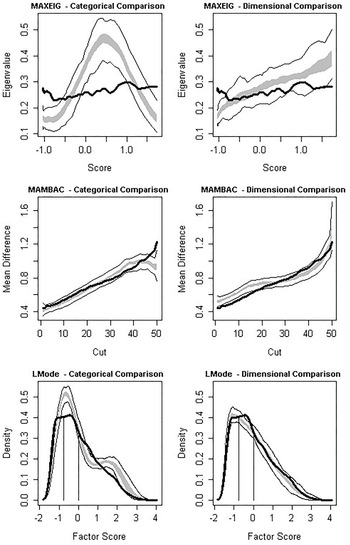
The averaged empirical MAXEIG curve fell within the region expected if the data were generated from a dimensional model but deviated markedly from what would be expected under a categorical model (see upper row of Figure 1). The CCFI value was .356, indicating that the data were most compatible with a dimensional model of individual differences.
Taxometric functions for dismissing states of mind. The dark line in each panel represents the empirical function. The shaded region represents the range of values that would be expected 50% of the time under categorical (left column) or dimensional (right column) models.

The averaged empirical MAMBAC function was more ambiguous. As can be seen in the middle row of Figure 1, the empirical MAMBAC function had a U-shape, with a higher elevation on the right side. This pattern is most compatible with data generated under a dimensional model with skewness. The CCFI value, however, was .524, indicating that the MAMBAC results were ambiguous with respect to the question of whether adults’ dismissing states of mind were categorically or dimensionally distributed.
As can be seen in the lower row of Figure 1, the empirical L-Mode function was most compatible with what would be expected under a dimensional model. The corresponding CCFI was .347. The average CCFI value for these three taxometric procedures was .409. Using the CCFI profile method, the average CCFI was .397.
In sum, the results of two of the three taxometric procedures indicated that a dimensional model better captures variation in dismissing states of mind than a categorical one. The results of a third procedure were ambiguous. Likewise, the two summary statistics that take the results of all three taxometric tests into account indicated that dismissing states of mind were more consistent with a dimensional than a categorical model based on Ruscio et al. (Reference Ruscio, Walters, Marcus and Kaczetow2010) guidelines.
Preoccupied states of mind
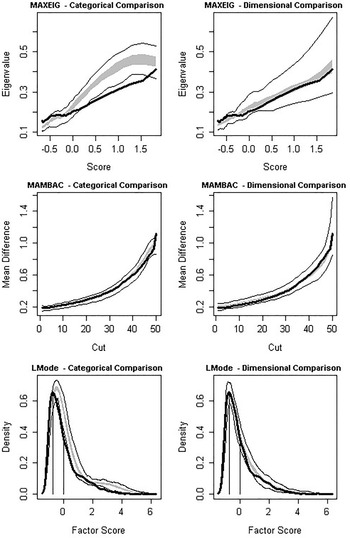
Because the confirmatory factor analyses indicated that Models 1–3 provided a good fit to the data, we conducted the taxometric analyses on all three sets of indicators of parents’ preoccupied states of mind. The first analysis involved the four indicators of the preoccupied/unresolved factor specified in Model 1: passivity, mother anger, father anger, and unresolved trauma. The second analysis involved the five indicators for the preoccupied/unresolved factor specified in Model 2: passivity, mother anger, father anger, unresolved trauma, and unresolved loss. The third analysis involved the three indicators of the preoccupied factor (without unresolved indicators) specified in Model 3: passivity, mother anger, and father anger. Because the confirmatory factor analyses indicated that Model 4 did not provide a good fit to the data, taxometric analyses were not completed for the active and passive forms of preoccupation. For the sake of brevity, only the results for the preoccupied/unresolved variable specified in Model 2 (the model with the largest number of indicators) are reported in Figure 2. However, the general conclusions for the other indicator sets are the same (see Table 3).
Taxometric functions for preoccupied states of mind. The dark line in each panel represents the empirical function. The shaded region represents the range of values that would be expected 50% of the time under categorical (left column) or dimensional (right column) models.

The averaged empirical MAXEIG curve was most compatible with that expected under a dimensional model as opposed to a categorical one (see upper row of Figure 2). The CCFI values for all three sets of variables were below .40, indicating that the data were most compatible with a dimensional model of individual differences.
The averaged empirical MAMBAC function was more ambiguous. As can be seen in the middle row of Figure 2, the empirical MAMBAC function had a U-shape, with a higher elevation on the right side. This pattern is most compatible with data generated under a dimensional model with skewness. The CCFI values for the three sets of variables ranged from .415 to .515, indicating that the MAMBAC analyses were largely ambiguous with respect to the indicators of E/U.
The empirical L-Mode function was most compatible with what would be expected under a dimensional rather than categorical model. The CCFI values were below .40 for all three sets of variables. Similarly, the average CCFI values and the CCFI profile values were below .45 for all three sets of variables.
In summary, the results of the MAMBAC analyses were ambiguous for all three sets of variables. However, the results of the other two taxometric analyses and the summary statistics indicated that a dimensional model better captured variation in preoccupied/unresolved states of mind than a categorical one.
Unresolved states of mind
To examine whether variation in parents’ unresolved states of mind was more compatible with a categorical or dimensional model, we conducted taxometric analyses using the two rating scales that were included as indicators of the unresolved latent factor specified in Model 3. The MAXEIG and L-Mode methods were not used for these analyses because they require at least three indicators of a construct. Instead, the MAMBAC and MAXSLOPE taxometric procedures were used (Ruscio & Walters, Reference Ruscio and Walters2011). The CCFI values along with the categorical base rate estimates from each procedure are provided at the bottom of Table 3.
The CCFI value for the MAMBAC procedure was .249, indicating that the data were most compatible with a dimensional model. On the other hand, the CCFI value for the MAXSLOPE technique was .485, indicating that the MAXSLOPE results were ambiguous. The two summary statistics, the average of the two CCFI values and the CCFI profile average, were both less than .45. Thus, these taxometric results for parents’ unresolved states of mind are more compatible with what would be expected under a dimensional rather than categorical model.
Discussion
In this study, we addressed two conceptually and empirically distinct questions regarding the latent structure of the AAI. The first was how many factors underlie the variation in adults’ attachment states of mind as assessed with the AAI scales. To address this question, we conducted the first set of confirmatory factor analysis that: (a) assessed the fit of the theoretically based 3-factor model representing dismissing, preoccupied, and unresolved states of mind and (b) directly compared this 3-factor to the 2-factor model that was based on the results of prior exploratory factor analyses of the AAI. The second question was whether the individual differences on these factors are categorically or continuously distributed. To address this question, we conducted taxometric analyses of the factors supported by the confirmatory factor analysis. As a result, the current study included the first taxometric analysis of adults’ unresolved attachment state of mind. By using AAI data gathered from over 3,000 individuals across 40 international studies, the current study represents the largest sample investigation of the latent structure of adults’ attachment states of mind.
Regarding the question of factor structure, the results of the confirmatory factor analyses indicated that: (a) a 2-factor model representing adults’ dismissing and preoccupied attachment states of mind and (b) a 3-factor model that further distinguished unresolved from preoccupied states of mind were both compatible with the data. Tests of the relative fit of the two models did not provide consistent evidence favoring one model over the other. In contrast, the confirmatory factor analyses clearly indicated that a different 3-factor model that separated the preoccupation factor into active and passive forms did not provide a good fit to the data (cf. Haltigan et al., Reference Haltigan, Roisman and Haydon2014b).
One possible interpretation of these results is that AAI coders’ ratings of narratives about early attachment experiences reflect two, relatively independent latent phenomena. The first is the extent to which narratives reflect a dismissing attachment representation, which involves interviewees turning their attention away from attachment-related experiences by idealizing their childhood attachment relationships and claiming not to remember attachment-related events. The second is the extent to which narratives reflect a preoccupied attachment representation, which involves interviewees becoming emotionally overwhelmed or dysregulated (i.e., angry, passive, or disoriented) while discussing attachment experiences in childhood and adulthood. This 2-factor model is consistent with prior exploratory and confirmatory factor analyses of the AAI (e.g., Haltigan et al., Reference Haltigan, Roisman and Haydon2014b; Raby et al., Reference Raby, Yarger, Lind, Fraley, Leerkes and Dozier2017b), but it differs from the standard conceptualization of adults’ attachment states of mind in two key ways. First, within this 2-factor model, adult attachment security is not a distinct and unitary phenomenon but rather reflects the co-occurrence of low levels of dismissing and preoccupied states of mind regarding attachment-related information. Second, this 2-factor model suggests that the two ratings of adults’ potential unresolved states of mind and the ratings that traditionally have been used as indicators of a preoccupied state of mind reflect a common underlying construct.
A second possible interpretation of the factor analytic results is that in addition to the latent factors representing adults’ dismissing and preoccupied attachment representations there is a third factor that is marked by the incoherence of adults’ narratives when discussing incidents of loss or trauma. By distinguishing unresolved from preoccupied states of mind, this 3-factor model is more consistent with the standard approach to coding the AAI (Main et al., Reference Main, Goldwyn and Hesse2003–2008). In this 3-factor model, however, the correlation between the latent factors for preoccupied and unresolved states of mind was large (latent r = .87). This large correlation between the latent factors indicates that the variance shared among the ratings of preoccupied states of mind is highly overlapping with the variance shared between the ratings of unresolved loss and unresolved trauma. In other words, to the extent that unresolved loss and trauma co-occur, indicators of preoccupation are also present. Likewise, when markers of unresolved loss and trauma are both absent, indicators of preoccupation also tend to be minimal. It is important to acknowledge, though, that the zero-order correlations between the ratings of angry, passive, and unresolved discourse were rather modest, thus leaving room for the possibility that the ratings capture somewhat different phenomena. Furthermore, the modest zero-order correlation between the unresolved loss and unresolved trauma ratings may indicate that these ratings capture two relatively independent aspects of lack of resolution. Alternatively, because both unresolved scales require a “qualifying” event to have occurred (namely, loss of a loved one or a childhood trauma) before a rating greater than one can be assigned, the modest correlation between the two ratings may indicate that experiences of loss and trauma themselves are weakly related.
Further evaluations of the predictive validity of these 2- and 3-factor models would help inform whether preoccupied states of mind and the lack of resolution about loss or trauma are different albeit correlated phenomena, or whether preoccupation and unresolved loss or trauma are best conceptualized as manifestations of the same construct. The prediction of infant attachment outcomes in the next generation is considered to be a central test of the predictive validity of a measure of adult attachment representations (Main et al., Reference Main, Kaplan and Cassidy1985). Although meta-analyses of AAI categories predicting parent–child attachment provide some evidence for the predictive validity of preoccupied and unresolved states of mind (Verhage et al., Reference Verhage, Schuengel, Madigan, Fearon, Oosterman, Cassibba and Van IJzendoorn2016), the ability of a variable that combines ratings of preoccupied and unresolved states of mind to predict attachment in the next generation remains to be tested.
Regarding the question of categories versus dimensions, the taxometric analyses did not produce evidence supporting the traditional assumption that variation in adults’ attachment states of mind reflects categorical individual differences. In contrast, findings from two taxometric tests unambiguously favored a dimensional model for both dismissing and preoccupied states of mind. The results of the third test did not clearly support either a categorical or a dimensional model. Similarly, one of the taxometric tests supported a dimensional model for unresolved states of mind, whereas the results of the second were ambiguous. Importantly, the average CCFI values and the average CCFI profile values, which provide robust summaries of the taxometric evidence, consistently favored a dimensional model for dismissing, preoccupied, and unresolved states of mind. That said, the average CCFI value for the dismissing states of mind factor and the average CCFI profile value for the unresolved states of mind factor would have been considering ambiguous if we had used the more conservative .40–.60 threshold that we had selected a priori rather than the criteria recommended by Ruscio et al. (Reference Ruscio, Walters, Marcus and Kaczetow2010). Altogether, although the taxometric evidence is not unequivocal, the findings from this large sample study represent the clearest evidence to date suggesting that a dimensional model may provide a more plausible description of the variation in adults’ attachment states of mind than a categorical one across a range of populations.
A unique strength of the study was the unprecedented size and international diversity of its sample. For the current set of analyses, parents from the 10 countries were combined because this maximized the statistical power of the analyses and because we did not have an a priori expectation that the latent structure of the AAI would vary across cultures. Indeed, the factor structure of the AAI has been shown to be largely invariant across ethnic groups within the United States (Haltigan et al., Reference Haltigan, Leerkes, Wong, Fortuna, Roisman, Supple and Plamondon2014a). Nonetheless, an important direction for future research is to empirically evaluate whether the latent structure is invariant across more internationally diverse cultural groups (Putnick & Bornstein, Reference Putnick and Bornstein2016)
A limitation of the current study was a lack of information available about the interrater reliability of the AAI state-of-mind ratings within the CATS dataset. Because the AAI coding system emphasizes classifications, this information is typically not recorded. In addition, it was necessary to adjust the factor structure models in order to achieve adequate model fit for any of the confirmatory factor analyses. The two residual correlations suggest that there were some relationship-specific patterns of discourse during the AAI. Specifically, individuals who became angry when discussing their childhood experiences with a specific parent tended to not also idealize that parent (and vice versa). Because these ratings also loaded on the latent factors representing parents’ dismissing and preoccupied states of mind, these ratings appear to capture adults’ overall states of mind about their childhood attachment experiences as well as patterns of discourse that are unique to specific parental figures. Splitting the dataset into a discovery and a confirmation sample arguably would have been more of a strength had that decision been made a priori. Consistent with prior confirmatory factor analyses (Haltigan et al., Reference Haltigan, Roisman and Haydon2014b), the ratings of overall coherence were excluded from these analyses. The implication of this is that, in the fitted models, security of adult attachment could only be defined as lack of dismissiveness and preoccupation, whereas in the original coding system a high rating for coherence would define security (Hesse, Reference Hesse, Cassidy, Shaver, Cassidy and Shaver2016). Another potential concern is the lack of an established approach for conducting taxometric analyses with a multilevel dataset. However, that was addressed as much as possible within the current study with a series of simulations.
A more general limitation of latent structure analyses of the AAI state-of-mind rating scales is the limited number and somewhat complex nature of the indicators used to identify the latent constructs. For example, some constructs (e.g., unresolved loss) are measured by only a single rating scale, which precludes modeling latent variables for those specific constructs. In addition, according to the traditional coding system (Main et al., Reference Main, Goldwyn and Hesse2003–2008), coders could only assign a rating for unresolved loss or unresolved trauma if individuals had an applicable experience. Because less than 25% of the parents in the CATS dataset reported experiencing an applicable trauma occurrence, excluding those cases from the analyses would have drastically reduced the sample size (and therefore the statistical power) of the analyses. Instead, the parents who did not report an applicable loss or trauma experience were recoded as having received the lowest score on these scales. Although this decision is consistent with prior work in this area, it is possible that this decision may have falsely equated individuals who did not experience loss or childhood trauma and those who did not demonstrate lapses in the monitoring of speech or reasoning when discussing those types of experiences. Further work aimed at developing more psychometrically robust systems for scoring unresolved and disorganized states of mind based on AAI discourse, including systems that do not require participants to report an applicable experience, would be valuable. In addition, examination of the factor structure and taxometric characteristics of variables derived from other AAI coding systems, such as Kobak's (Reference Kobak1993) Q-Sort approach, would help inform whether the results of this study are specific to the traditional AAI coding system or reflect the latent structure of adult attachment representations more generally (e.g., Haydon, Roisman, & Burt, Reference Haydon, Roisman and Burt2012).
Despite these limitations, the findings from this large-sample study do suggest a need to reconsider the traditional assumptions about the latent structure of the AAI, especially the assumption that individual differences in attachment states of mind are categorical. Although there is a long and productive history of representing individual differences in attachment with a categorical model, the central hypotheses of attachment theory do not require this assumption (Waters & Beauchaine, Reference Waters and Beauchaine2003). For example, the ideas that individual differences in attachment are shaped by childhood experiences with caregivers, contribute to risk for psychopathology, and can be intergenerationally transmitted from parent to child do not rely on either a categorical or dimensional model of individual differences. In addition, the importance of Main et al.'s (Reference Main, Goldwyn and Hesse2003‒2008) key insight that the organization of individuals’ discourse when discussing their childhood attachment experiences is reflective of their attachment states of mind is not diminished by the use of dimensional measures. In contrast, dimensional indices of adults’ states of mind may help maximize the utility of the AAI by increasing the statistical power of tests of the predictive significance of adults’ attachment representations.
Indeed, a next step in evaluating the construct validity of these dimensional measures of adults’ AAI states of mind is to examine their developmental origins and sequelae (Van IJzendoorn & Bakermans-Kranenburg, Reference Van IJzendoorn and Bakermans-Kranenburg2014). Because AAI coders typically evaluate individuals’ attachment state of mind using the 9-point rating scales that were the focus of the current analyses prior to assigning classifications, data from studies that originally used AAI classifications to examine the correlates of adults’ attachment states of minds can be reanalyzed using these dimensional measures. Indeed, a growing number of studies that have either reanalyzed existing datasets or examined novel data have demonstrated that the dimensional indices of adults’ dismissing and preoccupied states of mind have distinct caregiving antecedents and are uniquely associated with individuals’ physiological responses in attachment-relevant situations, behaviors during interpersonal interactions, parenting behaviors, and symptoms of psychopathology (e.g., Haydon et al., Reference Haydon, Roisman and Burt2012; Haydon, Roisman, Owen, Booth-LaForce, & Cox, Reference Haydon, Roisman, Owen, Booth-LaForce and Cox2014; Martin, Raby, Labella, & Roisman, Reference Martin, Raby, Labella and Roisman2017; Raby et al., Reference Raby, Labella, Martin, Carlson and Roisman2017a; Whipple et al., Reference Whipple, Bernier and Mageau2011). Given the evidence from this study that the 3-factor model that separated preoccupied and unresolved states of mind into distinct factors provided an acceptable fit to the data, researchers should explore whether there are unique correlates of each of these attachment states of mind (Van IJzendoorn & Bakermans-Kranenburg, Reference Van IJzendoorn and Bakermans-Kranenburg2014). Those efforts will be complicated by the substantial statistical overlap between the preoccupied and unresolved state-of-mind factors. Nonetheless, the challenge will be to explore whether these conceptually different phenotypes have unique precursors and are associated with distinct clinical and interpersonal outcomes. Another important research direction is examining whether the associations between these dimensional indices of adults’ attachment states of mind and theoretically meaningful variables are observed in diverse cultural contexts and among families from various risk backgrounds (e.g., Haltigan et al., Reference Haltigan, Leerkes, Wong, Fortuna, Roisman, Supple and Plamondon2014a; Haltigan et al., Reference Haltigan, Roisman, Groh, Holland, Booth-LaForce, Rogosch and Cicchetti2019). As previously noted though, invariance of the latent structure of the AAI across diverse cultural populations needs to be evaluated before differential associations are tested in those groups.
Because the categorical system has served attachment research well during the past few decades, future studies of the predictive validity of the dimensional measures will benefit from considering whether the findings would not have been detected with the categorical measures. Some studies have reported that the dimensional indices have added value when examining the developmental antecedents and interpersonal correlates of individuals’ attachment representations (e.g., Haydon et al., Reference Haydon, Roisman, Owen, Booth-LaForce and Cox2014; Whipple et al., Reference Whipple, Bernier and Mageau2011). A crucial question will continue to be whether these empirically based indices of adult attachment yield new insights into the processes underlying the development of psychopathology, adaptive and maladaptive functioning in romantic and parent–child relationships, and the intergenerational transmission of attachment beyond the categorical approach.
Supplementary Material
The supplementary material for this article can be found at https://doi.org/10.1017/S0954579420000978.
Acknowledgments
Group author members are as follows: Ora Aviezer, University of Haifa, Israel; Kazuko Y. Behrens, SUNY Polytechnic Institute, Utica, NY; Karl-Heinz Brisch, Dr. von Hauner Children's Hospital, Munich, Germany; Rosalinda Cassibba, University of Bari, Aldo Moro, Italy; Jude Cassidy, University of Maryland, College Park, MD; Gabrielle Coppola, University of Bari, Aldo Moro, Italy; Alessandro Costantini, University of Bari Aldo Moro, Italy; Mary Dozier, University of Delaware, Newark, DE; Robbie Duschinsky, University of Cambridge, Cambridge, England; Elena Ierardi, University of Milano-Bicocca, Italy; Brent Finger, Montana State University, Billings, MT; Sonia Gojman de Millan, Research Center of the Seminario de Siciopsicoanálisis, Mexico City, Mexico; Susanne Harder, Department of Psychology, University of Copenhagen, Denmark; Nancy L. Hazen, University of Texas at Austin, TX; Mi Myoung Jin, SookMyung Women's University, Seoul, South Korea; Inês Jongenelen, Universidade Lusófona do Porto, Portugal; Esther M. Leerkes, University of North Carolina at Greensboro, NC; Francesca Lionetti, Queen Mary University of London, UK; Karlen Lyons-Ruth, Harvard Medical School, Boston, MA; Catherine McMahon, Macquarie University, Sydney, Australia; Elizabeth Meins, University of York, UK; Cecilia S. Pace, University of Genoa, Italy; David R. Pederson, Western University, London, Ontario, Canada; Cristina Riva Crugnola, University of Milano-Bicocca, Italy; Avi Sagi-Schwartz, University of Haifa, Israel; Sarah J. Schoppe-Sullivan, Ohio State University, Columbus, OH; Anna Maria Speranza, Sapienza University of Rome, Italy; Howard Steele, The New School, New York, NY; George M. Tarabulsy, Université Laval, Quebec City, Canada; Mette S. Væver, University of Copenhagen, Denmark; Mary J. Ward, Weill Cornell Medical College, New York, NY.
Non-author collaborators are as follows: Bronia Arnott, Newcastle University, UK; Heidi Bailey, University of Guelph, Canada; Johanna Behringer, Friedrich-Alexander-Universität Erlangen-Nürnberg, Germany; Patrick J. Brice, Gallaudet University, Washington, DC; Germana Castoro, University of Bari Aldo Moro, Italy; Elisabetta Costantino, University of Milano-Bicocca, Italy; Chantal Cyr, Université du Québec à Montréal, Canada; Carol George, Mills College, Oakland, CA; Gabriele Gloger-Tippelt, Ulm University Medical Center, Germany; Carollee Howes, University of California at Los Angeles, CA; Heidi Jacobsen, Regional Centre for Child and Adolescent Mental Health, Eastern and Southern Norway, Oslo; Deborah Jacobvitz, University of Texas at Austin, TX; Femmie Juffer, Leiden University, The Netherlands; Miyuki Kazui, Ibaraki University, Mito, Japan; Simo Køppe, University of Copenhagen, Denmark; Salvador Millán, Research Center of the Seminario de Siciopsicoanálisis, Mexico City, Mexico; Lynne Murray, University of Reading, UK; Alessandra Simonelli, University of Padova, Italy; Judith Solomon, Cambridge University School of Medicine, UK; Miriam Steele, The New School, New York, NY; Doug M. Teti, The Pennsylvania State University, State College, PA; W. Monique van Londen-Barentsen, Utrecht University, The Netherlands.
Financial Support
This work was supported by a grant from Stichting tot Steun Nederland to Mirjam Oosterman and Carlo Schuengel as well as a grant from the Social Sciences and Humanities Research Council Canada (grant number 430-2015-00989) to Sheri Madigan. We are also grateful for the financial support for the original studies which collected the data included in this work.