


Civic education is a powerful political tool, as reflected in extensive political conflict over its content and implementation. From the Confederate Myth of Reconstruction to Trump Era debates over critical race theory (CRT), racial conservatives—those interested in maintaining existing racial hierarchies in the United States—have historically aimed to undermine efforts to incorporate racially inclusive curricula that centers the political contributions of people of color into classroom instruction (Du Bois Reference Du Bois1998 [Reference Du Bois1935]; Loewen Reference Loewen1996; Moreau Reference Moreau2010; Woodson et al. Reference Woodson, Gates and Givens2023 [Reference Woodson, Gates and Givens1933]). Meanwhile, progressive reformers—including those affiliated with the ethnic studies movement—have aimed to incorporate lessons from movement spaces to create more empowering civic learning experiences for racially marginalized students (Sleeter Reference Sleeter2011). Extant work demonstrates that these efforts are not merely symbolic but also have meaningful impacts on democratic outcomes. Whether passed down through places of worship (Dawson Reference Dawson1994), families (Anoll Reference Anoll2022), or schools (Nelsen Reference Nelsen2023a), civic narratives are politically consequential and have discernable effects on political participation.
Sociologist and historian W.E.B. Du Bois identified this relationship early, concluding Black Reconstruction in America with a chapter entitled “The Propaganda of History” (Reference Du Bois1998 [Reference Du Bois1935], 711). According to Du Bois, characterizations of Black ignorance and corruption during Reconstruction disseminated in school curricula were not only false, but also worked to undermine the agency of African Americans: “In all probability [students will] complete [their] education without any idea of the part which the Black race has played in America; of the tremendous moral problem of abolition; of the cause and meaning of the Civil War and the relation which Reconstruction had to democratic government and the labor movement today” (Reference Du Bois1998 [Reference Du Bois1935], 713).
Building upon the insights of both Du Bois and those who have rigorously examined his scholarship, this article presents a DuBoisian approach to civic education: one that advocates for (1) content that is racially inclusive and addresses the democratic importance of political activism; (2) centers conversations about politics; and (3) ensures the ranks of K-12 educators are as diverse as the students they serve. Such an approach to civics marks an important departure from traditional civic education courses that aim to foster democratic capacity—the knowledge, skills, attitudes, and behaviors—that allow young people to participate in politics (Levinson Reference Levinson2012). These courses commonly take the virtues of American democracy as a given rather than grappling with how to prepare young people to participate in democracy when democracy itself is flawed (Nelsen Reference Nelsen2023a). I argue that a DuBoisian approach to civic education provides a useful framework for K-12 classroom practices that can equip young people with the capacity needed to navigate and transform a democratic system defined by persistent racial inequality and exclusion.
This article proceeds in two parts. First, I draw on Du Bois’ writings—and contemporary scholarship examining his work—to sketch out what a DuBoisian approach to K-12 civic education would entail. I do not claim to offer a new interpretation of Du Bois’ extensive writings on education. Rather I read his work on the democratic importance of education alongside contemporary civic education research to develop a framework for reforms to civic education specifically.
Highlighting the erasure of Black political agency during Reconstruction, Du Bois’ writing captures the political stakes of providing civic learning experiences in school and reflects widely studied pedagogical techniques with demonstrated effectiveness and appeal. In the process, I highlight how a DuBoisian approach to civic education provides a meaningful departure from more commonly invoked understandings of the democratic purpose of education frequently attributed to John Dewey. Specifically, Du Bois recognized that schools—frequently characterized as cradles for democracy by Dewey—could simultaneously reinforce existing racial inequities (Alridge Reference Alridge2008; Cadena Reference Cadena2023; Conwell Reference Conwell2016; Guhin Reference Guhin, Abrutyn and Lizardo2021; Pierce Reference Pierce2017). Even while acknowledging their faults, Du Bois recognized the importance of public schools as key sites of political learning for Black children, even as contemporaries such as Carter Woodson—a fellow champion for the teaching of Black history—grew disillusioned by the idea that public schools could bring about racial equality (Woodson et al. Reference Woodson, Gates and Givens2023 [Reference Woodson, Gates and Givens1933]). Thus, Du Bois’ scholarship provides a convincing case for creating space within K-12 civic education courses to learn about race, racism, and the political contributions of racially marginalized groups—and Black Americans in particular. Recent civic education scholarship substantiates Du Bois’ insights, showing that racially inclusive curricula can contribute to feelings of political empowerment and foster political empathy among youth across racial and ethnic groups—an important outcome for maintaining a pluralist, democratic society.
Second, I assess whether there is public support for a DuBosian approach to civic education using a national sample of over 2,000 Americans. I provide this snapshot of public receptiveness as one piece of information for advocates and scholars seeking to advance civic education reforms along these lines. Although Black Americans and Democrats are most supportive, I find that a majority of respondents across racial, ethnic, and partisan lines, including parents of K-12 students, support central tenets of a DuBoisian approach to civic education, including teaching young people about political activism, the historic roots of contemporary political challenges, and African American history. Some other tenets—talking about politics in the classroom and ensuring that educators and school administrators share the race and ethnicity of the student population they serve—prove more controversial. I also show that race, ethnicity, and partisanship interact with parental status to shape support for this approach: Among White and Asian respondents who identify as strong Republicans, parents are significantly more supportive of these interventions than nonparents. Among Latine respondents, regardless of partisanship, parents are significantly less supportive of this approach than Latine nonparents. Among African Americans, parental status plays no significant role in moderating support for a DuBosian civic education approach. These findings offer suggestions for advocates of civic education reform. By emphasizing the tangible pedagogical techniques associated with a DuBosian approach to civic education, it may be possible to sidestep the ambiguity and polarization of the CRT debate and reengage in the nuances of civic education policymaking.
W.E.B. Du Bois and Civic Education
Several scholars have recognized Du Bois’ important contributions to the study of education. In this area, Du Bois’ is perhaps most well-known for his work addressing the “Talented Tenth,” which emphasized the importance of creating educational opportunities for one in 10 Black men to prepare them for leadership roles in society via a liberal arts education centering the European canon in literature and philosophy (Du Bois Reference Du Bois1903; 1994 [Reference Du Bois1903]). Later, Du Bois revised the Talented Tenth into the Guiding Hundredth, which emphasized moral character and attempted to “democratize and internationalize his philosophy of education” (Rabaka Reference Rabaka2003, 416; see also Du Bois Reference Du Bois1948). However, recent scholarship makes a convincing case to also consider Du Bois’ extensive body of work addressing the democratic importance of education (Aldridge Reference Alridge2008; Cadena Reference Cadena2023; Guhin Reference Guhin, Abrutyn and Lizardo2021; Rabaka Reference Rabaka2010). It is that body of work which I draw upon in this article.
This work examines Du Bois’ thinking on the role of traditional public schools in sustaining racial inequities (Conwell Reference Conwell2016; Pierce Reference Pierce2017), the ability of Black educational institutions to foster Black scholars and scholarship (Morris Reference Morris2017), and the role of critical curricula in educating Black students (Cadena Reference Cadena2023). Others have recognized Du Bois’ educational thought—alongside Dewey and Durkheim—as emphasizing the “internal goods” rather than the external outcomes of education such as socioeconomic mobility (Guhin Reference Guhin, Abrutyn and Lizardo2021). In this sense, one can view the primary purpose of education as political and emphasizing “how students act as citizens and community members” (381; 383). This is the very essence of civic education.
In light of this existing work, my goal is not to offer a new reading of Du Bois’ education scholarship. Rather, I read Du Bois—and the existing secondary literature examining his work—alongside K-12 civic education scholarship in education and political science to draw insights for contemporary political debates over civic education. A shared link between Du Bois’ educational philosophy (Guhin Reference Guhin, Abrutyn and Lizardo2021) and recent civic education work (Nelsen Reference Nelsen2023a) is political empowerment: the willingness and ability to take political action, even in the face of daunting political challenges. Du Bois’ view that education should prepare Black students for full participation within America’s political processes, even in the face of political inequalities, provided a direct challenge to his contemporaries, most notably Booker T. Washington, who instead promoted industrial education for African Americans as the primary means of obtaining political equality via socioeconomic mobility (Du Bois Reference Du Bois1994 [Reference Du Bois1903], 31; Guhin Reference Guhin, Abrutyn and Lizardo2021, 395).
Centering Du Bois as a central figure within the realm of civic education also represents a meaningful departure from existing work examining the democratic importance of schools. Many in this space, centering the work of John Dewey, view schools as an important site for young people to acquire the values and relational skills that strengthen America’s pluralist democratic system (Reference Dewey2010 [Reference Dewey1916]; see also Guhin Reference Guhin, Abrutyn and Lizardo2021). As an example, one recent work in political science concludes “Like John Dewey before us … we find compelling reasons to believe that democratization of the polity will depend, at least in part, on efforts to make schools more just and democratic in their own right” (Bruch and Soss Reference Bruch and Soss2018, 50). Although Dewey’s work provides invaluable insights for the study of civic education, his scholarship often overlooks the role of public schools in sustaining racial inequality. As Sam F. Stack Jr. suggests:
“For Dewey, education was a process by which one learned to judge through reflection and inquiry, examining the evidence and leading to intelligent action. In the South and other parts of the country, education served to protect the status quo, reinforcing customs and traditions that grounded prejudice and led to racism. An examination of Dewey’s thought…shows that even in the 1940s he connected prejudice and racism too much to politics and economics and not enough to social forces, the deep-seated beliefs that people held that grounded prejudice” (Reference Stack2009, 23; 29).
In other words, although Dewey certainly recognized the importance of forging a multiracial society in both his activism and his later educational writings (Guhin Reference Guhin, Abrutyn and Lizardo2021, 395), his scholarship is less attuned to pedagogical interventions that would actually prepare individuals to live in a diverse society. Indeed, throughout Democracy and Education, Dewey emphasizes the important role classrooms play as microcosms for democracy. In his view, classrooms provide opportunities for students to develop democratic norms through largely unstructured social interactions and communal decision-making (Dewey Reference Dewey2010 [Reference Dewey1916], 236–237). Although aspiring for classrooms of this kind is laudable, Dewey may have overlooked necessary precursors to forge educational spaces of this kind, including lessons that aimed to first address individual prejudice and establish norms of equality. Dewey’s scholarship emphasizes that education’s meaning must derive from “the kind of society we have in mind” (112). Although his personal involvement with the National Association for the Advancement of Colored People (NAACP) certainly signifies the sort of society he imagined, as Stack (Reference Stack2009) suggests, Dewey may have overlooked the ways in which racism—both at the interpersonal and structural levels—could undermine his vision for education, even within racially integrated classrooms (Ramanathan and Nelsen Reference Ramanathan and Nelsen2024).
Reading Du Bois alongside his contemporaries also demonstrates that a DuBosian approach to civic education is not merely a stand-in for a framework that all racial progressives adhere to. For example, Carter Woodson—the founder of Black history month—also emphasized the democratic importance for Black Americans to learn African American history (Reference Woodson, Gates and Givens2023 [Reference Woodson, Gates and Givens1933], 96–97; 107–108). However, Woodson grew increasingly disillusioned with the idea that schools could bring about racial equality and became quite critical of Black educators (23–30; 93–100; 109–118). Unlike Dewey, both Du Bois and Woodson recognized that schools could help rearticulate existing racial hierarchies. Yet, Du Bois’ writings appear more optimistic about reforming civic learning initiatives in public schools than Woodson’s.
I argue that Du Bois’ work on civic education is built on a recognition that public schools possess the capacity to reinforce existing racial inequalities and also hold enormous democratic potential. Accordingly, the content of education is critical in determining whether its democratic potential can be realized for all students. Although Du Bois’ educational writings explicitly address educational practices that are empowering for Black students, I contend that a DuBoisian approach to civic education—one that centers pedagogical techniques that recognize and aim to confront the pervasiveness of America’s “color line” (Du Bois Reference Du Bois1994 [Reference Du Bois1903])—is politically meaningful for students across racial and ethnic lines. Such an approach includes racially inclusive content, open conversations about politics, and the importance of racial representation among teachers and school administrators. In each case, I also discuss recent scholarship that substantiates Du Bois’ insights.
Racially Inclusive Content
Du Bois’ scholarship on education highlights the importance of curricular content. Although his early work, including The Souls of Black Folks, states that education should prepare Black students for democratic participation (Reference Du Bois1994 [Reference Du Bois1903], 21), later works such as Black Reconstruction in America and “Does the Negro Need Separate Schools?” deepen this claim by discussing the stakes of content presented within history textbooks. As he notes in this text, traditional curricular content can deny Black students knowledge of their own history and the accomplishments of notable Black individuals:
“I remember once, in Texas, reading in a high-school textbook for colored students, the one anecdote given concerning Abraham Lincoln: he was pictured as chasing Negro thieves all night through the woods from his Mississippi flatboat! Children could read that history in vain to learn any word of what had been accomplished in American history by Benjamin Banneker, Jan Matzeliger, Elijah McCoy, Frederick Douglass, or James Dunn. In fact, one of the peculiar tragedies of the smaller southern colleges is that they hire teachers of history, economics and sociology, colored men trained in Northern institutions where not a word of any information concerning these disciplines, so far as Negros are concerned, has ever been imparted to them” (Du Bois Reference Du Bois1935, 335).
In this passage, Du Bois theorizes the potential detriments of whitewashed historical narratives for Black students, even when delivered by Black educators (see below for a further discussion of racial representation). As Meira Levinson argues, historical narratives—oftentimes featuring “godlike” white, male American heroes—are written for White students and present accounts of American history that are antithetical to the values and lived experiences of young people of color (2012; see also Epstein Reference Epstein2009; Nelsen Reference Nelsen2021b; and Ladson-Billings Reference Ladson-Billings1995; Rabaka Reference Rabaka2010). An alternative approach of centering positive portrayals of minority groups—rather than great individuals—in civics and history curricula allows for the development of positive group associations and increased political participation (García-Bedolla Reference García-Bedolla2005; also see Marx et al. Reference Marx, Ko and Friedman2009). Indeed, one contemporary textbook experiment demonstrates that Black and Latine youth report greater willingness to participate in politics when asked to read content that highlights the grassroots political action of racially marginalized groups (Nelsen Reference Nelsen2021a). Du Bois touches on this very theme in the same article:
“Negroes must know the history of the negro race in America, and this they seldom get from White institutions. Their children ought to study textbooks like Brawley’s ‘Short History,’ the first edition of Woodson’s Negro in Our History,’ and Cromwell, Turner, and Dyke’s ‘Readings from Negro Authors.’ Negros who celebrate the birthdays of Washington and Lincoln … ought not forget the 5th of March—the first national holiday of this country, which commemorates the martyrdom of Crispus Attucks. They ought to celebrate Negro Health Week and Negro History Week. They ought to study intelligently and from their own point of view, the slave trade, slavery emancipation, Reconstruction, and present economic development … I have become curiously convinced that until American Negroes believe in their own power and ability, they are going to be helpless before the white world, and the white world, realizing this inner paralysis and lack of self-confidence, is going to persist in its insane determination to rule the universe for its own selfish advantage. … It does not consist simply in trying to parallel the history of white folk with similar boasting about black and brown folk, but rather an honest evaluation of human effort and accomplishment, without color blindness, and without transforming history into a record of dynasties and prodigies” (Du Bois Reference Du Bois1935, 333–34).
As the excerpts above demonstrate, Du Bois articulated how meaningful racially inclusive content—rather than replacing White heroes with Black heroes—could unlock the enormous potential of democratic education in fostering political empowerment, especially for Black students. These insights regarding content have since been substantiated by decades of scholarship, particularly in the study of ethnic studies courses, which show a strong relationship between exposure to racially inclusive content and several favorable academic, political, and interpersonal outcomes (Carrel Reference Carrell1997; Bonilla et al. Reference Bonilla, Dee and Penner2021; Hughes et al. Reference Hughes, Bigler and Levy2007).
Open Conversations about Politics
In his writing on education, Du Bois consistently emphasizes the importance of developing both critical thinking skills and a sense of critical consciousness. In his view, schools that exposed students to critical and inclusive content gave them a space to make sense of their place in the world. Proponents of critical pedagogy such as Paulo Freire (Reference Freire2018[Reference Freire1968]) and bell hooks (Reference hooks2014[Reference hooks1994]) highlight similar themes within their work, emphasizing that the most meaningful and empowering educational experiences are those in which students and educators co-create knowledge through dialogue about contemporary political challenges. In Du Bois’ words, this also means that educators should be “natural, honest, and frank”—rather than pose—even when it is “bitter hard” (Reference Du Bois1969 [Reference Du Bois1920], 82). In Darkwater, Du Bois touches on this theme:
“In the teaching of my classes I was not willing to stop with showing that [racial discrimination in industrial wage labor] was unfair—indeed I did not have to do this. They knew through bitter experience its rank injustice, because they were black. What I had to show was that no real reorganization of industry could be permanently made with the majority of mankind left out. These disinherited darker peoples must either share in the future industrial democracy or overturn the world” (Reference Du Bois1969 [Reference Du Bois1920], 102).
Thus, grounding classroom conversations in students’ lived experiences and a broader historical understanding of where contemporary political challenges emerged from—akin to Du Bois’s frustration with the Confederate Myth of Reconstruction previously discussed—may foster political empowerment across racial and ethnic groups. Indeed, recent civic education scholarship demonstrates that, when high school teachers use history as a way to help students make sense of challenges in their lives, young people express feelings of empowerment and are more likely to participate in a variety of political activities (Nelsen Reference Nelsen2023b). More broadly, decades of education and political science scholarship demonstrate the benefits of discussing political topics—including controversial ones—in the classroom. This pedagogical technique consistently ranks as the most effective way to bolster rates of intention to vote and political knowledge among students (Campbell Reference Campbell2008; Gainous and Martens Reference Gainous and Martens2012; Hess Reference Hess2009; Hess and McAvoy Reference Hess and McAvoy2014; Kawashima-Ginsberg and Levine Reference Kawashima‐Ginsberg and Levine2014; Martens and Gainous Reference Martens and Gainous2013; Torney-Purta Reference Torney-Purta2002). Thus, racially inclusive content paired with open conversations about politics that both center students’ experiences and historical context has the potential to foster favorable political outcomes among racially marginalized students.
Racial Representation within Educational Settings
Finally, Du Bois’ scholarship demonstrates that representation is important both in schools and in teacher training. Representation in the ranks of teachers and administrators, in Du Bois’ view, can help facilitate the two pedagogical interventions discussed above. As Cadena (Reference Cadena2023) notes, for Du Bois, educational settings served as critical meso-level institutions that allowed Black educators and administrators to exercise greater ownership over content, pedagogy, and the disbursement of educational resources. In other words, greater control over the governance of schools allowed Black educators to foster learning experiences that challenged more traditional, White-centric educational institutions that sought to maintain the status quo (Stack Reference Stack2009, 23,29). In Dusk of Dawn, Du Bois reflects on his own experiences as both a student and educator within different educational institutions—a historically Black university and at Harvard:
“At Fisk, the problem of race was faced openly and essential race equality asserted and natural inferiority strenuously denied. In some cases the teachers expressed this theory; in most cases the student naturally forced it. At Harvard, on the other hand, I began to face scientific race dogma: first of all, evolution and the ‘Survival of the Fittest.’ It was continuously stressed in the community and in classes that there was a vast difference in the development of the whites and the ‘lower’ races; that this could be seen in the physical development of the Negro” (Reference Du Bois2007[Reference Du Bois1940], 49).
Similarly, in “Does the Negro Need Separate Schools?” Du Bois highlights the unique ability of Black schools to deliver racially inclusive content that may facilitate the development of political empowerment:
“In history and the social sciences the Negro school and college has an unusual opportunity and role. It does not consist simply in trying to parallel the history of white folk with similar boasting about black and brown folk, but rather an honest evaluation of human effort and accomplishment, without color blindness, and without transforming history into a record of dynasty and prodigies” (Reference Du Bois1935, 334).
Du Bois’ insight about Black-led educational institutions as a site of political empowerment is substantiated by a large literature examining the role of Historically Black Colleges and Universities (HBCUs) in forging the political power of African Americans. Black professors at HBCUs and other Black-serving institutions play an important role in the processes of political socialization among students. This occurs not only through the teaching of politically meaningful content but via mentorship that contributes to campus norms of collective responsibility and service (Rose Reference Rose2024). These experiences are crucial, especially when educational institutions are viewed as not only sources of individual mobility, but as pipelines for Black professionals—including teachers—that shape the implementation of public policy and ethos of public institutions such as schools (Morris Reference Morris2017; Morel Reference Morel2023). Existing work suggests that K-12 teachers of color within Chicago Public Schools have been pivotal in ensuring that students have access to meaningful civic education content and experiences and are more likely to do so when their school’s principal is a person of color (Nelsen Reference Nelsen2023a; Todd-Breland Reference Todd-Breland2018). Relatedly, a bourgeoning literature suggests that, on average, Black and Latine students’ academic outcomes (e.g., test scores) and behaviors (e.g., absenteeism) improve when they have teachers who share their racial or ethnic identity (Egalite Reference Egalite2024; Redding Reference Redding2019).
Of course, emphasizing the democratic importance of racially diverse K-12 teachers risks essentializing the benefits of teachers of color. Indeed, neither Du Bois nor Woodson viewed Black educators as a panacea for racial inequality. As an example, both noted that Black educators hired to teach in Southern schools—but trained in the North—were frequently ill-equipped to incorporate the insights of Black people into course materials (e.g., Du Bois Reference Du Bois1935, 335; Woodson et al. (Reference Woodson, Gates and Givens2023 [Reference Woodson, Gates and Givens1933], 20–21). Thus, in advocating for the recruitment and training of racially diverse educators as a means of securing vibrant civic learning experiences, civics reformers and policymakers should also be attuned to a wider array of policies that shape early professionalization experiences that contribute to effective K-12 teachers.
Taken together, Du Bois’ scholarship articulates a cogent vision for a civic education that addresses racism head-on and centers political empowerment as a desired civic outcome. Although the research addressed above largely focuses on the benefits of this approach for Black students, the civic education literature suggests that the benefits of these pedagogical techniques are observable across racial and ethnic groups. Next, I turn to existing K-12 public opinion data and an analysis of original survey data to assess the public’s receptiveness toward a DuBoisian approach to civic education
Racial Conservatism and Public Opinion toward K-12 Education Policies
Education was long believed to occupy a “special status” within American politics; decision-making in education policy was largely left to the devices of local school administrators, school boards, teachers’ unions, and parents—free from the polarized rhetoric of national politics (DeBray-Pelot et al. Reference DeBray-Pelot, Lubienski and Scott2007; Henig Reference Henig2013). In recent years, however, education policy has increasingly been utilized to further the political agendas of state and federal stakeholders (Henig et al. Reference Henig, Jacobsen and Reckhow2019; Morel Reference Morel2018). But even as education policy writ-large was long insulated from national politics, debates over civic education courses such as American government, United States history, and civics have been embroiled in broader national debates over equality, representation, and racial pluralism (Loewen Reference Loewen1996; Moreau Reference Moreau2010). The conservative position within these debates has never been about what is best for kids or multiracial democracy but represents attempts to maintain racial hierarchy by stifling the political agency of racially marginalized groups and stoking the flames of White grievance (Hooker Reference Hooker2023; Omi and Winant Reference Omi and Winant2014; see Appendix B for additional historical context).
The ongoing debate over the role of CRT in schools strikes a similar refrain. CRT emerged in the 1980s–90s in legal academia as a theory that explores how “colorblindness” and “political neutrality” can still contribute to racial inequities (Crenshaw Reference Crenshaw2019, 52, 60). In the 2020s, however, racial conservatives such as Cristopher Rufo, Glenn Youngkin, Ron DeSantis, and Donald Trump weaponized CRT to attack employer-sponsored diversity, equity, and inclusion (DEI) initiatives (Wallace-Wells Reference Wallace-Wells2021), race-conscious accounts of American history such as the 1619 Project, and to fuel successful bids for public office (Edwards-Levy Reference Edwards-Levy2021; Kamenetz Reference Kamenetz2021; Greene Reference Greene2022). The extensive and ambiguous use of the term has led some researchers to characterize CRT as an “empty signifier” employed by Republicans to tap into a broad range of “racial and cultural grievances” (Safarpour et al. Reference Safarpour, Trujillo, Green, Pippert, Lin and Druckman2024, 157; see also Carbone et al. Reference Carbone, Harell and Soroka2024).
Consistent with this portrayal of recent Republican attacks on CRT, public opinion data from the November 2023 GenForward Survey (see Figure 1) finds that a plurality of Americans (42%) hold ambivalent views toward CRT whereas Republicans hold far more negative views than Democrats (GenForward 2023; see also Safarpour et al. Reference Safarpour, Trujillo, Green, Pippert, Lin and Druckman2024; Carbone et al. Reference Carbone, Harell and Soroka2024). When asked about more tangible policies such as book bans and restrictions on curricula, however, a majority of respondents (53%) reported that they view these policies as a way for Republicans to secure political advantages rather than a reflection of true concerns about books and curricula. This view was expressed by 64% of African Americans, 76% of Democrats, and nearly half of Independents (see Figure 2). Similarly, when asked whether K-12 public schools teach too much, too little, or the right amount of Black history (see Figure 3), large majorities of Americans across racial, ethnic, and partisan groups believe that this topic should be kept the same or expanded. Black respondents (76%) and Democrats (62%), in particular, are in favor of increasing the amount of Black history taught in K-12.
Views on critical race theory by race, ethnicity, and partisanship.

Figure 1. Long description
Panel A: A horizontal bar graph showing views on critical race theory by race and ethnicity. The horizontal axis represents the percentage of respondents, ranging from 0 to 100 percent. The vertical axis lists different racial and ethnic groups: Overall, White, AAPI, Latinx, and Black. Each group has a series of horizontal bars representing different views: Very positive, Mostly positive, Neutral, Mostly negative, Very negative, and NA. The color scheme includes dark shades for positive views, gray for neutral, and light shades for negative views. The Overall category shows 15 percent Very positive, 16 percent Mostly positive, 42 percent Neutral, 11 percent Mostly negative, 16 percent Very negative, and NA. The White category shows 13 percent Very positive, 15 percent Mostly positive, 39 percent Neutral, 12 percent Mostly negative, 20 percent Very negative, and NA. The AAPI category shows 14 percent Very positive, 21 percent Mostly positive, 47 percent Neutral, 11 percent Mostly negative, 6 percent Very negative, and NA. The Latinx category shows 15 percent Very positive, 13 percent Mostly positive, 51 percent Neutral, 10 percent Mostly negative, 10 percent Very negative, and NA. The Black category shows 27 percent Very positive, 19 percent Mostly positive, 42 percent Neutral, 6 percent Mostly negative, 6 percent Very negative, and NA. Panel B: A horizontal bar graph showing views on critical race theory by partisanship. The horizontal axis represents the percentage of respondents, ranging from 0 to 100 percent. The vertical axis lists different partisan groups: Overall, Republican, Independent, and Democrat. Each group has a series of horizontal bars representing different views: Very positive, Mostly positive, Neutral, Mostly negative, Very negative, and NA. The color scheme includes dark shades for positive views, gray for neutral, and light shades for negative views. The Overall category shows 15 percent Very positive, 16 percent Mostly positive, 42 percent Neutral, 11 percent Mostly negative, 16 percent Very negative, and NA. The Republican category shows 5 percent Very positive, 35 percent Mostly positive, 21 percent Neutral, 35 percent Mostly negative, and NA. The Independent category shows 7 percent Very positive, 13 percent Mostly positive, 60 percent Neutral, 8 percent Mostly negative, 11 percent Very negative, and NA. The Democrat category shows 26 percent Very positive, 24 percent Mostly positive, 40 percent Neutral, 6 percent Mostly negative, and NA.
Views on book bans by race, ethnicity, and partisanship.

Views on Black History by Race, Ethnicity, and Partisanship.

These public opinion data suggest that many Americans are opposed to book bans and restrictions on courses such as Advanced Placement (AP) African American History (Fawcett and Hartocollis Reference Fawcett and Hartocollis2023). Yet, advocates of meaningful civic learning experiences often fail to articulate a cogent set of K-12 educational policies that effectively respond to Republicans’ use of CRT as a framing strategy (Safarpour et al. Reference Safarpour, Trujillo, Green, Pippert, Lin and Druckman2024, 157). I argue that a DuBoisian approach is useful in that it points to specific interventions that prepare young Americans, and particularly racially marginalized youth, to navigate an increasing fragile democracy. By emphasizing civic learning techniques that may contribute to a more vibrant and equitable multiracial democracy in the United States, policymakers can move beyond vague debates over CRT and instead consider what types of educational content and learning experiences are actually beneficial for young people. As I argued above, the benefits of a DuBoisian approach to civic education are well supported by existing empirical studies. Yet, understanding public receptiveness is a useful piece of information for scholars and advocates who are interested in implementing these changes.
Race is a central component of understanding public opinion in the United States, and this trend extends to K-12 education policies specifically. For example, the aforementioned GenForward Survey data (see Figures 1–3) demonstrate that Black Americans hold more favorable views of CRT, are more critical of book bans, and are more supportive of expanding the teaching of Black history in K-12 schools relative to other racial and ethnic groups (2023). Safarpour et al. (Reference Safarpour, Trujillo, Green, Pippert, Lin and Druckman2024) also find that Black Americans hold more favorable views of both CRT and teaching about the legacy of anti-Black racism (Reference Safarpour, Trujillo, Green, Pippert, Lin and Druckman2024, 176). Thus:
H1: Black respondents, relative to Asian, Latine, and White respondents, will be more likely to support a DuBosian approach to civic education.
Partisanship also emerges as an important factor in understanding public opinion toward contemporary K-12 educational policy areas. Leveraging nearly two decades of nationally representative survey data, Houston (Reference Houston2024a) demonstrates that partisanship gaps in preferences toward K-12 educational policy issues have increased considerably overtime (524). Although this work examines 16 policy areas, including support for charter schools, vouchers, and national standards, public opinion toward civic learning interventions is again absent. Elsewhere, however, Houston (Reference Houston2024b) does find that Democrats, relative to both Republicans and Independents, are more supportive of teaching about civics, democracy, multiculturalism, and history, which more closely align to a DuBosian approach to civic education. Thus:
H 2 : Democrats, relative to Republicans and Independents, will be more likely to support a DuBosian approach to civic education.
Parental status may also play an important role in shaping public opinion toward K-12 educational policies. Some argue that nonparents have “less skin in the game” and are more likely to evaluate K-12 education policies through a symbolic or partisan lens in the absence of parental concern over what is best for kids (Kogan Reference Kogan2025). Applied here, nonparents may evaluate the DuBosian civic education items more favorably to reflect their partisanship or their broad commitments to racial equity (Reference Kogan2025).
H 3 : Nonparents, relative to parents, will be more likely to support a DuBosian approach to civic education.
The mobilization of conservative parental rights groups such as Moms for Liberty in the wake of the first Trump Presidency, however, suggests that partisanship and parental status may interact to shape civic education policy preferences in important ways. In November of 2023, for example, just 13% of Republicans reported that parents “had too much say in decisions about what schools are teaching” as opposed to 26% of Democrats (Minkin Reference Minkin2024). Republican parents may be particularly opposed to civic learning interventions that deviate from more traditionally taught civic education topics, particularly those that aim to address racial inequality. Thus:
H 4 : Across racial and ethnic groups, parents who identify as strong Republicans will most strongly oppose a DuBosian approach to civic education.
However, it is also possible that the expectations put forth in H 3– H 4 could cut in the opposite direction. Parents may have greater firsthand experience with best practices in K-12 civic learning and may be less reliant on partisanship to evaluate these policies. In fact, Republicans and Democrats with school-aged children exhibit smaller partisan gaps in support for several educational policies, including support for increasing overall educational spending, increasing teacher salaries, and overall support for charter schools than their peers without children (Houston Reference Houston2021, 583–84). This trend is especially pronounced among Republicans (584). Thus, failing to find support for H 3 –H 4 would not be particularly surprising in light of work addressing the intersections of partisanship, parental status, and K-12 educational policy preferences.
Du Bois in Public Opinion
To assess public support for the tenets of a DuBoisian approach to civic education, I fielded an original survey of a national sample of 2,106 U.S. adults. The survey—discussed in greater detail in the Appendix—was fielded by Forthright from April 1st–10th, 2024, and distributed to a large, opt-in national sample closely resembling the U.S. population on many important observed demographic variables. A breakdown of this sample by race, ethnicity, and gender, is shown in Table 1.
Sample by race, ethnicity, and gendera

Table 1. Long description
The table presents the breakdown of a survey sample by race, ethnicity, and gender. It has 3 rows and 5 columns. The columns are labeled Asian, Black, Latine, White, and Total. The rows are labeled Women, Men, and Total. The values in the table are as follows: Row 1: Women, Asian, 66; Black, 167; Latine, 169; White, 697; Total, 1,099. Row 2: Men, Asian, 64; Black, 164; Latine, 174; White, 605; Total, 1,007. Row 3: Total, Asian, 130; Black, 331; Latine, 343; White, 1,302; Total, 2,106.
a One hundred eighty-seven individuals identify as multiracial. I opt to double count these respondents in the analyses that follow due to limited subgroup sample sizes. All of the analyses included in the article were replicated while omitting these individuals from the analyses (see Table 2A and Figure 1A). Differences in results are minimal. Removing these individuals yields significant differences between Asian and White respondents in two instances, suggesting the main results are more conservative estimates.
DuBoisian Civic Education Measures
Two survey questions explored support for the tenet of racially inclusive content and the importance of political activism. The first question asked respondents about their level of agreement with the following statement: Students should learn about the contributions of Black Americans at school, including their role in ending slavery and their work to establish the first state-funded public schools in the South during Reconstruction (1 = Strongly disagree | 5 = Strongly agree). To assuage concerns that a single question about support for teaching Black history does not adequately capture the more radical nature of Du Bois’ views toward curricular content, the second question considers whether students should be taught the value of political activism. Participants were asked about their level of agreement with the following statement: Students should learn about individuals and groups who used protests, boycotts, and other forms of political activism to fight for what they believed in (1 = Strongly disagree | 5 = Strongly agree).
Two questions gauged public support for the tenet of open conversations about politics, reflecting Du Bois’ view that schools should help foster critical consciousness and political empowerment and center student voice. The first question asked participants about their level of agreement with the following statement: Teachers should facilitate in class conversations about politics (1 = Strongly disagree | 5 = Strongly agree). The second question added a layer of specificity, asking about their level of agreement with the following statement: Teachers should use history to help students understand the roots of today’s political debates and challenges (1 = Strongly disagree | 5 = Strongly agree).
Finally, the survey included one question to measure public support toward the final tenet of a DuBoisian approach to civic education: that the racial and ethnic profile of teachers and school administrators should reflect that of the student population. Respondents were asked about their level of agreement with the following statement: It is important to hire teachers and school administrators who share the racial/ethnic identity of the students attending the school (1 = Strongly disagree | 5 = Strongly agree).
Methods
For each question, I explore the levels of support disaggregated across three categories: race and ethnicity, partisanship, and parental status. I selected these categories due to the importance of these dividing lines in the aforementioned public opinion studies about education policy and the ongoing CRT debate (Houston Reference Houston2024a; Carbone, Harrell, and Soroka Reference Carbone, Harell and Soroka2024; Safarpour et al. Reference Safarpour, Trujillo, Green, Pippert, Lin and Druckman2024). To test H 1 –H 3 , I employ the analysis of variance (ANOVA) and t-tests—discussed in greater detail in the appendix—to determine whether average rates of support for each of the DuBosian civic education items vary significantly across race, ethnicity, partisanship, and parental status.
As a robustness check, I conduct two ordinary least squares (OLS) regression analyses. The first analysis examines factors associated with support for a DuBoisian approach to civic education within racial and ethnic groups, including age, sex, educational attainment, and income. The second analysis, aligned to H 4 , includes an additional interaction term to assess whether parental status moderates observed relationships between partisanship and support for a DuBosian approach to civic education within racial and ethnic groups. The insights generated from these analyses not only deepen our understanding of public opinion toward a wider slate of K-12 education policies but are instructive for those seeking to build a coalition aimed at meaningful civic education reform.
Support for a DuBoisian Approach to Civic Education across Racial and Ethnic Groups
The ANOVA and t-tests summarized in Table 1A highlight statistically significant differences in support across racial and ethnic groups for all but one of the DuBosian civic education items: historically grounded conversations. Differences across partisanship groups are highly significant for all of the items (p < .001). The only statistically significant difference that emerges between parents and nonparents is for historically grounded conversations about politics (p < .05).
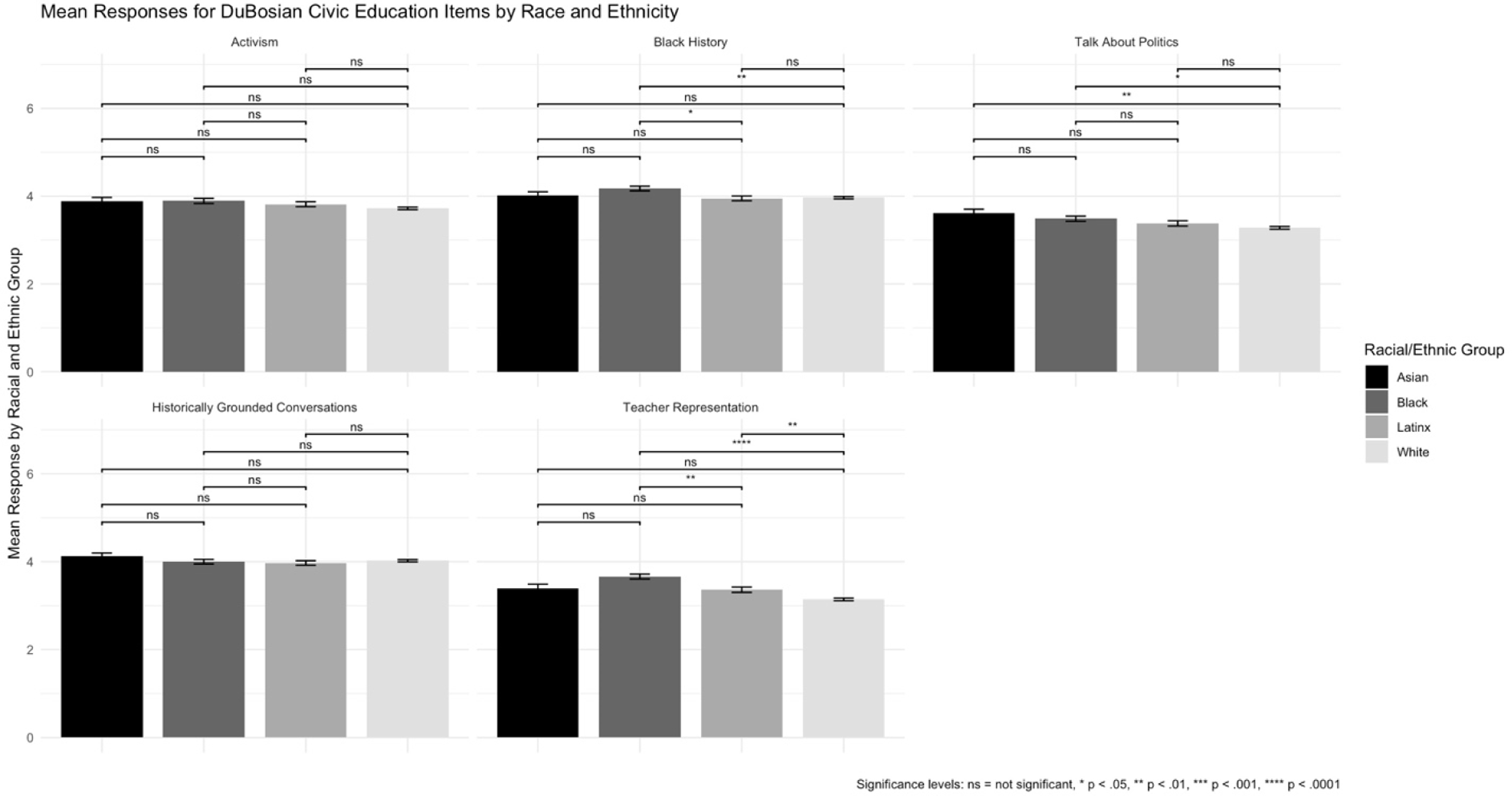
The pairwise comparison of means summarized in Figure 4 allow me to test H1: Black respondents, relative to Asian, Latine, and White respondents, will be more likely to support a DuBosian approach to civic education. Although means across racial and ethnic groups are fairly similar across the items, some statistically significant differences do emerge. Respondents across racial and ethnic groups express some degree of support for teaching about political activism (x̄ = 3.8). Although White respondents are the least supportive of this pedagogical intervention, no statistically significant differences emerge within the pairwise comparison of means using Bonferroni correction. Respondents are more supportive of teaching about Black history (x̄ = 4.0). However, Black respondents (x̄ = 4.2) are significantly more likely to support this intervention relative to both Latine (x̄ = 4.0; p < .05) and White (x̄ = 4.0; p < .01) respondents. Talking about politics proves less popular overall (x̄ = 3.3), again with Black respondents (x̄ = 3.5) significantly more supportive of this intervention than both Latine (x̄ = 3.4; p < .01) and White respondents (x̄ = 3.3; p < .05). Historically grounded conversations also receive some support (x̄ = 3.4) with no significant differences between groups. Support for ensuring that teachers reflect the diversity of their students receives the least amount of overall support (x̄ = 3.2). Black respondents are again most supportive of this aspect of a DuBosian civic education approach (x̄ = 3.7) relative to both Latine (x̄ = 3.4; p < .01) and White respondents (x̄ = 3.1; p < .0001). Latine respondents are also significantly more supportive of this item than White respondents (p < .01).
Comparison of means for DuBosian civic education items by race and ethnicity. Note: Proportion breakdowns for Figures 3–5 are included in Figures 2A–4A).

Figure 4. Long description
Panel A: A bar graph comparing mean responses for Activism by race and ethnicity. The horizontal axis represents racial/ethnic groups: Asian, Black, Latinx, and White. The vertical axis represents the mean response values ranging from 0 to 6. The bars are vertical and grouped by racial/ethnic group. The graph shows that the mean responses for Activism are relatively similar across all groups, with no significant differences indicated. Panel B: A bar graph comparing mean responses for Black History by race and ethnicity. The horizontal axis represents racial/ethnic groups: Asian, Black, Latinx, and White. The vertical axis represents the mean response values ranging from 0 to 6. The bars are vertical and grouped by racial/ethnic group. The graph shows that the mean responses for Black History are relatively similar across all groups, with no significant differences indicated. Panel C: A bar graph comparing mean responses for Talking About Politics by race and ethnicity. The horizontal axis represents racial/ethnic groups: Asian, Black, Latinx, and White. The vertical axis represents the mean response values ranging from 0 to 6. The bars are vertical and grouped by racial/ethnic group. The graph shows that the mean responses for Talking About Politics are relatively similar across all groups, with no significant differences indicated. Panel D: A bar graph comparing mean responses for Historically Grounded Conversations by race and ethnicity. The horizontal axis represents racial/ethnic groups: Asian, Black, Latinx, and White. The vertical axis represents the mean response values ranging from 0 to 6. The bars are vertical and grouped by racial/ethnic group. The graph shows that the mean responses for Historically Grounded Conversations are relatively similar across all groups, with no significant differences indicated. Panel E: A bar graph comparing mean responses for Teacher Representation by race and ethnicity. The horizontal axis represents racial/ethnic groups: Asian, Black, Latinx, and White. The vertical axis represents the mean response values ranging from 0 to 6. The bars are vertical and grouped by racial/ethnic group. The graph shows that the mean responses for Teacher Representation are relatively similar across all groups, with some significant differences indicated.
In sum, these analyses provide partial support for H 1 : Black respondents are significantly more supportive of three of the five DuBosian civic education items relative to both Latine and White respondents. Even so, the results also suggest fairly consistent support; majorities across each racial and ethnic group support content interventions examining political activism and Black history, perhaps reflecting broad agreement that young people should be exposed to different types of historical narratives within classrooms (Figure 2A). Historically grounded conversations also earn strong support across groups, whereas talking about politics in the classroom is less popular (Figure 2A). This may reflect concerns that classroom conversations allow teachers’ political viewpoints to enter the conversation or concerns that a student’s perspective opens them up to criticism from their peers. Hiring teachers who reflect the racial demographics of their students, however, proves to be the least popular aspect of the DuBoisian civic education scale, which may reflect Americans’ general hesitance to consider race in hiring processes (Gramlich Reference Gramlich2023; Figure 2A).
Support for a DuBoisian Approach to Civic Education across Partisan Groups
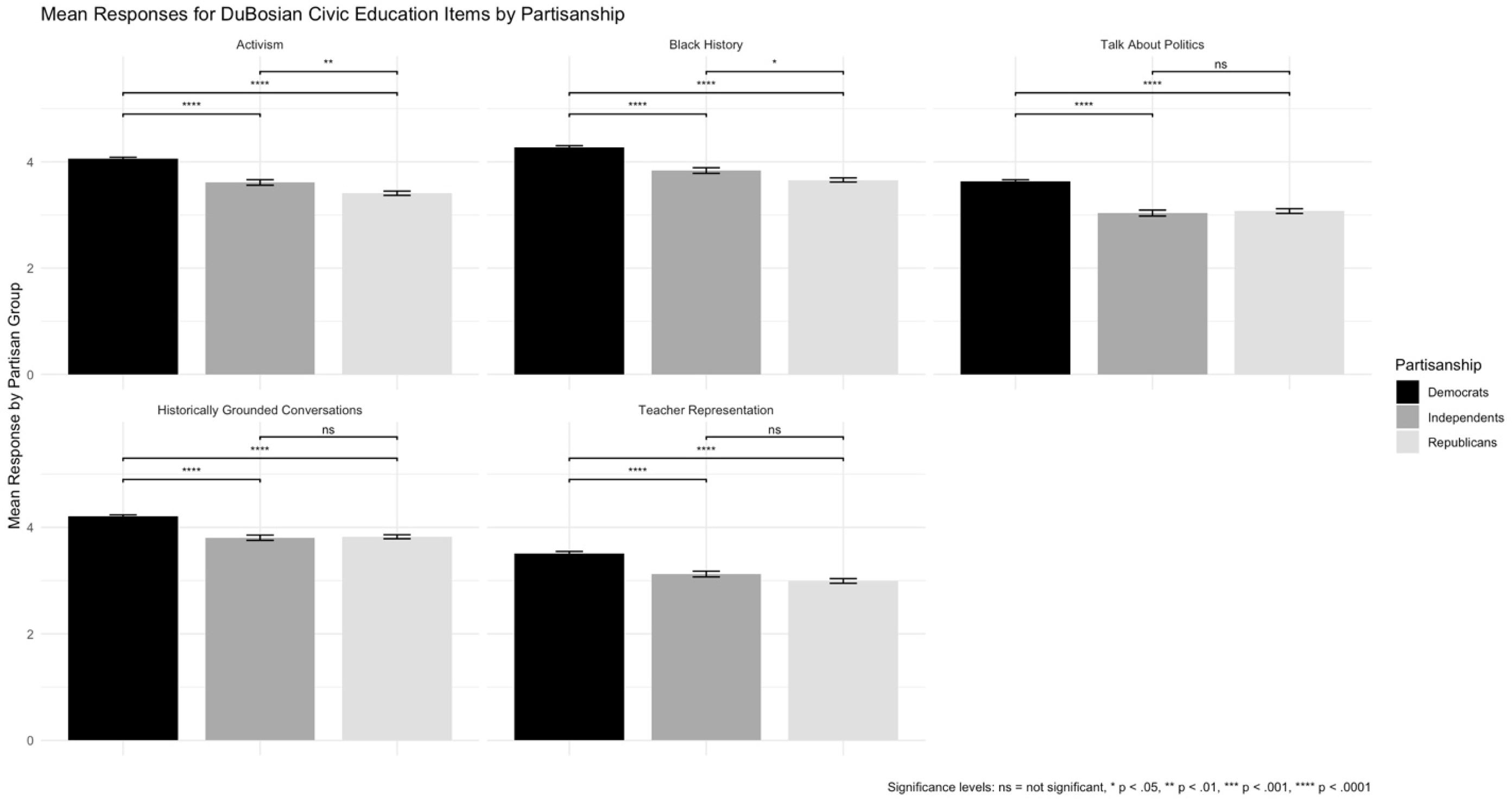
Next, I test H 2 : Democrats, relative to Republicans and Independents, will be more likely to support a DuBosian approach to civic education. I find strong support for this hypothesis across each of the items. As shown in Figure 5, Democrats (x̄ = 4.1) are significantly more likely to support teaching about political activism relative to both Independents (x̄ = 3.6; p < .0001) and Republicans (x̄ = 3.4; p < .0001). Independents are also more supportive of this intervention relative to Republicans (p < .001). Teaching Black history is also more popular among Democrats (x̄ = 4.3) relative to both Independents (x̄ = 3.8; p < .0001) and Republicans (x̄ = 3.7; p < .0001). Again, Independents are more supportive of this civic learning technique than Republicans (p < .05). Democrats are also more supportive of talking about politics in the classroom (x̄ = 3.6) relative to Independents (x̄ = 3.0; p < .0001) and Republicans (x̄ = 3.1; p < .0001). These relationships persist for historically grounded conversations about politics, with Democrats (x̄ = 4.2) expressing higher support than both Independents (x̄ = 3.8; p < .001) and Republicans (x̄ = 3.8; p < .001). Finally, Democrats (x̄ = 3.8) are significantly more supportive of hiring teachers that reflect student demographics relative to Independents (x̄ = 3.1; p < .001) and Republicans (x̄ = 3.0; p < .001). In line with the analyses by race and ethnicity, content interventions appear to provide the best opportunity for cross-partisan consensus, whereas considering representation in teacher hiring is the most polarizing issue (Figure 3A).
Comparison of means for DuBosian civic education items by partisanship.

Support for a DuBoisian Approach to Civic Education among Parents and Nonparents
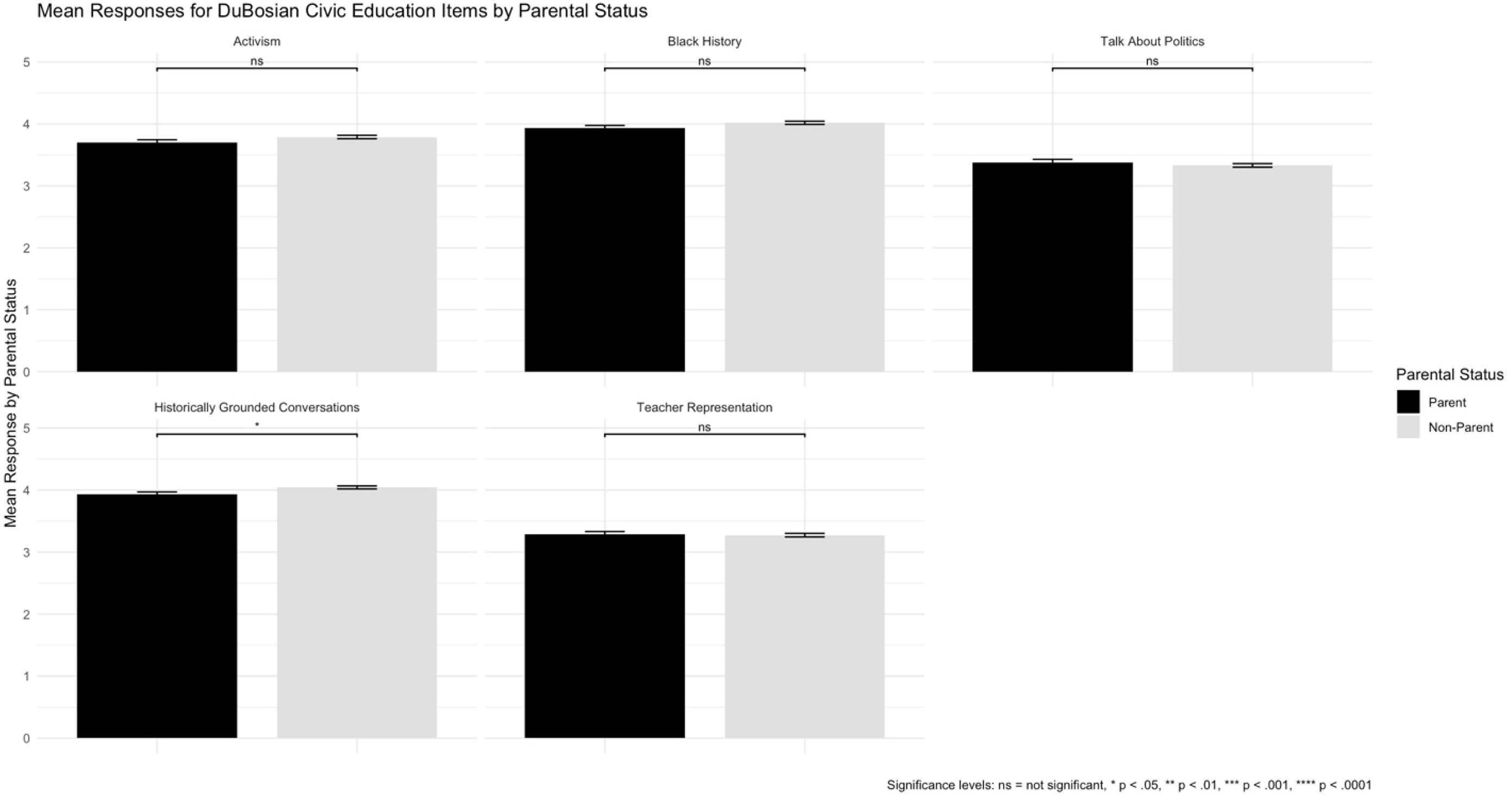
Next, I test H 3 : Nonparents, relative to parents, will be more likely to support a DuBosian approach to civic education. I find partial support for this hypothesis. As seen in Figure 6, although differences in means between groups are small, nonparents (x̄ = 4.0) relative to parents (x̄ = 3.9) are more likely to support historically grounded conversations about politics (p < .05). Differences between nonparents and parents are statistically insignificant for the other four items. Across each of the three subgroups analyses—race and ethnicity, partisanship, and parental status—content interventions highlighting political activism and Black history prove to be the most popular. Historically grounded conversations are also popular among parents and nonparents, whereas talking about politics is more controversial (Figure 3A). Similarly, although hiring teachers who reflect the demographic makeup of the student population is the least popular item of the DuBoisian civic education scale, parents are slightly more supportive of this intervention than nonparents (Figure 3A).
Comparison of means for DuBosian civic education items by parental status.

What Other Characteristics Are Associated with Support for a DuBoisian Approach to Civic Education?
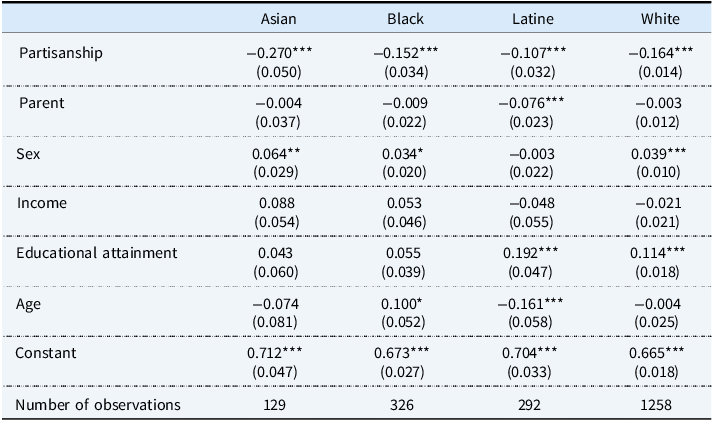
Although I present results from each question separately in the preceding analyses, it is important to note that the five measures for a DuBoisian approach to civic education scale onto an internally consistent measure (α = .79). Moreover, although examining subgroup breakdowns by race, ethnicity, partisanship, and parental status certainly provides a nuanced look into public opinion toward a DuBoisian approach to civic education, an additional OLS regression analysis presented in Table 2 highlights a more expansive list of covariates associated with support for Du Bois’ civic education philosophy within racial and ethnic groups.
Covariates of support for a DuBoisian approach to civic education

Table 2. Long description
The table presents data on covariates of support for a DuBoisian approach to civic education, categorized by race and ethnicity: Asian, Black, Latine, and White. It includes columns for each racial and ethnic group, with rows labeled for different covariates: Partisanship, Parent, Sex, Income, Educational attainment, Age, Constant, and Number of observations. Each cell contains a value with a standard error in parentheses. Notable trends include significant negative values for Partisanship across all groups, with the most substantial effect seen in the Asian group. The Sex covariate shows positive values for Asian, Black, and White groups, indicating a notable trend. Educational attainment has a significant positive value for the Latine group. The Constant row shows high positive values across all groups, with the Asian group having the highest constant value. The Number of observations varies, with the White group having the largest sample size.
Note: *p < 0.10, **p < 0.05, ***p < 0.01.
Consistent with existing work addressing public opinion toward education policy issues (Houston Reference Houston2024a), partisanship emerges as the most significant factor associated with support for a DuBoisian approach to civic education. This suggests that the “special status” of education policy—be it about school choice or civic education—may be beginning to buckle under the weight of political polarization (DeBray-Pelot et al. Reference DeBray-Pelot, Lubienski and Scott2007; Henig Reference Henig2013). Across racial and ethnic groups, identifying as a Republican is significantly and negatively correlated with the scale (p < .01). Although the descriptive data point to broad support for many of these pedagogical techniques and policies, polarization represents a major hurdle for building cross-group support for civic education reform. Similarly, among Latines, identifying as a parent or guardian of a K-12 student is negatively associated with support for a DuBoisian civic education approach. Thus, policymakers will have to consider how to best tailor policy messaging to win favor with distinct political constituencies.
The results also indicate that sex, educational attainment, and age are important factors to take into consideration when gauging public support for civic education policy initiatives. Asian (p < .01), Black (p < .01), and White (p < .01) women are significantly more likely to support a DuBoisian approach to civic education relative to men from those racial and ethnic groups. However, this gender gap does not hold true among Latines. One possible explanation for these gender gaps is that women tend to register lower than men on several measures of prejudice, including social dominance orientation (Pratto et al. Reference Pratto, Sidanius, Stallworth and Malle1994) and racial resentment (Kinder and Sears Reference Kinder and Sanders1996), and thus may be more open to racially inclusive approaches to civic learning. Among Whites (p < .01) and Latines (p < .01), higher rates of educational attainment are also positively associated with support for DuBoisian civic education measures. This may indicate that education contributes to greater openness toward content that emphasizes the histories and experiences of other groups, including African Americans. Age also appears to play a role in shaping public opinion toward these pedagogical techniques and education policies, albeit in different ways. Although older Black respondents are more supportive of a DuBoisian approach to civic education than younger Black respondents (p < .1), older Latines are significantly less supportive compared with their younger counterparts (p < .01). Differences in preferences among generational groups may reflect distinct processes of political socialization within racial groups that contribute to distinct expectations for educational policy changes. For example, older African Americans tend to be more supportive of affirmative action policies relative to younger African Americans, perhaps because they view it as a key victory from the civil rights movement (McCarthy Reference McCarthy2024). Similarly, older African Americans may be more supportive of a DuBosian approach to civic education because they are more familiar with the role that political education played in fueling civil rights era activism (Fernandez and McAdam Reference Fernandez and McAdam1988). In sum, those interested in building broad support for civic education reforms will need to be attuned to how preferences manifest differently across distinct constituencies within broader racial/ethnic groups.
Do Race and Parental Status Interact in Ways that Shape Support for a DuBosian Civic Education Approach?
Finally, I assess H 4 : Across racial and ethnic groups, parents that identify as strong Republicans will most strongly oppose a DuBosian approach to civic education. Figure 7 shows the plot of the interaction of parental status and partisanship on support for a DuBosian approach to civic education across racial and ethnic groups (see also Table 3A). I do not find support for this hypothesis. In fact, for both Asian (p < .05) and White (p < .01) respondents, I find that parents who are strong Republicans are significantly more likely to support a DuBosian civic education approach relative to nonparents who share the same racial/ethnic identity. However, given the limited number of parents within each subgroup sample, these results should be interpreted with a degree of caution.
Effect of parental status x partisanship on support for DuBoisian civic education.

Although this may be a counterintuitive finding in light of the conservative parental rights movement during the Trump presidencies, it aligns with existing public opinion studies that show that parents—those with the most “skin in the game”—may be more willing to support evidenced-based interventions, including those associated with a DuBosian approach to civic education, even when it conflicts with partisan cues (Houston Reference Houston2021; Kogan Reference Kogan2025). Future research should continue to assess whether parenthood has a depolarizing effect on K-12 educational policy preferences, particularly among Republicans.
Conclusion
This article presents a DuBosian approach to civic education—one that prepares young people to navigate an imperfect democracy characterized by racial inequality and exclusion. Such an approach marks a meaningful departure from traditional K-12 civic education initiatives, which commonly take the proper functioning of American democracy as a given. Writing in the wake of the end of Reconstruction, Du Bois recognized the important role that schools could play in preparing Black children to navigate and transform politics. I contend that Du Bois’ vision for democratic education was distinctive among his contemporaries—including those also involved in racially progressive organizations such as the NAACP. Unlike Dewey, Du Bois recognized that public schools could simultaneously foster democracy and reinforce existing racial hierarchies. Similarly, although certainly critical of public schools, Du Bois was arguably more optimistic than Woodson—a fellow champion for the teaching of Black history—in viewing democratic education as a means of challenging racial inequality.
Drawing from Du Bois’ writings, the secondary literature examining his scholarship, and contemporary research addressing best practices in K-12 civic education, I argue that a DuBoisian approach to civic education has a proven track record of fostering democratic capacity among young people, and racially marginalized youth in particular. Such an approach consists of three components: racially inclusive content that addresses the democratic importance of political activism, in-class conversations about politics, and training racially diverse cohorts of K-12 educators. Although this research provides strong empirical evidence for supporting a DuBosian approach to civic education, gauging public sentiment for these interventions can also provide helpful information for civic education advocates and policymakers.
Leveraging a national survey of over 2,000 respondents, I also consider whether there is public support for a DuBosian approach to civic education. Black respondents and Democrats are the most supportive of these interventions, but the analyses show that majority of respondents across racial, ethnic, and partisan lines, including many parents, support central tenets of this approach to civic education. Teaching about Black history and political activism and engaging in historically grounded conversations about politics are particularly popular. Meanwhile, talking about politics in the classroom and ensuring that the ranks of K-12 educators are as racially diverse as the students they serve are more controversial. Although these public opinion data provide a snapshot of public support for civic education, questions remain about the feasibility of implementing these policies. As the writings of Du Bois and his contemporaries demonstrate, revitalizing civic learning necessitates deep reflection both about how we select content and how we recruit and train teachers.
During the Trump Era, racial conservatives employed imprecise critiques of CRT to sow public distrust in racially inclusive approaches to civic education. However, the survey data presented in this paper suggests that broad subsets of Americans across racial, ethnic, partisan, and parental divides may be supportive of a DuBosian approach to civic education, especially pertaining to content. As debates over K-12 civic education content and CRT become more central to contemporary American politics, policymakers can leverage Du Bois’ observations to chart a strategic path forward; one that centers the importance of democratic education for the nation’s most marginalized children, acknowledges the challenges facing American democracy, and invokes precise language about the pedagogical techniques that are actually effective.
Supplementary material
The supplementary material for this article can be found at https://doi.org/10.1017/rep.2026.10102.
Funding statement
This study was funded by the University of Miami.
Competing interests
None.





 Open access

