In the vast historical literature on early modern state formation, especially in the subfields of state finances and state bureaucracy, gender is a relatively neglected category of analysis. This is perhaps because of a seeming lack of women in this sector, both back then and in the modern period. However, this is not a valid reason. This article argues that women – and gender – played a crucial role in the formation of the early modern state. And, of course, in an all-male context gender is also important, the lack of women also requiring explanation.Footnote 1 Focusing on Sweden in the sixteenth century, this article examines how gender relations affected state formation, and vice versa.Footnote 2
The sixteenth century was a transformative period in Europe, connecting the medieval realm, based on fief-holding nobles (läntagare), and the early modern fiscal-military state. In Sweden, the transition started rapidly in the 1520s, and by the 1620s Sweden had become one of the most efficiently organized fiscal-military states in north-west Europe. Its efficiency lay in the state's organizational capability to mobilize and transform human and material resources. The crucial point for early modern states was not the amount of resources at their disposal, but rather their capability to use those resources.Footnote 3 The political importance of the family in medieval society is well known.Footnote 4 However, its role in the emergence of the fiscal-military state is much less appreciated.Footnote 5 Even the better-developed study of female rulers and women at court only illuminates the role of women at the very top of early modern society.Footnote 6
Research within the field of state formation has long tended to focus on developments at the political centre. However, the last two decades have seen the development of a new type of research focusing on the relation between and integration of centre and locale. In this literature, the process is often described as a negotiation between different groups, and the state is seen as a network of different actors, not as a single entity. Steve Hindle's words that ‘historians of state formation must take account not merely of political or institutional innovation, but also of social, economic and cultural developments' are an important starting point.Footnote 7 Up to now, this new branch of state formation research has above all studied the relation between local arenas, such as law courts, and local elites and the growing central state. This research has been concerned primarily with taxation, legislation, and social regulation and control.Footnote 8 Gender has seldom been a major subject in these studies, especially not perspectives concerning how gender structures affected state formation.Footnote 9 Although there are some seminal studies which have been devoted to aspects of gender regarding state formation, these have had other concerns. The first focus is the relation between families, and their male and female members, and the state. Scholars such as Sarah Hanley and Julia Adams have stressed how important the family was for the power systems in early modern Europe.Footnote 10 Recent studies have also shown how important a family, and especially a wife, was for civil servants to meet their obligations.Footnote 11 A second focus area deals with families as the subjects of early modern states: on ordinary families and households and their use of, and interaction with, the state through institutions such as law courts, and on how different aspects of gender played crucial roles in these relations.Footnote 12 Very few studies take an interest in situations where women outside of the elite were directly involved in the affairs of the state or other institutions connected to the state.Footnote 13 But it is interesting to study these situations in which women held positions within the state because they were regarded as legitimate and rational in one historical context, but not in another. As long as forty years ago, Charles Tilly emphasized the importance of a prospective analytical perspective when studying the state formation process.Footnote 14 Taking an interest in the role of women within the early modern state is one way to avoid a retrospective perspective.
Heeding the call to study the social and cultural sides of state formation and forms of state organization that did not survive to modernity, this article examines how the system for organizing the allocation of resources created by the Swedish state was formed in relation to, and in interaction with, contemporary local society. By looking at one particular form of local administration and economic production – royal demesnes and estates – this article nuances and broadens our understanding of the early phases of the fiscal-military state, and shows that notions about gender and especially the gender division of labour were important for the organization and further development of the state in its endeavour to mobilize and transform resources. What follows argues that gender division of labour and traditional ways of organizing work and administration played a crucial role in the first phases of early modern Swedish state formation: that women's work affected the organization of the state. For the women involved, there was a window of opportunity to reach relatively high positions within the state apparatus and to make a living when the organization of the state was in a transformative phase. But this article also shows that the window of opportunity was disappearing at the end of the sixteenth century, and seeks to explain why this was the case.
I
When the union of Kalmar between the Scandinavian realms of Sweden, Denmark, and Norway was dissolved in 1523 with the election of Gustav Vasa (a Swedish nobleman and leader of the uprisings against the Danish king of the union Christian II) as Swedish king, a great reform and expansion of the Swedish state apparatus began. The new regime had to increase its income to pay debts to the Hanseatic city of Lübeck that had lent it money to finance the war against the king of the union. The new Swedish king also attempted to strengthen his position against the Swedish high nobility, who held a strong position vis-à-vis the king. During the earlier era of the union of Kalmar, the Swedish high nobility had strived for, and often achieved, a strong position within the realm in relation to the union kings that during the late fifteenth century had a hard time maintaining their rules in Sweden. Fifteenth-century Sweden can be characterized as an aristocratic republic, and the new king had to act in relation to that.Footnote 15
Gustav Vasa was not the only European prince with financial problems in the early sixteenth century, and not the only one who tried to solve them by a new kind of state organization. A problem often present for late medieval and early modern European princes was the discrepancy between income and expenses, both with respect to size and to form. Revenues in the form of taxes fixed at certain levels and often in kind, and then fixed as certain goods, could not meet the dynamic increase in state expenses ensuing from changes in warfare and from the growth in the local and central state apparatus.Footnote 16 In the Swedish case, the greatest part of the tax revenues was in kind, in the forms of grain, butter, iron, copper, fish, and so on. These products had to be transformed into cash or people, for example soldiers, to be useful to the Swedish crown. To achieve this transformation, the crown could use different strategies. One strategy was to negotiate with taxpayers to transform the taxes in kind to cash before they were collected. Another strategy was to use the products at the place where they were collected. The prince could move around the realm with his escort and consume from the storehouses at the different castles and local bases. An alternative to this sort of peripatetic kingship was to place military troops and other servants of the king, such as bailiffs (fogdar), at these places and let them consume the goods collected. To place bailiffs and troops at royal units around the realm was also a way to strengthen and manifest the presence of the state in the local communities, which on several occasions opposed many of the innovations that were introduced by the regime: the Reformation, especially the fiscal drainage of the church's resources, and higher taxes. The presence could mean military force, but more often entailed negotiations between the royal bailiffs and the people in the local law courts.Footnote 17
A fourth, more complex, way of managing the taxes in kind was to transform the revenues into more valuable or useful resources at a central level: to commercialize them. This was done by the Swedish state in the mid-sixteenth century, when warehouses were set up at which taxes in kind were collected, stored, and sold in the domestic or international market by merchants employed by the state.Footnote 18
Aside from taxes, the most important sources of income for the Swedish state were rents from crown land and incomes from state-controlled silver and copper mining in Sala and Falun.Footnote 19 During the Swedish Reformation and the fiscal reforms connected with it, all church land was confiscated by the crown; consequently, in the mid-sixteenth century, nearly one third of all land in Sweden belonged to the state.Footnote 20 The greatest share of the crown lands was cultivated by tenants, but some of it was held and cultivated by the crown itself, as crown demesnes. The system of demesnes was given higher priority by the Swedish government after the war with Russia in the 1550s. During the war, it had been impossible for Swedish troops to buy provisions in the border district between Russia and the Finnish part of the Swedish realm; there was no market for food and other supplies. To avoid a similar situation in the future, a system of royal estates was organized in both the Finnish and Swedish parts of the realm.
During the reign of Gustav Vasa (1523–60), the crown began to show a greater interest in developing and increasing its incomes from the crown domains; the land cultivated by the crown itself increased and the crown became more involved in the mining industry and began, as mentioned above, to trade nationally and internationally with products from farms and mines.Footnote 21 This increasing interest in managing the crown domains was not only present in Sweden, as a consequence of the problems with supplies during the wars with Russia. The same processes have been studied in Denmark, Austria, and in a number of German principalities.Footnote 22 Richard Bonney has described it as a process from a primitive domain state towards an entrepreneurial domain state in which several central and northern European states took part. The driving force of this development was the increasing costs caused by the higher level of aggression in the relations between the European states. Higher expenditures forced princes all round Europe to find new ways to increase their incomes. Princes who did have substantial incomes from domains began to develop organizations and strategies to increase them and handle them in a more efficient way.Footnote 23 For Sweden under Gustav Vasa, the main motivation to increase income was to strengthen the state's defence against domestic and international opponents, not to make aggressive warfare.Footnote 24
In previous studies of the domain state in Scandinavia and continental Europe, the main focus has been on the princes and their central governments and financial policies and the shift from domain state to tax state.Footnote 25 A similar focus has also been prevalent in studies of the large estates of the English crown, which made up a considerable part of its incomes during the sixteenth century.Footnote 26 Very few, if any, studies have paid any attention to the landed estates, the mines, and the people who worked there and what impact these organizations had on the relationship between centre and locale, and on the people working for the crown.Footnote 27
Along with the transformation of state finances, changes also took place in the administration of the Swedish state apparatus. At a central level, efforts were made to create a formalized central administration with separate councils that were given different areas of responsibility. A chancery and an exchequer were organized based on German prototypes. The all-male members of the two councils were to be recruited from the aristocracy and were meant to possess high collective authority.Footnote 28 The implementation of these reforms went slowly, and was not completed until the beginning of the seventeenth century. This is a process that can be described as a first small step toward a bureaucratization of the state administration, and similar steps were taken in many countries all over north-western Europe in the sixteenth and seventeenth centuries.Footnote 29
Viewed in European perspective, the most radical Swedish processes were the reforms of the state's local administration. As in many other parts of Europe, the local administration was dominated by the local elites. Large parts of the realm were held as fiefs by the domestic or (during the union of Kalmar) German or Danish nobility. The king and the central government had no control of the local administration, which was not at all connected to the central one.Footnote 30 This gave the elites a strong position vis-à-vis the king. Even if the Swedish fiefs (län) never became inheritable, as in other parts of Europe, the noble families tried to keep them within the families and the entire household was involved in the administration of the fiefs. This sometimes led to situations in which women, most often widows of enfeoffed noblemen, managed fiefs and even led the defence of castles in enfeoffed areas in cases of war. The Scandinavian context has been studied by Grethe Jacobsen and Anu Lahtinen, who have argued that this situation was caused by the combination of two varieties of power and authority that existed in late medieval and early modern Europe. An older system based on kin and family enabled women to possess power and authority. A newer system, based on legal authority and state institutions, emphasized male authority. In late medieval and early modern Scandinavia, this combination of family-based power and institutional power gave women a chance to be active within the state.Footnote 31
A similar situation seems to have prevailed in England in the same period. Because of the great significance of the household for the elite's exercise of power and authority, women, as mothers, sisters, and especially as wives, had an opportunity, and were expected, to become heads of households.Footnote 32 Jeri L. McIntosh has argued that ‘England was governed by households – from the royal one in London to the vertical and horizontal network of households spread across the land like fine mesh.’Footnote 33 In this way, women were able to exercise power in a strongly patriarchal system. McIntosh defines the household as constituted by ‘personal and economic relationships' between the householder and other dependent members of the household such as kin and servants.Footnote 34
During the reign of King Gustav Vasa, a large local administration was organized in most parts of Sweden directly under the control of the central administration in Stockholm. The king and his successors thus managed to reduce the dependence on traditional local elites and established a direct contact with the largest source of income for the Swedish crown: the freeholding peasants (skattebönder).Footnote 35 The king's stronger control of the local administration, and the correspondingly weaker control by the traditional local elites, also led to a decline in importance for the noble household and the loss of the opportunity for women, as widows, to become holders of fiefs.Footnote 36 Instead, the corps of royal bailiffs (fogdar), recruited among common people and paid by the state, grew from 38 (in 1525) to 223 (in 1560), and new administrative districts (fögderier) were formed.Footnote 37 The royal bailiffs were responsible for the collection of taxes and other state revenues, and they were also in charge of upholding order and protecting the state's wider interests in the local community.
As mentioned earlier, the process of change in state finances and the changes in the state apparatus were closely connected. The intense interest in controlling the revenues created a need to reform the local organization. In addition to its interest in taxes, the state also became more interested in the incomes from crown land and from mining. Royal estates, or demesnes, were set up and bailiffs were placed there to organize agrarian production and mining.
The bailiffs were in some cases responsible for both an estate and an administrative district and in other cases the post was split between two bailiffs depending on the sizes of estates and districts. These estates were created to increase the state's income, but also to strengthen the presence of the state in local communities. Alongside the positions as bailiffs, other opportunities for employment were created in this process of growth. First, the local organization needed clerks, scribes, and other assistants and servants to the bailiffs. Second, agrarian production and the mining industry also needed labour, for example to plough fields, make cheese, and mine ore, and to repair and make the tools needed at the estates. People were also needed to produce goods such as shoes and clothes that were used as wages in kind. A third sector that required labour was the service sector, which included cleaning, laundry work, serving at tables and different forms of care.
The expansion of the Swedish state apparatus was ongoing during the entire period from 1523 to 1620, and the numbers of civil and military servants employed by the Swedish state rose tremendously. In the year 1523, the people annually employed by the state can be counted in the low hundreds. In 1582, 4,854 persons were annually paid by the regional state administration. At the central level, including the court, we find another 1,000 persons, and in the domestically recruited army we find another 13,500.Footnote 38 In addition to annually hired personnel, thousands more people were paid by the crown for shorter periods. This makes roughly 20,000 persons who were more or less dependent on the crown for their incomes in a state with 600,000 to 700,000 inhabitants.Footnote 39 The crown needed to recruit and pay 20,000 persons who possessed adequate skills for serving the state in many various ways – from administrating tax revenues to spinning yarn for clothmaking. A considerable number of these people were women, especially at the estates and in agrarian production. The recruitment and hiring of persons took place in local communities by bailiffs after instructions from the central government.Footnote 40 The bailiffs had to adopt recruitment and employment to suit local circumstances and customs. A negotiation took place between the bailiffs and the possible employees. The potential employees held different positions in relation to the bailiffs based on how strong the demand was for their labour within the crown, their skills, and their broader position in the society, for example in terms of gender and social status.
The crown estates were multi-functional: they were units of production, units for collection of revenues and military strongholds. As a consequence, people doing administrative tasks, people performing military services, and people involved in the economy lived and worked together, and everything took place within the organizational structure of the state. This makes the Swedish case special in a European sixteenth-century context. In many other European realms, the local administration was in the hands of the local gentry and the people that they employed cannot be seen as state employees. In comparison to the Swedish case, their daily practices were not located within the state organization.
The organization of the demesnes was functional under the condition of defensive warfare and a non-expansive foreign politic. During the reign of Gustav Vasa's sons Erik XIV (1560–8), and John III (1568–92), foreign policy became more expansive, and Sweden started to wage war in the Baltic region. John III in particular attempted to transform the façade of the Swedish realm into a modern European renaissance state, and spent a lot of money on building and improving castles and estates. Both the warfare and building demanded cash, and the system of subsistence economy that was the base for the demesnes became ineffective. To secure a steady flow of cash into the treasury, large parts of the demesnes were leased out primarily to the nobility.Footnote 41 This process can be placed within the framework of an economic doctrine which implied that states should not trade and run production, a doctrine that became prevalent in north-west Europe in the late sixteenth century.Footnote 42 However, in this article focus will be on the period before the leasing.
The process of organizing and reorganizing the local administration and the setting up, and leasing out, of farms and mines, recruiting staff, and paying them is quite unique in another aspect as well. The growing Swedish state felt the need to document the process and was able to do so. The records from hundreds of estates, mines, and other units of the crown have been preserved.Footnote 43 The records contain accounts on the production at the demesnes, the revenues collected, and the wages paid out, and in many cases the correspondence between the estate management and the central government.
Moving from the general picture of the Swedish state formation process, we will now look more closely at how the demesnes were organized in practice.
II
How could the Swedish crown recruit all the people they needed? A factor that was especially relevant for the female employees was that the crown was also needed by them. It can be argued that the crown could offer them something they wanted. The expansion created new opportunities for work, and access to different kinds of resources in various amounts for the employees. Wages gave cash and goods, and those hired annually were often given bed and board, which meant shelter and protection. Employment could also provide skills and authority that strengthened the employed person's position in society. Mats Hallenberg has shown how the position of bailiff provided the holder with the possibility of both a good income during the service and a good career after the service ended.Footnote 44 An employment for a woman as an estate housekeeper (fataburshustru) or a dairywoman (mjölkdeja) gave her new opportunities and access to new resources. For instance, these women were sometimes given different types of crown revenues and even donations. Examples of this are Anna and Kerstin, two housekeepers from the 1530s. Hustru (wife) Anna, housekeeper at Gripsholm, was given the revenues from two hamlets in the rural parish of Erikstad and from a plot in the town of Västerås in 1536. Hustru Kerstin, housekeeper at the castle in Stockholm, was given a stone house in the middle of the town by King Gustav Vasa.Footnote 45 For the women at lower levels in the organization of the crown, the work brought other benefits. They were given a wage that was partly in kind, mainly clothing, and partly in cash. But the most important material outcome was bed and board. When wages and food are combined, board stood for 75 per cent of the total value of the salary for a majority of the servants at the demesnes.Footnote 46
Inspired by Amartya Sen's concept of capability, Richard Smith has pointed out that service could strengthen a young woman's capabilities within the Western European marriage pattern: ‘entry into service for the female of the late fourteenth and early fifteenth century…may have enhanced her “capabilities”, her choice-set, and her well-being in the broadest sense’.Footnote 47 A parallel view of the consequences of work for young women is pointed out by Tine de Moor and Jan Luiten van Zanden in their article ‘Girl power’.Footnote 48 The situation for the women employed by the crown, housekeepers as well as maids, can be interpreted in a similar way. Working for the crown gave them money of their own and a position outside the family, two aspects often emphasized when valuing women's bargaining position.Footnote 49
As has been convincingly argued by Jane Humphries and Carmen Sarasúa, constraints are often the most important factor for determining women's labour force participation in historical and contemporary societies. In most cases, women wanted to work and contribute to their families' economies, but in many cases, social and legal restraints limited their opportunities to get a job.Footnote 50 The special situation created in Sweden by the expanding state and by the mixed form of domain and tax increased the demand for women's work, and offered opportunities for women in the sixteenth century. Unlike earlier periods, these women were not primarily associated with the crown because of their husbands' work for the crown, but were employed in their own right. Next, we will look at why women were needed within the crown, but also why they disappeared.
III
In the course of the sixteenth century, the growing central administration was marked by a higher degree of specialization and formalization. It also began to show some characteristics of proto-bureaucracy, for example formal hierarchies, written instructions, and written documentation and archives. At the very least, the ruling kings were trying to reform their administrations in a proto-bureaucratic way.Footnote 51 The role of the nobility decreased, and non-noble civil servants came to dominate the central administration. One consequence of this development was that the opportunities for noblewomen to take part in their husbands' services to the crown diminished. But there was no independent bureaucracy. In contrast, everything done within the administration was strongly dependent on the king, and the bonds between the court and the administration were weak and in many cases even non-existent.Footnote 52 The relations between the king and the staff were still personal, typical of a feudal administration.Footnote 53 The local administration partly followed the same pattern, but there were some important differences.
The organization of the local administration in the royal demesnes can be interpreted in two different ways. On the estates, the bailiffs held the highest position. They were bound to the king by oath, and had an overarching responsibility towards the king for the running of the estates. Management and administration of the estates can be viewed as a male organization centred on the bailiff and his clerks or scribes (skrivare), under-bailiffs (underfogde), and other administrative servants (fogdetjänare). This is the picture often given in previous research, and contributes to an image of a linear development of an all-male state organization.Footnote 54 The leadership and administration of the estates is seen as a miniature version of the central all-male proto-bureaucratic administration.
But when scrutinized, the records, instructions, and letters from the crown can also be interpreted as another type of organization, modelled on the household with a man and a woman in leading positions. For instance, Niels Arfvedsson was appointed bailiff (fogde) at a royal demesne in the Swedish province Östergötland in 1544. In a letter with instructions from the central administration, he was told to employ his wife as housekeeper (fataburshustru) at the estate and to let her manage the sector of the demesne that ‘belonged to her’ (thenn deel henne bör). The letter ended with an exhortation directed at both the bailiff and his wife saying that, to avoid disgrace, they should obey this and further instructions.Footnote 55 Similar instructions are to be found in instructions to other bailiffs.Footnote 56 Both Niels and his wife were explicitly addressed in the letter. She was given a leading position on the estate in her own right, not just as wife to the bailiff. This conclusion is further strengthened by the fact that she was individually salaried by the crown, not together with her husband, the bailiff.
The bailiff's and the housekeeper's leading positions are also evident from the records of the estate. In most cases, they were the first two persons to be mentioned in pay rolls, and in lists of people served food at the estates (mantal).Footnote 57 In some cases, the sexes were recorded separately, first the male employees and then the female employees. In these cases, the bailiff was at the top of the listed men and the housekeeper at the top of the listed women.
The men that served in the administration under the bailiff, for example scribes and under-bailiffs, were instructed to be directly and indisputably subordinated to the bailiff. In contrast, the housekeeper was often described as more independent; she was to be responsible for the parts that ‘belonged to her’. Per Brahe, a Swedish nobleman who served several of the Vasa kings, wrote in his instructions for a noble household that the housekeeper was to manage and lead the work concerning ‘womenfolk's work’ (Quinfolckz gärningar). Brahe enumerated a vast number of different tasks belonging to women regarding production, for example of textiles, leather, and beer, management and supervision of the female labour, and the responsibility for household goods.Footnote 58 The relation between the bailiff and the housekeeper can therefore be characterized as co-lateral rather than as a relation between persons of different ranks, and in some crucial aspects it shared common features with a married couple in a household: marital status was important for each person, the two persons were of different sex, and they had both authority and different but overlapping areas of responsibility. The bailiff and the housekeeper were metaphorically the master and mistress governing a household.
The Swedish word used for the housekeeper, fataburshustru, is a compound of three words: the Old Swedish fatw, which means clothing, bur, which means storehouse (cf. Eng. bower), and hustru, which means wife or housewife. This etymology further strengthens the image of the household as the organizational model.Footnote 59
The early modern household was a strongly hierarchical organization. Both the relation between husband and wife and the relation between them and the other members of the household, were characterized by clear notions of superiority and subordination. These hierarchies were based on gender, marital status, age, and ownership.Footnote 60 For early modern England, Barbara Harris and Linda Pollock have described the relationship between aristocratic women and their husbands and male relatives as characterized by a special form of agency, subordinated agency.Footnote 61 The concept can also be used to describe the relation between the bailiff and the housekeeper (fataburshustru) in the Swedish case. The housekeeper was subordinated to the bailiff, but with a high degree of agency in the fields described as ‘womenfolk's work’.
In her study of orphanages in early modern Dutch cities, Ariadne Schmidt shows that these institutions had the family, or the household, as a model for their organizational structure. In these social institutions, a ‘father’ and a ‘mother’ and their staff gave care to orphans and the poor. Schmidt writes that ‘the work demanded the cooperation of both spouses' due to the prevailing gender division of labour and the strong connection between childcare and women/mothers and between economy and men/fathers.Footnote 62 Schmidt's words also make sense in the Swedish context. Due to the gendered division of labour in early modern Sweden, the different kinds of work performed on the estates demanded the participation of both male and female labour forces, in both manual work and management. Women were needed, among other things, to cook, brew, and weave but not least to manage other women's work. However, the aspect of childcare that Schmidt emphasizes in her explanation of the choice of the household as organizational principle, and the participation of women, was not present at the royal demesnes. Childcare was obviously not a major business at the crown units.
The royal demesnes were neither family-based households nor proto-bureaucratic organizations. They were a mixture of both, brought about by a need to increase and secure the incomes of the crown, an adaptation of the prevailing gender division of labour and the household as the dominant organizational context for work.Footnote 63
IV
At the centre of the household were the married couple. In the sixteenth-century Swedish royal estates, marital status was an important component in the organization and remuneration of work. In historical studies of modern society, marriage has been seen as an important factor preventing women from entering the labour market. The roles as mother and wife were not, it is argued, possible to combine with work outside the household.Footnote 64 For the early modern period, historians have instead pointed to the great importance of marriage for women's possibilities of making a living. Alice Clark and many after her saw the creation of a new household and a new unit of work and production in connection with marriage as positive for women's possibilities – the wife became a part, or an assistant, in her husband's trade.Footnote 65 In the organization of the sixteenth-century crown estates marital status also played a crucial role for both women and men.
The couples at the head of the demesnes, the bailiff and the housekeeper, were always married people. Sometimes, they were married to each other, as in the case with Niels Arvidsson and his wife in Östergötland, but in many other cases they were not. On the estate of Bro in the province of Värmland, the bailiff Anders Hansson's wife hustru Britta was recorded as a guest at the estate a couple of days per year, while at the same time hustru Karin was serving as housekeeper at the estate together with the bailiff.Footnote 66
A parallel can again be found in the ‘fathers’ and ‘mothers’ at the Dutch orphanages who were always married men and women. For the period prior to 1800, Ariadne Schmidt notices that ‘orphan parents were quite often not married to each other’.Footnote 67 Also on the Swedish demesnes the man and woman in the leading positions were not always married to each other, but they were almost always married.
That the housekeeper and bailiff were often not married to each other is important for understanding what work and marital status meant to these women serving as housekeepers for the crown. If married couples had routinely been used as leaders of the estates, it would be theoretically possible to interpret the situation as one where the crown sought men with bailiff skills and got the wives in the bargain. But as married women served the crown at demesnes where their husbands did not work, their work must be seen as having been valued in its own right by the crown, not as a complement the crown received when it hired a bailiff. The crown hired a married woman to be housekeeper because it needed the particular skills of a housekeeper, and not all bailiffs' wives had those skills.
But why was the housekeeper always described as married? Instead of only signalling a connection, or bond, to a certain man, marital status and the title hustru also bore many other semantic components in early modern Sweden and Europe, as has been shown by Merry Wiesner for Germany and Daniel Abreu-Ferreira for Portugal.Footnote 68 These components were decency, honesty, knowledge, and the capacity to govern, and they were generally expected to be found in a married woman in Western Europe. In a marriage pattern like the one described by John Hajnal and further elaborated by Peter Laslett and newly highlighted by Jan Luiten van Zanden and Tine de Moore, marital status, adulthood, and the capacity to take care of one's self and others were connected with each other.Footnote 69 It was these components the crown eagerly needed and sought when it employed married women. Female knowledge and leadership skills were essential for the organizing and running of the estates and the state. Thus, the wife-title does not always signal attachment to a man; it could also mean a woman capable of governing.
The general interpretation of men's and women's titles is that a man's title was connected to work or to social status, whereas a woman's title suggested marital status and her bond to a man.Footnote 70 It is often assumed that the title of wife (hustru) was used primarily to signal the married woman's tie to a certain man, her husband. Similarly, an unmarried woman had a tie to her father expressed through the patronymic name.Footnote 71 If we scrutinize how the word wife was used in early modern Sweden, however, this general picture can be questioned, as it has been for other parts of Europe.
One important factor to bear in mind when studying titles, and especially titles of marital status, is in which context the documentary source was produced. One of the most common sources used by historians studying social and cultural history is court records. In many European countries, the legal position of women was weak, and they were often represented in a court of law by their husbands or other male guardians. This may have led to an ‘overuse’ of titles suggesting bonds to a special man. It is therefore valuable to look into other types of sources to see if the same pattern appears outside the special context of the courts.
To use the household as an organizational model was not unique for the Swedish crown; orphanages in both Holland and Sweden were organized in this way too.Footnote 72 The nobility all over Europe also used the household model when managing its own properties and the state's. But there were two important differences between the use of the household by the nobility and by the Swedish crown: family and property. One major reason for the nobility to use the household model was to keep property within the family, and to secure and guard its own resources of power when other institutions were weak. This is why we find women as holders of fiefs and as heads of noble households. For the crown, the need to keep property within the family was not a reason to use the household as an organizational model. Instead, the choice must be understood in relation to the society the crown expanded within. Sweden was a society in many ways organized according to the household model, and when the crown needed labour to perform work at the units and manage them, they needed to use this well-known format, especially in a situation where the crown needed both men's and women's work. In these types of household-based hierarchies, marital status, and the title hustru, was important in relations both between women and between women and men.
The expanding Swedish state was dependent on the labour of both men and women when organizing the entrepreneurial domain state. But the expansion of state administration and the many large new units of production and work run by the state also affected the gender division of labour. This process will be analysed next.
V
In the mid-sixteenth century, the crown was running more than one hundred estates in the realm.Footnote 73 The staff on the estates comprised between twenty, at the smallest units, and up to more than one hundred annually hired persons at the biggest units. In addition, casual labour was used in the harvest and other labour-intensive periods. In this article, the main focus will be on the annually hired staff.
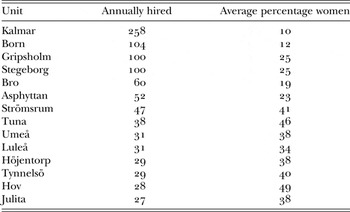
The gender ratio on the estates varied considerably. At the castle in Kalmar, on average during the period 1539 to 1610, 10 per cent of 258 annually hired persons were women; on the estate of Hov the corresponding number was 49 per cent of 28 annually hired.Footnote 74 These two units were parts of a more general pattern: small units had proportionately more female employees than larger units (Table 1).
Average number of annually hired persons and the share of women, 1539–1610

Source: Riksarkivet Värmlands handlingar 1571–6; Dalarnas handlingar 1545, 1547, 1548, 1550, 1557, 1569, 1571–91, 1598; Södermanlands handlingar 1539, 1545, 1553–6, 1559, 1561, 1562, 1569, 1571–5, 1578, 1581–1610; Västergötlands handlingar 1564, 1566, 1567, 1572, 1573, 1576, 1578, 1580, 1582–6, 1588–90, 1600–2; Smålands handlingar 1539, 1541–64, 1566–87, 1590, 1591, 1600; Västerbottens handlingar 1558–63; Östergötlands handlingar 1558, 1559, 1560, 1561, 1563; Strödda räkenskaper och handlingar t.o.m. 1630 Löningsregister.
The phenomenon of a lower proportion of female workers in larger organizations has been noticed by Christopher Middleton for English medieval estates. He sees a more distinct gender division of labour on the larger estates than in the households of peasants.Footnote 75 For early modern England, Jane Whittle has pointed out a similar situation, noting that female servants were cheaper and more multi-functional than male servants. As a result, in a household with a need or resources to hire only one servant, a female was often chosen.Footnote 76 The royal demesnes were not small households, but concerning the gender ratio they show similar patterns.
The great variation within the group shown in Table 1 has several causes. First, the larger units were often military strongholds of the Swedish state, and many soldiers were based there. These were all men, and 25 to 30 per cent of the annually hired persons at many of the larger units, such as Kalmar, Stegeborg, and Gripsholm, were soldiers and officers. Secondly, these larger units were in many cases also administrative centres for the local administration in a district (fögderi or län). Many parts of the administration were dominated by men. But dairywomen and housekeepers executed various administrative tasks within their posts, and housewives on the larger units kept their own accounts for their areas of responsibility.Footnote 77
The process of specialization in the administration of the crown had different short- or long-term effects on the female employees. A good example of this is the housekeeper at the castle in Stockholm. The castle was both a unit within the great organization of crown estates and a location for the central administration and the main residence of the king. In about 1550, a staff of clerks and scribes handling different branches of revenue collection had developed in Stockholm. As a result, the housekeeper's work also changed. She was given increased responsibility for the revenues belonging to her branch of the organization and a more independent position in her relation to the clerks and scribes.Footnote 78 In this early organization, both male and female servants of the state were involved. This can be seen as a combination of an organizational practice based on the household and its gender division of labour, giving the women responsibility for such things as textiles and household inventories, and an emerging bureaucracy that placed administration in the hands of men. A combination of this kind was typical for the early phases of the state formation process: skills and knowledge were sought after, and women often possessed administrative skills that were needed by the state. Both housekeepers and male officers were employed by the crown, but the general trend was for the professional male administrators like clerks and scribes to take over administrative tasks from housekeepers for whom administration was one of many tasks. In these cases, specialization and masculinization were closely connected.
Together with the male dominance within the military sector and the administration there was a third factor behind the male dominance on the larger units: men were performing tasks that women did in the smaller ones. At the larger estates such as Kalmar and Stegeborg, specialized men with titles such as brewer (bryggare), weaver (vävare), and baker (bagare) were employed. At smaller units, such as Hov and Julita, brewing, baking, and weaving were all tasks taken care of by women, both by women with titles connected to these tasks, such as brewster (bryggerska), weaveress (väverska), bakeress (bakerska), and women with more general titles connected to work, such as maid (piga). Traditionally, in family-based households in the countryside and in towns, these were tasks most often performed by women and they belonged to the tasks Per Brahe called ‘womenfolk's work’.
Male weavers were first mentioned in Sweden as late as the early sixteenth century, and even at the beginning of the seventeenth century this was an unusual trade for male craftsmen in Swedish towns.Footnote 79 The same was true for brewing; for a long time it was a female or gender mixed trade in Swedish towns. The craftsmen employed by the crown were some of the first within these branches in Sweden.Footnote 80
The reasons behind the changes on the crown estates are various and entangled in each other.
The first factor in the process towards masculinization was scale. On larger units, larger quantities of beer and bread were needed, and the scale of production increased. Connected to scale was specialization – the task, for example, of brewing was no longer one of ‘womenfolk's work’. Instead, it became more or less a full-time occupation. At the smaller unit of Julita a woman named Cecilla was employed as brewster, cellar maid, and weaveress in 1589.Footnote 81 Brewing for the nearly thirty persons that made up the annually hired staff did not make a full-time job for Cecilla, and she combined it with weaving and managing the storing and serving of the beer she produced. This sort of combination of tasks within a single employment can be found among several women on smaller crown units.Footnote 82 On larger units such as Gripsholm, the work of brewing was full-time work for one, or more, persons. At this point, when the task was full-time work, a masculinization often began to take place. When a task developed into specialized full-time work, it could be filled with other components connected to the male sphere. This is the second factor in the process towards masculinization.
One such component connected with male work was training, and especially training in a work labelled as ‘skilled’. In the cases of brewing and weaving, the brewers and weavers had brew-hands, or apprentices, who were trained in the skills of brewing or weaving. To scrutinize the notion of skill present in the societal and cultural context is highly important for the understanding of how differences between male and female performers of these tasks were understood. As James R. Farr has pointed out, a production-centred definition of skill misses a lot of the word's meaning.Footnote 83 There are plenty of examples of manual dexterity that have not been seen as skill by historical contemporaries. The meaning of skill must be understood in a context wider than the production and its techniques.Footnote 84 To label a task skilled or unskilled is not intrinsic to the task itself; the notion of skill is created in the meeting of required abilities, the social position of the performer, the context in which the task is performed, and the surrounding society. The use of apprentices was one important component in the process that gradually labelled these tasks as skilled and suitable for men to do. A related aspect was the notion that brewing, for example, is one special skill that can be separated from other skills and can be taught and transferred between individuals.
The differences between women and men in these crafts became apparent in two sets of instructions from the crown to bailiffs about male and female weavers. In the first set of instructions, a letter from the central administration in Stockholm to Hans Linneväver (linen-weaver) in the demesne manor in Uppsala instructed Hans to ‘teach apprentices weaving’ (‘wnderwysa Läredrengerne…till att weffua’).Footnote 85 In the second set of instructions, the bailiff Anders Sigfridsson was told to find three or four women who could weave and spin and send them to the royal demesne in Kungsör. These two sets of instructions show how the crown, and society at large, understood and described male and female work and the skills connected to these tasks. The linen-weaver was told to teach the young men the skill of weaving, and the skills to become a weaver, in an ordered master–apprentice relation. By contrast, women were considered to possess certain kinds of knowledge as if by nature and the bailiff's task was to find examples of these women. In the eyes of the crown, these women did not possess transferable skills in the same way as the linen-weaver in Uppsala. They were women who could weave, but this may not have been regarded as a skill in the same way as that of the linen-weavers; they were doing ‘womenfolk's work’. This difference becomes even more obvious if we look at what they produced. In some cases, it is possible to see in the accounts what sort of textiles the male and female weavers were producing. In many of these cases, it was the same type of fabric.Footnote 86 The notion that women had some skills by nature has been pointed out in earlier studies of gender and work. Ariadne Schmidt sees similar differences between females and males employed at the Dutch orphanages.Footnote 87
Related to the process of specialization and the construction of skills was the importation of knowledge and labour primarily from the German territories to Sweden. In many areas of warfare, administration, and production techniques, Sweden was far behind continental Europe and England, and during the regimes of Gustav Vasa and his successors, knowledge and skill in all these sectors were imported.Footnote 88 For example, brewers, maltsters, and weavers were brought from Germany to Sweden.Footnote 89 On the continent, the process of specialization and masculinization had often gone further than in Sweden and both weaving and brewing were in many places considered male crafts.Footnote 90 When these men arrived in Sweden, they further ecouraged masculinization. Their Swedish apprentices were not women, in spite of the fact that in many cases this would have been the obvious alternative, as women were already employed as weaveresses and brewsters within the crown estates and both tasks had strong female connotations in sixteenth-century Sweden. But instead, young men were instructed to become apprentices to the immigrated craftsmen to learn their skills of brewing and weaving. In this way, the Swedish process bore some important similarities to the masculinization of brewing that took place in England in the late middle ages.Footnote 91 In both England and Sweden, male immigrants were important for the process.
A second example of the different views of male and female skills concerns women who sometimes served as both brewsters and weaveresses, such as Cecilla at Julita mentioned above. The combination of tasks by one female employee indicates that her work was not seen as specialized and that she was not regarded as somebody who possessed a special skill; she was simply doing ‘womenfolk's work’. Men were seldom described using these combinations of different tasks; they were most often described with one title only connected to their work.Footnote 92 Another example of this notion is Brahe's discussion of ‘womenfolk's work’ (Quinfolckz gärningar). Brahe did not mention any ‘menfolk's work’. He never chose to lump all the male employees together under one label as he did for the female ditto. In this respect, female employees were seen as much more gendered than their male counterparts, for whom a professional position played a much more important role. The different interpretation of female and male work as skilled or not is an important factor in the understanding of the process of masculinization within the organization of the Swedish crown. Both women and men were employed, but when it was possible for men to take over work previously carried out by women, they did so both in the sector of administration and in the sector of production. The expansion of the crown stimulated a process of specialization and masculinization.
This process was further strengthened by the way female and male work was remunerated and the possibilities for the employed men and women to organize their lives. The male masters in brewing and textile production could become masters in guild-regulated trades in towns: they could marry and set up households of their own close to the royal demesnes. Their wages were adapted to their positions as heads of households; they were paid in the form of beställningar, allocations of specific crown revenues containing different commodities necessary for their subsistence. The brewsters and weaveresses were in some cases married women, but they were more often unmarried and lived within the large household of the crown. Bed and board were parts of their wages. Their occupation never became the primary economic base for a family household when they got married, as was the case for male crown employees of the same trade. The crown adapted its organization and remuneration of labour according to gender norms present in the society.
Adapting the local administration and the demesnes in line with prevalent structures and norms made it possible for the crown to expand its institutions relatively quickly. As a result, many women became employed. But while the organization of the crown was expanding to sizes never seen before in Sweden, it also changed the prevalent practices and formed new ways of organizing administration and production. This process formed new gender norms connected to labour and management, norms that to a greater extent than before equated them with male gender.
In earlier research on processes of masculinization, economic resources and guilds are often pointed out as the main reasons for the exclusion of women.Footnote 93 However, new research has argued that specialization and masculinization within work performed by both men and women could evolve outside guild-organized trades as well, and the Swedish case corroborates this argument.Footnote 94 The men within the Swedish crown estates were not organized in guilds, and guilds were generally quite weak institutions in sixteenth-century Sweden.Footnote 95 Private economic resources were in the Swedish case not needed to establish a workshop; it was financed by the crown. In the Swedish case, the organizational context in which the work was performed was more important for determining gender divisions. During the sixteenth century, the dominant gender notion did not qualify women for working within other organizational types than households. Women were seldom seen as specialists or administrators. This notion also diminished women's chances of establishing households in their own name, and therefore also limited their work situation in comparison to men performing the same tasks.
VI
Over the course of the sixteenth century, a number of major changes that would affect people's work and livelihoods were set in motion and reinforced in Swedish society. In a broad sense, all of these changes can be linked to state formation. The expansion of the state brought with it a variety of new livelihoods. New employment opportunities were created in craft occupations, agriculture, and within administration and management. State formation changed old and formed new power relations between groups in society at large and at an individual level, and in these processes, gender played a crucial role.
The labour of both women and men was central to the emergence of what might be called the entrepreneurial domain-tax state. Running hundreds of estates in order to make the domain revenues bigger, and to handle them more effectively and efficiently, demanded thousands of employees. When creating an organization on this grand scale, the representatives of the crown had to take into consideration the prevailing system of gender division of labour. This system shaped the ways the crown could act, and how the crown was organized along the lines of both household and proto-bureaucracy. In the sixteenth century, the household was the predominant organizational principle, connected to a strongly gendered hierarchy and notions about male and female tasks. As marital status was important in the household hierarchy, it also played a crucial role in the organization and the management of the state. At the turn of the century, however, the demand for female labour also decreased due to new ways of administrating the state and its sources of income. The number of women employed by the crown diminished when they were no longer needed as housekeepers, dairywomen, or brewsters. These persons most probably continued to brew and to make cheese, but they were no longer a part of the crown estates.
The Swedish case is in many aspects unique, and is worthy of attention in its own right as an example of a Scandinavian model of state building that enabled Sweden to became a key player in the European wars of the sixteenth and seventeenth centuries. With an efficient and effective state-controlled local administration and a rational management of the domains and the taxes in kind, Sweden managed to build a strong position in relation to many larger European states, despite its small population. Sweden is an interesting example of how state formation varied within Europe: different factors and components played different roles in different countries. But the results from this study also speak to the broader theme of state formation and gender division of labour in early modern societies. By going beyond international warfare and macro perspectives of fiscal systems and instead looking at local aspects of the process and its impact on ordinary people's lives, this study brings out the household as an organizational model and highlights the meaning of marital status and the nature of masculinization. In these ways, it shows that gender was a constitutive feature of early modern state formation.