As with all diagnostic technologies, the cost-effectiveness of molecular pathology testing is highly context dependent (Reference Faulkner, Annemans and Garrison1). This is because both clinical and cost-effectiveness depend upon how diagnostic and treatment pathways are organized locally as well as features specific to the test-based technology (Reference Faulkner, Annemans and Garrison1). Molecular pathology testing is a rapidly changing area (2) and national assessments of clinical and cost-effectiveness may not be available when health-care providers need to make decisions about testing strategies. Hospital-based health technology assessment (HB-HTA) provides a framework for context-specific (sub-national) evaluation, but there is little evidence in the literature of its use in the United Kingdom (Reference Sampietro-Colom and Martin3). The objective of this study is to illustrate a context-specific economic evaluation applying a framework developed as part of the AdHopHTA project (Reference Sampietro-Colom, Lach and Cicchetti4) to a case study in molecular pathology testing in colorectal cancer (CRC) in the West of Scotland.
Case Study
Background
Clinicians and pathologists in the West of Scotland proposed a change of molecular pathology testing strategy to improve patient experience and reduce downstream inefficiencies in the treatment of CRC. No national HTA was available to inform decision makers (5), and no specific funding for economic evaluation is provided by the body charged with making decisions about molecular pathology testing in Scotland (6). This case study was carried out using resource made available by Glasgow Molecular Pathology Node (7), which is a translational research collaboration between the University of Glasgow, NHS Greater Glasgow and Clyde, and several biotechnology industry partners.
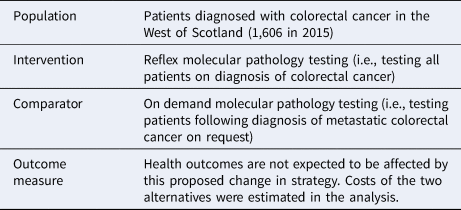
Table 1 sets out the population, intervention, comparator, and outcome measure for the case study.
Population, Intervention, Comparator, and Outcome Measure for Case Study

CRC has high incidence and mortality rates in Scotland (8;9). Cancer services in the National Health Service (NHS) in Scotland are organized on a regional basis with the West of Scotland region accounting for 1,606 (43 percent) of the incident cases in Scotland in 2015 (9). The West of Scotland Cancer Network (WoSCAN), of which NHS Greater Glasgow and Clyde forms part, serves a population of 2.5 million people (approximately 46.5 percent of the Scottish population) (10). Cancer care in the West of Scotland region is delivered at fifteen hospitals funded by four regional health boards (11) supported by a centralized molecular pathology laboratory funded on a national basis (6). Molecular biomarker testing in CRC was standardized across Scotland in 2015 when the Molecular Pathology Steering Committee approved a national patient testing pathway, whereby all patients with metastatic disease are offered testing for several gene mutations that impact either treatment or prognosis of disease.
The mutations in question are in the KRAS and NRAS (collectively referred to as RAS) genes, both of which encode proteins involved in the epidermal growth factor receptor (EGFR) pathway, and in the BRAF gene, which is a downstream effector of the RAS genes. The aim of this national pathway was to ensure both equity of service across Scotland and also effective patient stratification for prognostic or therapeutic purposes. The Molecular Pathology Steering Committee is informed by recommendations from the Molecular Pathology Evaluation Panel (MPEP) who were the intended audience for this assessment.
RAS and BRAF testing in Scotland are currently carried out on request after the confirmation of metastatic disease and through the multi-disciplinary meeting (MDM) where clinical colleagues discuss a patient's results and treatment. This is believed to be the current practice in many UK NHS settings (5). RAS mutation status impacts upon treatment options as only patients with RAS wild-type disease (i.e., no NRAS or KRAS mutations) would be offered EGFR inhibitors (EGFRi), such as panitumumab and cetuximab. These drugs must be given in conjunction with an infusional intravenous (IVI) chemotherapy regimen, including a 48-hour 5-fluorouracil (5-FU) infusion administered through a central venous catheter as an outpatient. Approximately 50 percent of patients have RAS mutated disease and can be offered noninfusional regimens using oral capecitabine with intravenous oxaliplatin (oral + IV) instead of infusional 5-FU with similar clinical benefit (12;13).
Patients with BRAF mutations have a significantly poorer prognosis and require a different treatment regimen (BRAF mutant patients have an estimated overall survival of 6–9 months, compared with over 36 months estimated overall survival for RAS and BRAF wild-type patients). Therefore, there is a significant impact on the level of information that can be given at a first consultation when the RAS and particularly BRAF mutation status are not known (Reference Yuan, Wang and Qin14). Due to the poor prognosis conferred by mutant BRAF status, these patients are unlikely to reach second-line therapy (Reference Sanz-Garcia, Argiles, Elez and Tabernero15) and would be best served by entry into clinical trials or consideration of triplet chemotherapy first line.
As patients are appointed to oncology clinics as soon as possible after the diagnosis of metastatic colorectal cancer, the results of genetic tests are often unavailable at the first oncology appointment. Patients usually expect to discuss their diagnosis, prognosis, and management plan at their first appointment, and also expect to start systemic treatment at the earliest opportunity, particularly if they have high symptomatic burden. Without the genetic test results, definitive information about prognosis and the treatment plan cannot be given. To avoid delays in treatment, patients fit for all therapies are often consented for insertion of a peripherally inserted central venous catheter (PICC) and commenced on an IVI chemotherapy regimen while awaiting the RAS test result in case they become eligible for the addition of EGFRi. Even so, patients with RAS wild-type disease will require a further consultation with medical staff to consent to the additional EGFRi. Patients with BRAF mutant disease may have missed the opportunity to participate in clinical trials specific to their disease. Patients with RAS mutant disease are highly likely to remain on IVI chemotherapy once commenced, which is more expensive than the oral + IV alternative as well as being more invasive and inconvenient for patients.
Clinicians suggested that a potential solution to the delays in availability of test results and consequent sub-optimal interventions would be to incorporate KRAS, NRAS, and BRAF gene testing into the routine tests undertaken on diagnosis for all patients, including those without metastatic disease. This reflex testing strategy would serve a further purpose of improving the information available to study the RAS and BRAF mutation colorectal cancer patient cohorts as they represent large areas of unmet clinical need. Screening patients in the first-line setting offers the opportunity to correlate response to adjuvant chemotherapy, disease free survival, and primary tumor site with mutation status to advance the standard of care for these patients.
Screening of patients at diagnosis for the presence of mutations in RAS and BRAF would also offer the opportunity for increased entry of patients onto clinical trials in the adjuvant setting. Reflex testing of all new colorectal cancer diagnoses would allow the implementation of a robust system for the collection and processing of DNA for this patient cohort, thus providing a repository of diagnostic material that can potentially be used for extended testing for patients wishing to enter future clinical trials or for selection of appropriate patient cohorts for future therapies associated with a molecular companion diagnostic marker. However, this extension to testing would increase costs for the nationally funded molecular pathology service so an economic evaluation of the change in downstream treatment costs is appropriate.
Methods
The initial step in our process was to form a multi-disciplinary project team including molecular pathologists, a clinician, and a health economist. An employee of Merck, the manufacturer of cetuximab was also part of the project team because the company collect a substantial body of evidence on CRC and are knowledgeable about molecular pathology practice on an international basis. This multi-disciplinary team was important to ensure that all relevant considerations were included. No formal literature review was undertaken, but data were sought specifically to populate the decision tree from the most reliable available source. We mapped the current and proposed treatment pathways for newly diagnosed patients using clinical guidelines from the National Institute for Health and Care Excellence (NICE) (16) and the Scottish Intercollegiate Guideline Network (SIGN) (17) and input from clinicians.
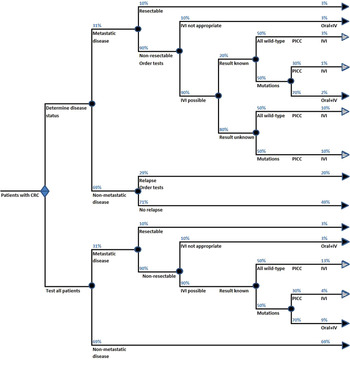
These pathways were set out as a decision tree with a 26-week time horizon as this is in line with first-line treatment duration (see Figure 1). This time-horizon was believed to be sufficient to capture any differences in costs. A UK NHS Health and personal social care perspective was adopted (18). Clinical outcomes were not modeled as in the judgement of the project team clinical outcomes would only be improved by the change from the current to the proposed pathways. This is because outcomes from both chemotherapy regimens are equivalent (12;13), and outcomes would improve due to reduction in adverse events and reduction in quality of life associated with the insertion of a PICC line. The model was checked for internal validity by a colleague within the University of Glasgow, Health Economics and Health Technology Assessment team.
Decision tree illustrating current and proposed KRAS/NRAS/BRAF test and relevant first-line treatment pathway for colorectal cancer in the West of Scotland. PICC, peripherally inserted central catheter; IVI, intravenous infusional chemotherapy; Oral + IV, oral and intravenous chemotherapy; CRC, colorectal cancer. Diamond represents a decision node. Circle represents a probability node. Percentages represent the base case estimates (see Table 1). Solid arrow represents branches where treatment pathways are identical between the current and proposed strategies; striped arrows represent changed treatment pathways.

Figure 1 shows both the current pathway whereby patients are tested for NRAS/KRAS/BRAF at confirmation of metastatic disease and the proposed pathway where all patients are tested at diagnosis. The first split of the tree indicates the decision whether to follow the current or the proposed pathway. The second split in the current pathway shows the division between metastatic and nonmetastatic disease. For patients with metastatic disease, the next split divides those who have resectable (operable) disease from other metastatic patients. For some patients with unresectable disease, IVI chemotherapy would be inappropriate, for example due to patient fitness, and this is shown as the third split in the decision tree. For the remainder of patients with unresectable disease, some have a RAS/BRAF result known at their first oncology appointment. If the result is known, PICC lines are inserted appropriately and chemotherapy started according to NRAS/KRAS status. Where the result is unknown, PICC lines are inserted and IVI chemotherapy commenced (in case EGFRi can be added once the result is known). For patients with nonmetastatic disease at diagnosis, the model only includes the cost of later NRAS/KRAS testing, which is done for patients who later relapse. Where results are not known at the initial clinic visit, then often a further clinic visit is required to inform the patient of test results and implications. This is not represented in Figure 1 to retain clarity of presentation.
In the proposed pathway (the lower branch of the decision tree), all patients are tested NRAS/KRAS/BRAF status at diagnosis of CRC (reflex testing). This allows a simplification of the metastatic, unresectable disease branch as all results are known. In the proposed pathway, all patients with no mutations (all wild-type) will have PICC lines inserted and receive IVI chemotherapy. Some patients with mutations will also receive IVI chemotherapy where the clinician recommends this.
Data to populate the decision trees were taken from a local audit, national and regional cancer registries, a comprehensive Health Technology Appraisal on treatment with cetuximab (19), Scottish Medicines Consortium (SMC) Advice on cetuximab (20), UK NHS reference costs (21), and a micro-costing of current laboratory costs undertaken by the project team (unpublished). Some assumptions were made by the project team based upon their clinical knowledge (proportion of patients who would be clinically unable to receive IVI chemotherapy, the proportion of patients whose cancer was metastatic but wholly resectable (i.e., both primary tumor and metastatic sites operable) at diagnosis, and the proportion of patients who clinicians would choose to treat with an IVI regimen regardless of whether they would later qualify for treatment with cetuximab.
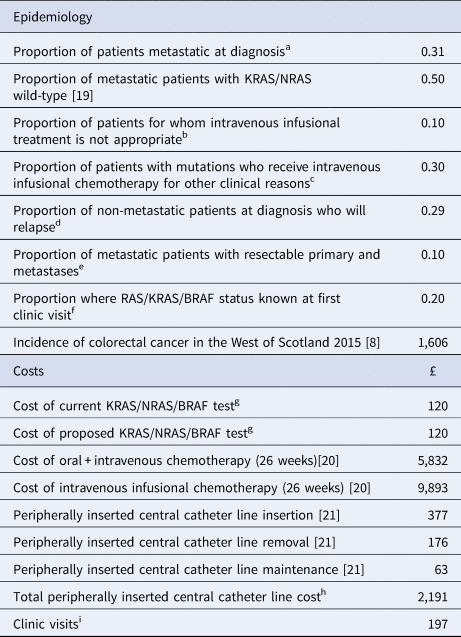
For all but the final parameter, these estimates were compared with estimates in the literature (see Table 2 for details). Inputs to the model and data sources are set out in Table 2. PICC and Hickman line insertion and maintenance incurs costs which include; out-patient appointment for siting of line, imaging to ensure placement is correct and district nurse support in the form of weekly visits for flushing and maintenance of the line. PICC and Hickman lines are also associated with adverse side effects such as bleeding, clots, infection risk, and slippage of line requiring re-siting. The costs included for these lines are based on the costs of PICC line insertion, removal and maintenance. Costs of adverse events are not included in the model. Costs are not discounted given the short time horizon of the economic evaluation.
Inputs to the Model and Data Sources

aData from West of Scotland Cancer Network provided by DC – not available online. Range suggested in [19] is 20–55%.
bExpert opinion from cross-disciplinary project team. Tappenden et al. [24] suggest that 10-15% is an appropriate estimate.
cExpert opinion from cross-disciplinary project team. No estimate available from the literature.
dData from West of Scotland Cancer Network provided by DC – not available online. Tappenden et al. [24] Figure 1 suggests 31% is an appropriate estimate.
eExpert opinion from cross-disciplinary project team. Tappenden et al. [24] quote evidence that up to 20% may be resectable but that this is an aggressive stance. A personal communication informing this HTA report considered that a maximum of 15% would have resectable primary tumour and metastases.
fData from internal clinical audit performed by YT/JG (unpublished).
gData from micro-costing analysis undertaken by GM at Glasgow Molecular Pathology Laboratory.
hCalculated as insertion + removal+(26 × maintenance)
iR044X Specialty Group Costs – Gross cost per attendance, consultant outpatients, Scotland average available at https://www.isdscotland.org/Health-Topics/Finance/Costs/Detailed-Tables/Speciality-Costs/Outpatients.asp.
One-way sensitivity analysis was undertaken whereby certain input parameters were varied in turn over a given proportion (whereas all other inputs to the model were held constant) to determine the impact of an over or under-estimation on the base-case results. This form of sensitivity analysis was undertaken as this allowed decision makers to assess the individual impact of each of the input parameters. One way sensitivity analysis was undertaken for (i) the proportion of patients metastatic at diagnosis (range, 20-55 percent taken from NICE Technology Appraisal 242) (19); (ii) proposed test costs (range from base case £120 calculated in micro costing exercise to £200, which is the level reimbursed previously by Merck to laboratories carrying out these tests and considered to include an element of surplus over cost); and (iii) the proportion of patients whose disease was not metastatic at diagnosis but who subsequently relapsed (range, 29 percent reduced to zero).
Where no suitable range could be identified from evidence sources, we varied the range to determine the highest level at which the cost savings would be reduced to zero. This threshold analysis was undertaken for the proportion of patients who are NRAS/KRAS/BRAF wild-type, the proportion of patients with resectable metastatic disease, the proportion of patients for whom IVI chemotherapy would be inappropriate, the proportion of patients prescribed IVI chemotherapy regardless of NRAS/KRAS/BRAF status, and the proportion of results currently known at the multi-disciplinary team meeting.
Some input variables were not varied as the project team were confident that the value was appropriate and supported by good quality evidence. These variables were incidence of CRC in the West of Scotland, which is supported by registry information and the cost of FOLFOX and XELOX (IVI and oral + IV chemotherapy treatments), which was obtained from a comprehensive Technology Assessment report (19). The costs relating to PICC lines were also not subject to sensitivity analysis as they are believed to be under-estimated by the project team. This is primarily because maintenance of a PICC line used in the West of Scotland in CRC requires one visit per week by a district nurse, which would cost at least the £63 allowed in this analysis and no costs are included for the adverse events associated with PICC lines, such as blockage and infection. The evaluation was assessed against the AdHopHTA checklist for hospital-based health technology assessment.
Results
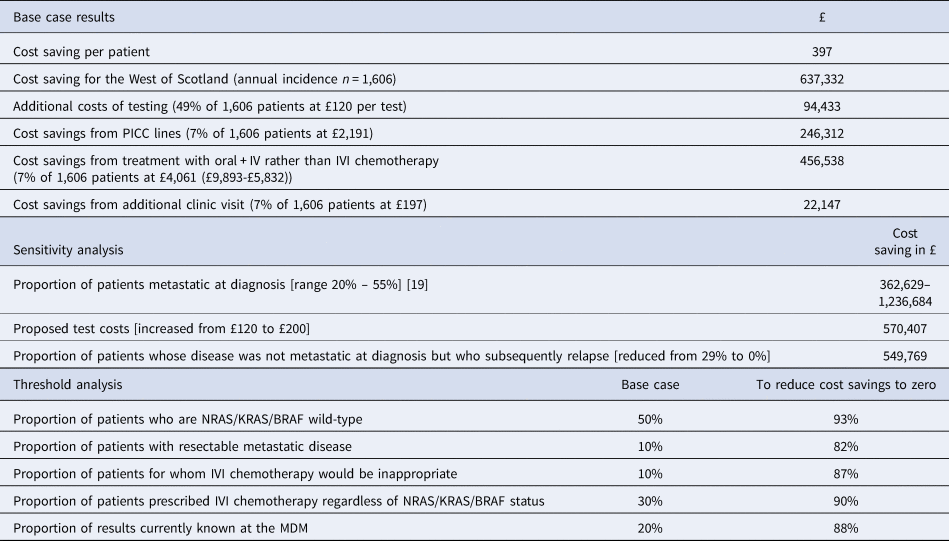
A context-specific economic evaluation was carried out over a period of several months and was used to inform the Molecular Pathology Evaluation Panel in their ongoing consideration of molecular pathology testing in colorectal cancer. No changes have been introduced to the testing strategy to date. The evaluation met all relevant criteria in the AdHopHTA checklist (see Supplementary Table 1). The base-case analysis indicated that the process change would save £397 per patient, which equates to £637,332 per annum in the West of Scotland. This saving resulted primarily because approximately 7 percent of patients (n = 112) are predicted to avoid PICC line insertion and IVI chemotherapy, which more than outweighs the additional cost of testing for those patients with nonmetastatic disease at diagnosis and who do not relapse. Those avoiding PICC line insertion and IVI therapy can be seen from Figure 1 as in the current strategy the striped arrowheads showing IVI treatment total 24 percent (3 percent + 1 percent + 10 percent), whereas under the proposed strategy IVI treatment totals only 17 percent (4 percent + 13 percent).
Additional testing costs are incurred for 49 percent patients being the difference between testing 100 percent patients under the proposed strategy compared with 51 percent (31 percent metastatic plus 29 percent relapsed of 69 percent nonmetastatic) under the current strategy. Testing costs are anticipated to reduce under the new testing strategy as a result of increased volumes and this test cost has been included as both current and proposed test cost to ensure estimates of cost savings are conservative.
Sensitivity analysis showed that the overall cost saving was not highly sensitive to any individual parameter when varied within ranges judged feasible by the project team. The threshold analysis showed that the assumptions made about the proportions of patients falling in each category could vary considerably before the overall cost saving was reduced to zero. This is because the cost saving from diverting an individual patient from IVI treatment and PICC insertion is high compared with test costs so that only a small number of patients need to be diverted in order for the proposed change to deliver cost savings. Table 3 summarizes the base case results and the results of sensitivity and threshold analyses.
Base-Case Results and Sensitivity and Threshold Analyses

Note. Number in brackets is the reference to the source of the data where a reference is included. Some figures are rounded.
IV, intravenous; IVI, intravenous infusional; MDM, multi-disciplinary team meeting; PICC, peripherally inserted central catheter.
Discussion
This study applied a context-specific form of economic evaluation consistent with the AdHopHTA checklist to evaluate a strategy of reflex RAS/BRAF gene testing for patients in the West of Scotland. This method of context-specific evaluation could be used in other areas to evaluate proposed changes to molecular pathology-based testing strategies, particularly where national evaluation is not undertaken on a timely basis or not considered relevant. The findings in the case study are not directly generalizable as they are dependent upon existing local treatment pathways, the organization of local cancer services, and capacity and organization of molecular pathology services. However, the results are a useful starting point for decision makers in other contexts in determining useful data sources, documenting pathways, and indicating factors specific to the context that may indicate potential cost-saving opportunities.
A strength of this study is its context-specific focus, the involvement of a cross-disciplinary expert project group representing the different service areas affected and the presentation of both qualitative and quantitative information to the decision makers. The study was relatively quick and resource light, as a result of the suitability of a costs-only analysis, the simplicity of the model and the approach to evidence gathering. The model was simple as it considered only costs and had a relatively short time horizon. Evidence was based on easily available national resources and local experience informed by the expert project team. One-way sensitivity analysis was appropriate, because the cost saving was relatively large and not sensitive to any individual parameter. It also allowed decision makers to assess the importance of individual parameters. The study met all relevant criteria of the AdHopHTA checklist.
A limitation of the method as set out in this study is that it has not demonstrated that it is applicable to a situation where health outcomes are affected. It may not be possible to adopt such a quick and resource-light approach if this were the case. A limitation of the specific case study was the range of data sources relied upon in the evaluation and the use of estimates made by the expert project team, which included an employee of the pharmaceutical company that manufactures cetuximab (Merck Serono Limited). Merck Serono Limited have no direct commercial interest in the result of this study as the number of patients prescribed cetuximab would be unchanged. Although the range of literature sources was narrow, they were high quality sources and the input variables were varied over a wide range in sensitivity analysis.
The estimates made by the expert team were subject to threshold analysis that showed how much the estimate would need to change the conclusion of the study. An important limitation is that data from a small clinical audit informed the parameter that drove the main cost savings (proportion of results currently known at the MDM). Although threshold analysis showed that this parameter could vary from the base-case of 20 percent to 88 percent before there were no cost savings, this study will be followed by a larger clinical audit that will assess the accuracy of those data and consider other regions of Scotland before any decision being made on the extension of testing.
A final limitation is that the extent of the potential savings is dependent upon the absolute and relative prices of IV and IVI chemotherapy regimens. The costs used in the analysis were taken from a reliable source (a comprehensive HTA report) (19). It would be useful to confirm that the actual cost of the pharmaceuticals to the NHS in Scotland is not significantly different from the values used in this analysis before a decision being made.
Implications
Context-specific economic evaluation (akin to hospital-based HTA) with input from a multi-disciplinary project group may offer a quick and relatively resource-light method of assessing changes to molecular pathology testing strategies. This may be sufficient for the needs of local decision makers as well as more relevant and timely than national guidance. The economic evaluation can be quality checked against established frameworks such as the AdHopHTA checklist used in our case study. As uncertainties in the analysis are made clear in the analysis, decision makers can ask for further evidence in any areas of concern.
The implications of the analysis in our case study is that a change to reflex testing for CRC has the potential to deliver cost savings but further clinical audit should confirm the proportion of patients for whom the result is not known at the time of the MDM. Decision makers will need to consider other factors in their decision such as budget implications, capacity constraints, capital expenditure, and other developments in CRC diagnosis and treatment. Although savings may be made overall, the change would have a negative budget impact in pathology, as extra cost would be borne there. Savings would be realized in pharmaceutical budgets. No capital expenditure would be required to make the change and capacity could be increased in Glasgow Molecular Pathology Laboratory. The increase in capacity was costed as part of the micro-costing analysis. Other developments in molecular pathology testing will need to be taken account in the final decision about reflex testing. If, following clinical trials such as POLEM (22), PDL1 +/− CTLA4 inhibitors become the standard first-line metastatic treatment for patients with micro-satellite instability high metastatic cancers (23), then molecular pathology tests will be required for all patients on diagnosis of CRC (reflex testing).
Supplementary material
The supplementary material for this article can be found at https://doi.org/10.1017/S026646231900045X
Author ORCIDs
Janet Bouttell, 0000-0002-4568-5483.
Conflicts of interest
Janet Bouttell and Ruth McLaughlin are funded by the Glasgow Molecular Pathology Node, an MRC ERSC funded project that aims to improve translation of molecular technologies from the development stage into clinical practice. Janet Graham is a Senior NRS Fellow. David Creed is an employee of Merck Oncology.