NORTH OF THE ANTONINE WALL
ABERDEENSHIRE
(1) Aberdeen, Milltimber (NJ 8580 0077): 90 bread ovens were found on the north bank of the river Dee.Footnote 8 The ovens were similar in style to those found at Kintore Roman camp,Footnote 9 but all were deliberately dug into the banks of dried up palaeochannels which cut across the site. There was no evidence of ditches in the extensive area stripped of topsoil (nearly 5 ha), but the ovens suggest the presence of a Roman camp. Bayesian analysis of radiocarbon dates has shown the features most likely date to the Agricolan campaigns of the 80s.
FIFE
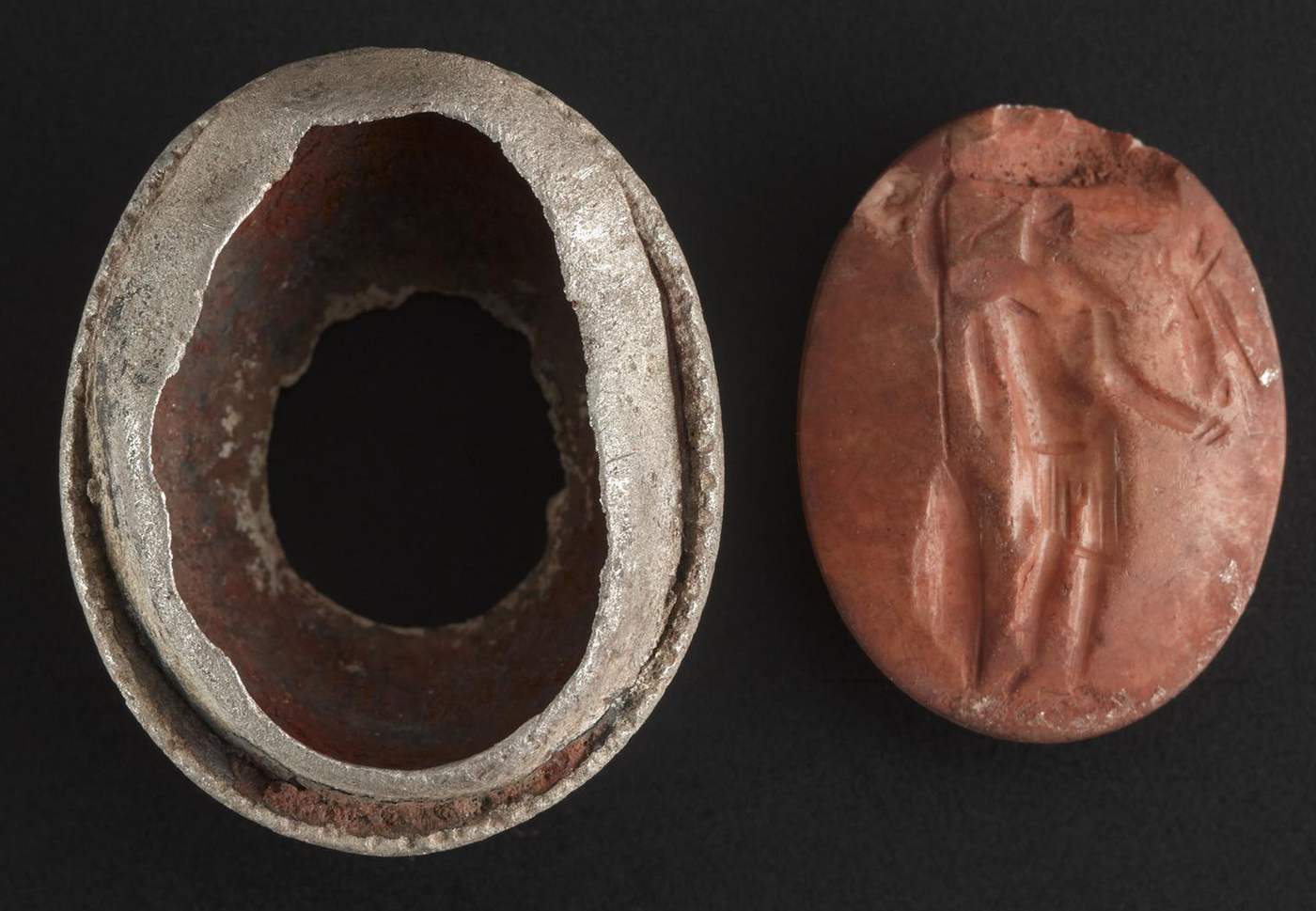
(1) Capledrae (NT 19 98): the discoveryFootnote 10 of a late Roman silver ring with a re-set earlier intaglio (fig. 3) gives credence to an antiquarian account of ‘Roman jewellery’ being found near the Devil's Stane in the late nineteenth century.Footnote 11 This link to an earlier standing stone finds parallel in other silver hoards in the area.Footnote 12 The ring's hoop is lost; the bezel (H 19 mm, W 15.5 mm, T 7.5 mm) has a truncated conical form typical of the late Roman period, the upper decorative serrated edge probably mimicking beaded wire. The pale pink intaglio (second/third century a.d.), its front deliberately coloured red to mimic jasper, shows Mars with spear and shield holding Victory, who carries a wreath and palm branch.Footnote 13
Silver ring and intaglio from Capledrae, Fife. (Photo: Mary Freeman, © National Museums Scotland)

SOUTH OF THE ANTONINE WALL
SCOTTISH BORDERS
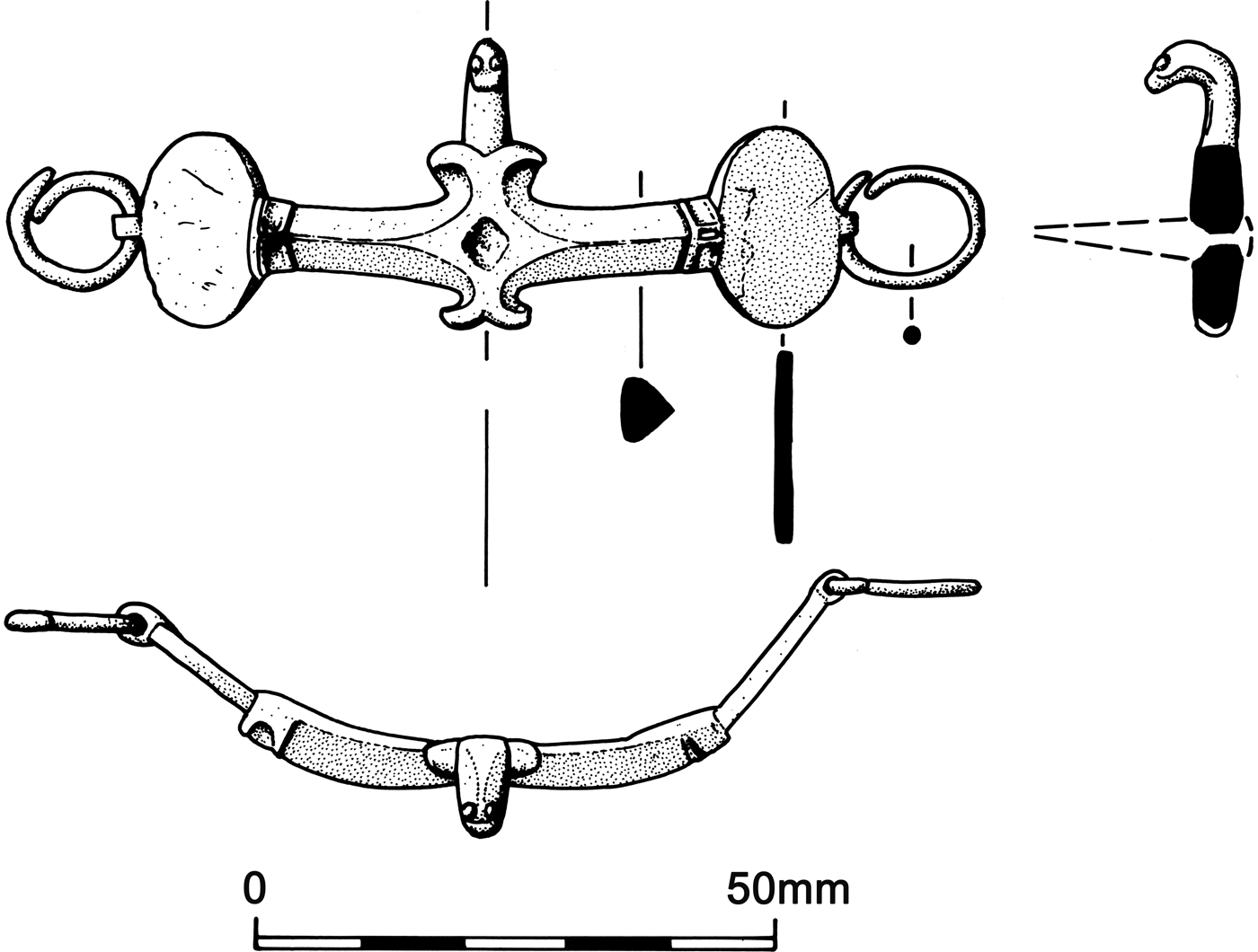
(1) Old Melrose (NT 58 34): finds from metal-detecting surveyFootnote 14 in an area of the Newstead complex which has seen no previous investigation indicate military activity of uncertain character. No substantial cropmarks are known in this area, some 1.5 km south-east of the fort;Footnote 15 the material could represent a halo of debris around the military complex, but its intensity suggests more concentrated activity, such as losses from troops stationed at a temporary camp.Footnote 16 The bronze coinage awaits study, but cavalry fittings and denarii are consistent with a predominantly Flavian date. The exception to this, and the most remarkable find, is a copper-alloy spur (fig. 4), a unique find for Scotland but with plentiful late fourth/fifth-century parallels elsewhere,Footnote 17 although differing in detail in the presence of fastening rings on the terminal plates, which are usually riveted. This suggests activity linked to the late Roman military.
Late Roman spur from Old Melrose. (Drawn by Alan Braby)

DUMFRIES & GALLOWAY
(1) Kirkpatrick Fleming (NY 27 70): an aureus of Nero was found in the area of the temporary camp.Footnote 18
(2) Creetown, Greenburn (NX 48 61): a small hoard of 14 denarii ending with Hadrian may offer some clue to the location of Roman activity in this area, where a road is anticipated.Footnote 19
SUPPLEMENTARY MATERIAL: CONTENTS
For Supplementary Material for this article please visit https://doi.org/10.1017/S0068113X18000314