Implication
Meat from less intensive but more economically sustainable production regimens is often lower in quality than meat from more intensive systems. Thus, additional value-added processing is necessary for meat to be equivalent to the meat from intensive systems. This study clearly shows that use of pelvic suspension for carcasses from cattle on a less-intensive feeding regimen will yield meat that is as palatable as that from a more intensive production–processing system. Furthermore, if meat-packing plants use Achilles suspension, it is obligatory to invest a longer, more extensive feeding system to create meat with equal sensory properties as pelvic-suspended meat.
Introduction
In many countries, cattle production is based more on feeding forage than on grain. Economic constraints on the production segment often involve shorter feeding times with less-intensive dietary regimens, whereas the meat production segment optimizes cost by increasing carcass weight per animal. These forces often conflict.
Longissimus muscle properties are affected by nutritional background (Bowling et al., Reference Bowling, Smith, Carpenter, Dutson and Oliver1977; Schroeder et al., Reference Schroeder, Cramer and Bowling1982; Mitchell et al., Reference Mitchell, Reed and Rogers1991a), carcass suspension method (Hostetler et al., Reference Hostetler, Carpenter, Smith and Dutson1975; Troy, Reference Troy1999) and ageing (Mitchell et al., Reference Mitchell, Giles, Rogers, Tan, Naidoo and Ferguson1991b; Brewer and Novakofski, Reference Brewer and Novakofski2008). Ahnström et al. (Reference Ahnström, Hessle, Johansson, Hunt and Lundstrom2009) reported that pelvic suspension was a useful tenderness intervention for meat from forage-fed Charolais heifers, a late-maturing breed.
Correlations between sensory evaluation and objective measures of meat tenderness vary widely in the literature (Szczesniak, Reference Szczesniak1968; Peachey et al., Reference Peachey, Purchas and Duizer2002). The strength of these correlations seems to vary depending on gender (Peachey et al., Reference Peachey, Purchas and Duizer2002) and the amount of variation in the data set (Szczesniak, Reference Szczesniak1968). In earlier studies, we have shown that pelvic suspension significantly reduced both between- and within-animal variation in Warner–Bratzler peak force measurements (Ahnström et al., Reference Ahnström, Enfält, Hansson and Lundström2006 and Reference Ahnström, Hessle, Johansson, Hunt and Lundstrom2009), but no further investigations on different instrumental measurements of tenderness were carried out in those studies. However, differences between suspension methods are clearer when analysed sensorially instead of with Warner–Bratzler shear evaluations (Ahnström et al., Reference Ahnström, Hessle, Johansson, Hunt and Lundstrom2009). Because compression variables and sensory tenderness have higher correlations than Warner–Bratzler evaluations and sensory tenderness (Bouton et al., Reference Bouton, Ford, Harris and Ratcliff1975), compression may be one way to improve our understanding about tenderness differences related to pelvic suspension.
The main purpose of the study was to examine the effects of pelvic suspension on meat quality parameters assessed in longissimus thoracis et lumborum (LTL) muscle from forage-fed Angus heifers. This study also compared the combined effects of a more extensive nutritional regimen and Achilles suspension with a pasture feeding system and Achilles or pelvic suspension. Finally, the study also investigated the relationships between different instrumental measurements (Warner–Bratzler shear force and compression forces) and sensory tenderness in meat from animals differing in between- and within-animal variation.
Material and methods
Cattle background, feeding regimen and slaughter age
A total of 40 Angus heifers weaned at 8 months of age were fed a forage-based diet consisting of a grass–clover silage during a 5-month initial indoor period; they were then grazed on seminatural grassland for 5 months. Half of the heifers (n = 20) were slaughtered directly from pasture at an age of 18 months. The other half (n = 20) were housed during the winter for 4 months, while being fed a forage-based diet consisting of grass–clover silage, and were slaughtered at 22 months of age. Average live weight gain of the heifers was 0.69 kg/day before weaning, 0.63 kg/day during the initial indoor period and 0.68 kg/day during the grazing period. Weight gain during the second indoor period was 0.44 kg/day for the 22-month-old heifers. Details of this feeding regimen are described by Hessle et al. (Reference Hessle, Nadeau and Johnsson2007).
Slaughter, chilling and carcass suspension
The animals were slaughtered at a commercial plant. Whole carcasses were electrically stimulated (80 V for 30 s) 30 min after exsanguination. Conformation and fatness were graded according to the EUROP schemes modified to the Swedish system, in which 15 classes are used (Swedish Board of Agriculture, 1998; Commission of the European Communities, 2005). The EUROP classes were transformed to numerical figures for conformation score (1 = P−, poorest and 15 = E+, best) and fatness (1 = 1−, leanest and 15 = 5+, fattest). Cold carcass weight (0.98 × hot carcass weight) was recorded. For the heifers slaughtered at 18 months of age, the left side from each carcass was hung by the obturator foramen of the pelvic bone, whereas the right side was suspended by its Achilles tendon. Pelvic suspension was performed using a rope to re-hang the carcasses, just before the carcasses entered the cooler, ∼1 h after stunning. Only Achilles suspension was used for animals slaughtered at 22 months of age. Carcasses were chilled at 2° to 4°C until the next day and then cut commercially at a commercial plant after separating the forequarters and hindquarters between ribs 10 and 11.
Quality analyses
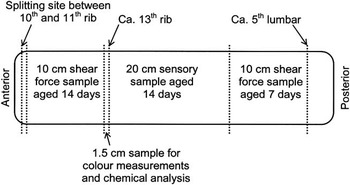
A 50-cm section of LTL (rib 11 to the last lumbar vertebrae; Figure 1) was removed from all carcasses 24 h after slaughter. Muscles were vacuum packaged and aged at 4°C for 7 days post mortem. The pH was measured after ageing at the anterior end using a probe electrode (Knick SE104, Knick Elektronische Messgeräte GmbH & Co. KG Berlin, Germany) attached to a pH meter (WTW pH 340, WTW GmbH, Weilheim, Germany). A 1.5-cm-thick slice of LTL was removed (see Figure 1) for colour measurements and chemical intramuscular fat (IMF) analysis. Two 10-cm-thick samples for shear force measurements were removed from the LTL and vacuum packaged. One sample was frozen (−20°C) directly (7 days post mortem) and the other was aged until 14 days post mortem before freezing at −20°C. A 20-cm sample for sensory analyses was removed, vacuum packaged and aged until 14 days, and then frozen at –20°C.
Sample locations of the longissimus thoracis et lumborum for technological and sensory evaluation of meat from Angus heifers.

Instrumental tenderness
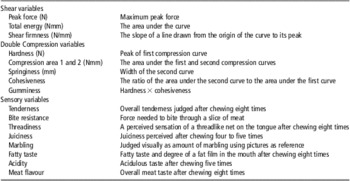
Instrumental tenderness was (Table 1) measured on LTL samples using Warner–Bratzler shear force and compression force methods described by Honikel (Reference Honikel1998) with modifications as indicated below. Peak force (N), total energy (Nmm), hardness (N), compression area 1 and 2 (Nmm), springiness (mm), cohesiveness and gumminess were recorded according to Honikel (Reference Honikel1998), and shear firmness (N/mm) was measured (Table 1) as described by Larmond and Petrasovits (Reference Larmond and Petrasovits1972).
Variables for shear, compression and sensory analysis

Samples were thawed overnight at 4°C while remaining in their vacuum packages and then placed in a water bath (20°C) for 1 h to standardize the sample temperature before evaluating the juice loss. The samples were again vacuum packaged and cooked in the bag in a water bath for 2 h at 70°C. The weight of the meat samples was recorded before freezing, after thawing and after cooking to calculate the freezing (including thaw loss) and cooking losses. The samples aged for 14 days were frozen without re-packaging; thus, freezing losses after 14 days of ageing is the combined loss of both ageing and thawing.
The cooked meat samples were stored at 4°C overnight. From each sample, 40-mm-long strips with a 100-mm2 (10 × 10) cross-sectional area were removed with the fibre direction parallel to the longitudinal dimension of the sample. The Warner–Bratzler and compression assessments were made 15 mm from each end, which made it possible to use both methods on every strip. The shear force measurements were conducted perpendicular to the fibre axis using a Stable Micro System Texture Analyser HD 100 (Godalming, Surrey, UK) equipped with a Warner–Bratzler shear force blade with a rectangular hole of 11 mm × 15 mm. The blade was 1 mm thick and had a speed of 0.83 mm/s when cutting through the samples. On average, 11.8 strips (s.d. 0.58) from each sample were tested and the mean calculated.
Compression measurements were recorded perpendicular to the fibre direction with a squared flat-ended plunger (10 × 10 mm) driven at 0.83 mm/s twice vertically 80% of the way through the strip. The strips were placed in a metal cell fitted with two lateral walls along the long dimension of the strips (10 mm wide × 20 mm high × 50 mm long); thus, there was lateral strain on both sides and movement possible only in the longitudinal direction along the fibre axis. On average, 11.7 strips (s.d. 0.66) from each sample were tested and the mean calculated.
Sensory analysis
Samples from the LTL were thawed overnight at 4°C, then wrapped in aluminium foil and cooked in a conventional oven at 125°C to an internal end point temperature of 70°C. Seven panelists, experienced at assessing beef and trained in accordance with ISO 8586-1 (1993), conducted a descriptive test profile (ISO, 1985). The cooked samples were tempered to room temperature (∼20°C) and served in coded Petri dishes in replicates as rectangular, 3.8-mm-thick slices. The crust and outer layer of connective tissue were removed before panel evaluation. The sensory attributes of acidity, fatty taste, meat taste, juiciness, tenderness, bite resistance, threadiness and visible marbling (Table 1) were judged on an unstructured intensity line scale from 0 to 100. The assessments were performed in duplicate in a room with separate booths for each panelist and normal white light according to ISO 8589 (1988). The PSA program (PSA system/3 2.09 1994) was used for data collection. Unsalted wafers and water were available for use between samples.
Chemically determined IMF
Samples frozen on day 7 were partly thawed, chopped into small pieces and mixed. Duplicate subsamples were analysed for IMF by the SBR method (Nordic Committee on Food Analysis (NMKL), 1989) after hydrolysis with HCl diethyl ether and petroleum ether for extraction. Values for the duplicates were averaged.
Colour measurements
Freshly cut samples were bloomed on day 7 for 1 h and evaluated using a Minolta Chroma Meter CR300 (Minolta, Osaka, Japan) with an 8-mm aperture and a 0° viewing angle with the specular component included. A white tile (L* = 97.47, a* = −0.20 and b* = 1.79) was used for standardization according to the manufacturer's recommendations. CIE (Commission Internationale de l'Eclairage) L* (lightness), a* (redness) and b* (yellowness) values (Illuminant D-65) were obtained from three scans of each steak and averaged.
Statistical analysis
Statistical evaluation was carried out using the Procedure Mixed in SAS (Version 9.1, SAS Institute Inc., Cary, NC, USA). For the carcass and fat traits, slaughter age (18 and 22 months) was included in the model as a fixed effect. For the meat quality traits, suspension method and slaughter age were the fixed effects with animal as a random effect. For cooking loss, IMF was additionally included in the model as a covariate. As only Achilles suspension was used in animals slaughtered at 22 months of age, no interaction effect between suspension method and slaughter age could be included. For the sensory evaluation, the random effect of panel member was also included. Differences between least-squares means were evaluated with the estimate option. Differences due to ageing (7 v. 14 days) were evaluated within suspension method/slaughter age subgroup with ageing time as fixed and animal as the random effect.
Results
Carcass traits
Carcasses from heifers slaughtered at 22 months of age (Table 2) were heavier (P = 0.001) and fatter (P = 0.001) and had more IMF (P = 0.001) than heifers slaughtered at 18 months of age. No differences in muscularity based on conformation score (P = 0.463) were due to slaughter age.
Carcass quality traits in Angus heifers slaughtered at 18 and 22 months of age, least-squares means and s.e.

s.e. = standard error; IMF = intramuscular fat.
1Conformation; classification according to the EUROP grading system: 6 = O+; 7 = R−, where a higher number means higher muscling.
2Fat class; classification according to the EUROP grading system: 7 = 2+; 10 = 4−, where a higher number means thicker fat cover.
3Chemically determined intramuscular fat percentage in longissimus.
Technological meat quality
pH, colour and water loss
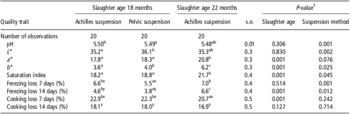
The LTL muscle from the 18-month-old group had a slightly lower pH in the pelvic-suspended sides than muscle from the Achilles-suspended sides (5.49 v. 5.50, P = 0.001). At 22 months of age, muscle pH from the Achilles-suspended sides did not differ (P > 0.05) from either of the 18-month-old groups.
In heifers slaughtered at 18 months of age, LTL muscles hung by the pelvic bone were slightly lighter (higher L* values, P = 0.002) and more yellow (higher b* values, P = 0.025) than LTL from the Achilles-suspended side (Table 3). Slaughter age influenced both a* and b* values, where heifers slaughtered at 22 months of age had more red (P = 0.001) and yellow (P = 0.001) colour attributes than those slaughtered at 18 months of age. Saturation index values were also higher at 22 months of age indicating a more saturated, vivid red colour.
Colour, pH and loss values for longissimus thoracis et lumborum from Angus heifers slaughtered at 18 and 22 months of age, least-squares means and s.e.

s.e. = standard error.
1 P-value for the effects of slaughter age and suspension method; significant values are formatted bold (P < 0.05).
a,b,cMeans within a row with the same or no superscript letter are not different (P > 0.05).
x,yMeans within a column and variable with no x or y superscript letter are not significantly different between 7 and 14 days of ageing (P > 0.05).
Freezing and cooking losses for the LTL were partly affected by suspension method and slaughter age (Table 3). Muscles from 18-month-old heifers aged for both 7 (P = 0.001) and 14 days (P = 0.004) had lower freezing losses for pelvic-suspended sides than for Achilles-suspended sides. The samples aged for 14 days from 22-month-old heifers whose sides were suspended by the Achilles tendons had higher freezing losses than samples from 18-month-old heifers. Cooking loss was lower for the Achilles-suspended sides aged for 7 days from heifers slaughtered at 22 months of age (P = 0.002) compared with the 18-month-old groups, where no differences could be found. Including IMF as a covariate in the statistical model removed the differences in cooking loss between age groups. For samples aged for 14 days, cooking losses did not differ between the different treatments. When evaluating the effects of 7 v. 14 days of ageing, freezing losses were reduced after ageing in samples from heifers slaughtered at 18 months of age, whereas cooking losses were reduced in muscle from both the age groups.
Warner–Bratzler shear force and compression measurements
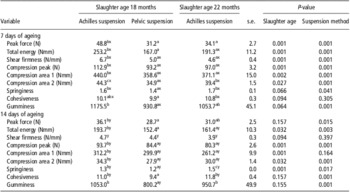
The LTL samples aged for both 7 and 14 days from the 18-month-old group hung by the pelvic bone had lower peak force and required less total energy to shear samples than the Achilles-suspended group, with a larger difference between suspension methods for the samples aged for 7 days (Table 4). The compression parameters responded similarly. For shear firmness, the difference between suspension methods was significant only for samples aged for 7 days. Samples from heifers slaughtered at 22 months of age had shear and total energy values similar to samples from the pelvic group with the 18-month slaughter age. The pelvic-suspended sides from 18-month-old heifers were similar to Achilles-suspended sides from 22-month-old heifers, except for springiness and cohesiveness after both 7 and 14 days of ageing, for compression area 2 after 7 days of ageing and gumminess after 14 days of ageing, indicating more tender meat for pelvic-suspended sides for these variables (Table 4).
Shear and compression variable traits for longissimus thoracis et lumborum from Angus heifers slaughtered at 18 (n = 20) and 22 (n = 20) months of age and suspended by the Achilles tendon or the pelvic bone, least-squares means and s.e.

s.e. = standard error.
a,b,cMeans within a row with the same superscript letter are not different (P > 0.05).
x,yMeans within a column and variable with no x or y superscript letter are not significantly different between 7 and 14 days of ageing (P > 0.05).
Variation in Warner–Bratzler shear force clearly decreased in pelvic-suspended samples compared with Achilles-suspended samples. Between-animal variation and within-animal variation, calculated as the coefficient of variation, decreased in samples aged for both 7 and 14 days. Between-animal variation decreased from 36.9% to 11.9% for samples aged for 7 days and from 31.0% to 16.7% for samples aged for 14 days. The corresponding values for within-animal variation were decreased from 28.0% to 14.5% (P = 0.001) for samples aged for 7 days and from 21.2% to 13.2% (P = 0.003) for samples aged for 14 days. For the compression peak, the decrease in within-animal variation was evident, with decreases from 23.6% to 14.8% (P = 0.001) after 7 days of ageing but from 13.4% to 11.6% (P = 0.226) after 14 days of ageing. For the between-animal variation, the decreases were from 15.2% to 7.5% for samples aged for 7 days and from 13.4% to 11.6% for samples aged for 14 days.
When evaluating the effects of 7 v. 14 days of ageing for the LTL (Table 4), samples from Achilles-suspended sides aged for 14 days were more tender with reduced peak force and total energy than those aged for 7 days. Moreover, shear firmness and the compression parameters except gumminess were lower after 14 days of ageing. Peak force and total energy from the pelvic-suspended sides aged for 7 days did not differ from those aged for 14 days, but shear firmness and all compression parameters except cohesiveness were reduced after ageing. The importance of ageing Achilles-suspended sides was more obvious for samples from the 18-month-old heifers than from the 22-month-old animals, where peak force was similar after 7 and 14 days of ageing (P = 0.267). However, total energy and all compression parameters except gumminess showed the effect of ageing in the 22-month-old samples as well.
Sensory
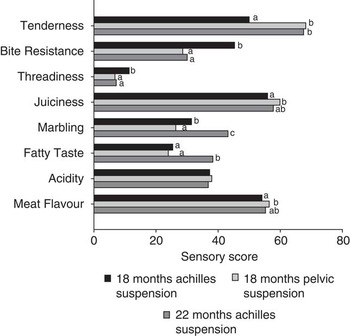
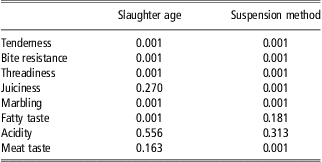
Sensory analysis performed on LTL samples aged for 14 days clearly showed that suspension method strongly (P = 0.001) affected all sensory traits except fatty taste (P = 0.181) and acidity (P = 0.313; Figure 2 and Table 5). Muscles from pelvic-suspended sides had higher tenderness, lower bite resistance, less threadiness, higher juiciness and meat flavour and less visible marbling than meat from Achilles-suspended sides at 18 months of age. The sensory parameters also agreed with the compression texture traits that meat from pelvic-suspended sides had a different profile than Achilles-suspended sides at the same age.
Least-squares means for sensory characteristics of longissimus thoracis et lumborum samples aged for 14 days from Angus heifers with slaughter age of 18 and 22 months and Achilles and pelvic suspension. Sensory scores within an attribute with the same letter are not different (P > 0.05). P-values for each trait can be found in Table 5 (s.e. 1.8–3.2).

P-values for sensory characteristics of longissimus thoracis et lumborum samples from Angus heifers for the effect of slaughter age and suspension method (Figure 2)

Prolonging the cattle rearing period from 18 to 22 months of age increased tenderness and decreased bite resistance and threadiness in the Achilles-suspended sides to values similar to pelvic-suspended sides. Visible marbling and fatty taste were higher for heifers slaughtered at 22 months of age (P = 0.001 for both; Figure 2 and Table 5).
Relationships between instrumental and sensory data
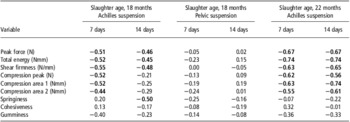
The relationships between the different instrumental measurements and sensory tenderness for the LTL muscle are presented in Table 6. Correlations were considerably higher for carcasses suspended by the Achilles tendon than those hung by the pelvic bone, where instrumental texture data did not correlate significantly with sensory-evaluated tenderness. For the samples from heifers slaughtered at 18 months of age and suspended by the Achilles tendon, sensory-evaluated tenderness and shear variables were more significantly correlated after 7 days of ageing than after 14 days of ageing, whereas this difference between ageing times was absent in the 22-month-old heifers.
Correlations between sensory tenderness (assessed at 14 days of aging) and shear variable traits (measured at 7 and 14 days of ageing) in longissimus thoracis et lumborum from Angus heifers slaughtered at 18 and 22 months of age and suspended by the Achilles tendon or the pelvic bone (only 18 months)

Significant values are formatted bold (P < 0.05).
Discussion
The results from this study showed that slaughtering heifers directly after the grazing period and using the conventional suspension method from the Achilles tendon did not always produce beef with optimal tenderness. Pelvic suspension and a finishing period improved tenderness and other sensory traits and also reduced variation between animals. In addition, clearly, meat from carcasses hung by the pelvic bone had a more positive palatability and textural profile than meat from Achilles-suspended carcasses unless an extended feeding period is used. Moreover, pelvic suspension can clearly reduce or replace ageing an additional 7 days.
Sensory parameters positively influenced by pelvic suspension in this study were tenderness, bite resistance, threadiness and juiciness. These results are supported by other studies on pelvic-suspended meat where sensory parameters measuring tenderness have been improved (Bouton et al., Reference Bouton, Fisher, Harris and Baxter1973; Claus et al., Reference Claus, Wang and Marriott1997).
The shear values declined significantly because of pelvic suspension, which confirms other findings on heifers by Mooney et al. (Reference Mooney, Joo, Kim and Troy1999) and Ahnström et al. (Reference Ahnström, Hessle, Johansson, Hunt and Lundstrom2009) and several studies on other gender categories (Hostetler et al., Reference Hostetler, Landmann, Link and Fitzhugh1970; Bouton et al., Reference Bouton, Fisher, Harris and Baxter1973; Wahlgren et al., Reference Wahlgren, Göransson, Linden and Willhammar2002; Derbyshire et al., Reference Derbyshire, Lues, Joubert, Shale, Jacoby and Hugo2007). However, other studies report no differences in shear force for pelvic-suspended heifers, although bulls did show differences (Ahnström et al., Reference Ahnström, Hunt and Lundström2011).
Shear and compression variables clearly decreased with increased ageing time for Achilles-suspended samples, especially for heifers slaughtered at 18 months of age. Pelvic suspension reduced the need for ageing by producing tender meat already after 7 days of ageing. This may be of major importance for the meat industry to achieve a faster throughput of meat while at the same time maintaining a good tenderness level. Similar results have been reported in Ahnström et al. (Reference Ahnström, Hessle, Johansson, Hunt and Lundstrom2009), Bouton et al. (Reference Bouton, Fisher, Harris and Baxter1973) and Bouton and Harris (Reference Bouton and Harris1972).
For plants that cannot practice pelvic suspension, our data indicate that increased time on feed from 18 to 22 months of age will improve meat colour and many measures of tenderness, increase carcass weight and increase IMF while using the more traditional Achilles-suspension system. Samples from the 22-month feeding regimen needed less ageing than the 18-month-old product. However, using the combination of pelvic suspension and the shorter feeding time (18 months) was the most efficient and required the least feed and labour per kg produced meat.
The final pH measured after 7 days of ageing was slightly lower in pelvic-suspended sides than in Achilles-suspended sides from heifers slaughtered at 18 months of age. This has been shown in earlier studies on Charolais heifers by Ahnström et al. (Reference Ahnström, Hessle, Johansson, Hunt and Lundstrom2009) and for heifers of the dairy breed Swedish Red in Ahnström et al. (Reference Ahnström, Hunt and Lundström2011). No such decrease in pH was, however, observed for the bulls and cows in the latter study. In addition to lower pH, the pelvic-suspended sides also had lower freezing losses than Achilles-suspended sides, but no difference was found in cooking loss. Although the lower pH values for meat from pelvic-suspended sides could increase moisture losses, the opposite occurred likely because of the effects of increased sarcomere lengths that accompany pelvic suspension (Ahnström et al., Reference Ahnström, Hunt and Lundström2011). In addition, Barnier and Smulders (Reference Barnier and Smulders1994) reported decreased losses for pelvic-suspended sides. When comparing losses from the two slaughter ages, the cooking losses after 7 days of ageing were lower for 22-month-old samples, which could partly be explained by the higher IMF content at 22 months of age. Similar results were also found by Jeremiah et al. (Reference Jeremiah, Dugan, Aalhus and Gibson2003). Post-rigour muscle pH increases as ageing time increases (Boakye and Mittal, Reference Boakye and Mittal1993), which tends to improve water-holding capacity. This may explain our results with lower freezing and cooking losses after 14 days of ageing than after 7 days of ageing. As the purge was not measured separately but included in the 14-day freezing loss in this study, we have no record of when the fluid was lost from the meat. However, because the freezing loss after 14 days of ageing was lower than after 7 days of ageing, purge seems to be larger during the first period of ageing.
The lower amount of visible marbling in meat from pelvic-suspended heifers found in Ahnström et al. (Reference Ahnström, Hessle, Johansson, Hunt and Lundstrom2009) was confirmed in this study. This may be because of a stretching of muscle fibres in the adipose tissue, leading to less obvious visible marbling. As some consumers prefer to buy meat with low marbling even though the taste of meat with higher marbling is preferred (Grunert, Reference Grunert1997; Ngapo and Dransfield, Reference Ngapo and Dransfield2006), use of pelvic suspension could also provide an advantage in juiciness and flavour in addition to its greater tenderness.
In this study, we included both 7 and 14 days of ageing before performing the instrumental shear force and compression evaluation, comparing that to sensory eating quality after 14 days of ageing. Interestingly, the instrumental shear force and compression measurements performed after the same ageing time as the sensory testing did not show higher correlations than the 7-day samples. This can be partly due to variation in tenderness along the LTL muscle, because the 14-day instrumental sample was taken at rib 11, a site that has been reported to have higher tenderness than more posterior samples (Gariepy et al., Reference Gariepy, Jones and Robertson1990). The 14-day samples were also somewhat lower in between-animal variation and could therefore show weaker correlations, as discussed by Szczesniak (Reference Szczesniak1968). Generally, correlations for the compression traits were of the same magnitude or lower than the shear force traits. The compression variables springiness, cohesiveness and gumminess were not significantly correlated with the sensory-evaluated tenderness. The only exception was for springiness after 14 days of ageing (r = −0.50; P = 0.020) in the Achilles-suspended sides and was because of a very tender sample with values in line with pelvic-suspended sides. Correlations between sensory-evaluated tenderness and instrumental tenderness measurements in the pelvic-suspended sides were quite low and likely because of the higher level of tenderness and less variation between samples. Our conclusion that the strength of the relationship between sensory and instrumental tenderness varies depending on variation in the actual material agrees with Brady and Hunecke (Reference Brady and Hunecke1985), who showed poor correlations between compression traits and sensory tenderness. Our results were not in line with those of Toscas et al. (Reference Toscas, Shaw and Beilken1999) who claimed compression was the best predictor of tenderness. Instead, we conclude that, for this material, peak force and total energy were good predictors of sensory tenderness.
Conclusions
Our data clearly show advantages of pelvic suspension in the industry to improve tenderness, decrease variation in tenderness and reduce the need for extended ageing of bovine LTL muscle. Pelvic suspension is also effective in producing meat that is sufficiently tender from cattle directly from pasture where conventionally hung carcasses may show suboptimal tenderness. This will increase flexibility in both production and processing segments.
Acknowledgements
The authors are grateful for the help provided by Dr Ingemar Hansson and Ms Gertrud Andersson during sampling and analysis and for help with the sensory analysis by Ms Katarina Virhammar. All staff at the Götala research station are thanked for care of the animals and sampling at the slaughterhouse.