INTRODUCTION
A major challenge in rice research is to breed varieties that are adapted to the varying conditions in unfavourable rainfed rice areas. On nearly 60 million ha of rainfed areas in Asia, rice production remains low and unstable due to frequent drought, flooding and other biotic and abiotic stresses (International Rice Research Institute (IRRI), 2011). Rice is an economically important crop and a major source of income for 450 million people on 23 million ha of rainfed areas in the eastern states of India, where farmers remain poor (Courtois et al., Reference Courtois, Bartholome, Chaudhary, McLaren, Misra, Mandal, Pandey, Paris, Piggin, Prasad, Roy, Sahu, Sahu, Sarkarung, Sharma, Singh, Singh, Singh, Singh, Singh, Singh, Singh, Sinha, Sisodia and Takhur2001). Generating suitable technologies for stress-prone environments requires a multidisciplinary approach because of the complexity of the biophysical, social and economic conditions. The wide variability in biotic and abiotic factors contributes significantly to differences between results from on-station experiments and those from actual field tests (Almekinders and Elings, Reference Almekinders and Elings2001; Zolvinski, Reference Zolvinski2008). Witcombe (Reference Witcombe2001), in a review of some participatory research in India, summarized from several crops the deficiencies and disadvantages in trials and varietal release systems that contribute to the low adoption of technologies, particularly in marginal areas. These include, among others, trials that poorly represent farmers' actual field conditions, poor reliability of trials, exclusion from selection of varieties that are more adaptable and selection criteria used that do not allow trade-offs between traits. Courtois et al. (Reference Courtois, Bartholome, Chaudhary, McLaren, Misra, Mandal, Pandey, Paris, Piggin, Prasad, Roy, Sahu, Sahu, Sarkarung, Sharma, Singh, Singh, Singh, Singh, Singh, Singh, Singh, Sinha, Sisodia and Takhur2001), in their study, described ways to adjust on-station management to come close to farmers' field conditions and farming management. They affirmed that breeding programmes were mainly conducted on regional research stations, generally representing only a part of the target environments. Paris et al. (Reference Paris, Singh, Singh and Ram2006) noted that past studies indicate that participatory approaches help reduce these differences, especially when they involve both male and female farmers.
Rice productivity in stress-prone environments is lower than in irrigated and favourable areas. In spite of the release of many modern varieties, adoption in rainfed environments remains low. The diffusion of new technologies is notably slow. In submergence-prone rice areas in Cuttack and Bhubaneswar in India, the extent of adoption of modern varieties is 10–20% (Courtois et al., Reference Courtois, Singh, Pandey, Paris, Sarkarung, Baghel, Sahu, Sahu, Sharma, Singh, Singh, Singh, Sisodia, Misra, Roy, Chaudary, Prasad, Singh, Sinha, Mandal, Ashby and Lilja2000, Reference Efisue, Tongoona, Derera, Langyintuo, Laing and Ubi2001). In Bangladesh, the dominant rice varieties were of an old generation (released before 1990) in stress-prone environments. The observed dominance of a few old varieties at selected sites in India, Bangladesh and Nepal indicates that the variety replacement rate is low (Pandey et al., Reference Pandey, Gauchan, Malabayabas, Bool-Emerick and Hardy2012). This low rate of adoption of technologies, particularly the use of modern rice varieties, largely emanates from a lack of understanding of the preferences of farmers for rice varieties to meet their needs (Efisue et al., Reference Efisue, Tongoona, Derera, Langyintuo, Laing and Ubi2008) and farmers' limited exposure and access to new cultivars and other varieties included in a ‘basket of options’ (Halaswamy et al., Reference Halaswamy, Gowda, Seetharam, Virk and Witcombe2001; Witcombe et al., Reference Witcombe, Joshi, Joshi and Sthapit1996). These, in turn, result in unsuitable varieties being promoted. Getting feedback from farmers and the community ensures technology-fit that was often lacking in past development efforts. Joshi and Witcombe (Reference Joshi and Witcombe1996) indicated that the adoption rate could be increased with improved farmers' participation, systematic testing in zonal trials and a more relaxed varietal release system, among others. Plant breeders should understand farmers' criteria for selecting rice varieties and involve them, even in the early evaluation part of the breeding process (Paris et al., Reference Paris, Singh, Singh and Ram2006).
Unfavourable rice areas are characterized by heterogeneity in the ecosystems. There is thus a need to better understand variability in the ecosystems as influenced by climatic fluctuations, heterogeneity in topography or landscape and types of abiotic stresses. Similarly, social and cultural factors (e.g. the use of high-quality rice for gifts or religious purposes), economic considerations (e.g. a premium price in the market) and livelihood use (rice straw as material for roof thatch, animal feed) are integral to farmers' decision-making process, but are seldom formally taken into account in breeding goals (Courtois et al., Reference Courtois, Bartholome, Chaudhary, McLaren, Misra, Mandal, Pandey, Paris, Piggin, Prasad, Roy, Sahu, Sahu, Sarkarung, Sharma, Singh, Singh, Singh, Singh, Singh, Singh, Singh, Sinha, Sisodia and Takhur2001).
The criteria for selecting rice varieties may also differ by gender. In Southeast Asia, women are assuming increasing roles in agriculture and are becoming a repository of indigenous knowledge on the use of rice. For example, in eastern Uttar Pradesh, India, women from poor farming households and lower social status provide 60–80% of the total labour inputs in rice farming, mainly being responsible for pulling of seedlings, transplanting, weeding, post-harvest activities, seed selection, storage and preparation of food products (Paris et al., Reference Paris, Singh, Cueno and Singh2008). However, traditionally, agricultural scientists and extension workers mainly consider male farmers in research, training, and consultation meetings, leaving the opinions of female farmers widely undocumented (Paris et al., Reference Paris, Singh and Luis2001a).
Farmers prefer traits other than high yield, and this point needs to be well understood. Quite a significant number of studies are available with strong involvement of breeders, other biological scientists and social scientists that allow for a more careful assessment of the conditions in the target areas, and the selection of appropriate varietal development interventions. With this strong disciplinary alliance, a now widely adopted approach in eliciting farmers' selection criteria is participatory varietal selection (PVS). One aspect of this is the mother–baby trial, first introduced by Snapp for a project in Malawi (Snapp, Reference Snapp1999; Snapp et al., Reference Snapp, Kanyama-Phiri, Kamanga, Gilbert and Wellard2002). As a novel trial method, this allows for farmers to assess a subset of the most promising technologies (varieties) at multiple sites. The use of PVS has been proven to be successful in eliciting farmers' preferred varieties for several commodities and contributing to farmer-to-farmer spread, for example rice in Witcombe et al. (Reference Witcombe, Petre, Jones and Joshi1999); a combination of crops such as rice and chickpea in Joshi and Witcombe (Reference Joshi and Witcombe1996) and finger millet in Halaswamy et al. (Reference Halaswamy, Gowda, Seetharam, Virk and Witcombe2001). Rana et al. (Reference Rana, Kaul, Appaji, Parbhakar, Reddy, Witcombe and Virk2001) reported the importance of farmers' participation in the selection of rabi sorghum in India, indicating that the low adoption of technologies, varying growing conditions and multiple production constraints were some of the difficulties in designing a research activity, but PVS can help to overcome the lack of cultivar choice. PVS has been shown to be cost-effective, with financial analysis revealing a high internal rate of return (Witcombe et al., Reference Witcombe, Petre, Jones and Joshi1999). It also allows the systematic identification of acceptable new varieties to overcome the problems brought about by farmers' continued use of landraces or obsolete cultivars and management practices that are not adaptable in the field (examples of studies that used and describe the PVS-related approaches are Paris et al. (Reference Paris, Manzanilla, Tatlonghari and Labios2011), Witcombe et al. (Reference Witcombe, Joshi, Joshi and Sthapit1996) and Joshi and Witcombe (Reference Joshi and Witcombe1996). Paris et al. (Reference Paris, Singh, Luis, Singh, Singh, Singh, Singh and Sarkarung2001b) involved in PVS indicated that farmers' decision to adopt a technology depends strongly on their perception of its performance relative to what is currently being used. A study revealed the positive impacts of including female farmers in PVS for rice varieties in eastern Uttar Pradesh, India (Paris et al., Reference Paris, Singh, Cueno and Singh2008).
As early as the 1970s, IRRI was developing rice varieties suited to environments that suffer from abiotic stresses such as drought, submergence, salinity and problem soils. The process had been rather long until the recent development of marker-assisted breeding that can now reduce the time involved in developing new varieties. IRRI's entry into the use of participatory approaches in rice breeding dates back to 1997, when scientists from different disciplines at IRRI and partners conducted studies integrating the voice of farmers. However, in more recent years, a systematic and easy-to-follow protocol, especially for farmers and researchers, has been developed at IRRI that incorporates gender issues and forges better ties among scientists from various disciplines (Paris et al., Reference Paris, Manzanilla, Tatlonghari and Labios2011).
A milestone in breeding for abiotic stress-prone ecosystems was the identification of the SUB1 gene responsible for tolerance of submergence type of flooding. This gene was transferred (process of introgression) into the following six Asian rice mega-varieties (or rice varieties that were widely grown in many countries, particularly in Asia): Swarna, Sambha Mahsuri, IR64, BR11, Thadokkam 1 (TDK1) and CR1009. These mega-varieties, which possess agronomic and quality traits preferred by farmers, were improved with the addition of the SUB1 gene (through introgression) using marker-assisted backcrossing (MABC) (Mackill et al., Reference Mackill, Collard, Neeraja, Rodriguez, Heuer, Ismail, Brar, Mackill and Hardy2006; Septiningsih et al., Reference Septiningsih, Pamplona, Sanchez, Neeraja, Vergara, Heuer, Ismail and Mackill2009) to produce Swarna-Sub1, Sambha Mahsuri-Sub1, IR64-Sub1, TDK1-Sub1, BR11-Sub1 and CR1009-Sub1. These varieties were developed without the benefit of participatory approaches. However, to accelerate the adoption of these varieties, farmers have to be involved in the variety testing and evaluation process; hence, the project called for field validation using participatory processes. From June 2007 to December 2009, a project, ‘Evaluation and dissemination of submergence-tolerant rice varieties and associated new production practices in Southeast Asia,’ was implemented by IRRI and the National Agricultural Research and Extension Systems (NARES) in the following five countries of Southeast Asia: Lao PDR, Indonesia, the Philippines, Thailand and Vietnam, with funding support from the Ministry of Foreign Affairs (MOFA) of Japan. One component of the project focused on the socioeconomic dimensions of developing and disseminating new and appropriate varieties and management practices. An initial paper was published in 2011 based on the results of the first year of the project using the 2008 data and focusing on an assessment of the risks of submergence and relating farmers' preferences and the results of adaptability trials (Manzanilla et al., Reference Manzanilla, Paris, Vergara, Ismail, Pandey, Labios, Tatlonghari, Acda, Chi, Duoangsila, Siliphouthone, Manikmas and Mackill2011).
This paper, as a follow-up, mainly highlights the gender perspectives in validating the performance of submergence-tolerant (Sub1) mega varieties on experimental stations and in farmers' fields as feedback to the breeding agenda for submergence-tolerant rice varieties in Southeast Asia. Using additional data on farmers' feedback using methodologies for sensory tests and data from the PVS farmer-managed (PVS-FM) trials now provide an added and deeper perspective. Specifically, the objectives of this paper are to (1) describe the PVS process used in validating submergence-tolerant varieties in several countries in Southeast Asia; (2) determine farmers' (male and female) preferences for lines/varieties and their selection criteria based on a visual test (using an exercise called ‘preference analysis’ (PA)), cooking and eating quality (based on sensory tests or ‘organoleptic’ tests) and evaluation using actual field performance of varieties and (3) provide some insights and recommendations on how farmers' needs and preferences can be incorporated into the process of setting breeding goals.
METHODS
Sites and participants
This study was conducted at selected sites in four Southeast Asian countries: Lao PDR, Indonesia, Thailand and Vietnam. The NARES established the PVS researcher-managed (PVS-RM) trials at selected sites following a protocol developed at IRRI. The provinces for each country represent rice areas that are severely affected by floods. Partners from NARES that joined IRRI in testing the varieties in selected villages were the Cuu Long Delta Rice Research Institute (CLRRI), Vietnam (southern); Agriculture Science Institute for Southern Coastal Central of Vietnam (ASISOV), Vietnam (central); National Agriculture and Forestry Research Institute (NAFRI), Lao PDR; Ubon Ratchathani Rice Research Center (URRC), Thailand; Prachinburi Rice Research Center (PRRC), Thailand and Indonesian Center for Food Crops Research and Development (ICFORD), Bogor, Indonesia.
Methods of data collection
The project used both qualitative and quantitative methods to gather data on the biophysical and socioeconomic conditions at the project sites; determine farmers' preferred varieties/pre-released lines and define the criteria used in the selection process. Participatory rural appraisal (PRA) tools were used in characterizing the biophysical and socioeconomic situations of the rice farming household, including key informant surveys, focus group discussions with men and women and problem-tree analysis to define the village descriptor. Published and unpublished reports and completed studies generated the secondary data. Socioeconomic baseline surveys were also conducted to determine the farming conditions, flood risks and damages, technology needs and use, income from rice and other sources, data on production and consumption, coping mechanisms or adjustments in farm management practices and other gender-differentiated information. A total of 753 randomly selected respondents from the project sites in the four countries were interviewed using a structured questionnaire. A related paper was published in 2011, with highlights of the results for five countries (Manzanilla et al., Reference Manzanilla, Paris, Vergara, Ismail, Pandey, Labios, Tatlonghari, Acda, Chi, Duoangsila, Siliphouthone, Manikmas and Mackill2011). The project sites involved the following provinces in each country: Khammouane and Champassak (Lao PDR); West Java and South Sumatra (Indonesia); Hau Giang, Long An and Binh Dinh (Vietnam) and Ubon Ratchathani and Prachinburi (Thailand).
‘Flooding’ generally refers to any type of flood events of varying depth, duration, water quality, source and timing. ‘Submergence’ as used in this study refers to the occurrence of flash floods of up to 18 d mainly during the vegetative stage. With consultation with local and district officials, the research team selected sites that are predominantly affected by ‘submergence type’ of floods and where the Sub1 varieties can be appropriately promoted. For research purposes, IRRI considers the following definition: ‘Frequent flash floods/temporary floods are submergence floods that stay for periods longer than 10 days and up to 18 days’ (Ismail et al., Reference Ismail, Vergara and Mackill2008; Maclean et al., Reference Maclean, Dawe, Hardy and Hettel2002).
Moreover, participants for the PVS trials were mainly selected based on this type of flooding. Several data collection activities were conducted during the PVS trials such as PA, sensory tests and monitoring visits to elicit farmers' preferences and opinions about the performance of the submergence-tolerant varieties and to record the submergence conditions during the trials. Due to extensive data collection, only the countries with villages that completed the activities relevant to the topics covered in this paper have been included.
Participatory varietal selection (PVS) process
There are two main steps in the PVS approach used in the project: The PVS-RM or the ‘mother’ trial, and the PVS-FM or the ‘baby’ trials (Paris et al., Reference Paris, Manzanilla, Tatlonghari and Labios2011). This varietal trial design was based on the model introduced by Snapp (Reference Snapp1999) called ‘mother–baby trials’ that allows for enhancing farmer participation in conventional on-farm research.
PVS-RM trials:
Research collaborators from NARES facilitated the PVS-RM trials using at least 16 varieties/lines (including the Sub1 entries) grown in farmer-cooperators’ fields and the local checks in each country. Depending on the availability of seeds, the common varieties used in the trials included the following: IR64-Sub1, Swarna-Sub1, Sambha Mahsuri-Sub1, TDK 1-Sub1, BR11-Sub1, CR1009-Sub1, PSB Rc 68, INPARA-3, IR49830-7-1-2-3 and IR40931-33-1-3-2. Additional entries were provided by the NARES. Farmer-cooperators refer to both male and female farmers who have agreed to test the varieties and be partners of the project in using participatory approaches for the project implementation. These farmers have provided the field experimental sites and participated in the project from beginning to end. The entries underwent PA when the lines were at least 80% mature. This selection technique allowed male and female farmers and breeders to vote and register their criteria for their most- and least-preferred lines/varieties included in the set. Immediately after the voting process, a focus group discussion was conducted to elicit male and female farmers' preferred traits. PVS was conducted during the 2008 and 2009 wet seasons. In addition, to test whether the selected varieties met farmers' criteria in terms of eating and cooking characteristics, the lines/varieties underwent a sensory or organoleptic test. The top three preferred lines/varieties and local variety were included as samples during the sensory test. Protocols in the conduct of the sensory test were developed and included in the data analysis.
PVS-FM trials:
While the PVS-RM trials were carried out in five countries, three countries completed the PVS-FM activities, Lao PDR, Vietnam and Indonesia, involving 95, 18 and 51 farmer-cooperators respectively. The selected varieties/lines from PA under the RM trials in the 2008 wet season were included in the FM trials in the 2009 wet season, wherever seeds were available. The FM trials were conducted to further test the performance of the selected varieties under actual farmers' field conditions and to assess farmers' perception of post-harvest quality as well as the decision to continuously adopt the variety. Conducted in the provinces of West Java, Indonesia; Long An and Hau Giang in southern Vietnam, and Khammouane and Champassak in Lao PDR, the trials used the same methodologies for data collection to compare and contrast performance across countries. Three monitoring visits were conducted in each country to observe the trials at different rice planting stages: (1) two weeks after transplanting, (2) two weeks before transplanting and (3) one month after harvest. To ensure that the perspectives of both male and female farmers were elicited, both husbands and wives were interviewed during the monitoring visits.
Data analysis
Since the study aims to incorporate gender perspectives in the evaluation of submergence-tolerant varieties under PVS trials, most of the analyses were done by comparing the evaluation of male and female farmer-cooperators. Furthermore, the study highlights the preferred varieties and their desirable traits as evaluated by both male and female farmers, with the hope that these can be considered in further breeding for faster adoption of the varieties. Thus, the study is limited to describing the similarities and differences in preferences of men and women and recognizes that other factors might affect farmers' adoption of technology, such as the differential access to and control of inputs and knowledge.
The data gathered from PA were quantified using a ‘preference score’. This was based on ‘visual’ evaluation of the lines’ performance in farmers' fields. To analyse the differences in the preferences of breeders and farmers, they were also asked to evaluate the lines in RM trials. All farmers' (male and female) and breeders’ evaluations, expressed in preference scores, were compared. The preference scores were computed using the following formula:
 \[
{\rm Preference}\,{\rm score}\,{\rm (PS)} = \frac{{{\rm Number}\,{\rm of}\,{\rm positive}\,{\rm votes}\, - \,{\rm number}\,{\rm of}\,{\rm negative}\,{\rm votes}}}{{{\rm Total}\,{\rm number}\,{\rm of}\,{\rm positive}\,{\rm and}\,{\rm negative}\,{\rm votes}\,{\rm cast}}}.
\]
For the sensory test data analysis, the organoleptic test is a useful tool for evaluating the cooking and eating quality of the top three preferred varieties. Evaluation was done one month after harvest, with rice milled using the prevailing system in the community. In the villages, a small or village-type mill was mainly used for as long as the cooking and milling system was made standard or uniform for all samples. A simple system of ranking and rating was used according to the criteria employed. Each sample of cooked rice was rated based on acceptability (yes = acceptable, no = not acceptable) and ranking (4 = least preferred, 1 = most preferred). Fisher's exact test was used to test the statistical significance of the association between the variety and its acceptability to farmers. Overall ranking for each variety was based on the relative weight given by men and women, where relative weight is computed as follows:
 \[
{\rm Relative\, weight = Total}\,{\rm rank}\,{\rm of}\,{\rm variety}\,1/{\rm total}\,{\rm rank}\,{\rm of}\,{\rm all}\,{\rm varieties}\,{\rm tested} \times {\rm} 100.
\]
RESULTS AND DISCUSSION
General characteristics of the rice farming systems
In general, rice is the major source of income of the sample households at the study sites where floods occur. Income from rice ranged from 34 to 62% of the total household income except in Thailand, where the proportion of income from rice in total income was within a lower range, i.e. 6–17%. Farming households derived income from other sources such as non-farm employment (small business enterprise, remittances, salaries) and off-farm employment. In Thailand, 50% of the parcels are in lowland and medium land, whereas for the rest of the sites in other countries, rice lands are mostly situated in the lowlands, making them highly vulnerable to flooding conditions. In Ubon Ratchathani, 34% of the land is devoted to rubber production, providing an economic safety net during income shortfalls from rice due to flooding.
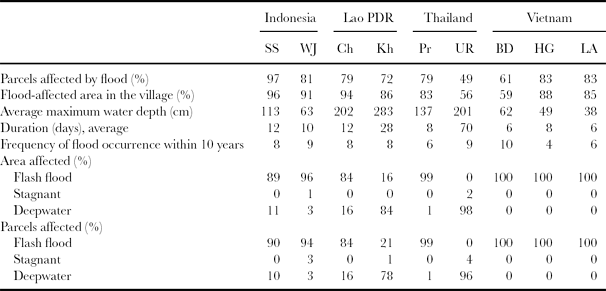
Flooding is a major concern at the study sites as it occurs in 49–97% of the parcels planted to rice, or 56–96% of the total area of the village (Table 1). The frequency of flood occurrence in a 10-year period ranged from four in Hau Giang to a maximum of 10 in Binh Dinh, both in Vietnam. With flooding, farmers suffered rice production losses of <10% in Long An to about 77% in Khammouane. These losses depend on the characteristics of flood, such as depth of water, timing with respect to the growth stage of rice, duration, frequency of occurrence and even quality of water. Parcels used for rice production are located in different parts of the toposequence and are therefore affected by different flood regimes. Floods can be of short duration (about one week) or they can last up to one month in many cases. But in some areas, especially in Lao PDR, sites can be affected by stagnant and deepwater floods that stay for more than two months.
Characteristics of flood events in the villages/project sites based on household surveys.

Legend for provinces. SS: South Sumatra, WJ: West Java, Ch: Champassak, Kh: Khammouane, Pr: Prachinburi, UR: Ubon Ratchathani, BD: Binh Dinh, HG: Hau Giang, LA: Long An.
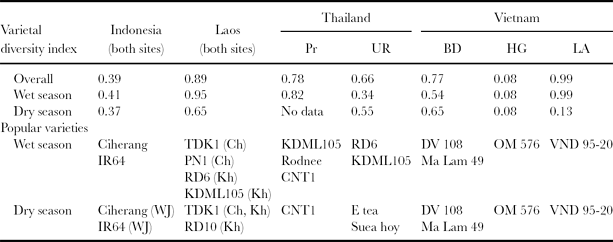
Farmers generally select varieties on the basis of their perception of the best combination of traits that can be used so that these varieties will outperform the varieties they commonly use (Adesina and Baidu-Forson, Reference Adesina and Baidu-Forson1995; Joshi and Pandey, Reference Joshi and Pandey2006; Paris et al., Reference Paris, Singh, Luis, Singh, Singh, Singh, Singh and Sarkarung2001b). They match varieties with the agroecological conditions prevalent in their fields. Social factors are crucial in understanding the farmers' varietal selection process. For instance, in Lao PDR, the results of the survey indicated that farmers like TDK1, a glutinous variety, which can be used during the wet and dry seasons, especially in Champassak. Glutinous rice is heavier in the stomach and can easily give a feeling of fullness compared with other varieties. Reports indicate that about 85% of the rice germplasm sampled was of the glutinous rice type, attesting to consumers’ and farmers' preference for sticky rice (Schiller et al., Reference Schiller, Chanphengxay, Linquist and Appa Rao2006: 133–134). RD6 and KDML 105 were the most popular varieties in Ubon Ratchathani, Thailand. These two varieties are photoperiod-sensitive and suitable for planting in the lower portion of the toposequence. This confirms the finding that the position of the farmers' field in the toposequence can determine the maturity group and degree of photoperiod sensitivity among other traits (Courtois et al., Reference Courtois, Bartholome, Chaudhary, McLaren, Misra, Mandal, Pandey, Paris, Piggin, Prasad, Roy, Sahu, Sahu, Sarkarung, Sharma, Singh, Singh, Singh, Singh, Singh, Singh, Singh, Sinha, Sisodia and Takhur2001). KDML 105, Rodnee and CNT1 were the varieties most widely used in Prachinburi, Thailand (Table 2). Generally, the varietal diversity index is high, reflecting how diversified the selections of varieties are among farmers in each country to address the complexity of environmental stresses and the combination of social and economic value of rice to the farmers. The variety diversification index measures the degree of diversity of varieties farmers choose to grow. It is high if the index is approaching the value of 1.0 and is low if it is approaching zero. In Lao PDR, TDK1, RD6 and KDML 105 are the most common cultivars but they vary across cropping seasons. Farmers used TDK1 during the dry season in both provinces but during the wet season, it is the dominant variety only in Champassak. TDK1 is a photoperiod-insensitive variety. In Thailand and Vietnam, the diversity of varieties grown differs across provinces. In Vietnam, farmers in Hau Giang grow limited choices of varieties compared with farmers' choices in Binh Dinh and Long An, which are highly diversified. In Hau Giang, 94% of the farmers grow OM 576, while in Long An, 73% grow VND 95-20. In Indonesia, Ciherang is the most popular variety in both dry and wet seasons, grown by 62% of the farmers, already replacing the previously widely grown IR64, because of the former's resistance to common pests and diseases.
Varietal diversity index (VDI) and the most popular varieties in each country.
Rice varietal diversity is measured using the rice VDI, where: index = 1 minus the squared sum of the proportional area planted to each variety, and for a particular farmer it was measured using the following formula:
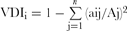 ${\rm VDI}_{\rm i} = 1-\sum\limits_{{\rm j} = 1}^n {({\rm aij}/{\rm Aj})^{2}}$; for popular varieties, only those with more than 15 respondents reporting were included.
Participatory varietal selection – preference analysis
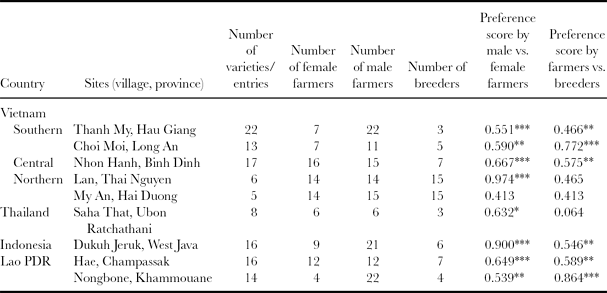
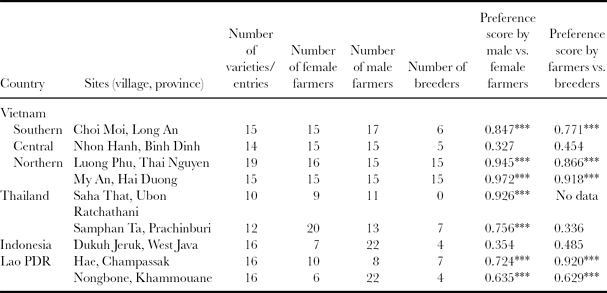
The results of PA for the 2008 and 2009 wet seasons are shown in Tables 3 and 4 respectively. The design of the PVS trials was largely dependent on the timely availability of test seeds. Certain limitations on the number of trials and farmer-cooperators were attributed to the difficulty in getting the import permit for the seeds and the bureaucratic in-country seed delivery system. Not all countries were able to test the same set of entries/varieties during the two wet cropping seasons. The preference scores derived from the PA exercise were correlated between male and female farmers and between farmers and breeders to determine whether there was any association in their selection criteria for the most- and least-preferred entries.
Correlation analysis of preference scores across countries, 2008 wet season.
PA was conducted in Indonesia in the dry season.
Level of statistical significance: *p < 0.1, **p < 0.05, ***p < 0.01.
n = number of varieties or entries in the trials.
Source: Preference analysis conducted by NARES, as updated table in Manzanilla et al. (Reference Manzanilla, Paris, Vergara, Ismail, Pandey, Labios, Tatlonghari, Acda, Chi, Duoangsila, Siliphouthone, Manikmas and Mackill2011).
Correlation analysis of preference scores across countries, 2009 wet season.
Level of statistical significance: *p < 0.1, **p < 0.05, ***p < 0.01.
n = number of varieties or entries in the trials.
For 2008, statistically significant results showed a positive correlation between the preference scores for the varieties given by male and female farmers in all provinces. Correlation coefficients ranged from moderate to very strong association (r = 0.55–0.97). This indicates that, at these sites, there is some agreement between the lines/varieties preferred by both men and women, affirming that women are equally knowledgeable as the men in evaluating the visible characteristics of the varieties that they grow. In Hai Duong, a correlation of r = 0.41 was found to be not statistically significant, and there is therefore not enough evidence to show the differences in male and female farmers' as well as all farmers' and breeders’ opinions about the characteristics of the entries. In Hai Duong, based on focus group discussions, female farmers affirmed that only the males make the final decision on which variety to grow, as they are more knowledgeable and have better awareness of the performance of technologies.
Some studies explain the possible differences in gender-based selection of traits and qualities of technologies. For instance, a study on maize in Ghana by Morris and Doss (Reference Morris and Doss1999) suggested that gender-linked differences in the adoption of modern varieties are not ascribed to the inherent characteristics of the varieties; rather, they are attributed to differences in access to inputs and information. It should be noted, although, that the study was done at sites where male- and female-headed households can make independent decisions on technologies. This can well indicate that, in areas where roles and access to inputs are somewhat differentiated, consulting women can lend deeper insights into the rice qualities that should be considered in breeding programmes. In this study, the households’ male and female members, who are the subject of inquiry, were making somewhat dependent observations that can be related to their preferences; hence, their choices of varieties in most cases were the same. Meinzen-Dick et al. (Reference Meinzen-Dick, Quisumbing, Behrman, Biermayr-Jenzano, Wilde, Noordeloos, Ragasa and Beintema2010: 45) indicated that a more critical assessment of gender roles and specific socio-cultural contexts may reveal other factors constraining adoption such as perceptions of the traits or risks associated with new technologies.
In the wet season of 2009, the same PA exercise with a different group of farmers showed a significantly positive strong to very strong correlation between male and female farmers' preference scores for the varieties in almost all villages (r = 0.64−0.97) except in Binh Dinh and West Java. Any differences in the results can be explained by wide variability in performance of the varieties/entries across genotypes and by genotype × location interactions, as perceived by the farmers, between seasons. Final results were affected by the number of entries in the exercise, for which the low number (n samples) led to statistically insignificant results.
Similarly, when combined (male and female) farmers' preferences were compared with the breeders’ preferences, the analysis showed moderate correlation (r = 0.47) to very strong correlation (r = 0.97) for most villages, except Hai Duong (2008) and Binh Dinh and West Java (2009) because of the limited number of entries used in the PA in the wet season. These results indicate that farmers and researchers somewhat agree on the characteristics that reflect potentially high-yielding varieties as well as on the varieties that could perform well in farmers' fields. These significant findings confirm that farmers (now recognized as ‘farmer-scientists’ in their own right) can tell, based on visual observations, which varieties can perform well under varying conditions (Paris et al., Reference Paris, Singh, Atlin, Sarkarung, McLaren, Courtois, Allister, Piggin, Pandey, Singh, Singh, Singh, Singh, Singh, Mandal, Prasad, Sahu, Sahu, Sharma, Singh, Thakur, Singh, Chaudhary, Ram, Witcombe, Parr and Atlin2002). Like the breeders, farmers use a number of agronomic traits that can reflect good yield performance – e.g. number of tillers, panicle size, grain quality, resistance to lodging and resistance to pests and diseases. Similar to the observations made by Courtois et al. (Reference Courtois, Bartholome, Chaudhary, McLaren, Misra, Mandal, Pandey, Paris, Piggin, Prasad, Roy, Sahu, Sahu, Sarkarung, Sharma, Singh, Singh, Singh, Singh, Singh, Singh, Singh, Sinha, Sisodia and Takhur2001), the degree of agreement or disagreement between breeders’ and farmers' preferences was strongly determined by the overall performance of the lines because the farmers were evaluating the varieties in terms of the package of traits most important to them.
The study did not test the impact of socioeconomic and biophysical conditions of the farmers, since the farmers who joined the field tests and PA exercise were not the same as those included in the baseline survey. The project could have provided a more in-depth analysis of what can contribute to the differences in the pattern of preferred traits based on disaggregated results. As in Courtois et al. (Reference Courtois, Bartholome, Chaudhary, McLaren, Misra, Mandal, Pandey, Paris, Piggin, Prasad, Roy, Sahu, Sahu, Sarkarung, Sharma, Singh, Singh, Singh, Singh, Singh, Singh, Singh, Sinha, Sisodia and Takhur2001), the agreement between farmers' and breeders’ ratings could not be disaggregated according to different typology of farmers based on socioeconomic characteristics as, in some cases, only a few farmers participated in the exercise, and, based on the PA, it appeared that not enough information would indicate that the farmers had significant differences in farm characteristics that would reflect differences in their preferences. To provide added insights, the results of the PA were discussed with the farmers to reveal reasons for differences, or similarities, and the reasons behind their preferred traits using a focus group discussion (Table 6).
In running the correlation between the preference scores of farmers (combined male and female) and yield, this study did not get any statistically significant results. This result indicates that farmers consider other factors, aside from yield, in selecting varieties or entries as revealed during focus group discussions. Farmers' preferences were based on other characteristics that are mainly dictated by social and economic factors such as plant height (for ease of harvesting), maturity (when crop production stages matched the existing cropping pattern, opportunity for a second rice or non-rice crop, and flooding conditions in the area) and grain quality (based on perceived consumer taste preferences). Also, in rainfed rice environments, wide variability in performance due to changes in biotic and abiotic factors made it somewhat difficult to predict overall varietal performance.
Farmers' preferences and selection criteria
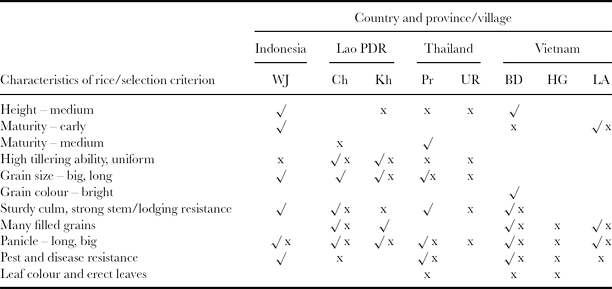
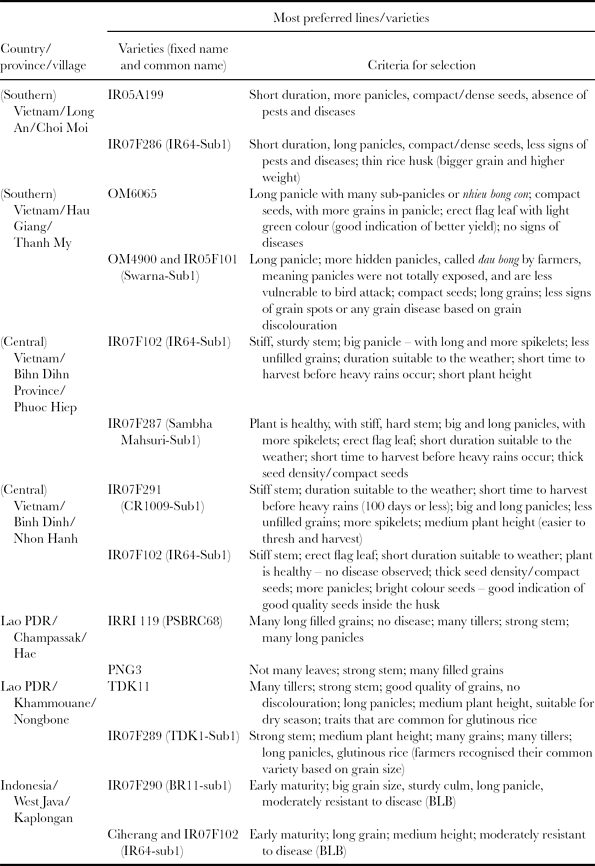
Results of the comparison of characteristics of rice varieties used by farmers in the 2008 and 2009 wet seasons' PA for the four countries are presented in Table 5. The selected sets of criteria that farmers in Vietnam, Lao PDR and Indonesia used for specific varieties/lines are presented in Table 6. As flood-prone ecosystems are complex and unpredictable, farmers differed in their perceptions about the variety that is most adaptable under their field conditions.
Criteria used in the selection of the most preferred varieties, 2008 and 2009 wet seasons.
Legend for provinces. WJ;: West Java, Ch: Champassak, Kh: Khammouane, Pr: Prachinburi, UR: Ubon Ratchathani, BD: Binh Dinh, HG: Hau Giang, LA: Long An.
Marks: ✓: WS 2009; x: WS 2008.
Farmers' most preferred varieties and criteria for selection (Vietnam, Lao PDR and Indonesia), 2008 wet season.
Source: Updated table based on preference analysis conducted by the NARES; Manzanilla et al. (Reference Manzanilla, Paris, Vergara, Ismail, Pandey, Labios, Tatlonghari, Acda, Chi, Duoangsila, Siliphouthone, Manikmas and Mackill2011).
What are the preferred varieties and what are the bases for selection? Farmers have indicated varying combinations of traits preferred in a variety, such as long and big panicles, sturdy culm, strong stem/lodging resistance, pest and disease resistance, uniform and high tillering ability and many filled grains, as major considerations in varietal preferences. The growth duration of the variety was also considered an important trait, as farmers are concerned about the cropping calendar (adjusting crop establishment to avoid the probability of flood occurrence), cropping system (to be able to grow another crop of rice or other crops) and timing of crop growth (to avoid occurrence of pests, diseases and bird attacks). Farmers have their own ‘scientific’ way of evaluating the performance of the varieties, which is similar to the way scientists would evaluate a crop stand based on agronomic characteristics. They count the tillers and seeds, check leaves for any signs of disease, and even pull out the plant to evaluate the roots. In Thang My village, southern Vietnam, farmers selected OM 6065 for its long panicles and presence of more sub-panicles, called nhieu bong con, which can give higher yields. In Choi Moi village, farmers preferred IR82355-5-2-3 for its short duration, more panicles, compact or dense seeds, and observed absence of brown planthopper infestation. OM 4900 and Swarna-Sub1 (IR05F102) were the second choices because of their long panicles and more hidden panicles that farmers call dau bong (panicles were not totally exposed or were partly hidden by the longer flag leaf). This is an important trait that assures farmers of crop protection from bird attacks.
Differences in biophysical and socioeconomic conditions among the villages and sites help explain most of the observations. For instance, farmers mentioned that timing and extent of flooding, sources or causes of flood events, cycles of pests and diseases, and location of farms were some of the biophysical factors they consider in selecting rice varieties. Flooding at southern Vietnam sites has short duration and shallow depth, making it easy for farmers to avoid any potential impact of floods. In northern Vietnam, the common cropping pattern is rice–corn–vegetables, and flash flooding occurs in late July until early August, just before flowering. Thus, farmers prefer medium duration varieties.
During the focus group discussion, farmers revealed that socioeconomic factors such as the predominant farming system (monocropping versus rice–corn–vegetable system in the northern region and rice–rice culture in the southern region), expected yield, availability of seeds, and farmers' knowledge about the varieties were also important. The other traits important to women were height of the plant or length of the stalk for ease of harvesting and threshing. Thus, varieties with these additional traits will be positively regarded by women, as reduction in their time and energy will enable them to engage in more remunerative activities. In Lao PDR, farmers' strong preference for glutinous rice was evident in how they evaluated other varieties against their standard characterization of a glutinous rice crop stand.
The results showed the stark necessity of exposing farmers to new varieties and eliciting their criteria in selecting varieties. These pieces of information will be vital for breeding rice varieties suitable to farmers' environment and needs (biophysical, social and economic). However, it should be noted that, in most cases, there were differences in the sets of entries/lines in the PA exercise and the variable biophysical conditions that significantly influenced farmers' choices. Also, because of the complexity of the flooding ecosystems, lines/varieties had varying performance. It is therefore crucial in any varietal development programme to understand the characteristics of floods and other biotic and abiotic constraints surrounding the ecosystem, which may affect varietal performance.
Sensory tests for cooking and eating quality
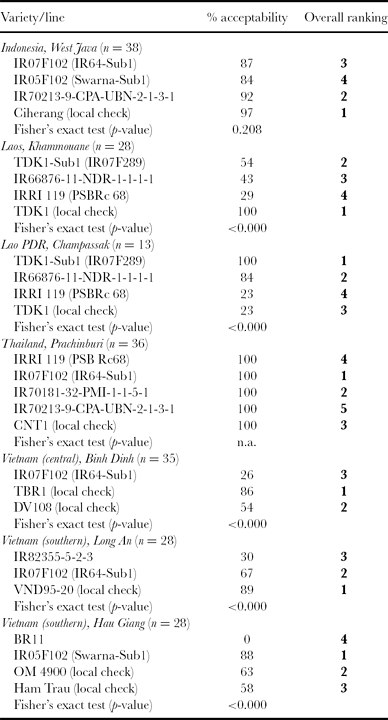
Farmers' perceptions obtained through PA conducted in the RM trials were mainly based on visual rating. A variety may be visually desirable, but it may not have the quality traits that consumers want. Thus, a sensory test was done to give farmers the opportunity to evaluate the cooking and eating qualities of their best rice cultivars. The top three most preferred submergence-tolerant varieties from the PA conducted in the 2008 wet season (when seeds were available) were tested against the local popular variety. Sensory tests provide the physical basis for the final acceptability of rice and can guide the development of varieties catering to varying tastes and uses for buyers and consumers. Results provide some basis for assessing rice not only for qualities as staple food but also for suitability in processing into other products such as rice noodles, delicacies and other food preparations. Since farmers are untrained evaluators, the test involved a simple method of asking about the acceptability of the variety and ranking the criteria used in the selection process. The study identified more female participants for the sensory test since they are the ones preparing the food and cooking rice for meals. In other related studies (Paris et al., Reference Paris, Singh, Luis, Singh, Singh, Singh, Singh and Sarkarung2001b), the women were found to be skilful in evaluating post-harvest traits, including the cooking and eating qualities of rice. The results are presented in Table 7, showing the overall ranking or position given by farmers to each line or variety included in the sensory test.
Percentage acceptability and overall ranking by the farmers of their preferred lines/varieties, results of sensory evaluation, 2009 wet season.
To test the association between ‘acceptability’ of the varieties and the farmers' perception of a good variety for eating and cooking qualities, Fisher's exact test was used. This ensured the reliability of using a simple evaluation process of obtaining the degree of acceptability based on ‘yes’ or ‘no’ answers. A statistically significant test result indicates that farmers accept the varieties if they find that these lines exhibit their preferred qualities. The characteristics that were commonly indicated were taste, colour, consistency, aroma, cohesiveness and tenderness. The resulting preferences for cooking and eating qualities reflect the variability in the quality of the seeds as affected by weather conditions at harvest. This is illustrated by the findings from two provinces in Lao PDR where differences in the evaluation of TDK1, a popular local variety, were noted. Farmers rejected TDK1 seeds in Champassak because of poor quality when the crop was harvested under inclement weather conditions. On the other hand, farmers preferred TDK1 in Khammouane because of its good taste, stickiness and aroma (or ‘sweetness’ as described by farmers) since the sample was sourced from newly milled rice. The rest of the test varieties in this village were tagged ‘off-aroma’ or do not exhibit the distinctive and usually pleasant smell that farmers prefer in their varieties. This was attributed to their source from the previous year's harvests and these varieties were milled using the inefficient village-type mill.
The introgression of the SUB1 gene into a popular variety has no effect on traits other than the target trait of flooding tolerance. The results of the sensory test indicated that TDK1-Sub1 got the farmers' nod in terms of eating and cooking qualities; it had an acceptability score of 100% in Champassak and 54% in Khammouane. IRRI 119 (PSBRc 68), observed to have acceptable agronomic characteristics, was not preferred by the farmers because of the hardness of leftover rice. In Lao PDR, particularly in the study villages, it is very common for households to cook their rice in the morning and keep it in a native rice receptacle for consumption in the evening. Cultural differences that in turn influence consumer preferences between sites or across countries should be considered in identifying varieties for diffusion.
In southern Vietnam, the sensory test was conducted in Choi Moi, Long An. VND95–20 ranked number one with 89% acceptability, followed by IR64-Sub1 with 67% acceptability. Farmers preferred their local variety because of its sweet (good) taste, good aroma, white colour and cohesiveness. In Binh Dinh, 86% of the participants accepted TBR1, while 74% did not find IR64-Sub1 acceptable for various reasons. TBR1, IR64-Sub1 and DV108 ranked first, second and third, according to farmers' own criteria, respectively. The unmilled IR64-Sub1 rice showed black spots, while its milled grain had a high percentage of breakage. Note that the poor grain quality was also influenced by the weather at the time of harvest. The seeds got soaked in rainwater and were not sun-dried.
Farmers in each country were also asked to rank three varieties. In Thailand, all varieties were acceptable to the farmers, but IR64-Sub1 was deemed the best because of its good taste, white colour and ‘acceptable’ cohesiveness. It has a distinctive and usually pleasant smell or aroma similar to the other commonly used varieties. In the Philippines, IR64, the local check variety, was still the top choice for its good taste, consistency and white colour. In both countries, farmers' preferences for grain qualities such as slender or intermediate shape and white colour were evident in their choices. In Indonesia, Ciherang, a local popular variety, was also the top choice. Both Ciherang and IR64-Sub1 possess characteristics that are most acceptable to Indonesian consumers, with their white colour, long and slender grains, good aroma and cohesiveness. In Lao PDR, TDK1 and TDK1-Sub1 were the most favoured varieties. The sensory tests indicate that male and female farmers have common knowledge of the traits most acceptable to the village people and that these should be taken into account in germplasm development.
Participatory varietal selection – farmer-managed
The FM trials (baby trials) were conducted to further test the performance of the most preferred seeds selected in the RM trials (mother trials). Farmer-cooperators in Indonesia, Lao PDR and Vietnam were given about 5.0 kg each of the submergence-tolerant varieties. In Indonesia, farmers planted INPARA 3 (IR70213-9-CPA-12-UBN2-1-3-1), IR64-Sub1 (IR07F102) and Swarna-Sub1 (IR05F101). In Vietnam, farmers grew IR64-Sub1, Swarna-Sub1 and IR82355-5-2-3. Lao farmers cultivated different sets of submergence-tolerant varieties such as IR66876-11-NDR-1-1-1-1, PSBRc 68 (IRRI 119) and TDK1-Sub1 (IR07F289). The yields of the Sub1 varieties were compared with those of the farmers' local varieties. A majority of the farmers planted high-yielding varieties. Small portions of land in Lao PDR are still planted to traditional rice varieties such as Sanpatong, Inthala and Dor, which farmers use for special products such as rice cakes.
The survival rates of the submergence-tolerant varieties in different countries were affected by the duration and timing of flooding. Survival rate is the percentage of rice plants alive after a flooding event. Survival rates were higher (97–100%) during longer flooding events of 4–20 days and at different stages of rice growth. The submergence-tolerant varieties that were exposed to more than seven days of flooding had consistently higher survival rates than the local check. Similarly, higher survival rates (90–100%) were also noted for the submergence-tolerant varieties that were exposed at the early phase (tillering stage) to longer flooding duration (10–20 days). However, in Indonesia, when submergence-tolerant and local varieties were exposed at a later stage (stem elongation), the same survival rates (99%) were observed since the plants were already mature and the depth of flooding was only 63–67 cm. Higher survival rates (100%) were observed in Lao PDR. Clearly, this showed that depth of flooding is critical in rice plant survival.
A majority of the farmers who experienced flooding had plants affected in the vegetative phase, particularly at the tillering stage. Flood damage to crops can vary, depending on the duration and timing of occurrence with the crop growth stage (Manzanilla et al., Reference Manzanilla, Paris, Vergara, Ismail, Pandey, Labios, Tatlonghari, Acda, Chi, Duoangsila, Siliphouthone, Manikmas and Mackill2011; Septiningshih et al., Reference Septiningsih, Pamplona, Sanchez, Neeraja, Vergara, Heuer, Ismail and Mackill2009; Wang et al., Reference Wang, Vergara, Li, Mackill and Ismail2009). Based on farmers' perceptions, the survival rates of submergence-tolerant varieties were generally higher than those of local popular varieties at different duration, depth and timing of flooding. In terms of yield, no significant differences were noted between the mean yields of the test varieties mainly because the floods differed in characteristics and, in some cases, floods were easily avoided by re-planting and re-sowing. The commonly grown cultivars are already high yielders and can well serve as materials for the introgression of the SUB1 gene. In the case of Indonesia and Vietnam, since flood duration is short and floods occur mostly at the early stages of crop growth, the yields of local varieties were consistently higher than those of submergence-tolerant varieties. Varieties such as Mekongga and Ciherang have potential yields as high as 8.0 t ha−1 compared with the yields of submergence-tolerant varieties such as INPARA 3 (7.4 t ha−1), IR64-Sub1 (6.1 t ha−1) and Swarna-Sub1 (5.2 t ha−1) (based on on-station experiments). In Hau Giang, Vietnam, the yield difference was significant because only 5% of the local varieties did not survive after flooding. Local variety OM 4088 yielded 7.0 t ha−1, whereas Ham Trau and OM 4059 yielded 6.5 and 5 t ha−1 respectively; all out yielded Swarna-Sub1, with a potential yield of only 4.6 t ha−1 under normal conditions.
The yield differences between submergence-tolerant and local varieties in Lao PDR were statistically significant for varieties that had substantial decrease in survival rates when flooding occurred at a critical stage such as flowering and heading. Some farmers reported that, although the local varieties survived, their harvests translated into low yields. This shows that, during flood events, yield is more sensitive than survival rate (Wang et al., Reference Wang, Vergara, Li, Mackill and Ismail2009).
The findings about survival rates, depth of flooding and yields were noted on the basis of the patterns of results observed in the field. Since on-farm experiments such as the FM trials are subjected to uncontrolled environments, other factors may have also affected the performance of the varieties. Further adaptability trials should be carried out to systematically understand the relationship between potential grain yield and variables such as flooding duration, depth and timing. This study indicates that locally popular cultivars, which have high yields and are widely grown in farmers' fields, are potential materials for the incorporation of the SUB1 gene. This gene will provide added protection needed during occurrences of submergence-type floods.
The Wilcoxon signed-rank test was used to test differences between male and female farmers' perceptions on agronomic characteristics. Both groups of farmers were asked to rank the submergence-tolerant varieties based on 14 agronomic traits, including tillering ability, plant height, tolerance of submergence, tolerance of pests and diseases, lodging resistance, grain yield, ease in harvesting and threshing, milling recovery, market price, cooking and eating quality, and storage quality. Ranking is considered 1 if the submergence-tolerant variety is worse than the local variety; 2 if it is the same as the local variety; and 3 if it is better than the local variety. Overall, the ratings of male and female farmers were the same for the three varieties tested against the local check for most of the agronomic characteristics. Only the tillering ability of INPARA 3 in Indonesia, the lodging resistance of IR82355-5-2-3 in Vietnam, the tolerance of submergence of PSB Rc 68 in Lao PDR and the plant height of Swarna-Sub1 in Indonesia were rated differently by male and female farmers. As in the previous exercises on PVS-RM, the results in this PVS-FM revealed that female farmers are as knowledgeable as male farmers in terms of evaluating the performance of different rice varieties suitable to their farming conditions, but the ratings may differ in some cases due to various cultural and economic contexts.
CONCLUSIONS
The ultimate test for the efficacy and acceptability of varieties is when farmers actually use them and they stay long in the field. Participatory research for development calls for genuine involvement of farmer-users in various stages of the process to ensure better adoption of technologies (Paris et al., Reference Paris, Singh, Singh and Ram2006). Getting feedback from farmers is one way of ensuring that their preferences and selection criteria are given utmost importance in varietal development, improvement and seed multiplication systems for them to find use in farmers' fields. This means that male and female farmers should make the decision, and not the researchers or any other development partners. Farmers' decisions about the adoption of a technology are influenced by their perception of the performance of a new technology in relation to their current practice (Joshi and Pandey, Reference Joshi and Pandey2006). The rice farmers at the study sites used multiple criteria in making their selection and therefore it would be best if as many good traits as possible could be combined in a greater number of varieties. In essence, the perspective from the scientific community should follow the bottom-up or needs-based approach to suggest solutions to identify productivity constraints.
Farmers' adoption decisions are also based on their perceptions of the added advantage offered by the new varieties. Using simple steps, those farmers can easily identify with and that still follow systematic collection and analysis of data, and male and female farmers' views in trials conducted under farmers' field conditions can be captured. The PA under the PVS used in this project contributed to a more active interaction with the users. This, in turn, provided easier means for farmers to make individual decisions and for communities to collectively discuss and provide feedback to breeders on the combination of rice characteristics most acceptable to a greater number of farmers.
The PVS process, in many programmes in different partner-countries, is beginning to find relevance, particularly in the varietal release system (Manzanilla, et al. Reference Manzanilla, Paris, Vergara, Ismail, Pandey, Labios, Tatlonghari, Acda, Chi, Duoangsila, Siliphouthone, Manikmas and Mackill2011), as it is cost-effective and can reduce the time requirement of testing under the formal release system (Paris et al., Reference Paris, Manzanilla, Tatlonghari and Labios2011), allows getting feedback from farmers and breeders in a simple way, can showcase the performance of varieties under both on-farm and on-station conditions, and is a useful tool for predicting whether farmers will adopt a variety or not (Paris, et al., Reference Paris, Manzanilla, Tatlonghari and Labios2011: 3). PVS also serves as an entry point for other interventions, such as training on other farm aspects and in the fast-track delivery of new tolerant lines and varieties to farmers (Vial et al., Reference Vial, Inthapanya and Fukai2008). One notable difference of this project with PVS is highlighting the importance of getting feedback from both male and female farmers on the traits that are socio-economically important to them. The inclusion of active poor female farmers as project cooperators in PVS-RM and PVS-FM trials underscored their increasing role in managing farm operations and concomitantly in decision-making, particularly with respect to the selection of seeds, seed health and seed management. Also, the PVS protocol incorporates a simple way of quantifying and systematically collecting feedback from farmers. Combining this with the qualitative means of eliciting insights and farmers' perspectives allows a deeper understanding of their decisions on what to grow. The protocol also incorporates sensory evaluation for cooking and eating qualities, which is often not included in similar project activities on varietal selection (Vial et al., Reference Vial, Inthapanya and Fukai2008).
The PVS process and resulting data can be integrated into the varietal release process in terms of meeting requirements for on-farm trials in a multi-location system. To date, a number of countries in South and Southeast Asia are using the results of PVS in evaluating lines subject to national varietal release system requirements. The clamour to adopt participatory approaches in varietal release systems has been mounting, yet this has not been easy for all countries. Nevertheless, at IRRI, programmes on varietal development for stress-prone environments are now carried out with a PVS approach. In the Philippines, the release of variety IR64-Sub1, with the common name ‘Submarino 1’, benefited from the PVS data together with other requirements for national cooperative testing (Manzanilla et al., Reference Manzanilla, Paris, Vergara, Ismail, Pandey, Labios, Tatlonghari, Acda, Chi, Duoangsila, Siliphouthone, Manikmas and Mackill2011). Other varieties have been released with supporting data based on PVS results. TDK1-Sub1 in Lao PDR is undergoing further testing for pest and disease resistance and with application pending for government release (K. Douangsila, Director, National Rice Research Programme (NRRP), National Agriculture and Forestry Research Institute (NAFRI), Ministry of Agriculture and Forestry, personal communication, February 2012). Similarly, IR64-Sub1 that has been a product of the PVS process is now part of their seed multiplication and distribution programmes, particularly in affected irrigated areas. In Indonesia, the Indonesian Center for Rice Research (ICRR) has been a partner of IRRI in a number of programmes, resulting in the release of six varieties for inland swamps and flooded conditions, including INPARA 4 (Swarna-Sub1) and INPARA 5 (IR64-Sub1). Accelerating the seed multiplication of these newly released varieties is high on their development agenda (Nugraha and Sasmita, Reference Nugraha and Sasmita2012). Ciherang-Sub1, a derivative of IR64 that meets the taste of the Indonesian populace for similar traits that once were the selling point of IR64, is now undergoing evaluation in farmers' fields in many countries. PVS has also been a major approach in the implementation of the Stress-Tolerant Rice for Africa and South Asia (STRASA) project under the Bill & Melinda Gates Foundation, the results of which have been successful in releasing of drought-, submergence- and salinity-tolerant varieties in Nepal, Bangladesh and India. Once the varieties are released, they can become part of out-scaling and national programmes on seed multiplication and dissemination.
But, although a number of project-based PVS activities have transformed the research and development activities in rice in Asia and have influenced to a certain extent the fast-track release of many stress-tolerant varieties, it is still a question as to how well some of these learnings are really institutionalized in the current status of varietal release systems in many countries. One issue that has been articulated in many fora is the need to enhance the efficiency and transparency of existing variety testing and release procedures to encourage FM on-farm trials in the later stages of testing to essentially document the performance of varieties in varying actual field conditions and to get feedback from farmers. As PVS is most applicable to stress-prone environments, it has been discussed among those engaged in reviewing the system that, for varieties for marginal and resource-poor ecosystems, the results of PVS should be evaluated against revised, less strict and more flexible release standards that would focus on ‘acceptability’ rather than numerical yield advantage. Another issue is the consideration of location-specific releases of varieties on regional basis or within a limited geographic scope if the results of multi-location trials are to adequately showcase the variety's performance in comparison to the local check variety.
Targeting a greater number of users of varieties and appropriate management options entails the enhancement of NARES capacity in using participatory approaches. As frontliners in the development process, they need to be better equipped to handle participatory tools for problem diagnosis, varietal selection with farmers and technology diffusion. Their role is crucial in future efforts at integrating and mainstreaming social and gender perspectives in varietal development programmes. NARES and other partners’ better understanding of the factors that influence women's empowerment and better access to training and information must be high on the research agenda.
As Efisue et al. (Reference Efisue, Tongoona, Derera, Langyintuo, Laing and Ubi2008) had found out, different plant types and management practices should target different ecologies to enhance community impact. In this study, farmers at different sites, as affected by various types of flooding in general and by submergence in particular, require different plant types. Because of the complexity and diversity of rice farming systems in submergence-prone areas, farmers should have a ‘basket of options’ to have more choices of varieties or new lines suitable to their specific conditions. The new submergence-tolerant lines and varieties must have the traits needed so that these new ones can outperform current popular varieties before farmers will adopt them. The current selection of genotypes for submergence tolerance needs to be expanded to include tolerance for other types of floods such as germination-stage floods, stagnant floods and deepwater floods. In addition, this study provided information on the current popular rice varieties and their traits as the basis for introgression of the SUB1 gene into existing cultivars. Farmers face varying excess water conditions requiring different plant types with different combinations of characteristics. The current available genotypes perform differently under varying conditions, indicating wide variation in genotype × environment interactions. Thus, further studies are needed to gain a broader perspective on how to better improve current lines/varieties.
Acknowledgements
This research was made possible through the generous support of the Ministry of Foreign Affairs (MOFA) of the Japanese Government. The authors wish to acknowledge NARES that participated in the study. Due recognition is also accorded to the staff members of IRRI, who provided support in conceptualizing, collecting and analysing the data, and reviewing the paper. Many thanks also go to many farmers and extension workers at the project sites who participated and generously shared time, experience and knowledge in making this endeavour possible.