The rise and spread of Islam took place so rapidly that in the century following the death of Mohammed, large parts of the Mediterranean basin—much of which previously had been under Roman rule—came under the leadership of Muslim caliphs. Islam's success as a political-religious movement brought the Muslim religion to the Iberian peninsula in Western Europe and, eventually, to the Byzantine capital of Constantinople in southeastern Europe. In response to a plea from the Byzantine emperor under threat of being overrun by invading Muslim Turks, in 1095 CE Pope Urban II appealed to Christians in the West to assist their eastern brethren, with a further goal of recapturing Jerusalem and the Holy Land from Muslim control. The military mobilization that followed came to be known as the Crusades, which took place for the next two centuries.
The Holy Land Crusades were, perhaps, the largest-scale military mobilizations of the medieval period and a defining feature of a critical period for the establishment of European states. Blaydes and Chaney argue that feudalism—first introduced in the ninth century—played a decisive role in the emergence of European institutional exceptionalism, particularly as feudal associations encouraged early forms of executive constraint.Footnote 1 But feudalism also entrenched personal elite relationships that hindered productive economic and political competition.Footnote 2 Ruggie describes the shift from medieval feudalism—with its multiple and overlapping layers of sovereign authority—to a system of territorial states as “the most important contextual change in international politics in this millennium.”Footnote 3 Explanations for this transition abound, yet we are aware of none that consider how the rise of Muslim military and political power may have affected European institutional development.Footnote 4
The Holy Land Crusades—which arose in response to the expansion of Muslim polities in the East—impelled Western Europe to break from feudalism and move toward the creation of increasingly impersonal and consolidated states. Although the state structures that emerged were not always highly capable or centralized, they nonetheless represented a significant discontinuity from those that existed in the recent past. European monarchs began to enjoy greater political power over what had previously been a loose network of decentralized local elites. Indeed, Spruyt argues the early twelfth century was a turning point in the development of state formation in Western Europe during which time “taxation, administration, and the subsequent policing of society increased the ability of the state to intervene in all aspects of social life.”Footnote 5 By 1500 CE—and the emergence of long-distance, Atlantic trade opportunities—European monarchs were already well on their way to developing the types of growth-enhancing institutions that seemed critical for industrialization and, eventually, democratic consolidation.Footnote 6 Yet scholars specializing in political economy have paid relatively little attention to institutional developments in the late medieval period when Europe first began to enjoy the institutional advantages that facilitated colonial ventures, trade expansion, and technological innovation.
We explore four causal channels by which crusader mobilization strengthened nascent states. First, the departure of relatively large numbers of European elites for the Holy Land reduced the absolute number of elites who might serve as challengers to the king, increasing the stability of ruling monarchies. Second, crusade tithes were also among the first “per-head” taxes to be levied on European populations, creating precedent for later forms of centralized taxation and encouraging the development of representative institutions. Third, the large-scale sale of land by rural elites seeking to finance crusade expeditions undermined existing feudal institutional forms. Finally, the Crusades were a catalyst for the reintegration of Western Europe into global trade networks with implications for the rise of towns and urban governance structures. Using an original data set of the geographic origins of elite crusaders, we find that areas with large numbers of Holy Land crusaders saw increased political stability, a higher probability of establishing parliamentary institutions, higher downstream levels of tax revenue, and greater urbanization, even after controlling for a number of possible confounders.
Our findings contribute to a scholarly debate regarding when the critical institutions associated with the modern state first appeared. The existing literature on state formation has been focused on three key questions: When did nascent, territorial states first emerge? How did territorial states come to predominate over other forms of governance, such as city states? And how did norms of state sovereignty evolve? Prominent existing work has focused on how territorial states came to displace other institutional forms of governanceFootnote 7 and when and how sovereignty emerged and evolved as an international norm.Footnote 8 The origins of states and the state system, however, remain opaque. Although our causal mechanisms linking the Crusades to state formation, particularly our focus on the importance of war preparation and urban capital accumulation, resemble those emphasized by Tilly,Footnote 9 we date the point of critical transition to modern statehood centuries earlier than Tilly.Footnote 10 As a result, our focus on institutional developments in the twelfth and thirteenth centuries is more in line with scholars who emphasize the medieval origins of the modern state.Footnote 11
Our findings also relate to a small, but growing, literature that considers how developments in the Islamic world affected the evolution of European political institutions. For example, existing scholarly work has considered how historical developments in the Ottoman Empire influenced religious reform and interstate conflict within Europe.Footnote 12 This is the first study we are aware of that pushes back the historical time horizon to empirically examine how developments on Europe's periphery influenced its history through an examination of interactions between Christians and Muslims during the medieval period. As such, we provide a “second image reversed” perspective on the question of European state formation by examining the international sources of Europe's political development.Footnote 13
Crusader Mobilization and Financing
Holy Land crusades of the medieval period were large, papally sanctioned expeditions, undertaken on Christ's behalf, typically with Jerusalem as the goal of the mobilization.Footnote 14 Madden describes the Crusades as wars against enemies of the Church.Footnote 15 Crusader expeditions shared some characteristics with preexisting forms of Holy Land pilgrimage. Yet the preponderance of historians have argued that, in terms of scale and objective, the Crusades constituted a previously unknown form of war. Indeed, Riley-Smith calls the First Crusade a “war of a type never experienced before and on a scale not known for six centuries.”Footnote 16
A number of factors distinguished the Crusades from other forms of conflict. While Byzantine and Iberian Christians were engaged in battle with Muslims on their own soil, other Europeans mobilized for war without concern for territorial defeat in their homelands. The battleground was extremely far from mobilization and recruitment locales, leading crusader expeditions to be extremely costly. Finally, recent historical accounts generally concur that crusader mobilization took place as a result of ideological and religious motivations rather than with an expectation of financial gain.
Despite some of the important differences between traditional wars and mobilization for the Crusades, in many ways, leading social scientific accounts of the impact of war making on societal change should be relevant. Tilly argues that the need to build and equip armies constituted among the largest single incentives for extraction over the long run of European state making.Footnote 17 In Tilly's account, however, war making alone does not a state make. The earliest full-fledged nation-states developed in capital-intensive polities where a “capitalized coercion mode” might predominate.Footnote 18 The account that we provide in this article describes how crusading had an impact on both the rise of capital and the emergence of states with the capacity to extract broadly from their subject population.
The Social Origins of Holy Land Crusaders
There is general agreement among historians on the numbering of the first five crusades: the First Crusade, 1096–1102 CE; Second Crusade, 1147–49 CE; Third Crusade, 1188–92 CE; Fourth Crusade, 1202–04 CE; and Fifth Crusade, 1217–21 CE. Some have argued for the relevance of three additional numbered crusades (the Sixth Crusade, 1227–29 CE; Seventh Crusade, 1248–54 CE; and Eighth Crusade 1270–72 CE) in addition to hundreds of smaller, minor crusades. But what do we know about the social, political, and economic origins of Holy Land crusaders? A variety of sources suggest that the primary crusade participants were members of the European elite—including nobles, knights, and monarchs—as well as the full complement of individuals who might accompany elites on such a journey. Part of the reason that elites were crusade participants was that the costs of raising the funds necessary to participate would be difficult, even for the affluent, and virtually impossible for poor nobles who might be required to raise up to four times their annual income.Footnote 19 This is not to say that elites were the numerical majority of travelers to the Holy Land; historians have suggested that nobles and knights in the First Crusade, for example, traveled with at least three to four times their numbers in squires, grooms, and other staff.Footnote 20 But it was the elites who “took up the cross” and most of what is known about the crusaders is drawn from charters that document the preparations of elite participants.
Primary crusaders in the First Crusade were drawn from across Europe's “arms-bearing class.”Footnote 21 Although none of the participants in the First Crusade were monarchs themselves, sons, brothers, and other relatives of kings participated in the First Crusade and monarchs themselves participated in later crusade waves.Footnote 22 Large numbers of crusaders came from the “political and administrative elite” including earls, sheriffs, and royal agents.Footnote 23 Tyerman writes that the “most characteristic English crucesignati were local landlords, knights and gentry, who … travelled with their small groups of companions, relations, vassals and neighbors.”Footnote 24 By the middle of the twelfth century, the crusading movement was an important part of the “collective consciousness” of noble and knightly families who constituted an important pool of potential crusaders.Footnote 25
What motivated individuals to take up the cross? Riley-Smith sees pious idealism at the root of the crusaders—that crusading was a Christian act of charity reflecting love of God and love of one's fellow Christians in the Holy Land.Footnote 26 Participants in Holy Land expeditions also sought spiritual privileges, most important of which was the indulgence. Brundage defines an indulgence as “a remission of the temporal penalties resulting from sin, granted after the eternal penalties for the sinful act have already been forgiven in sacramental confession.”Footnote 27
What might crusaders hope to gain from participating in a crusade?Footnote 28 The cost of crusading was so staggering that historians deemed profit an unlikely motive for participation. Crusading was a voluntary endeavor, and it is generally believed that individuals were not forced into the practice.Footnote 29 Crusaders did not come home wealthy, but they did enjoy status rewards as a result of their participation. Among the upper ranks of society there was enthusiasm for the practice as a key part of “chivalric culture.”Footnote 30 Religious rhetoric was typically also associated with medieval themes of “obligation, defence, honour and glory.”Footnote 31 As a result of these status rewards, crusaders might expect to even “arrange more advantageous matches for their sons and daughters.”Footnote 32
A number of legal rights and customary privileges also came to be associated with the act of crusading. These dispensations were granted by successive popes and included protection of property and possessions during a crusader's absence and legal privileges including the right to delay judicial procedures or to be judged in ecclesiastical rather than secular courts.Footnote 33 Perhaps the most important of these privileges was the right to “sell lands outright, and to mortgage or hypothecate them, even including fiefs.”Footnote 34 Before the Crusades a landholder would be required to receive the consent of his wife, heirs, and lord, if he was a vassal, to sell land; and consent was not often given.Footnote 35 This change to customary law had an enormous impact on feudal land-holding patterns in Western Europe.Footnote 36 The possibility also emerged at this time for the use of land as “security for loans of money,” establishing new financial procedures with wide-ranging consequences.Footnote 37 The ability to sell land without seeking the permission of others who might be affected by the sale through interlocking feudal obligations was highly significant.
Financing Expeditions to the Holy Land
Intimately linked to the class status of crusaders is the issue of how they financed their ventures. There is not a great deal of information about how nonelite crusade participants financed their activities.Footnote 38 Much more is known, however, about how European elites financed Holy Land expeditions as a result of crusader charters that document financial and other arrangements.
Land and Other Property Sales
Because crusading was extremely costly, it was typically individuals with resources who could participate in the Holy Land expeditions. Great lords were required to support the financial expenses associated with large vassal contingents of combatants and noncombatants. And the financing of a person's participation was borne primarily by that individual, even after twelfth-and thirteenth-century efforts by popes and kings to raise funds for large-scale expeditions.Footnote 39
Land and other property sales were the dominant mode by which individuals financed their expeditions. Although most crusade funds were raised through land transactions,Footnote 40 prospective crusaders also sold vineyards, mills, ovens, market rights, future revenue streams, and even serfs.Footnote 41 Many of the properties were very largeFootnote 42 and the tendency for many individuals to seek cash for land in a relatively short period of time led to major declines in the value of land. For example, the prices that many received in 1096 CE were depressed because crusaders glutted the market with numerous estates.Footnote 43 As a result, crusaders sold their lands on highly unfavorable terms.Footnote 44
According to historians of the era, one's willingness to pledge or sell property was an “extreme measure”Footnote 45 and there was no precedent for such widespread, nearly simultaneous, sale of landed estates. Until that point, it was extremely rare for financially healthy landholders to sell their estates, disinheriting their children in the process.Footnote 46 The decision to embark on a Holy Land expedition, then, imposed on the crusader's family “a medium-term or permanent diminution of estates and future profits.”Footnote 47 Because the sale of land or other revenue streams created a huge burden for crusader family members, many crusaders sought to arrange for wives to enter religious houses and to secure places for themselves in monasteries upon their return from their crusade.Footnote 48 Such arrangements were often undertaken under conditions when religious institutions served as sources of credit.Footnote 49
Before the Crusades, a landholder could not sell his property without the consent of his wife and heirs, or his lord, if holding feudal obligations.Footnote 50 Until the pope granted crusaders the right to sell or pledge land without the consent of lords or relatives in 1145 CE, crusaders used forms of moral persuasion to seek consent for land sales. But after 1145 CE, crusaders were offered opportunities to liquidate real property more easily. The net result was the “the alienation of property by crusaders.”Footnote 51 Outright land sales were not the only option for crusaders because forms of mortgage also emerged during the medieval period in response to crusaders' need for cash. Crusaders borrowed from merchants, religious orders, monarchs, and lesser lords,Footnote 52 using their land as collateral.Footnote 53 Tyerman characterizes the situation like this: “the problem was to capitalize land, rents, and rights of jurisdiction into bullion or war materials; the solution was sale, lease or mortgage.”Footnote 54
The relatively widespread, rapid sale and lease of feudal lands privileged capital holders who had the ability to acquire property or offer loans.Footnote 55 Under these circumstances, crusaders and their families were “habitual losers,” from an economic and financial perspective.Footnote 56 This redistribution of financial resources within medieval society—in a relatively short period of time and for reasons largely unrelated to the political economy of Europe, itself—represented a massive social, economic, and political shock. The net result was that the ability to sell land “contributed to the destruction of feudal landholding patterns in Western Europe during the thirteenth century … a development of fundamental importance in shaping the future economic and social contours of Europe, for it made possible the spread of landholding among larger and more diverse sections of the population.”Footnote 57
Medieval Origins of “National” Taxation
The history of the Crusades is closely linked to the origins of national taxation in Western Europe. Although the early waves of crusade were characterized by individual-level fundraising efforts of landed elite, over time more institutionalized forms of financing began to emerge. This occurred both in response to events taking place in the Holy Land, in particular the loss of formerly crusader-held lands, but also the growing participation of heads of state in crusader expeditions. In particular, the emergence of the “poll” tax—or general tax per head—in Europe is connected to urgent conditions associated with crusade financing.
Existing feudal structures provided the institutional basis upon which medieval kings might engage in general taxation of their subjects. In particular, “feudalism recognized the vassal's obligation to aid his lord in extraordinary need.”Footnote 58 As a result, the ability of monarchs to demand these funds “could be justified as logical extensions of doctrines implicit in feudal relationships.”Footnote 59 Although no kings were direct participants in the First Crusade, the kings of France and Germany were concerned with subsequent crusades and, over time, “with royal involvement came royal taxation.”Footnote 60 In 1146 CE, King Louis VII of France raised money with a “general levy on all subjects of the king” for which a “census was made through all France; neither sex nor order nor dignity excused anyone from giving aid to the king.”Footnote 61 In 1166 CE, he levied a property and income tax on all subjects for the defense of Jerusalem.Footnote 62 King Henry II of England followed suit with a tax earmarked for paying mercenaries in the Holy Land and building fortifications.Footnote 63
The ability to tax emerged from a feudal lord's right to seek financial aid during times of emergency—such as the Crusades and the ransom for King Richard when he was kidnapped while returning from the Holy Land—and it was through the use of emergency aid that general taxation emerged.Footnote 64 Indeed, Ames and Rapp argue that “tax systems originated with the need of medieval governments for ‘extraordinary’ revenues.” Appeals made by the pope to support the crusaders' efforts in their “hour of need”Footnote 65 assisted monarchs who sought to implement widespread taxation.Footnote 66
The most famous of the exigent taxes was the Saladin Tithe. The loss of Jerusalem to the Muslim sultan, Saladin, in 1187 CE “led to greater efforts by monarchs and popes alike to create large-scale means for raising crusade funds.”Footnote 67 The kings of France and England both imposed an “uncustomarily steep, one-time levy of 10 percent on all income and nonessential movable goods” in support of the reconquest of Jerusalem.Footnote 68 The Saladin Tithe has been described as novel in its severity.Footnote 69 In England, the tax was collected at the level of the parish using an elaborate bureaucratic “machinery” that had not existed previously. According to Cazel, “each taxpayer assessed himself (and) … paid his tax before committees composed of the parish priest, the rural dean, and the clerk of the baron on the local level, and of a Templar and Hospitaller, and clerks of the bishop and king on the diocesan level … if the collectors questioned the man's payment, a sworn jury of four to six men in the parish was called to assess him.” Punishment for nonpayment included excommunication and imprisonment.Footnote 70 Even though Philip II of France eventually abandoned the Saladin Tithe because of strong protest, his difficulty in collecting the tax led him to put into place administrative reforms in 1190 CE that “materially and later crucially improved Capetian financial resources.”Footnote 71 This view is consistent with Ruggie's argument that the Crusades “were not designed to suggest new modes of raising revenues for territorial rulers, but they ended up doing so.”Footnote 72
Efforts to collect taxes in support of the Crusades were not restricted to France and England. The first general tax known to have been levied in Germanic lands was decreed by Philip of Swabia, who—in 1207 CE—“ordered a general almsgiving for the Holy Land to be paid for five years” to be assessed by collectors appointed by bishops with nobles taking responsibility for enforcement.Footnote 73 Although nobles were asked to give as they saw fit, nonnobles “paid on each plow and in the towns two pence on each house.”Footnote 74 In 1221 CE, Emperor Frederick II imposed a tax on clerical and lay subjects in Sicily for a planned crusade.Footnote 75 Although not related to the Holy Land expeditions, Spanish monarchs levied a sales tax on all goods—the alcabala—as a source of income to defray costs associated with the reconquest of Spain from Muslim rule.Footnote 76 The alcabala eventually became a permanent royal fiscal tool.Footnote 77 Ames and Rapp write that “when the basic tax structure of Castile was set down in the 1200s the citizenry had every expectation of indefinite conflict … the consequence was a perpetual tax system.”Footnote 78
Trade, Urbanization, and State Formation
The Crusades also had significant economic effects beyond the area of taxation. Although there had been a flourishing trade in the Mediterranean region during the Roman period, the fall of the empire was associated with a reduction in cross-regional trade. The Crusades opened eastern Mediterranean ports to northern and western European traders after being largely closed for five centuries; in this process, “eastern” goods were able to reach Western Europe without having to move through Byzantine territory.Footnote 79
Abu-Lughod provides a well-developed elaboration of the mechanisms by which the Crusades increased commercial activity in northwestern Europe.Footnote 80 She argues that there had existed a significant political, social, and economic bifurcation during the early medieval period between relatively underdeveloped northwestern Europe and a more prosperous southern Europe on the Mediterranean coast. When Crusaders from northern and western parts of Europe began to travel to the Holy Land on Italian ships, this encouraged a reintegration of northwestern Europe “into a world system from which she had become detached after the ‘fall of Rome.’”Footnote 81 Her contention is that the Crusades were crucial in breaking northwestern Europe out of its relative isolation with associated long-term impacts on trade, growth, and urbanization.
Increased trade was spurred, in part, by the creation of a growing taste for “eastern” products that were introduced to Western Europe as a result of the Crusades. These products included spices, silk, porcelain, and other luxury goods.Footnote 82 Flemish nobles who participated in the Crusades discovered tradable goods from the East for which their cloth might be exchanged.Footnote 83 Indeed, Abu-Lughod argues that “the revival of the Champagne fairs in the twelfth century can be explained convincingly by both the enhanced demand for eastern goods stimulated by the Crusades and … the increased supplies of such goods they could now deliver.”Footnote 84 The net result was a rapid urbanization of northwestern European cities, such as Flanders and Bruge, which served as important trade hubs.Footnote 85 Abu-Lughod concludes that the thirteenth century was one of economic “efflorescence” on the European continent, at least in part, because of expanded horizons and trade opportunities associated with the Crusades.Footnote 86
This period of growing trade and economic exchange in Europe coincided with the rise of city-states, many of which were controlled by merchant guilds.Footnote 87 Few scholars in political science have pointed out how urbanization aided in processes of state formation.Footnote 88 Urban governments were frequently territorial rulers, serving as “nodes of control, both economically and militarily, within vast rural spaces.”Footnote 89 Urban historians have long pointed to the city as the model for the early modern state from an institutional development perspective, suggesting that cities served as pioneers for the development of legal codes, new bureaucratic forms, and institutions of conflict management. Dilcher, for example, reports that medieval cities created “a detailed law of privileges, conferments, statutes, unions, customs, and precedents, which went far beyond the archaic medieval territorial law.”Footnote 90 Isaacs and Prak describe cities as “laboratories of political technique” arguing that medieval city-states developed many of the essential tools of modern statehood in the realms of military, diplomatic, and fiscal affairs.Footnote 91 Finally, urban governance forms were also important because of the constituencies they created. Spruyt argues that “the growth of towns caused a new political group to emerge: the burghers or town dwellers.”Footnote 92 Tilly concurs and suggests that the growth of urban oligarchies led rulers to seek to incorporate those interests, often in representative institutions.Footnote 93
Stasavage suggests that autonomous cities first arose when groups of actors, particularly merchants, sought to create more secure forms of property rights protections by avoiding management by a feudal ruler.Footnote 94 He explains why autonomous cities enjoyed initially strong, and later stagnant, economic growth but does not focus on why autonomous cities developed where they did. Our historical explanation of the impact of the Crusades, and the associated empirical analysis, offers one interpretation for why autonomous cities developed when and where they did across medieval and early modern Europe.
Implications
We have argued that at least some part of the tremendous societal changes in Western Europe of the twelfth and thirteenth centuries might be attributed to the long-term impact of Holy Land Crusades. There are a number of causal channels by which crusader mobilization affected economic and political structures in medieval Europe.
First, crusading led relatively large numbers of European landed elites to leave northwestern Europe with the aim of reaching the Holy Land. Although most crusaders sought to return to their homes,Footnote 95 many did not and—for those who were able to return—the cost of financing their expedition left them in a vastly different economic position than when they set out. The absence of these individuals reduced the absolute number of elites who might serve as challengers to the king while simultaneously reducing the financial capital of the landed class. In some cases, the individuals who undertook crusade were on bad terms with sitting kings,Footnote 96 thus having the most to gain from monarchical overthrow. We posit that crusader mobilization should have a positive impact on the durability of monarchical rule.
Second, historians have pointed to the thirteenth century as a critical point in the development of systems of taxation.Footnote 97 In particular, states began to move away from feudal financial obligations to more centralized tax systems. Although general poll taxes began as demand for “extraordinary” revenue, these levies ultimately became “the fiscal basis of government.”Footnote 98 The precedent established as a result of extraordinary taxation was critical in the consolidation of state power and central authority in England, France, Germany, and, eventually, the Low Countries.Footnote 99 The crusader expeditions and, associated taxation institutions, provide a vital bridge between feudalism and more modern states. The link between taxation and the development of representative institutions is well-established; with regard to the Crusades, Andrea describes how councils were convened for the purpose of decreeing crusade-related legislation.Footnote 100 Eventually, national assemblies were called to approve a variety of royal decisions,Footnote 101 many of which were related to taxation. We posit that areas with high levels of crusader mobilization were more likely to develop representative parliamentary institutions and greater downstream capacity to raise tax revenue.
Finally, there was a major reorganization of societal wealth as elite families sold or mortgaged their landed estates within a relatively short period of time, driving down the relative price of land. Because crusading was often “ruinously expensive” for participants,Footnote 102 the losses incurred by crusader families accrued to holders of capital and these changes became a “vehicle for social mobility.”Footnote 103 Cazel argues that the economic transactions that took place as a result of crusader mobilization had profound economic effects:
The borrowing and lending necessary for most of the crusaders stimulated credit formation and the development of credit institutions and instruments. Indeed, the money economy as a whole must have been stimulated by these great enterprises which took so much money. The transformation of gold and silver altar ornaments into coin for crusaders may have helped to heighten the inflation that occurred during the Crusades, especially in the later twelfth century. The sale of land to finance most assuredly helped to make the market in real estate which was bringing about a new social order in the age of the Crusades. The principal beneficiaries of all these financial transactions were the bourgeoisie, who loaned the money, bought the land, sold the provisions, furnished the transportation, and generally benefited from the financial activity of the crusaders.Footnote 104
The relative empowerment of holders of capital to holders of land encouraged city growth where towns increasingly represented “a distinctive juridical space ‘immune’ from the substantive and procedural rules characteristic of the feudal system.”Footnote 105 The rise of towns was particularly significant when urban areas emerged as entities capable of claiming rights of a corporate natureFootnote 106 with long-term implications for the development of executive constraint. The net social result was that the Crusades redistributed wealth away from nobles and toward a nascent bourgeoisie.Footnote 107 Our logic here is similar to Acemoglu and colleagues in their argument that Atlantic trade strengthened commercial interests outside of the royal circle.Footnote 108 In this case, crusader mobilization created early opportunities for the emergence of political institutions to protect merchant interests. This bourgeoisie was further empowered as increased demand for “eastern” goods—combined with greater trade opportunities via Italian merchants—led to a renaissance of trade and exchange. We posit that crusader mobilization should have a significant impact on the rise of towns in Europe, measured in terms of both urban population growth and city autonomy.
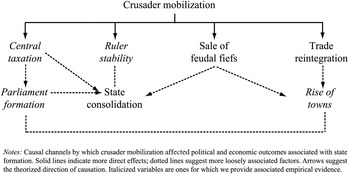
The areas of impact that we have described do not exist independently of each other. For example, the growing opportunities and inclination to sell or mortgage feudal fiefs affected both the consolidation of states and the rise of a town-dwelling merchant class. Similarly, increased capacity and incentive for the collection of taxes by a centralized authority encouraged the formation of representative assemblies while simultaneously contributing to the growth of consolidated state institutions. Finally, a number of studies have suggested that the existence of representative institutions is correlated with urbanization.Footnote 109 Constable sums up our position well when he argues that the Crusades affected almost every aspect of life in the twelfth century by breaking the old social and economic order through an exchange of property and transfer of treasure into liquid assets as well as “development of centralized financial administration.”Footnote 110 This leads him to conclude that “how the crusaders got to the East may have had a more profound influence on the West than what they brought back with them when they returned.”Footnote 111 Figure 1 provides a schematic of some of the channels by which crusader mobilization affected political and economic structures.
Impact of crusader mobilization on political and economic outcomes

Empirical Analysis
To operationalize these hypotheses we undertake a series of statistical tests as a step toward understanding the impact of the Crusades on the development of the modern state in Europe.
Data
A major contribution of this project relates to the collection of the first data set (that we are aware of) that documents the geolocational origins of Holy Land crusaders across multiple waves of the Crusades. We also create the first data set (again, that we are aware of) on the location of cathedrals built across Europe in the medieval period. The cathedral locations provide information about underlying levels of both religious commitment and wealth; as such, cathedral locations serve as an important, previously unanalyzed control variable in our analysis.
Crusader Data set
For our data on crusader mobilization, we collect information on the name, title, and geographic place of origin for elite Holy Land crusaders mobilized from across continental Europe. As we described earlier, crusaders were “overwhelmingly nobles or knights and their military households.”Footnote 112 The primary source for this information includes modern historical accounts that depended on primary sources, nineteenth-century historical accounts, as well as some primary sources.Footnote 113 For example, Riley-Smith includes an appendix of Holy Land crusaders, including their place of origin, based on his reading of the narrative sources, cartularies, and other collections of documents.Footnote 114
To create the crusader location points, if there existed a map of crusader origins, these points were projected onto the historical maps of the Euratlas project by Nussli.Footnote 115 Euratlas provides historical maps on Europe from the year 0 to 2000 CE every 100 years. For each century, the maps provide political boundaries of different units within the continent, their sovereign rulers, and their dependent states. We use the 1200 CE map to calculate crusaders who mobilized during the First through Fourth Crusades for each sovereign entity in the map. That is, we count the number of recorded locations from which crusaders were mobilized and use it as a measure of crusade mobilization.Footnote 116
Where a projection of crusader points did not exist from existing historical maps, location points were identified using Google Maps based on the place of origin information collected. If no place of origin information was available for a particular individual but the noble's name indicated his place of origin (that is, for “de Coucy” or similar, Coucy would be searched and, if found, used as the location) this location was used as place of origin. If the locational information could not be identified at the level of a particular town, village, or identifiable family home, such as a castle, the point would be placed within the county borders of his home county at the time that he embarked upon the crusade. Individuals for which no location information existed were dropped. This crusade variable is our proxy for the level of crusade mobilization in each entity.
We focus on crusader mobilization through the Fourth Crusade (which ended in 1204 CE) for two reasons. First, these were the largest and most significant of the Crusades. Indeed, out of 1,051 elite crusaders whose home locations we identified, 916 are categorized as participating in the first four waves. In addition, if we believe that crusader mobilization had an impact on stability and institutional development, we might be concerned that the later crusade waves (those initiated in the late thirteenth century and after) may have been affected by the processes that we are describing. As a result, we focus on mobilization over the roughly one-century interval between 1096 and 1204 CE (that is, First through Fourth Crusades).Footnote 117 By the end of the Fourth Crusade, there were thirty-one mobilization locations per political entity, on average. The standard deviation is high, however; the most common place of origin for crusaders was in France with 423 by 1204 CE. The Holy Roman Empire (270) and England (178) also saw large numbers of crusaders.
Dependent Variables
We test our hypotheses using a number of dependent variables drawn from a variety of sources. First, to test whether crusader mobilization has a positive impact on the durability of monarchical rule, we use data on ruler duration drawn from Blaydes and Chaney.Footnote 118 In the paper, the authors determine the length of rule for every monarch in Europe that assumed power in each political entity for every Euratlas map layer on the interval 700 to 1400 CE. We convert these time lengths to a set of mean values of duration of rule in each locale for each century. That is, for a given sovereign entity we take the average of years of rule for all rulers within each given century from 700 to 1400 CE. Second, we use the Blaydes and Chaney measure of parliament, an indicator for whether at least one parliament meeting was held between 1100 and 1400 CE.Footnote 119 Next, to test whether areas with high levels of crusader mobilization were better able to collect tax revenues, we rely on data from Karaman and Pamuk on tax revenue between 1500 and 1800 CE.Footnote 120 We also use data drawn from Bairoch and colleagues on urban population on the interval 800 to 1800 CE to test whether crusader mobilization had a significant effect on the rise of towns in Europe.Footnote 121 To test the impact of crusader mobilization on the development of autonomous cities, we use data from Stasavage on both the degree and duration of city autonomy.Footnote 122 Finally, we use data from Stasavage on the frequency of French provincial assemblies to conduct analysis on the within-France impact of crusader mobilization.Footnote 123
Alternative Causal Channels
Our strategy for dealing with the question of causal identification is to develop a series of empirical specifications that seek to minimize omitted variable bias within the constraints of our historical data collection. We include a number of key control variables that were—to the greatest degree possible—fixed at, or around, the time the regressor of interest was determined as a way to rule out alternative mechanisms through which ruler duration, parliament formation and taxation, and urbanization might have occurred.
One alternative explanation to the one that we have put forward is that geographic factors were associated with both crusader mobilization as well as our outcomes of interest. We include a number of geographic control variables to address this possibility. For example, latitude and agricultural suitability are both included as control variables because together they may determine the agricultural productivity of land.Footnote 124 Given the importance of agricultural productivity in the medieval period, we believe that latitude and land suitability are likely a product of, and an explanation for, a variety of social, economic, and political outcomes. Following Stasavage, geographic scale may determine the likelihood of forming representative assemblies and may also be associated with certain polity forms, such as city-states.Footnote 125 Therefore, we include polity size as a control variable. Finally, we include a measure of terrain ruggedness to account for the possibility that crusaders were more likely to be recruited from flatlands; both wealth and heavy cavalry may have been more common in areas with flat terrains. This, in turn, may have led to greater crusader mobilization. Our measure for ruggedness is based on the Topographic Ruggedness Index (TRI),Footnote 126 which measures the mean variance of terrain roughness based on elevation for each state.Footnote 127
We also believe that the social, economic, and political impact of the Crusades must be considered in the context of preexisting feudal institutions. To identify the incremental effect of crusader mobilization after controlling for feudalism, we include the fraction of the political entity in 1200 CE that was under the Carolingian Empire in 800 CE per Blaydes and Chaney.Footnote 128 In addition, crusader mobilization may have been affected by the interaction between feudalism and geography.Footnote 129 In particular, crusader mobilization may have been most common in feudal areas with relatively flat terrains because those areas would have been associated with mounted shock combat warriors and also would have had the ability to support relatively large populations. We capture this potential channel by introducing an interaction term between TRI and the fraction of a political entity in 1200 CE that was Carolingian in 800 CE.
Although few would argue that northwestern Europe was wealthier than Byzantium or Europe along the Mediterranean coast at the start of our study period, it is possible that forms of economic development both allowed for crusader mobilization and was also associated with ruler stability, the rise of towns, parliaments, and centralized taxation. To control for levels of wealth and development before the first wave of crusaders, we use the number of important cities by 1000 CE in each political entity as defined in Nussli.Footnote 130
As the recent historical literature on the causes of crusade mobilization suggests, the number of crusaders mobilized in each political entity may simply be a reflection of how devout the region was to the Christian values of salvation, and these values, not crusaders, could potentially explain the subsequent political and socioeconomic outcomes associated with state formation. In other words, religious fervor was a common cause for both crusader mobilization and our outcome variables of interest. To take this causal channel into account, we have collected original data on the number of cathedrals built in each political entity before the start of the Crusades. We collected this data from a variety of sources but most notably nonprofit websites aimed at providing information about the location of Catholic churches worldwide. This measure has the added benefit of helping to control for levels of societal development. Because cathedral building in the medieval period was costly and required a sizable nonagricultural labor force, we make the assumption that cathedrals were built in places that had the capacity and religious desire to dedicate funds and manpower to such efforts.
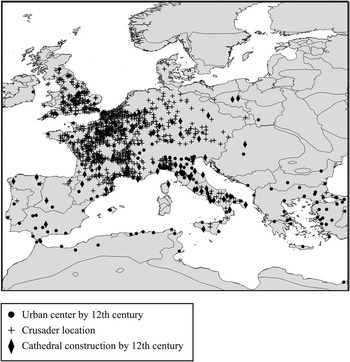
Figure 2 maps three of the variables used in our analysis—elite crusader mobilization between 1096 and 1204 CE, locations of major urban centers by 1000 CE, and cathedrals built by 1100 CE within the “sovereign state” boundaries of 1200 CE, as defined by Nussli.Footnote 131
Map of first- through fourth-wave elite crusaders, 1096–1204 CE

Empirical Findings
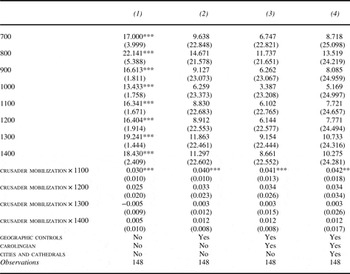
Table 1 displays the statistical relationship between crusader mobilization—our key independent variable—and ruler duration. The unit of analysis for these empirical tests is the “sovereign state” described by Nussli;Footnote 132 it is a territory delimited by borders where an authority exercises effective public power on the population and territory with the capacity for absolute control. This differs from a dependent, or vassal state, which would be subject to a higher political entity.Footnote 133 In the following estimates, we restrict the sample to entities in Europe that existed in 1200 CE and run an ordinary least squares regression of the following form:
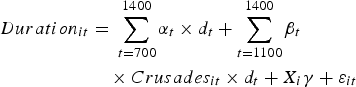 $$\eqalign{Duratio{n_{it}} & = \,\sum\limits_{t = 700}^{1400} {{\alpha _t}} \times {d_t} + \sum\limits_{t = 1100}^{1400} {{\beta _t}} \cr & \quad \times Crusade{s_{it}} \times {d_t} + {X_i}\gamma + {\varepsilon _{it}}}$$
where Duration it is the mean duration of ruler in state i in year t, d t are century dummy variables, Crusades it is the number of crusader mobilization sites recorded during the first four campaigns, X i are control variables, and the standard errors ε it are clustered by state. The set of controls include geographic variables such as the latitude, polity area, the agricultural suitability of the polity and the ruggedness measure (TRI). We also include the percentage of area under Carolingian rule to control for the impact of feudal institutions, and the interaction between our measure of feudal influence and TRI. We also include the number of important cities by 1000 CE as a measure of pre-crusader economic development, and the number of cathedrals built before the year 1100 CE as a measure of both economic development and religious fervor.Footnote 134
Impact of crusader mobilization on duration of rule

Notes: Standard errors are in parentheses. * p < .1; ** p < .05; *** p < .01.
No crusaders mobilized before 1096 CE; therefore, the by-century results from 700 to 1000 CE simply reflect the mean duration of rulers in Europe (with and without controls, depending on the column). From 1100 CE and onward, however, each column reports the mean duration of noncrusader states, as well as the difference in mean duration between crusader states and noncrusader states (reflected by the interaction terms).Footnote 135 Our estimates suggest a positive effect on the mean duration of rule in the twelfth century, and this effect is statistically significant with the inclusion of a variety of control variables. The coefficient value displayed in column (4) in Table 1, for example, suggests that each additional crusader mobilized led to an additional half month (0.042 years) in the monarch's mean duration of rule. For 1100 CE, the mean duration of rule was 17.1 years (standard deviation, 7.5 years). A one-standard-deviation increase in crusader mobilization represents a 3.5 year increase in mean duration, which explains 47 percent of the standard deviation in the mean duration of rule.Footnote 136
A second implication of our historical narrative suggests that areas with higher levels of crusader mobilization were more likely to develop representative institutions, such as medieval parliaments. Using data from Blaydes and Chaney on medieval parliaments over the period between 1100 and 1400 CE, we find that roughly half of the non-Muslim polities in Europe witnessed parliament formation.Footnote 137 Figure 3 displays the partial regression plot of the conditional effect of crusader mobilization on the number of centuries a parliament existed in a polity between 1100 and 1400 CE. After controlling for agricultural suitability and pre-Crusades urbanization—two variables that would seem to be important predictors of parliament formation—we find that states with higher levels of crusader mobilization had parliaments meet in more centuries across the interval 1100 to 1400 CE. Although we have a small number of observations, there appears to be a positive relationship between crusader mobilization and parliament formation.
Partial regression plots on existence of parliament

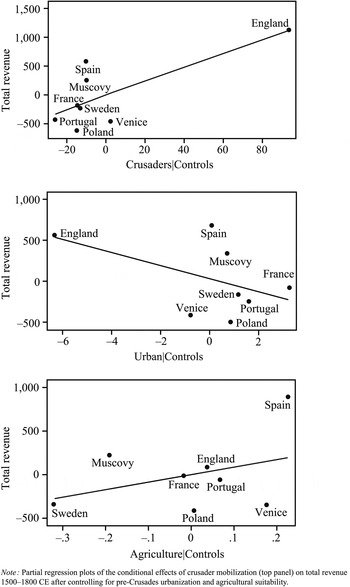
To corroborate our expectation about the institution-building capacity of crusader mobilization we consider an additional data set that reflects institutional development. Karaman and Pamuk have compiled state-level total revenue collection data in the early modern period, in particular, for a variety of European polities for the years 1500, 1600, 1700, and 1800 CE. The mean total revenue over the four centuries is 307 tons of silver; over the years the mean increased rapidly from 48 tons of silver in 1500 CE to 696 tons by the year 1800 CE. In our analysis, again, we include only the sovereign entities that existed in 1200 CE; these include England, France, Russia, Poland, Portugal, Spain, Sweden, and Venice.Footnote 138 Figure 4 displays the partial regression plot of the conditional effect of crusader mobilization on total state revenue over the interval 1500 to 1800 CE. Again, after controlling for agricultural suitability and pre-Crusades urbanization, we find that states with higher levels of crusader mobilization enjoyed higher levels of total revenue in the early modern period.Footnote 139
Partial regression plots on early modern tax revenue

Next we test the impact of the Crusades on the rise of towns, which we measure using two proxies—urban population growth and city autonomy. First, we investigate the effect of crusade mobilization on city growth using data from Bairoch and colleagues. There are 2,204 cities included in the data, with city population estimated at multiple points over the interval 800 to 1850 CE. We focus on the average effect of crusader mobilization on the subsequent growth of urban populations.Footnote 140 In this part of the analysis, we use each city instead of sovereign entity as the unit of analysis. This approach circumvents the problem of having to aggregate missing city population figures at the political-entity level. We also create fifty-kilometer buffer zones around each city location to calculate crusader mobilization in the vicinity of the city, as well as the number of cathedrals and the fraction of arable land as control variables. The reduced-form estimation equation is the same as before:
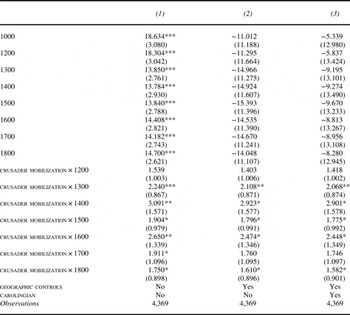
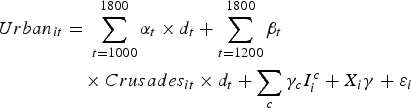 $$\eqalign{Urba{n_{it}} & = \,\sum\limits_{t = 1000}^{1800} {{\alpha _t}} \times {d_t} + \sum\limits_{t = 1200}^{1800} {{\beta _t}} \cr & \quad \times Crusade{s_{it}} \times {d_t} + \sum\limits_c {{\gamma _c}} I_i^c + {X_i}\gamma + {\varepsilon _i}}$$
where Urban it is the population in city i in time t, I i is the state dummy, and the controls X i include latitude, agricultural suitability, TRI, an indicator for whether the city was part of the Carolingian Empire, and the interaction between TRI and the Carolingian indicator. Coefficient β t captures the estimated impact of crusader mobilization on urban population in year t.
The first set of estimated coefficients in Table 2 reports the mean population of cities (in thousands) by each century without crusader mobilization. Interaction terms are introduced starting from 1200 CE to report the difference in mean population between the crusader and noncrusader cities. These estimates show that in the subsequent centuries after 1200 CE crusader mobilization in each city has a statistically significant and positive impact on city population. The coefficient value displayed in column (3), for example, suggests that each additional crusader mobilized led to between 1,582 and 2,901 additional residents in urban population, depending on the century. For 1300 CE, a one-standard-deviation increase in crusader mobilization represents an increase by 5,060 inhabitants, or 30 percent of the standard deviation in urban population.
Impact of crusader mobilization on urbanization

Notes: Standard errors are in parentheses. * p < .1; ** p < .05; *** p < .01.
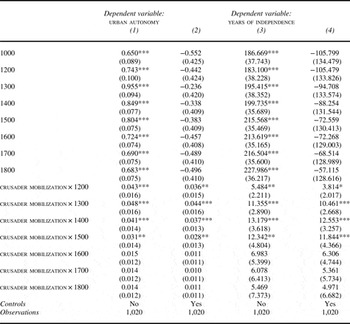
Another way to measure the rise of towns is to look at the extent to which these localities were autonomous. We use two outcome variables from Stasavage: the fraction of time (in centuries) that the town was autonomous, and the number of years it remained independent.Footnote 141 The city autonomy variable takes a value between 0 and 1, representing the fraction of the time period for which a city was politically autonomous; the independence variable is the average number of years a city was autonomous over a given century. We estimate a specification of the form:
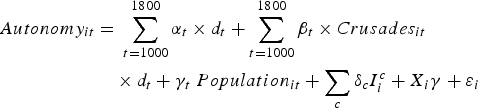 $$\eqalign{Autonom{y_{it}} & = \,\sum\limits_{t = 1000}^{1800} {{\alpha _t}} \times {d_t} + \sum\limits_{t = 1000}^{1800} {{\beta _t}} \times Crusade{s_{it}} \cr & \quad \times {d_t} + {\gamma _t}\ Populatio{n_{it}} + \sum\limits_c {{\delta _c}} I_i^c + {X_i}\gamma + {\varepsilon _i}}$$
where Autonomy it is city i's level of autonomy or years of independence, Population it is the city i population in time t, I i is the state dummy, and X i includes the control variables used in Stasavage including dummy variables for oceanic ports, riverine ports, bishop's seats, Roman settlements, latitude, and longitude.Footnote 142 We present the results in Table 3 for the eight centuries between 1000 and 1800 CE. In columns (1) and (2) the mean autonomy level for Europe and the difference between crusader and noncrusader cities are presented with and without controls, respectively. In columns (3) and (4) the dependent variable is the mean years of independence. These results show that crusader mobilization had a positive impact on city autonomy throughout the four centuries from 1200 to 1500 CE.
Impact of crusader mobilization on urban autonomy and years of independence

Notes: Standard errors are in parentheses. * p < .1; ** p < .05; *** p < .01.
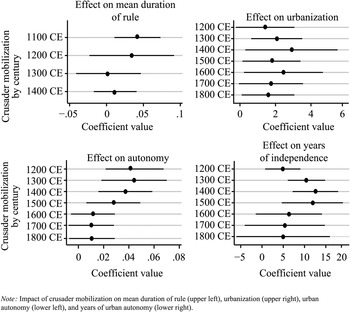
Figure 5 summarizes the effects of our main regression tables. The empirical models used to generate the effect for the outcome variables are the specifications with the greatest number of control variables. The upper-left panel emphasizes the immediate, positive effect of crusader mobilization on the mean duration of rule.Footnote 143 Because the causal mechanism that we describe suggests ruler duration increases as a result of the depopulating of elites from polities during the time of the Crusades, it is not surprising that these effects do not persist. The upper-right panel displays the effect of crusader mobilization on growth of urban populations. Although there is no immediate effect in 1200 CE, on the interval between 1300 and 1600 CE there appears to be a positive, statistically significant impact of crusader mobilization, conditional on a variety of control variables. The two lower panels display the over-century impact of crusader mobilization on urban autonomy and years of autonomy. The Crusades effect is relevant for each measure on the interval 1200 to 1500 CE. We have suggested that urbanization and urban autonomy were both important contributors to the development of the European system of sovereign states.
Impact of crusader mobilization on various outcomes

Robustness
Although we have attempted to devise a fairly stringent set of empirical tests, there remain important concerns about the robustness of our empirical findings. We therefore run additional tests to interrogate the robustness of our main results.
Within-France Analysis
We explore the impact of crusader mobilization at the provincial level within France for two variables—urbanization and the frequency of assembly meetings. France provides an ideal case study for within-state investigation because it witnessed the highest level of crusader mobilization in Europe.
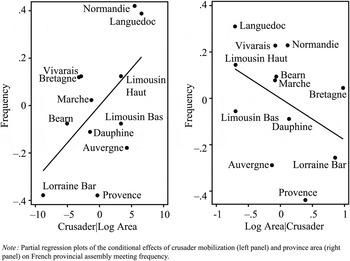
Stasavage discusses provincial assemblies in fifteenth-century France, which met in addition to a national representative institution (the Estates General).Footnote 144 These provincial assemblies played a significant political role, both in managing local affairs and administering taxes. Stasavage uses the frequency of assembly meetings as a proxy for the degree of control exerted over expenditures and explores the extent to which province size (his key explanatory variable) explains variation in meeting frequency. We investigate the correlation between crusade mobilization and the frequency of provincial assembly meetings using the Stasavage data set.
In a bivariate regression, there is a positive relationship between meeting frequency and crusader mobilization; with the small number of observations, however, the coefficient is statistically insignificant. Following Stasavage, we repeat our analysis after dropping two outliers, Bourgogne and Poitou, and the relationship between meeting frequency and crusader mobilization is much stronger. Because Stasavage demonstrates the relevance of province size as a predictor of meeting frequency, we include area in square kilometers as a control variable. Figure 6 displays the partial regression plots showing the effect of crusader mobilization and province area on meeting frequency. Crusader mobilization is positively and statistically significantly correlated with meeting frequency and province area is negatively associated with meeting frequency, as per Stasavage.
Partial regression plots on French provincial assembly meetings

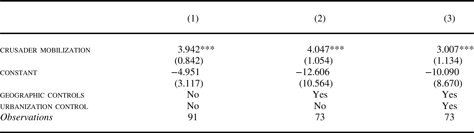
In addition to testing the relationship between crusader mobilization and the frequency of provincial assembly meetings, we also investigate the effect of the Crusades on urbanization within France. Using Bairoch city population data, we calculate the total urban population (in thousands) for each of ninety-one geographic areas within France in 1500 CE. As a control, we also calculate the total urban population in 1000 CE by combining all of the cities reported by Bairoch within each French region. Table 4 reports regression results that suggest that, with or without controls for unit size, agricultural suitability, and urbanization in 1000 CE, the impact of crusader mobilization on urbanization at the regional level remains positive and statistically significant. The coefficient values suggest that a region with an additional crusader mobilization location by 1200 CE has a three to four thousand person larger urban population by 1500 CE. The magnitude of the effect is large when we consider the average urban population in 1500 CE to be 15,500; we also find that a one-standard-deviation change in crusader mobilization explains between 59 and 78 percent of the standard deviation in urban population. Overall, these findings support our hypotheses and corroborate our cross- “national” results.
Impact of Crusader Mobilization on Urbanization within France, 1500 CE
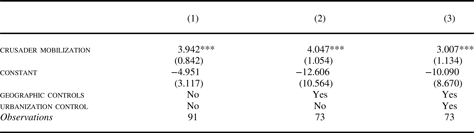
Note: Standard errors are in parentheses. * p < .1; ** p < .05; *** p < .01.
Alternative Polity Boundaries
One of the primary challenges to our analysis is associated with the relatively small number of data observations. A related potential concern for some of our outcome variables is that we confine our analysis only to non-Muslim polities that existed in 1200 CE. We first focused on these polities because our goal is to measure the effect of crusader mobilization on outcome variables after controlling for prior levels of development and other influences. We also take entity boundaries in 1200 CE as fixed, and assign control variables accordingly. Although this approach allows us to look at polity boundaries in 1200 CE as the historical arrangement for analysis in subsequent centuries, it also drastically reduces the number of observations for some outcome variables.
Since we know how the boundaries changed over the time period, we take an alternative approach when estimating the impact of crusader mobilization. We obtain the number of crusader mobilization sites for all the polities by counting the number of sites under changing boundaries. We also obtain a new set of control variables by counting the number of important cities and cathedrals for each year. Using this “flexible boundaries” approach, we estimate the impact of crusader mobilization on mean ruler duration, for example, by including observations in which the region saw the rise of a new polity in place of the old. Both Crusades it and control variables now vary over time with changing state boundaries, taking into consideration boundary changes over the time period. We find that the results on ruler duration remain similar to the “fixed” boundary main estimates.Footnote 145 Allowing for boundary change provides a different interpretation than our preferred approach, however; while we increase the number of observations with flexible boundaries, we can interpret only a regional effect rather than the effect associated with a particular polity.
We might also consider validating results on the existence of medieval parliaments and tax revenue collection in the early modern period with this approach because both suffer from relatively small numbers of observations. Allowing for flexible boundaries means that we are able to include additional states to the data set. Again, we reproduce the partial regression plots for parliaments and revenue, respectively, when controlling for pre-Crusades urbanization and agricultural suitability. With these additional observations, the positive relationship between total revenue collected and crusader mobilization is much stronger; results on the existence of a medieval parliament are similar to what has been reported in the main results section.Footnote 146
Conclusion
Understanding the conditions that led to the rise of the state, and the associated state system, is foundational to the study of the field of international relations.Footnote 147 Although a number of important scholarly works in international relations have explored the origins of the state system, Fioretos has argued that the field—as a whole—has not engaged sufficiently with a growing literature on historical institutionalism across the social sciences.Footnote 148 The question of how the state system took form would seem to be an ideal case for understanding how the timing and sequence of political events—primary foci of historical institutionalism—have affected governance forms over time.
The Crusades were a turning point in the emergence of a system of sovereign, territorial states. Areas with high levels of crusader mobilization witnessed more political stability in the centuries to follow. The causal mechanism that we put forward is that the departure of relatively large numbers of European landed elites for the Holy Land reduced the absolute number of elites who might serve as challengers to the king. This interpretation is supported by historical accounts that suggest that sitting monarchs benefited from the Crusades in that “foreign responsibilities kept the knights away, resulting in more power for the monarchs who stayed at home.”Footnote 149 Political stability, in turn, had important implications for processes of state formation. Indeed, Strayer argues that increased political stability in the late medieval period was one of the “essential conditions for state-building.”Footnote 150
We also find that areas with large numbers of Holy Land crusaders had a higher probability of establishing parliamentary institutions and a downstream advantage in the collection of revenue. The relationship between war mobilization and building of state institutions has been elaborated most famously by Tilly who argued that “preparation for war, especially on a large scale, involves rulers ineluctably in extraction.”Footnote 151 Crusade tithes were among the first national poll taxes levied on European populations and, even where attempts to collect crusader tithes failed, monarchs were able to build fiscal and extractive capacity as a result of their efforts to do so. Centralization of fiscal capacity has been closely linked to processes of state formation.Footnote 152 Levi has gone as far as to argue that “the history of state revenue production is the history of the evolution of the state.”Footnote 153
We find that crusader mobilization is also associated with higher rates of urbanization and urban autonomy across Europe. We posit two causal channels by which this occurs. The first is related to the large-scale sale of land by nobles who sought to raise funds to participate in the Crusades. Through these land sales, capital holders were empowered relative to feudal land holders, encouraging the rise of towns. The sale of land by nobles participating in the Crusades also facilitated the transition from feudalism to a system of consolidated sovereign states. The second causal channel is related to the economic impact of northwestern Europe's reintegration into Mediterranean trade as a result of the Crusades. Increased trade was also spurred by the creation of a growing taste for “eastern” products that were introduced to Western Europe as a result of the Crusades.
We contribute to a scholarly debate regarding “when” and “why” the essential elements of the modern state first began to appear. On the question of “when,” we tend to concur with Strayer—who argues that the key elements of the modern state emerged starting in 1100 CE—and disagree with Tilly—who sees the late fifteenth century as the critical moment of transition to the modern state. On the question of “why,” however, we tend to concur to a greater extent with Tilly—who focuses on the importance of both war preparation and urban capital accumulation—compared with Strayer—who focuses on the growing influence of the Latin church and higher levels of elite education, among other factors. This argument suggests that although the military elite of Latin Christendom eventually gave up on taking back the Holy Land, developments in the Islamic world had a lasting impact on state formation in Europe.
Our findings also contribute to a growing literature in political economy that considers the historical origins of institutions that encourage economically productive behaviors. In other words, how do countries arrive at the “doorstep conditions” that make it possible to transition to an “open access order” with its associated constellation of political and economic rights?Footnote 154 Prominent existing accounts emphasize the cumulative and lasting effects of small political, social, or other differences at critical junctures.Footnote 155 Rather than viewing the development of growth-promoting institutions as a function of small, virtually random perturbations, we consider how the rapid rise of Islam—a large change in the political ecology of the world system—affected institutional development in Europe. As such, we provide a new perspective on the historical origins of Western Europe's inclusive economic and political institutions that takes into account the interactive and interdependent nature of influences across world cultures.
Supplementary Material
Supplementary material for this article is available at http://dx.doi.org/10.1017/S0020818316000096.