Introduction
Much attention has been dedicated to advancing knowledge on the influence of destructive interparental conflict (IPC) on children’s development. Findings suggest that exposure to destructive conflict behaviors, such as intense anger, contempt, and verbal or physical hostility between parents, places children at risk for difficulties in the areas of social, emotional, and physiological development (Harold & Sellers, Reference Harold and Sellers2018; Kopystynska et al., Reference Kopystynska, Mueller, Bradford, Chandler, Foran and Higginbotham2022; van Eldik et al., Reference van Eldik, de Haan, Parry, Davies, Luijk, Arends and Prinzie2020). In comparison to destructive IPC, more remains to be explored about the role of constructive IPC on children’s well-being (Warmuth et al., Reference Warmuth, Cummings and Davies2020). Constructive IPC is characterized by mutual respect, compromise, and progress toward resolution, which may reduce pathogenic implications (Harold & Sellers, Reference Harold and Sellers2018; van Eldik et al., Reference van Eldik, de Haan, Parry, Davies, Luijk, Arends and Prinzie2020).
According to the emotional security theory (EST), children’s emotional security, which reflects children’s sense of inner safety in the context of interparental relationship, explains how exposure to dimensions of IPC might affect children’s subsequent developmental outcomes (Cummings & Miller-Graff, Reference Cummings and Miller-Graff2015; Davies et al., Reference Davies, Martin, Sturge-Apple, Cicchetti and Cohen2016). EST proposes that children have a higher-order goal to preserve stable family environment where parents can effectively solve their disagreements (Davies & Cummings, Reference Davies and Cummings1994). EST assigns equal weight to the impact of constructive and destructive IPC on child emotional insecurity, positing that destructive IPC reduces a child’s security and constructive IPC aids in promoting it. However, since its conception (Davies & Cummings, Reference Davies and Cummings1994), EST has been revised (EST-R) to suggest that the presence of positivity during conflict, such as constructive IPC, does not necessarily imply greater security, but that the threat from the conflict may simply be reduced (Davies et al., Reference Davies, Martin, Sturge-Apple, Cicchetti and Cohen2016). Some evidence exists in support of EST showing that the magnitude of the link (in terms of regression coefficient) between constructive IPC and emotional security is similar to that of destructive IPC and child emotional security, though in the opposite direction (e.g., McCoy et al., Reference McCoy, Cummings and Davies2009). However, in most studies, in comparison to destructive IPC, the relation between constructive IPC and child emotional security is less strong (Kopystynska et al., Reference Kopystynska, Paschall, Barnett and Curran2017; Lee et al., Reference Lee, Pace, Lee and Altschul2021; van Eldik et al., Reference van Eldik, de Haan, Parry, Davies, Luijk, Arends and Prinzie2020) or not statistically significant (Brock & Kochanska, Reference Brock and Kochanska2016; Davies et al., Reference Davies, Martin and Cicchetti2012; Lee et al., Reference Lee, Lee, Volling and Grogan-Kaylor2023). These latter findings are supportive of EST-R, suggesting that destructive IPC poses threat to child emotional security and that constructive IPC may not be as efficient in enhancing it. We, therefore, used EST-R as our guiding theoretical framework.
Regardless of children’s age, exposure to IPC produces some level of emotional reactivity, and as noted before, experiences with more hostility and anger between parents is related to greater levels of emotional insecurity (Cummings & Davies, Reference Cummings and Davies2010; Davies et al., Reference Davies, Martin, Sturge-Apple, Cicchetti and Cohen2016). As outlined in EST-R, this may occur directly or through other factors. For example, parents experiencing hostility may engage in unsupportive parenting, a process known as the spillover hypothesis, which in turn alerts even infants to respond with emotional distress (Du Rocher Schudlich et al., Reference Du Rocher Schudlich, Jessica, Erwin and Rishor2019). When examining constructive conflict, it is important to consider that while no serious escalation may occur, the level of constructiveness varies (from low to high) and the use of constructive tactics does not necessarily imply heightened levels of affection in the interparental relationship (Cummings & Davies, Reference Cummings and Davies2010; Larrosa et al., Reference Larrosa, Escudero and Cummings2009). Put differently, parents using constructive behaviors are still faced with a disagreement, and the overall atmosphere may involve some tension during the negotiation process. Therefore, because expression of constructive conflict behaviors may involve some amount of neutrality (Larrosa et al., Reference Larrosa, Escudero and Cummings2009), it may be complex for young children (e.g., preschoolers) to decipher its level of threat to their well-being. With this in mind, the current study sought to unpack processes that undermine young children’s emotional security.
In sum, EST-R suggests that following exposure to IPC, children’s emotional insecurity is a gateway (i.e., a mediator) to children’s adjustment (Davies & Martin, Reference Davies and Martin2013), a proposition that has been supported empirically (van Eldik et al., Reference van Eldik, de Haan, Parry, Davies, Luijk, Arends and Prinzie2020). EST-R further posits various processes that may undermine children’s emotional security, including parenting, parent psychopathology, family climate, and child attributes, and testing these proposed processes is a needed direction for this research area (Davies & Martin, Reference Davies and Martin2013). The goal of this study was to examine the theorized role of parental psychopathology, specifically depressive symptoms, as an explanatory mechanism through which destructive and constructive IPC exert influence on child emotional insecurity (Davies & Martin, Reference Davies and Martin2013). As proposed by the theory, in this mediational chain, differences in conflict management behaviors would be associated with parental psychopathology (indexed by mothers’ and fathers’ depressive symptoms), thus shaping a child’s sense of security in the family unit. We tested this process-oriented approach using two-wave data (when children were approximately 15 and 36 months of age) from the Building Strong Families (BSF) project, which was a multi-site evaluation of relationship education that included a sample of primarily low-income unmarried couples who were expectant or new parents.
IPC and depressive symptomology
Parents’ depressive symptoms and IPC are associated with each other, such that greater levels of depressive symptoms are related to more destructive and less constructive IPC (Kopystynska et al., Reference Kopystynska, Barnett and Curran2020; Kouros et al., Reference Kouros, Merrilees and Cummings2008). Regarding directionality, individuals experiencing depressive symptoms might express themselves in ways that reflect their state of mind (e.g., anger, sadness, less positive affect), thus their depressive symptomology influences their conflict behaviors. Research supports this possibility, particularly for fathers. For example, across various stages of children’s development, only father depressive symptoms related to greater levels of destructive IPC both concurrently (Du Rocher Schudlich & Cummings, Reference Du Rocher Schudlich and Cummings2007; Du Rocher Schudlich et al., Reference Du Rocher Schudlich, Jessica, Erwin and Rishor2019) and longitudinally (Curran et al., Reference Curran, Li, Barnett, Kopystynska, Chandler and LeBaron2021; Keller et al., Reference Keller, Cummings, Peterson and Davies2009). These longitudinal investigations have also revealed a cross-over effect such that father depressive symptoms were related to higher levels of mother destructive IPC (Curran et al., Reference Curran, Li, Barnett, Kopystynska, Chandler and LeBaron2021; Keller et al., Reference Keller, Cummings, Peterson and Davies2009). Regarding constructive IPC, evidence is sparce and mixed. In early childhood, only father depressive symptomology contributed to less constructive behaviors (Du Rocher Schudlich et al., Reference Du Rocher Schudlich, Jessica, Erwin and Rishor2019), but in late childhood, the link was significant for both parents, though with stronger effects for fathers (Du Rocher Schudlich & Cummings, Reference Du Rocher Schudlich and Cummings2003, Reference Du Rocher Schudlich and Cummings2007). These findings imply more serious consequences of paternal depressive symptomology on family conflict (Du Rocher Schudlich et al., Reference Du Rocher Schudlich, Jessica, Erwin and Rishor2019).
The reverse may also be true: engaging in specific conflict behaviors may impact a person’s mood and mental wellbeing, but this possibility has received less empirical attention, and the findings are inconsistent. Using a longitudinal lens, Curran et al. (Reference Curran, Li, Barnett, Kopystynska, Chandler and LeBaron2021) did not find that destructive IPC was predictive of depressive symptoms for mothers or fathers, but Lee et al. (2020) reported that constructive IPC was a potential contributor to fewer depressive symptoms of the reporter and the reporter’s spouse (i.e., the cross-over effect). Although there are convincing arguments for both sets of directional pathways, which are also depicted in EST-R (Davies & Martin, Reference Davies and Martin2013), the original argument for child emotional insecurity is based on how children react to IPC (Cummings & Davies, Reference Cummings and Davies2010). Therefore, in the current study, we used IPC as a precursor of parents’ depressive symptomology, thus testing parents’ depressive symptomology as a mechanism through which IPC affects child emotional insecurity.
Depressive symptomology and child emotional insecurity
Children growing up in homes where parents struggle with depressive symptomology are likely to experience psychological problems themselves (Cummings & Davies, Reference Cummings and Davies2010; Wilson & Durbin, Reference Wilson and Durbin2010). Various reasons account for this possibility, including genetic factors, the role of environment (e.g., as early socializers of children’s behaviors, parents serve as role models for emotional expressions), and the way parents with depressive symptoms respond to children’s needs (Goodman et al., Reference Goodman, Rouse, Connell, Broth, Hall and Heyward2011; Wilson & Durbin, Reference Wilson and Durbin2010). In relation to child emotional insecurity, more consistent associations have been found for fathers, such that father depressive symptoms foster greater levels child emotional insecurity both in infancy (Du Rocher Schudlich et al., Reference Du Rocher Schudlich, Jessica, Erwin and Rishor2019) and kindergarten years (Cummings et al., Reference Cummings, Cheung and Davies2013). Paternal depression appears to pose greater threat to a child’s level of emotional security in the family unit (Cummings et al., Reference Cummings, Cheung and Davies2013), which could be due to behaviors that men have when experiencing depressive symptoms (Addis, Reference Addis2008). This may include more expression of anger as opposed to sadness (Addis, Reference Addis2008), which in turn activates a stronger response in children (Davies & Martin, Reference Davies and Martin2014).
IPC, depressive symptomology, and child emotional insecurity
Amongst many proposed links, EST-R posits that conflict behaviors have an impact on parents’ psychological well-being (or lack thereof), thus leading to varying levels of children’s security in the family unit (Davies & Martin, Reference Davies and Martin2013). As noted above, fewer studies have examined the impact of IPC on depressive symptomology, but marital relationship literature that includes twin data provides convincing evidence that relationships have a stronger influence on spouses’ mental health, rather than vice versa (see Braithwaite & Holt-Lunstad, Reference Braithwaite and Holt-Lunstad2017). This phenomenon is known as experience hypothesis (vs. selection hypothesis). Couples who engage in hostile exchanges and show disdain for each other are generally at greater risk for depression (Whitton & Whisman, Reference Whitton and Whisman2010). Depressive symptomology may be a result of higher levels of stress, loneliness, and hopelessness that stems from a low-quality relationship. As a result, children’s exposure to expression of parental depressive symptomology (e.g., expression of anger, sadness, and agitation with the other parent) might enhance their level of emotional insecurity in the family unit. Testing this process empirically may help identify points of intervention, which may be useful for families who might have more opportunities for conflict, such as those included in this study.
Extending the common fate model
Most studies conceptualize IPC at a couple level (see Kopystynska et al., Reference Kopystynska, Mueller, Bradford, Chandler, Foran and Higginbotham2022), which can be characterized by one of three approaches. The first approach is separating out how individual, independent sources of variance influence each other, while treating interdependent (or shared) sources of variance as error (e.g., the actor-partner interdependence model). The second approach is averaging or summing mothers’ and fathers’ scores of IPC (whether observational or reported), which assumes both partners have the same views, same errors, and same contribution to the construct. Lastly, the third approach is by loading mothers’ and fathers’ scores onto one latent construct, which captures the interdependence of the construct, but treats individual sources as error (e.g., the common fate model; CFM; Ledermann & Kenny, Reference Ledermann and Kenny2012).
All three approaches require treating one source of variance (e.g., the individual) as error to explicitly examine another source (e.g., the dyadic relationship). A notable limitation of these approaches is the assumption that partners within a relationship use similar conflict strategies, which may not always be the case (e.g., Kopystynska et al., Reference Kopystynska, Paschall, Barnett and Curran2017). Thus, the average score captures the mean-level of relationship temperature without taking into account that some partners may be on the opposite ends of the spectrum, and because of that, outcomes may be different in those couples than for partners who have a similar average score because their ratings are alike. Also, most measures of IPC assume that both partners’ responses represent the same construct validity, which may not always be the case as partners’ perceptions of relationship constructs may depend on their gender and personal experiences (Beam et al., Reference Beam, Marcus, Turkheimer and Emery2018; Ledermann & Kenny, Reference Ledermann and Kenny2012). For example, women emphasized the importance of communication and emotional expression, and because of that, their approach to reporting conflict may differ to that of men (Beam et al., Reference Beam, Marcus, Turkheimer and Emery2018).
With this possibility in mind, in the current study, we extended the common fate model (CFM) analysis, which allowed us to partition dyadic constructs into both shared variance as well as the unique variance of each reporter (Galovan et al., Reference Galovan, Holmes and Proulx2017). By conceptualizing the CFM as a second-order latent variable, we separated out the unique mother and father variance from the measurement error. We then used the residual variance of the mother and father latent variables as the unique effect of the mother and father. Said another way: the first-order latent variables (of mother conflict and father conflict) capture the true value of conflict for mother and father, which respectively predict their responses to the conflict measure, with unexplained variance in the measure modeled as error. The data, however, are dyadic, and because both mother and father report on the same, shared construct means there is interdependence of data, a shared source of variance. Modeling a second-order CFM allows us to explicitly model that source of shared variance as a latent factor. Because the mother and father first-order latent variables serve as indicators for the CFM, the residual variance of the first order latent constructs is the unique contribution of the mother or the father. Substantively explained, shared variance, on the one hand, represents interdependence between partners that describes their experiences together as a couple (Galovan et al., Reference Galovan, Holmes and Proulx2017). Unique variance, on the other hand, characterizes each partner’s unique response on the measure that could be explained by, for example, personal characteristics or personal history (Ledermann & Kenny, Reference Ledermann and Kenny2012).
As noted above, not all items may be perceived similarly between mothers and fathers. Further, items in a measure may not relate to the shared aspect of the construct the same way they do to the unique aspect. In a second-order latent variable, the items are forced to relate to the shared and unique aspects of the construct (e.g., conflict) the same way for mothers and fathers, respectively; to avoid this problem, the bi-factor first-order model, an alternate, generalized version of the second-order approach can be used (Geiser, Reference Geiser2021). In the bi-factor first-order model, the CFM loads across both mother and father items as a first-order factor, and the mother and father each have their own unique latent variable defined by just their own respective items. None of the latent variables are allowed to correlate with each other. If the loadings for the mother were constrained to be equal between the CFM factor and the unique factor (and the same for fathers) this would be equivalent to the second-order version of the model (Geiser, Reference Geiser2021). However, because such constraints are not required, in the current study, shared variance captured both partners’/parents’ shared perception of conflict behaviors in the relationship and unique variance gauged individual differences in conflict perception between the two partners/parents in a relationship.
Current study
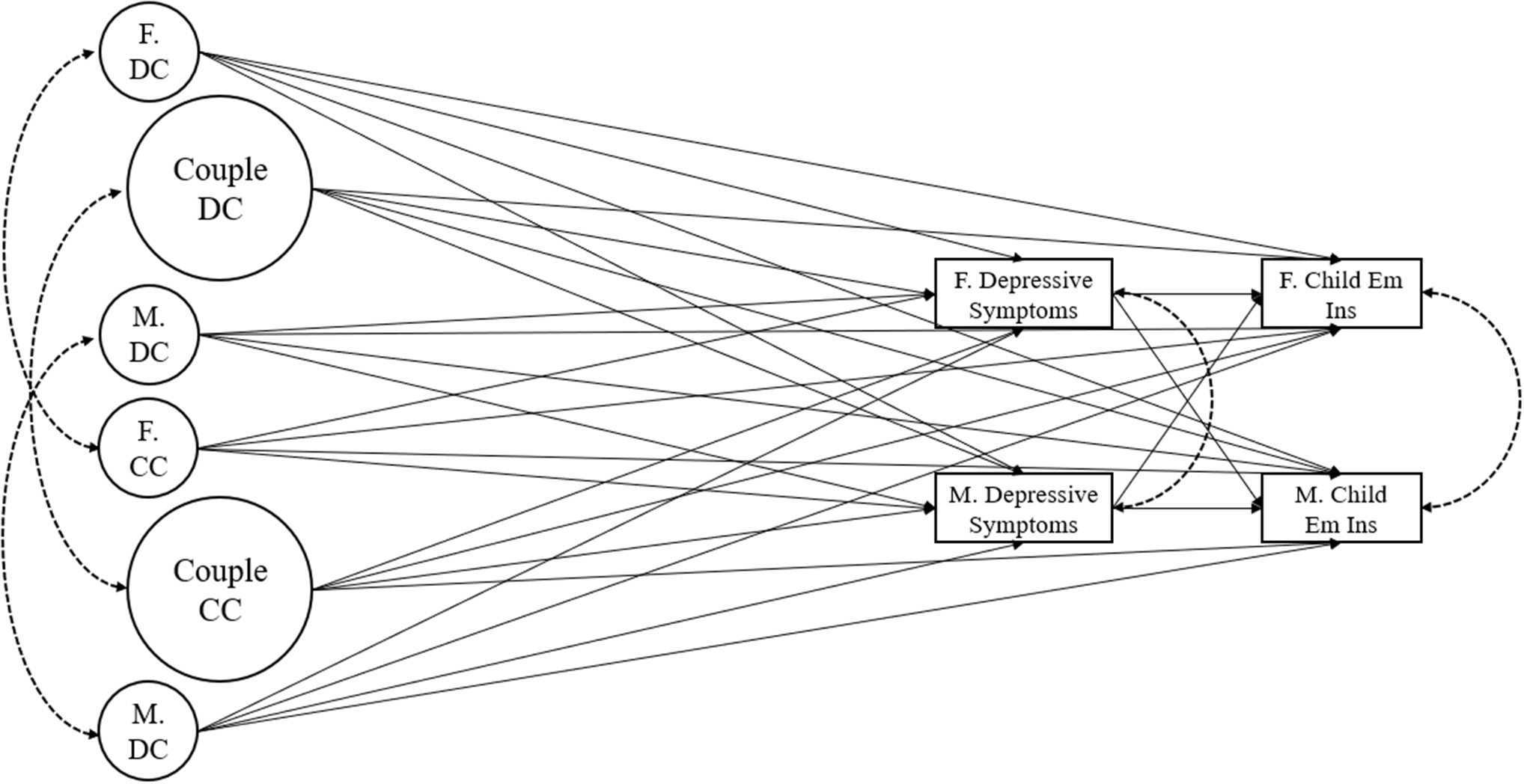
We tested parts of the EST-R theory, focusing on the associations of mother and father constructive and destructive IPC and child emotional insecurity, both directly and through parents’ depressive symptomology (see Figure 1). By extending the CFM, we partitioned unique variance of each conflict strategy from shared variance. Considering that this is a new technique that has not yet been explored within the IPC literature, some links between study variables are exploratory in nature.
Structural portion of the two-wave mediation model. Note. M. = Mother; DC = destructive IPC; CC = constructive IPC; Em Ins = emotional insecurity. Correlations shown with dotted lines. Control variables are not shown for ease of reading.

Research questions (RQs) and hypothesis (H) regarding direct relations:
-
1. RQ1 and RQ2. Does the shared variance of destructive IPC relate differently to mother and father depressive symptomology (RQ1), and child emotional insecurity (RQ2) than the unique variance of mother and father destructive IPC?
-
2. RQ3 and RQ4. Does the shared variance of constructive IPC relate differently to mother and father depressive symptomology (RQ3), and child emotional insecurity (RQ4) than the unique variance of mother and father constructive IPC?
-
3. H1. Mother and father depressive symptomology will be associated with greater levels of child emotional insecurity, and it is suspected that the link will be stronger for the same reporter because individuals who experience depressive symptomology may see their child in the way that is consistent with how they feel (Belsky et al., Reference Belsky, Caspi, Moffitt and Poulton2020).
RQ regarding the proposed mediation:
-
1. RQ5. What aspects of constructive and destructive IPC (i.e., shared and/or unique variance) instigates a mediational chain involving mother and father depressive symptomology, which in turn is hypothesized to relate to child emotional insecurity?
Method
Participants
The data for this study were drawn from the federally funded Building Strong Families Project (BSF), a multisite intervention program facilitated by Mathematica Policy Research, Inc. (Hershey et al., Reference Hershey, Devaney, Wood and McConnell2008). The goal of BSF was to encourage healthy marriages by providing education and services to low-income couples who were either expecting or recently had (within three months) their first biological child together. Couples were recruited from hospitals and clinics from eight cities across the United States between July 2005 through March 2008. Eligible couples were at least 18 years of age, romantically involved, and were unmarried at conception of their baby. History of intimate partner violence disqualified couples from participation in the study. Although income eligibility was not an exclusion criterion, BSF targeted low-income populations. Couples were randomly assigned to the intervention or control group. There were no effects of the intervention on conflict behaviors or children’s emotional insecurity (Hershey et al., Reference Hershey, Devaney, Wood and McConnell2008). Thus, we combined intervention and control groups.
Procedures
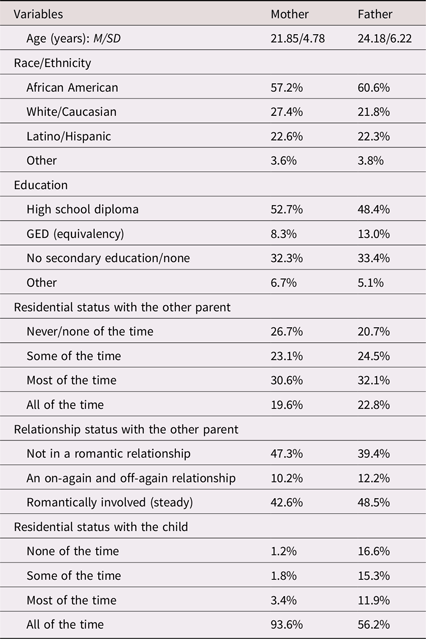
During recruitment, each parent completed a consent form and the baseline information. Then, couples were randomly assigned into control and treatment (i.e., BSF intervention) groups. Although the control group did not receive any services through the BSF program, they were eligible to obtain services that were available in the community. BSF consisted of three waves of data: recruitment/baseline (W0), and when children were approximately 15 (W1) and 36 (W2) months old. At W0, demographic information was collected, such as parents’ age, ethnicity, level of education, marital status, and financial difficulties (see Table 1). Follow-up surveys were collected at W1 and W2 and in-home direct observations were conducted at W2. Surveys at both W1 and W2 were similar in content allowing for the assessment of BSF services effects. Our main analyses were based on the data collected at W1 and W2. Participants who reported at W1 were included in the study, for a total of 4,424 parent-pairs. The present study included mothers’ and fathers’ reports of destructive IPC, constructive IPC, depressive symptomology, and child emotional insecurity. Their responses to survey questions were gathered via phone interviews. Adult participants were paid $25 separately after each assessment.
Demographic information

Measures
Main variables
W1 destructive IPC
Using a 9-item measure (Hershey et al., Reference Hershey, Devaney, Wood and McConnell2008), mothers and fathers reported on their perception of the other parent’s destructive conflict behaviors and how often they as parents engage in destructive conflict management (e.g., “When we argue, I feel personally attacked by my partner” and “Little arguments turn into ugly fights with accusation/criticism”). Responses (α = .88/.87 mothers/fathers) were rated on a 4-point Likert-type scale (1 = often happen to 4 = never happen) and reverse-coded for higher scores to reflect greater use of destructive IPC.
W1 constructive IPC
Using an 8-item measure (Hershey et al., Reference Hershey, Devaney, Wood and McConnell2008), mothers and fathers reported on their own perception of constructive conflict behaviors with their partner and how often they as parents engage in constructive conflict management (e.g., “I feel respected even when we disagree” and “Even when arguing we can keep a sense of humor”). Responses (α = .88/.85 mothers/fathers) were rated on a 4-point Likert-type scale (1 = often happen to 4 = never happen) and reverse-coded so that higher scores indicated greater constructive IPC.
W2 depressive symptoms
Mothers and fathers reported on their depressive symptoms using a short version of the Center for Epidemiological Studies Depression Scale that consists of 12 items (Ross et al., Reference Ross, Mirowsky and Huber1983). Participants recalled the frequency of potential symptoms of depression (e.g., “I felt lonely” and “I felt that I could not shake off the blues even with help from family or friends”) in the past week. Items were rated on a 4-point Likert-type scale (1 = rarely or none of the time to 4 = most or all of the time). Responses for mothers/fathers (α = .88/.88) were averaged separately to create a depressive score for each parent.
W2 child emotional insecurity
Mothers and fathers separately reported on their child’s emotional insecurity in the presence of parental conflict using a 10-item measure from Emotional Reactivity and Behavioral Dysregulation subscales of the Security in the Marital Subsystem-Parent Report Inventory (SIMS-PR; Davies et al., Reference Davies, Forman, Rasi and Stevens2002). Parents were read the items (e.g., “Seeing argument between you and [mother/father], child appeared angry”; α = .85/.88 for mothers/fathers) and asked to rate their responses on a 4-point Likert-type scale (1 = often to 4 = never or not applicable). These items have been validated and used in studies with other samples (e.g., Cummings et al., Reference Cummings, George, McCoy and Davies2012). The items on the scale were reverse-coded so that higher scores would represent highest levels of child emotional insecurity in response to IPC. Responses were averaged to create a separate score for mothers and fathers.
Control variables
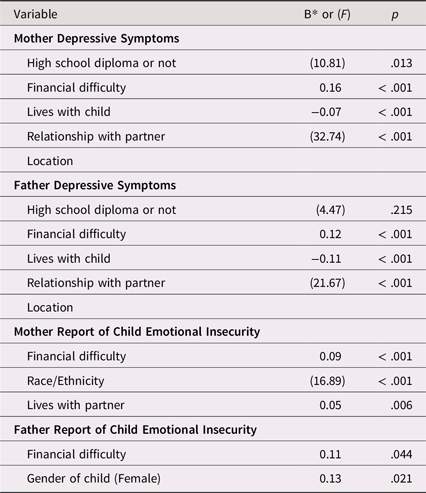
Participants reported on whether they had obtained a high school diploma or GED; if they live with their child (none, some, most, or all of the time); their current relationship status with the other parent (not in a romantic relationship, in an on-again and off-again relationship, or romantically involved on a steady basis); if they live with the other parent (none, some, most, or all of the time); the location of the BSF program; their race/ethnicity (Black/African American, White, Other); gender of the child; and their age. Distribution of these variables are in Table 1. Further, their level of financial difficulty was based on a sum of three yes/no questions: (1) You could not pay the full amount of the rent or mortgage that you were supposed to pay? (2) You had service turned off by the water, gas or electric company, or the oil company would not deliver oil because you could not afford to pay the bill? (3) You were evicted from your home or apartment because you could not pay the rent or mortgage? On average, the sample reported low levels of financial difficulties (Ms = .54/.51, SDs = .79/.78 for mothers/fathers) with 62.4% of mothers and 64.2% of fathers indicating “no” to all three questions. These control variables are commonly included in other studies with BSF data (e.g., Curran et al., Reference Curran, Li, Barnett, Kopystynska, Chandler and LeBaron2021; Kopystynska et al., Reference Kopystynska, Barnett and Curran2020).
Missing data
Missing data were handled via full-information maximum likelihood (FIML), which uses all available data to calculate the maximum likelihoods, eliminating the need to remove participants who have some, but not all, variables. There was no attrition in parent-pairs, as all parent-pairs who had at least one parent respond at W1 had at least one parent respond at W2. Individual parents did have missing data (total missingness in used variables is ∼ 15%, including when only one parent responded). Through careful review of missingness patterns and correlation with missingness (not shown), it was concluded that our data was MAR. As such, we proceeded with FIML to handle missingness in data. It should be noted that including all the possible data leads to reduced bias, compared to removing participants with missing data from analysis, regardless of type of missingness (Geiser, Reference Geiser2021). Each parent-pair included in the model contributed at least one piece of information to the analyses.
Despite the use of FIML, fathers’ reports of child emotional insecurity had enough missingness that less than 10% of parent-pairs had data for that variable; as such, results regarding father report of child emotional insecurity should be interpreted with caution. This high level of missingness was due primarily to how the BSF data were gathered; however, a subsample of fathers was asked the questions regarding emotional insecurity, and whether there was a response gathered appears to be aligned with the designation of MAR. A comparison between a model with and without father report of emotional insecurity revealed no differences in model fit, latent variables, or remaining regression pathways. As such, we opted to include the fathers’ reports of emotional insecurity to be able to investigate those paths for those who did provide data, with the caveat that there should be caution in interpretation.
Analytic plan
We estimated a bi-factor, first-order model, wherein both father and mother indicators loaded on a common fate latent variable, and father indicators on a father latent variable and mother indicators on a mother latent variable. These latent variables were constrained to have no correlation with each other (Geiser, Reference Geiser2021). This was done for destructive IPC and constructive IPC. As explained in the literature review section, this extension to the common fate model separates mother and father unique variance from their shared variance, for both types of IPC. Because fathers reported on both destructive and constructive IPC, the unique variance of father destructive and constructive IPC was correlated; the same was done for mothers. Because the shared variance for destructive and constructive IPC variables occurs within the same relationship, the latent variables representing the shared source of variance for constructive and destructive IPC were correlated (see Figure 1).
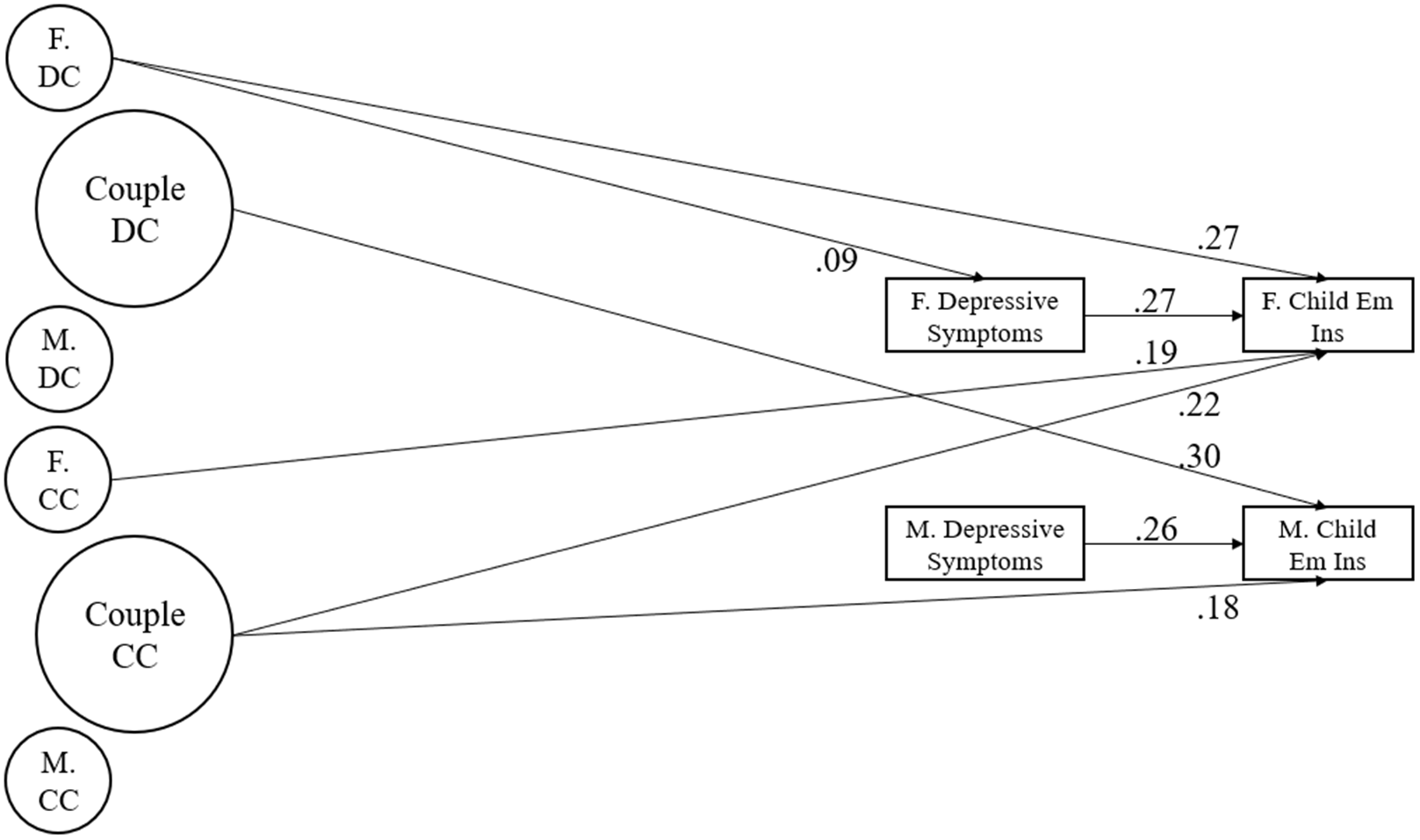
The structural portion of the model is in Figure 2. In the structural portion of the model, father depression at W2, mother depression at W2, father report of child emotional insecurity at W2, and mother report of child emotional insecurity at W2 were all predicted by the shared and unique variances of destructive and constructive IPC at W1. Father report of child emotional insecurity and mother report of child emotional insecurity were then in turn predicted by father and mother depressive symptoms. For a rigorous analysis of a two-wave mediational model, autoregressive paths were included from W1 to W2 depressive symptoms (Kline, Reference Kline2016). To account for interdependence of data, father and mother reports were correlated for depressive symptoms and child emotional insecurity. In addition to the primary regressions of interest, the model included control variables. Depressive symptoms and child emotional insecurity each were predicted by all of the covariates. Couple-level variance for destructive and constructive IPC was predicted by whether the mother and father were in a relationship and if they lived together. For the purpose of parsimony, non-significant covariates were removed from the model.
Regression coefficients of the estimated model. Note. Model fit indices were χ2(1659) = 4421.19, p < .001, CFI = .95, RMSEA = .019, 90% CI [.019, .020], SRMR = .04. F. = Father; M. = Mother; DC = destructive IPC; CC = constructive IPC; Child Em Ins = child emotional insecurity. Only significant pathways shown. Standardized betas reported. There was one indirect effect: F. DC → F. Depressive Symptoms → F. Child Em Ins, B* = .04, p = .017, B = .02, 95% CI [.005, .033].

Analyses were performed in R (4.4.0; R Core Team, 2024) using lavaan (Rosseel, Reference Rosseel2012) and psych (Revelle, Reference Revelle2021). Exogenous variables (i.e., control variables in this model) had their parameters freely estimated. Because allowing the exogenous variables to have their parameters freely estimated allowed for keeping all 4,424 parent-pairs, we focused on goodness-of-fit indicators rather than the chi-square statistic, as chi-square is known to be sensitive to sample size (Kline, Reference Kline2016). Specifically, we used a CFI of .95, an RMSEA of less than .05, and an SRMR of less than .05 to indicate acceptable fit (Hu & Bentler, Reference Hu and Bentler1999). Indirect effects were determined using 95% confidence intervals.
Results
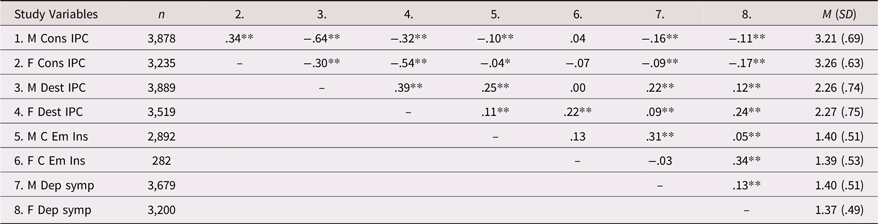
Zero-order correlations are in Table 2. In terms of primary analyses, after removing non-significant covariates, the final model demonstrated acceptable fit: χ2(1659) = 4421.19, p < .001, CFI = .95, RMSEA = .019, 90% CI [.019, .020], SRMR = .04. For mother and father depressive symptoms, removed control variables included parents’ residential status (if they live with the other parent), their age, their race/ethnicity, and gender of the child. For child emotional insecurity, the only retained control variables for fathers were financial difficulty and gender of the child, and retained control variables for mothers were financial difficulty, if they live with the other parent, and race/ethnicity. See Table 3.
Zero-order correlations of observed study variables

Note. M = mother, F = father, Cons IPC = constructive interparental conflict, Dest IPC = destructive interparental conflict, C = child, Em Ins = emotional insecurity, Dep symp = depressive symptoms.
**p < .01, *p < .05.
Retained control variables and their parameter estimates

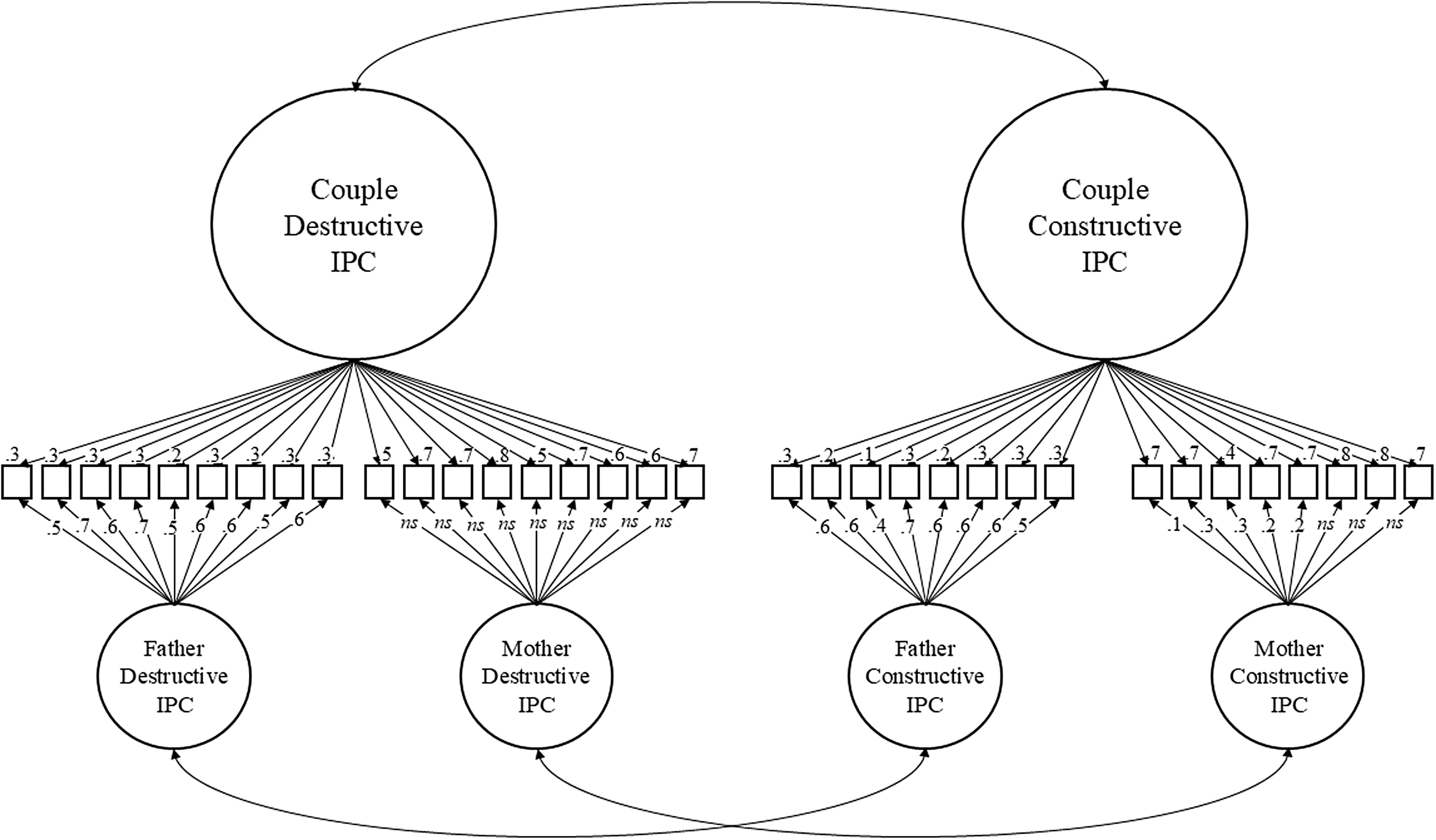
For the measurement model of IPC, we found evidence of the common fate (i.e., shared source of variance) variable, reflected in the identified loadings and associations with other variables. As a reminder, the common fate variable represents the dyad-level source of variance in parent response to measure indicators. In general, mother indicators loaded more strongly on the common fate variables (destructive IPC, .49 – .73; constructive IPC, .38 – .82) than on her unique variance variables (destructive IPC, .02 – .56, ns; constructive IPC, .16 – .30). In fact, for destructive IPC, the mother unique variance did not have a single significant indicator. This suggests that the entirety of the mothers’ responses was driven by the shared, interdependent, couple-level experience of destructive IPC. The general pattern was reversed for the fathers, suggesting individual, non-shared sources of variance (destructive IPC, .53 – .67; constructive IPC, .38 – .66) were a stronger predictor for father response to survey items than the shared, dyadic-level sources of variance (destructive IPC, .25 – .34; constructive IPC, .10 – .35). See Figure 3. Results regarding each regression path are detailed by outcome below.
Measurement model of destructive and constructive IPC. Note. IPC = interparental conflict. Standardized loadings reported.

IPC and depressive symptomology (RQ1 and RQ3)
Father unique source of variance for destructive IPC predicted father report of depressive symptoms (B* = .09, p = .002). No other source of variance for either IPC was predictive of reported depressive symptoms for either parent.
IPC and child emotional insecurity (RQ2 and RQ4)
For conflict behavior, father report of emotional insecurity was positively predicted by three sources: father unique source of variance for destructive IPC (B* = .27, p = .001), father unique source of variance for constructive IPC (B* = .19, p = .016), and the shared source of variance for constructive IPC (B* = .22, p = .028). Mother report of child emotional insecurity was positively predicted by two sources of conflict: shared source of variance for destructive IPC (B* = .30, p < .001) and the shared source of variance for constructive IPC (B* = .18, p < .001). For mother report only, destructive IPC was found to be a stronger predictor than constructive IPC (post hoc Wald test = 8.14, p = .004).
Depressive symptomatology and child emotional insecurity (H1)
H1 was supported. Mother report of her own depressive symptoms positively predicted her report of child emotional insecurity (B* = .26, p < .001). Likewise, father report of his own depressive symptoms predicted his report of child emotional insecurity (B* = .27, p < .001). Post hoc tests found no difference in the strength of the regression pathways for mothers and fathers. There were no partner effects.
Indirect paths (RQ5)
A single path demonstrated a mediational relation. Father source of unique variance for destructive IPC had an influence on father report of child emotional insecurity through father-reported depressive symptomology, (B* = .04, p = .017, B = .02, 95% CI [.005, .033]).
Sensitivity analysis
We ran an additional, targeted sensitivity analysis, wherein the additional predictors of emotional insecurity (depressive symptoms and covariates) were constrained to be zero. Results yielded findings that were similar, but not identical. Father report of child emotional insecurity continued to be predicted by his unique variance for destructive and constructive IPC, consistent with the full analysis. Mother report of child emotional insecurity was less consistent, with both positive and negative predictions of child emotional insecurity from reports of constructive IPC.
Discussion
Guided by EST-R theory, we examined the influence of destructive and constructive IPC on child emotional insecurity, both directly and through parents’ depressive symptomology. A notable contribution of this study was the dual influence of mother and father individual-level and couple-level IPC (unique and shared variance, respectively). We found some gendered differences in the influence of unique versus shared variance of IPC on these processes. By applying the extension of CFM, we showed that parents responded differently to the same items on the conflict scale. Mothers’ responses to conflict items were nearly entirely explained by the interdependence of data that comprised the shared source of variance (e.g., shared experiences in the relationship, such as the nature of interactions) rather than by mothers’ unique source of variance. Consistent with prior research, this finding suggests that women are generally more relationship oriented (Schoenfeld et al., Reference Schoenfeld, Bredow and Huston2012; Williamson et al., Reference Williamson, Nguyen, Bradbury and Karney2016). In contrast, fathers’ response to items were based mostly on their own unique source of variance, rather than a shared one. These findings could inform relationship education efforts by bringing awareness to differences in conflict evaluation between mothers and fathers.
Destructive IPC and depressive symptomology (RQ1)
The overall pattern of findings is that we found evidence that only fathers’ mental health was affected by aspects of destructive IPC, which is consistent with other studies that show stronger association between destructive IPC and depression for fathers versus mothers (Du Rocher Schudlich et al., Reference Du Rocher Schudlich, Jessica, Erwin and Rishor2019). Importantly, the current study provides a greater level of specificity showing that it is the father unique variance of destructive IPC that is related to greater levels of father-reported depressive symptomology. Among this sample of primarily unmarried low-income couples, fathers’ own characteristics may be contributing to their report of destructive behaviors and mental health, and as fathers report more destructive behaviors, they are likely to experience depressive symptoms. For intervention efforts, it may be worthwhile to consider the types of behaviors that underlie destructive conflict behaviors and depressive symptomology (e.g., antisocial behaviors). Next, in this primarily unmarried sample there were no cross-partner effects, such that neither mother’s nor father’s unique variance of destructive IPC affected their partner’s depressive symptoms. When one parent perceived greater conflict than the shared perception, there was no direct impact on the mental well-being of the other parent. Lastly, shared variance of destructive IPC was unrelated to parental depressive symptoms.
Constructive IPC and depressive symptomology (RQ3)
Neither shared nor unique variance of constructive IPC related to depressive symptoms of the reporter. Although some evidence exists supporting the idea that constructive IPC may reduce symptoms of depression (Lee et al., Reference Lee, King, Wickrama and O’Neal2020), and despite significant correlations between the two variables in the current study and others (e.g., Du Rocher Schudlich & Cummings, Reference Du Rocher Schudlich and Cummings2007; Johnson & Anderson, Reference Johnson and Anderson2015; Kopystynska et al., Reference Kopystynska, Barnett and Curran2020), at this level of analysis, current findings report no such relations. We offer the following explanations. When parents use constructive behaviors, it does not imply that their relationship is highly affectionate (Cummings & Davies, Reference Cummings and Davies2010; Larrosa et al., Reference Larrosa, Escudero and Cummings2009) or that they experience positive synchrony (Sasaki & Overall, Reference Sasaki and Overall2023). A neutral tone of constructive behaviors may not be enough to reduce depressive symptomology. Thus, consistent with the EST-R, constructive conflict may have less weight (or impact) not only on child emotional insecurity, but other variables as well, such as parents’ depressive symptomology. The ordering of variables may be another explanation. It could be that depressive symptomology is more likely to contribute to less constructive IPC as found in other studies (Coyne et al., Reference Coyne, Thompson and Palmer2002; Du Rocher Schudlich & Cummings, Reference Du Rocher Schudlich and Cummings2007; Du Rocher Schudlich et al., Reference Du Rocher Schudlich, Jessica, Erwin and Rishor2019). The question of directionality should be further explored.
IPC and child emotional insecurity (RQ2 and RQ4)
Different aspects of constructive and destructive IPC contributed to greater levels of children’s emotional insecurity, and consistent with EST-R, the impact of destructive IPC was stronger for mothers’reports of child emotional security (Davies et al., Reference Davies, Martin, Sturge-Apple, Cicchetti and Cohen2016). We only found evidence that shared variance of destructive IPC contributed to elevated levels for mother-reported child emotional insecurity. Perhaps because women are more relationship-oriented (Williamson et al., Reference Williamson, Nguyen, Bradbury and Karney2016), their perception of the child’s behavior is colored by how they feel in the relationship. Another reason could be that because more mothers in this sample were living with the child (i.e., the case of single mothers), they were more likely to be exposed to how the child behaves after the argument, and therefore, may have been more reliable reporters than fathers. Although we controlled for the father’s residential status with the child, future research should focus on potential moderating effects of living arrangements on reliability of parent report of emotional insecurity. Further, we only found evidence that father unique variance of destructive and constructive IPC contributed to greater levels of father-reported emotional insecurity. As referenced before, reporter bias is one plausible explanation. Fathers’ maladaptive conflict management behaviors may be driven by their own characteristics outside of the relationship (e.g., anxiety), and they are likely to view a child’s responses to conflict that is consistent with their state of mind (e.g., seeing their child as anxious or frightened).
We also found that shared variance of constructive IPC contributed to both parents’ report of children’s emotional insecurity (with equal strength). To our knowledge, this is the first study to report such results, because most current literature suggests either null or small inverse associations between constructive IPC and child emotional insecurity. Current findings are consistent with EST-R and suggest that presence of positivity during conflict may not be enough to transform the presence of conflict from a threat into a condition for greater security (Davies et al., Reference Davies, Martin, Sturge-Apple, Cicchetti and Cohen2016). However, unlike in prior studies, by separating IPC into shared and unique variance, our findings show that only the shared variance of constructive IPC related to elevated levels of emotional insecurity. This association may be obscured in studies using different analytical approaches in which shared and unique variance are not separated. Similarly, sensitivity analyses revealed that shared variance of constructive IPC was negatively related to mothers’ reports of child emotional insecurity when mothers’ depressive symptomology is not taken into account, a finding opposite in direction from the full analysis. This opposite finding suggests the importance of controlling for parent psychopathology, and the potential complexity of a young child’s response to constructive IPC. Although there are times when couple-level constructive IPC may appear to reduce insecurity, our findings emphasize the importance of considering analytical method and its implications. Additional research is needed to unpack this complexity further.
This link between constructive IPC and increased emotional insecurity may be more evident given the age of the children in the study; at 36 months it is possible that the nuances of constructive IPC are not readily interpretable as evidence of security. For example, during an argument, parents may use words to express their feelings in a neutral or calm tone, but their dialog or tense body language may signal some form of dissatisfaction if they are not responding to each other’s needs (see Sasaki & Overall, Reference Sasaki and Overall2023). Thus, it is important to keep in mind that despite using constructive conflict behaviors, parents are in the process of solving a disagreement, which can be arousing for young children. Thus, even constructive IPC may be stressful as these young children may not understand the underlying positive or neutral behaviors and language in the context of a parental disagreement. Another possibility is that young children may react to the absence of parental attention during constructive IPC, as the parents are focused on each other. This may make the children appear more “needy” to their parents in the aftermath of the conflict.
We note that measures of constructive IPC typically allow participants to rate consistency of their behaviors from low to high regarding verbally expressing affection or validation (Cummings & Davies, Reference Cummings and Davies2010). This may be insufficient to truly capture constructive behaviors. Once separated from the sources of individual variance, the remaining shared variance represents the aspects of the conflict that shape both parents’ responses regarding this consistency—essentially, the shared and observed behaviors, not the underlying perceptions. Indeed, being constructive requires more than just showing or verbally expressing affection and validation (Sasaki & Overall, Reference Sasaki and Overall2023). Such behaviors need to be accompanied by reciprocity, behavioral synchrony, and provision of support tailored to address each other’s needs (Sasaki & Overall, Reference Sasaki and Overall2023). This high level of constructiveness calls for genuine responsivity on each parent’s part that may not be fully realized through communication training only, which is the goal of many intervention efforts (Cummings et al., Reference Cummings, Faircloth, Mitchell, Cummings and Schermerhorn2008), including BSF. Thus, behavioral synchrony may have been absent for the child to feel secure, which may be the reason we found that constructive IPC prompted child emotional insecurity. To improve relationship curricula, it may be worthwhile for intervention programs to consider the complexity of constructiveness.
Depressive symptomology and child emotional insecurity (H1)
Mother and father depressive symptoms related to greater levels of child emotional insecurity, according to their own reports. The literature regarding this link, however, is mixed. For example, in a sample of infants, only father-reported depression related to infants’ observed emotional insecurity (Du Rocher Schudlich et al., Reference Du Rocher Schudlich, Jessica, Erwin and Rishor2019). For older children (i.e., late childhoodthrough adolescence), both parents’ depressive symptomology has been related to parent-reported insecurity in children (Kouros et al., Reference Kouros, Merrilees and Cummings2008). However, neither observational measures (Du Rocher Schudlich & Cummings, Reference Du Rocher Schudlich and Cummings2007) nor children’s own reports of emotional insecurity (Kouros et al., Reference Kouros, Merrilees and Cummings2008) related to mothers’ and fathers’ depressive symptomology. Reporter bias may be a plausible explanation. When parents feel sad and blue, their depressive symptomology clouds their reports of child behavior as they see their child’s behavior through the lens that is consistent with their state of mind (Belsky et al., Reference Belsky, Caspi, Moffitt and Poulton2020).
Mediational pathways linking IPC to children’s emotional insecurity (RQ5)
Only one mediational path was supported: unique variance of father-reported destructive IPC related to father-reported depressive symptoms, which in turn was associated with father reports of child emotional insecurity. This finding supports the proposed path as outlined in EST-R. However, considering that no other mediation was found, we posit that reporter bias may have played a role here. Specifically, the reporter’s personal characteristics that may be driving the report of higher destructive conflict behaviors might then contribute to the reporter experiencing depressive symptoms, and further colors how a reporter views a child’s behavior. Nonetheless, this finding underscores that paternal vulnerability may have a cascading impact on children’s development. As shown by father unique variance having an effect distinct from the shared variance, our findings imply that it may be advantageous to determine which personal characteristics are responsible for underlying behaviors of this mediation chain.
Strengths and limitations
The current study includes several strengths. First, our analysis of IPC was novel and relatively new to the field. By extending the CFM, we separated couple-level (shared variance) from individual-level (unique variance) IPC. Importantly, we found some differences in the impact of each on parental depressive symptoms and child emotional insecurity. Second, using both mother and father data, we detected gender differences in the processes that we believe have practical implications and which we have discussed. Third, we explored parent psychopathology as a mechanism through which IPC influences child emotional insecurity (Davies & Martin, Reference Davies and Martin2013). Current findings provide partial support showing parental psychopathology, namely depressive symptoms, is the path through which paternal destructive IPC (unique variance) is linked to child emotional insecurity. Fourth, our rigorous mediation analysis was computed using two-wave data while controlling for earlier levels of the construct, thus allowing us to detect presumptive chain of events. Lastly, our analyses included low-income primarily unmarried families, a relatively understudied population that may be at greater risk for experiencing these personal and relational challenges.
Several limitations should be noted. First is the measure of IPC, which was specifically designed for the BSF project. Unlike the Problem-Solving Scale (Kerig, Reference Kerig1996) which has been commonly used to assess IPC, the measure used in this study lacks validity tests, though there is evidence of published papers using this measure (e.g., Kopystynska et al., Reference Kopystynska, Barnett and Curran2020; Lee et al., Reference Lee, Pace, Lee and Altschul2021). The potential conceptual distinctions between measures may, in part, explain why we found that dyad-level constructive IPC is a potential precursor to increased emotional insecurity among young children. The specific behaviors measured may be critical in determining the outcome of constructive IPC on parents’ mental health and child experiences. Future research should investigate how different conceptualizations of constructive IPC (and their measures) yield various results. Second, survey items captured two possibilities: one partner reporting on how the other is behaving and how they both as a couple (regardless of relationship status) engage in conflict. Although this was the reason for application of CFM, it is not currently known what drives couple-level responses vs. individual level responses. Future research should investigate what predicts each. Third, it is recommended that mediation is computed using three waves of data, but BSF included only two assessments (post baseline) that had variables of interest. Fourth, given that our sample consisted primarily of low-income young couples with young children, the results may not generalize to higher income families or older children. These analyses should be replicated with children at diverse developmental points, as constructive IPC may have different implications for children who are able to better understand the nuances of parental conflict. Relatedly, many couples in this sample broke up between the two waves of the study, and these findings may not generalize to couples in more stable relationships (e.g., married couples). Finally, although we believe the processes evaluated in this study to be consistent, it should be noted that the data were gathered from 2005 – 2008. Future research should replicate our analyses with more contemporary data.
Implications
Current findings support EST-R in the following ways. First, we found support that paternal depressive symptomology is a mediating mechanism between father unique variance of destructive IPC and father-reported child emotional insecurity (Davies & Martin, Reference Davies and Martin2013). This cascading effect of destructive IPC on fathers’ depressive symptomology and child emotional insecurity offers a process-oriented approach to target interventions. In addition to teaching couples how to reduce destructive IPC, intervention programs may consider including curricula on mental health because of the substantial overlap between a person’s behavior and their state of mind. This suggestion is consistent with Belsky et al.’s (Reference Belsky, Caspi, Moffitt and Poulton2020) assertion that interventions should address multiple needs. Second, children’s emotional insecurity was promulgated by both destructive and constructive IPC at the couple-level (i.e., shared variance). However, consistent with EST-R, the impact of destructive IPC on mother-report of emotional insecurity was stronger than for constructive IPC (Davies et al., Reference Davies, Martin, Sturge-Apple, Cicchetti and Cohen2016). Thus, in the current study, adaptive conflict behaviors reduced but did not eliminate the threat from the conflict between parents. While it is encouraged that couples learn techniques that facilitate replacement of destructive behaviors with constructive ones, intervention programs may want to consider other aspects of dyadic behaviors that are associated with responsivity (e.g., show understanding and care for the other person’s concerns).
Data availability
The data were obtained with approval from the Inter-university Consortium for Political and Social Research at the University of Michigan.
Acknowledgments
This study was not pre-registered. It was approved as secondary data analysis by the Institutional Review Board at Utah State University (Protocol #12763). The data came from the Building Strong Families (BSF) project, a national longitudinal study (2005 – 2008) aimed at strengthening relationships among low-income unmarried parents. The authors are grateful to parents and children who have participated in the BSF project.
Funding statement
This research received no specific grant from any funding agency, commercial, or not-for-profit sectors.
Competing interests
The authors declare none.