The Anglo-Scottish ‘traditional’ (or ‘folk’) ballad has coexisted in the different media of sound and writing from the early modern period right up until the present day. In practice, the genre is loosely defined by narrative songs collected from singers ‘in the field’ during the various phases of folk song revival that occurred in the Romantic period, during the late Victorian and Edwardian era up until the First World War, and again in the aftermath of the Second World War. At the other end of the time scale, some of the same narrative ballads were being printed on broadside sheets from the sixteenth century onwards, and the practice of printing broadside ballads could still be encountered in some places as late as the first half of the twentieth century. The standard ballad editions are Francis James Child's The English and Scottish Popular Ballads and, for the melodies, Bertrand Bronson's The Traditional Tunes of the Child Ballads. These works are best thought of as providing something of a benchmark for the genre, though they certainly do not circumscribe it in its entirety.
Although we know comparatively little for certain about the practice of ballad singing prior to the folk song revivals, there is no real reason to doubt that ballads were being sung from an early date.Footnote 1 So, for three centuries and more, we can take it that the written form of the Anglo-Scottish ballad has happily coexisted with its vocal performance. But there is now, I think, a prevalent assumption that the written ballad is, or ought to be, conceptually tied to its vocal performance. This is almost certainly a twentieth-century phenomenon, attributable in no small part to Bertrand Bronson's advocacy of ‘the ballad as song’ and his definitional challenge – ‘Question: When is a ballad not a ballad? Answer: When it has no tune’ – which has gained considerable currency.Footnote 2 But Bronson was reacting particularly to a scholarly legacy that had paid little attention to the music of the ballads, and he was perhaps led to overstate his case.
The present article seeks to argue that a hierarchy of ballad documentation that seems to privilege sound is misleading. Rather, the ballad has always been, and remains, accessible through complementary media that fulfil different purposes and follow different conventions. In the course of this discussion we shall consider different levels of music-writing and the non-indexical relationship between sound and writing in the ontology of music; the ‘metaphysics of presence’ and the privileging of sound over writing, which Derrida famously attacked; and the work of text and music editors in establishing ‘sets of instructions’ for the reconstruction of musical and literary works – all leading towards the position that different and complementary sets of instructions can quite independently facilitate access to the intangible ballad.
Writing, sound, and ballad ontology
Landmark figures in the history of ballad scholarship – Child himself, his Scottish predecessor William Motherwell, and even, belatedly, Sir Walter Scott – were acutely alert to the potential aesthetic merit of variations on the ballad theme created by individual singers. But The English and Scottish Popular Ballads still has a place for printed broadsides, as well as for manuscripts that were written down for reasons that may well have had nothing to do with vocal performance, such as the seminal Percy folio manuscript, described as the ‘foundation document of English balladry’.Footnote 3 Child was content, too, to collate texts that were ‘pretty much the same’ but which derived from quite separate sources. In the wake of these great editors the distinction between ‘type’ (the abstract sum of all possible renditions of a ballad, regardless of medium) and ‘version’ (a rendition ascribed to a single source, most often an individual singer) came to be the predominant paradigm for ballad studies. The folk song collectors of the Victorian/Edwardian revival published songs from individual contributors in specialist outlets such as the Journal of the Folk-Song Society, and also in volumes aimed at a more general audience, compiled by the likes of Cecil Sharp and Sabine Baring-Gould, often harmonized with piano accompaniments. The sources of the songs are rightly credited, but it is difficult to imagine that the distinction could ever have become blurred between the contributor's ephemeral vocal rendition, more often than not noted down with pencil and paper, and the printed words and music notation. The two were self-evidently different things.
Of course I cannot prove this, because people at the time were not writing in these terms. But some comments of Cecil Sharp's certainly suggest an awareness of the distinction. Writing to Percy Grainger in 1908, Sharp stated that when transcribing a folk song ‘our aim should be to record its artistic effect, not necessarily the exact means by which that effect was produced […] [I]t is not an exact, scientifically accurate memorandum that is wanted, so much as a faithful artistic record of what is actually heard by the ordinary auditor.’Footnote 4 These remarks came in the context of an exchange with Grainger concerning the use of the phonograph in recording folk songs and the practice of transcription from phonograph recordings. Grainger, on the other hand, in notations published in the Journal of the Folk-Song Society, did seek to reproduce as much information as could possibly be accommodated within a conventional system of staff notation; his aim was to achieve ‘a detailed notation of the more or less slight variations occurring throughout a singer's performances of the song’.Footnote 5 The list of things that he considered to be of account included variations in pitch and interval, variations of speed, rhythmic irregularities, melodic variations from one stanza to the next, dynamic details, lengths of notes, ornamentation, dialect phonetics and blends of vowel sounds, and additional meaningless syllables. Where Sharp stated that he did not want a ‘scientifically accurate memorandum’, Grainger, though he did not phrase it in quite those terms, evidently did; indeed, the obsession with such details was an important component of his modernist musical aesthetic.Footnote 6
C. J. Bearman has argued that the supposed dispute between Grainger and other members of the Folk-Song Society has been much exaggerated, and that the differences between his collecting methods and Cecil Sharp's derived as much as anything from their immediate social and personal circumstances.Footnote 7 Nevertheless – and at the risk of misrepresenting Sharp's notations, which do in fact take considerable account of such things as variations in melody between different stanzas – there is still a philosophical difference between the two collectors. It seems reasonable to suppose that this bore some relation to their rather different intentions vis-à-vis folk song collecting: close musicological analysis of folk song practice, style, and structure on Grainger's part; the reinvigoration of English musical practice and the popularizing of folk song, particularly in schools, on Sharp's.
The music-writing practices of Sharp and Grainger can also be related to the distinction later made between so-called ‘prescriptive’ and ‘descriptive’ uses of music-writing. Charles Seeger defines these terms, respectively, as the difference ‘between a blue-print of how a specific piece of music shall be made to sound and a report of how a specific performance of it actually did sound’.Footnote 8 Seeger went on to advocate a further, ‘scientific’, graphic form of descriptive music-writing enabled by electro-mechanical recording using an oscillograph, against which conventional written notations could be compared. This is actually something that Percy Grainger had envisaged, though it was not available at the time he was writing.Footnote 9 But Seeger's account never gives the impression that music as sound and music as writing could be held as ontological equivalents.
The possibility of automatic graphic music representation can be traced back to the 1850s and the phonautograph invented by the French printer Édouard-Léon Scott de Martinville. This device turned sound into a set of visible tracings on paper blackened by smoke from an oil lamp, by means of a stylus attached to a diaphragm vibrating in response to the sound waves. Scott envisaged a time when ‘the musical phrase escaping from the lips of the singer will come to write itself […] on an obedient page and leave an imperishable trace of those fugitive melodies that the memory no longer recalls by the time it searches for them’.Footnote 10 Scientists at Lawrence Berkeley National Laboratory have recently realized that possibility, employing optical imaging techniques to enable the replaying of one of Scott's phonautogram tracings, dating from 1860, of an unknown vocalist (possibly Scott himself) singing a line of ‘Au claire de la lune’.Footnote 11 Unlike Charles Seeger's graphic music-writing experiments, however, the phonautogram tracings were for Scott an objective in their own right. When, later in the century, he came to evaluate Edison's phonograph, he considered it a failure because it reproduced merely sound, not writing.Footnote 12 In Scott's conception, it seems, music could exist in either medium, sound or writing, simultaneously and interchangeably.
This should not be overly surprising. For some traditions of Western art music, as Leo Treitler describes it, the written score is functionally and ontologically parallel with the sounded performance: ‘The questions “what is this piece” and “how does it go” could both be answered either by writing out a score or by making a performance.’Footnote 13 Or, as James Grier has it, ‘The piece […] resides equally in the score and in the performing conventions that govern its interpretation at any particular historical moment’,Footnote 14 leading on to a comparison and a distinction that will be critical to what follows here:
For most of the Western art tradition, the act of creating a musical work consists of two stages, composing (which is usually synonymous with the inscription of the score) and performance. These two intermediary steps place the musical work on the same plane as dance and drama, in which the execution of a work, which could exist in written form (the script in drama and choreographic notation in dance), occurs in performance. At the same time, it marks a distinction between the work, which depends equally on the score and performance for its existence, and a text, either written (a score) or sounding (a performance)[,] that defines a particular state of the work.Footnote 15
In other words, at least in the Western art music tradition (which may be relatively unusual in this respect), ontologically music can be conceived – interchangeably, simultaneously, and independently – as either sound or writing.
A crucial point, which Grier's comparison with dance and drama makes explicit, is that the one – sound or writing – is not, and is not expected to be, an exact mirror of the other. The American philosopher C. S. Peirce distinguished three kinds of signs: likenesses (or icons), indications (or indices), and symbols (or general signs).Footnote 16 A likeness is a sign that conveys the idea of something simply by imitating it. An indication is a sign that conveys information about something by virtue of being physically connected with it. A symbol or general sign is one that is connected with the object it represents merely by agreed convention. We will be less concerned here with likenesses, but drawings of things, imitative sounds, and onomatopoeic words can all be considered as likenesses. The whistling of a ballad tune might, under certain circumstances, be considered a likeness of what it is supposed to represent. On the other hand an oscillogram made electro-mechanically from a pre-existent sound recording would be categorized as an indication. It bears a causal, ‘indexical’ relationship with the sound that brought it into being by virtue of a direct physical connection between the two things. Scott de Martinville's phonautogram tracings, and the variable pitch grooves cut or pressed into phonograph cylinders and gramophone records, retain this indexical connection with their source. Rothenbuhler and Peters, however, argue that in the digital environment that physical connection has been severed, and that a sequence of zeroes and ones is no more than a series of symbols or general signs.Footnote 17 Ordinary words are symbols, and the same is true of written music notations. It is also the case that ordinary words remain symbols regardless of whether they are written down or vocalized.
A symbol, moreover, does not indicate a particular thing, rather it indicates a kind of thing. Peirce explains the point thus:
Any ordinary word, as ‘give’, ‘bird’, ‘marriage’, is an example of a symbol. It is applicable to whatever may be found to realize the idea connected with the word; it does not, in itself, identify those things. It does not show us a bird, nor enact before our eyes a giving or a marriage, but supposes that we are able to imagine those things, and have associated the word with them.Footnote 18
So the written word ‘bird’ refers by convention to a group of things we associate with that sequence of letters, and the spoken word ‘bird’ likewise refers by convention to a group of things we associate with that sound. But the written word does not necessarily refer to the spoken word at all, or vice versa. A symbol of one kind cannot be assumed automatically to identify a symbol of a different sort just by virtue of the fact that, independently, they both indicate the same kind of thing and therefore enjoy a certain equivalence.
This is comparatively easy to grasp in relation to written and spoken words, not least because it is relatively easy to envisage the sort of real-world referents that they identify. And although it is much harder to describe the things that the individual components that make up a passage of music might identify, it is nonetheless not difficult to apply the analogy of written and spoken words to written and performed music en masse. The point is readily illustrated by the consideration that a piece of music written out in staff notation could conceivably be written out using an entirely different semiotic system, such as a hand graph of frequency and amplitude variations, just as there are other systems besides written language for words (sign language, for example). For our purposes the principle should be clear – that, just like works of Western art music, the ‘same’ ballad can happily coexist in two semiotic systems, sound and writing, which are equivalent but which bear neither an indexical nor a symbolic relationship to one another.
Ballad semiotics and the metaphysics of presence
Scott de Martinville's experiments proved something of a dead end, as subsequent inventors concentrated on mechanisms capable of reproducing sound, leading to Edison's phonograph and Berliner's gramophone. One can presume that the development of phonography and the ubiquity of recorded sound in the twentieth century have encouraged the idea that, in the context of musical forms, including the ballad, sound and writing exist in a hierarchical relationship, with the former enjoying a position of primacy.
Erika Brady, in her account of the adoption of the phonograph for ethnographic studies, has linked the popularity of phonography with a wider late Victorian preoccupation with the collecting of indexical items, items that retain a physical link with the past.Footnote 19 In fact, the earliest American ethnographers tended to downplay their reliance on the phonograph, both out of a reluctance to advertise the artificiality it seemingly introduced into the fieldwork situation and out of a wish to present their results as a clear ‘scientific’ record untrammelled by the practicalities of their acquisition.Footnote 20 Phonograph cylinder recordings were often valued primarily as a means of acquiring written text and music transcriptions.Footnote 21 These ‘derived texts’ became the primary materials for subsequent analysis, textual adjustments were frequently made during their preparation, and in many cases the cylinders themselves were eventually discarded.
Several of the leading figures of the English folk song movement experimented with phonograph recording,Footnote 22 and a number of their cylinders have survived. The collectors appear to have been transparent about their use of the machine, and such disagreements as they had were largely about just how reliable phonograph recordings could be, in comparison with pencil and paper transcriptions made by ear.Footnote 23 Modern authorities have tended to endorse these reservations, particularly as they concern the machine's susceptibility to distortion and its frequency limitations in relation to the human voice. A note of reservation inserted by the editing committee of the Journal of the Folk-Song Society into the introduction to Grainger's published transcriptions summarizes their concerns: ‘About the value of the phonograph as an aid to collecting there can be no doubt; whether it is sufficiently perfect as yet to be preferred as a substitute for the human ear is still a disputable point.’Footnote 24 Grainger's own introductory remarks indicate that among the perceived advantages of phonograph recording were both the preservation of the singers' performances for posterity and the ability to play the recordings repeatedly in order that several different musicians could make written notations of the same performance.Footnote 25
Historically, the oldest extant copies of Anglo-Scottish ballads are of words in manuscript form, while the earliest large corpus of ballads is in cheap print, on broadside sheets and, somewhat later, in small chapbooks. The sellers of ballad sheets are usually envisaged as singing them out loud at fairs and markets and the like, both to advertise their wares and to pass on the tunes to potential purchasers. While seventeenth-century broadsides do often specify a tune by name, this practice died out during the eighteenth century. It seems unlikely that ballad singers (as opposed to performers of instrumental music) made much use of written music notations (a number of ballad sheets from the late seventeenth century do carry printed notations, but they represent a tiny proportion of the overall output). The primary raison d'être of printed ballads must have been to provide the words in a readable format. One of the things we do know about early printed broadsides is that they were often pasted onto the walls in places such as alehouses and private dwellings, where they would be available to be read, most probably out loud.Footnote 26
From the sixteenth to the twentieth century the Anglo-Scottish ballads coexisted as sound and writing. Even at their earliest appearance, in manuscripts of the mid-fifteenth century, they inhabited a social environment that can be characterized as text-based. Arguments over precise levels of literacy, the literacy of individual singers, or instances of demonstrable oral transmission are all beside the point in an environment that could conceive of texts per se, amenable to realization in either writing or speech and to alternation between the two media. That writing and printing have a social history throughout the whole of this period of the English-language ballads is an observation that scarcely needs to be elaborated here.
The argument, however, is not simply a historical one – though writing must, of course, be known and practised if it is to be brought into the equation at all – but one that derives from the nature of language itself. In Saussurean linguistic terms, language exists in the abstract as langue and finds its concrete expression as parole, through either speech or writing or any other system one may care to imagine. The words of a ballad actually offer quite a good analogy for the semiotics of language, for they can be envisaged both as being held simultaneously in the minds of numbers of different people, and as being amenable to expression at different times and places through singing, recitation, writing, or print.
The main thrust of Jacques Derrida's argument with Saussure – not to mention Plato, Aristotle, and Rousseau – is to counter the notion that writing is subservient or secondary to speech and that the historical institution of writing somehow ‘usurps’ speech.Footnote 27 The starting point is the Aristotelian definition whereby spoken words are the symbols of mental experience, while written words are but the fallible symbols of spoken words.Footnote 28 But Derrida sets out to show that the arbitrariness of linguistic signs characterizes both writing and speech, and that this situation precludes any relationship of natural hierarchy and subordination between the two media; and in consequence any unreliability and absence of immediacy that can be charged to writing can also be charged to speech.Footnote 29 What is important here is not so much Derrida's seemingly paradoxical demonstration that speech is therefore a form of writing (‘arche-writing’), as his emphasis on the status of both writing and speech as independent, but equally fallible, ways of expressing thought, consciousness, originating ideas. Once speech is acknowledged as being just as unreliable as writing, an incidental consequence is that the special bond that ties the spoken word to its human, intellectual source is broken, and with it the ‘metaphysics of presence’ that has served to privilege speech since, Derrida would argue, the time of Plato.
This, then, is a point of the greatest significance in relation to the writing down of ballad words. The ballad at large needs to be conceived in terms of something other than written or vocalized words alone, for which ‘language’ is probably the most appropriate abstract noun, and for ballad music the (less familiar, more problematic) equivalent would be ‘musical language’.Footnote 30 Nevertheless, the difficulty of making this imaginative move beyond, or behind, vocalized sound – ballad singing – should not be underestimated. There are numerous different and interrelated reasons for this, not the least of which stems from the metaphysics of presence that is posited by various broadly ethnographic perspectives on folk song (and folklore at large). Such approaches ascribe authority and ontology to the individual, personalized source – the contributor, informant, or ‘bearer of tradition’ – and not to the text. For some scholars authority and ontology reside in the transient moment of performance itself. For some, too, the practice of singing and its social environment are simply of greater interest than the matter of what is sung, which is a perfectly legitimate research preference. More pressingly, the difficulty of conceiving of ballad melodies in written notation as anything but secondary to singing, in a tradition that historically has probably made reference only relatively rarely to written music, must seem to many to be insurmountable; and this in turn reflects back upon the words, even though the historical independence of ballad words in writing and print is incontestable. Again the authenticity ascribed to so-called ‘oral tradition’, to the genuine folk singer as ‘unlettered peasant’, maintains a strong hold on the imagination, even while the exclusivity of oral transmission is increasingly being challenged.Footnote 31 Furthermore, the variation that is frequently considered to be the key characteristic of folklore items can be ascribed, in varying degrees, to the agency of individual performers, elevating the ballad singer in some instances to a position more or less akin to that of the literary author or the composer of art music.Footnote 32
Nevertheless, once the ballad is conceived as rooted in language, then its concrete expression in either sound or writing can be addressed on its own terms. Both speech and writing are systems with their own historically constructed conventions, their own social character, their own strengths and limitations. Sound exists only as it is going out of existence and consequently has to be experienced sequentially.Footnote 33 Writing, in contrast, is ‘branchable’, which is to say that it can be accessed at any point and from there the reader can move backwards or forwards, or jump to another point (hypertexts represent an extension of this capacity of writing). Curiously, while sequential experience matches very well with the inexorable movement of ballad narratives – ballad storytelling – the ability to move backwards and forwards actually matches rather well with the recursive structural patterns that are often particularly evident in the ballad's way of presenting narrative, as signalled by formulas and commonplaces. Paradoxically, these are just the elements of ballad structure that have been argued to point towards the essentially oral nature of ballads.Footnote 34 Ballads can be thought of as providing an intriguing and instructive illustrative instance for the respective and mutually supportive strengths of sound and writing.
Sound is often perceived as communal and participatory, while writing has the capacity to remain individual and detached. Sound is sometimes presented as ‘warm’ and writing as ‘cold’, which also reflects this perceived communal–individual opposition, but this probably has more to do with choice of social situation than with the inherent nature of the semiotic system. The lone reader is no more or less isolated than the individual who sings a ballad entirely for her own pleasure, which may be a much more common scenario than has generally been recognized.Footnote 35 Reading aloud, which was an important mechanism for the maintenance of a text-based social environment in England and Scotland right up until the early twentieth century, has the capacity to bridge perceived distinctions between the two media. It places the auditor in the presence of the speaker, which is often taken as a characteristic of communication employing sound, while at the same time maintaining the separation of author and reader, which is a common attribute of writing as a communication medium. More or less as reading aloud was beginning to die out as a social practice, recording technologies were beginning to ensure that sound no longer posits the necessary presence of the originating source any more than does writing. Just as one rarely reads a piece of writing in the presence of the author, the listener to recorded music is equally separated from the performer.
There is, moreover, a theoretical basis for this position. Jonathan Sterne has shown how Hermann von Helmholtz's nineteenth-century discoveries in acoustics paved the way not just for the technical advance of sound reproduction technologies, but for the cultural assimilation of recorded sound.Footnote 36 Essentially, what Helmholtz demonstrated is that sounds are synthesized not at the point of production but at the point of reception, and that therefore it is the processing of the waveform that is critical, not the source. The cause is, if not irrelevant to, at least separable from the effect – so sound becomes an effect that can be reproduced (heard) in isolation from its ultimate source, just as writing can be reproduced (read) in the absence of its author. Derrida, too, writes about phonography as a technology that enables spoken language to function without the presence of the speaking subject.Footnote 37 Between them, Helmholtz and Derrida have successfully divorced the semiotics of sound, as of writing, from the metaphysics of presence.
Ballad as ‘text’ and ‘work’
Another, quite separate, way of addressing the same issue is to distinguish between: 1) the concrete embodiment of a physical text, and 2) the intangible idea of the literary or musical work.Footnote 38 A work can be perceived differently from different perspectives, and the perception may alter over time. For example, for the author or composer the work is a dynamic product of the imagination, while for the reader or auditor it may be more or less well represented by a particular copy of a book or a particular musical performance. From the perspective of reception the work is an imagined whole made up of all of the variant editions of a book, all the variant performances of a piece of music, and the impact they have made in the minds of countless readers and auditors. A text, on the other hand, comprises a particular sequence of marks, such as a set of words or musical pitches, embodied in a document or physical carrier, such as a manuscript or printed book, a phonograph cylinder or CD – or, in fact, the air, in which the marks of words and music are constituted by waveform vibrations.
Texts can be known and studied; works can only be conjectured.Footnote 39 Such conjectures are necessarily formed on the basis of the texts that are available, but the extent to which a work can be exemplified by any particular text is equally necessarily limited. This is probably even more apparent in the case of musical than of literary works, for it is self-evident that neither the score nor any single performance can fully represent all the possibilities of a work.Footnote 40 Texts can therefore be conceived as sets of instructions for the reconstruction of works.Footnote 41 But any text may nonetheless be a faulty witness to a work, and so any exercise in reading and/or hearing a text is necessarily also an exercise in determining, to the best of one's ability, of what words and punctuation, or what particular arrangement of musical pitches, the work itself is properly comprised.Footnote 42 This situation is, of course, most pressing in relation to scholarly editing, but the scholarly editor stands for the general reader or auditor in this regard – attempting to the best of his or her ability to reconstitute a ‘correct’ set of words and punctuation or arrangement of musical pitches that will serve as one particular, and, it is to be hoped, reasonably reliable, set of instructions for the reconstruction of the work. Just as the inevitably fallible editor may err in doing so, equally he or she may more often be successful in correcting errors in the previously available text(s). Indeed, it is not inconceivable that an editorial error might fortuitously cancel out a pre-existing error, and so inadvertently recover a more precise rendering of the work.
Once writing has been liberated from a role that is deemed to be subservient to speech, and once sound itself has been separated from the metaphysics of presence that ties it to a particularized source, then texts constituted either in sound or in writing can be understood as providing independent sets of instructions that permit the reconstruction of works. The intangible work itself, in the case of the ballad, is constituted not out of the vocalized sounds or written words per se but out of language and musical language. The activity of writing down or transcribing the ballad, therefore, can usefully be thought of as very much akin to that of editing, in that it involves the critical establishment of one more set of instructions designed to facilitate access to the intangible work.
But just as there is more than one different kind of editing,Footnote 43 there can be more than one kind of ballad writing. Non-historical editing, such as publishing-house copy editing, can be distinguished from historical editing, for example. The latter more evidently involves varying degrees of intervention in a text with a view to bringing it nearer to the work that is conjectured to lie behind it.Footnote 44 These different editing activities will more or less inevitably produce somewhat different end results, which will mirror both different perspectives on the relationship of text to work, and different purposes and target audiences for the edited text. It should be apparent now that this account of text editing is not altogether far removed from the distinction between ‘prescriptive’ and ‘descriptive’ levels of music-writing, or between Grainger's and Sharp's different intentions for music transcription, where different levels of intervention on the part of the transcriber render different end results, which accord with different goals established at the outset. In the same way, different kinds of text editing are constrained by different goals, which often impose practical and economic constraints affecting such things as typography and mise en page.
Pragmatics of ballad writing
What, then, is the purpose of writing down ballads? Why write them down at all if a sound recording is likely to be preserved in any case? Prior to the advent of the phonograph, writing provided the only permanent record of transient sound and, as we have seen, in the early years of phonography writing still provided a more reliable record. Grainger acknowledged the wisdom in writing down both words and tune independently of the recording, partly because of the risk of the recording becoming damaged, but also because writing is superior for distinguishing unknown words (especially where the recording is faint), and he also thought it instructive to compare notations made on the spot with those derived from recordings.Footnote 45 His observations remain pertinent.
Even in the 1930s J. M. Carpenter, who collected ballads and folk songs, sea shanties, folk plays, and instrumental music in Britain and Ireland between 1928 and 1935,Footnote 46 was initially in the habit of shaving and reusing the dictaphone cylinders on which he had made sound recordings.Footnote 47 Carpenter's surviving dictaphone recordings include many of the earliest known sound records of the Child ballads from Britain, though many of them are of very poor quality.Footnote 48 Besides displaying the effects of age (some of the cylinders are now unplayable because of the effects of mould) and wear (there is considerable extraneous noise in the frequency range of the human voice), the recordings were evidently made at a slow (and variable) speed in order to fit as much recorded sound as possible onto a single cylinder. Presumably this was done because of the cost and bulk of the cylinders, and for the same reason the recordings are in most instances not of entire songs but of, say, four initial stanzas of a ballad, or two of other songs (though there are some exceptions to this rule of thumb). Subsequent to making the sound recording, Carpenter's practice was to take down the words in full from dictation, usually on a portable typewriter, asking questions of the contributor when he thought it necessary and making handwritten adjustments to the dictated copy, which was later typed up as a fair copy.Footnote 49 He also made his own transcriptions of both music and words from the recordings. This is presumed to have involved repeated playing of the cylinders, which contributed to their deterioration, though he later made lacquer disc copies, apparently at the suggestion of Alan Lomax.Footnote 50 Present-day scholars are able to make their own transcriptions of both music and words from tape and digital copies that have been made from the cylinder and disc recordings.Footnote 51
Of necessity the written copies provide a different exemplification of the ballad from the sound recordings. And this is not simply because the sound recordings are not very good in this particular case. While on the one hand the written ballad cannot adequately represent such things as the quality or timbre, or even the local accent, of the recorded voice, on the other hand it can provide lexical, syntactic, and semantic precision that is not available from sound. Writing offers distinctions in matters such as:
spelling – e.g. the capacity to distinguish between homophones; to distinguish between English and Scots, and between British and American English; to flag up dialect words and hapax legomena (that is, words or forms of which only a single instance is found in a corpus);
capitalization – e.g. to indicate proper names;
word division – e.g. to make visible distinctions between words such as green wood and greenwood, holy-day and holiday;
punctuation – e.g. marking the beginning and ending of direct speech, separating repeated words;
verse layout (mise en page) – e.g. rendering stanzaic structures immediately evident (an instance of the ‘branchability’ of writing mentioned above).
All of these possible distinctions are the products of conventions that have evolved historically (and can be expected to continue to evolve) so as to facilitate access to the constitution and the semantics of texts, and thence of works. This suggests that a prime purpose behind the written ballad lies in the presentation of a ‘reading text’, which might equate to something closer to the ‘prescriptive’ than the ‘descriptive’ end of the spectrum of music-writing. This sort of text is particularly suitable for reading for pleasure, for literary and musical analysis and comparison, for social-historical documentation, and for learning the ballad to sing. All of these things would rank among the primary justifications for undertaking a critical multimedia edition of the Carpenter ballads or, indeed, of the entire collection. The written ballad additionally serves the function of clarification of a text in another system, that of recorded sound, but the two texts still remain quite independent, non-indexically related entities. Together they shed their combined light on the nature of the work.
Here, then, it will be worth looking at some examples of exactly what this means. Consider a couple of simple words that crop up in ballads: castle as written does not distinguish between southern English pronounced something like ‘carsle’ and a more northern pronunciation like ‘cassel’; country does not necessarily indicate when the stress falls on the second syllable, as it does on occasion at the end of a verse line, which can sometimes be found represented by a kind of eye-dialect as countree. The latter example is not atypical of a tendency in ballad writing to go some way, though not usually very far, towards representing what might conceivably have been some, though by no means all, of the phonetic aspects of the way the ballad was recited or sung. The spelling north countree, for example, is given in a copy of ‘The Two Sisters’ from Lancashire published in Notes and Queries in 1852 (Child 10 R a).Footnote 52 Another copy, of similar date, has West Countree, this time in a text deliberately written out in a representation of a Berkshire dialect (Child 10 R c).Footnote 53 By way of comparison, still in the nineteenth century, a broadside copy of ‘The Golden Vanity’ (Child 286) printed in London by H. Such has the conventional spelling North Country.Footnote 54 So, although the Oxford English Dictionary does record both countree and countrie as archaic spellings, it is most likely that such endings really amount to no more than eye-dialect. But even in a verse context where the stress falls largely on the final syllable, no one actually needs the -ee spelling in order to read the word from the page.Footnote 55 When Carpenter took down ‘The Golden Vanity’ from Richard Warner in Cardiff in 1928 and variously typed North Country, North Countree, and North Countrie in three different typescript copies, it is certainly not clear that the unorthodox spellings have any particular meaning or authority at all.Footnote 56
In the case of historic copies of ballads that have come down to us in writing alone, there is mostly no way of knowing whether peculiarities of spelling really do reflect aspects of vocal performance. They might, but equally they might not. In some instances, however, sound recordings and music notation can provide clues. Carpenter collected the carol-ballad ‘The Holy Well’ from Samuel Heather of Camborne, Cornwall, in 1934.Footnote 57 When he took down the typescript, presumably from dictation rather than singing as such, he initially typed the first stanza thus:
Subsequently, he made a number of handwritten alterations to this initial rough copy typescript, which were incorporated into a later fair copy, where this stanza now reads:
Listening to the recording, there is reason to think that these alterations were probably made in response to the way the contributor sang the carol-ballad. This would account for the repeated lines, the expanded syllables, and the abbreviation of the preposition at to a'. This particular fair copy thus appears to be something of a hybrid mix of transcription from dictation and from singing.
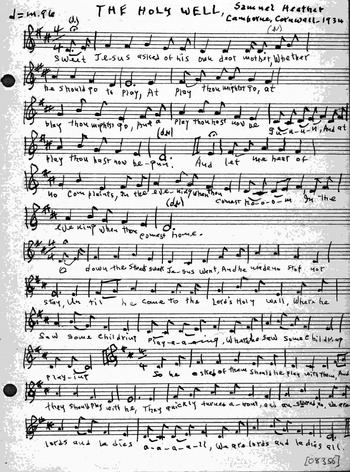
Carpenter's own transcription of the words and tune, derived from the sound recording, is shown in Figure 1. The words, it will be noted, differ in some details from those given in the fair copy (and in the rough copy with handwritten alterations). A new transcription, derived from the sound recording as it now survives (in fact taken from a digital surrogate), and attempting to render all of the audible phonemes, might be as follows:
Carpenter Collection, MS p. 08356.

It is possible both to confirm with some confidence that, pace Carpenter's fair copy, the sound recording does have might'st (twice) and begun (not begone), and to count the vowel sounds when begun and home are expanded to fit the melody. It is nonetheless extremely difficult to decide whether the preposition really is at or a ', and whether or not there might be an s sound at the end of complaint. (It is worth remarking that these sorts of difficulties cannot be attributed solely to the poor state of cylinder recordings from the 1930s, for it can be just as difficult to make the same kind of decisions when transcribing from a modern CD.) The point is that a reader faced with just Carpenter's fair copy might assume that forms such as mightest (versus mightst in the same line), begon-ne, and ho-o-o-o-ome have some real phonological authority, when in fact this is not demonstrably the case.
There are various reasons for presenting ballad music in a written semiotic system – for ease of technical analysis, for example – and such notation also requires that the words be presented in the form of a text underlay. In such a case the correct number of syllables needs to be presented to fit with the musical pitches. So one would indeed want to write begu-u-u-un and ho-o-o-ome, for example. This is not, however, necessarily the case when presenting the words separately from the music notation. One would wish to distinguish begun from begone on grounds of semantics, and might'st from mightest on the ground that -'st is a widely recognized contraction. But the argument for preserving begu-u-u-un or ho-o-o-ome in the absence of the musical pitches is a much weaker one, for (while not wishing to exaggerate the difficulty in this particular instance) the regular spellings begun and home meet the primary demands of lexical familiarity and semantic precision.
Similar difficulties are further compounded in two stanzas (3 and 4) of the same carol-ballad collected from Sidney Veal, of Troon, Cornwall, also in 1934.Footnote 60 These might be transcribed from the sound recording, again attempting to render all of the audible phonemes, as follows:
This is pretty much what Carpenter's own transcription has. However, both the rough copy and fair copy typescripts of this carol-ballad have the word childeren in both of these stanzas. Of course, there is no way of knowing what Mr Veal said when dictating the words, or what Carpenter thought he said, but as a representation of the sound recording, childeren is just as certainly wrong in the second of the stanzas as it is correct in the first. Carpenter's typescripts could almost be thought to have the effect of making Mr Veal look like a speaker of a particular dialect. Although the English Dialect Dictionary does not list childeren as such, it does record childer as being in general dialect use and also records childern from Cornwall.Footnote 61 But the issue is a more general one concerning representation, and in the first stanza of the same ballad both rough and fair copy typescripts have the word play-ay-ay, which has the appearance of representing something closer to singing than to dictated speech, yet the sound recording (and Carpenter's own transcription) quite clearly has the word falling on just a single pitch (a minim in Carpenter's transcription) – though on the recording it actually sounds rather more like school than play.
‘The words should be taken down in ordinary English spelling …’
The linguist Dennis Preston has noted how, historically, scholars have been in the habit of transcribing items of verbal folklore in a manner that attempts to convey some details of the original pronunciation. In doing so, he argues, they have been prone to apply non-standard respellings of words, intended to convey the ‘flavour’ of informants' speech, in a non-systematic fashion. In particular, they have tended mostly to respell ‘that which strikes them as nonstandard or unusual’, meaning, in effect, that they have more frequently respelt the language of groups of people who are perceived as being ‘other’. That is to say, non-standard spellings reflect transcribers' perceptions of their sources; and those perceptions usually, albeit no doubt involuntarily, Preston claims, reflect detrimentally on the status of those sources. In order to avoid such pitfalls, he offers the following pragmatic advice:
Transcribe differences at the morphological level and above; do not try to show regular phonological differences which may deviate from some preconceived notion of ‘standard’ unless such differences are important to the discussion of the text or a complete understanding of it. If that is the case, a phonetic transcription, narrow as the point to be made requires, is the appropriate strategy, or, in some cases where the variety differs radically from better-known ones, a new spelling system might be devised.Footnote 62
Preston's detailed prescriptions are quite complex of application, and require some knowledge of linguistic rules governing phonological and morphological changes, but for practical purposes they advise against the respelling of words where a variant pronunciation (or ‘phonetic realization’) can be considered predictable on the basis of a knowledge of the relevant linguistic and/or interactional environment.Footnote 63
Preston's proposal provoked a short but bad-tempered debate with Elizabeth Fine, who mounted a defence of ‘literary dialect’ spelling as a means of representing performance features in print.Footnote 64 She notes, for example, that casual speech can be ‘an important contextual indicator of the psychological scene and interpersonal relationships of the participants in a performance. Whether or not casual speech usages indicate a regional dialect, they indicate the conscious or unconscious choices of a performer, which can convey important information about folklore and its social use.’Footnote 65 Preston responded in some detail, to the effect that respellings ‘make us believe that an accurate transcript has been given when, in fact, no phonetic work has been done at all’.Footnote 66 In contrast, what Fine is actually mostly concerned with is the imaginative recreation or ‘translation’ of spoken texts into another, written ‘language’, capable of conveying as much as possible of the characteristics of the ‘performance’ that lies behind it, in accordance with her rigid conception that folklore equates to ‘artistic verbal performance’.Footnote 67
Preston and (to a lesser extent) Fine are primarily concerned with the representation of ‘natural’ speech and not with the rendering of aesthetic artefacts such as ballads and songs, which employ a different linguistic register from that of everyday conversation. Percy Grainger, for example, remarked on the reduced occurrence of dialect patterns in the folk songs he recorded in Lincolnshire relative to the everyday speech of their singers.Footnote 68 Similarly, then, the dropping of the t sound from a' play in the singing of ‘The Holy Well’ does not say anything about the everyday linguistic and hence social status of Sam Heather, and the initial typing suggests that when dictating he said at. Thus Preston's objection to dialect forms on social grounds does not seem especially applicable, but the gist of his objection to a non-systematic, impressionistic respelling remains pertinent, especially if inconsistency is compounded by the introduction of forms that are driven by melodic requirements rather than by genuine linguistic variation. To repeat the point, child-e-ren makes perfect sense as the underlay to two quavers and a crotchet, but has little value at all as a rendering of the English word signifying young people, boys and girls.
At the end of the nineteenth century the Folk-Song Society issued a leaflet called Hints to Collectors of Folk Music, which gives some practical advice on the matter: ‘The words should be taken down in ordinary English spelling, but with no alterations made for the sake of grammatical correctness.’Footnote 69 But on the whole it is folk narrative scholars who seem to have been most alert to the potential pitfalls of writing down words (possibly because expression in prose is less constrained by the requirements of metre and melody, and because folk narratives have less of a printed legacy than do ballads). The different levels at which folk narratives are amenable to transcription range widely, from a loose paraphrase through to the development of elaborate systems for representing such features as pauses of different lengths, asides, self-corrections, interruptions, aspects of stress and intonation, and so on, as well as niceties of regional, dialectal, and idiolectal pronunciation, and the provision of international phonetic alphabet (IPA) and/or other phonetic renderings.Footnote 70 Some would wish to go further and incorporate systems for representing proxemic, kinesic, paralinguistic, and interactional information.Footnote 71 At least some of these features, we might observe, are beginning to emerge in Grainger's transcriptions. Yet it is immediately evident that such an accumulation of detail will bring with it an accumulation of difficulties, in the areas of precision, consistency, accessibility, and so forth. Graham Shorrocks, for example, recommends four different, simultaneous levels of transcription, representing variously suprasegmental features (stress, intonation, and so on), phonetic or phonemic transcription, literary dialect (an accessible rendering of unusual phonetic and phonemic forms), and ‘translation’ into standard English.Footnote 72 In fact, what this potential accretion of methods implies more than anything is that different levels of transcription are best suited to different purposes: the study of performance, linguistic analysis, comparative studies, general reading, and so on.Footnote 73
This accumulating level of potential complexity, discussions of different ways of doing transcriptions, and bad-tempered arguments such as those between Preston and Fine all stem from what appears to be an orthodox assumption: that ‘any published text of a tale should be an exact record of the performance’.Footnote 74 Other formulations include ‘verbatim’ texts or transcriptions,Footnote 75 ‘word for word exactness’,Footnote 76 and Fine's virtuous asseveration that ‘our job is to record the speech we hear as accurately as possible’.Footnote 77 Now the reason that lies behind these sorts of expression of orthodoxy is the long-standing perception that there is no single text of a folktale – or ballad or folk song – either as between its different performers or between its individual performances, but that an equivalent authority rests with each separate iteration of the ‘same’ thing. To be sure, this insistence on the separation of iterations has to some extent been driven by a reaction against earlier collecting and transcribing practices that involved the conflating or summarizing of texts. It certainly also begs some pressing questions as to the exact constitution of ‘performances’ and their supposedly iconic status. Nevertheless it is largely unexceptionable as a statement of the unstable nature of folkloric items, or ‘works’ – even if it now seems that they share this condition much more closely with works of canonical literature and music than has previously been generally recognized.
Where the problem arises is with the extrapolation of such a recognition of the integrity of separate iterations into a hierarchy of documentary authority, which descends from ‘live’ performance, through audio/video recording, to written transcription. Such an assumption of hierarchy brings with it the proposition that a ‘verbatim’ transcript, made from either the live performance or an audio recording, is both (theoretically) possible and inherently desirable. Relative to the transcription, the tape recording can be held to be the ‘primary document’ – even though within the aforementioned hierarchy it patently is not. Arguably the live performance might be held to constitute the ‘primary document’, though the effect of the presence of an observer, underwritten by Helmholtz's discoveries in acoustics, would make it difficult to maintain even that position. If not, then maybe the ‘primary document’ would be something like the performer's ‘mental concept’;Footnote 78 but even if such a thing could be said to exist, it would surely be a constantly changing abstract, again subject to external influences, including the interest shown by the researcher. So the ‘primary document’ is a vanishing ideal, in continual retreat from the potential investigator.
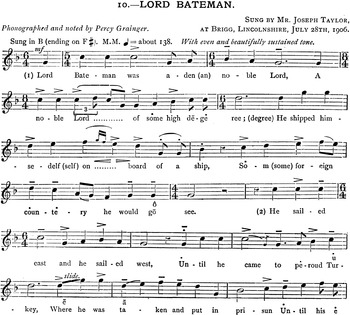
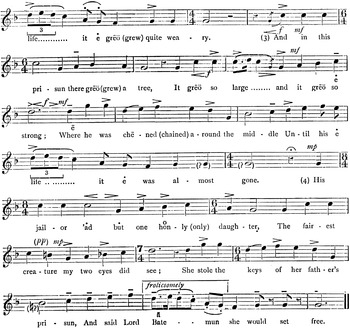
What lies behind this assumption of documentary hierarchy seems to be the metaphysics of presence. The closer to the designated source, both physically and in terms of perceived steps of ‘mediation’, the more textually authoritative the item is deemed to be. Yet, as the examples given above of child-e-ren for children or begon-ne for the grammatically and semantically requisite begun indicate, the apparent authority achieved from representing something in one semiotic system (writing) in a fashion that has the appearance of being that much closer to a rendering of the same thing in another semiotic system (sound recording) can be quite misleading. Grainger's phonetic transcriptions provide further instances of the same kind of thing. Figure 2 shows the transcription of Joseph Taylor's ‘Lord Bateman’ (Child 53).Footnote 79 Even granted that many of the hyphens simply indicate where a word is split across two or more musical pitches, and that a clear key is provided to the orthographic symbols used in the transcriptions,Footnote 80 the difficulty of reading the words is still such that Grainger himself was obliged in some instances to provide a rendering in standard English orthography. At the very least, a standard rendering of the words separately from the music would provide a clear reading text. Grainger's remarks on the phonetic habits of Lincolnshire folk singers – their tendency towards mixed standard and regional pronunciations, and their habit of inserting additional syllables into words sung over more than one pitch – do usefully describe something of the flavour of performances.Footnote 81 But given the difficulty of reading and the subjectivity of the renderings, writing prisun for prison, grēö for grew, chēned for chained, and Ba/ãtemun for Bateman really takes us no closer to the designated source than does the general direction, ‘With even and beautifully sustained tone’, that heads the transcription.
Joseph Taylor, ‘Lord Bateman’, transcribed by Percy Grainger, Journal of the Folk-Song Society 3/3 (no. 12) (1908), 192–3.

continued

While probably few would want to disagree with that description of Joseph Taylor's singing, there is certainly greater scope for disagreement about the precision of some of the phonetic renderings.Footnote 82 But the purpose here is not to argue for any particular standard of verbal transcription: as with the folk narratives mentioned above, different transcription levels are suitable for different purposes, and none of them bears an indexical relationship with its source. Rather, the problem lies in equating a documentary hierarchy with the metaphysics of presence at all. As argued above, the semiotics of both sound and writing can be satisfactorily isolated from their putative point of origin. Accordingly, writing and sound enjoy a non-indexical and non-hierarchical relationship.
The ballad as writing and the ballad as sound – live singing and sound recording in various formats, printed broadsides and songbooks, different levels of written transcription – all provide different and complementary sets of instructions to facilitate access to the intangible ballad as ‘work’. The notion of ‘translation’ between media, or from performance to print, is, on this model, simply quite wrong. The problem with the effort, as described by one ballad editor, ‘to present the song as it was actually sung’,Footnote 83 is not so much that it is doomed to failure, as that it represents a confusion of textual categories from the very start.
The equation with the metaphysics of presence of a documentary hierarchy for the Anglo-Scottish ballad that privileges sound is closely paralleled by the demand for ‘authenticity’ and the concomitant distrust of ‘mediation’ that came to characterize the folk song revival during the later twentieth century. In the scholarly context, that distrust of mediation is most closely identified with the writings of David Harker. There is also some resonance with what the German Marxist critic Walter Benjamin identified as the ‘aura’ of the work of art, that quality that supposedly belongs uniquely to the ‘original’ artefact and its singular presence in time and space, and which is requisite to concepts of authenticity and tradition. The general thrust of Benjamin's famous essay on ‘The Work of Art in the Age of its Technological Reproducibility’ is that the multiplicity enabled by mechanical reproduction has had the effect of diminishing the ‘aura’ of artefacts and thus diluting the notions of authenticity, tradition, and authority that can attach to them.
Benjamin's argument, however, is problematic in a number of ways, of which the most important for the present discussion is the scant consideration that he gives to the phenomenon of printing at large, and especially to the early proliferation of popular and ephemeral printed items, of which the broadside ballad sheets are a prime instance. While we can state relatively little for certain about ballad singing in England and Scotland in the earlier period, the printed broadsides and chapbooks remain accessible. Although they vary in quality, together they disclose a remarkable vernacular aesthetic, which is only reinforced by physical aspects of typography, illustration, decoration, and so forth. But their crucial importance for the present discussion is that they embody a functional aesthetic that is complementary to, and yet still quite separate from, vocal expression. They provide the critical historical evidence for the coexistence of the Anglo-Scottish ballad in two separate semiotic systems, sound and writing, each of which can be thought of as conforming to its own conventions and enjoying its own authority. By way of a very brief international comparison, the ‘ballad picture show’ of Germany, known as Bänkelsang, current over much the same period, made very deliberate use of complementary media to communicate stories in narrative verse: vocal performance, pictorial display, and the words in print on ballad sheets or in chapbooks, sometimes also including a prose redaction.Footnote 84 A modern English ballad edition, with clear reading text ‘in ordinary English spelling’ and music notation following established conventions, might lack some of the aesthetic charm of earlier printed ballad sheets, but it fulfils a very similar function.