Introduction
Shortly after the first detection of a Severe Acute Respiratory Syndrome-Coronavirus-2 (SARS-CoV-2) case in Belgium, the health care crisis was declared a pandemic by the World Health Organization on March 11, 2020. As the Coronavirus-2019 (COVID-19) pandemic and previous epidemics have shown, emergency departments (EDs) are at the frontline of care for outbreaks of viral diseases. Reference Dugas, Morton and Beard1 As the gate keeper of the hospital, the EDs have to reorganize their structure, staff, supplies and functioning systems swiftly in order to cope with a rapidly increasing number of patients while maintaining efficient care of high quality. Reference Scarfone, Coffin, Fieldston, Falkowski, Cooney and Grenfell2,Reference Möckel, Bachmann, Behringer, Pfäfflin and Stegemann3
This study performed an assessment of measures taken by Belgian EDs at the start of the COVID-19 pandemic, in the period from March 1 until May 31, 2020. This assessment aimed at providing more information in order to learn and to better prepare for future emerging infectious diseases and slow onset disasters.
Narrative
A retrospective study was conducted among Belgian EDs following an approval by the Research Ethical Committee UZ/KU Leuven. Participation was voluntary and withdrawal had no consequences. Anonymity and confidentiality were guaranteed.
A survey consisting of 40 questions was sent by mail to all ED heads using the online SurveyMonkey platform® (SurveyMonkey Inc., California, USA). The questions addressed the 4 S’s in disaster medicine, namely the expansion and reorganization of the ED structure, staff and supplies, and actions undertaken to facilitate the extraordinary patient care and flow. For descriptive statistics, Excel® (Microsoft Corp., Washington, USA) and Graphpad Prism® (Graphpad Software Inc., California, USA) were used.
Survey response rate
Out of 114 Belgian EDs questioned, 62 (54%) answered the primary quantitative questions we inquired on, and 41% of ED heads completed 90% or more of the questions in our survey. With a total of 30990 beds, our respondents represent approximately 60% of all Belgian hospital beds. 4
Structure
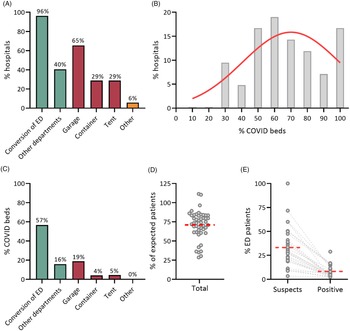
In Belgium, the majority of participating EDs (84%) reported that they expanded their bed capacity. On average, the total number of beds was augmented by 46%. In addition to the regular ED space, 84% of the respondents used 1 or several extra modalities to accommodate patients (Figure 1a). From the responding hospitals, 40% implemented ED care at other wards, 65% utilized their ED garage/ambulance bay, 29% utilized external tent facilities, and 29% used containers. A total of 6% reported the use of additional spaces in the hospital (chapel and dining hall amongst others). Most EDs reserved 50% of their beds or more for COVID-19 suspect patients, with an average of 64% (Figure 1b). They were mostly accommodated inside the hospitals’ structure, more specifically in the typical ED space (58% of ED beds), other wards (15%), and the improvised garage structure (19%) (Figure 1c). Less than 10% of all beds provided for COVID-19-suspect patients were sheltered in tents or containers. Participating ED heads indicated they would rather use these types of structures outside of the hospital for (pre)triage (72%). Out of every 3 participating EDs, 2 indicated that they treated ambulatory patients with mild respiratory symptoms outside of the typical ED space, and 29% provided the urgent care for ambulatory patients like minor trauma outside of the ED.
Structural reorganization of emergency departments (EDs) at the start of the COVID-19 pandemic A) Different modalities were used at the EDs to accommodate patients, both COVID-19 suspect patients and non-suspect. Data are depicted as a percentage (%) of hospitals that used the different spaces. Bars in green represent in-hospital structures, bars in red are out-of-hospital structures, alternatives are depicted in orange. B) A certain amount of beds were reserved for COVID-19 suspect patients. Data are presented as a percentage (%) of hospitals that reserved a certain number of their ED beds for COVID-19 suspect patients. The solid red line represents predicted values modeled with nonlinear regression. C) The percentage (%) of reserved COVID-19 beds per modality. D) The total number of patients seen at the ED during the first wave of the pandemic, presented as a percentage (%) of the expected number of patients as deduced from the year before. E) ED patients that were considered COVID-19 suspect and/or that tested positive. Data are presented as a percentage (%) of ED patients per hospital. Dashed lines represent matched datapoints from the same hospital.

Looking to the future, many EDs reported that there are plans for a new hospital or renovation of the existing ED (55% within the next 5 years). A total of 9 respondents indicated that they incorporated surge capacity infrastructure in the new plans, based on the events during the first wave of the COVID-19 pandemic.
Staff
The majority of participating EDs deployed extra staff, mainly nurses (90%), logistical staff (82%), and physicians (71%). Most indicated that they needed less than 50% extra personnel. These extra staff members originated mostly from other hospital wards (96% of respondents). Furthermore, final-year medical students (38%), and retired staff (8%) were put into service. More overtime hours were registered for physicians (60%) and nurses (20%). A higher absenteeism rate was observed in 27% of the participating EDs when compared with the same period of 1 year earlier. In order to support personnel, the participating EDs organized extra training on the correct use of personal protective equipment (PPE) (96%), management of COVID-19 (88%), specific simulation training (44%), and the use of thoracic ultrasound (10%). Moreover, 87% of the participating EDs provided additional psychological support for their staff.
Supplies
More than half of the respondents (56%) reported an acute shortage (defined as a ‘stock less than 7 days’) of PPE. In general, most of the participating EDs had sufficient medication available. However, several reported an acute shortage of muscle relaxants (36%), sedatives (34%), and antibiotics (10%). About 17% also had a shortage of ventilators and/or non-invasive breathing material.
System
Most of the participating hospitals (93%) indicated they had a plan for mass casualty incidents. However, only 61% had made specific preparations for a sudden onset disaster. At best, 15% felt they were sufficiently prepared for the COVID-19 pandemic.
As mentioned before, most participating EDs reserved 50% or more of their beds for COVID-19 suspect patients (Figure 1b). In hindsight, the number of patient presentations at the ED dropped by 29% compared to the average number of patients seen in a 3-month period the year before (Figure 1d). On average, only 1 in 3 patients presenting at the ED was considered a suspected COVID-19 patient and only 7% finally tested positive (Figure 1e).
Discussion and Conclusion
Since the beginning of this pandemic, enormous efforts have been made to augment the surge capacity for COVID-19 (suspect) patients at the ED. In Belgium, every ED adapted their individual capabilities to meet the surge in continuation of care for other ED patients. There was no national guidance on the process. This survey demonstrated that participating EDs used various structural approaches to meet the increased demands. Most participating hospitals provided the majority of COVID-19-suspect patient care within the walls of the hospital. Although almost 1 out of 3 EDs used tents and/or containers, only a minority of COVID-19 suspect patients were accommodated in this manner. These structures were rather used for (pre)triage or ambulatory patient care.
An assessment on the planning of new hospitals or ED renovations revealed that the majority of participating Belgian EDs plan to do so within 5 years. This creates opportunities for better preparedness for future, slow onset, emerging infectious disease disasters. Conveying new plans should happen with hospital disaster management specialists in order to anticipate specific needs. For example, it might be valuable to incorporate the possibility of double entry, separation walls for cluster isolation, negative pressure rooms, etcetera. Reference Paganini, Conti, Weinstein, Della Corte and Ragazzoni5
In addition to altered structural demands, Belgian EDs also faced staffing challenges. The majority of participating EDs deployed additional staff, most of them normally working on other wards. Furthermore, the respondents indicated that the absenteeism rate was higher than registered in the previous years. This survey did not determine whether this was due to an infection with COVID-19, psychological burden, or other reasons, but these findings align with what has been noticed in other studies. Reference Tujjar and Simonelli6
The participating Belgian EDs did not challenge major medication shortages. However, in more than 50% of the EDs, there was an acute shortage of PPE. This shortage was a worldwide problem during the first wave of the pandemic. Reference Bressan, Buonsenso and Farrugia7,8 Stockpiling sufficient PPE and implementing guidelines on its appropriate use and need are advised to optimize availability. 9
EDs had to estimate the number of patient presentations in anticipation of the surge. Nearly all participating Belgian EDs decided to expand their bed capacity. Nevertheless, it has now become clear that ED patient volumes have decreased across the globe and our study further supports these findings. Reference Barten, Latten and van Osch10,Reference Man, Yeung, Chung and Cameron11 Amongst others, this was either due to fewer traffic and/or workplace accidents, or due to fear of exposure to infected patients, or concerns of themselves overwhelming the hospitals. Data suggests that these latter factors impose great risks for so called ‘secondary deaths.’ Reference Giamello, Abram, Bernardi and Lauria12,Reference Weinstein, Ragazzoni, Burkle, Allen, Hogan and Della Corte13 However, it is not clear whether a similar decline will be observed in future pandemics, so evidently this should not be relied upon.
This study has some limitations. As for most surveys, non-response error might contribute to our findings due to voluntary participation. The survey was designed diligently in conjunction with an expert in survey measurement and questionnaire design, but did not undergo a formal validation process. This study focused particularly on Belgian emergency departments hence, there is some limitation of generalizability to other countries/healthcare systems.
For future research, an inquiry on the measures the EDs wish they would have taken when reflecting back on this disaster would be useful. These answers would be an important step toward improved preparedness for slow onset, emerging infectious disease disasters. Besides, it would be interesting to assess measurable health care parameters and outcomes (e.g. waiting times, mortality, etc.) to perform a comparison between hospitals and disaster measures taken, or to examine preparedness as a predictor of disaster outcomes.
In conclusion, this survey is insightful regarding disaster planning in Belgian EDs. More than 1 out of 3 participants indicated they did not have a plan for epidemiological disasters. Almost every participating ED reported they felt unprepared for this pandemic. Nevertheless this survey demonstrated that many aspects of the “4S’s” theory for surge capacity (Structure, Staff, Supplies, and Systems) were adequately deployed. Based on this study, EDs should, in addition to stockpiling sufficient supplies, prepare multidisciplinary strategic, and operational plans for coming pandemics. These should involve all aspects of patient care. Having disaster teams that include representatives from all hospital areas will be of paramount importance in avoiding fragmentation. Reference AlAssaf14
Acknowledgements
We want to express our thanks to Prof. Em Jaak Billiet for aiding in the setup of the questionnaire and Elisabeth Rossaert for the invaluable help in analytical input.
Author Contributions
VT equally contributed as first author. All authors discussed the results and contributed to the final manuscript. HR, VT, ML, and SM conceived and designed the analysis and wrote the manuscript. HR, VT, and ML collected the data. ML, DD, and VP contributed data, analysis tools and performed the analysis.
Conflict of interest
The authors have no conflicts of interest to declare.