It is well recognized that postoperative development of pulmonary regurgitation after surgical repair of tetralogy of Fallot may be detrimental.Reference Hugel, Hannekum, Schreiber and Dalichau1–Reference Cheung, Konstantinov and Redington3 There is a sudden haemodynamic change from a pressure-loaded to a volume-loaded ventricle. Pulmonary regurgitation further increases the volume load on the right ventricle, especially in the setting of a patch placed across the ventriculo-pulmonary junction and small pulmonary arteries. Chronic volume overload in the long-term postoperative period may result in dilation and dysfunction of the right ventricle.Reference Bouzas, Kilner and Gatzoulis2–Reference Frigiola, Redington, Cullen and Vogel4 To maintain better pulmonary valvar competence, we have used a homograft monocusp from our own tissue bank when we placed incisions across the ventriculo-pulmonary junction. The aim of this study is to evaluate the mid- to long-term outcome of this procedure, and to identify the determinants of its durability.
Materials and methods
Patients
We obtained approval from the Institutional Review Board for the study, and the need for individual consent was waived. Since July, 1996, we have inserted a homograft monocusp when our surgical repair of tetralogy of Fallot has included a so-called “transannular incision”, in reality an incision across the ventriculo-pulmonary junction. By June, 2005, over a period of 10 years, we performed total correction in 218 patients with tetralogy of Fallot at our institution. Among them, an incision across the ventriculo-pulmonary junction was required in 103 patients (47%), and a homograft monocusp was inserted in 54 patients (25%). We reviewed retrospectively the medical records, homograft registry data, and echocardiographic data of these patients. Their median age at surgery was 8.1 months, with a range from 27 days to 37.5 years. Of the patients, 39 of 54 (72%) were under the age of 1 year. The median body weight at surgery was 7.8 kg, with a range from 3.9 to 42.0 kg, and 30 were male and 24 female. The median pulmonary arterial index was 246, with a range from 74 to 712, square millimetres per square metre. Associated defects were stenoses of the right or left pulmonary arteries in 19 (35%), absent pulmonary valve syndrome in 4 (7%), pulmonary valvar atresia in 3 (6%), and atrioventricular septal defect with common atrioventricular junction and ventricular shunting in 1 (2%). In 20 (37%) patients, 21 procedures had been performed previously, including creation of a systemic-to-pulmonary arterial shunt in 16, with or without angioplasty of the pulmonary arteries, and balloon valvoplasty in 5.
Preparation of the homograft
The tissue bank of our institution was approved by the Korean Food and Drug Administration. Homografts were procured from beating heart donors, either brain-dead mullti-organ donors, or recipients of cardiac transplantation. For the processing of homografts, we modified a protocol from an established centre.Reference Davies, Katsumata, Westaby, Piwnika and Westaby5 In short, after sterilization in 4°C antibiotics solution for 12 to 24 hours, homografts were cryopreserved by freezing (ThermoForma Cryomed 7453; Thermo Electron Co., Marietta, OH, USA). The choice of a homograft, for example, aortic or pulmonary, was based on availability, and the preference of the surgeon, and was not randomized or driven by protocol. We used 19 aortic monocusps, and 35 pulmonary. The technique used for preparation of the monocusp from native trifoliate valve has been described fully in our previous study.Reference Jun, Park, Park, Chae, Kang and Lee6
Operative techniques
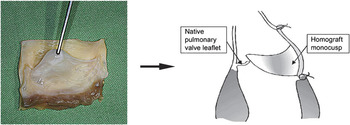
After routinely establishing aorto-bicaval cardiopulmonary bypass with moderate hypothermia, antegrade cold blood cardioplegia was infused intermittently, and a left ventricular vent was inserted through right upper pulmonary vein. The intracardiac repair was performed through the right atrium and/or the pulmonary trunk. A transjunctional incision was made at the anterior zone of apposition between the valvar leaflets, making the incision into the right ventricle as small as possible. When the zone of apposition was not located anteriorly, or not adjacent to the incision, the incision was made through the valvar leaflet, adding additional sutures to make the leaflets competent. The monocusp was adjusted to approximate to the native valve and the posterior wall of the pulmonary root (Fig. 1). In small infants, we made the monocusp patch narrower than the original shape by placing sutures at the zones of apposition between the leaflets. An additional Goretex patch was required to create a right ventricular outflow hood in 1 adult. The pressures in the right ventricle and aortic root were measured after discontinuance of the cardiopulmonary bypass and modified ultrafiltration. The median period of bypass was 175 minutes, with a range from 73 to 268 minutes, and median period of aorta cross-clamping was 119 minutes, with a range from 30 to 191 minutes. The median ratio of right ventricular to aortic pressures after bypass was 0.6, with a range from 0.2 to 0.8.
Preparation and insertion of a homograft monocusp. A monocusp was trimmed along the zones of apposition between the leaflets and placed to approximate its leaflets to the remnant of the native pulmonary valve and the posterior component of the ventriculo-pulmonary junction.

Analysis of data
Echocardiography was performed regularly during follow-up, specifically being undertaken before discharge, between 3 and 6 months, and 1 year after surgery, and then annually in the absence of a significant clinical change. Dysfunction of the monocusp was defined as significant regurgitation, moderate or more, or stenosis with a peak pressure gradient of 50 mmHg or more, of the monocusp valve on follow-up echocardiography. Failure of the monocusp was defined as the need for reoperation or intervention on the graft, valve-related death, or any death due to an undefined cause. Survival analysis was performed using the Kaplan-Meier method. Factors influencing graft dysfunction were evaluated using the log-rank test and the Cox regression model by the SPSS program (version 13.0, SPSS Inc, Chicago, IL, USA). We considered p-values of less than 0.05 as significant.
Results
Survival
Of our patients, 2 died early (3.7%). Of these, one was an 8-months-old patient who died with acute respiratory distress syndrome and sepsis due to fulminant adenovirus infection 14 days after the operation. This patient had been successfully weaned from a ventilator after repair, and had shown no haemodynamic abnormality except mild pulmonary regurgitation on postoperative echocardiography. The other was a 27-days-old patient with absent pulmonary valve syndrome and hyperinflated left lung. Postoperative echocardiography revealed moderate pulmonary regurgitation, but no signs of low cardiac output. The patient died of pneumonia and sepsis 24 days after the operation. Follow-up was completed in 48 of the 52 survivors (92%). In the median follow-up of 64.3 months, ranging from 0.3 to 120 months, there had been no late deaths.
Function of the homograft monocusp
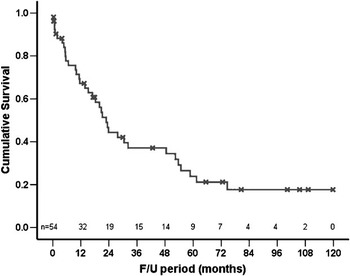
In 36 patients (67%), we found significant pulmonary regurgitation on the latest echocardiography. Of these, 1 patient underwent pulmonary valvar replacement with a tissue valve 8 months after the initial repair because of severe pulmonary regurgitation and right ventricular dilation. No patient showed significant pulmonary stenosis, although 8 patients had a peak pressure gradient through the right ventricular outflow tract of more than 20 mmHg. Balloon angioplasty or stenting was needed in 5 patients to relieve stenoses in the right or left pulmonary arteries, albeit that there was no valve-related intervention. The overall Kaplan-Meier estimates of time-related freedom from graft dysfunction were 67.2 ± 6.7% at 1 year, 37.1 ± 7.3% at 3 years, 23.8 ± 6.7% at 5 years, and 21.2 ± 6.4% at 7 years (Fig. 2). Freedom from graft failure was 98.0 ± 2.0% at 1 years, and 95.6 ± 3.1% at 3, 5, and 7 years.
The overall Kaplan-Meier estimates of time-related freedom from graft dysfunction, which was defined as significant regurgitation (moderate or more) or stenosis (peak pressure gradient 50 mmHg or more) of the monocusp valve on follow-up echocardiography.

Analysis of risk factors
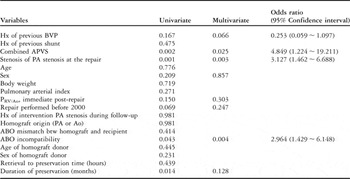
We found that a diagnosis of absent pulmonary valve syndrome, stenoses in the right or left pulmonary arteries at the time of repair, and ABO blood group incompatibility between donor and recipient all emerged as significant risk factors for valvar dysfunction by multivariate analysis, although the duration of preservation, and repair performed before 2000, were also associated with valvar dysfunction when assessed by univariate analysis (Table 1). A history of previous balloon valvoplasty had a positive influence on valvar function, but showed only borderline significance (p = 0.066). Other variables, such as a history of previous systemic-to-pulmonary arterial shunt, ABO mismatch, age of the patient, whether the graft was aortic or pulmonary origin, native pulmonary arterial index, and intervention for stenosis of the pulmonary arteries during follow-up, did not affect outcomes statistically.
Analysis of risk factors for dysfunction of the homograft monocusp.

Abbreviations: Ao: aorta; APVS: absent pulmonary valve syndrome; BVP: balloon valvoplasty; Hx: history; PA: pulmonary artery; PRV/Ao: pressure ratio of the right ventricle to the aorta; RV: right ventricle.
Discussion
Some patients with tetralogy of Fallot also require incisions across their hypoplastic ventriculo-pulmonary junction, the so-called transannular incision, as part of the surgical repair. Surgical correction in this setting can lead to a sudden haemodynamic change from a pressure-loaded to a volume-loaded ventricle. This, in turn, results in increased end-diastolic volume, which can depress the function of the right ventricle and the cardiac output.Reference Hugel, Hannekum, Schreiber and Dalichau1 The condition can then be worsened by a ventricular incision, and needs a period of time for recovery. Chronic pulmonary regurgitation itself adversely affects right ventricular function, leading to cardiac enlargement, biventricular dysfunction, and arrhythmias.Reference Bouzas, Kilner and Gatzoulis2, Reference Cheung, Konstantinov and Redington3 It also decreases exercise capacity, and has a negative influence on lung function.Reference Jonsson, Ivert, Jonasson, Holmgren and Bjork7, Reference Jonsson, Ivert, Jonasson, Wahlgren, Holmgren and Bjork8
There is general consensus that prevention and correction of pulmonary regurgitation is important over the long-term, and can be critical in some situations, such as elevated pulmonary vascular resistance, small pulmonary arteries, multiple distal pulmonary stenosis, right ventricular dysfunction, and tricuspid regurgitation.
Although many studiesReference Turrentine, McCarthy, Vijay, McConnell and Brown9–Reference Roughneen, DeLeon, Parvathaneni, Cetta, Eidem and Vitullo15 have addressed the methods of reconstructing the right ventricular outflow tract to prevent pulmonary regurgitation, as yet there is no standard surgical approach, particularly for infants and small children during the initial repair. We have used a homograft monocusp valve from our own tissue bank since 1996, and previously published our early results.Reference Jun, Park, Park, Chae, Kang and Lee6
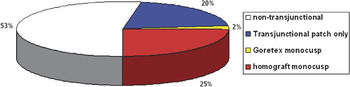
Several questions may be raised concerning this study. With regard to the indication for enlargement of the right ventricular outflow tract by means of a transjunctional incision, it is our policy to make every effort to maintain the native pulmonary valve, and to decrease the frequency and size of ventriculotomy. Generally, a transjunctional patch is considered when the orifice of the pulmonary valve after commissurotomy is below 2 standard deviations of normal, or when the right ventricular pressure after repair exceeds 80% of systemic pressure. In Figure 3, we show the proportion of the patients requiring a homograft monocusp among our total cohort of patients with tetralogy of Fallot. With regard to the choice of a transjunctional patch, there have been no strict criterions. Use of the monocusp was based on availability, and preference of the surgeon, and was not randomized. Although we have tried to insert the monocusp as distally as possible, it is the case that such insertion requires a longer ventriculotomy to fit well in the right ventricular outflow tract. Trying not to make a further incision to insert a monocusp valve, a pericardial transjunctional patch may suffice in some patients who require only a few millimetres of ventriculotomy when the right ventricular outflow tract is non-obstructive. Because the number of available homograft monocusps is limited, we often reserve the monocusp for cases such as absent pulmonary valve syndrome. We had a small experience using a Goretex monocusp, but abandoned the technique because of the development of stenosis due to immobilization.
Our total number of patients with tetralogy of Fallot repaired in the same period, numbering 218, with a median age of 8.0 months, and median pulmonary arterial index of 296 square millimetres per square metre, are grouped by the type of reconstruction on the right ventricular outflow tract.

In this study, we present the follow-up results for a period of more than 5 years, focussing on the function of the homograft valve and identifying the risk factors for its dysfunction. Our 2 early deaths were associated with respiratory infection. Since none of our patients died subsequently, we did not calculate rates of survival. The overall Kaplan-Meier estimates of time-related freedom from graft dysfunction were 67.2 ± 6.7% at 1 year, 37.1 ± 7.3% at 3 years, 23.8 ± 6.7% at 5 years, and 21.2 ± 6.4% at 7 years (Fig. 2). Failure of the homograft monocusp was observed in 2 patients, specifically one who died with moderate pulmonary regurgitation, and the other who underwent replacement of the valve. Freedom from graft failure was 98.0 ± 2.0% at 1 year, and 95.6 ± 3.1% at 3, 5, and 7 years. Freedom from severe or free pulmonary regurgitation was 91.5 ± 4.1% at 1 year, 74.8 ± 6.6% at 3 years, 59.9 ± 8.0% at 5 years, and 52.7 ± 8.5% at 7 years.
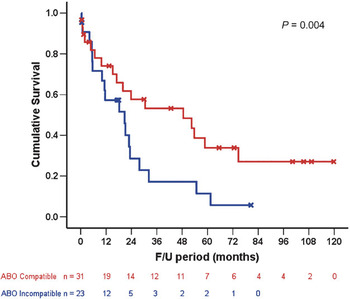
The homograft monocusp rapidly degenerates at 2 to 3 years after implantation with wearing down of the leaflet. Calcification and stenosis of the leaflet, in contrast, were seldom observed. As for their durability, procurement and processing can play an important role.Reference Niwaya, Sakaguchi, Kawachi and Kitamura16, Reference Gall, Smith, Willmette and O’Brien17 Our homografts were harvested from heart-beating donors with a median age of 38.5 years. With such a short warm ischaemic time, the homografts were sterilized in 4°C saline containing antibiotics such as amphotericin B, which is known to reduce homograft immunogenicity.Reference Gall, Smith, Willmette and O’Brien17 The lack of stenosis was probably not due to growth, but rather to dilation. The reduced level of calcification suggests that our homografts might have decreased immunogenicity. Immunogenicity, nonetheless, might play some role, since ABO incompatibility between donor and recipient was shown to have a significant negative influence on valvar function (Fig. 4). Although, we were unable to identify the precise reason, the methods of preparation of the homograft are closely related to longevity of the graft, which is determined by cell viability and immunogenicity.
Comparison of freedom from dysfunction of ABO blood group compatible grafts with that of incompatible grafts.

Stenosis of the pulmonary arteries at the repair, and a diagnosis of absent pulmonary valve syndrome, were identified as risk factors for valvar dysfunction. This can be explained by increased afterload of the monocusp, anatomically and functionally.Reference Kang, Redington and Benson18 It is interesting that a history of previous balloon valvoplasty on the atretic pulmonary valve had a positive influence on the graft function, although this had statistically borderline significance. We performed balloon valvoplasty in 5 patients with atretic pulmonary valves and less severe infundibular stenosis. Only one of them required an additional shunt. Assurance of forward flow through native pulmonary valve, and avoidance of shunting, might affect this finding, although a history of previous systemic-to-pulmonary arterial shunting had no significance.
As Ionescu et al.Reference Ionescu, Tandon and Macartney12 pointed out, the surgical technique is another important factor affecting results. Early development of pulmonary regurgitation by technical factors can be explained as follows, first, the longer distance to be covered by the monocusp leaflet during the rapid phase of closure,Reference Bigras, Boutin, McCrindle and Rebeyka10, Reference Sievers, Storde and Rohwedder19 second, irregular movements of the valve during closure as a result of buckling,Reference Sievers, Storde and Rohwedder19 and third, the width of the monocusp.Reference Bigras, Boutin, McCrindle and Rebeyka10, Reference Bechtel, Lange and Sievers20 Our technical considerations have been described in detail in our previous study. In short, we make the ventriculotomy as short as possible to make the patch smaller, and to make the level of ventriculo-arterial junction of the monocusp positioned distally. So as to make the monocusp patch not too wide, we separate the valve during preparation along the zones of apposition between the leaflets, adding sutures at the margins of the zones of apposition if the patch was too wide for the patient native ventriculo-pulmonary junction. We retain the native valve posteriorly for better coaptation (Fig. 1). We position the monocusp distally to prevent pulmonary regurgitation even when there is dilation of the ventriculo-pulmonary junction.
Our present study is a non-randomized and retrospective. Management, surgical technique, and preparation of the homograft have evolved during the period of study although time factor was not significantly associated with valvar function (Table 1). For analysis of risk factors, the number of patients in some groups is too small, although our findings did show statistical significance.
In conclusion, our use of a homograft monocusp valve has proved satisfactory in preventing pulmonary regurgitation. The effect, however, is limited in its duration. Stenosis of the pulmonary arteries at the time of repair, ABO blood group incompatibility between donor and recipient, and associated absent pulmonary valve syndrome, were all identified with early dysfunction of the graft. Theoretically, therefore, the homograft monocusp has the advantage of preventing pulmonary regurgitation in the early postoperative period, but its clinical significance needs to be defined with longer-term follow-up.
Acknowledgements
We thank You-Kyung Lee and Si-Young Oh for their devoted support in preparing the homograft and collecting the data.