

Introduction
Mass-casualty triage is the process by which large numbers of patients affected by a single incident are sorted and ordered for transport and treatment from the scene of a mass-casualty incident (MCI). By definition, disasters occur when a scarcity of at least one available resource limits immediate treatment and transport of all victims.Reference Baker 1 Triage allows the disbursement of resources including responders, transport vehicles, equipment, and medications in a manner which will provide the greatest benefit to the greatest number of people.Reference Baker 1 , Reference Iserson and Moskop 2
Currently, MCI triage in the US is typically accomplished by using an algorithm which measures certain physiologic parameters, and established normal values for these parameters, to determine which patients are treated first and which can wait for treatment without significant risk of deterioration.Reference Cone and MacMillan 3 , Reference Culley and Svendsen 4 There is broad agreement among professional stakeholder organizations in the US that triage methodologies should conform to a variety of criteria known as the Model Uniform Core Criteria (MUCC) for MCI triage. These criteria include flexibility, simplicity, broad applicability, and basis in the best available evidence, among many others.Reference Lerner, Cone and Weinstein 5 , 6 Most triage systems measure circulation, respiratory effort, and mentation as the basis upon which triage decisions are made. Most methods use familiar categories to differentiate patients into those who are either dead or expected to die no matter the intervention (Expectant/Dead or Black); those requiring rapid initiation of critical care (Immediate or Red); other injuries which require significant intervention but which may tolerate a delay in care (Delayed or Yellow); and minimal injuries requiring only basic medical care or no care at all (Minor or Green).Reference Iserson and Moskop 2 , Reference Lerner, Cone and Weinstein 5 The most commonly used MCI triage protocol in the US is the Simple Triage and Rapid Treatment (START) triage system.Reference Cone and MacMillan 3
The process of START involves an initial sorting of patients based on their ability to follow a command to leave the scene. Each patient is then assessed according to an algorithm that takes into account breathing, circulation (as measured by either the presence of a radial pulse or measurement of finger capillary refill time), and ability to follow commands. A patient who is ambulatory and follows commands is Green; a patient that is not breathing is labeled Black; a patient who has an abnormality of any of the above metrics is Red; and patients who have intact respirations, circulation, and mentation but have other injuries are Yellow. This process is expected to take between 30 and 60 seconds per patient.Reference Cone and MacMillan 3
The use of these criteria should identify patients that will benefit most from the resources available, with the goal of decreasing critical mortality (ie, the percentage of patients with survivable injuries who die).Reference Baker 1 , Reference Jenkins, McCarthy and Sauer 7 In addition, any algorithm should seek to minimize over-triage (the assignment of a well patient to an urgent category) and under-triage (the erroneous assignment of an ill patient to a less urgent category). Over-triage puts patients at risk by wasting resources that are needed for critical patients. Under-triage causes missed opportunities to use resources on patients who need them urgently. Both types of error introduce inefficiency into the system and may result in increased critical mortality.Reference Hupert, Hollingsworth and Xiong 8
Regardless of the triage methodology selected by an agency or government, it is important to ensure that the algorithm meets some standard of utility and ease of use. Every modality necessitates initial and refresher training for providers and may have inherent limitations in its real-world use. As noted above, there is also a time cost associated with using a formal triage modality with published ranges between 30 and 60 seconds per patient.Reference Cone and MacMillan 3 , Reference Jones, White and Tofil 9 Finally, many providers note that they do not always adhere to formal algorithms when applying the triage modalities in real-world practice.Reference Armstrong, Hammond, Hirshberg and Frykberg 10 , Reference Frykberg and Tepas 11
Despite most providers’ familiarity with the concept of triage, there is a paucity of literature which demonstrates the effectiveness of these methods in real-world or simulated situations.Reference Jenkins, McCarthy and Sauer 7 There has been research showing that focused teaching regarding a triage system improves the rate of correctly triaging on written exams.Reference Risavi, Salen, Heller and Arcona 12 Computer algorithms have also been used to compare triage methods by retrospectively assigning patients according to chart review.Reference Culley and Svendsen 4 , 6 In a retrospective review of the response to a 2003 train crash MCI, Kahn and colleagues found poor agreement between START categories and outcome measures based upon hospital admission and modified Baxt criteria.Reference Kahn, Schultz, Miller and Anderson 13 They noted that while the level of under-triage of Red patients was low, there was a significant amount of over-triage. Another study compared the sensitivity and specificity of a variety of triage methodologies and found that many major modalities achieved sensitivities of between 82% and 85% with better specificities ranging from 86%-96%.Reference Garner, Lee, Harrison and Schultz 14 Both over-triage and under-triage have been observed in other studies, highlighting the imperfect and difficult nature of MCI triage.Reference Frykberg and Tepas 11 , Reference Frykberg 15
The researchers in this study are not aware of any studies that compare the use of one or more formal methodologies to a condition where responders triage patients without the use of an established algorithm. The goal in this investigation was to compare the speed and accuracy of START and an “intuitive” triage approach, in which a health care provider uses immediate, visual, and clinical gestalt to sort patients into groups based on how critical their injuries are.
Methods
Disaster Lab Conceptualization
The Disaster Lab/Operation Central Shield project was conceived in September 2015 by a group of researchers at the University of Massachusetts Medical School (Worcester, Massachusetts USA), and planning continued through September 2016 when the event was held and data were collected. The concept included a research component designed to allow testing of multiple, innovative disaster-management techniques as well as a full-scale exercise (FSE) designed to assess the host region’s preparedness for a large-scale MCI. Planning incorporated multiple stakeholders, such as the area’s Central Medical Emergency Direction (CMED; Holden, Massachusetts USA), regionalized Emergency Medical Services (EMS), local fire departments, the Department of Public Health (DPH; Boston, Massachusetts USA), the local police department, and all hospitals in the city of Worcester, Massachusetts. The simulated MCI was designed as an “active-shooter” incident at a concert in a large, inner-city convention center. Funding for the FSE was provided by the Central Massachusetts Homeland Security Advisory Council (Worcester, Massachusetts USA) and conducted according to Homeland Security Exercise and Evaluation Program (HSEEP; Washington, DC USA) standards. Funding for the research aspect of the project was provided by the University of Massachusetts Medical School.
Study approval was obtained from the University of Massachusetts Medical School academic Independent Review Board [IRB ID H00011322]. Table-top exercises and small-scale MCI drills continued through August 2016, including input from local hospitals. Coordination with city planners regarding impact to the local community, traffic, schools, and the need for public messaging was undertaken. Additionally, coordination between the City of Worcester, Massachusetts communications office, the area’s office of the Mayor and City Manager, the DCU Convention Center, the UMass Medical System, and the UMass Medical School was completed. The research exercise took place on the morning of September 20, 2016, followed by the afternoon “Operation Central Shield” FSE.
“Victim” actors were recruited primarily to be participants in an FSE being conducted to test the first response capability of the city and surrounding region. Those same volunteers agreed to participate in research studies being done in the morning before the actual city-wide response drill. Actors, both men and women 18 years old or older, were recruited from the community, area government officials, local colleges, and the University of Massachusetts Medical School staff and their families by word of mouth and paper fliers. One-hundred and forty-three people volunteered to participate. Signed consent was obtained before any activity began. First responders were recruited from local first responder agencies in the area through electronic email notifications. Purposefully, START was selected for evaluation as it is the MCI triage modality used by all EMS agencies in Massachusetts. 16 Study participants were provided with lunch, lunch time entertainment from a local band, and study tee shirts. In addition, each study participant was given a stopwatch and instructed in its use prior to the study.
Data Collection
Identical scenarios were run multiple times, each time using a different set of paramedic responders. Responders were randomized to two groups: those instructed at the beginning of the scenario to use START to assign triage categories, or those instructed to simply use their intuition to assign a category to each patient. Those responders in the START group were designated the control group of this cluster randomized simulation. Responders in both groups used standard Red/Yellow/Green/Black triage cards to make the triage assignments. All participants were paramedics in Massachusetts and were assumed to be knowledgeable regarding the use of START triage as use of this modality is mandated in MCIs by the Massachusetts Office of Emergency Medical Services (OEMS; Boston, Massachusetts USA). 16 Responders in the “intuitive” groups were given no other instruction about the basis on which to make decisions, other than: “Use your own intuition of who should be assigned what triage category, but do not use START triage.” Responders in the START group were instructed to use the standard START methodology to assign a triage category to each patient. Responders in both groups were told that the simulation represented an MCI caused by an active shooter, and that dyes and props colored red should be considered blood. Care was taken to apply moulage to study volunteers in ways that would accurately depict the nature of their injuries, which ranged from severe, multi-system penetrating trauma to those who were uninjured.
Volunteer victims were given information about their condition and whether or not they could respond to questions and ambulate, as well as what their simulated respiratory rate should be. They were instructed to act in a similar manner during each trial and were assigned specific locations within the simulation area to ensure that they were “found” in exactly the same position for each trial. Victims were instructed to follow any commands given by responders and to act out only injuries and vital signs indicated on their victim identification cards. These cards matched moulage applied to their clothing and moulage applied to the rest of their bodies as indicated. Responders were permitted, but not required, to look at the victim identification cards in each trial which showed their respiratory rate, capillary refill time, and level of alertness. With the exception of capillary refill, victims also acted out these parameters. Victim presentations had been previously validated by an independent group of three board certified Emergency Physicians who were also Board Certified in EMS practice through the American Board of Emergency Medicine (ABEM; East Lansing Michigan USA).
Data collection was performed by measuring the time taken by each group of paramedics to assign each individual patient a triage category. This was accomplished by giving each “victim” a stopwatch, which they were then instructed to start at the beginning of each iteration of the simulation and to stop the timer when they received a triage tag. Green patients were instructed to stop their timers when they had walked to a pre-designated data collection point away from the scene, if they were instructed to move by the responders. After all victims had been triaged in each trial, research assistants recorded the time on each stop watch and noted it according to the victim identification number.
A small number of individual victim triage times were not recorded in the above fashion due to error, or they were illegible. For these values, researchers calculated a mean value for patients in that category during that trial and used these imputed values to perform subsequent statistical analysis. In all, such imputation was performed for eight data points in the START trials and five data points in the intuitive triage trials.
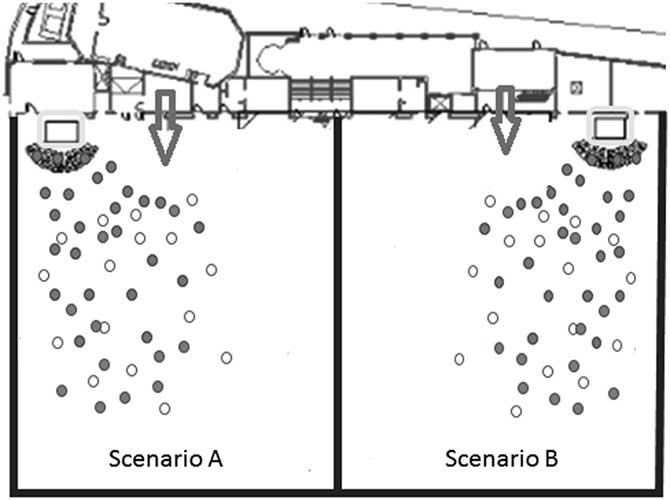
The simulated scenario was an active shooter standing on the stage, so more-severe injuries were grouped near the stage while less injured patients tended to be further away from the stage. Responders entered the scenes at analogous locations in both scenarios (indicated by arrows in Figure 1). Two trials were running simultaneously during the investigation but used a mirror image patient distribution so that the responders were seeing exactly the same scene whether they were in Scenario A or Scenario B. The patient distribution is presented in Figure 1. Not all victim positions were occupied as volunteers were limited, but in both scenarios, victim distribution began near the simulated stages (highlighted in boxes) and proceeded outward. This meant that the locations and numbers of victims in each category was similar for both Scenario A and Scenario B. Slight differences in total numbers of victims and victim category distribution between the two scenarios was due to some volunteers spontaneously switching sides out of a desire to be near friends. Despite this, the overall distribution of patients was very similar, as can be seen in Table 1. Both intuitive triage and START protocols were run on each side, and data were aggregated for analysis to minimize any effect of slight differences between the two scenarios.
Scene Layout. Note: The simulated active shooter was located on the stage (box) in each scenario, leading to the higher triage categories of the simulated patients nearest this area. Higher acuity (higher triage category) patients were grouped nearer to the stage. Arrows indicate the location of ingress of first responders.

Victim Counts by Category

In addition to measuring the speed of triage category assignment, the degree of accuracy of the triage results was measured. There was expected difficulty in measuring triage accuracy in a simulation due to variability in volunteer acting, moulage application, and other “artificial” factors. Indeed, there are certain factors, such as the presence of large pools of rapidly accumulating blood, true respiratory distress, and others that, if present in real life, might be expected to favor speed in an intuitive triage situation as these patients might naturally call attention more readily. Similarly, patients with internal bleeding only or minimal visible injuries might tend to favor more accurate triage by a method that deliberately assesses vital signs such as capillary refill and respiratory rate.
Finally, any “gold standard” assessment of the simulated victims would, by necessity, rely on an existing triage algorithm such as START to generate a pre-exercise “correct” triage category. This might skew the results for accuracy unfairly in favor of the START trials.
For these reasons, it was decided to compare the triage category assignments for each patient between the two conditions (intuitive triage and START) rather than comparing the decisions made by the responders to a “correct” category. It was felt that this limited, to the greatest extent possible, any inaccuracy due to the artificiality of the simulation itself. In order to accomplish this, continuous video recordings were taken of the trials to review the triage category assigned to each patient in each trial. Each trial was filmed from two perspectives, thus able to record patient triage categories as assigned by responders and indicated by the colored triage tags used. Most, but not all, of the triage decisions were visible using the above method. In cases where video evidence did not definitively show the triage colors, no assumptions were made and these data points were not used in the comparison analysis. The researchers compared the triage decisions made by each group in each scenario (A and B) and performed a X2 analysis of the level of agreement between START and intuitive triage groups in each scenario.
Although speed data were collected for a total of five trials (three START and two intuitive triage), comparison data for accuracy analysis were only available for four trials (two START and two intuitive triage) due to degraded video quality that made the analysis of the final START run impossible. This study also measured percentage agreement between the triage categories assigned in each trial, as well as calculated the percentage of time that START assigned a “higher” or more urgent category than intuitive triage, and vice-versa.
Results
Comparison Analysis
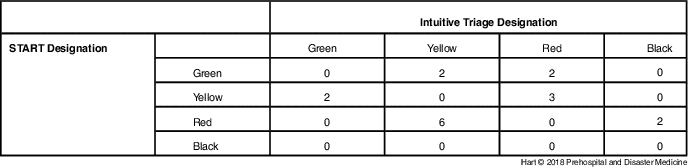
There was a very high degree of agreement between triage categories in trials when comparing START and intuitive triage groups. In Scenario A, there were 39 pair-wise comparisons possible and 32 instances of agreement between START and intuitive triage groups. In Scenario B, there were 45 pair-wise comparisons possible and 35 instances of agreement between START and intuitive triage (Table 2).
Number of Instances of Triage Category Disagreement between START and Intuitive Triage Groups

Abbreviation: START, Simple Triage and Rapid Treatment.
Although there was a very high degree of agreement between the two groups, it was also of interest to know whether one method (intuitive triage versus START triage) over- or under-estimated a patient’s need for urgent transport. Both errors are known to occur commonly in real-world situations and it is unrealistic to expect that any triage modality that is sufficiently quick to allow assessment of a large number of patients will not have some degree of inaccuracy. Therefore, to measure the rate of over- and under-triage in the study groups, a head-to-head comparison was performed to determine if one modality consistently over- or under-estimated patient severity in comparison to the other. Out of a total of 17 instances of disagreement between the groups, the intuitive triage groups assigned a higher category nine times (52%) - almost exactly one-half of the time (Table 3).
Instances of Disagreement between Triage Categories

Abbreviation: START, Simple Triage and Rapid Treatment.
This result demonstrated that when disagreements occurred, the groups were not significantly different in the number of times they over- or under-triaged compared with each other. A Chi-squared analysis comparing the expected versus actual number of episodes of over-triage between the two groups was performed. For two equivalently accurate triage systems, the number of over- and under-triage would be equal when disagreements occurred. Given 17 episodes of disagreement, the expected over-triage by one system was 8.5 episodes. Based upon this expected value, a Chi-squared analysis was performed and no significant difference between the two methodologies was found (P = .971). This comports with the idea that over- and under-triage were observed essentially equally in the two triage methodologies. This analysis was performed using Excel 2013 Data Analysis (Microsoft Corp.; Redmond, Washington USA) package.
The key results of this investigation were the average times taken to perform triage. The analysis measured the total time that each victim measured on his or her stopwatch before a triage category was assigned. This study compared START trials with intuitive triage trials based on the mean time to triage for all patients and for patients within specific triage categories. This study also measured the average time to triage for the sickest patients, and so compared average time to triage for the group of combined Red, Yellow, and Black categories.
The times were compared using two-tailed, two sample T-tests assuming unequal variances and an expected difference in means of zero. These analyses were performed using Excel 2013 Data Analysis package.
The concept of using intuitive triage was, as far as the researchers could determine, new in the literature. Therefore, the expected effect size of using this protocol compared to START triage was unknown. As an a priori power calculation requires an assumption of effect size, none was performed prior to this study.
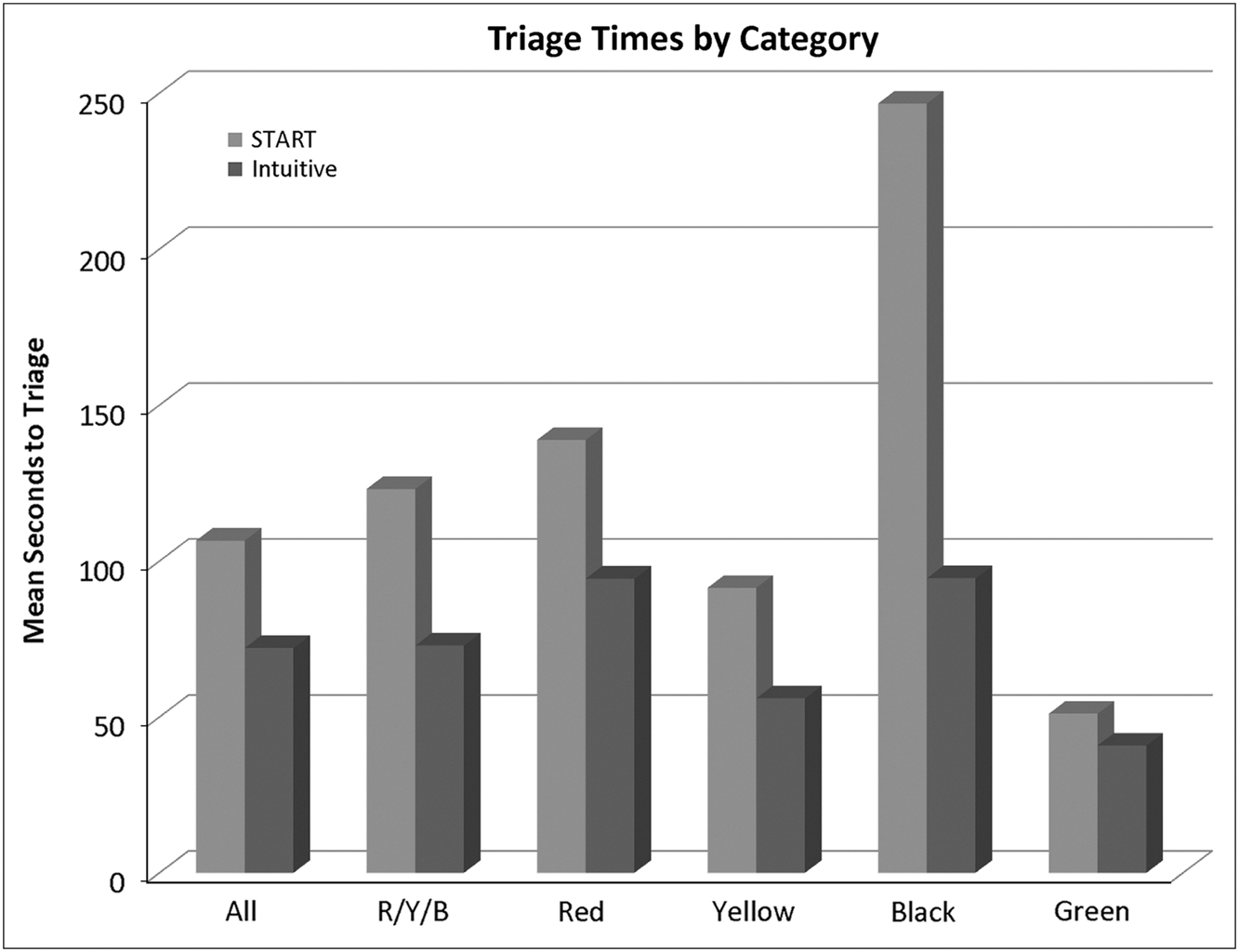
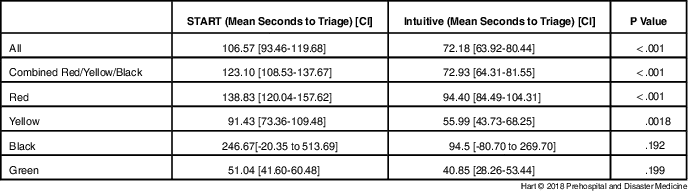
The results are reported in number of seconds to the assignment of a triage category. Intuitive triage was significantly faster for all categories, except for Black and Green. It should be noted that there were very few observations in the Black triage group, and that in both the START and intuitive groups, responders chose to initially give a command for all patients who could walk to move off of the field. This was done in the intuitive triage groups as well as the START groups, despite the intuitive triage groups not being specifically instructed to do so. This may account for the similarity of triage times between the two methodologies in the Green category and may suggest that this type of mass sorting is an ingrained part of responders’ intuitive approach to MCI triage.
The results of this analysis are presented in Table 4 and Figure 2.
Mean Time to Triage. Abbreviation: START, Simple Triage and Rapid Treatment.

Mean Time to Triage

Abbreviation: START, Simple Triage and Rapid Treatment.
Discussion
This study presents a comparison of the time required to triage patients on the scene of a simulated MCI using either an algorithmic triage modality such as START or what the authors have referred to as “intuitive triage:” decision making based upon their instinctive perception of how critical a patient is. The results were obtained during a high-fidelity simulation and demonstrated that intuitive triage is much faster with seemingly little effect on triage accuracy. In fact, across all levels of patient criticality except dead (Black) and minimal (Green), there was a significant reduction in time required to triage victims.
The recent trend in increased numbers of active-shooter incidents and bombings make clear the need for response plans that take into account the time-critical nature of victims of these incidents.Reference Garner, Lee, Harrison and Schultz 14 Recent military and civilian experience has shown that interventions such as stopping bleeding and early transport to definitive surgical care are among the most effective ways to reduce critical mortality. Although the accepted time required to triage each patient using traditional modalities is relatively short (30-60 seconds), this compounded over an MCI which includes hundreds of victims could put many victims at risk of dying from preventable causes while the triage process is on-going.
The results of this study demonstrate the significant time benefit attainable by employing an intuitive triage method over the current standard of care triage methods, such as START. As the injuries sustained by victims of MCIs are often time-sensitive, the morbidity and mortality benefit of this could be significant. The understandable reservation associated with such a triage method is concern over the accuracy of triage with such a rapid evaluation. However, given the agreement in triage categories found between intuitive triage and START in this study, it is likely that this potential loss of accuracy would be minimal, and it would be offset by the benefit due to the increased speed with which patients could be triaged and treatments begun.
Limitations
Although the results of this study suggest that intuitive triage modalities may be effective and more time-efficient, significant limitations of this study make further investigation necessary.
First, this study used a high-fidelity simulation, but the results of studies in this type of environment always suffer from a reasonable doubt that real-world experience will track with that of responders during exercises. Although this is a difficult limitation to overcome given the unpredictable nature of MCIs and the inherently dynamic environment of disasters, it is important to note. However, it should be considered that some elements of a real-life incident such as active bleeding and true respiratory distress might actually make intuitive triage more rather than less applicable.
Secondly, the simulated scenario was a particular type of fast moving MCI (ie, an active shooter) where wounds are more likely to be easily apparent and where time is extremely limited. It may well be that in other types of MCIs, a more traditional triage methodology out-performs intuitive methodologies. This will only be better understood through further study.
Third, this study compared triage decisions between the modalities as opposed to some measure of “gold standard” correctness. This was done intentionally to help ensure that the methods were compared fairly, but it is important in future work to compare any new triage method to some objective standard of correctness in order to determine its test characteristics. This is just one of many potentially useful avenues for further investigation.
Finally, all of the responders who participated in this study were paramedics and so represented a higher level of training than is present in many EMS systems around the country. It is possible that their higher level of training allowed them to make more correct or insightful decisions than would be expected from prehospital providers with less training.
Conclusions
This initial study of an intuitive triage method suggests that in certain types of MCIs, and with certain types of responders performing triage, much faster triage decisions can be made while maintaining accuracy in those decisions. Meanwhile, START and other triage algorithms have proven useful in a number of real-world applications, and any definitive conclusions about their utility should come only after further study is conducted into the potential of more intuitive and less algorithmic approaches. Still, this study does suggest that significant time could be saved using such a method and clearly warrants further investigation to test the results presented here.