Children with specific language impairment (SLI) have special difficulty comprehending complex grammar (Bishop, Bright, James, Bishop, & van der Lely, Reference Bishop, Bright, James, Bishop and Van Der Lely2000; Montgomery & Evans, in press; Norbury, Bishop, & Briscoe, Reference Norbury, Bishop and Briscoe2002; van der Lely, Reference van Der Lely1996, Reference van Der Lely1998; van der Lely & Stollwerck, Reference van Der Lely and Stollwerck1997). Many of these same children also evidence a wide array of limitations in other cognitive abilities such as in the areas of phonological memory capacity (Dollaghan & Campbell, Reference Dollaghan and Campbell1998; Gathercole & Baddeley, Reference Gathercole and Baddeley1990; Marton & Schwartz, Reference Marton and Schwartz2003; Montgomery, Reference Montgomery1995, Reference Montgomery2004) and speed of processing (Leonard et al., Reference Leonard, Weismer, Miller, Francis, Tomblin and Kail2007; Miller, Kail, Leonard, & Tomblin, Reference Miller, Kail, Leonard and Tomblin2001; Montgomery, Reference Montgomery2002, Reference Montgomery2005; Windsor & Hwang, Reference Windsor and Hwang1999a). It also has been suggested that, relative to age peers, children with SLI have attentional limitations, including poorer selective attention (e.g., Stevens, Sander, & Neville, Reference Stevens, Sanders and Neville2006), sustained attention (e.g., Helzer, Champlin, & Gillam, Reference Helzer, Champlin and Gillam1996; Montgomery, Reference Montgomery2005, Reference Montgomery2008), and reduced attentional resource capacity/allocation (Ellis Weismer, Evans, & Hesketh, Reference Ellis Weismer, Evans and Hesketh1999; Hoffman & Gillam, 2002; Marton & Schwartz, Reference Marton and Schwartz2003; Montgomery, Reference Montgomery2000a, Reference Montgomery2000b). However, the nature of the relation between these children's complex sentence comprehension deficits and their apparent attention difficulties is unclear. The aim of the present study was to address this issue.
SENTENCE COMPREHENSION DEFICITS IN SLI
As a group, children with SLI show much greater difficulty processing and comprehending complex sentences than their age-matched peers (e.g., Bishop et al., Reference Bishop, Bright, James, Bishop and Van Der Lely2000; Montgomery & Evans, in press; Norbury et al., Reference Norbury, Bishop and Briscoe2002; van der Lely, Reference van Der Lely1996, Reference van Der Lely1998; van der Lely & Stollwerck, Reference van Der Lely and Stollwerck1997). In these studies, children with SLI and typically developing (TD) children listened to complex sentences such passives (e.g., The boy was kissed by the girl) and pronominals (e.g., Mowgli says that Baloo Bear is touching him) as well as simple active sentences. After each sentence the child selected from an array of pictures that one best matching the sentence. Across all of the studies, children with SLI, relative to age peers, consistently showed poorer comprehension of the complex sentences but not the simple sentences. It has also been shown that, relative to age mates, children with SLI have marked difficulty in understanding sentences containing center-embedded relative clauses, even when such sentences conform to canonical word order (Curtiss & Tallal, Reference Curtiss, Tallal and Miller1991; Montgomery, Reference Montgomery1995, Reference Montgomery2000a, Reference Montgomery2000b, Reference Montgomery2004). For instance, in the Montgomery studies children with SLI and TD age mates listened to simple sentences (e.g., The dirty boy climbed the tall tree) and semantically reversible complex sentences containing either one relative clause (e.g., The girl laughing is touching the boy) or two relative clauses (e.g., The little boy standing is hugging the little girl sitting). The simple and complex sentences were crafted into two sentence length conditions, one corresponding to a set of short-version sentences containing simple sentences and complex sentences and the other corresponding to a set of long-version sentences matched to the shorter sentences for semantic content and syntactic structure. Thus, the only difference between the short- and long-version sentences is that the longer sentences contained extra (nonessential) verbiage. The aim of the studies was to follow up the Curtiss and Tallal study by assessing the (a) effect of sentence length (not sentence structure) on children's comprehension and (b) relation between short-term memory (STM) and sentence comprehension. From these studies, it was shown that the children with SLI had significantly greater trouble comprehending the longer sentences than the short sentences, relative both to the TD children and to themselves. However, given the nature of the analyses (i.e., analyses commingled sentence complexity and length) it was unclear what specific effect complexity had on the comprehension of the children with SLI separate from length. However, inspection of the children's response patterns revealed that the children with SLI had a strong tendency to miscomprehend the complex sentences but not the simple sentences, regardless of sentence length.
In the case of passive and pronominal sentences, van der Lely and colleagues (van der Lely, Reference van Der Lely1996, Reference van Der Lely1998, Reference van Der Lely2005; van der Lely & Stollwerck, Reference van Der Lely and Stollwerck1997) proposed that the poorer comprehension of these structures by children with SLI is attributable to a deficit in the syntactic system. Specifically, these investigators suggest that these children's core deficit is in the representations and/or mechanisms responsible for building hierarchical grammatical structures, that is, computing syntactic dependencies (particularly long distance ones) between different sentence elements. Framed within Chomsky's Minimalist Program (Reference Chomsky1995), it is, moreover, proposed that children with SLI treat the syntactic operation Move, as optional. By contrast, in TD children the Move operation functions obligatorily. There is, however, another explanation for these children's comprehension problems. Reduced general processing capacity may well interfere with these children's comprehension of a range of complex sentence structures.
PROCESSING CAPACITY DEFICITS AND SENTENCE COMPREHENSION IN SLI
Phonological STM (PSTM) and comprehension
One prominent and well-documented processing capacity deficit that children with SLI exhibit is in the area of PSTM capacity. Many children with SLI have less ability to store as much verbal information at any given moment as TD children (Dollaghan & Campbell, Reference Dollaghan and Campbell1998; Gathercole & Baddeley, Reference Gathercole and Baddeley1990; Montgomery, Reference Montgomery1995, Reference Montgomery2000a). The PSTM capacity of children with SLI has been estimated using a variety of recall tasks, including digit span or word span (Archibald & Gathercole, Reference Archibald and Gathercole2007) and nonword repetition (Dollaghan & Campbell, Reference Dollaghan and Campbell1998; Ellis Weismer et al., Reference Ellis Weismer, Tomblin, Zhang, Buckwalter, Chynoweth and Jones2000; Gathercole & Baddeley, Reference Gathercole and Baddeley1990; Montgomery, Reference Montgomery2000a). The consistent pattern across studies is that children with SLI demonstrate significantly reduced recall compared with their same-age TD peers.
It has been argued that a limitation in PSTM capacity, under certain circumstances, interferes with the language comprehension of these children (Montgomery, Reference Montgomery2002). Norbury et al. (Reference Norbury, Bishop and Briscoe2002), for example, provide indirect evidence for this claim. They showed that a deficit in PSTM (indexed by nonsense word repetition) significantly correlated with the poorer comprehension of passive and pronominal sentences in children with SLI. Similarly, reduced PSTM capacity may well help explain, at least in part, the difficulty children with SLI have comprehending complex sentences containing double- and single-embedded relative clause sentences (e.g., Montgomery, Reference Montgomery1995). In three studies by Montgomery (Reference Montgomery2000a, Reference Montgomery2000b, Reference Montgomery2004) children listened to simple and complex sentences (in both long and short versions of each other), with sentence length being the key variable of interest. The children also completed a nonword repetition task. Two common findings emerged from these studies. First, regardless of sentence length, the children with SLI showed a very strong tendency to miscomprehend the complex sentences but not the simple ones. Second, relative to TD children, the children with SLI performed significantly worse on the nonword repetition task, suggesting they had a marked PSTM capacity deficit. Correlation analyses showed no significant relation between PSTM and the comprehension of the long sentences (Montgomery, Reference Montgomery2000a, Reference Montgomery2000b, Reference Montgomery2004) but these findings may have been because of a lack of power. Given the co-occurrence of memory problems and difficulties with complex sentence comprehension, it is possible that some sort of information processing limitation of the children with SLI interfered with their complex sentence comprehension.
Auditory/verbal attention
Some theoretical background. It has been argued by some cognitive researchers (e.g., Baddeley, Reference Baddeley1999; Cowan, Reference Cowan, Miyake and Shah1999; Guttentag, Reference Guttentag1989; Posner, Reference Posner1995; Shiffrin & Schneider, 1977) that attention plays a critical role in much of cognitive processing, including language processing. Although current theories view attention as a complex multidimensional construct (e.g., Baddely, Reference Baddeley1999; Cooley & Morris, Reference Cooley and Morris1990; Cowan, Reference Cowan, Miyake and Shah1999; Mirsky, Anthony, Duncan, Alhearn, & Kellam, Reference Mirsky, Anthony, Duncan, Alhearn and Kellam1991), there is no single dominant theory. From a neuropsychological perspective (Mirsky et al., Reference Mirsky, Anthony, Duncan, Alhearn and Kellam1991) attention includes several experimentally identifiable dimensions, including sustained attention. Sustained attention refers to the ability to maintain attentional alertness (arousal) over time in an effort to identify/select a specific stimulus (target) in the midst of other (distracting) stimuli in a continuous flow of incoming information. Another prominent view of attention is that the attentional system comprises a limited amount of resources/capacity or “mental energy” (e.g., Baddeley, Reference Baddeley1999, Reference Baddeley, Stuss and Knight2002) that can be devoted in whole or in part to some cognitive activity. Closely related to capacity is resource allocation. Allocation refers to one's ability to split one's mental resources in a flexible way while carrying out a cognitive activity such as sentence processing/comprehension. For example, someone who is listening to a speaker in a noisy room might allocate some of his/her mental resources to syntactic and semantic operations while at the same time he/she allocates considerably more resources to phonological operations to ensure accurate lexical processing (and word recognition).
Experimental studies of adult language processing suggest that attention has an important functional role in language processing/comprehension. Neuroimagaing data from a study by Lockwood, Murphy, and Khalk (Reference Lockwood, Murphy and Khalak1997), for example, indicate that neural mechanisms associated with sustained attention are activated in adults during reading comprehension, as well as during grammaticality judgment tasks. With respect to resource capacity/allocation, perhaps the best-known behavioral evidence comes from the work of Just and Carpenter and colleagues (e.g., Just & Carpenter, Reference Just and Carpenter1992; King & Just, Reference King and Just1991) as well as others (e.g., Chen, Gibson, & Wolf, Reference Chen, Gibson and Wolf2005; Roberts & Gibson, Reference Roberts and Gibson2002). The results of these studies suggest that the comprehension of complex sentence structures invites the controlled and flexible use of listeners’ attentional resources.
Investigators can approach the study of language processing from a broad working memory perspective or from the perspective that attentional resource capacity/allocation is a submechanism of working memory. In the present study, we are conceptualizing attentional resource capacity/allocation to be a submechanism of the broader construct working memory. In either case, there is at least one important structural and functional similarity between the construct of working memory and the notion of attentional resource capacity/allocation. Both perspectives entail the notion that listeners are endowed with a finite pool of activation (i.e., mental energy) that can be allocated to both verbal processing and storage, with the allocation of resources being dictated by the demands of the comprehension task. Listeners’ working memory or attentional resource capacity/allocation capacity is often estimated using concurrent information processing-storage tasks (i.e., listening span task, counting span task) in which listeners must perform some kind of cognitive processing task such as performing math problems or comprehending sentences while simultaneously remembering the number of dots presented in an array or a list of words. Research has shown that adults’ performance on such concurrent processing-storage tasks correlates significantly with their processing/comprehension of complex sentences. Moreover, it has been shown that increases in syntactic complexity call for greater amounts and more flexible use of a listener's attentional resources (or working memory capacity).
Auditory/verbal attention limitations in SLI. Within the SLI literature, research into the attentional abilities of children with SLI, particularly sustained attention, is limited. There are, however, some neurophysiological data suggesting that children with SLI have problems with selective auditory attention, especially at the earliest stages of sensory processing (e.g., Stevens et al., Reference Stevens, Sanders and Neville2006; Uwer, Albrecht, & von Suchodoletz, Reference Uwer, Albrecht and von Suchodoletz2002). There is also some anecdotal evidence that these children have difficulty maintaining auditory attention and that this difficulty may relate to their poorer performances on various language-related tasks. Helzer et al. (Reference Helzer, Champlin and Gillam1996), for example, assessed the perceptual processing of children with SLI and TD children using gap detection tasks. The children with SLI, although showing similar thresholds overall to the TD children, required significantly more trials to reach criterion than their age-matched peers. These researchers suggested that poor sustained attention was a likely explanation of the “slower” learning of the children with SLI. Other investigators (e.g., Stark & Heinz, Reference Stark and Heinz1996) have reported similar results of children with SLI being less efficient to learn the acoustic cues that differentiate phoneme contrasts, with the implication being that poor attention could be a contributing factor. More recently, Spaulding, Plante, and Vance (Reference Spaulding, Plante and Vance2008) provided more direct behavioral evidence suggesting that preschoolers with SLI have significantly greater difficulty than age peers sustaining their auditory attention, especially under cognitively demanding conditions. Of interest, these authors found no evidence that the sustained attention problems of the children with SLI crossed over into the visual modality.
In contrast to the nearly absent literature exploring the auditory vigilance of children with SLI there is a developing literature on these children's attentional capacity/allocation (e.g., Ellis Weismer, Evans, & Hesketh, Reference Ellis Weismer, Evans and Hesketh1999; Hoffman & Gillam, Reference Hoffman and Gillam2004; Mainela-Arnold & Evans, Reference Mainela-Arnold and Evans2005; Marton & Schwartz, Reference Marton and Schwartz2003; Montgomery, Reference Montgomery2000a). Children in all of these studies completed concurrent verbal processing and storage tasks in which they engaged in verbal processing while at the same time remembering/recalling sets of words. The results of these studies have consistently shown that children with SLI typically show similar processing (i.e., comprehension) to TD children but significantly poorer word recall. For instance, results from Ellis Weismer et al. (Reference Ellis Weismer, Evans and Hesketh1999) and Mainela-Arnold and Evans (Reference Mainela-Arnold and Evans2005), both of whom used the competing language processing task (CLPT; Gaulin & Campbell, Reference Gaulin and Campbell1994), showed that children with SLI and TD children had comparable comprehension but the children with SLI yielded significantly lower word recall, particularly as the number of to be recalled words increased. Montgomery (Reference Montgomery2000a, Reference Montgomery2000b) used a three-tier word recall task to assess the attentional resource capacity/allocation of children with SLI and TD children. The children were asked to recall as many familiar nouns (e.g., tree, cat, seed) as they could under three different processing load conditions. One condition was a simple span task requiring free recall. A second (single-load) condition asked children to recall word lists according to the “physical size” of the word referents beginning with the word referring to the smallest referent and ending with the one referring to the largest referent. In the third (dual-load) condition, children were asked to arrange the words (a) into two semantic categories and then (b) according to the size of the word referents within each category as in the single-load condition. For example, if a child were given the word list bike, nut, car, tree, plane, the proper response would be bike, car, plane//nut, tree. Thus, this condition not only required the children to maintain accurate verbal storage but also to perform two mental operations.
Results were clear cut in both studies. The two groups yielded similar word span in both the simple and single-load conditions. The groups’ similar simple span were taken to suggest that the SLI and TD groups had overall comparable STM capacity in the absence of any processing demands. Similarly, the groups’ comparable single-load performance implied that the children with SLI were comparable to TD children in allocating their mental resources to both STM and semantic processing (i.e., mental operation associated with rearranging the words by referent size). However, it was performance in the dual-load condition that discriminated the groups, with the children with SLI performing significantly worse (i.e., recalling fewer words). The poorer performance of the SLI group was interpreted to mean that under high-load processing conditions (e.g., completing two mental operations) the verbal storage of these children suffers. To help explain why the SLI group attained a lower dual-load word span than the TD children an error analysis was performed focusing on whether the children had difficulty establishing the semantic categories, rearranging the words according to referent size, or both. Inspection of the error patterns revealed that although the children with SLI were able to establish two semantic categories (albeit one category may have contained just one item) their greatest difficulty related to properly ordering the words by referent size and/or remembering all of the words within each category. Thus, the children had the ability to perform the semantic categorization part of the task but lacked sufficient resources to complete the second mental operation before some of the items faded from memory. Taken together, the results across all of the SLI studies to date suggest that the difference between children with SLI and TD children is not in the ability to allocate mental resources. Rather, children with SLI appear to have less overall attentional resources available to perform such concurrent processing-storage tasks.
Relation between attention and sentence comprehension in SLI. The potential influence of resource capacity/allocation on the sentence comprehension of children with SLI has received some research attention, but the extant findings are mixed. Ellis Weismer et al. (Reference Ellis Weismer, Evans and Hesketh1999), for instance, reported a positive relation between the CLPT (word recall) and score on a standardized sentence comprehension test (including simple and complex structures) for TD children but not in children with SLI. Although using different resource capacity/allocation and sentence comprehension tasks, Montgomery (Reference Montgomery2000a, Reference Montgomery2000b) also reported no association between resource capacity/allocation and sentence comprehension. However, given that both simple and complex sentences were commingled in the analyses any potential association between attention and at least complex sentence comprehension may have been obscured. Ellis Weismer and Thordardottir (Reference Ellis Weismer, Thordardottir, Accardo, Rogers and Capute2002) did, however, show that, after accounting for nonverbal IQ, the most unique variance in standardized sentence comprehension score of children with SLI and TD children was accounted for by resource capacity/allocation.
No research has examined what role sustained attention might play in the sentence comprehension of children with SLI. Results of a real-time sentence processing study by Montgomery (Reference Montgomery2008), however, might provide a clue. In this study, 6- to 10-year-old children with SLI and TD children completed a continuous performance task, the dual-load word recall task described above, and a conventional word recognition reaction time (RT) task. The vigilance task was the same one used in the present study in which children were asked to complete an 11-min task in which they responded to hearing a target word (dog) as it appeared amidst a stream of nontarget items. The word-monitoring task (which comprised only simple sentences) required children to make a timed response immediately upon recognizing a sentence-embedded target word. Results showed that both sustained attention and resource capacity/allocation significantly correlated with sentence processing (indexed by word recognition RT) but only for the children with SLI. Results were interpreted to mean that simple grammar is not yet processed “automatically” by children with SLI but it is by TD children.
AIM AND PREDICTIONS OF THE PRESENT STUDY
Few studies have examined the intersection of the attentional and language processing systems in children with SLI. The results of one study (Montgomery, in press) suggest that the interplay between the systems may be different in children with SLI and TD children, at least with respect to online sentence processing. The purpose of the present study was to investigate whether sustained attention and resource capacity/allocation are related to the offline complex sentence comprehension of children with SLI and TD children.
Relative to TD children, the children with SLI should show (a) poorer sustained auditory attention on an auditory continuous performance task (e.g., Montgomery, Reference Montgomery2008) and (b) reduced attentional resource capacity/allocation (Ellis Weismer et al., Reference Ellis Weismer, Evans and Hesketh1999; Mainela-Arnold & Evans, Reference Mainela-Arnold and Evans2005; Montgomery, Reference Montgomery2000a) on a two-tier word recall task. It was also predicted that for both groups both aspects of attention should significantly correlate with complex sentence comprehension given the overall cognitive demands of such an offline task and the results of the adult language processing literature showing sustained attention is involved in reading comprehension (Lockwood et al., Reference Lockwood, Murphy and Khalak1997) and an association between resource capacity/allocation and complex sentence comprehension (e.g., Chen et al., Reference Chen, Gibson and Wolf2005; Just & Carpenter, Reference Just and Carpenter1992; Roberts & Gibson, Reference Roberts and Gibson2002). Successful comprehension should require the children's sustained attention and attentional resource capacity/allocation because they must maintain their attention and allocate their resources through the course of processing the sentence as they (a) generate an appropriate linguistic representation of the input, (b) scan and visually process each picture, (c) generate a corresponding linguistic representation of each of the pictures, and (d) select the one picture that best matches the input sentence. With respect to simple sentences, we predicted no correlation should emerge between attention and comprehension for the TD children. This prediction is based on the fact that the sentences are well within the linguistic competence of the children (e.g., De Villiers & DeVilliers, Reference De Villiers and De Villiers1973; Dick, Wulfeck, Krupa-Kwiatkowski, & Bates, Reference Dick, Wulfeck, Krupa-Kwiatkowski and Bates2004). For the children with SLI, even though the sentences are within their linguistic grasp a significant correlation should emerge between both aspects of attention and comprehension given that the offline comprehension task entails a number of attention-demanding mental operations (e.g., Montgomery, in press).
METHOD
Participants
Data for this study come from 26 children with SLI ranging in age from 6 years, 10 months (6;10) to 10;8 (ageM = 8;5) and 26 TD children matched for chronological age (ageM = 8;2) who took part in one of three previous studies examining the association between working memory and sentence comprehension (Montgomery, Reference Montgomery2000a, Reference Montgomery2000b, Reference Montgomery2004). Common to each of these studies was that all of the children completed the two attention tasks reported in the present study. Each child with SLI was matched with a TD child on age ± 3 months and on gender.
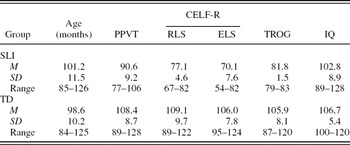
Children with SLI scored −1.2 SD or more below the mean on at least two of the three receptive subtests and two of the three expressive subtests on the Clinical Evaluation of Language Fundamentals—Revised (CELF-R; Semel, Wiig, & Secord, Reference Semel, Wiig and Secord1987). They also attained an overall receptive language standard (RLS) score and an overall expressive language standard (ELS) score at least −1.2 SD below the mean. In addition, they performed below −1 SD from the mean on the Test for Reception of Grammar (TROG; Bishop, Reference Bishop1989). The TD children performed at or above −1 SD from the mean on the same language measures. The children with SLI attained a significantly lower score on all the language measures, CELFRLS: F (1, 50) = 464.11, p = .001, η2 = .82; CELFELS: F (1, 50) = 559.39, p = .001, η2 = .85; TROG: F (1, 50) = 441.30, p = .001, η2 = .81.
All of the children demonstrated at least normal-range nonverbal IQ (≥85) on the Test of Nonverbal Intelligence (TONI; Brown, Sherbenou, & Johnsen, Reference Brown, Sherbenou and Johnsen1990), normal-range hearing sensitivity as determined by audiometric pure tone screening at 20 dB HL (ANSI, 1990), and no oral structural/motor impairments affecting speech or nonspeech movements of the articulators (Robbins & Klee, Reference Robbins and Klee1987). The groups differed in IQ, although, F (1, 50) = 7.13, p = .001, η2 = .07, with the SLI group achieving the lower score. None of the children had a history of frank neurological impairment or psychological/emotional disturbance or attention-deficit disorder (ADD; from parent report). Each group included 18 boys and eight girls. Within the SLI group, three children were African American and one was of Hispanic descent. In the TD group, three children were African American and two were of Hispanic descent. To adjust for potential dialectical variations of the African American children, responses on each of the expressive subtests of the CELF were evaluated relative to the dialectical variations outlined by Washington and Craig (Reference Washington and Craig1994). Table 1 displays descriptive summary data for each group.
Descriptive summary data for the SLI and TD groups

Note: SLI, specific language impairment; TD, typically developing; PPVT, Peabody Picture Vocabulary Test; CELF-R, Clinical Evaluation of Clinical Fundamentals—Revised; RLS, total receptive language score; ELS, total expressive language score; TROG, Test for Reception of Grammar.
Stimulus generation procedures
The same procedures were used to generate the verbal stimuli for the attentional resource capacity/allocation task and the sentence comprehension task. A high-quality recording of a male speaker producing the stimuli was made in a sound treated booth. For the resource capacity/allocation task, stimulus words were read in list fashion. For the sentence comprehension task, each sentence was read at a normal rate (∼4.4 syllables/s; Ellis Weismer & Hesketh, Reference Ellis Weismer and Hesketh1993) and with normal prosodic variation. Prior to waveform editing, each stimulus word and sentence was low-pass filtered (4.5 kHz) and digitized (10 kHz) and stored on disk. Each digitized audio waveform was edited interactively to identify the acoustic onsets and offsets of each word. The edited stimuli were then output (10 kHz, low-pass filtered 4.5 kHz) in random (or prespecified random) order from the computer to audio tape.
Sustained auditory attention
Children's sustained auditory attention was assessed using the Auditory Continuous Performance Test (ACPT, Keith, Reference Keith1993). The task was administered in accordance with standard administration procedures. Children listened to an 11-min audiotape, consisting of a list of 600 monosyllabic words read by a male speaker at a rate of approximately two words/s. The target never appeared twice in a row. Successful performance on the task required the children to maintain their attention over time in an effort to selectively respond to the target word dog while disregarding (i.e., inhibit making a response) to all nontarget items.
General task procedures. Children were told that they would hear a man saying a long list of words and that in the list they would hear the word dog many times. They were instructed to listen very carefully and to raise a finger or tap a finger on the table each time they heard the word dog. The examiner sat next to the child in the test suite and recorded all responses on the ACPT score sheet, including correct responses (hits), false alarms (false positives), and no responses (misses). During the task the examiner did not speak to the child or encourage him/her to pay attention or to stay focused. However, before the task began the examiner encouraged the child to pay good attention throughout the task. Four demonstration trials and five practice trials preceded the experimental trials to familiarize the child with demands of the task. Each trial included six words, with the target dog randomly appearing in word position two to six.
Attentional resource capacity/allocation
We used the word recall task from our previous studies (Montgomery, Reference Montgomery2000a, Reference Montgomery2000b) to measure children's attentional resource capacity/allocation abilities. This task was used for three reasons. First, similar to the view of Kane and colleagues (Kane, Bleckley, Conway, & Engle, Reference Kane, Bleckley, Conway and Engle2001; Kane, Conway, Engle, Reference Kane, Conway and Engle1999) and Cowan and associates (Cowan, Reference Cowan, Miyake and Shah1999; Cowan et al., Reference Cowan, Elliott, Saults, Morey, Mattox and Hismjatullina2005) we regard this task to reflect children's domain-general use of controlled and flexible attentional abilities, that is, allocation of attentional resources to the language processing system and STM. Second, because the task includes highly familiar words any difference between the SLI and the TD groups can be interpreted to be primarily attributable to group differences in resource capacity/allocation, not linguistic knowledge. Third, performance on similar listening span tasks has been shown to correlate with complex sentence comprehension in adults (e.g., Daneman, & Carpenter, Reference Daneman and Carpenter1983; Just & Carpenter, Reference Just and Carpenter1992; Roberts & Gibson, Reference Roberts and Gibson2002). Finally, some researchers (e.g., Christiansen & MacDonald, Reference Christiansen and MacDonald1999) might argue that such a measure is not appropriate to use in language-processing studies because a correlation between performance on such a task and sentence comprehension is inevitable, rendering the interpretation of such a relation theoretically vacuous. This concern is diminished, however, given that both verbally based tasks (listening span) and math-based tasks (operational span) significantly correlate with a variety of cognitive performances (e.g., Conway & Engle, Reference Conway and Engle1996; Daneman & Merikle, Reference Daneman and Merikle1996; Kane et al., Reference Kane, Bleckley, Conway and Engle2001).
Although our original task included three different recall conditions (i.e., no load, single-load, dual-load) the present study employed the no-load (simple span) and the dual-load conditions. Simple span was used as a control condition. We used the dual-load condition for two reasons. First, we reasoned that performance in this condition is similar to the attentional demands of sentence comprehension, that is, allocating resources to both STM storage and to the language-processing system. Second, it was performance in the dual-load condition (not the single-load condition) that discriminated children with SLI from their TD peers (Montgomery, Reference Montgomery2000a, Reference Montgomery2000b). To be successful children must allocate their limited resources simultaneously to STM storage (i.e., to retain the input words) and to the language processing system (to arrange the words in a specific manner during recall).
Stimulus words. A set of 25 words was created, with 5 highly familiar, monosyllabic words (e.g., Moe, Hopkins, & Rush, Reference Moe, Hopkins and Rush1982) selected from five basic semantic categories (animals, transportation, clothing, body parts, “plant things”). No rhyming words appeared in the set. It is important that using highly familiar words minimizes the likelihood that poor performance on the task is attributable to representational deficits.
Word lists. Five word lists were created (i.e., three-word lists, up to seven-word lists), with each list containing words from two different semantic categories. Each list included three trials. Words within each list and within each trial were randomized but with the constraint that no list included the same word twice and within a trial two words from the same category could not occur next to each other. The latter constraint was intended to yield lists containing no partially “predetermined” semantic categories, thereby inviting maximal semantic processing.
Processing load conditions. For both conditions, there were five word lists. Each condition included a randomly ordered set of word lists, none of which began with a three-word list and ended with a seven-word list. The intent of this design feature was to minimize poorer performance on longer lists if they always appeared later in each condition. All the children received all the word lists in each condition.
No-load condition (simple span). For each word list, children were instructed to recall as many words as possible, regardless of order of presentation. Free recall and not serial recall was of interest because we wished to estimate simple span apart from any additional processing requirements associated with retaining the serial position of words (i.e., tagging temporal location of each word in a list; see Gillam, Cowan, & Day, Reference Gillam, Cowan and Day1995, for a discussion of the processes underlying serial recall). We predicted that the SLI and TD groups should yield comparable simple spans (Gillam et al., Reference Gillam, Cowan and Day1995; Montgomery, Reference Montgomery2000a, Reference Montgomery2000b).
Dual-load condition (semantic categorization plus size processing). For each of the five word lists, children were instructed to (a) “put the words that go together in some way in little groups” and (b) order each of the words inside each group according to size, “starting with the smallest thing and ending with the biggest thing.” Relative to simple span, this condition was designed to invoke greater attentional resources as well as controlled/flexible use of resources by requiring children to complete two mental operations (semantic categorization plus size processing) while simultaneously retaining all of the input words.
Pilot testing. To ensure that all word lists yielded a single preferred order of item recall, each word list was piloted extensively in three phases with 20 different graduate students in each phase. A separate pilot study was also conducted with a group of TD children. The pilot testing procedures were successful in yielding a preferred order of recall for each word list in the dual-load condition. For details related to the construction of this task and pilot results see Montgomery (Reference Montgomery2000a, Reference Montgomery2000b).
General task procedures. Prior to the experiment proper, children were administered three brief pretests to assess their ability to understand the processing demands of the dual-load condition. In each pretest, children were presented familiar, monosyllabic words (not the experimental words) in lists varying from three to four words. Three demonstration trials and three practice trials preceded the actual pretest trials. During demonstration, the examiner used his hands and fingers to illustrate the idea of (a) grouping the words into semantic categories during recall and (b) arranging the words during recall according to the physical size of word referents. For instance, if the input were cow, plane, mouse, bike, the response would be mouse, cow//bike, plane. The first pretest was a semantic categorization task in which the children were asked to group those words that went together in some way next to each other as they repeated the words back to the examiner. In the second pretest, a size processing task, they were asked to reorder the words “starting with smallest thing and ending with the biggest thing” as they recalled as many words as they could. In the third pretest, combining semantic categorization + size processing, the children were told that they “would be doing both things with each list of words.” They were instructed to (a) first put the words that went together in little groups and (b) then order the words in each group from the smallest thing to the biggest thing. They were allowed one repetition of the input and two opportunities to recall the word list. To advance to the experiment proper, they had to respond correctly on six of eight trials (75% accuracy) on the first two pretests (see Data Preparation Section for the definition of a correct response). If any child failed to meet this criterion, the pretesting procedure was repeated until they met the criterion. It should be noted that less than 2% of children (from each group) required a repetition of training. Such pretesting thus facilitated our interpretation that any observed group difference in the dual-load condition would be attributable to differences in attentional resource capacity/allocation and not to a lack of understanding the task.
For the experiment, the children were again instructed to listen carefully to a man saying some lists of words. They were asked to repeat as many of the words as they could in the order that was required for each condition. Throughout testing, the children received constant encouragement and praise and, as needed, reminders to “listen carefully” and “stay focused.” So as not to penalize children for potential occurrences of ambient noise (e.g., coughing, sneezing), they were provided one repetition of any trial if needed. Two opportunities for recall were offered, and the children's second production was the one that was scored.
Sentence comprehension task
The children's sentence comprehension was measured using a conventional picture pointing task. The stimuli for the task included simple and complex sentences taken from our earlier studies (Montgomery, Reference Montgomery2000a, Reference Montgomery2000b, Reference Montgomery2004). Recall, however, that these studies focused on the effects of sentence length not complexity on children's comprehension. Thus, the stimuli included a set of short sentences containing both simple and complex structures and a set of longer sentences similar to the shorter ones for semantic content and syntactic structure. In the present study, however, our interest focused on syntactic structure (simple versus complex). Thus, the sentences varied on syntactic structure not length.
The simple sentences included 10 that contained double marking of number (e.g., Point to the picture of the three cats) and 10 active sentences containing adjectival/adverbial material modifying the subject and/or object noun (e.g., The dirty little boy climbed the big tall green tree). It should be noted that these stimuli corresponded to the long version simple sentences from our previous studies (Montgomery, Reference Montgomery2000a, Reference Montgomery2000b, Reference Montgomery2004). The complex sentences included 20 semantically reversible items, 10 that included one relative clause (e.g., The girl smiling is pushing the little boy) and 10 that contained two relative clauses (e.g., The boy standing is kissing the little girl sitting). Note that the relative clauses were truncated and not marked by the inclusion of a relative pronoun plus auxiliary verb (e.g., The boy who is standing is kissing the little girl who is sitting). The sentences were manipulated in this fashion because the purpose of the original studies was to use sentences modeled after those used by Curtiss and Tallal (Reference Curtiss, Tallal and Miller1991) to evaluate the role of sentence length on children's comprehension. It should also be noted that the complex sentences here corresponded to the short-version complex sentences used in our earlier studies. Selecting the long-version simple sentences and short-version complex sentences from the original studies thus allowed us to match the simple and complex sentences in the present study on overall length. The mean number of words contained in the simple and complex sentences was 9.0 and 8.8, respectively, a difference that was not significant, t (19) = .719, p = .48. In addition, the length of the one-clause sentences and two-clause sentences did not differ, t (9) = −1.96, p = .08. Finally, all of the sentences contained vocabulary appropriate to 5- to 6-year-olds’ comprehension and production abilities (e.g., Miller, Reference Miller1981; Moe, Hopkins, & Rush, Reference Moe, Hopkins and Rush1982).
Picture stimuli. For each of the 40 sentences, four color illustrations were created by a professional illustrator: one that matched the stimulus sentence and three foils. Foil pictures differed from the target picture along just one or two relevant semantic dimensions (e.g., size of the sentence's subject/object, reversal of agent and patient roles, color, or number of objects) or a single syntactic dimension (e.g., tense). A booklet containing 50 preexperimental pictures (corresponding to the nouns, verbs, adjectives, adverbs contained in the experimental sentences), 6 practice pictures, and then the 40 experimental pictures was created. Target pictures appeared equally often in each quadrant on the stimulus page.
General task procedures. The children received the 40 experimental sentences via headphones at a comfortable listening level. While listening to each sentence, subjects were shown an array of four pictures. After hearing each sentence, they were asked to point to the picture corresponding to the sentence. Subjects were allowed one additional presentation of each stimulus sentence. Subject responses were scored as correct or incorrect. Prior to experimental testing, a pretest was administered to assess children's knowledge of the nouns, verbs, adjectives, and adverbs appearing in the sentences. All children performed with 100% accuracy.
Data preparation
The dependent variable in the no-load (simple span) and dual-load conditions was word span, defined as the longest list length for which a child correctly responded on at least two of the three trials. If the child produced three different spans at a given list length (e.g., stimulus word list: five words; responses: three words recalled, four words recalled, five words recalled), word span was defined as the middle span (e.g., four words). A correct response in the simple span condition was defined as the child recalling as many words as possible for each word list, regardless of presentation order. In the dual-load condition, a correct response was defined as the greatest number of words properly grouped by semantic category and properly (sequentially) ordered by size during recall. Word spans were used in each of the analyses below. Note that less than 1% of word lists/trials needed to be repeated for both the SLI and TD groups because of ambient noise.
RESULTS
Sustained attention
The primary dependent measure for this task (ACPT) was d ′, reflecting children's overall response sensitivity/accuracy. Measure d ′ is based in signal detection theory (for a summary, see Macmillan & Creelman, Reference Macmillan and Creelman1991) and reflects a ratio of the percent hits relative to percent false alarms (d ′ = z[hits] – z[false alarms]). This score controls for children's tendency to respond in a prosocial manner (i.e., respond in the affirmative rather than the negative to please an adult). Implicit in d ′ scores is a dual score reflecting child's ability to maintain attention to detect a target while inhibiting responding to all nontarget items (i.e., producing false alarms). In addition to calculating percent hits and false alarms percent misses was also calculated. A separate between-group analysis of covariance (ANCOVA) on each of these dependent measures was run using IQ (TONI score) as the covariate since the SLI group attained a significantly lower IQ.
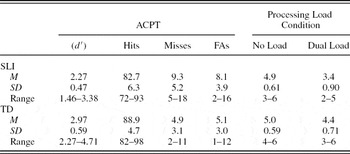
The first analysis revealed that the SLI group yielded significantly poorer sensitivity (d ′) compared with the TD group, F (1, 49) = 18.16, p = .001, η2 = .27. Likewise, relative to the TD group, the SLI group yielded a significantly lower hit rate, F (1, 49) = 12.64, p = .001, η2 = .25, and a significantly higher rate of misses, F (1, 49) = 12.46, p = .001, η2 = .20, and false alarms, F (1, 49) = 8.46, p = .005, η2 = .15. Descriptive summaries for each group on this task and the resource capacity/allocation task are displayed in Table 2.
Performance of the SLI and TD groups on each of the attention tasks

Note: SLI, specific language impairment; TD, typically developing; ACTPT, auditory continuous performance task; d ′, mean sensitivity score; Hits, mean percent hit rate; Misses, mean percent missed responses; FAs, mean percent false alarms; No Load, mean number of words recalled; Dual Load, mean number of words recalled in the attentional resource capacity/allocation task.
Attentional resource capacity/allocation
Two impressions can be gleaned about the SLI and TD groups’ performances from inspecting Table 2. First, both groups showed a similar overall recall pattern and second the SLI group differed from the TD group in the dual-load condition. Results of a Group (2) × Processing Load (2) repeated-measures ANCOVA supported these impressions. Nonverbal IQ was used as the covariate to adjust for any influence that the lower IQ of the SLI group may have played between the groups’ performances. Results revealed significant effects for group, F (1, 99) = 11.56, p = .001, η2 = .11, and processing load, F (2, 99) = 65.68, p = .001, η2 = .40, but no significant Group × Processing Load interaction, F (1, 99) = 2.81, p = .12. The group effect was because of the children with SLI performing more poorly than the TD children and the processing load effect was because of the children performing worse in the dual-load condition than the simple span condition. Within-group post hoc analysis showed that the children with SLI recalled significantly fewer words in the dual-load condition relative to simple span, t (25) = 14.40, p = .001. Likewise, the TD children yielded significantly shorter word span in the dual-load condition compared with the simple span condition, t (25) = 8.23, p = .001.
Sentence comprehension
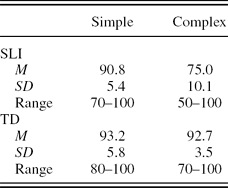
Accuracy analysis. As can be seen from Table 3, the SLI group appeared to perform similarly to the TD group on the simple sentences but more poorly on the complex sentences. Results of a Group (2) × Sentence Type (2) repeated-measures ANCOVA (using TONI score as the covariate) indeed revealed a significant effect for group, F (1, 99) = 50.96, p = .001, η2 = .34, as well as a significant sentence type effect, F (1, 99) = 39.51, p = .001, η2 = .29, and Group × Sentence Type interaction, F (1, 99) = 34.13, p = .001, η2 = .26. The group effect was because of the children with SLI performing more poorly than the TD children while the sentence type effect arose because children comprehended more simple sentences than complex sentences. The interaction was examined by performing a dependent samples t test for each group on sentence type. Whereas the children with SLI comprehended significantly fewer complex sentences than simple sentences, t (25) = 9.79, p = .001, the TD children showed no difference between sentence type, t (25) = .461, p = .65.
Mean percent correct comprehension of the simple sentences and complex sentences
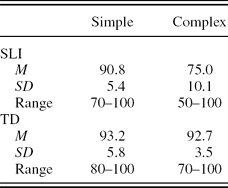
Note: SLI, specific language impairment; TD, typically developing.
Finally, a within-group analysis was carried out to determine whether the children differed in their comprehension of sentences containing a single clause from sentences containing two clauses. Of interest, both groups comprehended significantly more single clause sentences than two-clause sentences. The SLI group obtained a mean score of 78% for the single clause sentences and a mean score of 72% for the two-clause sentences, t (25) = 4.62, p = .0001. The TD children achieved 95% accuracy for the single clause sentences and 90% accuracy for the two-clause sentences, t (25) = 3.63, p = .001.
Error analysis. We also performed an analysis of the types of errors made by each group on the complex sentences. Recall the SLI group produced an error rate of about 25%, whereas the TD group's error rate was about 7%. For both the one-clause and two-clause sentences, the children with SLI demonstrated the following pattern (pooling across clauses): (a) selection of a foil depicting the reversal of the agent and patient roles (60%), and (b) selection of a foil depicting the proper agent and patient roles but where the agent was not of the proper size or color (38%). This difference was significant, t (25) = 3.35, p = .001. The TD children showed the opposite pattern (25 and 71%, respectively), with the difference being significant, t (25) = 4.96, p = .001.
Correlation analyses
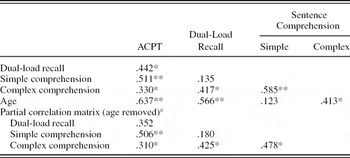
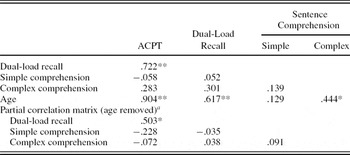
The correlation matrices and partial correlation matrices (i.e., adjusting for the variance accounted for by age) for each group appear in Table 4 (SLI group) and Table 5 (TD group). Age rather than specific abilities such as syntactic knowledge (e.g., TROG score) was used as the covariate because if it is found that age covaries with ACPT score and dual-load span score, partialing out age subtracts the shared variance in both of these attention abilities that may contribute to sentence comprehension. By contrast, using a language score (e.g., TROG or CELF receptive score) as the covariate to adjust for group differences in language knowledge would effectively eliminate the processing component of the dual-load span task, thereby making it a simple word recall task (i.e., comparable to the single-load condition) and not a simultaneous processing-storage task. Correlations were computed between the two attention variables and the comprehension of simple and complex sentences. The dependent variable in the ACPT was d ′ score and the variable in the resource capacity/allocation word recall task was word span in the dual-load condition. Significant correlations reported in both matrices were medium (about .4) or large (above .5) correlations (Cohen, Reference Cohen1983).
Correlation and partial correlation matrices for the SLI group

Note: Because age covaries with ACPT and Dual-Load, partialing out age also subtracts shared variance in both ACPT and Dual-Load that may contribute to sentence comprehension. SLI, specific language impairment; ACPT, auditory continuous performance task (percent hits); Dual-Load Recall, recall in the dual-load condition of the resource capacity/allocation task.
aAdjusting for the variance accounted for by age.
*p ≤ .05. **p ≤ .01.
Correlation and partial correlation matrices for the TD group

Note: TD, typically developing; ACPT, auditory continuous performance task; Dual-Load Recall, recall in the dual-load condition of the resource capacity/allocation task.
aAdjusting for the variance accounted for by age.
*p ≤ .05. **p ≤ .01.
SLI group. It can be seen from Table 4 that age correlated significantly with each of the attention measures and with complex sentence comprehension (but not with simple sentence comprehension). Further, it can be seen that although performance on the two attention measures significantly correlated with each other there was no significant colinearity (e.g., r ≤ .80; Stevens, Reference Stevens2002). However, when age was covaried out, the correlation was nonsignificant. With respect to comprehension, ACPT significantly correlated with both simple and complex sentence comprehension, with the partial correlation (after removing the effects of age) remaining significant in both cases. Word span also correlated significantly with complex sentence comprehension, even when age was partialed out. The magnitude of the correlation between ACPT and complex sentence comprehension versus word recall and complex sentence comprehension was not significant (z = .797, p > .05).
TD group. Age correlated with each of the attention measures and with complex sentence comprehension but not with simple sentence comprehension (Table 5). ACPT significantly correlated with word span and the partial correlation remained significant after age was removed. Regarding comprehension, neither ACPT nor word span significantly correlated with the comprehension of complex sentences or simple sentences.
DISCUSSION
The aim of this study was to determine whether two aspects of attention, sustained auditory attention and attentional resource capacity/allocation, might be associated with the comprehension of complex sentences in children with SLI and age-matched TD children. We were also interested, by comparison, in whether simple sentence comprehension would involve the same attentional abilities in either or both children with SLI and TD children.
Sustained attention
Relative to the TD children, the children with SLI showed overall poorer response sensitivity, as indicated by their significantly lower d ′ score than the TD children. Recall that d ′ is an index of the ability to detect a signal (target) amidst a stream of nontarget items. Thus, d ′ reflects the children's ability to make an appropriate response to the presence of a target while simultaneously inhibiting making a response to all nontargets. Also, recall that, relative to the TD group, the SLI group demonstrated an overall lower hit rate (and conversely a higher miss rate) indicating that they had significant trouble sustaining their attention. This finding is consistent with the suggestion made by some investigators (Helzer et al., Reference Helzer, Champlin and Gillam1996; Montgomery, Reference Montgomery2005; Stark & Montgomery, Reference Montgomery1995) and with recent empirical evidence indicating that preschool children with SLI demonstrate significantly greater difficulty than age mates sustaining auditory attention (Spaulding et al., Reference Spaulding, Plante and Vance2008). The children with SLI also showed greater difficulty with response inhibition compared with the TD children, as evidenced by the fact that the SLI group produced a greater proportion of false alarms than the TD children. Poorer inhibitory control for children with SLI has also been reported by other researchers. For instance, Mainela-Arnold and Evans (Reference Mainela-Arnold and Evans2005) and Ellis Weismer et al. (Reference Ellis Weismer, Evans and Hesketh1999), using the CLPT, showed that children with SLI produced greater numbers of interference errors than TD children when recalling sets of sentence-final words (i.e., they had trouble inhibiting the recall of words from prior sets). Marton and Schwartz (Reference Marton and Schwartz2003), using a more conventional word recall task, reported very similar findings. Using an antisaccade task, Im-Bolter, Johnson, and Pascual-Leone (Reference Im-Bolter, Johnson and Pascual-Leone2006) also showed that children with SLI exhibit difficulty with response inhibition. In combination, then, the lower hit rate and poorer response sensitivity of the children with SLI in the present study suggest that these children, relative to TD peers, had significantly weaker attentional control, both with respect to maintaining attention and inhibiting their responding.
For both groups, the ability to maintain attention was found to correlate strongly with age. The findings for the TD children are in keeping with the developmental literature (e.g., Brodeur, Trick, & Enns, Reference Brodeur, Trick, Enns, Burack and Enns1997; Enns, Reference Enns1990). The SLI data, importantly, indicate that children with SLI between six and 10 years also demonstrate developmental improvement in the ability to maintain auditory attention.
Finally, the question might be asked whether the pattern of attention and language problems observed here in the children with SLI is unique to this population or is evident in other children, for example, those with ADD and/or attention-deficit/hyperactivity disorder (ADHD). The present data do not allow us to clarify the nature of the attention problems observed in the children with SLI and the extent to which their problems relate to the deficits characteristic of children with ADD or ADHD. Further research is needed to address this issue. Further research is also needed to determine whether the sustained attention problems seen in the present study are also evident in the nonauditory modality. If the findings from Spaulding et al. (Reference Spaulding, Plante and Vance2008) could be replicated and generalized to older children with SLI it may be that the sustained attention difficulties of older children with SLI are confined to the auditory modality. Additional study is also needed to examine whether the same pattern of association between sustained attention and complex sentence comprehension observed in children with SLI holds for children with ADD or ADHD. Results from such collective research efforts would enhance our understanding the nature of SLI.
Attentional resource capacity/allocation
The children with SLI and the TD children revealed a similar word span in the simple span condition, but the dual-load condition yielded a significantly lower span for the SLI group. Both of these findings are consistent with those reported in our two previous studies (Montgomery, Reference Montgomery2000a, Reference Montgomery2000b). We interpret the lower dual-load word span of the children with SLI to indicate not that these children have trouble allocating their resources simultaneously to verbal processing and verbal storage, but rather have a smaller overall attentional resource capacity than the TD children (e.g., Ellis Weismer et al., Reference Ellis Weismer, Evans and Hesketh1999; Marton & Schwartz, Reference Marton and Schwartz2003; Montgomery, Reference Montgomery2000a, Reference Montgomery2000b). The children with SLI had less resources to devote to (a) STM storage to keep the words in an active state and (b) two simultaneous semantic processing operations, one involving categorizing the words and a second related to rearranging the words in each category according to physical size of the word referents. The fact that the children with SLI achieved a dual-load span of 3.4 words (vs. 4.4 for the TD group) and had a comparable span to the TD children in the simple span condition suggests that they had some ability to allocate their mental resources. There are, however, other possible reasons for their poorer dual-load score that we cannot rule out. As noted in our previous studies, poorer semantic knowledge (i.e., less elaborate network of lexical knowledge), inefficient semantic processing (e.g., slower ability to semantically categorize the words and arrange the categorized words according to physical size of the word referents), and/or faster decaying traces could be contributing factors to the poorer performance of the children with SLI (see Montgomery, Reference Montgomery2000a, Reference Montgomery2000b, for more detailed discussions of these points).
As was the case with the ACPT, performance on the dual-load word span task correlated significantly with age for both groups of children. The TD findings are consistent with the developmental literature, which shows that TD children's ability to engage in simultaneous information processing and storage improves with age (e.g., Barrouillet & Camos, Reference Barrouillet and Camos2001; Gathercole, Reference Gathercole1999; Gavens & Barrouillet, Reference Gavens and Barrouillet2004). Significantly, the present findings also reveal that young children with SLI demonstrate age-related improvement in such ability.
It was also found that ACPT score correlated with dual-load word span for both the children with SLI and the TD children, although when age was factored out the correlation was nonsignificant in the SLI group but remained significant for the TD children. Generally, the pattern of findings suggests that performing a presumably challenging mental task involving simultaneous verbal processing and storage invites significant vigilance. Although attention (i.e., selective attention) has often been implicated in the preperceptual stage of visual or auditory processing (e.g., Stevens et al., Reference Stevens, Sanders and Neville2006), the present results are consistent with findings indicating that sustained attention is involved in the postperceptual stage of processing, especially during working memory tasks similar to the one used in the present study (e.g., Cowan, Reference Cowan, Miyake and Shah1999; Cowan et al., Reference Cowan, Elliott, Saults, Morey, Mattox and Hismjatullina2005). In fact, recent conceptualizations of working memory by Cowan and colleagues and Kane and associates (Kane et al., Reference Kane, Conway and Engle1999, Reference Kane, Bleckley, Conway and Engle2001) regard the constructs of attention and working memory to be highly integrated structurally and functionally, that is, relevant material stored in working memory reenters the focus or scope of attention.
Sentence comprehension
The children with SLI and their TD age-matched peers, not surprisingly, showed comparable comprehension of simple sentences, but the children with SLI had significantly poorer comprehension of complex sentences. These findings are similar to those reported by other investigators who have shown that complex structures pose special difficulty for children with SLI (Bishop et al., Reference Bishop, Bright, James, Bishop and Van Der Lely2000; Norbury et al., Reference Norbury, Bishop and Briscoe2002; van der Lely, Reference van Der Lely1996, Reference van Der Lely1998; van der Lely & Stollwerck, Reference van Der Lely and Stollwerck1997). The present findings support Curtiss and Tallal's (Reference Curtiss, Tallal and Miller1991) findings and help to clarify the findings of the Montgomery studies (Reference Montgomery1995, Reference Montgomery2000a, Reference Montgomery2000b, Reference Montgomery2004) in two important ways. First, given the design of the present study the findings indicate that sentences containing one relative clause and those with two embedded clauses are troublesome for children with SLI. Second, two-clause structures are especially difficult, as indicated by the children comprehending significantly fewer of these structures than sentences containing a single relative clause. The children's poorer comprehension of the two-clause sentences cannot be explained by differences in sentence length because there was no difference. An error analysis was also performed to examine the nature of the comprehension errors made by the children. Results revealed that their errors were primarily driven by a difficulty assigning the proper thematic role to the correct noun phrase (NP). These results suggest that the children had difficulty making proper thematic role assignments even though the sentences did not violate canonical word order as other complex sentences do (e.g., passives: The boy was kissed by the girl; object relatives: The cat that the mouse scratched ran away). Of interest, the TD children, who made few errors, showed little difficulty assigning the proper thematic role to each NP.
For both the SLI and TD groups, age correlated significantly with complex sentence comprehension but not with simple sentence comprehension. The lack of correlation with simple sentences is not surprising given that all of the sentences were early-acquired structures and thus well within the children's linguistic competence (e.g., DeVilliers, & De Villiers, Reference De Villiers and De Villiers1973; Dick et al., Reference Dick, Wulfeck, Krupa-Kwiatkowski and Bates2004; Maratsos, Reference Maratsos1974). The correlation between age and complex sentence comprehension, however, indicates that even complex structures following a canonical word order continue to improve with age for children with SLI and TD children alike.
Relation of attention and sentence comprehension
In children with SLI, both aspects of attention were found to be significantly involved in complex sentence comprehension, even after factoring out the effects because of age. Further, it appears that both aspects of attention were equally important in these children's understanding complex sentences, as evidenced by the lack of significant difference in the magnitude of the correlation between the two attention variables and sentence comprehension. The predictions relating to the association between attention and simple sentence comprehension were partially borne out. Comprehension significantly correlated with sustained attention but not with attentional resource capacity/allocation.
Given the mental demands of offline sentence comprehension, it is no surprise that a correlation was found between both aspects of attention and complex sentence comprehension. Conventional picture pointing tasks not only invoke language-specific processes but also a range of information processing operations. As described earlier, successful comprehension would seem to require children to (a) sustain their attention on the input sentence long enough to generate an appropriate linguistic representation; (b) scan and visually process each picture, also presumably requiring sustained attention; (c) generate an appropriate linguistic representation of each picture; and (d) select the one picture that matches the input sentence. The children's poorer understanding of the complex sentences appears to reflect the interaction of a less efficient language processing system and a capacity-limited attentional system (e.g., Montgomery, Reference Montgomery2005, 2006). For instance, children with SLI are slower language processors than their TD peers (e.g., Montgomery, Reference Montgomery2002, Reference Montgomery2005, 2006). Because complex sentences take longer to process than simple sentences (e.g., Chen et al., Reference Chen, Gibson and Wolf2005; King & Just, Reference King and Just1991; Montgomery, Magimairaj, & O'Malley, Reference Montgomery, Magimairaj and O'Malley2008) the children with SLI were under greater time pressure to perform a range of language and language-related processing operations, as well as other cognitive operations, before the sentence representation they generated faded from memory. For instance, they needed to generate several intermediate linguistic representations of the input (e.g., portions of the noun phrase), store the products of this processing in working memory (Just & Carpenter, Reference Just and Carpenter1992), and then reactivate these representations (before they decayed) so they could reenter the focus of attention (Cowan, Reference Cowan, Miyake and Shah1999) and be integrated with newer representations into a single coherent sentence meaning. The sum total of the language and information processing operations evidently exceeded the limits of these children's language processing and attentional systems. The correlation pattern for the simple sentences, by contrast, showed that although the processing of simple grammar required the sustained attentional effort of these children (Montgomery, 2006, Reference Montgomery2008) it did not approach the upper bounds of the children's overall attentional resource capacity. That is, the children were able to complete the different language-specific and more-general mental operations associated with the offline comprehension of simple sentences in a timely fashion.
There are two other possible reasons why the complex sentences were more difficult than the simple sentences and the attention variables correlated with complex comprehension. Recall that the sentences derived from our previous studies (e.g., Montgomery, Reference Montgomery2000a, Reference Montgomery2000b, Reference Montgomery2004). The simple sentences in those studies did not uniformly match the argument structure and semantic reversibility features of the complex sentences. The key manipulation in those studies centered on creating two sets of sentences (i.e., short version, long version) containing equal numbers of simple and complex sentences. In the present study, to create a set of complex sentences and a set of simple sentences matched for length we needed to select the long-version simple sentences and the short-version complex sentences. This selection process yielded a set of simple sentences that was not uniform in containing two semantically reversible arguments. All of the complex sentences, however, included these features. Thus, it could be that the complex sentences were more difficult and required greater attentional resources not just because they contained embedded relative clauses but also because they required the processing of two semantically reversible arguments in relation to both the main verb phrase and the embedded verb phrase.Footnote 1
A second structural reason may have to do with the fact that the complex sentences contained truncated relative clauses (e.g., The boy standing is kissing the little girl sitting) rather than fully expressed clauses (e.g., The boy who is smiling is kissing the little girl who is crying). Perhaps the children did not interpret the sentences as complex structures as intended but instead as sentences containing postmodified NPs, for example, The boy smiling = The smiling boy; the girl crying = the crying girl. On this view, the children would have adopted a noncanonical NP processing strategy rather than the intended structuring of the participles (e.g., smiling, crying) as part of a relative clause. It is possible, then, that adopting an unusual NP processing strategy was sufficient to cause the children's poorer comprehension relative to the TD children and to their own comprehension of the simple sentences. It appears that adoption of such an unusual processing strategy imposed by the task also invited greater attentional resources.Footnote 2
For the TD children, the story was quite different. No significant correlations emerged between the attention measures and either simple or complex sentence comprehension. The absence of a significant relationship between attention and the comprehension of simple grammar was predicted because the sentences were well within the children's linguistic competence. However, the lack of a meaningful correlation between attention and complex sentence comprehension was somewhat surprising. These findings may have been because of the fact that the correlations were computed using a score that combined the two-clause and one-clause sentences. Perhaps significant correlations would have occurred for just the two-clause sentences. This possibility was tested and the correlation results remained nonsignificant (r ≤ .24, p ≥ .27).
Another potential reason for the lack of meaningful correlation was that the complex sentences used here did not violate canonical word order (e.g., The girl smiling is pushing the little boy; The boy standing is kissing the little girl sitting), resulting in minimal linear distance between each NP and its relativized verb phrase (VP). Thus, correct comprehension could occur by using a relatively simple canonical word order strategy. By contrast, other complex sentences that include relative clauses often contain a linear distance between the head of the subject NP and the VP in the main clause, as in subject–subject sentences (The boy [who is kissing the girl] is standing). In complex sentences such as subject–object relatives (The little boy [that the girl kissed] was sitting on the couch) there is both a linear distance between the head of the subject NP and the VP in the main clause and the need to make two perspective shifts when assigning the proper thematic role to each NP (e.g., Booth, MacWhinney, & Harasaki, Reference Booth, MacWhinney and Harasaki2000; MacWhinney, Reference MacWhinney and Kuczaj1982). In such sentences, there is presumably a shift from the subject of the main clause (e.g., the little boy) to the subject of the relative clause (e.g., the girl) back to the subject of the main clause as a listener builds a sentence-level interpretation of “who did what to whom.” Sentences of this sort cannot be understood using a simple left–right processing strategy. This perspective shifting, coupled with the linear distance between NP1 and the VP of the main clause, not only places a heavier burden on working memory (i.e., listener must store in working memory the partial analyses of earlier clause material while processing new, incoming material) but also on the attentional system. The listener must allocate mental energy to reactivate these earlier representations (e.g., Love, Reference Love2007; McElree, Foraker, & Dyer, Reference McElree, Foraker and Dyer2003) and bring them back into the focus of attention (e.g., Cowan, Reference Cowan, Miyake and Shah1999) to integrate old information with incoming information. Thus, the complex sentences used in the current study apparently did not begin to approach the limits of the language processing and attentional systems of the TD children. Alternatively, it is possible that these children, like the children with SLI, did not interpret the complex sentences as containing an embedded relative clause. They, too, may have interpreted them as sentences containing postmodified NPs. If this is the case, the children were still more successful than the children with SLI at using an atypical processing strategy with minimal attentional involvement.
A final possible reason for the lack of a meaningful correlation between attention and language comprehension in the TD group relates to the fact that only highly familiar lexical items were used in the sentences. This design feature was originally put in place to isolate the role of sentence length in children's sentence comprehension. The use of high frequency vocabulary in the stimuli probably reduced the semantic processing demands of the task and took maximum advantage of the beneficial effects of well-established semantic networks (Cowan, Reference Cowan, Miyake and Shah1999). Had we also manipulated word frequency and included low frequency lexical items it is possible that a significant correlation between attention and at least complex sentence comprehension would have emerged for the children in the TD group.
CONCLUSION
Many children with SLI have marked difficulty comprehending complex sentence sentences compared with their age peers. Results from this study indicate that a limitation in a general aspect of cognitive functioning, namely attention, plays an important role in sentence comprehension. The significant correlations between attention and comprehension for the SLI group do not inform the issue of causation, but they do suggest that weak ability to sustain auditory attention and a reduction in attentional resource capacity/allocation is associated with these children's poor complex sentence comprehension.
Future research might investigate whether the sustained attention problems of children with SLI are specific to the auditory/verbal domain or whether they cut across the auditory and visual domains. Results from a recent study examining the auditory and visual vigilance of preschool children with SLI by Spaulding et al. (Reference Spaulding, Plante and Vance2008) suggest that these children have a deficit specific to the auditory modality. However, these results await replication and extension to school age children with SLI. Future studies might also examine the intersection of attentional functioning and comprehension of complex structures that do not conform to canonical word order. Experimental designs that assign children with SLI to different intervention conditions that are designed to improve attention, memory, or language comprehension could inform our understanding of causal mechanisms underlying the relationships among these cognitive systems.
APPENDIX A
EXPERIMENTAL SENTENCES
Simple sentences: Double marking of number
1. Point to the picture of the three cats
2. Point to the picture of the two zebras
3. Point to the picture of the one dog
4. Point to the picture of the four apples
5. Point to the picture of the two glasses
6. Point to the picture of the four ducks
7. Point to the picture of the two cars
8. Point to the picture of the three monkeys
9. Point to the picture of the one truck
10. Point to the picture of the three clowns
Simple sentences: Extra verbiage
1. The dirty little boy climbed the big tall green tree
2. The little girl is washing the dirty plates and glasses
3. The truck has three broken windows and a flat tire
4. The skinny boy is crawling under the old brown fence
5. The short fat clown is holding the little yellow balloons
6. The big dog is biting the black and yellow bird
7. The tall boy is hugging the little white-haired woman
8. The little smiling boy is pushing the tall skinny girl
9. The little furry cat is chasing the big black dog
10. The tall skinny girl is chasing the little brown horse
Complex sentences: One-clause items
1. The girl smiling is pushing the little boy
2. The chicken eating is kicking the little dog
3. The clown sitting is hugging the short boy
4. The furry cat standing is biting the brown mouse
5. The little boy falling is grabbing the old man
6. The tall girl reading is pushing the skinny boy
7. The red clown jumping is grabbing the tall boy
8. The fat man eating is pushing the old woman
9. The laughing girl dancing is touching the skinny man
10. The tall boy smiling is kissing the little girl
Complex sentences: Two-clause items
1. The boy standing is kissing the little girl sitting
2. The man waving is pushing the little girl standing
3. The cat standing is scratching the little dog drinking
4. The fat horse sitting is biting the goat standing
5. The brown mouse sitting is scratching the cat eating
6. The fat clown laughing is hugging the girl crying
7. The tall boy laughing is pulling the clown crying
8. The old woman sitting is touching the boy crying
9. The little boy drinking is touching the girl standing
10. The dirty goat standing is kicking the horse falling
ACKNOWLEDGMENTS
This study was supported by a research grant (DC 02535) from the National Institute on Deafness and Other Communication Disorders, National Institutes of Health. We express our gratitude to the children and their parents who participated in this study.