INTRODUCTION
Dolphins are known to produce a large variety of sounds, usually grouped into three major categories (Popper, Reference Popper and Herman1980; Richardson et al., Reference Richardson, Greene, Malme and Thomson1995): (i) echolocation clicks, that are pulsed sounds of very short duration (Au, Reference Au1992); (ii) pure tone whistles (e.g. Tyack Reference Tyack and Hopp1998; Janik, Reference Janik2000); and (iii) an array of sounds, less distinct, of burst pulsed broadband signals, such as screams (Schevill & Watkins, Reference Schevill and Watkins1966), harsh metallic cries (Steiner et al., Reference Steiner, Hain, Winn and Perkins1979), barks and calls (Norris et al., Reference Norris, Würsig, Wells, Würsig, Brownlee, Johnson and Solow1994; Richardson et al., Reference Richardson, Greene, Malme and Thomson1995).
Most efforts on acoustic investigations of wild dolphins are being carried out on whistles, which it seems are a unique evolutionary characteristic sound of the Delphinidae (Podos et al., Reference Podos, Da Silva and Rossi-Santos2002). On the other hand, the pulsed calls of dolphins are often briefly discussed in general studies concerning repertoire descriptions (e.g. Norris et al., Reference Norris, Würsig, Wells, Würsig, Brownlee, Johnson and Solow1994; Van Parijs et al., Reference Van Parijs, Parra and Corkeron2000; Monteiro-Filho & Monteiro, Reference Monteiro-Filho and Monteiro2001). Little is known also about the properties of burst pulses. The spectral, temporal, and amplitude characteristics of pulsed calls have been only marginally explored (Lammers et al., Reference Lammers, Au and Herzing2003).
For the spinner dolphin, Stenella longirostris (Gray, 1828), the literature also brings much information on whistles and clicks (Bazúa-Durán & Au, Reference Bazúa-Durán and Au2002; Lammers & Au, Reference Lammers and Au2003; Bazúa-Durán, Reference Bazúa-Durán2004). Lammers et al. (Reference Lammers, Au and Herzing2003) provide a revision of previous qualitative and quantitative studies on pulsed calls and click trains for S. longirostris.
The aim of this work is to describe the call vocalizations (type (iii) described above) utilized by S. longirostris in the Fernando de Noronha Archipelago, which is regularly visited by groups of spinner dolphins that exhibit different types of reproductive behaviour, with larger mating groups being very acoustically active, emitting loud whistles, clicks, and burst-pulsed signals (Silva Jr et al., Reference Silva, Silva and Sazima2005).
MATERIALS AND METHODS
Study site
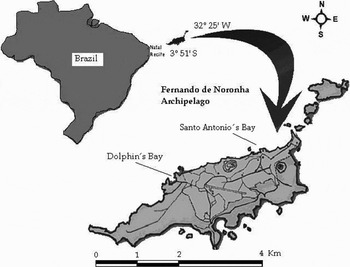
The observations and recordings were made in the south-west Atlantic in the Fernando de Noronha Archipelago, off north-eastern Brazil (03°50′S 32°25′W), 345 km east of the São Roque Cape in north-eastern Brazil. Observation sessions were mostly carried out at Santo Antonio's Bay, a 5–15 m deep bay (see Maida & Ferreira, Reference Maida and Ferreira1997; Carleton & Olson, Reference Carleton and Olson1999, for detailed description) (Figure 1).
Map of Fernando de Noronha Archipelago. The recordings and behavioural observations of spinner dolphins were made at Santo Antonio's Bay.

Recordings
Vocalizations were recorded from a small inflatable boat, using a portable Sony TCD-5M cassette recorder and a High Tech HTI-94-SSQ Series 2 wire hydrophone. This recording system has a frequency response up to about 17 kHz, suitable for detecting and recording most delphinid sounds. Dolphin groups were located and approached, and the motor disengaged before recordings were made. High quality signals, those with a suitable signal/noise ratio, were registered using the tape counter of the recorder. Acoustic data were acquired during June 2004, in a total survey effort of 25 h (6 h of recordings).
Acoustic sample
At the laboratory, we reviewed all the tapes, using the tape counter additional information to locate the presence of calls. The selected recordings were previewed using a real-time spectrograph (CANARY 1.2, Cornell Bioacoustics Workstation). Calls were digitized from the tape recorder direct on to a Macintosh desktop computer. Spectrograms for each call were generated using fast-Fourier transformations (FFT = 512) at a 21 KHz sampling rate.
Measurements
Four acoustic parameters were measured from spectrographs, using an on-screen cursor, for the fundamental frequency of each call: (i) duration; (ii) frequency amplitude; (iii) minimum frequency; and (iv) maximum frequency.
Complementarily, we also classified calls by their shape contour by visual inspection of the spectrograms. Methods to describe and categorize pulsed calls for spinner dolphins are further documented by Lammers et al. (Reference Lammers, Au and Herzing2003).
RESULTS
Seventy-three pulsed calls were selected for digitization and measurements, chosen by a suitable noise/signal ratio, so that timing and frequency parameters could be discerned from background noise. The intensity of these sounds was variable, always with harmonics scored from 1 to 20, and peak of energy on the basis or lower frequencies. Pulsed calls were produced in bouts or associated with whistles. The acoustic data were recorded on reproductive/mating groups, commonly observed in the area (Silva Jr et al., Reference Silva, Silva and Sazima2005) engaged many times in courtship behaviours.
Descriptive parameters of the calls
The fundamental frequency of the calls had the duration of 0.046 to 2.08 s (mean 0.433, SD 0.433), amplitude of 0.13 to 2.01 kHz (mean of 0.36, SD 0.29), minimum frequency of 0.22 to 1.80 (mean 0.55, SD 0.29), maximum frequency of 0.46 to 7.50 (mean 1.00, SD 0.89).
Shape contour analysis
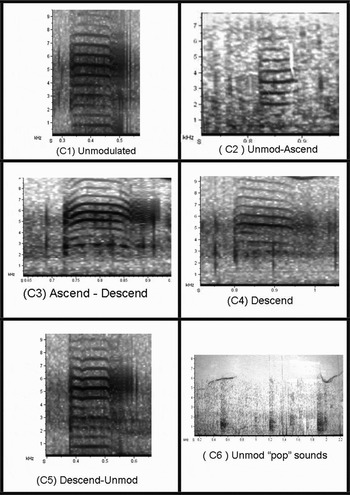
We identified six basic types of discernible calls (Figure 2), as summarized in Table 1. Variant C1 (N = 13) consisted of a tonal sound, unmodulated, a mean duration of 0.282 s and a mean amplitude of 3.15 kHz (0.55 to 3.7 kHz). Variant C2 (N = 24) began unmodulated then ascending, a duration of 0.161 s, frequencies ranging from 0.52 to 6.21 kHz and a mean amplitude of 5.69 kHz. Variant C3 (N = 17) presented a contour with ascending frequency modulation, which then descended, 0.64 s of duration and a mean amplitude of 6.81 kHz (0.55 to 7.36). Variant C4 (N = 5) was characterized by a short note with descending frequency modulation, with duration of 0.101 s and the frequency ranging from 0.97 to 3.71 kHz. Variant C5 (N = 7) corresponded to a call with descending frequency modulation turning to unmodulated, with duration of 0.106 s, and amplitude of 5.21 kHz, ranging from 0.77 to 5.99 kHz. We could identify a sixth particular class of sound, the variant C6 (N = 7), we called ‘pop’ sounds, with unmodulated frequency, much shorter in duration (0.095–0.878) than others and highly repetitive.
Representative spectrograms of the different call types, identified by the shape contour inspection, emitted by the spinner dolphins, at Fernando de Noronha Archipelago, north-eastern Brazil.

Simple call types, identified by shape visual inspection, emitted by the spinner dolphin, Stenella longirostris, in the Fernando de Noronha Archipelago, north-eastern Brazil, with sampled number, types of modulation, and physical parameters (frequency, kHz; time, seconds (s)).

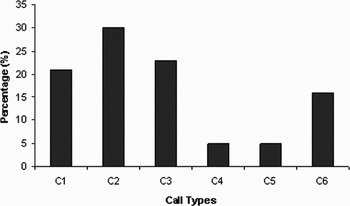
The relative frequency (percentage) of occurrence for classes of shapes (N = 6) for 43 simple calls of the spinner dolphin at Fernando de Noronha, is illustrated in Figure 3, showing heterogeneity instead of predomination among the identified call types, with C1, C2 and C3 calls presenting higher frequencies, 21, 30 and 23%, respectively.
Relative frequency (percentage) of occurrence for classes of call shapes of the spinner dolphin at Fernando de Noronha, Brazil.

DISCUSSION
In this study, we found that the calls of Stenella longirostris in the Fernando de Noronha Archipelago are diverse and more complex than previously recognized for spinner dolphins. We found six discernible types of call, varying in duration from 0.050 to 2.29 s (mean = 0.467), ranging between 0.20 and 9.31 kHz, with harmonics and high energy at lower frequencies.
In the literature, few studies have presented information on this class of sound. Norris et al. (Reference Norris, Würsig, Wells, Würsig, Brownlee, Johnson and Solow1994) characterized the burst pulsed signals as the most complex spectral class of sounds, varying in duration from 0.2 to 4.0 s (mean = 0.5), ranging between about 5 and 60 kHz.
Lammers et al. (Reference Lammers, Au and Herzing2003) found that the social signals produced by spinner and spotted dolphins span the full range of their hearing sensitivity, are spectrally varied, and that the burst pulses are probably produced more frequently than reported by audio-range analyses.
Comparing our results with those presented in Norris et al. (Reference Norris, Würsig, Wells, Würsig, Brownlee, Johnson and Solow1994), we found similar mean durations for the spinner dolphin calls, despite the smaller maximum value for duration. For the total range of the burst pulsed signals, Norris et al. (Reference Norris, Würsig, Wells, Würsig, Brownlee, Johnson and Solow1994) presented values much higher than those of this present study. We interpret this as a possible bias when classifying and grouping any class of sounds of different manners among distinct researchers. Furthermore, differences in the recording system and in environmental characteristics can also influence the obtained range of frequencies.
Due to the limitation of band recordings of our equipment we were unable to compare our results with those reported by Lammers et al. (Reference Lammers, Au and Herzing2003). However, these authors report that the high frequency peaks for burst pulsed sounds for spinner dolphins are about 32 kHz.
Such differences found between the calls for the spinner dolphin of Brazil (present study) and Hawaii (Norris et al., Reference Norris, Würsig, Wells, Würsig, Brownlee, Johnson and Solow1994) could reflect differences in dolphin ecology and behaviour. Despite the fact that spinner dolphins use oceanic shores and beaches similarly, in Kealakekua Bay dolphins are observed either feeding or resting, while in Fernando de Noronha, the dolphins reach the bay in the early morning just to rest and breed, for their feeding is in the adjacent open ocean during the night time (Silva Jr et al., Reference Silva, Silva and Sazima2005). Also, to date, mating groups producing excessive noises during copulation are commonly observed in Noronha waters (Silva Jr et al., Reference Silva, Silva and Sazima2005). So, all these behaviours associated with specific bottom relief as well as different trophic relationships (Silva Jr et al., Reference Silva, Silva, Sazima and Sazima2007) may also shape dolphin communication.
Ecological influences reflected in distinct geographical repertoires, are well described for other cetacean species such as the humpback whale (Winn et al., Reference Winn, Thompson, Cummings, Hain, Hundnall, Hays and Steiner1981), the blue whale (Stafford et al., Reference Stafford, Nieukirk and Fox2001) and the bottlenose dolphin (Ding et al., Reference Ding, Würsig and Evans1995; Morisaka et al., Reference Morisaka, Shinohara, Nakahara and Akamatsu2005).
Discrete pulsed calls are also considered as the most common social sound pattern for the killer whales (Ford & Fisher, Reference Ford and Fisher1982). Pulsed calls are very complex with energy at 500 Hz to 25 kHz and pulse repetition rates up to 5000 per second. The duration of pulsed calls range from 0.05 to 10 s, but most are 0.5–1.5 s long (Schevill & Watkins, Reference Schevill and Watkins1966; Ford & Fisher, Reference Ford and Fisher1982). Complexity on the use of calls is also mentioned in the literature for other Delphinidae, such as those of Orcinus orca (Ford, Reference Ford1991), Delphinapterus leucas (Sjare & Smith, Reference Sjare and Smith1986), Monodon monoceros (Ford & Fisher, Reference Ford and Fisher1978), Globicephala macrorhynchus and G. melas (Rendell et al., Reference Rendell, Matthews, Gill, Gordon and Macdonald1999), and for Sotalia guianensis (Monteiro-Filho & Monteiro, Reference Monteiro-Filho and Monteiro2001).
In the present study, we could verify that some calls seems to occur in specific contexts, such as the C6—‘pop’ call type, simultaneously with clicks and whistles, during euphoric sound production of the animals. It is probable that the calls are related to reproductive groups that are actively moving and producing intense sounds, as preliminarily commented by Silva Jr et al. (Reference Silva, Silva and Sazima2005).
Many aspects of the behavioural use and context of the spinner dolphin sounds remain unknown. New research efforts in other areas worldwide, where the good water visibility allows gathering accurate behavioural information, as initiated by Norris et al. (Reference Norris, Würsig, Wells, Würsig, Brownlee, Johnson and Solow1994) in Hawaii, should be continued, as well as in Midway Atoll (Karczmarski et al., Reference Karczmarski, Würsig, Gailey, Larson and Vanderlip2005) and French Polynesia (Poole, Reference Poole1995) emphasizing bioacoustics to reinforce the complexity of the spinner dolphin sound repertoire.
ACKNOWLEDGEMENTS
We thank IBAMA for work permits in the Fernando de Noronha National Marine Park, June 2004 interns for logistical support. M.R.S. thanks the Instituto Baleia Jubarte/ Humpback Whale Institute, Brazil, Petrobras and Aracruz Celulose for financial support, Jeff Podos for allowing the sound equipment usage, initial guidance and encouragement, and Renato Garcia for helping with Canary Software. An anonymous referee provided constructive criticism that helped to improve this manuscript.