Significant outcomes
-
∙ The dynamic thiol–disulphide homeostasis can be used as an assayed, accurate and novel oxidative stress marker in the pathogenesis of Alzheimer’s disease (AD).
-
∙ The dynamic thiol–disulphide homeostasis is a cost-efficient and easily accessible method for evaluating patient with AD.
-
∙ Measuring these parameters can provide an overview for understanding the disease process.
Limitations
-
∙ This research has been conducted in a single centre with a small group of patients.
-
∙ In this study, the results have not been correlated with other oxidative stress parameters such as lipid hydroperoxide, total antioxidant status, total oxidant status, oxidative stress index, paraoxonase and arylesterase.
-
∙ The detailed neuropsychiatric evaluation cannot be performed in patients with AD.
-
∙ The parameters cannot measure in the cerebrospinal fluid because of the limited amounts.
Introduction
Alzheimer’s disease (AD) is a chronic and progressive neurological disease characterised by cognitive and behavioural deterioration that especially affects social and occupational functioning. AD is the most common cause of dementia (Reference Markesbery1).
Oxidative stress damages biological structures such as protein, deoxyribonucleic acid (DNA) and ribonucleic acid (RNA) in living organisms, by the reactivity functions of free radicals. Oxidative stress is characterised by the balance between oxidative and anti-oxidative mechanisms of living organisms. It is caused by an imbalance between production and detoxification of reactive oxygen species (ROS). Brain tissue is quite sensitive to oxidative stress because it is the largest consumer of oxygen (Reference Liang, Ho and Patel2,Reference Steele, Fuller, Maczurek, Kersaitis, Ooi and Münch3).
The final common pathway that leads to progressive cognitive and behavioural impairment in AD is the loss of selective cells in the brain. However, what factors lead to selective cell loss in the brain is still not known. Many studies show that oxidative stress leads to neuronal degeneration in AD and plays a role in the pathogenesis of AD (Reference Markesbery1,Reference Steele, Fuller, Maczurek, Kersaitis, Ooi and Münch3–Reference Mecocci, Macgarvey and Kaufman9).
Several tests can be used to measure levels of antioxidant and oxidant enzymes and molecules to illustrate the oxidative stress in the organism. Thiols are the most important reductant molecules in the body. ROSs formed in the organism transfer excessive electrons to the thiols and oxidise them; thereby, disulphide bonds are formed. However, these disulphide bonds are reversible. They can turn back into thiols depending on the organism’s antioxidant–oxidant balance. Thus, we can refer to a dynamic thiol–disulphide homeostasis condition (Reference Erel and Neselioglu10–Reference Cremers and Jakob12).
Dynamic thiol–disulphide homeostasis has a critical importance for antioxidant protection detoxification, signal transduction, apoptosis and regulation of enzymatic activation, transcription factors and cellular signalling mechanism. In disease processes caused by oxidative stress, dynamic thiol/disulphide homeostasis in the organism is expected to be affected (Reference Erel and Neselioglu10,Reference Turell, Radi and Alvarez11).
In AD patients, oxidative stress is proven to be increased by various mechanisms such as high iron levels, which increase the formation of free radicals in the brain; the levels of aluminium and mercury; increased lipid peroxidation and polyunsaturated fatty acids in the brain; increased oxidation of protein and DNA; impaired energy metabolism; and increase in glycation end products (Reference Markesbery1,Reference Steele, Fuller, Maczurek, Kersaitis, Ooi and Münch3). In the event of oxidative stress, determination of changing dynamic thiol/disulphide homeostasis provides valuable information in various abnormal biochemical processes (Reference Erel and Neselioglu10). It seems likely that oxidative stress may be one of the factors responsible for AD, and dynamic thiol/disulphide homeostasis is deteriorated in patients with AD.
Aims of the study
The aim of this study was to evaluate the dynamic thiol–disulphide homeostasis as an oxidative stress parameter in patients with Alzheimer’s disease by using a novel and automated assay. In this study, we have hypothesised that the mechanisms underlying AD also affect dynamic thiol–disulphide homeostasis in the organism. Last, the study aimed to investigate the relationship between dynamic thiol–disulphide homeostasis and mini mental state examination (MMSE) score and duration of disease.
Material and methods
Selection of the participants
This study was conducted with 51 patients (27 women and 24 men) aged between 48 and 90 years and diagnosed with AD according to the diagnosis criteria of DSM-IV Alzheimer-type dementia, and 46 healthy volunteers (24 women and 22 men) aged between 44 and 86 years, with no health complaints. We received the written consent of all participants. The approval of the Ethics Committee of Yıldırım Beyazıt University Faculty of Medicine, was obtained before the study. Further clinical evaluation of all the volunteers participating in the study was conducted by researchers in the clinical and outpatient setting. In the clinical evaluations, patient information related to detailed medical history, neurological examination, age, sex, duration of disease and treatment information for the disease have been obtained. All patients were subjected to MMSE, applied by experienced researchers, to determine their cognitive status and MMSE scores. No participant included in the study had a history of smoking, alcohol or drug use. Patients diagnosed with a progressive brain disease, other chronical systemic or comorbid diseases and those taking a special diet or with chronic use of drugs were excluded from the study. No malignancy, systemic disease or neurological disease was detected in healthy individuals in the control group. Further, none of the patients or control subjects had any acute medical problems such as trauma or infection when blood samples were obtained. Lipid profile, blood glucose levels, complete blood count, kidney function tests, blood electrolyte levels and iron profile of all subjects were normal.
Plasma sampling and analytic procedure
Venous blood samples from the patients and healthy controls in the study were collected through the antecubital vein. Blood samples were taken in the morning after fasting for 12 hours and placed in ethylenediaminetetraacetic acid tubes. Plasma blood samples were centrifuged at 1500 rpm for 10 min within 30 min after receiving them from the participants. These samples were stored at −80°C until used.
The method of laboratory
In this study, dynamic thiol–disulphide homeostasis in the serum samples of patients with AD and healthy individuals has been identified by using an automated method newly developed by Erel et al. (Reference Erel and Neselioglu10) Total thiol (–SH+–S–S–) and native thiol (–SH) concentrations in the samples were measured by using Ellmann’s and modified Ellmann’s reagent. Native thiol content was subtracted from total thiol content, and half of this difference gave the amount of dynamic disulphide bonds (–S–S–). In addition, the (–S–S–)×100/(–SH), (–S–S–)×100/(–SH+–S–S–), and –SH×100/(–SH+–S–S–) ratios were calculated using these parameters.
Statistical analysis
The obtained data were analysed using statistical software prepared for the social sciences (SPSS, Version 17, Chicago, IL, USA). In the study, descriptive statistics (mean, standard deviation, median, minimum, maximum, number and percentage) are given for continuous variables. In addition, homogeneity of variances, which is one of the prerequisites of parametric tests, was controlled by using Levene’s test. Normality assumption was examined using the Shapiro–Wilk test. To evaluate the differences between two groups, Student’s t-test was used if preconditions of parametric tests were provided; otherwise, Mann–Whitney U-test was used to evaluate the differences. The linear relationship between two variables was evaluated using the Pearson correlation coefficient if preconditions of parametric tests were provided; otherwise, the Spearman correlation coefficient was used to evaluate the relationship between two continuous variables. p<0.05 was considered statistically significant.
Results
In this study, the average age of the participants diagnosed with AD was 75.27±7.72, whereas the average age of the participants in the control group was 75.15±7.17. There was no statistically significant difference between patients and the control group in terms of age and gender (p=0.497). The average age of the patient with AD at onset is 72.7, and average of follow-up time is 2.6 year.
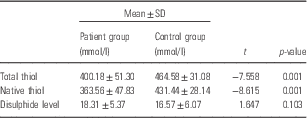
The average value of total thiol level was found to be 400.18±51.30 mmol/l in patients with AD, and this value was found to be 464.58±31.08 mmol/l in the control group. Statistically significant difference was found between these two groups in terms of total thiol values (p=0.001). The average value of native thiol level was 363.56±47.83 mmol/l in the patient group and 431.44±28.14 mmol/l in the control group. There was statistically significant difference between these two groups in terms of native thiol levels (p=0.001). The average dynamic disulphide bond level was 18.31±5.37 mmol/l in the patient group and 16.57±6.07 mmol/l in the control group: no statistically significant difference was found between these two groups in terms of dynamic disulphide bond levels (p=0.103) (Table 1).
Descriptive statistics and comparisons of total thiol, native thiol and disulphide variables by groups

SD, standard deviation.
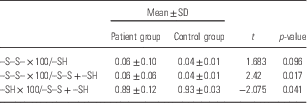
The average of –S–S×100/–SH value was 0.06±0.10 in patients with AD and 0.04±0.01 in the healthy control group. No statistically significant difference was found between patient and control groups in terms of average –S–S×100/–SH values (p=0.096). The average –S–S×100/–S–S+–SH value was found to be 0.06±0.06 in patients with AD, whereas the average S–S×100/–S–S+–SH value was 0.04±0.01 in the control group. Statistically significant difference was found between patient and control groups in terms of average S–S×100/–S–S+–SH values (p=0.017). The average –SH×100/–S–S+–SH value was found to be 0.89±0.12 in patients with AD, whereas it was 0.93±0.03 in the control group. Statistically significant difference was found between patient and control groups in terms of average –SH×100/–S–S+–SH values (p=0.041) (Table 2).
Descriptive statistics and comparisons of –S–S–×100/–SH, –S–S–×100/–S–S+–SH, –SH×100/–S–S+–SH variables by groups
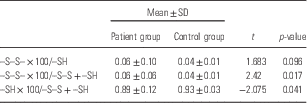
–S–S–, dynamic disulphide bond; –SH, native thiol; –S–S–+–SH, total thiol; SD, standard deviation.
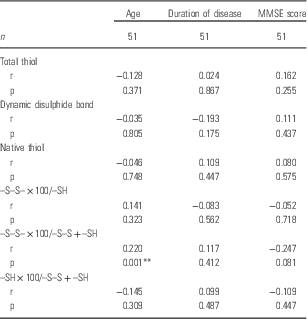
Given the correlation analyses, no statistically significant correlation was found between total thiol levels, native thiol levels, amount of dynamic disulphide bond, –S–S–×100/–SH, –S–S–×100/–S–S+–SH, and –SH×100/–S–S+–SH ratios of patients with AD and their MMSE score and duration of disease. There was a positive and statistically significant relationship between total thiol level, native thiol level and amount of dynamic disulphide bond of patient with AD and their –S–S–×100/–S–S+–SH ratios (p<0.01). There was no statistically significant relationship between age and descriptive variables (Table 3).
The relationship between total thiol levels, native thiol levels, amount of dynamic disulphide bond, –S–S–×100/–SH, –S–S–×100/–S–S+–SH, and –SH×100/–S–S+–SH ratios of patients with Alzheimer’s disease and their mini mental test score and duration of disease

–S–S–, dynamic disulphide bond; –SH, native thiol; –S–S–+–SH, total thiol.
**p<0.01.
Discussion
The present study is the first study to evaluate dynamic thiol–disulphide homeostasis in the serum of patients with AD by this novel automated colorimetric method. According to information from previous studies of AD, oxidative stress is important in the pathogenesis of disease. We have measured total thiol, native thiol and dynamic disulphide bond amounts in the plasma of patients with AD and healthy individuals by a novel method that objectively shows the thiol/disulphide mechanism, which is an important and dynamic redox system in the organism. We examined –S–S–×100/–SH, –S–S–×100/–S–S+–SH, and –SH×100/–S–S+–SH ratios using these parameters. In this study, total thiol and native thiol levels of patient with AD were found to be statistically lower compared with the levels of healthy controls. On the contrary, the amount of dynamic disulphide bonds were found to be higher in the patient group; however, these differences were not statistically significant (p=0.139). In addition, the –S–S–×100/–S–S+–SH ratio of the patients with AD was significantly higher compared with that in healthy individuals, whereas –SH×100/–S–S+–SH ratio was found to be significantly lower. In the correlation analyses, total thiol levels, native thiol levels, dynamic disulphide bond amounts and –S–S–×100/–SH, –S–S–×100/–S–S+–SH and –SH×100/–S–S+–SH ratios were not found to be correlated with MMSE score and duration of disease.
Previous studies have shown that oxidative stress may play a role in the pathogenesis of many diseases, and thus thiol chemistry has become more important. Thiols are very important molecules in the antioxidation process that contain –SH groups. –SH groups can reduce electrons so organism can be protected from oxidative damage caused by ROS. Thiols are converted to disulphides by this reaction. In the past, only a single side of this double-sided balance had been measured. However, both variable levels were measured one by one and cumulatively with the method by Erel et al. (Reference Erel and Neselioglu10), and the status can be evaluated completely (Reference Erel and Neselioglu10–Reference Jones and Liang14). Findings using this novel method can be analysed objectively to determine whether thiol metabolism is affected in the pathogenesis of many diseases and, therefore, whether oxidative stress will be an important factor or not. Hence, we have investigated dynamic thiol–disulphide homeostasis that can be used as a marker of oxidative stress in patients with AD by using this newly developed method.
Studies conducted with AD have indicated that oxidative stress plays a role in the pathogenesis of AD (Reference Markesbery1,Reference Steele, Fuller, Maczurek, Kersaitis, Ooi and Münch3–Reference Mecocci, Macgarvey and Kaufman9,Reference Markesbery and Carney15–Reference Perry, Yong, Bergeron, Hansen and Jones19). In addition, results of some of these studies are found to be correlated with histopathological markers (Reference Markesbery1,Reference Aksenov, Tucker and Nair5,Reference Palmer18). ROSs are held responsible for neuronal degeneration in AD patients (Reference Markesbery1). In AD, knowing which mechanisms increase ROSs may lead to a new perspective in the prevention and treatment of the disease. Therefore, we wanted to analyse whether this dynamic redox system, which is very important in the organism, is affected in AD, by measuring dynamic thiol–disulphide homeostasis in plasma, by using the method (Reference Erel and Neselioglu10). Total thiol and native thiol levels of patient with AD were significantly lower; hence, we have found that this redox system is significantly affected in AD. We have not found any correlation amidst duration of disease, total thiol and native thiol levels and amount of dynamic disulphide bond, and this can be explained by the shortness of our follow-up time.
Simith et al. (Reference Smith, Carney and Starke-Reed20) have found oxide proteins in the frontal and occipital area of the brain at high levels. Meccocci et al. (Reference Mecocci, Macgarvey and Kaufman9) have found that levels of 8-hydroxy 2-deoxyguanosine, which are used as a marker of DNA oxidation in nuclear and mitochondrial DNA, are high in AD. In addition, lipid peroxidation is found be increased in AD (Reference Lovell, Ehmann, Butler and Markesbery21–Reference Palmer and Burns24).
According to a study conducted by Hernanz et al. (Reference Hernanz, De La Fuente, Navarro and Frank25), the plasma level of cysteinylglycine, which is one of the thiols with low molecular weight, is significantly lower in patients with AD than in healthy individuals. In addition, McCadden et al. (Reference Mccaddon, Hudson and Hill26) have found that homocysteine, which is also one of the thiols with low molecular weight, is increased in both plasma and cerebrospinal fluid (CSF), and hyperhomocysteinemia is found to be an independent risk factor for AD (Reference Mccaddon, Hudson and Hill26).
Before the clinical diagnosis of AD, the neurological changes have already begun. For this reason, some studies have been performed to determine if there any obtainable biomarkers that can be used to identify patients who will progress to AD before the clinical findings of the disease are seen. Some oxidative stress markers have been found in the blood, CSF and urine of patients diagnosed with mild cognitive impairment, and these markers have been compared with the levels in normal elderly subjects. Further, such studies have speculated that increased brain oxidative damage before the onset of AD occurs in patients who will develope AD in the future; therefore, these molecules could be used as predictive markers for AD (Reference Praticò, Clark and Liun27–Reference Padurariu, Ciobica and Hritcu29). Although it is an open question whether oxidative stress is a primary cause or merely a downstream consequence of the neurodegenerative process, based on these studies, it has been speculated that oxidative stress is a primary cause of AD.
According to the results of our study, it can be clearly said that dynamic thiol/disulphide homeostasis is affected in AD. This may play a role in the pathogenesis of this disease, and measuring this parameters can provide an overview for understanding the disease process.
Our study had some limitations. First, we have conducted this study in a single centre with a small group of patients. Although we would like to enroll much more patients, at the moment of the study this was the only number of the patients we could be able to collect. Because of this, some of the standard deviation values are high. Second, we could not correlate our results with other oxidative stress parameters such as lipid hydroperoxide, total antioxidant status, total oxidant status, oxidative stress index, paraoxonase and arylesterase. Third, the level of this parameter is more significant in the CSF, but this is technically impossible because most thiol components are carried by albumin, and in the CSF, thiol components and albumin levels are too small to be detected and measured. Further studies that can correlate particularly these results with corresponding histopathological markers are needed.
Conclusions
To the best of our knowledge, our study is the first to evaluate the dynamic thiol–disulphide homeostasis in the serum of patients with AD. The results of our study showed that this newly developed test can be used as an assayed, accurate and novel oxidative stress marker in the pathogenesis of AD. Moreover, it is a cost-efficient and easily accessible method.
Acknowledgements
The biochemical analysis of this study was performed at the biochemistry lab of Ataturk Education and Research Hospital. The authors would like to thank Ozcan Erel’s research asistants for their invaluable assistance. The authors also would like to acknowledge: Meliz Vural for her professional translation and Elsevier Language Editing Service for their Professional Editing.
Authors’ contributions: Dr. Gonul Vural, Dr. Hesna Bektas, Prof. Dr. Orhan Deniz, Dr. Salim Neşelioğlu, and Prof. Dr. Ozcan Erel make important and valuable contributions all steps of this article such as conception and design of the article, acquisition and interpretation of data, revising content and final approval.
Financial Support
This research received no financial support in the public, commercial, or not-for-profit sectors.
Conflicts of Interest
None.
Ethical Standards
The authors assert that all procedures contributing to this work comply with the ethical standards of the relevant national and institutional committees on human experimentation and with the Helsinki Declaration of 1975, as revised in 2008. Ethical approval of the study was granted by the Ethics Committee of Yıldırım Beyazıt University, Faculty of Medicine.