Doveweed’s light green color and coarse texture disrupts sward quality by contrasting with the color and texture of desirable turfgrass. Doveweed is a semisucculent herbaceous plant with a sprawling, creeping habit. Identifying characteristics are linear to oblong-lanceolate leaves 3 to 7 cm long and 1 to 2 cm wide, a fringe of hairs along the lower leaf margins, small (≤1 cm) purple ephemeral flowers, and a fibrous root system (Holm et al. Reference Holm, Plucknett, Pancho and Herberger1977).
Doveweed competes both laterally and vertically for soil and light resources as a result of its decumbent growth habit (Holm et al. Reference Holm, Plucknett, Pancho and Herberger1977). Under favorable growing conditions, the plants form dense, pure stands that smother competing species. Doveweed is a prolific seed producer, and its stems readily root when their nodes come in contact with moist soil, especially if stems are broken or cut (Holm et al. Reference Holm, Plucknett, Pancho and Herberger1977). The ability of this species to reproduce both sexually and vegetatively increases the importance of identifying effective herbicide control options. Doveweed completes its life cycle after seed production in early fall as temperatures begin to decline in the southeastern United States; a time of reduced growth of desirable turf in response to changing seasonal environmental conditions. If infestations are left unchecked, large voids in turf cover remain until conditions are again favorable for turf growth.
End user reports of selective postemergence (POST) doveweed control are inconsistent, and control is often short-lived. In related species, early POST applications of cloransulam applied at 0.018 kg ai ha−1 and lactofen applied at 0.22 kgaiha−1 controlled Asiatic dayflower (Commelina communis L.) approximately 80% and 67%, respectively, in soybean (Glycine max [L.] Merr.) (Ulloa and Owen Reference Ulloa and Owen2009). POST application of MSMA at 0.84 kg ai ha−1 controlled Benghal dayflower (Commelina benghalensis L.) 78% at 21 d after treatment (DAT) (Culpepper et al. Reference Culpepper, Flanders, York and Webster2004). In the same study, MSMA plus diuron applied at 0.84+1.12 kgaiha−1 and MSMA plus flumioxazin at 0.84+0.072 kgaiha−1 controlled Benghal dayflower 83% and 89%, respectively, 21 DAT (Culpepper et al. Reference Culpepper, Flanders, York and Webster2004). Previous research has not evaluated herbicides for selective POST doveweed control efficacy in bermudagrass turf.
Inconsistent doveweed control with nonselective herbicides such as glyphosate is common. According to the Weed Science Society of America, herbicide tolerance is defined as the inherent ability of a species to survive and reproduce after herbicide treatment, without selection or genetic manipulation (Anonymous 1998). Additionally, poor control with glyphosate has been documented in Asiatic dayflower and other Commelinaceae species (Culpepper et al. Reference Culpepper, Flanders, York and Webster2004; Webster and Sosnoskie Reference Webster and Sosnoskie2010). In one study, Asiatic dayflower biomass was not completely reduced by glyphosate applied at 6.72 kg ae ha−1, and application of the 1×rate, 0.84 kg ae ha−1, did not significantly reduce aboveground biomass compared to a nontreated control. This suggests tolerance of this species to glyphosate (Ulloa and Owen Reference Ulloa and Owen2009).
The objectives of this study were 1) to evaluate selective POST doveweed control options in ‘Tifway’ hybrid bermudagrass turf, 2) to compare the efficacy of single versus sequential applications of selective POST herbicides, 3) to quantify doveweed tolerance to glyphosate, and 4) to quantify recovery of foliar-applied glyphosate following treatment with a [C14]glyphosate solution.
Materials and Methods
POST Herbicide Control
Two studies were conducted between June and September of 2009, 2010, 2012, and 2013 to evaluate POST doveweed control options in ‘Tifway’ bermudagrass turf and to compare the efficacy of single and sequential POST applications. Studies were conducted on a mature stand of ‘Tifway’ bermudagrass established in a Vaucluse loamy sand (fine-loamy, kaolinitic, thermic Fragic Kanhapludults) with a soil pH of 6.1 and 1.4% organic matter in Augusta, GA (33°29′2.9′′N, 82°0′′38.2′′W). Routine preemergence herbicide applications had not been made to the study areas within 1 yr of study initiation. Doveweed density within the study areas was up to 85% cover.
Each study was repeated in a separate experimental area in sequential years. In both studies, initial POST applications were made when the majority of doveweed plants reached the five- to eight-leaf state. In study one, treatments were applied on July 7, 2009, and July 14, 2010. In study two, initial treatments were applied on June 28, 2012, and July 18, 2013, with sequential treatments applied 3 wk after initial treatment (WAIT). Atmospheric and soil environmental conditions for each application timing are presented in Table 1. Visual ratings were recorded 2, 4, and 6 wk after treatment (WAT) in study one and 2, 6, and 10 WAIT in study two.
Application dates and atmospheric and soil temperatures for postemergence doveweed control studies in Augusta, GA from 2009 to 2013.

a Air temperature was measured using a hand-held weather meter (Kestrel 3000, Kestrel meters, Birmingham, MI) immediately after herbicide application.
b Soil temperature was measured at a 2.54 cm depth using a hand-held analog soil thermometer immediately after herbicide application.
Treatments were applied using a CO2-pressurized boom sprayer calibrated to deliver a carrier volume of 187Lha−1 through 8003 flat-fan nozzles (Tee Jet, Spraying Systems Co., Roswell, GA). Treatments were not irrigated within 24 h of application, and plots were irrigated thereafter as needed to prevent wilt. Plots measured 1.5 by 2 m and were mowed twice per week at 5 cm with clippings returned. Fertilizer was applied according to soil test recommendations and was consistent across the experimental area.
Ratings included doveweed density, using a 0% to 100% scale (0% meaning no doveweed present, 100% meaning full doveweed stand), and bermudagrass turf injury, also using a 0% to 100% scale (0% meaning no injury, 100% meaning complete plant death). Percent doveweed control was calculated as the percent decrease of doveweed density relative to the initial doveweed within each plot prior to study initiation.
The experimental design for both studies was a randomized complete block with three replications. Treatments were arranged in a two-factor design with herbicide and experimental year as treatment levels. Percent doveweed control and bermudagrass turfgrass injury data were visually inspected by plotting residuals for homogeneity and normality of variance prior to analysis. Data were then subjected to ANOVA for evaluation of main effects and interaction between herbicide treatment and experimental year. When herbicide treatment by year interactions were not detected, data were combined for analysis and presented over years. Where appropriate, further mean comparisons between treatments were performed using Fisher’s protected LSD. All analyses were conducted using JMP Pro version 10 (SAS institute Inc., Cary, NC) and differences were based on α=0.05.
Dose Response of Doveweed to Glyphosate
Response of doveweed to glyphosate (Roundup ProMax, Monsanto, Saint Louis, MO) was evaluated by comparing a deionized water treatment with glyphosate applied at 0.09 (0.125×), 0.18 (0.25×), 0.36 (0.5×), 0.71 (1×), 1.42 (2×), 2.84 (4×), and 5.68 (8×) kg ae ha−1 following procedures modified from Seefeldt et al. (Reference Seefeldt, Jensen and Fuerst1995). Doveweed plants were prepared by first germinating seeds in petri dishes containing two sheets of Whatman No. 2 filter paper and 5 mL distilled water. Germinated seeds were then transplanted to 9-cm-diameter by 9-cm-deep pots filled with washed river sand. Plants were allowed to grow in a growth chamber set to maintain a constant temperature of 27 C with a 12 h photoperiod providing a photosynthetic photon flux density of 300 μmolm−2 s−1 using fluorescent and incandescent bulbs. During this period, plants were fertilized through subirrigation with a hydroponic growth solution (Grow-Big Hydroponic Plant Food, FoxFarm Soil and Fertilizer Company, Arcata, CA) at 1.3 mL L−1 every 10 d. Plants remained in the growth solution for 24 h, then were removed and allowed to drain. Between fertilization procedures, plants were surface-irrigated to field capacity every 2 d. Doveweed plants were allowed to develop to the five- to eight-leaf stage, at which point glyphosate treatments were applied. Treatments were delivered in a carrier volume of 374 Lha−1 deionized water with an air-pressurized spray chamber using a single 8003 flat-fan nozzle (TeeJet Technologies, Wheaton, IL) operating at 200 kPa. Shoot biomass was measured 21 DAT by clipping doveweed at soil level, drying tissue at 70 C for 48 h, then weighing. Injury ratings were expressed as percent dry weight of treated plants relative to the mean dry weight of the deionized water treated control plants (Seefeldt et al. Reference Seefeldt, Jensen and Fuerst1995).
Experimental design was completely randomized, with three replications, and the experiment was repeated in time. Treatments were arranged in a two-factor design with glyphosate rate and experimental run serving as factors. Regression analysis was conducted, and nonlinear models were fit to the data. A three-parameter logistic equation was used to describe the nonlinear response curve in doveweed biomass:
 $${{y\,{\equals}\,C} \mathord{/ {\vphantom {{y{\equals}C} {\left( {1{\plus}e^{{{\minus}A\left( {X{\minus}B} \right)}} } \right)}}} \right \kern-\nulldelimiterspace}{\big( {1{\plus}e^{{{\minus}A\left( {X{\minus}B} \right)}} } \big)}}$$
where y was shoot biomass, X was herbicide rate (kg ae ha−1), C was the asymptote, A was the growth rate, and B was the inflection point.
Shoot Absorption of [14C]Glyphosate
Shoot absorption of [14C]glyphosate was compared between doveweed with an intact cuticle, doveweed with a disturbed cuticle, and smooth crabgrass. Smooth crabgrass was chosen for comparison because glyphosate is frequently applied in the field to concurrently target smooth crabgrass and doveweed. Often, field application of glyphosate results in excellent smooth crabgrass control but poor doveweed control. Separate doveweed and smooth crabgrass plants were grown in individual containers in washed river sand (previously described) to approximately the five- to eight-leaf stage. Plants were then removed and roots were washed free of potting media. Washed plants were transplanted into 50 mL test tubes, which were then filled with the hydroponic solution used to subirrigate plants. The test tubes were wrapped with aluminum foil to protect against light intrusion into the growth solution.
A glyphosate solution was prepared to simulate a field application of glyphosate at 0.71 kg ae ha−1 in a 374Lha−1 carrier volume. Prior to glyphosate application, the youngest fully expanded leaf proximal to the apical meristem was designated for [14C]glyphosate treatment and covered with aluminum foil to shield the leaf from intercepting the spray solution. Glyphosate was then applied as previously descried in the dose-response study.
[14C]glyphosate (phosphonomethyl-14C; American Radiolabeled Chemicals, Inc., Saint Louis, MO) was dissolved in a commercial glyphosate formulation (Roundup ProMax, Monsanto, Saint Louis, MO) and diluted with distilled water to simulate a spray solution prepared to deliver 0.71 kgaeha−1 in 374Lha−1. The [14C]glyphosate solution was prepared such that the final radioactivity concentration was 200 kBq mL−1. No additional surfactant was added. Immediately prior to [14C]glyphosate application, the leaf designated for treatment on each plant selected for cuticle disruption was wiped five times in the acropetal direction on the adaxial side of the leaf with 100% acetone. A micropipette was then used to deliver five 2-μL droplets of [C14]glyphosate solution to each predesignated treatment leaf of each subset of plants to total 2 kBq per treatment leaf. Droplets were applied along the midrib of the adaxial leaf surface.
Three treated plants from each subset of plants were randomly selected for harvest 24, 72, and 144 h after treatment. At harvest, the treated leaf was excised from the plant and placed into a 15 mL centrifuge tube along with 7 mL of a methanol–water (1:10 v:v) solution. The excised leaf was washed within the centrifuge tube with a swirling motion for 30 s to remove any unabsorbed radioactivity. A 1-mL sample of the rinsate was then removed and placed in a 20 mL scintillation vial along with 15 mL of Optiphase HiSafe 3 (PerkinElmer, Waltham, MA) scintillation cocktail. Radioactivity was then quantified using liquid scintillation spectrometry (TriCarb 2900 Liquid Scintillation Analyzer, PerkinElmer, Waltham, MA). Radioactivity detected in the leaf wash was expressed as the percentage of the amount applied. Total recovery was 63% to 97%.
Experimental design was a completely randomized design, and the experiment was repeated in time. Treatment arrangement was a three-by-three-by-two factorial design with plant (doveweed with cuticle intact, doveweed with cuticle disturbed, and smooth crabgrass), harvest interval (24, 72, and 144 h), and experimental run serving as factors. The experiment included three single-plant replicates for each of the three plant treatments and harvest intervals. Data were subjected to ANOVA for evaluation of main effects, interaction between main effects, and interaction between main effects and experimental run. Where appropriate, further mean comparisons were performed using Fisher’s protected LSD. All comparisons were based on an α=0.05 significance level. Analyses were conducted using JMP Pro version 10 (SAS Institute Inc.; Cary, NC).
Results and Discussion
POST Control
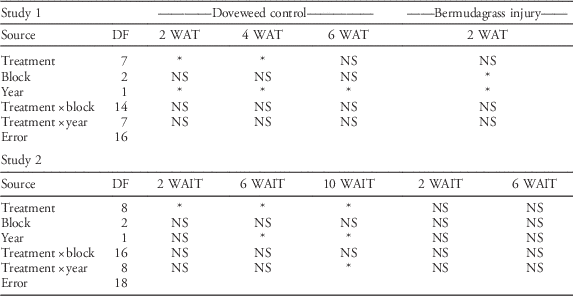
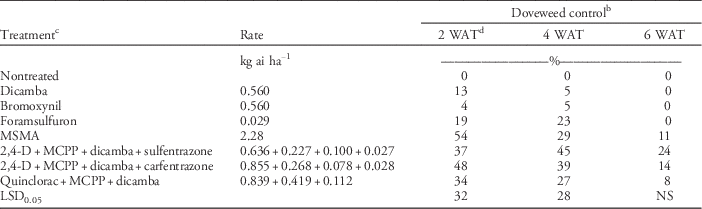
Turfgrass injury was not significant following any treatment application. In study one, treatment by year interaction was not detected for percent doveweed control at any rating date; therefore, data were combined between years prior to further analysis (Table 2). Doveweed control in the treated plots was significantly different than that in the nontreated plots at 2 and 4 WAT, although control was <60% across all treatments and rating dates (Table 3). MSMA provided 54% control 2 WAT, which is statistically superior to the control provided by dicamba, bromoxynil, or foramsulfuron. All combination treatments provided control similar to MSMA at 2 WAT, ranging from 34% to 48% (Table 3). 2,4-D plus MCPP plus dicamba plus sulfentrazone, and 2,4-D plus MCPP plus dicamba plus carfentrazone, controlled doveweed 39% to 45% at 4 WAT, which is significantly greater control than dicamba or bromoxynil provided alone (Table 3). Further differences between treatments were not detected 6 WAT and control in all treatments was <25% (Table 3).
ANOVA results for postemergence doveweed control in ‘Tifway’ bermudagrass in Augusta, GA, July through August of 2009 and 2010 (study 1) and 2012 and 2013 (study 2).Footnote a

a Abbreviations: DF, degrees of freedom; NS, not significant (α=0.05); WAIT, weeks after initial treatment; WAT, weeks after treatment.
*Significant at α=0.05 level.
Doveweed control with select postemergence herbicides in ‘Tifway’ bermudagrass. Augusta, GA, March through September, 2009 and 2010.Footnote a

a Abbreviations: fb, followed by; NS, not significant (α=0.05); WAT, weeks after treatment.
b Doveweed control was evaluated visually on a 0% to 100% scale.
c Trade name examples: dicamba, Banvel, Micro Flo Company, LLC; bromoxynil, Buctril, Bayer; foramsulfuron, Revolver, Bayer; MSMA, Target 6 Plus, Luxembourg-Pamol, INC.; 2,4-D+MCPP+dicamba+sulfentrazone, Surge, PBI Gordon; 2,4-D+MCPP+dicamba+carfentrazone, Speedzone, PBI Gordon; quinclorac+MCPP+dicamba; Onetime, BASF.
d Treatments were made on July 7, 2009, and July 14, 2010.
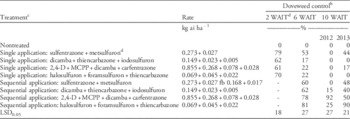
In study two, a treatment by year interaction was not detected for percent doveweed control 2 or 6 WAIT. However, a treatment by year interaction was detected for percent doveweed control 10 WAIT (Table 2). Therefore, 2 and 6 WAIT data were pooled between years prior to further analysis, and 10 WAIT control data were separated and analyzed by year. All treatments controlled doveweed from 61% to 79% at 2 WAIT. At 6 WAIT, a single application of sulfentrazone plus metsulfuron provided 53% control, while other single application treatments provided <25% control (Table 4). A second application of dicamba plus thiencarbazone plus iodosulfuron, 2,4-D plus MCPP plus dicamba plus carfentrazone, or thiencarbazone plus foramsulfuron plus halosulfuron at 3 WAIT improved control at 6 WAIT to >60% (Table 4). Sequential application of thiencarbazone plus foramsulfuron plus halosulfuron provided 81% control at 6 WAIT. Control at 10 WAIT was inconsistent between 2012 and 2013. At 10 WAIT, no single-application treatment controlled doveweed >50% in 2012 or 2013. In 2012, sequential application of 2,4-D plus MCPP plus dicamba plus carfentrazone controlled doveweed 92% at 10 WAIT, while all other treatments provided ≤25% control (Table 4). In 2013, sequential application of halosulfuron plus foramsulfuron plus thiencarbazone provided 90% control, while other sequential treatments provided 40% to 50% control (Table 4). These results indicate that POST options should not be solely relied on for doveweed control. The inconsistency observed at 10 WAIT is likely due to several factors, most notably the germination of additional doveweed seeds following the 6 WAIT rating. Further research is needed to determine the effect desirable turf stand density, soil moisture, and other environmental factors may have on the germination of doveweed seedlings following selective POST herbicide applications. Sequential POST applications improve control of other species compared to single applications alone. At 14 WAIT, sequential application of MSMA plus metribuzin at 2.2+1.4 kgha−1 increased goosegrass (Eleusine indica [L.] Gaertn.) control from ≤75% to ≥90% (Wiecko Reference Wiecko2000). Purple (Cyperus rotundus L.) and yellow (Cyperus esculentus L.) nutsedge control at 15 WAIT was improved by sequential application of sulfentrazone at 0.281 fb 0.281 kgaiha−1 or halosulfuron at 0.070 fb 0.070 kg ai ha−1 (Blum et al. Reference Blum, Isgrigg and Yelverton2000).
Doveweed control with select postemergence herbicides in ‘Tifway’ bermudagrass. Augusta, GA, March through September, 2012 and 2013.Footnote a

a Abbreviations: fb, followed by; WAIT, weeks after initial treatment.
b Doveweed control was visually evaluated on a 0% to 100% scale.
c Trade name examples: sulfentrazone+metsulfuron, Blindside, FMC Corporation; dicamba+thiencarbazone+iodosulfuron, Celsius, Bayer; 2,4-D+MCPP+dicamba+carfentrazone, Speedzone, PBI Gordon; halosulfuron+foramsulfuron+theincarbazone, Tribute Total, Bayer.
d Initial applications were June 28, 2012, and July 18, 2013. Sequential applications were July 19, 2012, and August 1, 2013.
Doveweed control is often short-lived following a single POST application due to doveweed’s continuous germination pattern throughout the growing season. Sequential applications improve control. However, full-season doveweed control should not be expected with only two POST applications of the herbicides evaluated. Further screening of herbicide active ingredients and combinations is needed to identify more effective options for season-long doveweed control. Additionally, combinations of PRE and POST herbicides should be explored to provide residual control following an herbicide application.
Dose Response of Doveweed to Glyphosate
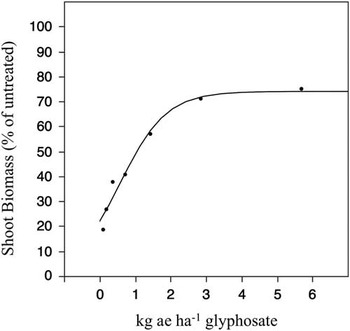
Treatment by run interaction was not detected in dose-response data. Therefore, data were pooled between experimental runs prior to further analysis. Complete plant death did not occur after glyphosate application at any rate evaluated (0.09 to 5.68 kg aeha−1) (Figure 1). The highest recommended glyphosate application rate for difficult-to-control turfgrass weeds is 1.73 kgaeha−1 (Anonymous 2009). The herbicide rate was calculated in this study to be lethal to 50% of the population (I50) (0.63 kgaeha−1); however, application at 3× this rate, 5.68 kgaeha−1, reduced doveweed aboveground biomass only 76% at 21 DAT (Figure 1). These data are consistent with field reports of doveweed tolerance to glyphosate.
Effect of glyphosate on shoot biomass of doveweed. Shoot biomass was calculated as a percent dry weight of treated plants relative to the mean dry weight of the deionized water treated control plants. The data were analyzed using the nonlinear regression equation y=C/(1+e –A(X–B)) where y was shoot biomass, X was herbicide rate (kgaeha−1), C was the asymptote, A was the growth rate, and B was the inflection point. Estimates for equation parameters A, B, and C were 1.08, 0.78, and 74.20, respectively. Summary of fit statistics Akaike’s Information Criterion, Schwarz Bayesian Information Criterion, Mean Squared Error, and r 2 were 64.66, 44.45, 19.29, and 0.97, respectively.

Benghal dayflower and Asiatic dayflower are species related to doveweed that have become troublesome weeds in agronomic crops because of their relative tolerance to glyphosate (Webster and Sosnoskie Reference Webster and Sosnoskie2010). In one study, differences in aboveground biomass between nontreated Asiatic dayflower and Asiatic dayflower treated with 0.84 kg ae ha−1 could not be detected at 21 DAT, and full control was not achieved at the 16× rate, 13.76 kg ae ha−1 (Ulloa and Owen Reference Ulloa and Owen2009). In another study, glyphosate application at 0.84 kg ai ha−1 controlled Benghal dayflower 70% at 21 DAT. Smaller plants (<6 cm) were completely controlled, while larger plants were not (Culpepper et al. Reference Culpepper, Flanders, York and Webster2004). Similar to these related species, it appears doveweed is also tolerant to glyphosate.
Absorption of [14C]Glyphosate
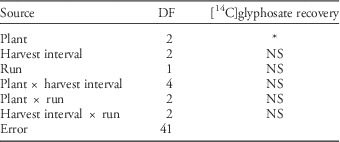
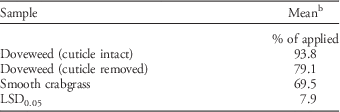
A treatment by run interaction was not detected in glyphosate recovery data; therefore, data were pooled between runs prior to further analysis (Table 5). Additionally, time after treatment was not significant (P=0.512), so recovery data was pooled across harvest intervals (Table 5). Recovery of [14C]glyphosate was 93.8% from the leaf surface in doveweed plants with an intact cuticle. In comparison, [14C]glyphosate recovery from the leaf surface of doveweed plants with a disrupted cuticle and from crabgrass plants was 79.1% and 69.5%, respectively (Table 6). Comparison of [14C]glyphosate recovery between doveweed with an intact cuticle, doveweed with a disrupted cuticle, and smooth crabgrass suggests that lack of doveweed control with glyphosate could be due to poor movement of the glyphosate molecule across doveweed’s cuticle layer. By treating doveweed’s cuticle layer with 100% acetone, the integrity of the cuticle layer was compromised, allowing for penetration of the glyphosate molecule through the cuticle layer.
ANOVA results for recovery of [14C]glyphosate after application to doveweed with cuticle intact, doveweed with cuticle disrupted, and smooth crabgrass at 24, 71, and 144 hours after application.Footnote a

*Significant at α=0.05 level.
a Abbreviations: DF, degrees of freedom; NS, not significant.
Percent recovery of [14C]glyphosate after application to doveweed with cuticle intact, doveweed with cuticle disrupted, and smooth crabgrass.Footnote a

a Leaves were spotted with five 2-μL droplets of glyphosate, corresponding to a 0.71 kg ae ha−1 application rate, with 0.20 KBq mL−1 radioactivity.
b Time after treatment was not significant in ANOVA (P=0.512), thus data within treatments were combined across harvest intervals.
Foliar absorption rate, and therefore efficacy of herbicide application, depends largely on the permeability of the target plant cuticle (Baker and Bukovac Reference Baker and Bukovac1971). A range of chemical groups comprise the plant cuticle. Cuticle composition is different for different species. The cuticle of creeping bentgrass (Agrostis stolonifera L.) is primarily comprised of primary alcohols, specifically 1-hexacosanol. Other constituents include various long-chain alkanes, fatty acids, one aldehyde, and a group of unidentified compounds (Bethea Reference Bethea2012). A study investigating the chemical composition of a barley (Hordeum vulgare L.) cuticle determined that it was 89% primary alcohols (Giese Reference Giese1975). In comparison, the cuticle of Benghal dayflower is composed almost entirely of hydrocarbons (n-alkanes), and is therefore relatively hydrophobic. In a study evaluating foliar uptake of [14C]glyphosate in Benghal dayflower, absorption was 66% after 72 h, lower than that observed in morningglory (Ipomoea grandifolia [Dammer] O’Donell) (80%) and smooth pigweed (Amaranthus hybridus L.) (90%) (Monquero et al. Reference Monquero, Christoffoleti, Osuna and De Prado2004). There is a close phylogenetic relationship between doveweed and Benghal dayflower; thus, it is possible that the chemical composition of doveweed’s cuticle layer prevents diffusion of glyphosate. Further research should determine the chemical composition of the doveweed cuticle so that herbicides with potential for doveweed control can be screened based in part on chemical properties.
Acknowledgment
The authors would like to thank the Carolinas Golf Course Superintendents Association for funding this research.