Network theory is an emerging approach that posits causal systems of interrelated symptoms are the ‘active ingredients’ of disorders rather than effects of a latent entity (Borsboom & Cramer, Reference Borsboom and Cramer2013; Borsboom, Reference Borsboom2017). Within this framework, edges refer to connections between symptoms (i.e. nodes), and disorders are conceptualized as patterns of dynamic relationships between symptoms, with greater connectivity conveying increased vulnerability for psychopathology (Scheffer et al. Reference Scheffer2012). This approach differs fundamentally from latent variable models, and as such, offers unique advantages. That is, latent variable frameworks model shared variance among symptoms, with the assumption that an underlying common cause activates multiple symptoms and accounts for symptom covariation. In contrast, the focus of network models centers around estimating unique variance between symptoms. Despite the growing number of network analyses in other fields of psychopathology (for an overview see Fried et al. Reference Fried2017), thus far few studies have examined the network structure of eating disorder (ED) symptoms, nor assessed the extent to which network structures change over the course of treatment.
Like other psychiatric disorders, EDs are serious illnesses that are associated with a range of negative correlates and sequelae, including significant co-occurring psychopathology (Klump et al. Reference Klump2009). Mood and anxiety disorders represent the most common comorbid diagnoses in EDs (Hudson et al. Reference Hudson2007), which is consistent with a preponderance of research implicating negative affectivity in the onset and maintenance of EDs (e.g. Stice, Reference Stice2001; Haedt-Matt & Keel, Reference Haedt-Matt and Keel2011; Wonderlich et al. Reference Wonderlich, Peterson and Smith2015). Such evidence suggests that ED and affective symptoms may have reciprocal and/or causal underlying relationships. Hence, identifying and understanding the complexities of relationships between ED and affective symptoms may allow prevention and intervention efforts to more precisely target key risk and maintenance mechanisms.
Network analyses of EDs
Network analysis is a developing methodology in the study of EDs. Among adults with EDs, body-checking emerged as a central symptom, and feeling the need to exercise daily and items related to dietary restraint were identified as ‘key players’(Forbush et al. Reference Forbush, Siew and Vitevitch2016). That is, key players refer to nodes that, when removed, fractures a network into smaller, more disconnected components; thus, this allows for the assessment of a node's influence on network cohesion (Borgatti, Reference Borgatti2006; Ortiz-Arroyo, Reference Ortiz-Arroyo, Abraham, Hassanien and Snášel2010). In another network analysis of adults with bulimia nervosa (BN), fear of weight gain and overvaluation of shape and weight emerged as centrally important, while physical sensations bridged ED to depression and anxiety symptoms (Levinson et al. Reference Levinson2017). Most recently, DuBois et al. (Reference DuBois2017) examined the network of a diagnostically heterogeneous sample of individuals with EDs and found that shape and weight overvaluation were central symptoms; furthermore, network connectivity was stronger among those with higher levels of overvaluation.
It is also worth noting that analytic techniques varied across these studies. Forbush et al. (Reference Forbush, Siew and Vitevitch2016) examined an association network in which the strength of connections between symptoms (i.e. edge weights) reflect zero-order correlations. In contrast, edge weights in the other networks (DuBois et al. Reference DuBois2017; Levinson et al. Reference Levinson2017) were partial correlation coefficients that control for all other symptoms, and were regularized using the graphical least absolute shrinkage and selection operator (glasso; Tibshirani, Reference Tibshirani1996; Friedman et al. Reference Friedman, Hastie and Tibshirani2008), which shrinks small edges to zero in order to estimate more parsimonious networks.
Treatment outcome and network analysis
Network analysis can also be used to examine changes in symptom associations over time and is thus well-suited to evaluate treatment targets and mechanisms of change. In theory, altering network structures may lead to reductions in symptom severity (Borsboom, Reference Borsboom2017). Moreover, negative affect, specifically depression and anxiety, is related to severity and treatment outcomes across ED diagnoses and treatment types (e.g. Spindler & Milos, Reference Spindler and Milos2007; Vall & Wade, Reference Vall and Wade2015). Therefore, it is possible that connectivity between ED, depression, and anxiety symptoms contributes to severity and maintenance of ED and co-occurring psychopathology; thus, identifying and targeting links between these symptoms may lead to reductions in connectivity, and allow for the development of more effective and efficient interventions.
Although a growing number of network studies have utilized EMA (ecological momentary assessment) to examine intra-individual temporal relationships (e.g. Wichers, Reference Wichers2014; Pe et al. Reference Pe2015; Bringmann et al. Reference Bringmann2016; Fisher et al. Reference Fisher2017), it is unclear the extent to which structural elements of networks convey prognostic information about individuals’ treatment outcome or course of illness over longer time periods, such as whether denser networks are more resistant to interventions given that highly connected symptoms are more prone to reciprocally activate and maintain each other. A study by Van Borkulo et al. (Reference Van Borkulo2015) compared network density of individuals with remitted and persistent depression, with results indicating that those with persistent depression evidenced a more densely connected network at baseline. Another study found increased connectivity in the network over the course of treatment, although symptom severity decreased (Beard et al. Reference Beard2016). In sum, it is yet unclear if and how treatment is associated with changes in network density.
The present study
The present research sought to examine the network of ED, depression, and anxiety symptoms before and after treatment in a clinical sample of individuals with EDs. This builds upon prior cross-sectional network studies of ED symptoms (Forbush et al. Reference Forbush, Siew and Vitevitch2016; DuBois et al. Reference DuBois2017) and the relationships between ED and affective symptoms (i.e. Levinson et al. Reference Levinson2017) by assessing changes in the global strength of networks over the course of treatment. There were three primary objectives of this study. First, we aimed to characterize the network structure of ED, depression, and anxiety symptoms at admission. These constructs were chosen given the preponderance of theoretical and empirical work implicating negative affect as a salient etiological and maintaining factor in EDs. Second, we assessed changes in global network strength at admission and discharge and examined whether such changes corresponded to decreases in symptom severity. Given the tenets of network theory, we expected that network strength would decrease over the course of treatment. Third, we also assessed the validity of network theory by examining whether individuals with denser networks (i.e. greater global network strength) upon admission evidenced poorer outcomes. Evaluation of these aims may (1) lend further evidence regarding central ED and affective symptoms and (2) provide novel information regarding the validity of network theory.
Method
Participants and procedure
Participants were consecutively admitted patients in residential and partial hospitalization programs. All participants were diagnosed with an ED according to Diagnostic and Statistical Manual-IV-Text Revised (DSM-IV-TR) criteria (American Psychiatric Association, 2000) based on clinical interviews. Upon admission and discharge, participants completed self-report questionnaires. All participants provided informed consent for research. The initial sample consisted of 2739 patients; the present study was limited to those who were at least 16 years old and completed both admission and discharge assessments, resulting in a final sample of 446 participants from residential (n = 204) or partial hospital programs (n = 242).Footnote †Footnote 1 The sample was predominantly female (84.0%) and Caucasian (96.0%). Participants ranged in age from 16 to 64 (M = 26.12, s.d. = 10.12). The mean BMI (body mass index) of the sample was 22.27 (s.d. = 7.71, range: 13.25–76.02); the mean lengths of stay for residential and partial hospitalization patients were 56.68 days (s.d. = 28.95) and 35.78 days (s.d. = 22.99), respectively.Footnote 2 Regarding ED diagnoses, 29.4% were diagnosed with anorexia nervosa restricting subtype (AN-r); 15.9% were diagnosed with anorexia nervosa binge-purge subtype (AN-bp); 28.0% were diagnosed with BN; and 26.7% were diagnosed with eating disorder not otherwise specified (EDNOS). Of the individuals with EDNOS, 13.7% reported objective binge-eating episodes (OBEs) without purging behavior, 36.8% reported purging behavior in the absence of OBEs, and 23.1% reported both OBEs and purging. The remaining 26.5% denied both OBEs and purging. Additionally, a large proportion of the sample met criteria for mood (70.6%) and anxiety disorders (73.8%).
Measures
Each network included selected items from the Eating Disorder Examination Questionnaire version 4 (EDE-Q; Fairburn & Beglin, Reference Fairburn and Beglin1994), Quick Inventory of Depressive Symptomatology – Self-Report (QIDS-SR; Rush et al. Reference Rush2003), and State-Trait Anxiety Inventory-Trait Subscale (STAI-T; Spielberger et al. Reference Spielberger1983). Item abbreviations (Table 1) were used in figures.
Item abbreviations

EDE-Q, Eating Disorder Examination-Questionnaire; QIDS-SR, Quick Inventory of Depressive Symptomatology Self-Report; STAI-T, State Trait Anxiety Inventory trait subscale.
a Calculated as the mean of the specified items.
EDE-Q
The EDE-Q is a 36-item measure of ED cognitions and behaviors over the previous 28 days. Most items range from 0 to 6, with higher scores signifying greater severity. The EDE-Q also assesses frequencies of ED behaviors (i.e. OBEs, self-induced vomiting, and laxative use). The EDE-Q global score was used as an index of overall ED psychopathology.
QIDS-SR
The QIDS-SR is a self-report measure of depressive symptoms over the previous week. Items are based on DSM criteria for depression and are rated from 0 to 3. Higher QIDS-SR total scores indicate greater depressive symptoms.
STAI-T
The 20-item STAI Trait subscale assesses individuals’ general anxiety level. Items are rated on a four-point scale ranging from 1 (almost never) to 4 (almost always); higher STAI-T total scores indicate higher levels of trait anxiety.
Statistical analyses
Missing data were imputed with using multiple imputations based upon fully conditional MCMC (Markov Chain Monte Carlo) modeling (Schafer, Reference Schafer1987). A total of 10 separate imputation data sets were created.Footnote 3 The final data set for network analysis was based on the average values of the 10 imputed data sets. The amount of missing data ranged from 0% to 4.7% at admission and 0% to 4.3% at discharge. Each network included 38 items from the EDE-Q, QIDS-SR, and STAI-T. Potential topological overlap was addressed by combining highly correlated variables that measured the same construct (Fried & Cramer, Reference Fried and Cramer2017). Based on prior research assessing the factor structure of the EDE-Q (Grilo, Reference Grilo2015), items related to dietary restraint (i.e. restraint over eating, food avoidance, and dietary rules), shape/weight overvaluation (i.e. importance of weight and shape), and body dissatisfaction (i.e. dissatisfaction with shape and weight) were combined into nodes labeled as ‘Restraint,’ ‘Importance,’ and ‘Dissatisfaction,’ respectively. Four items on the QIDS-SR that assess sleep disturbances were combined into one ‘Sleep’ node.
Network estimation
Gaussian graphical models (GGMs) were used to estimate network structures, in which edge weights reflect partial polychoric correlations (i.e. conditionally independent relationships) between nodes. GGMs were regularized using the glasso function (Tibshirani, Reference Tibshirani1996; Friedman et al. Reference Friedman, Hastie and Tibshirani2008). Edges were displayed in the resulting figures for weights ⩾0.05. To create the graphs, the Fruchterman–Reingold algorithm (Fruchterman & Reingold, Reference Fruchterman and Reingold1991) was applied. Each network included 38 nodes and 703 edge weights.
Aim 1
First, we characterized the admission network structure by examining the relative importance of nodes using the following centrality measures: strength, closeness, and betweenness. Strength is the sum of all absolute connections to other nodes, thereby representing the overall involvement of a node in the network. Closeness is the inverse of the mean shortest connection to all other nodes in the network; high closeness indicates a short distance between a node and other nodes and reflects the more direct flow of information to a given node. Therefore, closeness accounts for both direct connections to other nodes as well as the importance within the global network structure. Betweenness is the number of times the node lies within the shortest path between two other nodes; consequently, betweenness measures the extent to which a node acts as a bridge within the network. All centrality measures were standardized in figures. We also examined bridge symptoms linking ED symptoms to depression and anxiety symptoms in the network structure at admission.
Aim 2
We then assessed changes in global network strength between admission and discharge using an extension of the Network Comparison Test (NCT) that is appropriate for repeated measurements (Van Borkulo et al. Reference Van Borkulo2017). The NCT is a two-tailed permutation test that can evaluate the difference in global network strength between two networks; a resulting p value <0.05 indicates a significant difference in global strength (Van Borkulo, Reference Van Borkulo2015).
Independent from the network analyses, we also evaluated the degree to which symptom severity decreased during treatment. A repeated measures multivariate analysis of variance (RM MANOVA) assessed the degree to which total scores for all three scales (i.e. EDE-Q, QIDS-SR, and STAI-T) decreased from admission to discharge. RM MANOVA analyses included the length of stay (days) as a covariate.
Aim 3
Lastly, we assessed the degree to which global network strength at admission is a prognostic indicator of treatment outcome. We examined whether participants who evidenced relatively worse outcomes had a more densely connected network structure at admission compared to those who evidenced relatively better outcomes. To do so we calculated the change in EDE-Q global score from admission to discharge for each participant; the sample was then divided into two groups based on the median value of EDE-Q global change scores. A between-groups NCT was then conducted to compare the global network strength between these groups at admission and discharge assessments (Van Borkulo et al. Reference Van Borkulo2015). In addition, dependent NCTs were repeated to compare changes in network density between admission and discharge separately within each group.
Stability analyses
Stability analyses were conducted with the bootnet R package (Epskamp et al., Reference Epskamp, Borsboom and Fried2017a).Footnote 4 The accuracy of edge weights was examined using bootstrapped 95% confidence intervals (CIs), with larger edge weight CIs being indicative of lower accuracy. The stability of centrality indices was assessed by correlations between centrality indices for the full sample and indices for networks sampled with progressively fewer cases. Lower correlations between original indices and those from subsamples suggest results are more prone to error. We also calculated the correlation stability coefficient (CS-coefficient), which indicates the maximum proportion of cases that can be dropped such that the correlation between original centrality indices and those from subsamples is 0.70 or higher (Epskamp et al., Reference Epskamp, Borsboom and Fried2017a). Epskamp et al. (Reference Epskamp, Borsboom and Fried2017a) have suggested that the CS-coefficient should be at least 0.25, and preferably above 0.50. We also computed the edge weight and centrality difference tests for the admission network, which assess whether two edge weights or centrality indices significantly differ (Epskamp et al., Reference Epskamp, Borsboom and Fried2017a). Analyses were conducted using SPSS versions 22 and 25, R 3.3.2 (package qgraph 1.4.4; Epskamp et al., Reference Epskamp2017b).
Results
Stability analyses
Stability analyses for the admission network are available as online Supplementary Material. There were small to medium edge weight CIs. The CS-coefficients for strength, closeness, and betweenness were 0.67, 0.44, and 0.13, respectively; thus node strength was most stable.
Aim 1: Characterizing the admission network structure
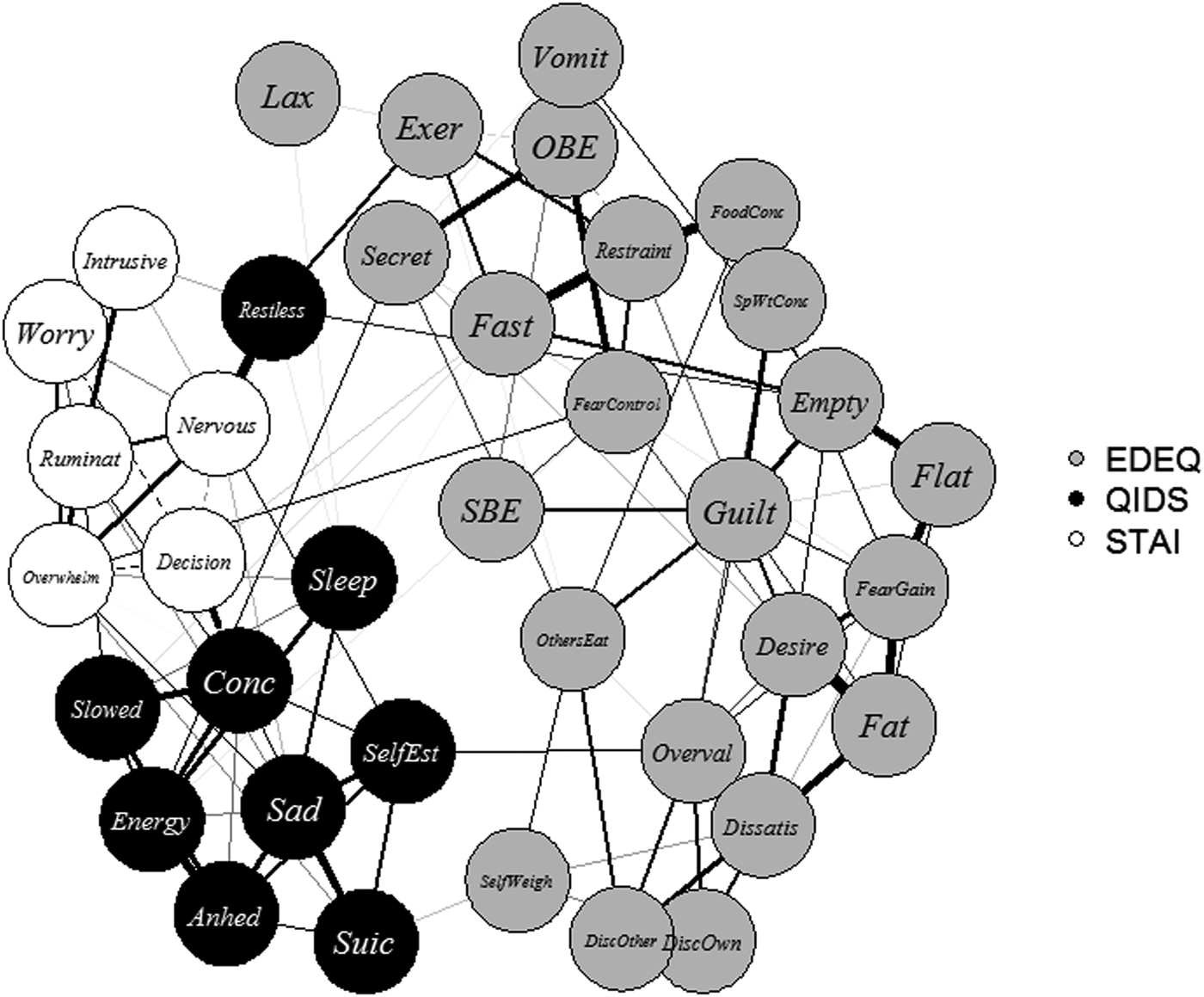
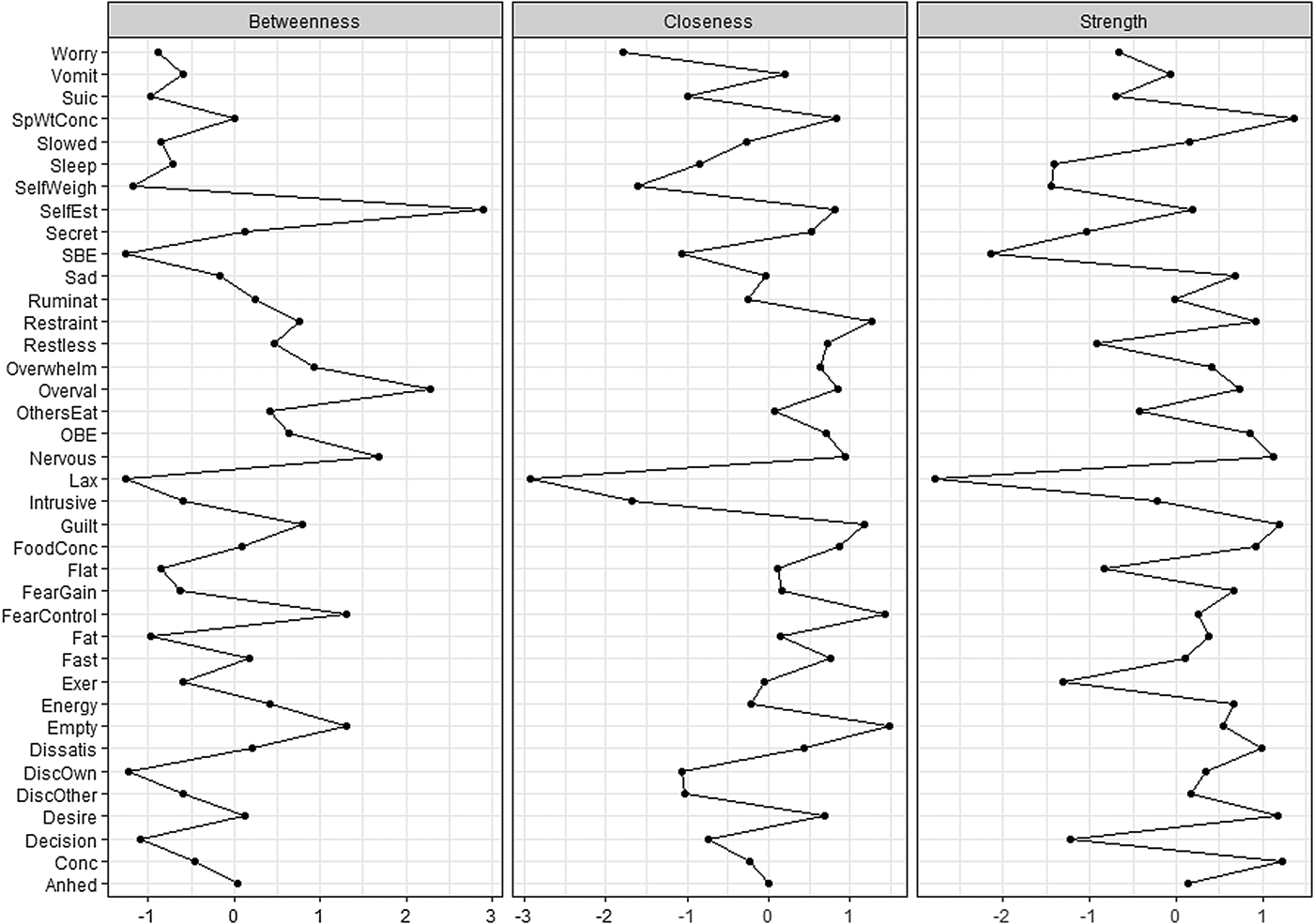
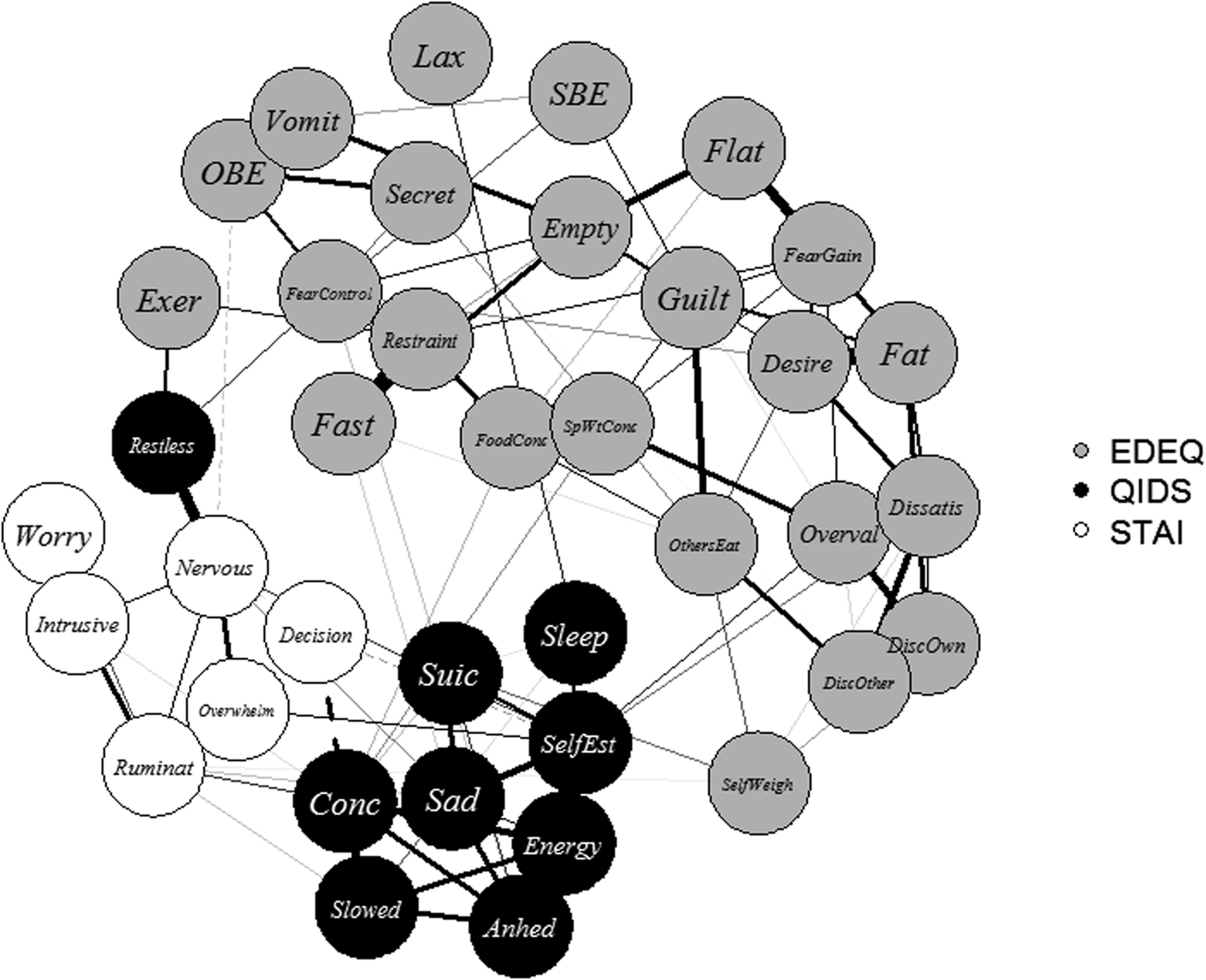
The network structure and standardized centrality indices at admission are displayed in Figs 1 and 2, respectively.Footnote 5 Nodes with the highest strength were shape and weight-related concentration difficulties (1.36), general concentration difficulties (1.22), guilt about eating (1.19), desire to lose weight (1.17), and nervousness (1.12). Nodes high in closeness included the desire for an empty stomach (1.48), fear of losing control over eating (1.44), dietary restraint (1.27), guilt about eating (1.17), and nervousness (0.94). Nodes with the highest betweenness were self-esteem (2.91), overvaluation of shape/weight (2.27), nervousness (1.68), desire for an empty stomach (1.30), and fear of losing control over eating (1.30). Restlessness served as a bridge from anxiety and depression symptoms to ED symptoms (i.e. exercise and wanting an empty stomach), and there were notable links between feeling overwhelmed and fear of losing control over eating, between lack of energy and eating in secret, and between self-esteem and overvaluation of shape/weight.
Network structure of eating disorder, depression, and anxiety symptoms at admission (full sample). Solid edge = positive association; dashed edge = negative association.

Centrality indices for the admission network of an eating disorder, depression, and anxiety symptoms.

Aim 2: Comparison of global network strength between admission and discharge and correspondence with changes in symptom severity
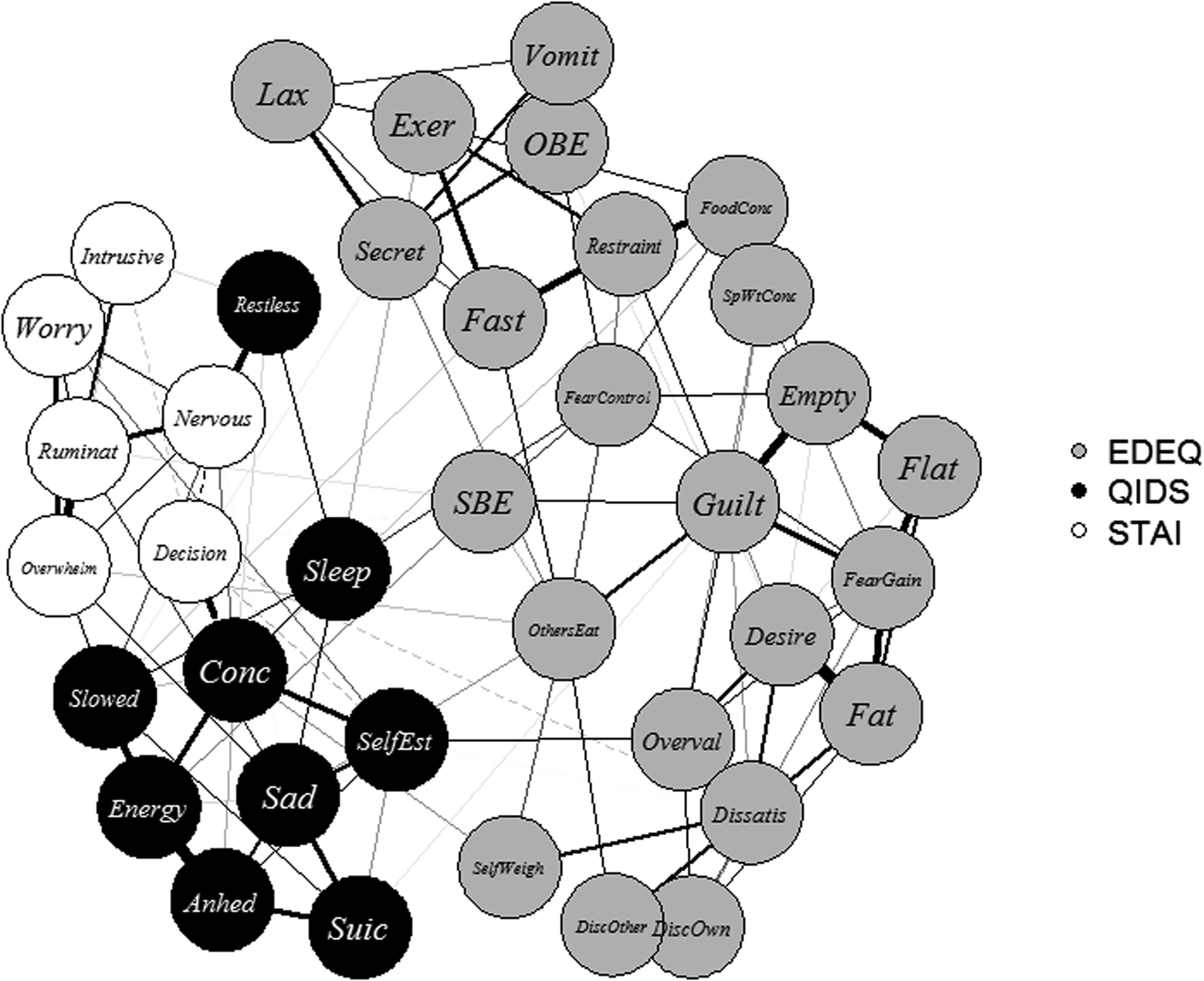
The discharge network is shown in Fig. 3. Results of the dependent NCT indicated that the global network strength did not change significantly between admission and discharge, p = 0.900. Conversely, RM MANOVA results indicated a significant effect of time across all measures, reflecting decreases in ED, depression, and anxiety symptoms, with medium to large effect sizes.Footnote 6
Network structure of eating disorder, depression, and anxiety symptoms at discharge (full sample). Solid edge = positive association; dashed edge = negative association.

Aim 3: Assessment of the validity of admission networks
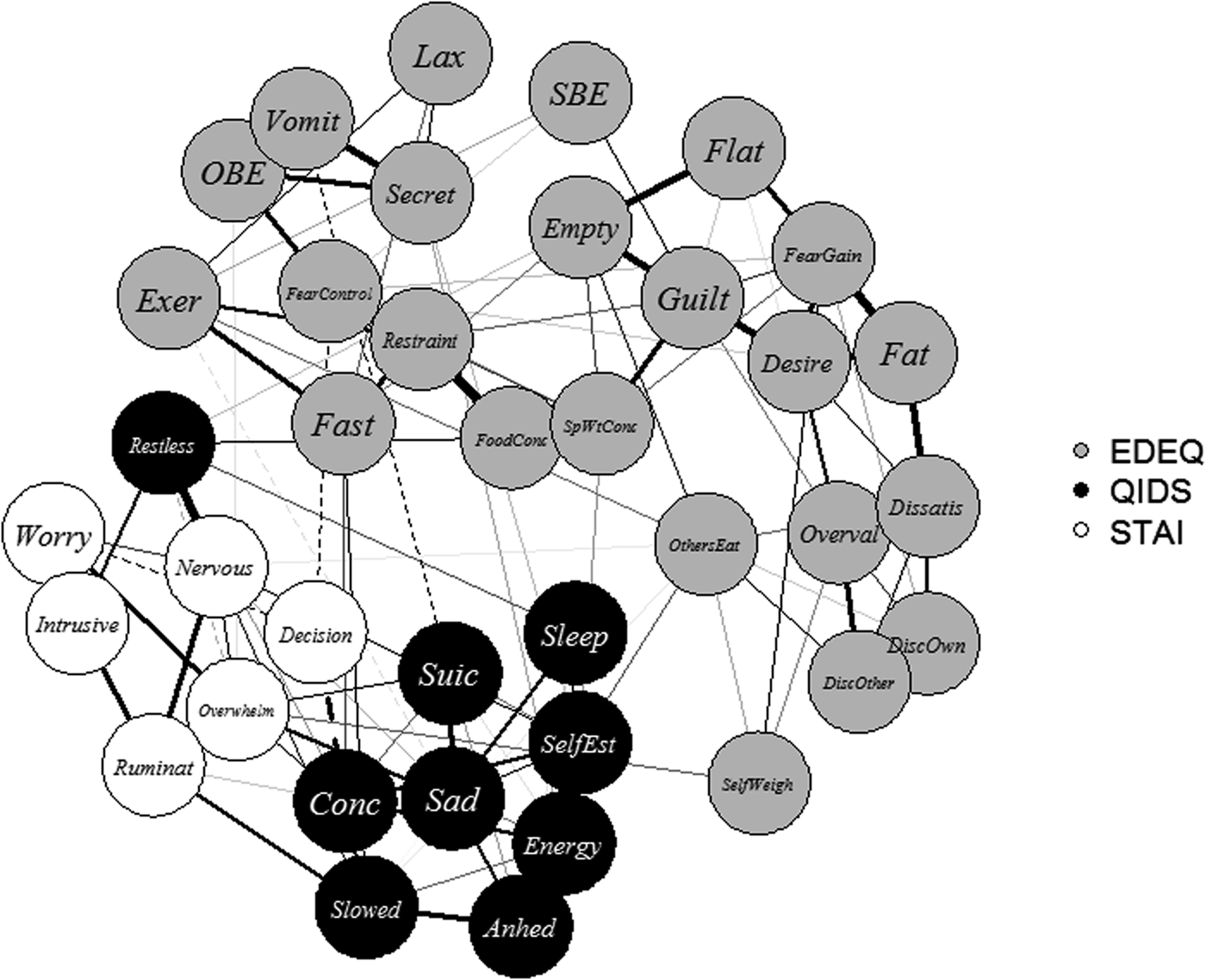
The admission networks for participants who evidenced less decrease in EDE-Q global scores during treatment (i.e. less improved group) and those who evidenced greater decreases in EDE-Q global scores (i.e. more improved group) based on the median split of changes in EDE-Q global scores are displayed in Figs 4 and 5, respectively. The between-group NCT comparing admission global network strength between groups was significant, p = 0.030, which indicated that the density of the admission network was greater among the less improved group compared to the more improved group. The same group differences were present in discharge networks, p < 0.001. Similar to the results for the entire sample, dependent NCTs within each group revealed no significant changes in global network strength over the course of treatment (more improved group: p = 0.500; less improved group: p = 0.860).
Network structure of the less improved group admission. ‘Less improved’ v. ‘more improved’ groups were defined by the median split of decreases on the EDE-Q global scale. Solid edge = positive association; dashed edge = negative association.

Network structure of the more improved group at admission. ‘Less improved’ v. ‘more improved’ groups were defined by the median split of decreases on the EDE-Q global scale. Solid edge = positive association; dashed edge = negative association.

Discussion
This was the first network study to include prospective data in an ED sample. Findings identified centrally important ED and affective symptoms in the admission network structure, and despite decreases in the severity of these symptoms, the global network strength did not significantly change during treatment.
Aim 1: Central ED, depression, and anxiety symptoms
Guilt about eating, fear of losing control over eating, and shape- and weight-related concerns (i.e. desire to lose weight, desire to have an empty stomach, shape/weight overvaluation, and concentration difficulties due to shape/weight concerns) emerged as important ED symptoms. The findings regarding the shape and weight-related concerns add to converging evidence for shape and weight concerns being core ED symptoms, which is consistent with a large body of theoretical and empirical work. In particular, the transdiagnostic cognitive behavioral model of EDs suggests overvaluation of eating, shape, and weight are core features of EDs and serve as dysfunctional schemes for evaluating one's self-worth (Fairburn et al. Reference Fairburn, Cooper and Shafran2003).
Several affective symptoms were also identified as important nodes in the network. Emotion-related ED symptoms (i.e. guilt about eating and fear of losing control over eating) evidenced high centrality, which is notable in light of affect regulation theories and empirical studies indicating negative affect, particularly guilt, is a salient factor contributing to ED behaviors (e.g. Berg et al. Reference Berg2013, Reference Berg2015). In addition, several other negative affect symptoms demonstrated high centrality (i.e. nervousness, feeling overwhelmed, concentration difficulties, and low self-esteem), which suggests that targeting these symptoms may be particularly effective.
A number of bridges to ED symptoms were also identified, which may lend insight into symptom relationships underlying comorbid mood and anxiety psychopathology in EDs. The bridge between feeling overwhelmed and fear of losing control over eating, which in turn was related to OBE frequency, is also consistent with affect regulation models; it could be that individuals who feel overwhelmed have greater tendencies to regulate or escape from negative affect via binge eating. Thus, emotion-focused interventions that aim to help individuals cope adaptively with distress may be useful to weaken these network connections.
The bridge between self-esteem and shape/weight overvaluation provides further support that self-appraisals may contribute to both ED psychopathology and affective disturbances. For instance, the transdiagnostic cognitive behavioral model suggests low self-esteem is one possible maintaining mechanism of EDs (Fairburn et al. Reference Fairburn, Cooper and Shafran2003). From another perspective, the theory underlying ICAT (integrative cognitive-affective therapy) suggests that self-discrepancies (i.e. inconsistencies between one's self-view compared with one's evaluative standards) may give rise to self-regulatory behaviors (e.g. self-criticism), which in turn promote negative affect and consequent ED psychopathology (Wonderlich et al. Reference Wonderlich, Peterson and Smith2015). Regardless of the theoretical standpoint, these findings suggest that targeting the link between self-esteem and shape and weight concerns (e.g. modifying schemes of self-evaluation) may be effective in reducing ED and co-occurring depressive symptoms.
In addition, exercise frequency and desiring an empty stomach were related to restlessness, which in turn was associated with nervousness. These results are noteworthy in light of Levinson et al.’s (Reference Levinson2017) finding that symptoms related to physical sensations bridged ED to anxiety and depression symptoms. Previous research has also indicated that drive for activity and restlessness are salient characteristics of AN (Casper, Reference Casper2006; Scheurink et al. Reference Scheurink2010) and that excessive exercise is related to anxiety and obsessive–compulsive symptoms in EDs (Holtkamp et al. Reference Holtkamp, Hebebrand and Herpertz-Dahlmann2004; Shroff et al. Reference Shroff2006). One possibility is that exercise serves to reduce anxiety among those with EDs (Holtkamp et al. Reference Holtkamp, Hebebrand and Herpertz-Dahlmann2004), and/or individuals with anxious temperament may experience restlessness and a stronger drive to exercise, especially in AN. This is also consistent with the close proximity of exercise frequency and restricting symptoms in the admission network.
Regarding the bridge between lack of energy and eating in secret, it may be that fatigue is related to decreased activity and social contact, which in turn may be related to a propensity to eat alone. Alternatively, some have suggested that fatigue is a marker of resource-depletion that limits capacity for self-regulation (Baumeister, Reference Baumeister1998; Hagger et al. Reference Hagger2010) and could be a risk for binge-eating behavior (Loth et al. Reference Loth2016); it is notable that eating in secret is a common feature of OBEs and was closely related to OBE frequency in the network. Thus, it may be that individuals who are fatigued are more prone to experiences lapses in self-control over eating, though further research is needed to test the directionality of this relationship.
Aims 2 and 3: Treatment outcome
Decreases in symptom severity during treatment did not correspond to changes in network connectivity. While the cause is not clear and may be in part related to a lack of statistical power to detect meaningful change, these results are not inconsistent with those of Beard et al. (Reference Beard2016), and other research showing correlations between symptoms increase during treatment (Fried et al. Reference Fried2016). A greater reduction in symptom severity and/or longer period of time could be necessary to change global network strength. Alternatively, it is possible that the treatment administered in these programs, while successful in dampening overall symptom severity, was not effective in targeting key symptom relationships maintaining ED psychopathology (i.e. network edges). If this was the case, participants may be vulnerable to relapse, though the lack of follow-up data in the present study precludes examination of this question. Therefore, additional research is needed to test whether changes in a network structure are associated with better outcomes and lower rates of relapse. However, results indicated that those who evidenced less improvement had more densely connected networks upon admission, which converges with findings of Van Borkulo et al. (Reference Van Borkulo2015) and provides some evidence in support of the validity of network approaches.
Limitations
There are several limitations to acknowledge. Participants were recruited from partial hospitalization and residential treatment programs, so ED behaviors may have been less likely to occur in these controlled environments, which may prevent generalizability to other treatment settings. The sample was also predominantly female and Caucasian and was limited to individuals ages 16 and older; thus it is not clear to what extent results apply to other demographic groups. The lack of change in density could be due to the heterogeneous nature of the treatment offered in these programs. The treatments implemented were not standardized, and therefore we cannot make conclusions regarding the influence of treatment components. Although there were relatively little missing data in the present study, and missing values were handled via multiple imputations, it is also worth noting that it is currently unclear how to best deal with missing data in network analysis. While stability analyses were consistent with previous network analyses finding the highest stability for node strength (Beard et al. Reference Beard2016; Epskamp et al., Reference Epskamp, Borsboom and Fried2017a), closeness and betweenness were less stable and should be interpreted with more caution. In addition, the non-significant NCT comparing admission and discharge network density should be interpreted cautiously as the ratio of parameters to participants in the present study (703:450) was likely underpowered to detect differences. Thus, it is imperative that future studies that aim to assess similar research questions utilize larger sample sizes. With respect to measures, the QIDS-SR has not yet been examined in ED networks, which limits comparisons to existing ED networks including depressive symptoms. Additionally, the STAI has been criticized as a measure of primarily somatic symptoms and may not adequately discriminate between anxiety and depression symptoms (e.g. Bieling et al. Reference Bieling, Antony and Swinson1998); thus, this measure may fail to capture all facets of anxiety and may overlap with depressive symptomatology. Future research could also assess the networks of ED symptoms and other specific anxiety features (e.g. social anxiety) that are not captured by the STAI. It is also important to note that networks were based on single items from self-report questionnaires, and individuals were assessed at only two times. Future research may benefit from multimodal assessments, the inclusion of latent variables within networks, and the use of intensive longitudinal designs. Lastly, it is clearly not possible to characterize individuals at the outset of treatment based on future treatment outcomes, which limits the utility of the present results. However, these findings nevertheless suggest that an individual who has a denser network at admission may evidence a poorer prognosis, and highlight the need for future prospective, intra-individual network analyses in the context of treatment.
Conclusions and future directions
Despite these limitations, results have relevant clinical implications and highlight important avenues for future research. Increasing evidence suggests shape and weight concerns and facets of negative affect are core components of ED networks, which is consistent with a wealth of theoretical and empirical work. Throughout the network literature, many have discussed highly central symptoms as being particularly relevant and potent targets of interventions, such that targeting these domains could maximize reductions in psychopathology. Certainly, future research is needed to test the extent to which focused interventions targeting these domains are effective in disrupting network structures. However, it is imperative to note that central symptoms may be the most difficult to treat due to their high connectivity within the network, as activation of any number of another connected symptom could serve to re-activate and maintain the central symptom. Therefore, in the context of interventions, it is likely that clinicians need to not only target central symptoms but also identify and address key symptom chains and clusters in which central symptoms are embedded. Furthermore, it has yet to be determined whether highly central symptoms are the most impairing aspects of psychopathology networks. In the case of EDs, it may be that while cognitive symptoms such as shape and weight concerns are highly connected within the network structure, the related negative affectivity and maladaptive behavioral responses (e.g. binge eating) may be more disruptive to individuals’ functioning and quality of life. We also note that due to the cross-sectional nature of the present network structures, it is yet unclear the degree to which nodes with high centrality temporally influence other symptoms, or alternatively, whether such symptoms are the end result of other causal symptom chains.
Along with this line, research is needed to examine the nature of changes driving the evolution of network structures and compare network dynamics across different ED diagnoses. Furthermore, adapting network approaches at the individual level may provide clinicians with a more precise understanding of idiographic symptom relationships and allow for more tailored interventions. In conclusion, results build upon previous ED networks and demonstrate a clear need for continued research to explore how this approach can best inform ED research and clinical practice.
Supplementary material
The supplementary material for this article can be found at https://doi.org/10.1017/S0033291718000867
Acknowledgements
This research was supported by the National Institute of Mental Health grant number T32 MH082761 (K.S. and T.M.).
Declaration of Interest
None.
Ethical Standards
The authors assert that all procedures contributing to this work comply with the ethical standards of the relevant national and institutional committees on human experimentation and with the Helsinki Declaration of 1975, as revised in 2008.