Introduction
Peripheral intravenous catheters (PIVC) are among the most common medical intervention for hospitalized patients. Worldwide, over one billion PIVC are placed each year, Reference Alexandrou, Ray-Barruel and Carr1 and over 300 million of these are placed in the US. Reference Alexandrou, Ray-Barruel and Carr2 The most common reasons for placement include intravenous (IV) medications and fluids. Reference Alexandrou, Ray-Barruel and Carr2
While PIVC can provide life-saving treatments, PIVC are a major source of complications such as infiltration, occlusion, leaking, pain, and dislodgement. Reference Marsh, Webster and Ullman3 Additionally, PIVC are a common source of hospital-onset Staphylococcus aureus bacteremia, with prior studies reporting that 8 to 36% of hospital-onset S. aureus bacteremia cases are caused by PIVC infection. Reference Austin, Sullivan, Whittier, Lowy and Uhlemann4–Reference Blauw, Foxman, Wu, Rey, Kothari and Malani8
Both the Infusion Nurses Society (INS) and the Centers for Disease Control and Prevention (CDC) have published guidelines on the prevention of PIVC-related complications. These guidelines agree upon the importance of hand hygiene prior to insertion, skin antisepsis, avoidance of areas where flexion occurs (eg the antecubital fossa), and placement of a secure, transparent dressing. 9,Reference Nickel, Gorski and Kleidon10 They also agree that PIVC that are no longer in use should be removed, with INS specifically stating that a catheter not used for more than 24 hours should be removed. Reference Nickel, Gorski and Kleidon10 Despite the guidance to remove unused PIVC, prevalence studies demonstrate that approximately 14% of all PIVC have not been used in the prior 24 hours. Reference Alexandrou, Ray-Barruel and Carr2 These “idle PIVC” contribute to avoidable morbidity and mortality.
The purpose of this study is to assess awareness of PIVC presence and their complications and to characterize which type of healthcare provider most commonly makes decisions regarding PIVC necessity, quantity, and duration on acute care units. Our hypotheses are that nursing staff are more aware of PIVC presence in patients than hospitalists and are widely seen as the best healthcare provider to make decisions about PIVC necessity.
Methods
Study design and population
This is a cross-sectional, anonymous, single-center survey of hospitalists (including physicians and advanced practice providers) and acute care nurses working on internal medicine, surgical, and orthopedics units. The study was administered between October 30, 2024 and November 30, 2024. Respondents who indicated that they primarily worked in critical care, obstetrics, and pediatrics were excluded.
Setting
The study was conducted at Denver Health Medical Center, a 500-bed academic safety net and teaching hospital. Hospital policy does not require placement of PIVC in the adult emergency department, acute care floors, or critical care floors. Electronic orders are available for placement, maintenance, and removal of PIVC, though these are not linked on a one-to-one basis; in other words, patients with multiple PIVC have just one order to place and maintain PIVC. The infection prevention team tracks rates of hospital-onset Staphylococcus aureus bacteremia (HO-SAB); approximately one-third of HO-SAB at this institution are secondary to infection of PIVC. Reference Young, Aragon, Cella and McVaney7 Routine surveillance for noninfectious complications of PIVC is not performed.
Survey development
The survey was created using the Research Electronic Database Capture (REDCap) software. Eight individuals piloted the survey to provide feedback on clarity and flow. The goal of this survey was to assess healthcare providers’ awareness of the presence of PIVC, to assess healthcare providers’ knowledge of complications related to PIVC, to understand patterns of decision-making regarding PIVC insertion, to identify factors that may contribute to PIVC access being discontinued sooner or maintained longer, and to evaluate healthcare providers’ attitudes toward removal of all IV access in select hospitalized patients (see Supplemental File).
Survey distribution
The survey distribution was multifaceted. A link to the survey was provided by email to eligible staff members; a reminder was sent weekly for three additional weeks. An invitation flyer containing a brief description of the survey with a quick-response (QR) code was distributed to nursing stations and provider charting areas. Finally, hospitalist staff were invited to participate during a staff meeting.
Data analysis
Descriptive statistics with Chi-square tests of independence were used to aggregate and determine associations between categorical survey responses and self-reported provider characteristics. Bivariate analysis was performed on decision-making survey responses using logistic regression, testing for the effects of provider years’ experience, provider type, and prior awareness and knowledge on key participants. Data were analyzed using SAS Enterprise Guide, Version 8.3 for Windows (Copyright © 2025 SASInstitute Inc., Cary, NC, USA.). This study was approved by the Quality Improvement Review Committee.
Results
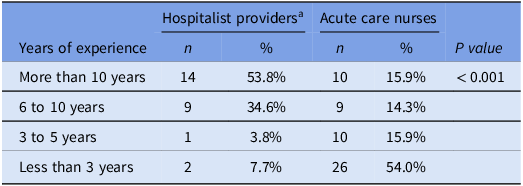
Eighty-nine survey respondents met inclusion criteria: 26 hospitalists (20 physicians [22.5%] and 6 advanced practice providers [6.7%]), 43 acute care nurses working on an internal medicine unit (48.3%), and 20 acute care nurses working on a surgical or orthopedic unit (22.5%). The survey response rate was 36% (26 out of 56 hospitalists, 63 out of 193 acute care nurses). Hospitalists reported more years of experience in healthcare than nursing staff (Table 1).
Years of healthcare experience

a Hospitalist providers includes both physicians and advanced practice providers
Awareness of PIVC and their complications
Nurses were more likely to agree or strongly agree that they were aware of how many PIVC their patients had than hospitalists (100% vs 46.2%, p < 0.00001). All acute care nurses and hospitalists agreed or strongly agreed that they were aware of complications of PIVC.
Decision making surrounding PIVC insertion
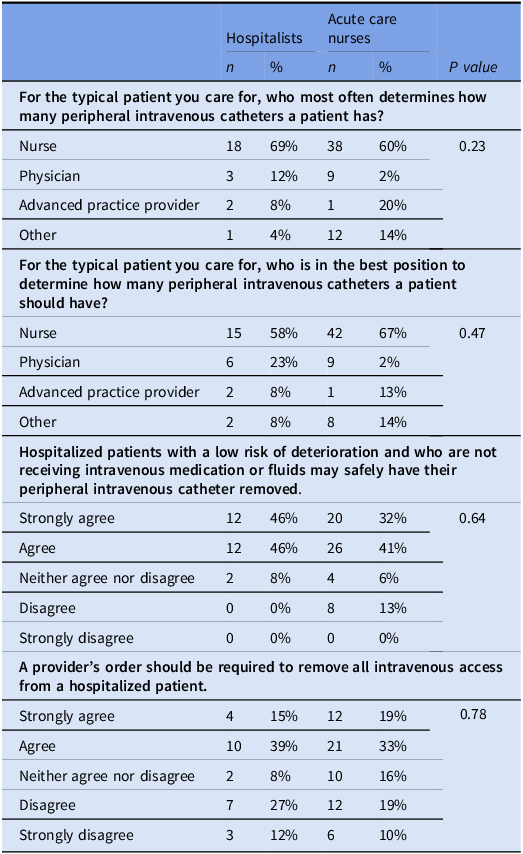
No hospitalist reported having PIVC insertion as part of their job, whereas 90.5% (n = 57) acute care nurses reported that PIVC insertion was part of their job. Both hospitalists and nurses reported that nurses most often decided the quantity, gauge, and site of PIVC access for patients, and both hospitalists and nurses agreed that nurses were in the best position to make these decisions (Table 2).
Decision-making regarding peripheral intravenous catheter insertion

Attitudes toward discontinuation of IV access for hospitalized patients
Most hospitalists and almost 3/4 of acute care nurses agreed or strongly agreed that PIVC access can be safely discontinued for hospitalized patients with a low risk of deterioration who are not receiving IV medications or fluids (n = 24, 92.4% and n = 46, 73.0% respectively). Hospitalists were more likely than acute care nurses to report that pain and the risk of bacteremia (69.2% vs 39.7%, p = 0.011 and 80.8% vs 52.4%, p = 0.024 respectively) influenced this decision. Over half of respondents agreed or strongly agreed that a provider’s order is necessary to discontinue all IV access with no significant difference between acute care nurses’ and hospitalists’ responses; similarly, responses were not statistically related to years of training in logistic regression models.
Discussion
We found that nurses select the quantity, gauge, and site of PIVC for acute care inpatients. This is in concordance with the literature. In an international prevalence study of PIVC, only 2% of PIVC in North America had been placed by physicians; the majority were placed by nurses or by IV specialty teams. Reference Alexandrou, Ray-Barruel and Carr2 Our study also showed that both nurses and hospitalists agree that nurses are in the best position to make decisions regarding PIVC. The anonymous survey design was a strength of this study. This study was limited by its single center design and its modest response rate. The representativeness of respondents compared with non-respondents is unknown, making response bias a possibility.
Prior authors have reported that nurses have a greater awareness of PIVC presence than physicians, Reference Adžemović, Govindan and Zheutlin11,Reference Marsh, Ray-Barruel and Adzemovic12 and our study confirms their findings. All acute care nurses that responded to our survey agreed or strongly agreed that they were aware of the number of PIVC that patients have, whereas less than half of hospitalists reported awareness of the number of PIVC that their patients have.
Despite nurses making PIVC insertion decisions, being regarded as the best provider to make the decision and having the greatest awareness of the number of PIVC for patients, less than half of acute care nurses and hospitalists reported that nurses should be able to remove PIVC without a provider’s order. In an ideal state, nurses are empowered to discontinue PIVC access when no longer in use. Nurse-led decision making, such as through the I-DECIDED tool, has been shown to have a 34% relative risk reduction in idle PIVC and a 32% relative risk reduction in PIVC-related complications. Reference Ray-Barruel, Chopra and Fulbrook13
How does a hospital empower nurses to remove idle PIVC? We hypothesize that this will require raising awareness about the prevalence of idle PIVC followed by a multifaceted intervention including education for both nurses and hospitalists, collaborative communication protocols, and electronic decision-making supports. Follow-up studies on successful and unsuccessful initiatives will be imperative to move this field forward.
Supplementary material
To view supplementary material for this article, please visit https://doi.org/10.1017/ice.2025.10352
Financial support
None.
Competing interests
All authors report no conflicts of interest relevant to this article.