

Luzzasco Luzzaschi (1545–1607) was the principal musical figure at the Este court in Ferrara during roughly the last thirty years of that court's existence. During those thirty years the Ferrarese court was perhaps the leading centre of composition and performance of secular music in Italy. An important point here is that Luzzaschi was a pupil of Cipriano de Rore during Rore's years as maestro di cappella at Ferrara (a point to which I will return), and that he worked at Ferrara throughout his life and remained there even after the dissolution of the Este court there in 1598. He was through and through a creature of and a creator of the Ferrarese artistic culture of the later sixteenth century. I stress this because my approach in this essay will be to raise the question of the various meanings that might attach to the decision to set the aforementioned text by Dante in Ferrara in the early 1570s.
The larger subject of which this essay is but a part is ‘le scelte poetiche di Luzzaschi’, to modify the title of a famous article by Nino Pirrotta.Footnote 1 As part of the preparation of my edition of the complete unaccompanied madrigals of Luzzaschi and of the commentaries on the text and setting for each individual madrigal, I have recently been focusing on Luzzaschi's production in the 1570s, the years of his First and Second Books of madrigals.Footnote 2 As is well known, the Ferrara of the 1570s was the seat of a vibrant literary culture, dominated by figures such as Giambattista Giraldi Cinzio, Giovan Battista Nicolucci detto il Pigna, Battista Guarini and the young Torquato Tasso. The texts set by Luzzaschi throughout his career were strongly influenced by this literary culture and its distinctive aspects.
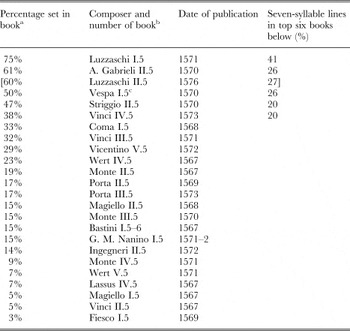
As an example, Table 1 gives some statistical indication of the unusual aspects of the texts set in Luzzaschi's First Book of 1571, when compared to other important collections in the several years before and after his First Book. I would note the prominent place played in this publication by the textual type of the sixteenth-century madrigal, and the relative absence, when compared to his contemporaries, both of texts in the classical Petrarchan forms and of texts by Petrarch himself. I want to emphasise the unusual nature of the texts set by Luzzaschi, and also the local Ferrarese stamp of many of them in those relatively rare cases when we are able to identify their provenance. The poetic form of the free sixteenth-century madrigal, which dominates the texts set in Luzzaschi's First Book, would become a speciality of the Ferrarese literary culture in the last quarter of the century. My point here is that Luzzaschi's texts, both in this book and throughout his career, reflect the local Ferrarese literary climate.Footnote 3
Percentage of sixteenth-century madrigal texts in representative madrigal books published 1567–1573

a The percentages exclude ottave, which were a small percentage of the texts set in these books and they are based on the number of individual partes in each publication.
b Publications from these years whose complete texts were accessible to me. Luzzaschi's Second Book is included for comparison, but not included in the average of the 23 books sampled, which is 24%.
c Like Luzzaschi's Books, dedicated to one of the Este princesses.
In the two madrigal books published by Luzzaschi in the 1570s, the First Book of 1571 and the Second Book of 1576,Footnote 4 probably the most striking textual choice, given the culture of the madrigal throughout the century, is that of ‘Quivi sospiri, pianti, ed alti guai’, two tercets, lines 22–7 from Canto 3 of the Inferno from Dante's Commedia:Footnote 5
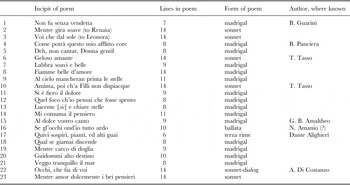
Table 2 gives a list of the texts set in Luzzaschi's Second Book of 1576. Buried in the middle section of the publication (the seventeenth of a total of twenty-three pieces) is the setting of the lines from Dante. This choice is striking because the madrigalists of the previous several decades simply did not set Dante. Besides an isolated three-voice setting published in 1562 of the first three tercets of the Commedia, there is nothing, at least nothing that we know of, until Luzzaschi's setting of 1576.Footnote 6 Luzzaschi's setting then seems to have touched off a series of six further settings of the same lines of text over the ensuing five years, settings to which I shall return below.Footnote 7
Texts set in Luzzaschi, Second Book for Five Voices (1576)

What might have been behind this choice of text on Luzzaschi's – or on his patrons' – part? What might it have meant to set a passage from Dante's Commedia in Ferrara of the early 1570s? Bernard Weinberg, in his monumental History of Literary Criticism in the Italian Renaissance,Footnote 8 chronicles and analyses what he terms the ‘quarrel over Dante’ in the sixteenth century, the most focused and intense phase of which he locates in the first two-thirds of the 1570s and especially emanating from Tuscan literary figures. He calls it a ‘miniature quarrel of the ancients and the moderns’ and a preview of the later quarrel over Tasso and Ariosto that was to flare up especially in the coming decade. A principal issue was the application of Aristotelian criteria to modern poetry.Footnote 9 A figure of major importance in this ‘quarrel’ was also one of the only non-Tuscans prominent in the debate, the sharp-tongued Modenese critic, philologist and translator of Aristotle's Poetics, Lodovico Castelvetro (1505–71).Footnote 10 As a Modenese, Castelvetro was, of course, a subject of the Este dukes of Ferrara and Modena. Already in the later 1550s and early 1560s Dukes Ercole then Alfonso d'Este had taken a position in defence of Castelvetro against the Roman religious authorities in the accusations of heresy levelled against him at the time, resisting the request to have him extradited to Rome for trial before the Inquisition. They did so partly as an assertion of Ferrarese autonomy in the face of a threat to one of their prominent citizens.Footnote 11 This attempt eventually failed, partly as a result of Roman pressure from Alfonso's uncle Cardinal Ippolito d'Este. The tenor of the first days of Castelvetro's trial in October 1560 so frightened him that he fled Rome, first back to the Este dominions, from which he was forced to leave in spring 1561 to take refuge in Switzerland. In the section on Castelvetro in the multi-volume Letteratura italiana, his intellectual position is characterised, not surprisingly, as ‘anti-romana, anticuriale, antibembesca’.Footnote 12 His wanderings in exile saw him received with honour by Emperor Maximilian II in Vienna in 1569. Maximilian had Lodovico's commentary on and translation of Aristotle's Poetics published (with a dedication to Maximilian) in 1570, and he intervened with Duke Alfonso to urge in a letter of April 1570 that Castelvetro be allowed to return to the Este dominions.Footnote 13 Castelvetro, who also purchased books for Alfonso on commission from the duke during his stay in Vienna, left Vienna in late 1570 and returned to his former refuge in Chiavenna, where he died the following year.
Aldo Vallone devotes a large section to Castelvetro in his history of Dante criticism in the Cinquecento, focusing on his relation to Aristotle's Poetics and to Bembo and bembismo.Footnote 14 The importance of Castelvetro's writings in the years of the quarrel over Dante is summed up by Carlo Dionisotti in his article on Castelvetro in the Enciclopedia dantesca:
The ‘poema epopeico’ of Dante, ‘civil and philosophical narrator’, appeared to [Castelvetro], in opposition to the judgement of Bembo, superior to any modern work, to that of Petrarch in particular, and only comparable to the Homeric models … The return to Dante characteristic of Tasso and of his age depends, if not exclusively on Castelvetro, then above all and principally on him.Footnote 15
These issues around Dante came into focus primarily in the important publications of the last decade of Castelvetro's life, in which Dante's Commedia and the opposition Dante/Petrarch figure large. Two of the most important of these treatises were published in 1572 by Castelvetro's brother Gianmaria after Castelvetro's death in 1571, and were dedicated to Duke Alfonso d'Este. I quote the title of this publication: Correttione d'alcune cose del Dialogo delle lingue di Benedetto Varchi, et una Giunta al primo libro delle Prose di M. Pietro Bembo dove si ragiona della vulgar lingua.Footnote 16 Clearly the connection of Castelvetro to the Ferrarese court did not end abruptly with his death in 1571. Indeed, his commentary on Petrarch's Rime was also dedicated by his brother to Duke Alfonso upon its posthumous publication in 1582. Moreover, Castelvetro's unpublished commentary on the first twenty-nine cantos of Dante's Inferno, left incomplete at his death in 1571, seems to have stayed with the Este, since it was in the library of Alfonso's cousin Cardinal Alessandro d'Este in the early seventeenth century.Footnote 17
Thus Castelvetro was not only one of the most important literary figures in the ‘quarrel over Dante’ in the years around 1570, he was also closely identified with the Este court. As further evidence of this, in the dedication to Duke Alfonso in 1572 of the Correttione to Varchi and the Giunta to Bembo, Castelvetro's brother recommends that Duke Alfonso consult with the Duke's personal secretary and close adviser Giovanni Battista Pigna for further background on Castelvetro's debates with Varchi and Bembo that are the subject of the volume. Pigna was not only the most prominent poet of the Este court around 1570 and the author of some of the few texts from Luzzaschi's First Book of 1571 that can be identified, he was also the duke's private secretary and one of the court's most influential courtiers. That Pigna should be called upon to represent Castelvetro and his position in the quarrels over Dante is but one more bit of evidence of the close attention of the Ferrarese court literary establishment to the ‘quarrels over Dante’ in the early 1570s and to Castelvetro's prominent place in them.Footnote 18
There is one further speculative avenue for deepening the cultural context around the choice of a text from the Commedia in Ferrara of the early 1570s. As I have mentioned above, the closely spaced series of publications in the quarrel over Dante that flared up in the early 1570s came principally from Tuscan intellectuals, with the exception, of course, of Castelvetro. In this context, one should recall that the decade previous to Luzzaschi's Second Book in 1576 had seen the climax of the long-running contest between the Este and the Medici over precedence in the diplomatic pecking order. The Este dynasty and Duke Alfonso in particular had had to accept a bitter setback when Pope Pius V in a bolla of 27 August 1569 conceded the title of Grand Duke to Cosimo de' Medici. On 5 March 1570 the Pope formally crowned Cosimo Grand Duke in a ceremony in Rome. Alfonso's efforts to lessen the effects of this setback continued vigorously across the first half of the 1570s. Castelvetro's intervention in opposition to the primarily Tuscan authors in the quarrel over Dante, and in particular his striking back at the very Florentine Benedetto Varchi in his Correttione of 1572 (dedicated, as we recall, to Duke Alfonso), could also have been seen and felt by the Este court as an anti-Tuscan gesture in the war over precedence and intellectual prestige.Footnote 19
Although the quarrel over Dante and the opposition Dante–Petrarch was scarcely founded by Pietro Bembo, his treatment of the issue in his Prose della volgar lingua (1525) and his stress of the opposition between grandezza–gravità–asprezza–durezza and piacevolezza–grazia–dolcezza–leggiadrìa focused the issue for many critics of the ensuing century.Footnote 20 The issue appears with particular application to Ferrara and Luzzaschi in the dialogue Il farnetico savio by Alessandro Guarini, son of Battista (Ferrara: Baldini, 1610).Footnote 21 The dialogue between the fictional interlocutors Torquato Tasso and the poet Cesare Caporali seems situated in Rome of the early 1590s, and may in fact have been drafted at this time. As part of a larger defence of the excellence of Dante, Guarini has the fictional interlocutor Tasso compare Luzzaschi as musician to Dante as poet and Luca Marenzio to Petrarch. The first (Luzzaschi)
wants to derive [his delight] from the imitation of those words, which he undertakes to represent with his notes. And to achieve this as his goal, he does not fear severity, does not avoid harshness, nor does he disdain even dissonance as against the artful [practice of] art, as long as it represents with music its [the poetry's] ideas, glossed by the accompanying musical figures, which are his [the musician's] poems and poetic lines. And with these he virtually paints everything that the words signify.
The second (Marenzio) ‘spreads round delight with his compositions through sweetness and gracefulness, above all things striving not to offend the ears, rather flattering them with exquisite suavity’.Footnote 22
Might the identification of Luzzaschi with the Dante-like aspro–duro–grave side of the opposition, as against the more accessible, Petrarch-like dolce–piacevole–leggiadro Roman style, already have been a subject of discussion in 1575? The well-known passage from the close of Tasso's dialogue La Cavaletta, overo de la poesia Toscana, from the early 1580s, in which the opposition gravità–dolcezza comes up from the very beginning and where Dante figures large, suggests that something like this stylistic dichotomy was already current in the early 1580s, and that Luzzaschi was associated with the grave, Dante side. At the close of the dialogue, the Tasso representative (called ‘forestiero Napolitano’) rejects ‘all that music which, in degenerating, has become soft and effeminate’. He asks [Alessandro] Striggio, Giaches [Wert], and Luzzasco ‘to bring it back to that gravità, by straying from which it has wandered into places about which it is better to be silent than to speak’.Footnote 23 Significant here is the similar vocabulary of pejoratives used by the fictional Tasso in Alessandro Guarini's dialogue, in which the figures he praises (in this case talking of painters, and specifically Tintoretto), ‘resemble magnificent Dante, [in] disdaining such exquisite scrupulousness, which suggests the effeminate and the soft …’.Footnote 24
I have reviewed the quarrel over Dante of the early 1570s, Castelvetro's position in the quarrel, the place of the quarrel in the Este–Medici competition for position and prestige at the time, and Luzzaschi's possible association with Dante in the quarrel. I have done this in order to suggest the manifold significance of choosing to set a text – any text – from the Commedia in the 1570s in Ferrara. One might also ask what lay behind the extraordinary choice, not just of any text by Dante but of the two tercets beginning with ‘Quivi sospiri’? An obvious answer might lie in the nature of the lines themselves. As several commentators on the Commedia have noted, these lines present a self-contained and extraordinarily dense description of a group of sounds, mostly preverbal, offering promising material for musical illustration. This may well be why a number of other madrigalists picked up the text after Luzzaschi set it – although, as we shall see, Luzzaschi did not respond to what one might call these ‘phonograms’ with what we call ‘madrigalisms’, or detailed musical representations of individual words.
But there may be more behind the original choice in Luzzaschi's book. Here again local Ferrarese history may suggest some context. Ferrara was racked by a series of violent earthquakes in the early 1570s, beginning on the night of 16–17 November 1570, continuing for several weeks thereafter in the winter of 1570–1, and recurring with lessening violence across the next three to four years. Both because of their violence and because of their persistence – some have numbered the shocks and aftershocks over the next few years as close to two thousand – the Ferrarese earthquakes were striking enough to attract international attention. They also left a tremendous physical and psychological impression on the Duchy and its citizens.
Suggestive in the context of this sustained natural disaster is the language and the context of Dante's Inferno, Canto III, especially when juxtaposed with some contemporary chroniclers' descriptions of the Ferrarese earthquakes (and their ideas about what they might mean). One chronicler, writing in his diary at the time of the earthquakes, noted: ‘it caused such a din that, when added to the grief-stricken cries of the people, it seemed as if the world were collapsing’.Footnote 25 Let me now quote Dante's text: ‘Quivi sospiri, pianti, ed alti guai / risonavan per l'aere senza stelle, / perch'io al cominciar ne lagrimai: / diverse lingue, orribili favelle, / parole di dolore, accenti d'ira, / voci alte e fioche, e suon di man con elle’Footnote 26 (‘Now sighs, wailing, and loud laments / resounded through the starless air, / so that I began to weep: / various languages, horrendous speeches, / words of suffering, cries of rage, / voices loud and faint, and with them the sound of the beating of hands’). The Enciclopedia dantesca notes that ‘the origin of earthquakes is attributed by Dante to the dry and dense vapours that, imprisoned in the bowels of the earth, provoke its shaking every time that they try to escape’.Footnote 27 Another contemporary Ferrarese chronicle noted ‘the abundant exhalations of gases [from the earth] that accompanied these earthquakes’.Footnote 28 Canto III of the Inferno ends in fact with an earthquake at the moment when Dante faints and he and Virgil are transported over the river into Limbo. In the Hollanders' translation: ‘… the gloomy plain shook / with such force, the memory of my terror / makes me again break out in sweat. / From the weeping ground there sprang a wind, flaming with vermilion light …’.Footnote 29
There is one further association of the Commedia and earthquakes, an association close not only to the guilt- and sin-obsessed, Counter-Reformation minds of such as Tasso and Leonora d'Este (to whom Luzzaschi's Second Book was dedicated), but also to many other citizens of the 1570s. An earthquake might be understood as a sign from God to revise one's heedless and pleasure-loving ways, in particular those of the contemporary Este court. ‘This long seismic period, considered exceptional even in the learned circles of the court, aroused heated debates. The religious interpretation, which in certain moments seemed to prevail over the naturalistic one, tended to see that phenomenon as a sign by God so that men might mend their ways.’Footnote 30 It might also be a reminder of the passion of Christ, who died for our sins. In his Sposizione (Commentary) on this concluding passage of Canto III, Castelvetro writes: ‘Now others might imagine that this earthquake happened every year at that point to recall the earthquake that happened at that point at the death of Christ.’Footnote 31
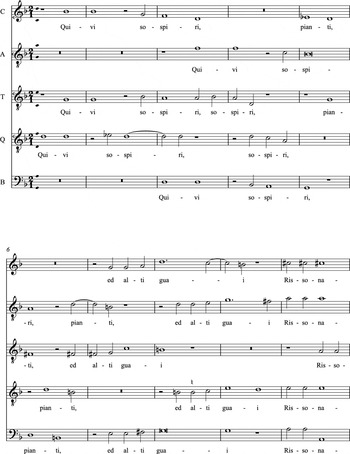
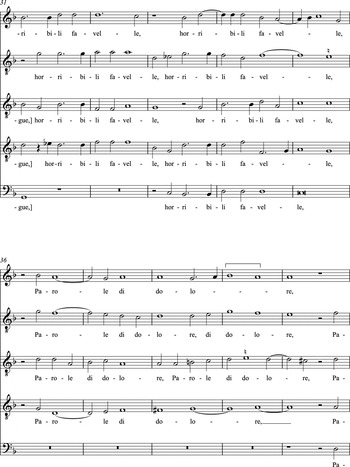
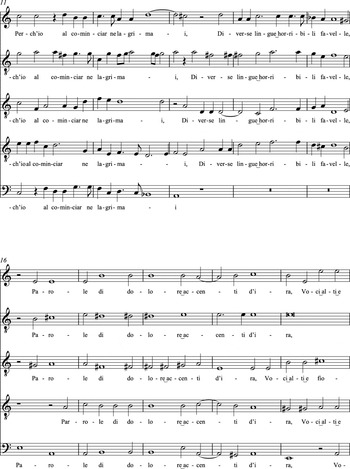
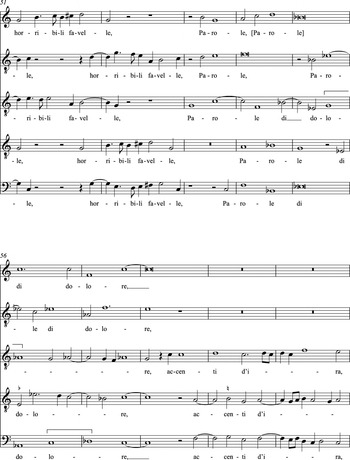
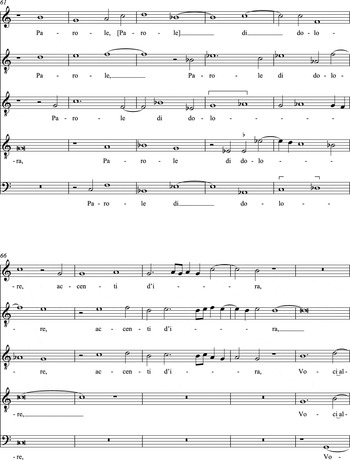
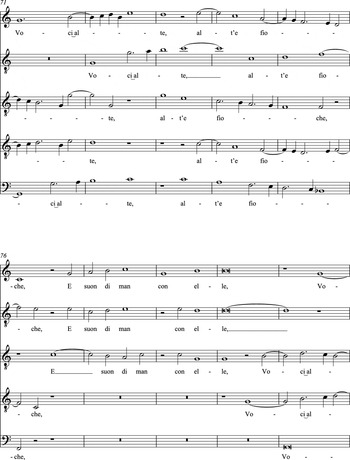
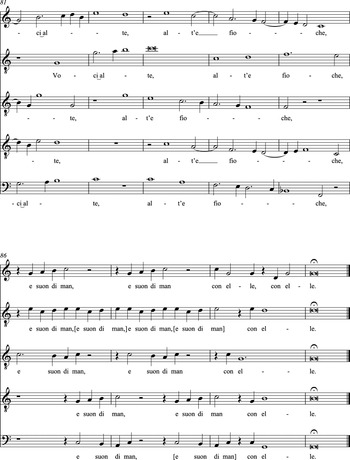
These are likely to be only some of the meanings that may have buzzed around these few lines from the Commedia – some of the meanings these lines set by Luzzaschi may have had for members of the cultural elite in Ferrara in the mid-1570s. What resonances may have been added by the nature of Luzzaschi's setting itself? See Example 1. The setting is densely chromatic, both in the sense of having direct chromatic melodic progressions and in the sense of using a wide range of chromatic pitches, for example, ranging from C♯ to D♭ in the space of three breves (bb. 10–12). Luzzaschi's setting was a breach of musical decorum, similar to what Bembists would claim for Dante's verbal language in the Commedia. I should stress that such a breach of musical decorum – this vocabulary of pitches – was exceptional for Luzzaschi, even in the Gesualdo-influenced years of the 1590s. Until my new complete edition of Luzzaschi's unaccompanied madrigals, the only of his madrigals previously available in modern edition were these very few ‘indecorous’ ones, which gives a false impression of his usual style.Footnote 32
Luzzasco Luzzaschi, Quivi sospiri, Second Book of Madrigals for Five Voices (Venice: Gardano, 1576), p. 23


Luzzaschi's setting is not only chromatic, it is also mostly homophonic. Even when it is not strictly homophonic it proceeds in varied homophonic groups of voices, one group often holding notes while the other group speaks, in such a way that the text is clearly understandable.Footnote 33 As I have stressed in the commentaries to individual pieces in my complete edition of Luzzaschi's unaccompanied madrigals, and as is clear in the madrigals themselves, Luzzaschi was primarily a master polyphonist. (He was the composer of three books of instrumental imitative ricercars.) Not for him the chordally based pseudo-polyphony that was increasingly dominant in madrigals of the 1570s and 1580s. I would propose that Luzzaschi has retained in Quivi sospiri as much as possible of his customary textural variety and complexity, even while writing in a severely declamatory style in which the clear delivery of the text was a primary goal.Footnote 34 I would also note that he avoids the tempting if conventional representations of individual words suggested by the text – for ‘alti guai’, ‘risonavan’, ‘orribili’, ‘voci alte’, for example – a restraint in which the composers of subsequent settings of the text across the next few years will not follow him, as we shall see.Footnote 35 He uses only less direct musical metaphors to represent fear and chaos – almost entirely chromaticism, with very little dissonance, since chromaticism unsettles the stability of the diatonic tonal system as a whole, while dissonance does not. The restrained severity of the piece is enhanced by a rate of motion that is sober and even, without the wide fluctuations of tempo or rate of motion that often characterise the madrigal in mid-century and beyond.
I would stress that this style of chromatic declamatory homophony was very rare in the madrigal as a whole. Looking back on it from our perspective, we tend to consider the style of Luzzaschi's setting, primarily because of its pitch vocabulary, as progressive, as avant-garde, as looking forward to the seconda prattica styles of the 1590s and beyond. I believe, however, that it was for Luzzaschi, from the point of view of 1576, a backward-looking style, looking back to an esoteric style of ten to twenty years before – in particular to the style of the few chromatic and declamatory pieces by Cipriano de Rore published between 1557 and 1566, a rare and esoteric style whose very limited resonance seems largely to have faded by the end of the 1560s. (Rore died in 1565.) It was to this style that Luzzaschi turned in searching for a style (and a master) that was of an elevation, a seriousness, and a severity equal to the cultural status and the seriousness of the famous textual source and of the loaded local context that he was attempting to represent.Footnote 36 The most consistently homophonic and declamatory of these chromatic pieces by Rore is the setting of Giovanni Della Casa's sonnet ‘O sonno’ from Rore's Second Book for Four Voices of 1557. But Rore's settings of ‘Se ben il duol’, ‘Poi che m'invita Amore’, ‘Mentre lumi maggior’, and ‘Dalle belle contrade’ from the five-voice collections of 1557–66 also have much of the chromatic successions and only slightly staggered homophony that I propose is the style to which Luzzaschi appealed in Quivi sospiri.Footnote 37
To form an idea of the rarity and closely focused reference of this style, one can consult what is still the best survey of the pieces resulting from the fascination in the second half of the century with the new possibilities of a fully chromatic pitch vocabulary: Theodor Kroyer's Die Anfänge der Chromatik im italienischen Madrigal des XVI. Jahrhunderts, published in 1902. As one can observe there, the fascination with chromaticism reached its height in the dozen years simultaneous with Rore's later publications, roughly 1554–66. Its manifestations, however, were rarely accompanied by the consistent declamatory near-homophony characteristic of Rore's pieces that I have cited above and of Luzzaschi's Quivi sospiri. This unusual combination of chromaticism and declamatory homophony can be found in only certain passages in a handful of individual pieces in books from these years by Cesare Tudino, Giulio Fiesco, Pietro Taglia, Francesco Manara, Stefano Rossetti, Pietro Vinci, and Gioseppe Caimo.Footnote 38 To attempt a detailed survey of the chromatic-homophonic style in these dozen years would cause a disproportionate detour in this essay on Luzzaschi's Dante setting. My goal here is simply to point out that the style is very rare and is concentrated almost entirely in composers working in centres in the Po Valley close to those places in which Rore worked and in the 1550s and early 1560s, the years in which he worked there. Thus I would claim that the stylistic reference on Luzzaschi's part is quite precise and unambiguous.Footnote 39 This particular chromatic-homophonic style might reasonably be seen as a conflation of the chromatic experiments centred around what one might call the Rore circle of the Po Valley with the homophonic-declamatory style represented by the madrigali ariosi of the Libri delle Muse published in Rome by Antonio Barré in these same years (1555–63).Footnote 40 Indeed, the non-chromatic and the much rarer chromatic versions of the arioso style appear separately in Stefano Rossetti's First Book for Four Voices of 1560.Footnote 41
Beyond the chromatic-declamatory style itself, there may be an additional connection of Luzzaschi's Quivi sospiri to Rore. A peculiarity of Luzzaschi's setting is its pitch vocabulary and choice of final, unique in his published madrigals. I would propose that his piece, though it steps far outside the bounds of customary modality, may be understood as centred in some version of mode 3/4 transposed down two fifths to D. All the cadences or half-cadences in the piece with the exception of the extraordinary non-cadence in bar 35 are on D (bb. 9, 22, 26, 44, 56, 57), F (bb. 13, 49) and A (bb. 18, 40), seeming to indicate a D centre. The E♭ of the doubly transposed Phrygian mode is not in this case specified in the signature. The E♭/E♮ ambiguity is simply left to signed accidentals to deal with. The opening gestures and the final cadences of the piece (bb. 1–5, 55–8) are all with E♭s. Another striking piece with the same final – in this second case the same E♭/E♮ ambiguity is highlighted by a contrasting signature in the various voice parts – is Rore's setting of the first two stanzas of Petrarch's double sestina ‘Mia benigna fortuna’, published in the Second Book for Four Voices of 1557.Footnote 42 Not only is the unusual pitch vocabulary, final, and E♭/E♮ ambiguity similar in the two pieces, large sections of Rore's madrigal are in the chromatically rich near-homophony that is the texture of Quivi sospiri. In distinction to what may have been his model in modal ambiguity and choice of final, Luzzaschi takes the pitch vocabulary one step further down the flat side (to D♭) for the dark image of ‘senza stelle’ (b. 12), and – very characteristically and in distinction to Rore – he has absolutely no authentic cadences in the setting at all, relying on various weaker cadential types – Phrygian cadences, half-cadences, imperfect plagal cadences – to maintain the musical flow across a series of contrasting verbal and musical fragments.Footnote 43 The only cadential move with a rising leading note is the double-leading-note cadence with harsh parallel fourths for ‘accenti d'ira’ (bb. 48–9), a subtle painting of the most active of the images, at once harsh and energetic, in Dante's text.
It is further testimony to the esoteric nature of the style chosen by Luzzaschi for his setting of ‘Quivi sospiri’ that none of the other settings in the years 1576–81 followed completely his stylistic lead, and only one did so even partially. These six settings (cf. note 7 above for the list of settings) present a wide range of musical reactions to an extraordinary text. They come largely from composers working in north-eastern Italy (Bologna, Padua, Udine, Vicenza) close to Luzzaschi's Ferrara, with the latest examples (by Pietro Vinci and Francesco Soriano, from Bergamo and Rome respectively) ranging somewhat farther afield geographically. All the settings are scored for soprano, alto, two tenors and bass in standard cleffing (C1, C3, 2 × C4, F4) and bear the time signature 𝄴. There is no consistent agreement as to modal or tonal orientation among the seven settings (including Luzzaschi's). I have mentioned the final and key signature of Luzzaschi's setting above. Renaldi's setting has a G final with no signature; that by Courtois has a D final with no signature; the setting by Mosto has an unambiguous A focus and final with no signature, while the later ones by Vinci, Micheli and Soriano have an apparent A focus with no signature, but close with half-cadences on E.
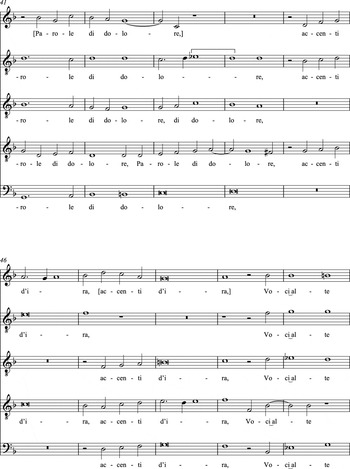
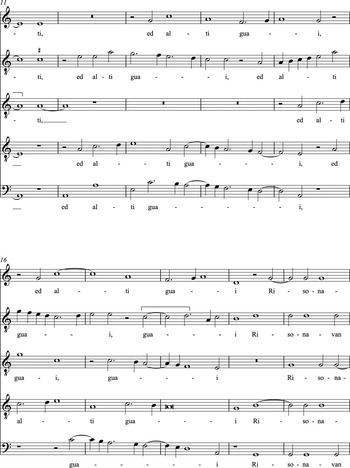
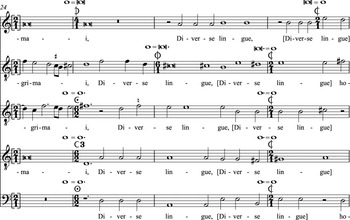
The closest setting, both in overall style and in some expressive details, to the Ferrarese Luzzaschi's is that by Domenico Micheli of the nearby cities of Bologna and Ravenna, published in 1581 (see Example 2). Like Luzzaschi, Micheli avoids the madrigalisms suggested by the text. (The only example might be the octave leap in some voices for ‘voci alte’.) His syncopated Tenor voice for ‘alti guai’ recalls Luzzaschi's similar device for ‘l'aer senza stelle’. The juxtaposition of sharp (B major) and flat (B flat) areas via a shift of a rising half step (B–E–A–B♭,bb. 1–2) recalls Luzzaschi's similar shift at his bar 11. Although Micheli uses more contrast of rhythmic motion than Luzzaschi, with quick declamation on semiminims and fusae for lines 3 and 4 of the text, his setting, for most of its thirty-two breves, is even closer than Luzzaschi's to a chromatic version of the purely homophonic declamatory style characteristic of the madrigale arioso. (Indeed, what James Haar has called the ‘arioso rhythm’ appears in Micheli's setting of line 2 of the text.)Footnote 44 After this consistent homophony, the sharp stylistic contrast that comes with his setting of the final line is particularly striking. This setting occupies 40 per cent of the brief madrigal (as opposed to the proportional one-sixth in Luzzaschi's setting), and it completely abandons the homophonic declamatory style of lines 1–5 for a style of free unsynchronised lines moving across quite normal harmonic successions and with melismas, sometimes on inappropriate words (e.g. ‘di’, Basso, b. 28). Presumably Micheli did this in order to satisfy the conventional need for increased musical weight in a closing section. But it marks a clear departure from his setting of the opening five lines of the text and from the overall stylistic consistency of what seems to have been his model.
Domenico Micheli, Quivi sospiri, Fifth Book of Madrigals for Five Voices (Venice: Gardano, 1581), p. 17


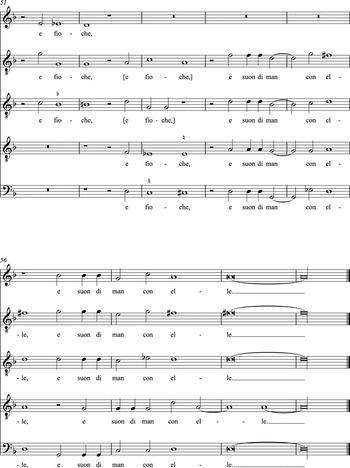
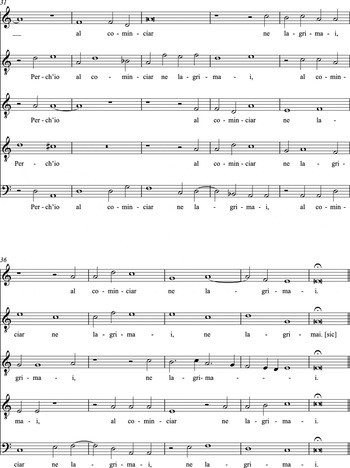
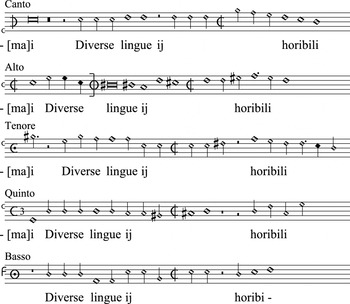
A separate line of stylistic descent seems to be established by the setting by the Paduan Giulio Renaldi (see Example 3). Like Luzzaschi's, Renaldi's was published in 1576. Since both Luzzaschi's and Renaldi's dedications lack dates, it is impossible to know which was published first, let alone which was written first. Modern commentators (Einstein, Degrada) have assumed that the more famous Luzzaschi initiated the series of settings, though there is no real evidence for this.Footnote 45 Renaldi, working in nearby Padua, may well have experienced echoes of some of the seismic events that shook Ferrara, and may also have talked with his Ferrarese colleague about Dante's text and its background in recent Ferrarese history. Whatever may have been their interaction, Renaldi took a completely different approach to clothing Dante's text in music. The first and most obvious difference is in the area of madrigalisms, or detailed musical representations of individual textual images. Renaldi splits ‘sospiri’ in two with a rest (so [minim rest] spiri), he uses high range in the individual voice parts, sometimes very high range (e. g. Alto, b. 73), for ‘alti’ and ‘alte’ in lines 1 and 6,Footnote 46 he uses a long harmonically static passage of repeated notes for ‘risonavan’, and he markedly accelerates the rhythmic motion for the slapping of hands in the final image. And, most strikingly, he uses differing mensural signs in the various voices to represent the ‘diverse lingue’ of line 4 of the text.Footnote 47 The textural and rhythmic contrasts between Luzzaschi's and Renaldi's setting are as large as the semantic ones. Renaldi uses highly imitative, rhythmically expansive, often melismatic textures. (His setting is almost twice as long as Luzzaschi's.) He uses wide variations of rhythmic values (see especially the beginning of his seconda parte).Footnote 48 His one clear connection to Luzzaschi's setting may be in harmonic vocabulary, which, though mostly fairly conventional, extends to D flat major (via the relatively conventional route of the circle of fifths) for ‘parole di dolore’ in line 5 of the text. However different it may be from Luzzaschi's setting, Renaldi's is a distinctive one, which reacts clearly to the extraordinary nature of the text.
Giulio Renaldi, Quivi sospiri, Madrigals and Canzoni alla Napolitana for Five Voices (Venice: Scotto, 1576), pp. 7–8


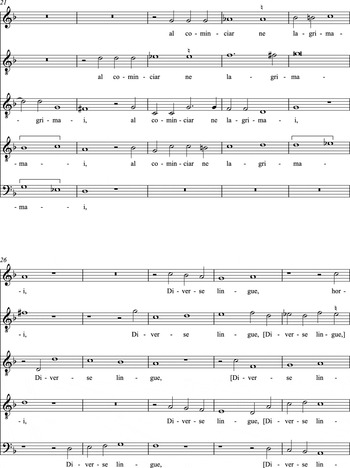
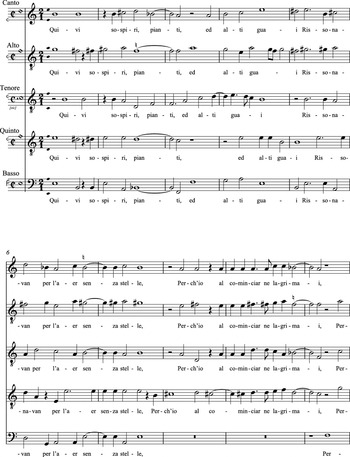
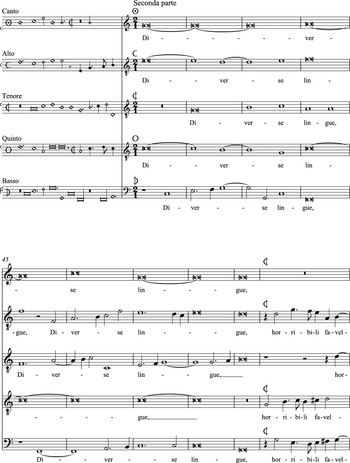
It found its clear imitator in the setting by Giovanni Battista Mosto of Udine, published in 1578. Mosto uses the same madrigalisms for ‘sospiri’, ‘alti guai’, ‘voci alte’ and similar mensural games for ‘diverse lingue’.Footnote 49 See Example 4a for the original notation and Example 4b for a proposed solution. His rhythmic values in the piece as a whole vary widely, though not quite so widely as Renaldi's. His textures are more homophonic, less imitative-melismatic than Renaldi's, though they are far from the declamatory near-homophony of Luzzaschi's setting and the pure homophony of the first five text lines of Micheli's. Like Renaldi, Mosto steps outside a relatively conventional harmonic vocabulary for ‘parole di dolore’, this time for an excursion far up the circle of fifths (to F sharp major!) instead of far down as in Renaldi. Significantly, in Mosto's setting this one harmonically adventurous spot is pure homophony.
Giovanni Battista Mosto, Quivi sospiri, First Book of Madrigals for Five Voices (Venice: Scotto, 1578), p. 8, setting of ‘diverse lingue’, original notation

Giovanni Battista Mosto, Quivi sospiri, proposed resolution, bb. 24–7

These three settings of this extraordinary text may serve to demonstrate by contrast how unusual is the style of Luzzaschi's austere setting, just as I have hoped to demonstrate the specific reference of this unusual style. The three additional settings published in 1580 and 1581 dilute both the contrast between Renaldi's and Luzzaschi's styles of setting and the distinctiveness of these two styles. The setting by Lambert Courtois, who worked in Treviso and Vicenza in the years around 1580, looks to be one of the most harmonically interesting ones. (Unfortunately, only the lowest three parts of this setting survive.) Like Luzzaschi's setting, it sets up the opposition between the sharp and flat sides of the tone system in the opening bars, ranging quickly from A major to E flat in the first line of text (for ‘sospiri, pianti’). There follows another striking dip to E flat for ‘ne lagrimai’ in line 3 of the text, then right back to A major chordsand out to B major chords for ‘horribili favelle’. Like Luzzaschi and Micheli, Courtois largely avoids conventional madrigalisms and usesinstead a consistently wide-ranging harmonic vocabulary to express the text. But the texture of his setting is largely imitative and often melismatic, far from the declamatory homophony of Luzzaschi's and most of Micheli's.
One might say that, in the ensuing settings by Pietro Vinci and Francesco Soriano, the vivid and original reaction to Dante's text by Luzzaschi and Renaldi had been tempered and absorbed for the most part into the common style of the madrigal, c. 1580. The setting by Vinci is the only setting besides Luzzaschi's to use direct melodic chromaticism: like Luzzaschi, he uses an ascending chromatic line for ‘perch'io al cominciar ne lagrimai’. Otherwise his setting, effective in an elegiac way, is in a quite conventional style for its time. Its harmonic range is relatively narrow, its rate of motion even, its textures a consistent imitative polyphony with four to five voices sounding.
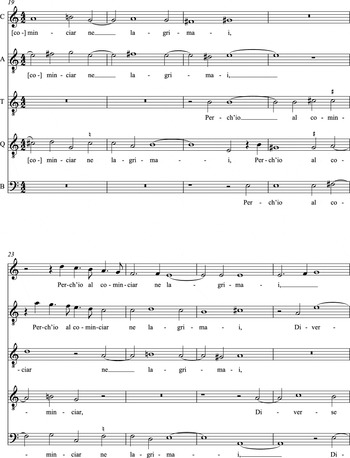
Even more neutral in its attitude towards the text is Soriano's setting from his First Book for Five Voices of 1581. Virtually any melancholic or lamenting text might have called forth this setting. The clearest nod to the nature of the text is the time signature (in four of the five voices) of 𝄴; the rest of the pieces in his First Book bear the time signature 𝄵. Beyond the somewhat predictable octave leaps for ‘alti guai’ and an effective B♮/B♭ contrast for ‘pianti’, both in the first line of the text, the melodic and harmonic language of the setting is quite conventional, with only a couple of B major triads in approaching medial cadences to E in a piece with an E final. The clearest indicator of Soriano's neutral attitude towards the extraordinary text is the contrapposto of a descending line in canzonetta-like dotted semiminims and fusae against a slower rising line in the lower voices to set ‘perch'io al cominciar ne lagrimai’ (see Example 5).Footnote 50
Francesco Soriano, Quivi sospiri, First Book of Madrigals for Five Voices (Venice: Gardano, 1581), p. 17, bb. 19–26

This series of settings of a text from the Commedia ends in 1581.Footnote 51 Dante remains poeta non grato for madrigalists until eighteen years later with Marenzio's setting of a canzone stanza drawn not from the Commedia but from the Rime: the first stanza from the fourth of the rime pietrose, ‘Così nel mio parlar voglio esser aspro’. The setting opens Marenzio's Ninth Book of 1599. One can trace no continuous connection in published musical documents between the brief series of settings of Dante that we have just considered and this later setting, just as one can trace only the most fragile musical/stylistic connection between the declamatory madrigals in chromatic homophony of the 1550s and early 1560s and the recurrence of this style in some passages in the Gesualdo–Luzzaschi publications of the middle 1590s and in a number of pieces of the early 1600s.
There is, however, one suggestive connection across this second gap from the 1560s to the 1590s – a connection involving both Dante and the chromatic declamatory style. This connection involves the figure of Vincenzo Galilei. Galilei is well known to have been a part of the Florentine Camerata in the house of his patron Giovanni de' Bardi and to have composed (or perhaps better, to have sung) a setting of the lament of Count Ugolino from Canto XXXIII of the Inferno in Bardi's cenacolo in 1582. No trace of this music remains.Footnote 52 But in his manuscript treatise of 1590–1 Galilei left a setting of the first five lines of the same canzone stanza from the rime pietrose set by Marenzio a few years later.Footnote 53 Galilei's setting is stylistically the closest piece to Rore's chromatic declamatory homophony since the settings by Rore himself adduced above – even closer than Luzzaschi's Quivi sospiri, since Galilei is quite content to abjure absolutely the temptations of polyphony. He claims to want to show ‘how without the use of these [dissonances] one can make a cantilena dura et aspra’.Footnote 54 He does so with a harmonic vocabulary ranging widely from E♭ to E major chords, all but one of them in root position. The setting opens with the root-position progression E minor, G major, B flat major and closes with the progression G minor, E major, likewise in root position, with the direct melodic chromaticism b′♭–b′♮ in the top voice. The setting is homophonic and syllabic, save for one brief melisma in the lowest voice, and has no rhythmic values less than a minim.
Although a piece for solo lute by Galilei with the same verbal heading (‘Così nel mio cantar’) appears in his tablature book of 1563,Footnote 55 this piece bears no relation to the later piece from the manuscript treatise.Footnote 56 Since many of the pieces with poetic titles in the tablature book of 1563 are demonstrably intabulations of vocal models whose composers are identified in Galilei's print, and since Galilei identifies himself as the composer of Così nel mio cantar, this lute piece suggests that there was a setting for voice of Dante's text by Galilei already in 1563, and that he was setting Dante during what would seem, to judge from the fact that the tablature book was printed by the Roman printer Valerio Dorico, to have been a Roman sojourn in the early 1560s.Footnote 57
Many commentators, myself included, have pointed to Bardi's connection with the Ferrarese court and its music around 1580, in the same years that Galilei sang his version of the lament of Count Ugolino in Bardi's rooms.Footnote 58 All of this may suggest that Galilei and Bardi's Camerata may have kept alive a tradition of musical setting of Dante in declamatory homophony across the 1570s and 1580s, perhaps enriched by the Ferrarese tradition of declamatory chromaticism.
Marenzio then chose in 1599 to set a text by Dante apparently twice set previously by Galilei. (One should recall Marenzio's presence in Florence in the late 1580s and Bardi's presence in Rome in the 1590s in the same circles in which Marenzio travelled in those years.) The text itself, as well as the setting, emphasises the aspro and duro qualities of the Dante/Luzzaschi side of the opposition set up by Bembo and revived by Alessandro Guarini several decades later. In choosing this text Marenzio may refer to a fragile tradition of settings of aspro texts by Dante – a tradition running through Galilei and Bardi, Luzzaschi, and the Ferrarese court. This reference might have suggested itself to him especially as he moved in his publications after 1594 beyond his more dolce and leggiadro style of the 1580s. I have previously pointed to one competitive interaction between Marenzio and Luzzaschi and the Ferrarese court musical and poetic establishment – an interaction that involves Se parto, io moro, the first madrigal of Marenzio's Book Six of 1594 and his first published madrigal after his silence of the early 1590s and, as I propose, a response from Luzzaschi in his Book Five of 1595.Footnote 59 This interaction involves, especially pointedly on Luzzaschi's part, another reference to the chromatic-homophonic style of Rore and of Quivi sospiri. Marenzio then seems to seal the reference to the complex and demanding style of the last decade of Rore's life in his own masterful imitation-emulation of the second part of the same setting by Rore of the opening two stanzas of Petrarch's sestina ‘Mia benigna fortuna’ to which I claim Luzzaschi made reference in his choice of tonal orientation in his setting of Quivi sospiri.Footnote 60
If, as I claim, Luzzaschi's Quivi sospiri was a backward-looking reference to Rore's declamatory and densely chromatic style that in 1576 seemed largely to have faded from the scene, Marenzio, in his last book of some twenty-five years later, seems to renew the reference to that distant stylistic model and to point it forward towards the nascent seconda prattica. (As is well known, the Monteverdi brothers a few years later will explicitly connect the ancestry of the seconda prattica back to Rore and to some of the very same pieces that I have singled out as Luzzaschi's stylistic models for Quivi sospiri.) That Marenzio does this in a publication dedicated to Margherita Gonzaga, the widow of Alfonso II d'Este, the last duke of Ferrara, may be taken as a bow on his part to the musical heritage of the Este court. And it may remind us, as I have said, that the chromatic experiments of the later 1550s and early 1560s were associated in particular with the patronage of the Este, since Rore, to whom the style refers, was (or had been) the maestro di cappella at the Este court, and Nicola Vicentino, whose L'antica musica ridotta alla moderna prattica of 1555 was the theoretical standard-bearer for the new chromaticism, was at the time employed by Cardinal Ippolito d'Este. This suggests in turn that Luzzaschi's setting of Dante, not only in its bold textual choice but also in its unusual and distinctive choice of musical style, was subtly asserting the cultural pre-eminence and prestige of Ferrara and the Este court, his home and his source of sustenance and support throughout his life.