INTRODUCTION
Benton Harbor, Michigan was placed under state-led “emergency financial management,” Michigan’s version of receivership, in April 2010. This intervention removed all power from its elected officials for four years, locally disenfranchising its population. Examining the ramifications of this racial disenfranchisement can help understand local Black governance and citizenship, and larger dynamics of contemporary race and politics.
At this moment of “low tide” in local elected governance, another governing structure became visible: what I call a White urban regime, building on Adolph Reed’s (1999) “Black urban regime.” I show how this case illuminates local racial politics, and the White urban regime’s operation, by discussing three aspects of emergency management in relation to racial governance in crisis. I derive my arguments from forty-four semi-structured interviews with key players and observers, ethnographic observations from over three months of fieldwork, and extensive archival research.
First, I examine the law’s logic as a political blank slate to reset “problem” government, obscuring the relationships producing inequality. The idea of the blank slate suggests (erroneously) that emergency managers are neutral administrators providing better governance, reinforcing the White urban regime’s depiction of Black city officials as hopelessly inadequate. By valorizing an abstracted notion of “change,” emergency management serves as one of many mechanisms destabilizing the city, keeping it in a state of crisis. Emergency management is not a solution to crisis, but one disruption in a series of human-made crises.
Next, the process of emergency management legitimates the systematic defunding of Benton Harbor and other postindustrial centers by pinning the blame on financial mismanagement rather than structural factors. Emergency management also facilitates additional extraction of the city’s assets, from land to services to water to pension funds. The concrete extraction matters, but the narrative justification of emergency management is a critical and underestimated tool for the White urban regime to legitimate its own role.
Third, I show how emergency management consolidated a White power structure already surrounding Benton Harbor, led by Whirlpool Corporation. Emergency management illuminates ongoing extreme race-based differences in social networks and resources, including setting the terms of debate (Stone Reference Stone2005) and legal powers. Emergency management facilitates upward asset transfer and symbolically legitimates the White urban regime’s shadow governance. While holding that Benton Harbor’s elected government cannot be trusted, the White urban regime is less accountable to residents, and its own inconsistencies are much less salient. Emergency management is one tactic in a broader political dynamic undermining both Black citizenship and elected Black governance, and providing alternative, depoliticized and limited forms of participation.
BACKGROUND
Michigan’s Emergency Manager law (PA 436, in its present iteration) permits the state to replace local government with an emergency manager (EM) for cities in financial crisis in what Michelle Anderson (Reference Anderson2012) calls “democratic dissolution.”Footnote 1 The law fits in the tradition of what Matthew Holden (Reference Holden1971) called “ripper” legislation rescinding governmental powers: from Oakland Public Schools to Camden, NJ and East St. Louis, this process of creating “financial wards” (Harris Reference Harris and Fortner2016, p.136) often occurs after minorities take office. In 2013, nineteen states allowed some form of state intervention in city finances, but Michigan’s legislation was the most extreme (Atwell et al., Reference Atwell, Fehr, Huh and Russell2013), although Rhode Island’s is comparable (Anderson Reference Anderson2012). A single state-appointed person with extra powers is supposed to fix municipalities’ problems faster and cheaper than elected government. Michigan has had an emergency financial manager law since 1988 (PA 101), but the law was significantly strengthened in 1990 (PA 72) and expanded again in 2011 (PA 4). Ever since its drastic expansion, emergency managers have been granted nearly-unlimited power in the name of balancing a city’s budget, including the discretion to determine elected officials’ remaining authority; break union contracts; sell public property or utilities; fire any public employee or cut benefits; eliminate, create or change positions; even dissolve the city. Emergency managers operate in a black hole of accountability—they cannot be sued by residents or have decisions appealed, and in cases around the Flint Water Crisis and Detroit Public Schools, the state has argued they are not public employees (Carmody Reference Carmody2018; Jackman Reference Jackman2017). By 2014, eight cities and four school districts had state-appointed emergency managers or consent decrees, and another two school districts had been dissolved by an EM.
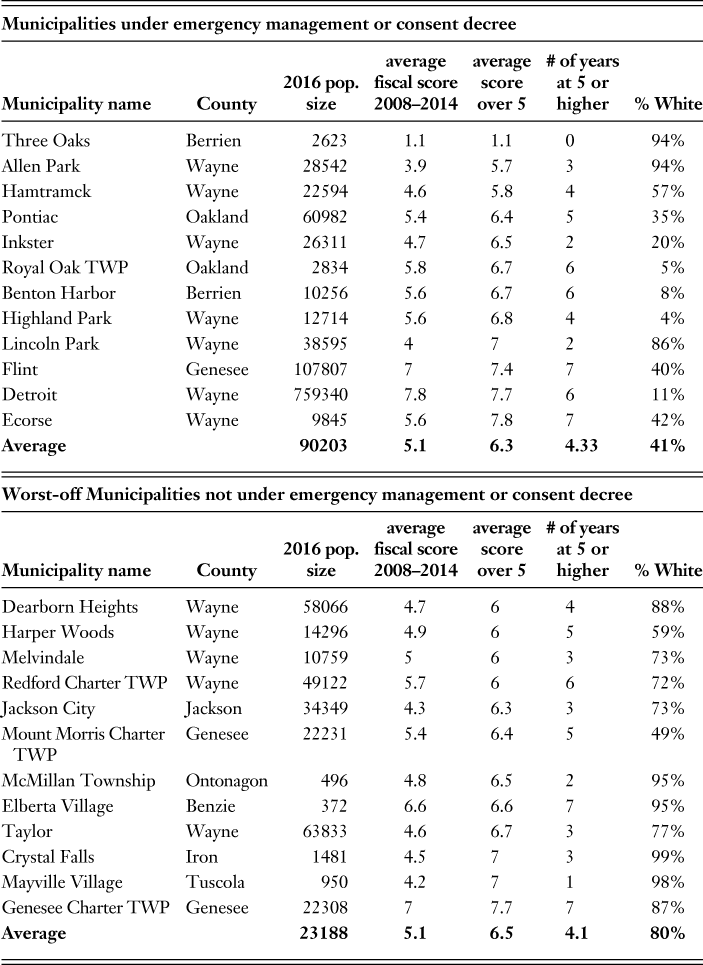
All iterations of the emergency manager law have had large racial disparities in implementation. Including Detroit (placed under state receivership in April 2013), half of all Black Michigan residents had no local elected city representation in 2014, as compared to only two percent of Whites. Further, the six cities most heavily populated by Blacks were all under some form of state administration. The law is supposedly triggered when cities’ fiscal health scores are elevated, but the review process allows discretion in applying the law: each bill specifying the many triggers for financial review concludes the treasurer, at their “sole discretion,” may identify “other facts or circumstances” indicating “probable financial distress” (PA 436 2012 141.1544.4.1.s). In a preliminary analysis of the probability a Michigan city would be taken over, chances of state takeover rise fifty percent with every ten percent increase in Black population, holding fiscal distress constant (Kirkpatrick and Breznau, Reference Kirkpatrick and Breznau2016). Between 2006 and 2011, the state used ten-point fiscal indicator scores, as proposed by Michigan State University (MSU) (Kleine et al., Reference Kleine, Kloha and Weissert2002): a score of 5 or 6 was supposed to trigger “fiscal watch,” and a higher score constituted “high risk” (Plerhoples and Scorsone, Reference Plerhoples and Scorsone2010). Snyder discontinued formal scoring (Spreen and Cheek, Reference Spreen and Cheek2016), allowing more discretion in state review. However, these scores were still computed for 2008 to 2014 by contractor Munetrix, and can be used to compare municipalities with and without financial review or state control. Table 1 lists communities with the worst fiscal health as assessed by the state, comparing the demographics and fiscal scores of those municipalities put under some form of receivership (emergency management or consent decree) to the worst-rated municipalities that escaped state control.
Michigan Municipalities with Worst Fiscal Scores, 2008–14*

* data comes from US Census and Munetrix
Even though the cities with highest Black population are also most likely to have financial problems because of deindustrialization and White flight, fiscal distress, as a standardized measure, cannot explain which cities were taken under emergency management. The total population of cities under receivership was only 21% White.Footnote 2 Table One shows the thirteen worst-off communities that were not taken over by the state have comparable fiscal warning scores, but very different racial demographics, with an average White population of 80% by municipality. (Of the next eighteen worst-off municipalities, with at least two scores above six, twelve were over 90% White). Moreover, eleven of the thirteen worst-off communities have received multiple warnings about financial malfeasance or noncompliance from the state Treasury department since 2004. Not only have these municipalities escaped formal review, their financial distress have rarely been covered in news media.
Moreover, much of the blame for growing deficits in majority-Black municipalities is attributable to the state itself, thanks to its revenue-sharing cuts. In Michigan, cities receive a relatively large portion of their funding from the state, owing to the 1978 Headlee Amendment, which capped municipalities’ property tax rates. But in 2003, legislators cut the statutory portion of revenue for all cities, diverting over $6.2 billion by 2014 (Minghine Reference Minghine2014). Because only the redistributive component of shared revenue was cut, it disproportionately hurt already-poor cities, compounding effects of the Recession.
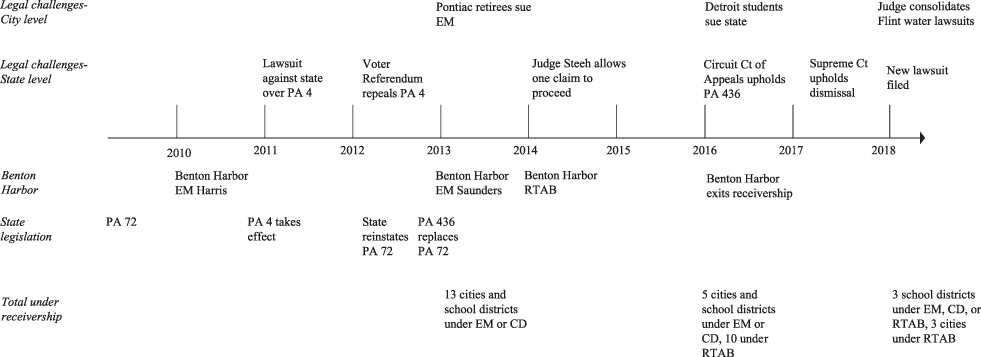
Community activists and officials in affected cities have mounted strong resistance to the law, especially since its expansion in 2011. Figure 1 shows a timeline of challenges and changes in the law. One prong of attack was a petition that obtained 200,000 signatures to place PA 4 under voter referendum—although a state board refused to certify petitions over font size. Petitioners eventually won through the Court of Appeals, and in November 2012, 52% of voters opposed the law. Despite the voters’ rejection of emergency management, the state legislature passed a new version (PA 432) within a month, effective March 2013—this law cannot be overturned by popular vote. Opponents to the law have also argued the legislature’s reinstatement of PA 72 during the period between the petition and referendum was invalid, as PA 72 was repealed once PA 4 replaced it, and therefore could not simply be reinstated with PA 4’s suspension (“Appeal” 2013).
Emergency Management Timeline

Several lawsuits have challenged the validity of emergency manager laws, both at the city and state level. In Pontiac, retirees sued Schimmel for actions during the law’s transition period (“Appeal” 2013); in Flint, citizens have filed hundreds of lawsuits against EMs and the state over their water crisis; and Detroit’s bankruptcy judge had to freeze several lawsuits to allow bankruptcy proceedings to go forward (Vlasic Reference Vlasic2013). In 2016, Detroit Public School students filed a class action lawsuit against Snyder for 14th Amendment violations, depriving them of the right to literacy after fifteen years under emergency management (Jackman Reference Jackman2017). The broadest challenge to PA 4 was mounted by representatives of multiple cities affected by emergency management, including Benton Harbor. In a 2014 State Supreme Court decision, Judge Steeh upheld only plaintiffs’ equal protection claim of the law’s disparate racial impact (“Order,” Phillips v. Snyder 2014, p.20). Steeh noted the “fiscal health” scoring system used to put cities under watch or review was only triggering Black cities despite equivalent scores in some White communities. However, the state dismissed this final claim in 2016, arguing:
There is no sufficiently direct connection to race in PA 436 that could amount to something…‘comparable to the odious practice the Thirteenth Amendment was designed to eradicate’…The state’s remedy for financially endangered communities—passed by state-elected bodies for which African-Americans have a constitutionally protected equal right to vote, and facially entirely neutral with respect to race— are far removed from being a ‘badge’ of the extraordinary evil of slavery. (Phillips v. Snyder 2016, p. 18)
Deploying slavery as the bar for “odious” racial practices, this argument presumes a linear model of racial progress (Ray and Seamster Reference Ray and Seamster2016; Seamster and Ray forthcoming). Since the law was written in colorblind “facially neutral” terms, its disparate implementation on Black cities would not be considered.
While the Supreme Court ultimately upheld the state’s dismissal of this lawsuit in October 2017, a new set of plaintiffs filed suit against PA 436 in December 2017, arguing the law violated the Equal Protection Clause of the 14th Amendment. With three cities and four school districts still under state control, continued concern is warranted. Given several cities have had multiple stints in receivership, emergency management is not gone but only dormant, ready to be reactivated as needed.
Clearly, anyone interested in race and voting rights, local participation and citizenship should be invested in emergency management. Sociologists studying race and citizenship have tended to focus on the racial consequences of felon disenfranchisement (Alexander Reference Alexander2010; Davis Reference Davis2005; Manza and Uggen, Reference Manza and Uggen2006) or other voter reforms (Chatman Reference Chatman2012), but few have examined the emerging case of whole cities being put under state receivership. Moreover, despite continuing resistance to the law, academic and policy research has mostly taken its existence for granted. A Pew study recommended the expansion of emergency management-type laws for all states (Atwell et al., Reference Atwell, Fehr, Huh and Russell2013).
Emergency management has even weathered the storm of the Flint Water Crisis. After emergency managers made the disastrous decision to use the corrosive Flint River, based on a bond contract with a White suburban water authority made under false pretenses, the state has evaded responsibility for its disproportionate role in the crisis (Hammer Reference Hammer2018). The Michigan Civil Rights Commission’s 2017 report assesses the role of the emergency manager law in producing the Flint crisis. While the authors argue emergency management in Flint represented “systemic racism,” and offer some potentially helpful modifications to the law, they assume reform is sufficient to remedy a law founded and implemented in systemic racism (Michigan Civil Rights Commission 2017). Moreover, some of their reforms would expand emergency management powers, like granting regional authority to solve bigger problems and suggesting EMs should train city leaders to prevent them “return[ing] without the training required to reach the expertise of those acting in the interim” (Michigan Civil Rights Commission 2017, p. 122), thus reinforcing blame on “bad” local management. Emergency management law’s ambiguous allocation of responsibility benefits the state when failures like these occur—it is easier for both residents and media to continue blaming the traditional scapegoat, city government, even for decisions made by a state-appointed EM. For this reason, more systematic assessments of emergency management’s role in reproducing racialized governance and inequality are urgently needed.
Urban Politics and the White Urban Regime
The field of urban regime analysis (e.g., Stone Reference Stone1989, Reference Stone1993, Reference Stone2005) is useful for examining governance. Stone’s scholarship focuses on the informal, well-resourced group of politicians, business people and elites who work through cooperation rather than bureaucracy or electoral politics to set agendas and, just as important, determine what will not be on the agenda. Urban regime analysis draws attention to the “flow” of decisions rather than open political conflicts. While this line of research minimizes the significance of electoral power and participation in these elite-run cities, none has yet considered a case in which elected local representation was invalidated. Who holds power in the urban regime when the state takes over?
Moreover, urban politics has generally employed a superficial view of racial politics. Adolph Reed’s (1999) concept of “Black urban regimes” is instructive, showing the limited power of governing Black elites to serve Black interests. Here I summarize Reed’s primary components of Black urban regimes, which I have identified previously (Seamster Reference Seamster2015): Black elected officials allying with Whites to serve Black elites’ interests, rather than their whole racial group; Black urban power as conditional, requiring endorsement of growth politics (Logan and Molotch, Reference Logan and Molotch1987); and the era of Black power coinciding with continued White institutional control (Holden Reference Holden1971) and decreased municipal power, perhaps as a response to Black electoral gains (Browning et al., Reference Browning, Marshall and Tabb1997). Some have called for the extension of Reed’s work to study the “racial power relationships” (Horan Reference Horan2001, p. 29) in every urban regime.
Drawing on Reed’s work, I propose a White urban regime has operated in Benton Harbor since its putative abandonment by Whites. I define this White urban regime as a racialized network of business people, landowners, developers, nonprofit heads, and philanthropists, which governs without needing formal elected positions within the Black-led city. By monopolizing local economic resources (including public grants and land), and shaping public agendas through formal and informal arrangements (Hunter 1963[1953]; Mills Reference Mills1956), this racialized network reproduces White interests. However, it has largely gone unmentioned in analyses of emergency management in Benton Harbor.
This economic and political control is narratively justified by the White urban regime’s positive public role as benefactors or city saviors, developed in relation to Black officials. The process of “territorial stigma,” which Dana Kornberg (Reference Kornberg2016) has fruitfully applied to the municipal level in a study of Detroit, has relational effects. Not only does stigmatizing a Black neighborhood or city as undeserving, undesirable, or threatening justify the deprivation of resources from that area, the process of stigmatization reciprocally frames White spaces and governance as deserving (if they are seen at all). The relentless focus on Black Benton Harbor residents and officials as problematic distracts from Whites’ actions just outside the lens. Moreover, shared stigma of Black governance and residents forms a “racial-sacrifice covenant” (Bell Reference Bell2004) to coordinate the actions of otherwise-competing White capitalists’ interests.
Black elites serve an important role in supporting the White urban regime, whether in elected office or supporting non-profit organizations or business ventures. While Black elite participation is essential, they have only limited access to these spaces of shadow governance, and can be replaced if they are out of compliance. Because they ultimately act in service of the White majority’s interests, Black elites’ participation does not alter the White urban regime’s “hegemonic Whiteness” (Hughey Reference Hughey2010)—the White urban regime does not operate under the “one drop” rule of racial classification. After all, Reed’s Black urban regime has White people working throughout its periphery, as mentors, growth advocates, or gatekeepers for public agencies and institutions. In a “White institutional space” (Moore Reference Moore2008), the role transcends the identity of the person occupying it (Bracey Reference Bracey2015). Both Black and White urban regimes are constructs calling attention to overlapping aspects of racialized governance in a larger system, and serving complementary analytic goals.
Ignoring the “Whiteness” of the White urban regime can lead to misinterpretation of these phenomena. For instance, Richard Harris (Reference Harris and Fortner2016) identifies similar variables for what he calls “community development regimes” in small distressed cities like Benton Harbor, where non-profits govern with state and other public entities to the exclusion of municipal government, which is “reduced to a situational variable” (p. 130). But in part because Harris does not consider the racial dynamics of dispossessed (Black) governance, he takes these “community development” goals at face value, without asking what these regimes may be gaining from their philanthropic involvement.
Importantly, the White urban regime is not disrupted by the ongoing “crisis” of Benton Harbor’s government—in fact, crises facilitate what I call an “extraction machine,” pulling assets from the city (Seamster Reference Seamster2016). In Glenn Bracey’s (2015) “critical race theory of state,” the state serves as an “instrument for maintaining White dominance” (p. 558), with Whites’ structural position shaping their interest and actions: White dominance includes Whites’ power to “exclude people of color from normal politics” (p. 580). The case of Michigan’s Emergency Manager law represents an interesting test, as elected Black officials were literally shut out from “normal politics.” But is “normal politics” state administration under the emergency management law, or White urban regime actions, or neither, or both?
DATA AND ANALYSIS
Data derives from a mixed-method ethnographic case study conducted between 2012 and 2016. I examined data from state-wide surveys; policy papers; local voting results; state and local demographic financial data; and emergency orders. I tracked emergency management lawsuits and the implementation and contestation of emergency management statewide.Footnote 3 I also conducted formal, semi-structured interviews with forty-four key figures and observers in Benton Harbor, several of whom I interviewed multiple times. Pilot interviews began in March 2012 and continued for an intensive period in May-July 2014, with the remainder conducted in May 2015. During the summer of 2014, I attended over twenty local meetings, primarily held at Benton Harbor’s City Hall or a major non-profit, and observed many other community events and locations.
During my formal interviews, I spoke with local politicians (including five of the nine city commissioners then serving) and board members, ministers, lawyers, business-people, nonprofit workers, activists, and other residents. Many first contacts came from my attending meetings—people often suggested themselves or others for interviews. I spoke less formally with dozens of other locals, many of whom suggested connections or generously provided their thoughts. I also spoke with over a dozen employees of state and federal agencies and data analysts. My interviews ranged from half an hour to five and a half hours, with most lasting between one to two hours. I conducted interviews at the public library, in coffee shops, respondents’ homes or offices, City Hall, and local educational institutions.
I employed snowball sampling to obtain my sample. This list of “who to talk to, and who not to talk to,” as one person said, neatly outlined the two political camps and mapped Howard Becker’s (1967) “hierarchy of credibility.” I wanted, and got, the official narrative for newcomers by the area’s most respectable representatives (Stack 1976). I triangulate this official narrative with several Black officials’ and residents’ view of the White urban regime and emergency management. Their perspective, that Benton Harbor’s resources and residents were being exploited for outsiders’ profit, amounts to a critical Black epistemology or “blues” epistemology (Barnes et al, Reference Barnes, Robinson and Wright2014; Robinson Reference Robinson2014; Woods Reference Woods2017 [1998]) connecting Black underdevelopment and White wealth.
I used a modified grounded theory approach for data analysis of archives, interviews and observations, building from initial theoretical concepts like the Black urban regime and growth machine theory but with openness to new findings. This method of analysis allows researchers to engage deeply both with their data and existing theory (Burawoy Reference Burawoy1998; Glaser and Strauss, Reference Glaser and Strauss1967), resulting in a theoretically generative series of arguments. Through iterative data collection and interpretation, building from within-case to cross-case analysis, I constructed and tested theoretical hypotheses until I reached theoretical saturation (Small Reference Small2009), when I was no longer encountering major new findings.
RESULTS
Benton Harbor and the “White Island Effect”
Benton Harbor, a small city of 10,000, sits on the southwest coast of Lake Michigan. Once a thriving city drawing Blacks as blue-collar workers during the Great Migration, the city has suffered from waves of out-migration, debt, and according to some, poor management. Further, as Black migrants moved north for the manufacturing jobs in heavy industry, including corporations like Whirlpool, the Whites in Benton Harbor fled to the adjacent town, St. Joseph, bringing their institutions with them, from schools to churches and the hospital, resulting in communities highly segregated by race and economics. Benton Harbor is now 88% Black, and one of the poorest towns in the state; it faces St. Joseph, now a White tourist town, just west across the Paw Paw River. The two cities are defined as mirror opposites to one another. While Benton Harbor’s median property value has decreased 20% to $49,200 between 2010 and 2016, St. Joseph, just across the river, saw median home values rise 2% over this same period, to $164,000 (American FactFinder).
A key dimension of underdevelopment is misreading cause and effect: seeing the destructive effects of policy and intensive involvement, as the evidence of abandonment (Woods 2017[1998]). While Benton Harbor is often portrayed as abandoned or “left behind,” Whirlpool still maintains facilities in and around Benton Harbor and enjoys favored status like tax exemptions. It has also created a series of community non-profits to carry out projects in the city, like a luxury golf course and residential development, Harbor Shores, built on industrial brownfields and Benton Harbor’s lake access. Deploying these organizations along with public employees at the county and state level, and selective funding choices, Whirlpool has run the White urban regime in Benton Harbor for decades. The name “Whirlpool” now has a metonymic quality for the whole constellation of businesses and developers circling the city. In City Hall, “Whirlpool” is configured by its opponents as the entity pulling the strings, endlessly proposing front-stage projects without explaining the back-stage motivations or end game. A Whirlpool heir, Fred Upton, is the representative for Michigan’s fourth congressional district; Al Pscholka, who wrote the 2011 expansion of EM powers, worked for Upton as well as for Cornerstone Alliance, Whirlpool’s primary non-profit vehicle for land acquisition and development.Footnote 4
Benton Harbor is surrounded by majority-White municipalities in Berrien County with much higher median incomes and tax revenue. In 2016, 65% of the White county population lived in a municipal unit that is less than 5% Black. One White urban regime member, “Donald,” described this extreme racial segregation as having occurred as a process of ghettoization through expulsive policy and NIMBY-ism, creating what he called “a White island effect:” “Everybody…put all of their dregs and all their problems into here, and…put a wall around it.” He continued, “we’ve got a lot of little communities around here…We’ve got nineteen. We’ve got townships, we’ve got cities, and they all have their own little fiefdom. And they’re racist, they’re stubborn, and they’re belligerent.” These small municipalities do appear to structure much of their identity around not being Benton Harbor through a process of territorial stigma. But, disturbingly, Donald was concerned the “wall” built around Benton Harbor couldn’t be high enough, because the city was “radioactive”:
It is the elephant in the corner of the room. It’s absolutely the problem child. And I don’t care how much fencing, I don’t care how deep the river is. If you don’t fix this problem, you’re never gonna fix your problems…And they [White municipalities] all have got the cancer or the radioactivity or whatever you want to call it, because that’s holding all of us back.
Local initiatives invoked similar language about “interdependence” and shared fates to explain in less harsh terms why Benton Harbor must be improved for others’ benefit.
Blank Slate
Emergency management represents an ideal tool for proponents of the “blank slate.” Emergency managers are supposedly neutral, unburdened by politics as usual. A Mackinac article called PA 4 a “‘clean rinse’” (Littman Reference Littman2012). A White small-business owner, “Sandy,” articulated similar themes in an interview:
Think of it as someone watching over—someone from the outside coming in. A fresh set of eyes, a neutral person who doesn’t have these long roots in the community, where they owe somebody, and they owe somebody, and ten years ago he did this favor.Footnote 5
The blank slate served the needs of the White urban regime. Donald talked at length about emergency management and Benton Harbor’s needs, “look[ing] at it from a 60,000 foot view.” According to Donald, the city had to “get worse before it can get better,” facilitating a clean slate in market-rate housing, charter education, and new government:
Listen, every good government needs a good enema. And that’s exactly what the EM does. It wasn’t working locally, so how do you get radical change to occur? I guess that’s the influence that I’m looking for. It’s all about inertia. So you have to break those chains. Just like we talked about the generational poverty… So the government contracts…in its purest state, it’s really, truly a libertarian idea to be able to go in, have a magic pen, and wipe out every contract, to be able to take every employee and strip it down… I’ve got free market, I can now negotiate based on—forget collective bargaining and all the other bullshit that goes along with the NLRB [National Labor Relations Board], and all the other stuff…So what I need is a benevolent dictator, for a short term, to get it back on track, and then let the market take over. But you can’t do that unless you can wipe it all out. It’s chemotherapy. It’s government chemo, and that’s what we need.
Donald echoes Milton Friedman’s on the convenience of “shocks” or crises to open opportunities for privatization and reform: “Only a crisis—actual or perceived—produces real change” (Friedman Reference Friedman1965). For Donald, emergency management represents the necessary “enema” or “chemo” to wipe out contracts, practices, and possibly also the people in charge—for the benefit of people like him. Donald explained, “it’s really important, for us, that the economics and the politics gets shaped a particular way because that drives our success.”
The very title of emergency management helps reinforce the idea of crisis, although some Michigan entities have been under emergency management for decades, or have cycled through repeatedly. The dominant logic assumes traditional governance is the problem while turnaround or “emergency” governance offers the solution (although usually relying on the same funding and political structures). In these “reform” programs, advocates can confuse change with progress, producing a constant imperative for change of whatever type, without knowledge about what came before or foresight into what comes next (Ray and Seamster Reference Ray and Seamster2016; Seamster and Ray forthcoming). This constant change can become its own kind of stasis, and destabilizes the ongoing work of governance.
Benton Harbor’s city commissioners, who also wanted change, were wary of the White urban regime’s series of spectacular plans without funding for the less-glamorous areas of city management and upkeep. Moreover, they were stuck in reactive mode. As a city commissioner put it, they experienced the constant re-imposition of the blank slate as “crisis: when they get a crisis and they keep you off guard because it’s another crisis. You got to deal with this all right now, and all the other stuff goes away. So that’s what they do to us.” One commissioner compared Benton Harbor’s external governance to post-invasion Iraq’s Reconstruction, which has also been rendered as a “blank slate” opportunity for outsiders (Klein Reference Klein2007). Two other commissioners mentioned Naomi Klein’s (2007) Shock Doctrine, which includes a chapter on Iraq Reconstruction, as providing apt conceptual analogies for their experience.Footnote 6 However, their ongoing resistance to emergency management was ignored or mocked, in an example of the more general discounting of anti-emergency management counternarratives Michael Doan calls “epistemic redlining” (2017).
Ironically, the emergency manager’s disruptive role represented continuity for Benton Harbor, which was already suffering constant staff turnover, often from White urban regime involvement. For instance, the “revolving door” of city managers was frequently invoked as a major indicator of Benton Harbor’s dysfunction, but this phenomenon came from power struggles between City Hall and the White urban regime. A city commissioner said every new city manager would start out saying the right things until Whirlpool’s nonprofit, Cornerstone Alliance, got to him. She reflected, “it was always a battle for that position.” A White urban regime member told the same story, complaining that as soon as they got somebody thinking the right way, the commission would fire him.
Black Governance Rendered Null and Void
While the emergency managers were praised for their supposedly superior skills, Treasury trainings for their position were only two days long in 2011 and 2012. Even with lengthier trainings, the legal ambiguity and constant law change would make it difficult for anyone to fully grasp the emergency manager’s role. The presentation of emergency management as an administrative or neutral “technocratic” law (Stanley Reference Stanley2016) obscures not only the racial disparities in its implementation, but also the political conflict around it, including the voters’ rejection of emergency management in 2012.
Joseph Harris and Tony Saunders were Benton Harbor’s two emergency managers (Harris from April 2010–January 2013; Saunders for the final year). While both emergency managers were African-American, they came from outside the area, as did most of the emergency managers statewide.Footnote 7 The twenty-seven emergency managers (six served in more than one emergency manager position, a few simultaneously) come from the pool of city administrators and financial managers rotating through Michigan cities.
Joseph Harris had previously served as Detroit’s Auditor General, briefly as Detroit’s CFO, and as an accounting professor at Wayne State. As emergency manager, Harris was frequently described as a petty tyrant who took the absolute power of his title too seriously. An anti-emergency management activist, “Rodney,” described him thus:
Harris was a terrorist…He was no picnic in the park. He thought he had so much power. He was arrogant…He came in telling commissioners off left and right, telling the mayor what he’s going to do and what he ain’t going to do. He said you all could have a meeting, take notes, and I want you to close it right then and there. Don’t vote on nothing. Don’t.
Even before Harris’ powers were expanded, citizens were resisting their elected officials’ expulsion. As the father of a city commissioner stated at a meeting,
We spent a lot of time beating the bricks to get people to get get [sic] out and vote for the nearly elected legislators/elected officials…I want to ask the question of the citizens, if there is a law that they (commission) cannot be able to speak or to or sit in on anything that is going on here with this financial director? (Heibutzki Reference Heibutzki2010)
Within a week of the state’s expansion of emergency managers’ power under 2011’s PA 4, “that’s when hell broke loose,” Rodney reflected. “One of the first things that Harris did was show them that he had absolute power. He took the mayor’s desk out of the office and put it in the basement. He took the keys and cell phones from the commissioners.” Harris issued a resolution limiting the power of the mayor and city commission to opening and adjourning meetings and approving minutes. Two months later, Harris further ordered that no city official or staff member could appear in an official capacity without his approval. If the Commission issued any resolution, the city clerk must append a statement that the action was “NULL AND VOID, AND OF NO FORCE OR EFFECT” (EM Order 11–21).
To save money, EM Harris followed the austerity playbook: selling off property, shrinking staff, and raising fees on residents. In one of his more widely-publicized actions, Harris (illegally) posted the city’s radio station and equipment on eBay (Savage Reference Savage2012), possibly to silence the commissioner who had been hosting radio shows criticizing emergency management. Harris closed and attempted to sell Benton Harbor’s community center and the city’s small-business incubator, both recently established with public funding, and sold City Hall’s administrative building to a developer. He sold acreage reserved for parkland, endangering future park funding, and supported Whirlpool’s major golf course development.
Meanwhile Harris fired city employees. He merged the police and fire departments, and cut essential personnel, assuming many of the roles himself (Order 11–05). In February 2011, Harris told attendees at an Emergency Financial Manager training, “the City Manager is now gone—I am the City Manager. I replaced the Finance Director. So I’m the Finance Director and the City Manager. I am the Mayor and I am the Commission and I don’t need them. All I need is the expertise” (Savage, Reference Savage2011). Harris destabilized the operations of City Hall by temporarily eliminating these positions required by city charter. The gap in staffing harmed institutional memory in city government, significantly lessened oversight for the emergency manager’s actions, and impaired City Hall’s functioning after emergency management. Harris also sought to reduce elected leadership. In Order 11–31, Harris introduced city ballot items to reduce the size and power of the city commission (something several White urban regime members told me they had wanted) and increase the city manager’s role. His proposed system would further decrease financial oversight, where auditors had already critiqued insufficient staffing.
The “dictator’s” reign ended, however, because he did not understand the tight interplay of government and corporate power in the region. As Rodney said of Harris, “He thought he was bigger than Whirlpool. He didn’t realize that Whirlpool was one of the reasons he was here.” Ultimately, Harris was expelled after Whirlpool and government representatives met with state leaders, and select city commissioners agreed to support a tax millage renewal in exchange for a new emergency manager. When Harris’ reign ended, so did the era of openly combative emergency management. But the differences between first and second emergency manager were more style than substance. Crucially, while the second emergency manager’s reign involved participatory rhetoric, Black residents and officials were still shut out of politics. Rodney commented:
they were so glad to get rid of Joseph Harris. Not only was Whirlpool happy, but the citizens were happy, the commissioners were happy, because this guy [Harris] was something else! He didn’t take no mess either…I figured the governor had a hard time dealing with him! Now he’s gone, and Saunders is in here, who speaks softly. He speaks softly, you see?...he was trying to play both sides of the fence to see where we was at. But yet he’s still, during that period of time, steady taking the last things we had.
Saunders was a much younger Emergency Manager: he told Crains Detroit the year after he left, “‘I was 26, and I had no idea what the hell I was doing’” (Pinho Reference Pinho2015). Prior to his stint as EM, Saunders had worked as the chief of staff for Detroit’s City Council president. After Benton Harbor, Saunders was hired as Wayne County’s CFO but was soon discovered to have also started his own turnaround firm, Dent Advisors, which targeted majority-Black school districts like Shelby County, TN and Prince George’s County in Maryland. In 2017, Saunders got out of trouble by leaving Wayne County for a development equity firm, headed by a county contractor who recently acquired Wayne County property (Jones Reference Jones2017).
Most people I interviewed in 2014, both those for and against emergency management, agreed Saunders seemed better than Harris. Saunders solicited opinions; he did not issue histrionic orders; he got along with the locals. He was even charismatic: a city commissioner described Saunders as a “dictator, but with a smile” (Gryczan Reference Gryczan2013). But as Rodney put it,
Saunders came in here, did a lot of stuff behind the peoples’ back. About as two-faced as you can get. If I had to choose I would take Harris over him, you see? You know Harris is going to do something. This guy was doing stuff undercover. That was the difference.
The second emergency manager was better at employing the discourse and symbolism of participation, and pleased outside observers who believed Benton Harbor’s problems occurred from overly-generous government spending. However, Saunders’ reputation for friendliness didn’t prevent him from blocking elected officials’ access to city property except during commission meetings.
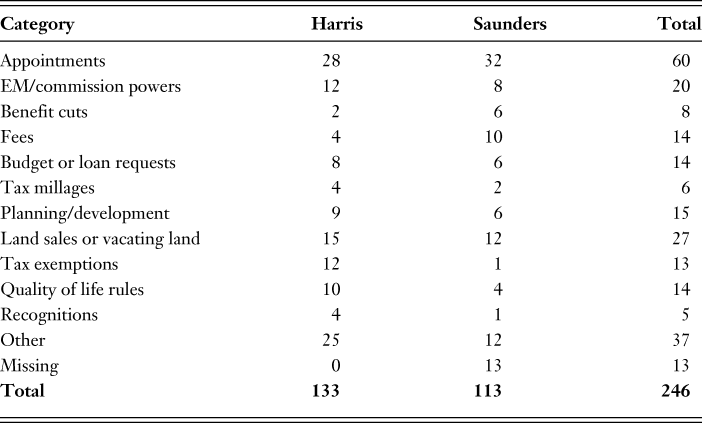
Table Two above categorizes Saunders and Harris’ two hundred and forty-six emergency orders under the three different laws. Saunders issued orders at a rate of nine per month, twelve of them on his last two days in power, more than double Harris’ monthly average. While they do not constitute the full range of emergency managers’ actions, tallying the two sets of orders still shows underlying similarities in priorities and governance. Of the thirteen orders providing tax exemptions, twelve went to local corporations or developers; twenty-seven orders sold or vacated property. The orders reflect whose habitus and contributions were being recognized or facilitated: most liquor licenses issued were for microbreweries or the Elks; the recognitions went to entities like Arts District benefactors, Whirlpool, and “Bike to Work Week” in a city where 60% of residents have no car (Bedford, Reference Bedford2009). Meanwhile, both emergency managers imposed austerity in raised fees and benefit cuts. Twenty orders specified city commission powers (usually limiting them).
Benton Harbor Emergency Manager Orders, 2010–2014*

* Benton Harbor EM orders available at http://www.bentonharborcity.com/em-directory
Saunders followed Harris in cuts and privatizations, two of which I will note here. First, Saunders gave control of city parks to a newly-created Conservancy, glowingly described to me by one White urban regime member as “a way to establish another group of people with influence, that could get things done without the corruption of the city politics.” (However, the organization has languished and may soon be shut down.) Second, just before he left, Saunders transferred city pensions to the statewide Municipal Employees’ Retirement System (MERS), as did five other cities’ EMs (as noted, Pontiac sued to prevent EM Louis Schimmel from doing the same). This amounts to an $11 million asset transfer from local to state-level control.
Individual Blame for Structural Problems
The strangling of elected commissioners’ power aligned with White urban regime members’ framing of Black governance. In majority-White spaces, the reaction to hearing I was studying politics and economics in Benton Harbor was often a dubious “good luck…” At one meeting, an attendee asked if I was studying local politics “in the context of—Barnum and Bailey?” Whites around Benton Harbor constructed “value agreement” (Hunter Reference Hunter1963 [1953]) around the city government’s supposed dysfunction, blaming commissioners’ alleged lack of education, “self-serving politics,” stupidity, nepotism, or corruption, for Benton Harbor’s problems. Focusing on individuals and their alleged deficits parallels “culture of poverty” narratives attributing Black poverty to behavior. One White urban regime member, “Steve,” commented, “It was just total complete stupidity and mismanagement [before emergency management].” A second White urban regime member, “Eric,” said the role of city commissioner was “a pretty complex job,” adding, “There’s a lot of people that don’t have that education, that are ignorant, maybe stupid—I don’t know—but certainly ignorant about it.” Donald said of the city commissioners,
They’re all whacked. They’re all whacked. Meaning, they’re from one end of the spectrum to the other, in terms of good, or bad, or crazy, or otherwise…you can have some that are whacked out left, and then [some] whacked out right.
These descriptions of Black commissioners effectively devalued that group’s perspective, with structural effects: several White urban regime members said they refused to work with city officials they deemed uncooperative, and admitted to directing resources away from City Hall.
City commissioners agreed local governance had traditionally been fractious and sometimes poorly-run. But the substance of their political disagreement mattered. In Benton Harbor, Black officials were divided on the White urban regime, and whether cooperation was necessary for the city’s survival. As some commissioners noted, conflict itself was not causally responsible for the city’s problems. In other contexts, we might call such political disagreement democracy.
Even Whites who opposed emergency management recognized the strength of the “dysfunctional” narrative. A lawyer noted difficulty obtaining plaintiffs for a lawsuit against emergency management: “It’s a challenge. Because Benton Harbor’s a dysfunctional community, I mean, it’s hard. Who do you have represent that?” He said it was worse in another city: “Every time a person we got referred to us—they might be fine people, I don’t know, but I can’t have someone who was arrested two months before, and two months before. But it’s the nature of a community that’s fractured. It’s dysfunctional, you know?” Under racialized citizenship in Michigan, state institutions interact to restrict Black voice and participation. Because Black residents are more likely to have a criminal record, that background labels them untrustworthy, even laughable, when they speak against an anti-democratic law. What is more, the criminal record patterns are not simply racially unequal, but, it is alleged by some residents, represent Whites’ ability to employ local legal institutions against Black resistance.Footnote 8
If Benton Harbor’s elected officials were assumed to be incapable and therefore deserving of emergency management, so were the city’s citizens. When asked about the emergency manager law’s antidemocratic aspects, White urban regime supporters dismissed this concern. Black elites alleged locals lacked the political acumen to make good decisions, due to what Reed (Reference Reed1999) might describe as the “uplift” perspective that “a leadership of the best men need not trouble itself with deliberatively based ratification and input from a population in need of tutelage and custodianship” (p. 20). For instance, the then-mayor of Benton Harbor alleged individuals who got evicted despite subsidized rent of what he said was $8 or $16 a monthFootnote 9 would not identify with or vote for a successful person. He was not alone in claiming housing subsidies disincentivized political action, rather than indicating residents’ poverty. Florence, a Black elite member, told me,
Well, the demographics of Benton Harbor are such as they have this raft of really, really young families. I mean kids, literally, that are heads of households, young women that are 16, 17, 18 years old. The welfare system provides them with money to get into an apartment. There they sit with their one or two babies and I don’t know if they could even articulate to a commissioner what they really need.
Respondents also frequently claimed Benton Harbor’s low voter eligibility rate and low electoral participation rendered elections meaningless. Several people claimed commissioners were getting elected based on the size of their family: for instance, “Pete,” a White man who worked in development, claimed,
You still have the individuals that might be getting a win by ten—we had a city commissioner couple years ago that was voted in and it was, like, a total of 62 votes. I mean there’s families out there that are 60 people…and he’s probably not the right guy for the job, but he just happens to have 60 family members and [they] rallied around him. The next thing you know, you’re elected as a city commissioner, you’ve got no business being in the city commission seat, but you are now running the city!
Donald, who also referred to “voter turnout here” as being “at a paltry single digit sometimes,” claimed buying votes in such a context was easy: “You can offer potato chips and a hot dog, find a bus, take them to the polling place, and they will go. And you will buy a vote for literally three or four bucks, in terms of transportation or food.”
By invoking young women with children, public housing, large families, and cheap vote fraud, these respondents drew on racial stereotypes supposedly in conflict with those of a “good citizen,” in line with a long history of invalidating Black citizenship based on irrelevant characteristics (Glenn Reference Glenn2002; Smith Reference Smith1997). This demeaning talk undermined Benton Harbor residents’ claims of violated democratic rights. If Benton Harbor’s democracy could be symbolically rendered worthless, then its loss was less important than in a city with less “suspect” citizens. The framing also undermined claims of racially disparate implementation: when I brought up the statistic about Black cities’ increased vulnerability to state takeover, Donald simply commented, “I don’t know if I buy that.”
Upstream Determinants of Municipal Crisis
By focusing on low-level mismanagement, the White urban regime pointed away from the potential role of business and the state in driving the city’s distress. Most people glossed over the property tax values that plummeted from White flight and the Recession. Nor did they mention the business incentives that provided a total of $52 million in tax waivers and credits for Whirlpool’s downtown campus alone—these were just the cost of business in today’s economy. And they certainly did not mention Michigan’s role in whittling down cities’ share of sales tax to balance the state budget—the revenue sharing cuts mentioned above. As the cuts disproportionately affected postindustrial cities, Benton Harbor’s loss was consistently almost double St. Joseph’s. By 2010, Benton Harbor was losing about half a million per year from this one cut, for a cumulative loss of $4 million. This loss roughly tracked Benton Harbor’s annual deficit—the deficit that partially triggered Benton Harbor’s takeover. (Detroit lost $700 million during the same period, which should complicate the traditional reasons given for that city’s bankruptcy in 2014.) For fiscal year 2017, Benton Harbor received $1.5 million from the state—over $1 million less than in 2000, without standardizing for inflation. In other words, the problems ascribed to individual Black politicians in Benton Harbor were caused by the same state actors who imposed emergency management. Federal funding for cities was also cut by 48% between 2005 and 2009 (Skidmore and Scorsone, Reference Skidmore and Scorsone2011).
While White urban regime members avoided this topic, several city commissioners cited revenue sharing as being directly responsible for their deficit. One commissioner claimed,
the state of Michigan…created the problem in the first place with revenue sharing. They took the money and gave it to somebody else…And that’s why I said yesterday that we need to sue the state, because they started this. And then they come over and take over communities and start selling off everything, and bringing in their buddies to capture anything that’s left.
Although MSU’s 2015 study agrees state funding cuts are accountable for cities’ distress, its authors claim a fairer distribution of funds is politically nonviable. Instead, they recommend a campaign to “raise awareness” that cities are not “solely” to blame for their crisis (Sapotichne et al., Reference Sapotichne, Rosebrook, Scorsone, Kaminski, Doidge and Taylor2015, p. 24).
Tightening the Stranglehold
Emergency management mapped neatly onto the White urban regime’s desires, presenting the promise of extreme change—and the possibility of new people in charge. Beyond the disparate impact of Black residents’ vulnerability to emergency management, the law’s implementation reveals another racialized outcome. As Benton Harbor citizens and government officials were shut out under emergency management, unelected members of the White urban regime consolidated their access to City Hall –and a set of social rules governed who wielded influence.
Letting White Outsiders In
The strongest academic defense of emergency management comes from a law professor who had consulted for Detroit’s EM; one benefit, he suggested, was that unelected officials “may also represent the interests of nonresidents and creditors who are not considered by those officials” (Gillette Reference Gillette2014). In Benton Harbor, I found a similar elevation of the interests of “nonresidents and creditors” above city residents’ self-determination. Moreover, Saunders’ “friendliness” did not evenly translate into access for all. The narrative I heard so frequently that the second emergency manager was relatively good was a story about racialized access: most people who made that comparison were White. As Rodney noted, the first emergency manager, Joseph Harris, did not understand other local entities, including Whirlpool, still held sway: only the elected government was displaced in emergency management. Saunders had a more sympathetic leadership style. But from the stories of privileged access told by White urban regime members, Saunders was “good” because he knew whom to listen to.
A pattern emerged in cross-case analysis: only White urban regime members, all White men and business owners, reported positive and personal relationships with one or both emergency managers. Donald described both emergency managers as “dear friends.” Eric said he met with the second emergency manager “all the time. Basically once a week”—he also encountered Saunders in social activities. Although he came from outside the area, Eric explained his local knowledge was useful to Saunders: “downtown there’s not a lot of people who are more involved and been here longer than me, so I kind of have a good understanding of the history…He was interested in that.” Several other White men also mentioned giving Tony Saunders input. Furthermore, these men had an easier time in getting their own needs met during emergency management. Donald was explicit about how the emergency managers facilitated his goals:
If you properly work the situation, and you have a good case, you could probably get a lot more done with the emergency manager if you have a good relationship with him, because it’s one stroke of the pen, as opposed to ongoing bureaucracy, going in front of the commission, having all kinds of debate, public forum, and people criticizing you for not doing it.
Here, Donald identifies not only the “bureaucracy” of normal city government, but also the public participation inherent in democratic governance, as obstacles for business and development.
White urban regime members also occasionally reported receiving information from the emergency managers in confidence. For instance, “Monty” explained he got a visit from a departing EM:
His comments to me were: “…We’ve still got a lot of work to do on the city commission. We’ve got a lot of work to do on people really understanding what cities are all about—schools, and streets, and financial responsibility.” There was a time, I was told, that there would be checks coming in and laying around for quite a few days before they got deposited.
Monty mentioned that, during his visit, the emergency manager “was not very complimentary about what there is to work with in the intelligence side of things,” legitimating Monty’s beliefs about city officials. Similarly, “Steve,” involved in business and boards downtown, described city hall’s former “corruption:”
They used to go down in there [the Water Department] and they’d find drawers full of bills. A lot of the bills were torn up. Any bills that had cash in them, torn out and money put in people’s pockets. A lot of checks were never turned in – a lot of stuff. The whole billing thing was just a fiasco.
As I was wondering how he knew these stories, Steve continued,
I asked the emergency manager one day because he was telling me all this stuff and I’m like, “How come you didn’t prosecute these people?” And he goes (emphasizing point with finger on table), “Steve, I was not brought in to prosecute. I was brought in to balance the budget and get it going.” He goes, “I had to get rid of a lot of people that were corrupt and doing bad things, but I couldn’t—I didn’t want to prosecute. I just wanted to fix.”
The information these men received from the emergency manager likely does not constitute state secrets, but the stories validated their opinions of Benton Harbor’s government. This access performed the important function of gossip, to establish solidarity and to draw a thicker boundary around “those corrupt, dysfunctional officials.” And it indicates the emergency managers’ relationship to the White urban regime—that intimacy of confiding, the gesture of visiting a powerful businessman in his office, may have been performed intentionally as political currency.
Black Insiders Left Out
Several commissioners claimed emergency managers represented local continuity as Black outsiders brought in to forward the White urban regime’s goals, often as non-profit leaders or city managers. One commissioner reflected,
I think it’s funny now, but they always bring another African American into our community and they say, ‘you go in there and get ‘em. You get ‘em. You make them feel comfortable, and then—‘ And I’m like, ‘I’m not comfortable with you, because I know who sent you.’
The succession of Black outsiders fit in with a larger network of Black governance supporting the White urban regime. A Black resident, “Cecily,” narrated what she saw as Whirlpool’s strategy for recruiting willing participants:
if we got these Black people – we got to help them. We don’t have enough White residents to get any commissioners…What White person (laughing) is going to move in here?...they are not coming in here and dummy down their ways of living to live around these Black people. So let’s see if we can get some Black commissioners, some Black pastors, some Black school board members, to converge onto us what their needs are, and we will converge onto them our thinking and how we get things done.
And because they want to be relevant…they want to be seen as some kind of iconic figure in the community…they buy all into this and they say, ‘yes, I’m on the this-and-that committee, and I am on this-and-that board, and I do this and I do that.’
But if Black elites were critiqued for supporting Whirlpool and the White urban regime through their political decisions, emergency management shows the limits of their influence. Given that the emergency manager law invalidated local governance, making their relationships difficult if not outright antagonistic, it is unsurprising city officials lacked this close contact with both emergency managers. But even members of the local Black elite, many of whom were neutral or positive regarding emergency management, did not describe similar access to the emergency managers. I would have expected Black elites outside the deposed city commission to report close relationships with or informal access to an emergency manager, as did the White urban regime. This was not the case.
A large part of my evidence from Black respondents consisted of the absence of any description of a relationship with an emergency manager. When Black respondents did describe interacting with the emergency managers, their experience was not positive, much less friendly. “Cecily” was not willing to be what she called a “muppet-puppet on a string” to keep her board membership. Cecily related an experience with EM Saunders to explain how she saw local Black residents being used as symbolic representation. She explained, “I thought, according to all the stuff that I read, that they made all these important decisions.” But Cecily continued,
I found out all these boards are the same. Legally, they have to exist so people have to be on them. But they have to get the right kind of people on them for people not to care, and to just do what they say. I found out, this is just a dummy board! The EM makes these decisions!...He’s just wanting you to make a recommendation so he can say he has something to counter his thinking.
If anyone could have expected to be part of the informal “advisory board” for an emergency manager, it was “Darlene.” A Black elected official who was not vulnerable to emergency management, Darlene was one of the most prominent members of the community. Born and raised in Benton Harbor, Darlene and her husband had racked up decades of service on boards and political leadership, and she was still extraordinarily involved in politics. She was also known, both by supporters and opponents, as someone who cooperated with Whirlpool. Darlene considered herself a go-getter (“I know how to get up and get out”), reading the legal section in the paper every day and sharing the information with her friends. She also invoked the Open Meetings Act to demonstrate that, while other residents might feel apprehensive about attending meetings, “I think you should use those kinds of things; if you feel like you’re not supposed to be there—they can’t keep you out. They will welcome you.”
But Darlene was ignored by both emergency managers. She said of the first emergency manager, Joe Harris, “He was a terrible person. He treated us like we were fools. He never wanted to listen to anything anybody had to say.” After describing Harris’ tone-deaf behavior, she proceeded to describe Saunders:
I thought he was good. I had great hopes for him. I thought he wasn’t scared. I liked that. He was amongst the people. I would see him at games and different things…[but] he wanted to go. I felt like he was doing things and he was in a hurry to go...And so when he was started announcing, he would be gone by—I said, ‘Is he through? Are we finished? Are we done? Are we fixed?’ Because I didn’t know. I had no way of knowing.
Just like I said to the one man, Harris, I said, ‘We need to talk. I’m the [elected role].’ I needed to talk to him. What do you want from the city? What should I be saying or to be able to tell him some things, because I know plenty. And it’s no secret, but I’m just walking around with it; who am I going to tell it to?
LS: Right. And he never contacted you either?
Darlene: No. Nor did the next one. Saunders. I think he did some good things. We have land, and he was selling everything he could and consolidating…But I don’t like it when you come into a community and you don’t try to know what was going on or what do you want or what is needed. Just to fix it and give it to you? That’s ugly, in my opinion. That’s what I think. So ugly things were done without any input from the people that we had voted in, and the citizens. There are citizens that have thoughts, or other elected officials. It should have been some time when they brought us all together and said, “What’s going on. Tell me. What’s going on here?” Because we could take them somewhere and they wouldn’t be able to find their way back. There are no signs on the streets.
Darlene did not know both emergency managers were soliciting advice and history—just not from Black Benton Harbor residents. Even as an elected official within a “working” unit of government, Darlene did not have access to Harris or Saunders. Darlene’s engaged view of citizenship, actively seeking out relevant information and emphasizing her right to attend political meetings, may paradoxically be what distances her from the White urban regime. White citizens around Benton Harbor were less occupied with front-stage political activities. Darlene knows this engagement is necessary to access valuable information otherwise kept among Whites, as she still lacks access to many “back rooms” producing that information.
So far, most analysis of the law’s racially disparate outcomes has focused on its concentration in majority-Black cities containing half of Michigan’s Black population. Critiques of the law have focused on the elimination of local democracy and stripped authority of local officials, reducing power to a single, appointed individual. But only fine-grained analysis reveals something even more serious about the racialized impact of emergency management. Benton Harbor’s political system was already structured to bypass locally-elected (majority-Black) governance. Under state receivership, elected Black governance was destabilized, shut out and restructured to reduce future input. But the unofficial, majority-White and well-off shadow governance was not disenfranchised: the White urban regime’s governance of Benton Harbor continued without interruption. If anything, Whites enjoyed easier access to City Hall, especially after the first emergency manager was deposed.
Rumors and Memory
What did city officials do without this informal access to the back rooms, particularly those opposed to emergency management? They made do with less than full information. Given the lack of communication between the business-oriented political machine and the impoverished residents, truth gets mixed with fiction in this “walled” city. But the extremity of claims made by the side protesting emergency management, whether true or false, makes them easy to dismiss by the White business elite. With discursive monopoly on “neutrality” and the local papers, the shifting stories and rumor-based knowledge of the White urban regime still maintain the confident air of truth. As a result, many Benton Harbor residents both mistrust official news and cling to documentation of facts or misdeeds. Among constantly-shifting conditions and players, with little historical memory either in City Hall or among business leaders, facts are at a premium. But facts outside the official narrative seem to lack some essential adhesive and melt away—echoing George Mead’s observation that “if a thing is not recognized as true, then it does not function as true in the community” (1936, p. 29).
For instance, while the emergency managers’ technical abilities were celebrated by the White urban regime, detractors argued both failed at managing finances. In my interviews, several people castigated the budget-balancing strategy of interfund borrowing as an example of city staff ineptitude prior to emergency management. However, the 2011 audit revealed Harris engaged in the same practice—something White urban regime members never mentioned.Footnote 10 A commissioner alleged,
What they said about us was that we were mixing, co-mingling funds, and not paying the pension. Joe [Harris] did the same thing… What he did was he closed out all of the bank accounts and had one checking account, and all he wrote—he was the only one to sign. He was the treasurer, he was everything. And he…paid everything out of one checking account. And he co-mingled funds…We don’t know what he did. A lot of it is still coming out right now.
In 2011 Harris was caught misappropriating pension funds into the general fund, then called it a “payroll error” from contracting out the process (Smith Reference Smith2012). In an interview, Harris attributed this error to “too little staffing,” without mentioning he himself had been reducing the staffing in the finance department (Smith Reference Smith2012). The 2011 audit also found Harris had simply erased the accumulated deficit to the pension fund from Benton Harbor’s books. When Saunders took over, he ratified his predecessor’s decision as a “write off of accrued pension distribution” (Order 13–28). A reporter for Michigan Radio, summarizing the audit finding, reported the cumulative deficit reduction by over $1 million as only “a sort of onetime accounting fluke” (Smith Reference Smith2012), for which Harris was never investigated.
Commissioners and others looking for information in Benton Harbor sometimes wound up dependent on rumor. A city commissioner asked me rhetorically during an interview, “Why would an emergency manager come in here shredding up documents?” The commissioner went on,
I didn’t see it, so I can’t say, but the person that was—ex-commissioner _____, he said, ‘You didn’t see that big ol’ truck out there? That was a shredder!’ And I do remember seeing somebody taking some boxes of something…but see, this is why they don’t want us approaching… This is why the emergency manager and the state has tried to change the arms of how they report—that they don’t have to answer to us. But I represent these people and if I want some information I should be able to get it.
Another person told me that years earlier, “they” (he didn’t know who) came and took out boxes of documents from City Hall. While I initially took this as a crucial metaphor, representing some Black commissioners’ and residents’ feeling that valuable information had been taken, there is some evidence other emergency managers purged information. An EM-hired contractor “consolidat[ing] records” threw out Highland Park’s high school library (a large collection of Black literature, music and films), causing confusion about how this collection constituted “records” (Stateside Staff Reference Staff2013). In Pontiac, Schimmel had a staffmember “shred 130 tons of unneeded documents at City Hall” (Blitchok Reference Blitchok2013). EM Harris’ attempted sell-off of City Hall’s radio station, when many Black residents did not trust the newspaper, can also be interpreted as an attempt to destroy or devalue local Black perspectives.
Shredder truck aside, destruction of knowledge certainly occurred under emergency management. In summer 2014, I asked a commissioner who had the documentation of the emergency managers’ actions, and she replied:
Right now? Staff does. I mean, I tell them all the time, ‘give it to me. Just give me all the contracts.’…I asked for it before Tony left—Saunders. He promised me, ‘Commissioner, I’m gonna give it to you. I’m gonna make sure that you get it. It’s gonna be a big document, but you’re gonna get it.’ OK. So, a little at a time, I get one piece of paper here that says this, and another document that says this. I’m holding it together. And, some of the other commissioners asking different questions and getting—so we come back together and say, ‘oh, now, that happened? Oh, we didn’t know that he made a contract with this person.’ And most of it were bad, bad deals.
In the public meetings I attended, commissioners and committee members were repeatedly rebuffed or delayed when they asked for more information. Five years of disruptive emergency management are compounded when those years’ activities are not made clear, at least to city officials. (For instance, 2017’s Treasury Report of Deficiencies or Findings found the city had missed a certificate of deposit and attributed its loss to turnover during and after emergency management.)
Meanwhile, White urban regime members could get information elsewhere, from Whirlpool’s development nonprofit Cornerstone Alliance, to the city and county records in St. Joseph, related state departments, and local historical associations. Besides, they had often drawn up the documents themselves. This led me to consider who was ultimately harmed by Benton Harbor’s lack of memory, and who benefitted from that constant forgetting, a form of epistemological ignorance (i.e., Mills Reference Mills1997).
The End of Emergency Management
Questions of management aside, Saunders is broadly viewed as successful because he balanced the city budget and left within thirteen months, turning over power to the commission—and the new advisory board that maintained oversight over decisions. Saunders’ balanced budget depended on a $2.3 million emergency loan to the city (Harris had earlier had a larger request rejected, as had the last city manager before emergency management).Footnote 11 The loan represented the emergency manager’s alternative to the city commissioners’ 1% income tax proposal in November 2013, unpopular in the business community as it would have taxed the income of non-residents who worked in the city (including most Whirlpool employees). In online comments and Cornerstone Alliance’s survey of business opinions on the proposed tax, some complained of “taxation without representation.” Their invocation of the patriotic cry has an interesting twist in a city where residents had lost political representation much more brutally.
The “emergency” loan seems to foreshadow continued state dependency and distress. Over half the new loan was garnished by the state and county government to repay prior debts. In an interview, a commissioner compared the loan to “sharecropping, where you never get out of debt, which means you can never leave the plantation. You’re not a slave, based on the law; however, you’re still under my control.” Moreover, this is not Benton Harbor’s first emergency loan: a total of $2.4 million in loans were obtained between 1981 to 1985, and not fully repaid until 2005, although this was not mentioned in discussions or media coverage. One commissioner reflected, “The EFM claimed he was coming to fix the financial situation. How did he fix it? Get a loan. If that’s the case, why didn’t the state give us a loan a long time ago?”
Emergency management’s legacy was still very present in summer 2014. City officials faced multiple lawsuits incurred through the emergency managers’ actions, but they, not the emergency manager, were liable for emergency managers’ decisions (Saunders was co-defendant on only one lawsuit, and cities are expected to pay EMs’ legal costs). The emergency managers’ legacy also persisted in their orders, which the commission could not revoke for two years. Further, Saunders significantly enhanced the powers of the city manager just before he left, making this position more like a permanent emergency manager. (Exiting emergency managers also created or strengthened the city administrator’s role in Allen Park, Hamtramck, Pontiac, and Flint, although the emergency manager’s choice was pushed out within seven months in majority-White Allen Park.)
Several commissioners claimed power had not actually been restored to elected government. When I asked a city commissioner about life since the end of emergency management, he replied,
Well, it’s not over…and actually I have the emergency manager’s final order, where it became more sophisticated, in that the TV was controlled where you had to get up and turn it…But now, through remote control, …now you can, through your phone, record something through DVR, and you don’t even have to be at home…So the way that they have transferred power, is where they don’t have to have an emergency manager physically here. However, the idea can still—not only exist, but control what happens.
Officials perceived that control occurring through emergency manager-appointed staff like the city manager, as well as the Receivership Transitional Advisory Board (RTAB) supervising commission decisions through June 2016. The commissioner invoking “remote control” above said EM Saunders told him a transitional advisory board would be need to be in place “‘maybe 20–30 years.’” For over two years after emergency management ended, the RTAB, staffed by appointed state and county government staff (all White men) and two Black current or former Whirlpool employees, met to oversee the commission’s decisions. Unlike the elected city commission, the RTAB could and did revoke EM decisions, and had easier access to information. RTAB meetings were brief and increasingly infrequent, which the board indicated showed their growing trust in the commission. But as their approval was required for any important decision, their laissez-faire approach sometimes hamstrung the commission, as when a vacant commission seat could not be filled for many weeks after candidate selection because the RTAB needed to approve the choice (Wrege Reference Wrege2016).
Between the RTAB and the expansion of the city manager’s power, external rule was institutionalized. It is problematic enough to have democratic self-rule temporarily removed in the name of an emergency. But the long-term solution, as well as much academic evaluation of this phenomenon, appears to be founded on the same position: that elected oversight of local functions is the key problem.
And is Benton Harbor better off? It certainly is a “shrinking city” (Anderson Reference Anderson2013). Despite major Whirlpool-led development, its tax revenues and total taxable value have declined since 2010. Cities taken over by EMs have seen exponential increases in their debt-to-asset ratios since takeover: Benton Harbor’s increased from 0.8 in 2010 to 1.4 in 2014 (Wang and Crosby, Reference Wang and Crosby2017). While the city commission and the White urban regime seem to have reached a détente, the cyclical nature of these dynamics indicates the calm may not be permanent. Benton Harbor narrowly approved an income tax in 2017, and Whirlpool CEO announced beforehand that an income tax would mean “we will certainly avoid creating any future jobs in Benton Harbor and instead focus on relocating jobs elsewhere in the area” (Wrege Reference Wrege2017). And with the emergency manager law still on the books, Benton Harbor’s sovereignty will always be considered temporary.
CONCLUSION
In this paper, I evaluated Benton Harbor’s time under emergency management as a manufactured crisis that destabilized local government rather than solving a problem. I showed how support for emergency management comes from a framework blaming individuals and management styles for structural disinvestment, especially at the state level. The emergency manager law is legitimated by racial stereotypes devaluing Black citizens’ right to self-rule and Black officials’ leadership. Moreover, we can understand emergency management as the state-sanctioned consolidation of power in the unelected White urban regime, whose informal access to Benton Harbor City Hall increased, while all Black city residents I spoke to were shut out. Finally, I discussed emergency management as one stage in an ongoing dynamic of constant change. The emergency managers’ tenure disrupted city government precisely when their ostensible job was to improve the city’s function. We can ask how the emergency manager law is supposed to help cities in the long term, and why it seems to have instead positioned Benton Harbor for decades of future indebtedness and state control.
This political and economic experiment failed in creating economic structures able to empower the local citizens in Benton Harbor. It did succeed, however, in channeling state resources to individuals and enriching those who are profiting off Benton Harbor’s poverty. Benton Harbor may seem like an aberration, but a city commissioner has called the city the “test tube baby” for the rest of the country. Municipal austerity and White urban regimes are already common, and the derogation of Black governance and political voice has a much longer history. The interests of Whiteness have always imperiled Black democratic aspirations; emergency management is just an unusual mechanism to carry out a familiar goal. However, the continued resistance of Black residents and officials echo W. E. B. Du Bois’ (Reference Du Bois1935) observation of Black Reconstruction’s dismantling: “Democracy died save in the hearts of Black folk” (p. 30).
Emergency management and its fallout matter greatly for how we understand racial citizenship, especially in Black-led cities. One direction for future research could focus on how receivership policies target Black institutions more generally, from school districts to Black-owned banks. Another line of research should investigate White localities’ practices that fail to meet standards of “good governance” but without being problematized. The White urban regime could also be assessed in other cities. My own developing research agenda with a co-author, Danielle Purifoy, explores how Black cities and towns strive within and against White dominance. Such investigations are essential for understanding contemporary race, space, and governance.
ACKNOWLEDGMENTS
The author would like to acknowledge the Kenan Institute for Ethics Rethinking Regulation Graduate Research Workshop, especially Melissa Jacoby; the Duke Sociology Race Workshop; and the Buell Center for Architecture’s workshop on Emergency Management at Columbia University, as well as the two anonymous reviewers, for comments on drafts of this paper. This research was supported by Duke Graduate School, the Rethinking Regulation Center at the Kenan Institute for Ethics, and the Center for the Study of Philanthropy and Voluntarism at Sanford School of Public Policy.