


The privatization of state enterprises has been a central element of economic reform over the past 25 years, and by most, but not all, accounts, the beneficial effects of privatization have outweighed the costs (e.g., Guriev and Megginson Reference Guriev and Megginson2007; McKenzie and Mookherjee Reference McKenzie and Mookherjee2003; Megginson and Netter Reference Megginson and Netter2001). Yet, for all its benefits, the public reviles privatization (Boix Reference Boix2005; Graham and Sukhtankar Reference Graham and Sukhtankar2004; Lora and Panizza Reference Lora and Panizza2003; Panizza and Yanez Reference Panizza and Yanez2005). Survey results from 17 Latin American countries in 2003 found that almost two-thirds of respondents believed that privatization was “not beneficial” (Lora and Panizza Reference Lora and Panizza2003). A nationally representative survey in Russia in 2006 revealed that 52% of respondents agreed that “the majority of private assets in the country should be nationalized” (Denisova, Eller, and Zhuravskaya Reference Denisova, Eller and Zhuravskaya2007, 4). Given the lack of public support, it is hardly surprising that recent years have seen significant reversals of privatization in Bolivia, Kazakhstan, Russia, Ukraine, Venezuela, Zimbabwe, and elsewhere.
Why do some oppose and others support revising market reforms such as privatization? Existing studies of public support for economic reform have focused almost exclusively on the impact of individual-level factors (e.g., Duch Reference Duch1993; Gibson Reference Gibson1996; Kaltenthaler, Ceccoli, and Michta Reference Kaltenthaler, Ceccoli and Michta2006; but see Grosjean and Senik Reference Grosjean and Senik2008a, Reference Grosjean and Senik2008b for studies of the effect of democracy). We advance the literature by examining how individual-level traits, such as market skills, interact with national-level factors, such as democracy and governance, in shaping support for economic reform. In particular, we test whether democracy and good governance complement market-relevant skills or substitute for them in transition countries. We use a survey of 28,000 individuals from 28 transition countries that is particularly well suited to study how individual characteristics and national institutions interact to shape attitudes toward market reform because it gathers rich individual-level information comparable across a relatively large number of reforming states with diverse institutions. We focus on a crucial component of market reforms in transition countries (i.e., public support for revising privatization). We find that under autocracy and weak governance institutions, there is no significant difference in the levels of support for revising privatization between respondents with high market skills (i.e., entrepreneurs and professionals) and respondents with low market skills (i.e., nonentrepreneurs and nonprofessionals). However, as the level of democracy and the quality of governance increases, the difference in the level of support for revising privatization between individuals with high and low market skills grows dramatically. In democratic and well-governed countries, respondents with low market skills support revising privatization at a much higher rate than respondents with high market skills. Favorable institutional settings allow those with market-relevant skills to reap the full returns of their efforts and thereby bolster their support for economic reform. Thus, in the postcommunist transition, there exists an important complementarity between a good institutional environment and skills useful to economic reforms.
Although many argue that groups who gain from economic reform, such as those with the skills most suited for a market economy, will be strong supporters of further economic reform (c.f., Fernandez and Rodrik Reference Fernandez and Rodrik1991), our study indicates that under autocracy and weak governance institutions, the high skilled will be no more supportive of further economic reform than the low skilled. It is democracy and good governance that drives a wedge between the preferences over economic reform of those with high and low market skills. Thus, our findings help illuminate how democracy and good governance shape the microfoundations of the politics of economic policy making: different coalitions may be needed to advance economic reform under autocracy and weak governance, on the one hand, and under democracy and good governance, on the other.Footnote 1
Our analysis underscores the importance of integrating national-level variables into analyses of individual-level preferences over economic policy. Recent years have seen a renewed interest in comparative political economy in this topic. For example, scholars have examined public attitudes toward trade openness, welfare policy, economic reform, and integration into the European Union in a broad range of countries (c.f., Baker Reference Baker2003; Hiscox Reference Hiscox2002; Iversen and Soskice, Reference Iversen and Soskice2001; Tucker Reference Tucker2006).Footnote 2 These studies have made valuable contributions, but they have not explored whether and how preferences vary depending on the institutional environment. We push this literature forward by identifying the complementarity of national-level institutions and individual skills for public support for economic reforms.Footnote 3
We begin by developing an argument about the interplay of individual and institutional-level factors in determining support for revising privatization before discussing the data and measures. We then present our empirical methodology, results, and robustness checks. We conclude by discussing the implications of our findings.
HYPOTHESES: SKILLS AND INSTITUTIONS
The literature on the politics of economic reform typically assumes that people evaluate policy ex ante based on its expected impact on their personal welfare and ex post based on the realized return from the policy (c.f., Fernandez and Rodrik Reference Fernandez and Rodrik1991; Roland Reference Roland2000).Footnote 4 Individuals who gain (or expect to gain) from a change in policy are likely to back the change in policy, whereas those who lose (or expect to lose) oppose it.Footnote 5 This is a central assumption that drives much of the theoretical literature on the political economy of reform and has been the subject of considerable empirical scrutiny (c.f., Baker Reference Baker2003; Tucker, Pacek, and Berinsky Reference Tucker, Pacek and Berinsky2002; Przeworski Reference Przeworski1991).
Scholars have identified a variety of individual traits that influence who benefits from economic reforms, such as market liberalization and privatization. These include skills, socioeconomic status, and location. Our primary focus is on skills relevant to a market economy based on the idea that higher levels of market skills are associated with greater returns to economic reform and, therefore, more vigorous support for reform. Indeed, there is solid evidence that economic reforms are related to differential rates of returns to market-relevant skills in transition economies (e.g., Brainerd Reference Brainerd1998; Svejnar Reference Svejnar, Ashenfelter and Card1999). In particular, returns to skills comprise an important component of wage decompression in reforming economies (e.g., Milanovic Reference Milanovic1999). If under a planned economy, returns to market skills were diminished by massive redistribution, the expanded opportunities offered by economic reform allow those with the skills most suited to a market economy to reap larger gains. The argument is even stronger with respect to entrepreneurial skills that were not at all in demand in a command economy (e.g., Earle and Sakova Reference Earle and Sakova2000). Building on this notion, we expect those with skills most suited to a market economy to be the strongest proponents of market reform.
Yet, little is known about whether the impact of market skills on support for economic reform depends on the institutional environment. Indeed, there are two alternative views of how private returns to skills from market-oriented reforms interact with the institutional environment. The ability to realize gains from market-relevant skills may depend on the extent to which institutions reward those talents. Theoretically, good institutions may be complements or substitutes for the private returns from economic reform.
Complementarity View
Consider the argument for complementarity. It envisions democracy and good governance institutions primarily as a means of constraining rulers from changing policy opportunistically and engaging in corruption and rent extraction, thereby allowing citizens to realize greater gains from economic reforms (c.f., Acemoglu and Robinson Reference Acemoglu and Robinson2006; Zinnes, Eliat, and Sachs Reference Zinnes, Eilat and Sachs2001). Secure in the knowledge that state officials are more constrained by democratic practices and capable governance institutions, those with the skills most suited to a market economy can use their talents to their greatest effect. Low skill citizens may still benefit from good governance and democracy, but their returns from reform will be lower than for high skill citizens. Given the greater returns to market skills from economic reform under good institutions, the high skilled will be stronger proponents of market reforms than the low skilled.
In weak institutional environments, the complementarity view suggests that the difference in the responses between those with high and low market skills will be much smaller. Weak institutions may prevent individuals with high market skills from realizing their potential returns from market reform, and, therefore, they may be much less enthusiastic about supporting economic reform. For example, under autocracy and weak governance institutions, the returns from market skills may not be realized because government officials are well placed to take them away through corruption, excessive taxation, and other means of rent extraction. In these environments, individuals with high market skills and low market skills will be reluctant to invest the time, energy, and capital to take full advantage of reform fearing arbitrary changes in policy, corruption, and simple government malfeasance. Thus, there is likely to be little difference in the assessment of economic reform between high- and low-skilled respondents.
According to the complementarity view, democracy and strong governance institutions drive a wedge between the preferences toward economic reform of those with high and low market skills. This view predicts significantly larger differences in attitudes toward economic reform between those with and without market skills under good institutions than under bad institutions.
Substitutability View
In contrast, the substitutability argument envisions democracy and good governance institutions primarily as increasing the motives and means for governments to engage in redistribution. It predicts that when democracy and governance institutions are strong, the differences in support for market reform between the low and high skilled will be smaller. Democracy increases incentives to use policy to redistribute benefits to groups harmed by economic reform, and good governance institutions can increase state capacity to deliver these benefits. The gains from economic reform may be distributed more evenly across the population under democracy and good governance because those who gain little from economic reform are better compensated through redistribution paid for by those who gain more from economic reforms. This argument has particular bite when the benefits of economic reform accrue to a small minority (Alesina and Rodrik Reference Alesina and Rodrik1994; Meltzer and Richard Reference Meltzer and Richards1981). Under good institutional conditions, individuals whose skills are most appropriate for the market will be less fervent supporters of economic reform, and those whose skills are less well suited to a market economy will be less strident opponents of reform due to redistribution.
According to the substitutability view, good institutions substitute for market skill differences in shaping public support for economic reform; therefore, we expect smaller differences in the assessment of economic reform between individuals with varying levels of market skills in good compared to bad institutional environments.
We test the complementarity and substitutability views by comparing the actual levels of popular support for revising market reforms for groups with high and low market skills in good and bad institutional environments. Our approach has an attractive feature: because we consider attitudes toward economic reform ex post (i.e., the attitudes of individuals who have already realized the gains and losses from economic reform), it implicitly takes into account the possibility of redistribution and government predation. Potential winners may gain little from economic reform because the (potential) gains may be redistributed or simply taxed away by subsequent government policy. Thus, we treat the expost individual assessment of reform as a proxy for the realized net effect of policy change on the welfare of the individual.
DATA SOURCES AND SUMMARY
A Measure of Support for Economic Reform
To study public support for economic reform, we focus on a critical component of building a market economy in transition countries: the privatization of state enterprises (Boycko, Shleifer, and Vishny Reference Boycko, Shleifer and Vishny1995; Megginson Reference Megginson2005). We use the “Life in Transition Survey” (LiTS), a survey based on face-to-face interviews using a representative sample of 1,000 individuals in each of 28 postcommunist countries conducted in the fall of 2006.Footnote 6 More specifically, we focus on responses to the following question from the survey:
In your opinion, what should be done with most privatized companies? They should be. . .
(1) Left in the hands of current owners with no change;
(2) Left in the hands of current owners provided they pay privatized assets' worth;
(3) Renationalized and kept in state hands;
(4) Renationalized and then reprivatized again using a more transparent process.
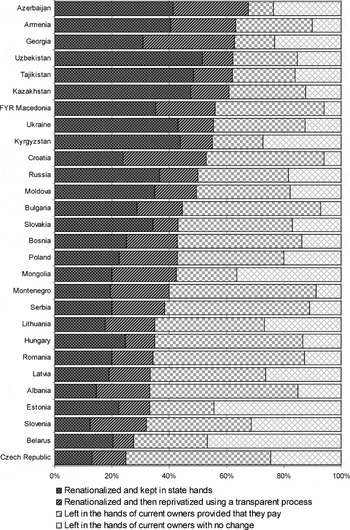
Figure 1 summarizes responses to this question. We dichotomize the responses by treating answers (1) and (2) as indicating opposition to revising privatization and responses (3) and (4) as signaling support for revising privatization. For our purposes, the critical distinction between these two groups is that the latter two responses entail the expropriation of privatized assets held by current owners—either by renationalization or by renationalization and then reprivatization, whereas the former two responses allow the current owners to retain their assets.Footnote 7 Support for the revision of privatization is the main dependent variable in our empirical analysis.Footnote 8
Public Support for Revising Privatization across Countries
Note: Weights applied to ensure that the population as a whole is represented, taking into account the age and gender distribution of the population in each country (see EBRD 2007a, 6). The reported percentages have a Bernoulli distribution. Their standard errors depend on the actual percentage and the number of observations (1,000 per country); thus, they are equal to 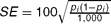 , where pi denotes the percentage points as reported in the table. The magnitudes of the SE indicate that if a difference between any two countries exceeds 3 percentage points, it is statistically significant.

On average, 46.7% of respondents in all countries support revising privatization by taking assets from the current owners through either renationalization or renationalization followed by reprivatization. This figure varies considerably across countries: from 67.8% in Azerbaijan to 24.8% in the Czech Republic. The majority of the population supports revising privatization in eleven of twenty-eight countries in our sample. Differences in question wording make direct comparisons with other surveys difficult, but these results are not too dissimilar from recent studies from Latin America. For example, Panizza and Yanez (Reference Panizza and Yanez2005) cite LatinoBarometer data from 17 countries in 1998, which finds that 50% of respondents believed that “privatization was not beneficial for the country,” a figure that rose to more than 65% in 2003.
We focus on support for revising privatization for several reasons. First, privatization is a key component of economic reforms in transition and developing countries, and removing assets from the hands of current owners marks a significant change in the economic and political environment. Even the threat of revising privatization can have important economic consequences by weakening the incentives of current owners to invest in their business. Second, privatization and its possible revision are high-profile policies that have engendered great public debate, which increases the likelihood that respondents have given the issue some thought. Third, the survey has a relatively clean question on support for and opposition to revising privatization that is comparable across countries. Our empirical results are unchanged when we use a more general question from the survey that asks directly about “support for a market economy” as a dependent variable, but we prefer to focus on the revision of privatization as a more concrete example of support for economic reforms (as we discuss in the “Robustness Checks” section later in this article).Footnote 9
Measures of Market-relevant Skills
Our main focus is on market-relevant skills. We proxy for them in two ways, relying on the type of jobs respondents hold and on their professions:
(1) First, we consider those who have become entrepreneurs and self-employed during the transition as having skills particularly suitable for a market economy. Economic reform gives new entrepreneurs an opportunity to reveal their market skills – talents that were not in demand before transition.
(2) Second, we deem those respondents who hold high managerial positions and work as top-level professionals (i.e., groups 1 and 2 in the 1-digit Standard Occupational Classification 2000) as having high levels of market-relevant skills. Top-level professionals and company managers have skills especially rewarded in a market economy where the wage distribution is substantially less compressed than in a command economy. We refer to these occupations as professionals in our analysis.Footnote 10
Seven percent of respondents are entrepreneurs, and 10% are professionals in our sample. The rest of respondents work for wages in the occupational groups 3 to 9 or do not work.Footnote 11 By construction, there is no overlap in these two groups (i.e., entrepreneurs and professionals), but we argue that both groups have skills with potentially high returns under a market economy.
Other conventional measures of human capital, such as education and experience (proxied by age), are poor indicators of market skills in a postcommunist environment. Much of the work experience gained by those who worked for many years under the command economy is likely to be of little value in a more open market economy (Guriev and Zhuravskaya Reference Guriev and Zhuravskaya2009). Similarly, education, particularly vocational education, prior to 1990 (and, in some cases, for several years after) was designed to prepare citizens to perform tasks relevant to a planned economy – tasks that are largely obsolete in a market environment. Note that we always control for these common measures of human capital in our analysis.
Measures of the Institutional Environment
Our focus is on whether the impact of market skills on support for economic reform is contingent on the level of democracy and on the quality of governance. To be more specific, we examine whether democracy and good governance serve as complements or substitutes to market skills. If, for example, democracy and market skills are complements, then as the quality of democracy improves, respondents with high market skills should be significantly more likely to support economic reform compared to those with low market skills. If democracy and market skills are substitutes, then in more democratic countries respondents with high market skills should be less likely to support economic reform in comparison to those with low market skills.
Given disagreement about how best to measure democracy, we use four indicators that emphasize slightly different elements of democracy: (1) the executive constraints measure from Polity IV, which captures the extent of limits on the policy-making power of the chief executive; (2) the democracy score from POLITY IV, which measures the intensity of political competition; (3) the voice measure from Kaufmann, Kraay, and Mastruzzi (Reference Kaufmann, Kraay and Mastruzzi2006), which indicates the level of popular participation and freedom of expression; and (4) the Freedom House Nations in Transit index, which is a score indicating the progress of democracy. Each commonly used measure of democracy has strengths and weaknesses. The two POLITY measures are based on relatively less subjective indicators, but the rating for executive constraints has a rather low ceiling.Footnote 12 The Freedom House measure seems to provide a closer fit with the secondary literature in the transition countries than the POLITY measures, but is based on rather subjective measures. The voice measure from Kaufmann, Kraay, and Mastruzzi (Reference Kaufmann, Kraay and Mastruzzi2006) is also based in part on subjective measures as captured by national-level surveys.
Our indicators of governance quality also come from Kaufmann et al. (Reference Kaufmann, Kraay and Mastruzzi2006). We use the following indices: government effectiveness, the rule of law, control over corruption, and regulatory quality. These measures are designed to highlight somewhat different aspects of the quality of governance; but, in reality, they are highly correlated across countries. Each aspect of the quality of governance, however, has the potential to shape the economic returns to market skills.
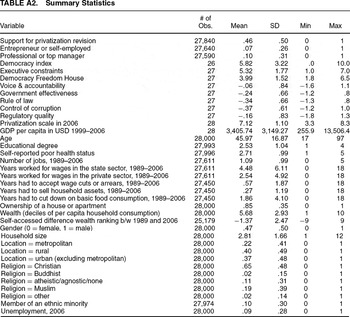
There are 28 countries in the LiTS survey, but most of the institutional measures are not available for Montenegro; in addition, the POLITY measures are not available for Bosnia. As a consequence, our sample consists of 27 countries (or 26 when we use the Democracy Index). We describe and summarize each main variable of interest as well as all control variables (to be introduced later) in Tables A1 and A2 in the Appendix.
EMPIRICAL METHODOLOGY
To test our hypotheses about the complementarity or substitutability of market-relevant skills and democracy and governance institutions, we compare individual support for revising privatization between groups that do and do not have market-relevant skills in good and bad institutional environments controlling for a wide range of individual and country characteristics.
As a first step (before we proceed to the core of our analysis), we want to establish the benchmark of an average effect of market-relevant skills on support for revising privatization controlling for all country-level variation. For that purpose, we conduct the following Probit estimation:

where i indexes individuals and c indexes countries in which individual i lives; Ri is a dummy that equals one if the individual i supports revising privatization; Ei is a dummy indicating entrepreneurs and self-employed persons; and Pi is a dummy indicating individuals working as professionals and top managers. ϕc is a country fixed effect. Xi is a vector of individual covariates; it includes a range of factors that may shape support for economic reform and may be correlated with market-relevant skills. The LiTS data offer a rich set of control variables related to individuals' transition experiences, including labor market history and hardships that individuals experienced between 1989 and 2006. In particular, we control for how long the respondents worked for wages in the state and private sectors, the number of different jobs they held, the number of years that respondents experienced food cuts, wage arrears, and whether they had to sell household assets to make ends meet. The list of individual controls also includes various proxies for the relative and absolute income and wealth of the respondent, as well as the respondent's perception of his or her position in the wealth distribution from the beginning of transition to 2006. In addition, we control for age, education level, gender, location of residence (rural vs. urban vs. metropolitan area), religion, whether the respondent belongs to an ethnic minority, and current labor market status (employed vs. unemployed).
In this specification, we use bootstrapped standard errors adjusted for clustering of a heteroscedastic error term at the level of primary sampling units (PSUs) (i.e., 50 residential locations drawn at random within each country).Footnote 13 Equation (1) estimates the average effects of market-relevant skills on the support of privatization revision, β1 and γ1, which are expected to be negative.
National Institutions and Individual Skills
Our primary interest, however, is in whether the effect of market-relevant skills on support for revising privatization depends on a country's institutional environment. Thus, as a second step in our analysis, we introduce interaction effects between variables measuring democracy and governance institutions and variables measuring market skills. Because this approach requires the use of variables measured at two different levels (i.e., individual and country level), we estimate three alternative models designed to handle multilevel data, each of which has its desirable and undesirable features. We begin with a probit model with country fixed effects, which is a direct generalization of Equation (1):

where Ic denotes a particular measure of institutional environment of country c (i.e., one of our proxies for democracy or governance quality). Superscript d at Ic indicates that we subtract the overall sample mean from the institutional measure Ic before taking the cross-term in order for β1 and γ1 to have the same interpretation as in Equation (1) (i.e., the effect of market-relevant skills evaluated at the average level of the institutional environment). We include institutional measures in these regressions one by one because they are highly correlated with each other and consider them simply as alternative measures of democracy and governance quality. The rest of the notation and the assumptions about the variance–covariance matrix are unchanged.
The coefficients on the interaction terms, β2 and γ2, test for the complementarity and the substitutability of institution I with individual market skills. If they have the same sign as the direct effect of market skills (i.e., are negative), we would conclude that there is a complementarity of skills and institutions. In contrast, if β2 and γ2 have the opposite sign of the direct effect of market skills (i.e., are positive), then skills and institutions are substitutes.
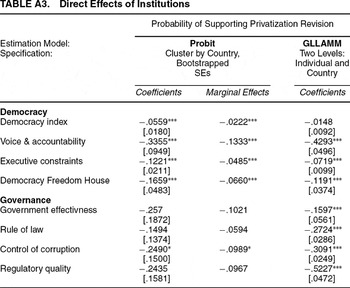
In addition, to highlight the direct effect of institutions, I, we estimate a probit model without country fixed effects, but with the direct effect of I as an additional covariate. In the following specification, we cluster the error term at the level of countries that is necessary as we include national-level variables in the list of covariates. As done previously, standard errors are bootstrapped.

Because Equation (3) omits country fixed effects, we control for the following national-level variables (Zc): the extent of country's large and small privatization in 2006 as measured by the EBRD and the log per capita GDP averaged for 1999 to 2006, because both income and the extent of privatization may shape the support for revising privatization.Footnote 14 The estimation of the parameter θ in Equation (3) is purely auxiliary because institutions are likely endogenous to public attitudes toward market reforms, and we do not claim to establish direct causality from the level of institutions to support for privatization revision. We discuss this issue (as well as the effect of the endogeneity of institutions for the estimation of our parameters of interest) in detail in the next subsection.
Estimating Equation (3) with a probit model has the advantage of simplicity and ease of computation, but only partially recognizes the nested structure of the data: responses from many individuals who reside in a small number of countries (Leoni Reference Leoni2009).Footnote 15 To make sure that our results are not driven by potential problems with the probit estimation of the variance–covariance matrix, we estimate Equation (3) using two additional methods. First, we estimate a one-step, two-level model using a Generalized Linear Latent and Mixed Model (GLLAMM), which takes into account that the data reside in two levels (Rabe-Hesketh and Skrondal Reference Rabe-Hesketh and Skrondal2008). Finally, we estimate a two-step model that also accounts for the nested structure of the data (Huber, Kernell, and Leoni Reference Huber, Kernell and Leoni2005).Footnote 16 This procedure begins by estimating a probit model for each country using individual-level predictors, and gathers the coefficients on the constants and individual-level variables, which are then used as the dependent variables in second-stage estimations with national-level variables as predictors (one at a time). The estimates of the national-level variables are weighted in accordance with the precision of the first-level estimates (Borjas and Sueyoshi Reference Borjas and Sueyoshi1994). This method is less efficient than one-step estimators, such as GLLAMM, but requires fewer distributional assumptions about the data (Beck Reference Beck2005; Leoni Reference Leoni2009). Both GLLAMM and the two-step method take into account the fact that we have only 27 country-level observations of the institutional environment. To the extent that the results are consistent across estimation procedures, we are more confident in them.
Endogeneity of Institutions
There are a number of reasons to believe that the level of democracy and the quality of governance institutions are endogenous to public support of market reforms in general and of privatization in particular.Footnote 17 Most important, crucial omitted variables, such as the quality and timing of reforms themselves, are likely correlated with both the quality of the institutional environment and public support for reforms. One can also argue that reverse causality is a potential problem for estimating the direct effect of institutions on public attitudes toward privatization because many of the institutional quality indices are themselves a compilation of survey responses, which to some extent may have been based on expert or public assessments of privatization. Note that this particular source of endogeneity is probably less damaging for the democracy variables than for the governance indicators because experts and survey respondents can more easily distinguish between privatization and political rights; moreover, POLITY IV measures of democracy do not include survey responses.
Our main focus, however, is on the interaction between the (endogenous) institutional variables, and our measures of market-relevant skills conditional on the effect of the institutional environment (either by controlling for country fixed effects or by the direct inclusion of institutional covariates). Our main identification assumption is that omitted variables and other potential sources of endogeneity of the institutional environment affect responses of individuals with high and low market skills to the same extent irrespective of the institutional environment. Thus, under this assumption, we can estimate the difference-in-differences effect of the interaction between market skills and institutions without a bias by comparing the difference in the support of market reforms between groups with low and high market skills in good and bad institutional environments.
RESULTS
Benchmark: Market Skills in an Average Institutional Environment
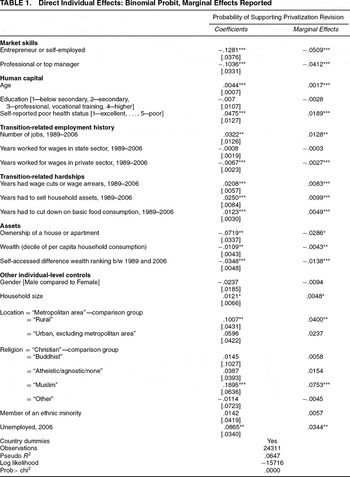
Table 1 presents the results of an estimation using individual-level factors as independent variables and controlling for all country-level variation (including institutions) with country fixed effects. Most important, we find that our measures of market skills are good predictors of support for the privatization status quo. Being a professional decreases the probability of supporting the revision of privatization on average by 4.1 percentage points. In addition, new entrepreneurs are on average 5.1 percentage points less likely to support revision of privatization than nonentrepreneurs. Thus, controlling for other factors, individuals with skills suited for an economy with extensive private ownership are especially likely to oppose revising privatization.
Direct Individual Effects: Binomial Probit, Marginal Effects Reported

Note: Bootstrapped standard errrors in brackets clustered at PSU level. Country fixed effects included.
*Significant at 10%; **significant at 5%; ***significant at 1%.
The relationship between other measures of human capital and attitudes toward revising privatization is weaker. This is, perhaps, because in transition economies these measures do not reflect the possession of skills specific to a market economy. Most notably, the level of education is statistically insignificant.Footnote 18 Age—often used in the literature as a proxy for experience—is positively related to support for revising privatization. The most likely reason for this relationship is that experience under a command economy does not help adjust to new market conditions (e.g., Guriev and Zhuravskaya N.d.). Note that the results are unchanged if we include a squared term for age in the list of regressors.
In addition, we find that employment trajectories are related to support for revising privatization. Respondents who held more jobs are more likely to favor revising privatization, whereas those who worked longer in the private sector are more vigorous opponents of revising privatization. Individuals who experienced extensive economic hardships related to transition are significantly more likely to favor revising privatization. Respondents from higher consumption deciles, those who own a home or an apartment, and those who moved up the wealth ladder during the transition support the revision of privatization significantly less than their counterparts with lower incomes and wealth and a less positive wealth trajectory during transition. The unemployed are significantly more likely to support a revision of privatization than the employed.Footnote 19
Market Skills in Different Institutional Environments
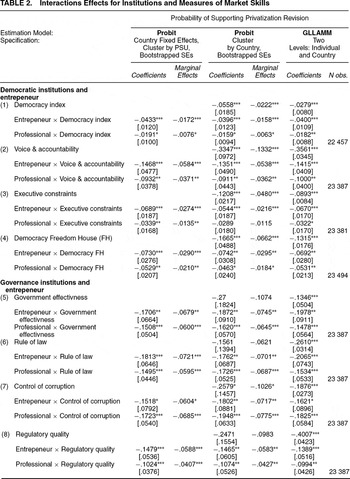
We now turn to the most important part of our analysis (i.e., testing for the complementarity or substitutability of democracy and good governance with market skills of individuals). We begin by exploring the impact of market skills conditional on the level of democracy and governance using single-stage estimations in Table 2. The first two columns present coefficients and marginal effects of the interaction terms between measures of market skills and institutions from the probit estimations with country fixed effects (i.e., Equation (2)). The top panel of Table 2 presents results for democracy, and the lower panel for governance institutions. The results are consistent with the view that both democracy and good governance institutions complement private returns to skill from economic reform. In regressions for all our measures of institutions without exception, the coefficients on the interaction terms between the relevant institution, on the one hand, and the dummy variables for entrepreneur and for professional or top manager, on the other hand, are negative and statistically significant. Therefore, as democratic institutions grow stronger and governance improves, the difference in the support for revising privatization between groups with high market skills and low market skills increases: those with market skills become stronger opponents of the revision of privatization relative to those without market skills.
Interactions Effects for Institutions and Measures of Market Skills

Note: Standard errors in brackets. *Significant at 10%; **significant at 5%; ***significant at 1%.
The first column indicates 8 separate regressions run for each model (one regression for each institutional variable).
All regressions include all individual-level factors from Table 1 as covariates. Only the coefficients of interest are reported in the table. The full regression output is available from the authors. The estimated coefficients on “Entrepreneur” and “Professional” dummies in every regression are as reported in Table 1 because we subtract the sample mean from the component variables before taking cross-terms.
In Columns 3 and 4, we report results from a probit estimation without country fixed effects, but with the direct effect of the relevant institution included and clusters by country (i.e., Equation (3)). The results comport well with the results based on the fixed effects estimation. Again, all interaction terms are negative and statistically significant (with one exception: the coefficient on the interaction between professionals and executive constraints is negative but insignificant). In Column 5, we repeat this estimation using GLLAMM, and despite the small number of second-level observations, the results are again consistent. Overall, the results strongly support the complementarity argument.
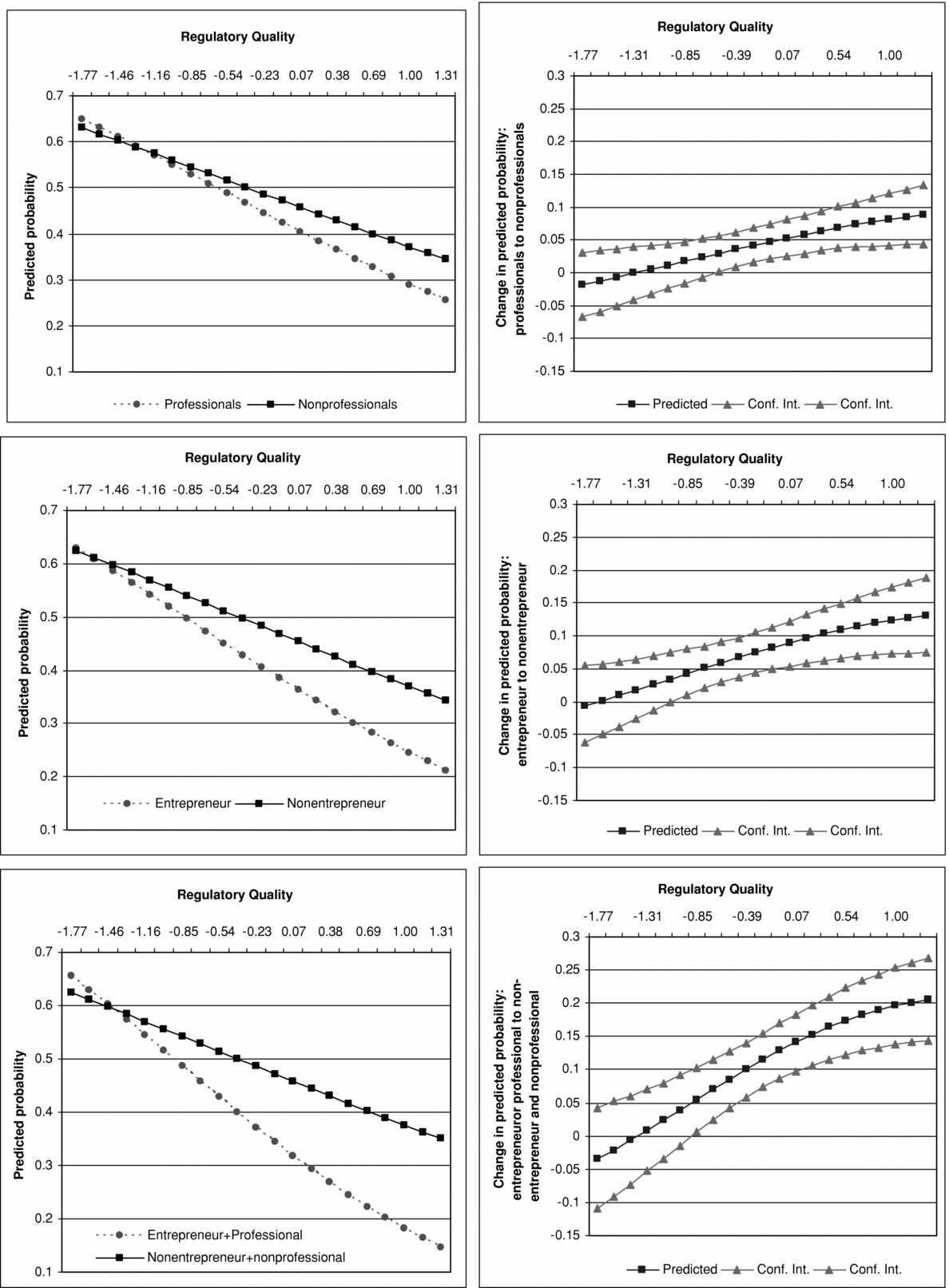
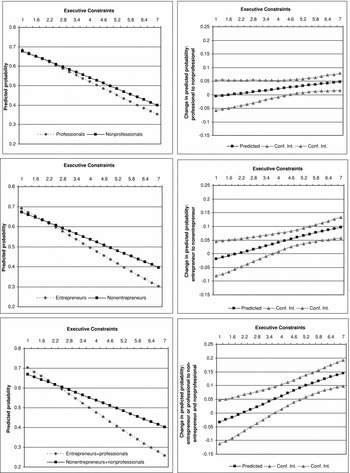
To illustrate the magnitude of our results, we predict probabilities of support for revising privatization with their confidence intervals for groups with high and low market skills at each level of institutional quality using Monte Carlo simulations. The simulations are based on a probit estimation similar to the one reported in Columns 3 and 4 of Table 2 (i.e., Equation (3)).Footnote 20 Using the results of these simulations, we generated a series of graphs. Figure 2 illustrates the differences in the predicted probability of support for the revision of privatization for individuals with and without market skills under varying levels of democracy as measured by POLITY IV's executive constraints variable. The graphs in the left column from the top to the bottom present predicted probabilities of support for revising privatization for (1) professionals compared to nonprofessionals, (2) entrepreneurs compared to nonentrepreneurs, and (3) a group of entrepreneurs and professionals compared to a group of nonentrepreneurs and nonprofessionals for each possible level of constraints on executives (in the range present in our data). The graphs in the right column depict the change in the predicted probability of supporting a revision of privatization associated with a move from (1) a professional to a nonprofessional, (2) an entrepreneur to a nonentrepreneur, (3) and an entrepreneur or a professional to a nonentrepreneur and nonprofessional, for each level of executive constraints with 95% confidence intervals.
Predicted Effect of Interaction between Constraints on Executives and Market Skills on Public Support for Revising Privatization

The first thing to note from these graphs is that at low levels of democracy there is no appreciable difference in the attitudes toward the revision of privatization between professionals and nonprofessionals and between entrepreneurs and nonentrepreneurs—groups with and without market skills have very high levels of support for revising privatization. At the lowest level of constraints on executives (i.e., as in Uzbekistan), the rate of support for the revision of privatization is at its peak (70%) for all groups regardless of market skills. As democracy becomes more robust, market skills begin to matter. For example, when the executive constraint score is at its maximum, which is the modal value for countries in our sample, moving from a professional to a nonprofessional increases the probability of supporting the revision of privatization by 5 percentage points and moving from an entrepreneur to a nonentrepreneur increases this probability by 10 percentage points. The effect of market skills is especially pronounced if we compare the support for revising privatization between entrepreneurs and professionals as one group and nonentrepreneurs and nonprofessionals as the other group, as we do in the bottom row of Figure 2. When the executive constraints measure is at its peak, a change from being either an entrepreneur or a professional to being a nonprofessional and nonentrepreneur is associated with an increase in the predicted probability of support for revising privatization of about 15 percentage points (with 10 being the lower bound of the 95% confidence interval). At this level of democracy, 40% of individuals in the group with low market skills support revising privatization, whereas the rate of support for revising privatization is only about 25% among those with high market skills. The bottom right graph shows that if the executive constraint measure falls below 4 (the level of Russia), the differences in attitudes toward privatization are not statistically significant for those with and without market skills, whereas for a level of constraints on executives above the level of Russia, these differences are statistically significant.
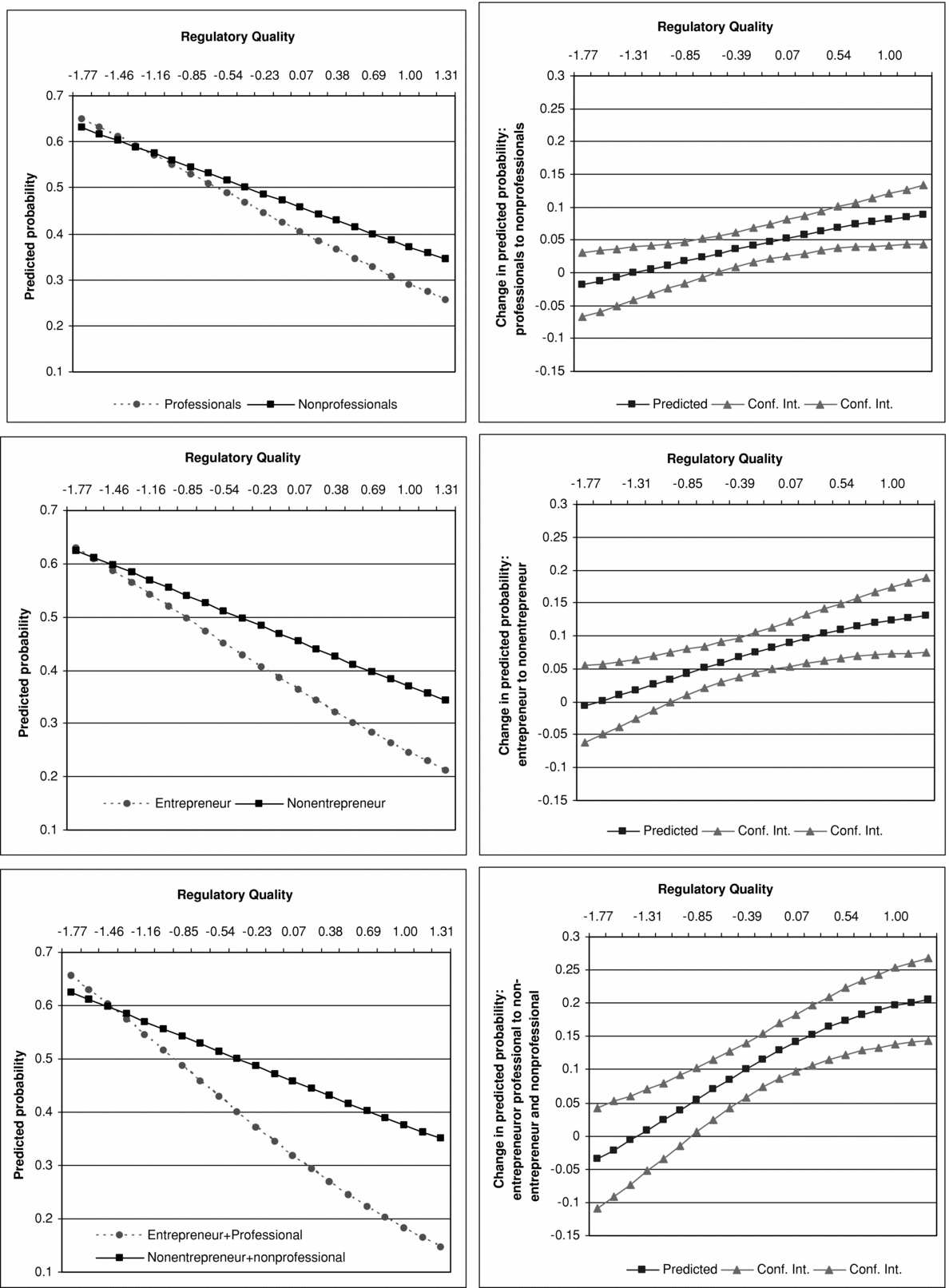
Similar graphs in Figure 3 illustrate the results for regulatory quality. Again, we see that the difference in the rate of support for the revision of privatization between nonprofessionals and professionals and between nonentrepreneurs and entrepreneurs increases with the quality of the regulatory environment. More specifically, as shown in the top row of Figure 3, moving from a professional to a nonprofessional increases the predicted probability of supporting a revision of privatization by about 2 percentage points when regulatory quality is at the 25th percentile (−.69, which is approximately equal to the level of regulatory quality in Georgia) and by about 7 percentage points when regulatory quality is at the 75th percentile (.66, which is approximately the level of the Slovak Republic). The middle row indicates that an increase in support for the privatization status quo associated with moving from an entrepreneur to a nonentrepreneur is even more striking. At the level of regulatory quality of Georgia, becoming an entrepreneur decreases support for revising privatization by about 5 percentage points, but at the level of regulatory quality of the Slovak Republic, this decrease is roughly 12 percentage points. The graphs in the bottom row, again, indicate that the greatest differences emerge if we combine different aspects of market skills (i.e., professional status and entrepreneurship): the corresponding difference in the support for revising privatization for people with low and high market skills at the levels of regulatory quality of Georgia and Slovak Republic are 7 and 18 percentage points, respectively. For the highest level of regulatory quality in our sample (Estonia), the rate of support for revising privatization is 35% for the group with no market skills, whereas it is 15% for the group with market skills. The differences in support for revising privatization for the two groups become statistically significant at the level of regulatory quality above Azerbaijan (−.85). The results using other measures of democracy and quality of governance are similar.
Predicted Effect of Interaction between Regulatory Quality and Market Skills on Public Support for Revising Privatization
Note: Graphs generated on the basis of probit estimation with clusters on PSU using King, Tomz, and Wittenberg (Reference King, Tomz and Wittenberg2000) software “Clarify, 2003” available at http://gking.harvard.edu/. “Conf. Int.” indicates the 95% confidence interval around the change in the predicted probability indicated by “Predicted.”
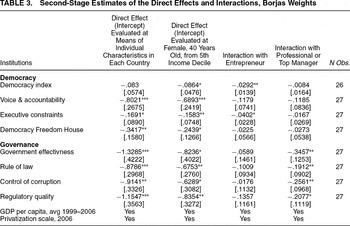
Finally, we report estimations of support for revising privatization using the two-stage method, as suggested by Huber, Kernell, and Leoni (Reference Huber, Kernell and Leoni2005). Table 3 presents coefficients from the second-stage estimation. The top panel reports results using the measures of democracy, and the bottom panel for the quality of governance measures. The results for interactions between market skills and institutions, reported in Columns 3 and 4, are somewhat weaker but consistent in certain respects with the probit and the GLLAMM results (reported in Table 2). The coefficients on the interaction between the measures of democracy and the dummy variable for entrepreneurship reported are always negative, but reach conventional levels of significance in only two of four regressions (Column 3). (In a third regression, the p-value of the estimated coefficient is .12.) The coefficients on the interaction terms between our four measures of democracy and a dummy variable for professionals and top managers have the correct signs, but are statistically insignificant (Column 4).
Second-Stage Estimates of the Direct Effects and Interactions, Borjas Weights

Note: Coefficients reported. Standard errors in brackets.*significant at 10%;**significant at 5%;***significant at 1%. The baseline in the first column is mean value for all individual characteristics calculated separately in each country; in the second column, it is a 40-year-old female from the 5th income decile. Coefficients are estimates using linear regression with Borjas weights. Each reported coefficient is taken from a separate second-stage regression with controls for GDP per capita and extent of privatization.
The coefficients on the interaction terms of our measures of governance and the dummy variables for entrepreneurs have the correct sign, but do not approach statistical significance (Column 3). In contrast, the coefficients on the interaction terms between the four governance measures and the dummy variable for professionals and top managers are always significant and negative. It is important to note that the loss of statistical power is expected given the limitations of having few (26 to 27) observations in the second-stage regressions. Overall, a consistent pattern of results emerges from the three different estimation procedures, which supports the view of complementarity of skills and institutions.
Direct Effect of the Institutional Environment
Thus far, we have examined the impact of market skills on support for revising privatization under varying institutional environments, but have not looked at whether institutions themselves are correlated with support for the revision of privatization. If democracy and good governance institutions help the population at large to gain from reform, then one might expect these national-level variables to be negatively associated with support for the revision of privatization.Footnote 21 The two-stage model advocated by Huber et al. (Reference Huber, Kernell and Leoni2005) permits an exploration of the direct effects of the national-level variables on individual-level responses. The estimates of the effect of national-level variables in the two-stage method are not invariant to the scaling of the individual-level variables. As the income distributions and demographic structures of the population vary substantially across countries in our sample, we present the results for an average respondent in each country in Column 1 of Table 3 and for a respondent who is a 40-year-old female from the 5th income decile in Column 2 of Table 3. Each of our four measures of democracy and governance significantly reduces the levels of support for revising privatization for a 40-year-old female, and this is also true for an average respondent, with the exception of the insignificant effect of the democracy index. Thus, on average, citizens in more democratic and better governed countries express lower levels of support for revising privatization.Footnote 22
The results on the direct effects of institutions are merely suggestive of correlations and limited in at least two important respects. First, and most important, institutions are endogenous (as we discussed previously). Second, the number of second-level observations (countries) is relatively small.
ROBUSTNESS CHECKS
In the main part of our analysis, we focus on support for the revision of privatization as a critical component of opposition to economic reform, but our results apply to public attitudes toward the market more generally. In particular, the results hold if we use responses to the following question in the survey as a dependent variable:
With which of these statements do you agree most?
(1) A market economy is preferable to any other form of economic system.
(2) Under some circumstances, a planned economy may be preferable to a market economy.
(3) For people like me, it does not matter whether the economic system is organized as a market economy or as a planned economy.
We repeated our analysis using a dichotomous variable that equals 1 if the respondent chose options 2 or 3, and 0, if the respondent chose option 1. This measure is highly correlated in our baseline measure of support for revision of privatization (the correlation coefficient is about .18 with p-value substantially below 1%). The results are robust to using support for the market as a dependent variable. The signs of the coefficients of interest are always the same, and the magnitudes of the coefficients are often a little smaller, but the coefficients remain statistically significant in the vast majority of cases. Note that some loss of statistical significance is to be expected given a larger measurement error in this question, which is more generally formulated and is not directly focused on reform per se, but on the existence of a market economy.
We also investigated whether institutions interact with other commonly used measures of human capital: education, age (as a proxy for experience), and health. No significant interactions effects were found. These results indicate that measures of human capital based on age and education are poor proxies for market-relevant skills in transition countries.
We further verified the robustness of our results by limiting the age of respondents to 60 years and younger to ensure that our results are not driven by the views of the retired population.
We also experimented with different model specifications. Because we have few second-level observations, we are somewhat limited in the number of independent variables that we can include in our estimations. Nevertheless, we also added variables for gross domestic product (GDP) growth from 1999 to 2006 and current levels of inequality to our estimations, but these variables were not significantly related to support for revising privatization and did not influence our main results. Although our results do not indicate that the impact of market skill on support for reform is conditional on economic inequality, this result may be specific to the postcommunist cases. Where economic inequality is on average higher, as in Latin America, the incentives for politicians to redistribute the gains from reform obtained by the highly skilled may be stronger because the median voter is more likely to be low skilled (Meltzer and Richards Reference Meltzer and Richards1981). This logic is more compatible with the substitution hypothesis. In contrast, where economic inequality is lower, as in much of Western Europe, the complementarity logic may have more bite.
We also examined whether the type of privatization (voucher vs. nonvoucher) or the method of privatization (sale vs. give away) influenced support for revising privatization directly and through interaction with market skills. These variables were generally unrelated to support for the revision of privatization and did not change our findings. However, capturing the type or method of privatization with a single measure is difficult, and these measures are likely to be noisy.
We also repeated our analysis using interactions of our national-level variables with only one of the two measures of market skills at a time in separate estimations. For example, instead of including interactions for measures of democracy and entrepreneurship and for democracy and professionals in each equation, we only included the latter interaction. The levels of statistical significance of our main variables of interest in our estimations remain unchanged.
In addition, we applied a weighting scheme for the summary statistics to account for the fact that the LiTS data may be somewhat biased toward elderly and female respondents due to nonresponses, even though the sample was originally constructed to be representative. In the baseline regressions, we do not apply this weighting scheme, but instead introduce controls for age and gender. When we use the weights in the regression analysis, the results do not change.
The results are also robust to dropping the two most authoritarian countries—Uzbekistan and Belarus—from the sample and to using the most recent values instead of the overtime averages for the institutional indicators.
Overall, our results prove to be robust.
CONCLUSION
Identifying the determinants of support for economic reform has been a central focus of recent research in comparative political economy, but most studies rely on data from too few countries to make it possible to analyze the impact of national-level institutions on individual preferences over policy. We take advantage of a new data set that allows us to explore how democracy and good governance interact with market skills to shape preferences over economic policy in 28 postcommunist countries. We find that under autocracy and bad governance, support for economic reform among individuals with market-relevant skills is not different than among individuals without market-relevant skills; however, as the quality of democracy and governance improves, the differences in support for economic reform between respondents with high and low market skills become greater. Thus, market skills and good institutional environments are complements rather than substitutes. These results hold not only for public support for revising privatization, but also for a market economy more generally.
Our results indicate that theories of the politics of economic reform may benefit from a consideration of how the institutional environment influences individual preferences over policy. Most works implicitly assume that groups benefiting or poised to benefit from economic reform will support economic reform regardless of the institutional setting, but our findings indicate that preferences over economic policy are conditional on the quality of democracy and governance. That the impact of market skills depends on the institutional environment suggests that theories of the politics of economic reform that rely on those with more market-relevant skills to push for economic reform, may have limited relevance under autocracy and in weak institutional environments. This is a potentially important limitation because economic reforms are often introduced in precisely these settings. Our results indicate that constituencies in support of economic reform may differ under democracy and good governance, on the one hand, and under autocracy and bad governance, on the other hand.
More generally, our study emphasizes the value of integrating national- and individual-level variables in the study of support for economic policy. Whether these results extend to policies beyond economic reform or to other regions of the world is an open question, but analyzing how skills and institutions interact to shape support for policy change is an important agenda for future research.
APPENDIX
Description of Variables

Summary Statistics

Note: For the summary statistics of individual-level variables, we apply weights to ensure that the population as a whole is represented, taking into account the age and gender distribution of the population in each country (see EBRD 2007a, 6). The summary statistics of country-level variables refer to averages over time. For the concrete time frame for each variable, see Table A1.
Direct Effects of Institutions

Note: Standard errors in brackets. *Significant at 10%; **significant at 5%; ***significant at 1%.
All regressions include all individual-level factors from Table 1 as covariates. Only the coefficients of interest are reported in the table. The whole regression output is available from the authors.




Comments
No Comments have been published for this article.