Introduction
Interspecific interactions among parasites co-infecting the same host have been well documented in both laboratory and field settings (Holmes, Reference Holmes1962; Holland, Reference Holland1984; Sousa, Reference Sousa1993). Several types of interactions are possible. Interspecific interactions can be positive when initial infection by one parasite species decreases the host's immune response, thus facilitating establishment and exploitation by other parasites (Sousa, Reference Sousa1994). More often, however, interactions are antagonistic; the presence of one parasite species decreases the number and has a negative effect on the distribution and reproduction of other species (Poulin, Reference Poulin1998). Antagonistic interactions between different parasite species in the same host may be expressed as direct competition or as interactive segregation, but elements of both may be present (Holmes, Reference Holmes1973). In the former case, selection would be expected to lead to an adaptively superior competitor, capable of excluding inferior competitors. In the latter case, selection would be expected to stabilize the segregation within hosts, leading to narrower niches for both parasites. Competitive exclusion among parasites appears to be fairly common and is frequently unilateral, with one species markedly affected by the presence of the second, but not vice versa (Schad, Reference Schad1966; Chappell, Reference Chappell1969; Holmes, Reference Holmes1973; Bates & Kennedy, Reference Bates and Kennedy1990). Competition between parasites can be seen as a potential regulator of parasite population densities and is an important factor structuring parasites communities (Grey & Hayunga, Reference Grey and Hayunga1980; Holmes & Price, Reference Holmes, Price, Anderson and Kikkawa1986; Kuris & Lafferty, Reference Kuris and Lafferty1994; Sousa, Reference Sousa1994).
In the British Isles, the distributions of two acanthocephalan species, Pomphorhynchus laevis and Acanthocephalus anguillae are local, restricted and discontinuous, and, when both species occurred in the same river systems, their distributions tended to be discrete, with little or no overlap (Kennedy et al., Reference Kennedy, Bates and Brown1989). In addition, where distribution overlap did occur, there was no record of both species occurring in the same fish host, such that the geographical and intestinal (i.e. within host) distributions of A. anguillae and P. laevis are mutually exclusive. Kennedy et al. (Reference Kennedy, Bates and Brown1989) thus suggested that interspecific competition between these two acanthocephalans species was one of the factors limiting their distribution.
Bates & Kennedy (Reference Bates and Kennedy1990, Reference Bates and Kennedy1991) investigated the possibility of interspecific competition using an elegant series of laboratory experiments designed to study the establishment, growth, maturation, fecundity and within-host site selection of the two species when alone and when co-occurring. The results, however, were contradictory. In the first experiment, rainbow trout (Onchorhynchus mykiss) were used as a laboratory host. Results showed that both the survival of A. anguillae and its location in the fish intestine of were affected by P. laevis, especially at high abundance of mixed infections. In contrast, P. laevis remained unaffected by the presence of A. anguillae, suggesting that the interspecific competition was unilateral (Bates & Kennedy, Reference Bates and Kennedy1990). In a second study using eels (Anguilla anguilla) as final hosts, Bates & Kennedy (Reference Bates and Kennedy1991) found no evidence of interspecific competition between P. laevis and A. anguillae. These two parasites utilize different crustacean species as intermediate hosts. Pomphorhynchus laevis relies on the amphipod Gammarus pulex, whereas A. anguillae exploits the isopod Asellus aquaticus. Both parasites, however, are capable of infecting a wide range of definitive hosts. Although interactions between these two species have been well studied in the laboratory, little attention has been devoted to the nature of their interactions in the field.
Here, some new results on the interactions between P. laevis and A. anguillae in two of their natural hosts in the River Tille (Burgundy, eastern France) are presented. Distribution patterns of each parasite species are assessed and results discussed in relation to previous considerations on their potential interactions. I specifically tested the exclusion hypothesis between P. laevis and A. anguillae to account for the lack of records of the two parasite co-occurring within the same host.
Materials and methods
This work followed the University of Burgundy guidelines for the treatment of animals in research. Information about individuals' origin, collection, housing conditions and killing are described below. Transport between sampling site and laboratory was devised to reduce stress and maximize animals' welfare.
A total of 195 individual fish were collected in the River Tille (Burgundy, France) between March and June 1999, using a hand net. The number of fish sampled was 104 Noemacheilus barbatulus (stone loach) and 91 Phoxinus phoxinus (minnow). After capture, fish were returned alive to the laboratory where they were immediately anesthetized with tricaine (MS-222, 300 mg/l, Sigma), killed by cervical dislocation, the fork length measured to the nearest 1.0 mm and weighted with a precision scale (±0.01 mg) (Precisa 262 SMA-FR). Fish were then dissected. The digestive tract, from stomach to anus, was removed and examined for parasites. Each parasite was identified based on the arrangement of the proboscis armature, number of hook rows and the size, shape and number of hooks by row (Brown et al., Reference Brown, Chubb and Veltkamp1986). For each parasite species, prevalence, mean abundance and mean intensity were calculated as described by Bush et al. (Reference Bush, Lafferty, Lotz and Shostak1997), as well as the variance-to-mean abundance ratio as a measure of over dispersion (Anderson & Gordon, Reference Anderson and Gordon1982). In addition, parasite biomass was taken as the total combined biomass of all parasites per individual host. The competition exclusion hypothesis was tested by comparing the observed number of concurrent infection to that expected on the basis of the prevalence of each parasite species using phi coefficient of association (Siegel & Castellan, Reference Siegel and Castellan1988). Because competition is both a spatial and temporal process; ideally, single habitat patches would be followed through time in a field. However, for endoparasites systems, this is clearly not possible because the host must be killed to count parasites. Detecting competition in the field is particularly difficult in this case where data are collected from a single sample. Thus, interaction coefficients between parasite species were estimated using a static regression approach to census data at one point in time over many sites (Schoener, Reference Schoener1974; Pfister, Reference Pfister1995). Separate regression analyses were performed on the abundance and total biomass of each parasite species (excluding uninfected fish), with fish size or fish biomass as the independent variable, respectively. Residuals from the regression for each parasite species were used in correlations for each parasite species against one another as an estimate of interspecies interactions (Rosenzweig et al., Reference Rosenzweig, Abramsky and Brand1984). Thus, prevalence, the variation in parasite species abundance and biomass due to fish characteristics are explained in the first regression, and only the variance unexplained by this is tested when assessing patterns potentially due to heterospecific parasite competition. In all cases, residuals were inspected for normality and for constant variance. Differences in the prevalence between parasites species and between fish species were tested using Fisher's exact test. Differences in mean biomass between parasite species were tested using the Mann–Whitney U-test. All results were considered significant at the 5% level.
Results
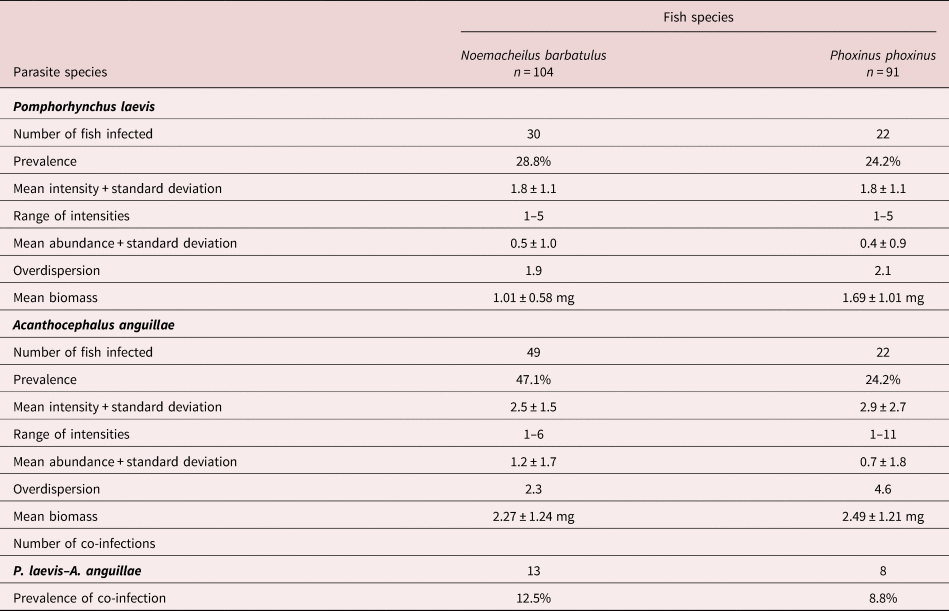
Pomphorhynchus laevis was found in both fish species (table 1). The prevalence of P. laevis was not significantly different between fish species (Fisher's exact test, P = 0.518; table 1). While A. anguillae was also found to occur in both P. phoxinus and N. barbatulus, parasite prevalence was significantly different between fish species (Fisher's exact test, P < 0.001; table 1). In all cases, the degree of overdispersion was >1, showing an aggregated distribution of each parasite species. A positive correlation was found between number of parasites and host body size in N. barbatulus (r s = 0.267, n = 104, P < 0.01) and P. phoxinus (r s = 0.508, n = 91, P < 0.0001). Similarly, parasite biomass and fish biomass were positively correlated in N. barbatulus (r s = 0.223, n = 104, P < 0.05) and P. phoxinus (r s = 0.507, n = 91, P < 0.001). There was no difference in the number of observed and expected concurrent infections based on the prevalences of P. laevis and A. anguillae in P. phoxinus (Phi coefficient of association, χ 2 = 2.35, df = 2, P = 0.125) or N. barbatulus (χ 2 = 0.24, df = 2, P = 0.623).
Occurrence of parasites among fish species in the River Tille (France).

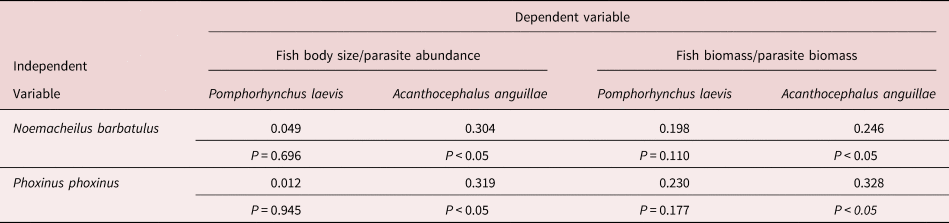
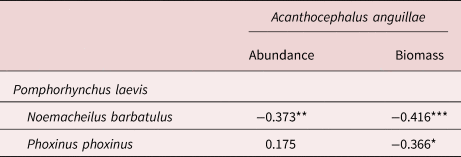
Fish body size and fish biomass explained a significant amount of the variation in the parasite abundance and parasite biomass of A. anguillae but not of P. laevis (table 2). There was a significantly negative interaction between P. laevis and A. anguillae for the parasite biomass in both P. phoxinus and N. barbatulus, and for the abundance of parasite only in N. barbatulus (table 3). In addition, mean parasite biomass differed significantly between A. anguillae and P. laevis in the N. barbatulus host (Mann–Whitney U, z = 7.78, P < 0.001) and in P. phoxinus (Mann–Whitney U, z = 3.39, P < 0.001) (see table 3).
Simple regression coefficients with their associated probabilities, for fish body size and parasite abundance relationship, and fish biomass and parasite biomass relationship.

Correlation coefficients between residuals from the regression between fish size and fish biomass and either abundance or biomass of each parasite species.

* P < 0.05.
** P < 0.01.
*** P < 0.001.
Discussion
The exclusion hypothesis based on competition between P. laevis and A. anguillae was proposed to account for the lack of records of the two parasites co-occurring within the same individual fish, even when the two species coexisted in the same river (Kennedy et al., Reference Kennedy, Bates and Brown1989). Contrastingly, the present data show no evidence for competitive exclusion between P. laevis and A. anguillae in the River Tille within the two natural final hosts, the stone loach and the minnow. However, a negative interaction between the two parasite species was detected in both abundance and biomass in N. barbatulus, and, to a lesser extent, in biomass in P. phoxinus.
The fact that the biomass analysis makes it easier to detect the negative interaction between the two parasites than the simple parasite number analysis could be explained by the difference in body size between P. laevis and A. anguillae. Indeed, from the host perspective, parasite biomass is known to be a more relevant measure of parasite abundance than the total number of parasite individuals, simply because body sizes of individual parasites can vary between parasite genus and species (Poulin & George-Nascimento, Reference Poulin and George-Nascimento2007). This hypothesis is confirmed in our study since the mean biomass of A. anguillae parasites were always more important than the mean biomass of P. laevis. In addition, this confirms that the biomass of parasite was limited, at least partly, by the host's characteristics (i.e. size and biomass).
Negative interactions between P. laevis and A. anguillae are not surprising and have been found previously by Bates & Kennedy (Reference Bates and Kennedy1990) in laboratory experiments in rainbow trout and by Dezfuli et al. (Reference Dezfuli, Giari, De Biaggi and Poulin2001) in brown trout (Salmo truta), although not strong enough to lead to an exclusion of one species from hosts harbouring a second species. Comparison with results from these previous studies seems to show a variation in the strength of these interactions according to biological processes and environment context.
In my study, the two species of fish hosts used are not the preferred hosts of either species of parasites (Bates & Kennedy, Reference Bates and Kennedy1991), and are rather small species compared to other fish species used in previous studies (Bates & Kennedy, Reference Bates and Kennedy1990, Reference Bates and Kennedy1991; Dezfuli et al., Reference Dezfuli, Giari, De Biaggi and Poulin2001). Thus, differences in the negative interaction between P. laevis and A. anguillae detected among studies within the different final hosts might merely reflect different host suitability for the two parasites.
Furthermore, Dezfuli et al. (Reference Dezfuli, Giari, De Biaggi and Poulin2001) pointed out that negative interactions between A. anguillae and P. laevis, and more generally between helminth species, were not significant in all streams, and could only be detectable under certain conditions of abundance and dispersion of parasite species among host individuals (Dobson, Reference Dobson1985). In this study, P. laevis and A. anguillae are characterized by a complex, two-host life cycle, and are known to induce modifications of their host's behaviour in ways that may increase their susceptibility to predation by final hosts (Lagrue et al., Reference Lagrue, Kaldonski, Perrot-Minnot, Motreuil and Bollache2007). The intermediate hosts of P. laevis are crustacean amphipod belonging to the genus Gammarus (Lagrue et al., Reference Lagrue, Kaldonski, Perrot-Minnot, Motreuil and Bollache2007; Moret et al., Reference Moret, Bollache, Wattier and Rigaud2007), whereas Asellus aquaticus is the intermediate host of A. anguillae (Dezfuli et al., Reference Dezfuli, Rosetti and Fano1994). These two intermediate hosts can show different densities according to water pollution level (Galli et al., Reference Galli, Mariniello, Crosa, Ortis, Ambrogi and D'Amelio1998; MacNeil et al., Reference MacNeil, Dick, Bigsby, Elwood, Montgomery, Gibbins and Kelly2002), or predator–prey relationship (MacNeil et al., Reference MacNeil, Dick, Bigsby, Elwood, Montgomery, Gibbins and Kelly2002), which may, in turn, influence the probability of infection for the definitive hosts.
Although competition often leads to exclusion, there are numerous mechanisms whereby coexistence can occur. Niche partitioning is, for example, one of the best-understood mechanisms of coexistence (Karvonen et al., Reference Karvonen, Terho, Seppälä, Jokela and Valtonen2006). Thus, competitive interactions within the host can shape the evolution of parasite phenotypes and can even facilitate the coexistence of multiple parasite types and increase parasite diversity (Bashey, Reference Bashey2015). Competition between P. laevis and A. anguillae in naturally infected hosts seems to lead to site segregation in the gut. An analysis of the situation in other and preferred hosts, like chub (Leuciscus cephalus) or barbel (Barbus barbus), and a comparison between interspecific and intraspecific competition could permit a better understanding of the population regulation and the maintenance of parasite diversity.
Acknowledgements
I thank Raphael Baudrillier, Gérard Gambade, Sophie Bourgeon, Nicolas Kaldonski, Fabien Lacaille, Vincent Pagnon, Alexandre Millon and Catherine Routhier for their assistance in the field, Claude Vaucher for his assistance in parasite identification, and Stewart Plaistow, Serge Morand, Robert Elwood and Clément Lagrue for their helpful comments on the first draft.
Financial support
We thank the Agence française pour la biodiversité (Mr Julien BOUCHARD) for offering to participate to the field monitoring campaign. The experiments and fish sampling comply with the current laws of France. This work was supported by a grant from the Conseil Régional de Bourgogne.
Conflicts of interest
None.
Ethical standards
The authors assert that all procedures contributing to this work comply with the ethical standards of the relevant national and institutional guides on the care and use of laboratory animals.