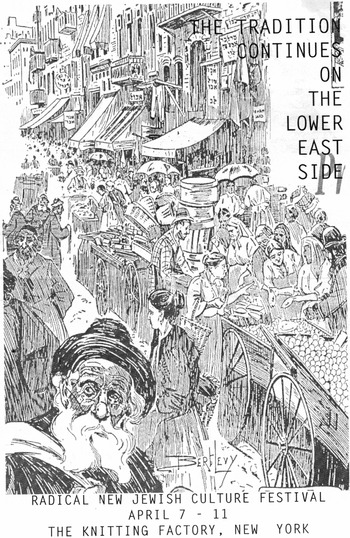
In April 1993 the Knitting Factory, a small nightclub in Lower Manhattan, hosted a five-day “Radical New Jewish Culture Festival.”Footnote 1 Despite the title's bold claim, the quaintly rendered pen-and-ink sketch on the cover of the festival's program was hardly radical or new (see Figure 1). Instead, it showed a classic turn-of-the-century Lower East Side street scene, filled with iconic images associated with Jewish life in that crowded immigrant quarter: a street packed with vendors, wares piled high in wooden carts, men and women in old-fashioned garb, tenement buildings cluttered with awnings, and signs in Hebrew lettering.Footnote 2 In contrast to the busy background, in the immediate foreground was an old man sketched in more detail. Glancing outside the drawing's frame, he sported a luxuriant white beard and soft white side-locks, small round spectacles, a dark coat, and a wide-brimmed hat: all signs of Jewish piety and adherence to Old World tradition.Footnote 3 It is striking, then, that the festival's title appeared directly beneath this man's gaze, and that superimposed on the street scene was the phrase “The Tradition Continues on the Lower East Side.”
Program cover, “The Tradition Continues on the Lower East Side,” Radical New Jewish Culture Festival, Knitting Factory, New York City, 7–11 April 1993.

The Knitting Factory was an incongruous place to evoke either Radical New Jewish Culture or Jewish immigrant life.Footnote 4 Located on a noisy thoroughfare in Lower Manhattan, since opening in 1987 “the Knit” had been the key nexus for New York City's transgressive downtown music world, whose overlapping networks included devotees of “New York Noise,” artists from post-1960s jazz and black experimentalist circles, European free improvisers, conservatory-trained jazz and “New Music” performers, and neo-funk/punk rockers. The “downtown scene” I discuss here was one such network, a community of interest that developed in the late 1970s–1980s among artists of varied backgrounds curious about developing compositional contexts in which they might, through improvisation, juxtapose, blend, and deconstruct musical idioms that were customarily kept separate.Footnote 5 The Knit became the main performance and gathering space for this newly forming community, whose modus operandi was to subvert tradition rather than to foster it.
The interplay between text and image on the program's cover yields several layers of cognitive dissonance regarding the festival's claimed link to Jewish tradition and its projection of a turn-of-the-century street scene onto the dire present of the streets outside the club. It is doubtful that the festival's producers could have claimed much common ground with traditionally observant Jews like the man depicted in the illustration, who would surely have censured the festival for transgressing the laws that govern the observance of the Jewish Sabbath. The program's cover illustration also created a puzzle by imposing the memory of a distant past onto the clamorous present of Manhattan's Lower East Side and the hardscrabble existence of its differently marginalized communities. The neighborhood was home to a working-class Puerto Rican community (“Loisada”), public housing projects, and a vociferous tradition of political activism. The neighborhood had been hit hard by the city's financial crises of the 1970s and 1980s, and in the early 1990s it was gripped by pitched battles over urban development and gentrification, driven both by class issues and by the threat that development posed to the neighborhood's cultural and creative identity.Footnote 6 Open-air markets were still held on the street, but the crowd on the program's cover seemed hardly representative of the current neighborhood's character or its most pressing concerns.
It is illuminating to consider these contradictions in light of the festival's broader context, for this event was part of a multifaceted creative endeavor. This endeavor, which identified itself under various rubrics—“Radical New Jewish Music,” “Jewish Alternative Movement,” “Jewish Avant-Garde Music”—was dubbed “Radical Jewish Culture” by saxophonist John Zorn, and for better or worse, given the hubris of the phrase, this rubric stuck. During the 1990s “Radical Jewish Culture” (RJC) was a galvanizing creative force, leading musicians to form new bands and to write, perform, and record a substantial corpus of new music.Footnote 7 The collective aspect of this project was new, but the RJC scene also crystallized a longstanding interest among downtown-based musicians, many of whom had previously written Jewish-identified pieces. The body of pre-RJC work recorded by pianist Anthony Coleman, clarinetist Don Byron, drummer Ted Epstein, guitarist Gary Lucas, vocalist Shelley Hirsch, saxophonist Roy Nathanson, guitarist Elliott Sharp, and Zorn himself illustrates that rather than manifesting a new idea, RJC intensified a creative impulse already present on the scene.Footnote 8
Whereas artists took part in RJC for a variety of reasons, in retrospect they were united by two main purposes. First, they created forums, of which the 1993 festival is an example, designed to present new music that engaged with Jewish cultural heritage while retaining the unique experimentalist character that was the hallmark of the downtown scene. From 1992 to 1997, there was a substantial annual RJC festival (with several evenings of themed programming) in New York City, and from 1995 to 1998 Michael Dorf, the Knit's founder—who had been producing klezmer festivals at the club since 1990—curated a public Passover seder that incorporated performances by downtown musicians. Artists also brought their Jewish-identified work to numerous venues in and outside New York City.Footnote 9 Second, through speaking and writing, musicians created a conceptual space in which to think collectively about the Jewish heritage many shared, in the context of the experimentalist scene they had helped to create.
One of the guiding questions was why it seemed radical to make Jewish music a focal point. After all, the downtown scene, whose main principle was an openness to creative influence from any quarter, had developed in a city whose character was strongly influenced by a wave of early-twentieth-century Jewish immigration. Nevertheless, whereas these musicians were cognizant of Jewish culture in many ways, each tended to maintain a divide between his or her creative (public) and Jewish (private) identity. I interviewed several artists who affirmed that before the first RJC festivals they had not realized many of their peers were Jewish. As vocalist Shelley Hirsch recalled, the Munich festival “was an amazing event, because it brought together all these people—I never knew Mark Dresser was Jewish, I never knew Lou Reed was [Jewish]. . . . And then you said, ‘That's incredible! I never thought of that person as being Jewish.’”Footnote 10 The first RJC festival created a kind of collective shock, yielding an unexpectedly powerful experience of purposeful, communal Jewish identification as downtown experimentalists per se. Artists followed up by pursuing the question of why such recognition had been lacking in the first place, and how this lack might have had a hitherto unrecognized impact on their creative work. As Coleman observed, “We looked around—each of us, individually—and we saw that this major part of our selfhood was missing as a [consciously chosen] color in our palette. And this seemed a little ridiculous.”Footnote 11 In this vein, interviewees often mentioned Jewish artists and thinkers—Lenny Bruce, Allen Ginsburg, Isaac Bashevis Singer, Saul Bellow, Gustav Mahler, Sander Gilman, Jonathan Boyarin, Bob Dylan—whose work they had begun investigating or revisiting.
Upon examination, then, the festival's producers had good reason for creating a program that juxtaposed competing signs of radicalism and orthodoxy. The semiotic interplay on the program cover signaled the larger focus of the festival: to point out and then redress the newly heard silence around Jewish heritage on their scene. The cover image did not so much reject the neighborhood's present identity as reclaim an aspect of its history hitherto ignored by most artists—thus reinscribing that history into the stories the downtown music world told itself about itself.Footnote 12 To this end, over several years of producing and participating in similar events, musicians created a plethora of new works, decisively changing not only the scene's repertoire but also its sonic and semiotic lexicon. As Coleman remarked in 2001, “Everything we do is marked by [RJC], whether we like it or not. And to that extent it lives on! I mean . . . I always think about Duke Ellington, I always think about [Anton] Webern. I'm always gonna think about this too. No matter whether it has a Jewish name, or it's on a Jewish [record] label, or it's a ‘Jewish’ project. It's there. It's become part of my skin.”Footnote 13
Zorn curated the first major event to claim the idea as a collective enterprise and co-wrote the festival's statement of purpose with guitarist Marc Ribot.Footnote 14 Both artists were interested in how Jewish heritage might inform both their own scene and the work of previous generations of experimentalists:
Is the [Jewish] historical memory of statelessness related to the patchwork music that came out of New York in the 1980s? Do the “rules” in game pieces like [Zorn's] “Cobra” (or for that matter, in Schoenberg's 12-tone system) reflect a Talmudic desire to codify? . . . Does the loose, motivic group improvising in [saxophonist] Roy Nathanson's work derive in part from Orthodox [Jewish] prayer traditions (in which members of the group may read the same text at different speeds)? For those whose work contains the signifiers . . . of punk and hardcore [rock], does their rage . . . connect with prophetic Jewish rage at a history of exile and aggression?Footnote 15
These open-ended questions were intended not as calls to systematic research—most of the scholarly work dealing with similar questions had yet to be written—but as creative spurs. Zorn and Ribot were both intensely involved with RJC in its early years, but they engaged it differently. As a composer, bandleader, performer, producer, and impresario, Zorn has been a major presence on the scene since the 1980s and has remained RJC's key champion. In 1995 he founded the record label Tzadik (in Hebrew, a “righteous man”), which publishes a wide range of contemporary music and includes a series devoted to new Jewish works. Zorn's main purpose in establishing this series was “to create something that spoke of a beautiful and positive future for the Jewish people,” to promote “Jewish music beyond klezmer,” and to write innovative, Jewishly inflected music—for example, by basing his three “Masada songbooks” (over five hundred pieces) on the pitch content of two synagogue modes.Footnote 16 As he asserts, “Questions arose, as did the need to address them. The [music on] the Radical Jewish Culture series is a first attempt at addressing some of these issues. . . . The series is . . . a challenge posed to adventurous musical thinkers. What is jewish music? What is its future? If asked to make a contribution to jewish culture, what would you do? Can jewish music exist without a connection to klezmer, cantorial or yiddish theatre? All of the cds on the tzadik RJC series address these issues through the vision and imagination of individual musical minds.”Footnote 17
Zorn's artistic strategy of drawing on traditional Jewish material but using it nonidiomatically is evident in his approach to synagogue modes, which have unique characters based on closely codified phrasing and inflections, but which Zorn uses loosely, in the manner of jazz scales. Moreover, he arranges his Masada pieces for ensembles made up of improvisers, each of whom puts a unique stamp on the material. Thus, in his acclaimed, piano-less post-bop quartet, acoustic Masada:
[Trumpeter] Dave Douglas and I are taking a lot of liberties, we're working modally, we're working with a variety of chords and scales on a variety of pedal points. . . . And at times, it does get into a kind of an Ornette-influenced harmolodic area—we go from one scale to another based on one pivot note, or something; we just jump freely from one scale to another. So we're trying to [approach] Jewish music, Jewish scales, in a [new] way. We go here, we go there.Footnote 18
In interviews Zorn continues to affirm his vision of RJC as a wellspring of new Jewish music that draws as much on contemporary practices as it does on Jewish qua Jewish material. Although his musical references, titles, and iconography—in Masada and throughout Tzadik's RJC series—are laden with associative meaning, he constructs a charged discursive context without engaging it verbally, maintaining that his interest lies in making music. With some resistance to the idea that Zorn's conception of RJC is either monolithic or wholly musical, I frame RJC here as a collective enterprise driven by a plethora of dissenting views, encompassing both music and a swirl of ideas artists exchanged (with each other and their audiences) in conversations and writing.
Ribot is one of the “individual musical minds” to whom Zorn refers, and with whom he frequently collaborates.Footnote 19 Like Zorn, he is a prominent figure in the downtown music world and an original thinker who has won acclaim as a soloist, side-performer, recordist, composer, and bandleader. Ribot shared in the general delight and surprise the 1992 Munich festival engendered among participants, noting, “It was a beautiful moment, because you could feel the performers who came were very excited. It felt liberating to perform in a Jewish context.”Footnote 20 He also contended that the festival came at an important moment given the evident rise of a neo-Nazi movement in Germany and Eastern Europe after the fall of the Berlin Wall:
What did give the “identity” task a feeling of urgency at the time was the fact that Downtown musicians do much of their business (touring, record deals and record sales) with Europe, especially Germany. . . . After the re-emergence of openly fascist groups in Europe and the US (with their supporters in the skin-head neo-nazi hardcore movement), silence about Jewish identity began to feel like collaboration, especially for those of us (Zorn, Elliott Sharp, myself) who used elements of hardcore [rock] in our own music.Footnote 21
In addition to co-authoring the festival statement, in the mid-1990s Ribot wrote a series of forceful essays, both arguing for the importance of greater Jewish visibility on the downtown scene and asserting that as the banner for many performances and hundreds of recordings, “Radical Jewish Culture” demanded a robust accounting from its main protagonists. He contended that whereas “RJC” intimated political boldness and artistic risk, in practice it had often enacted a conservative politics of engagement. For example, as he noted dryly, “While we premiered John Zorn's ‘Kristallnacht’ in the Lincoln Center–like multiplex where the Munich festival took place, a different kind of event was taking place in Rostock. Further north and east, and social light-years from our protected environment, German neo-nazis were throwing rocks and firebombs through the windows of immigrants to shouts of ‘auslander raus’ (Foreigner, get out).”Footnote 22
In his essays Ribot also expanded upon the idea that RJC's artistic promise lay outside the sphere of klezmer music. He argued that as an invented tradition, klezmer not only offered performers and their audiences an ersatz experience of Jewish authenticity, but also distracted artists from considering the ways in which their more experimental work—however freewheeling and sui generis—was also deeply imbricated with Jewish tradition. Ribot suggested that artists downtown were already engaged in creative practices that had conceptual links to processes of Jewish textual exegesis, and he urged them accordingly to turn an experimentalist lens on RJC in order to examine the musical “language of [Jewish] signification.” This concern was central to Coleman's work as well; as he explained,
klezmer—its gestures, its scales, its instrumentation—are the basis for the signification of Jewishness in nearly all the new Jewish music. . . . And that's why I'm uncomfortable with it. It's not that I haven't used it—you can surely hear it in my piece “Jevrejski by Night” [Jewish by night] (1992). But the challenge for me has always been to figure out a way to use the tropes and signifiers in a more abstract way. Barnett Newman, Morton Feldman: That's my Radical Jewish Culture too!Footnote 23
In the 1970s and 1980s musicians in the U.S. klezmer renaissance had modeled the process of re-engaging with Jewish heritage through music. With its links to the folk and “roots” music scenes, klezmer did not have much of a presence downtown until 1990, when clarinetist Don Byron, a regular on the scene, brought his Music of Mickey Katz project (a band that included several downtown musicians) to the Knit.Footnote 24 In interviews, Byron's downtown colleagues recalled these performances as a revelation; yet RJC developed in part as a reaction against klezmer, or rather, against the notion that klezmer music and Jewish music were coterminous. Whereas klezmer revivalists and downtown improvisers confronted similar questions about late-twentieth-century U.S. Jewish identity, they met these questions with different responses. Artists downtown, whose primary interests lay outside klezmer research and revitalization, also tended to be chary of the debates about authenticity that quickly arose in the klezmer world.Footnote 25 Rather, they approached “Jewish music” as a set of possibilities to be explored under the sign of downtown-style experimentalism, using the creative practices and syntax they had developed together over the last several decades.
The discussion here draws on an archive of documents I collected during several years of fieldwork on the downtown scene and subsequent follow-up visits: transcripts from recorded interviews; field notes from concerts and conversations; contemporaneous films, audio and video recordings, interviews, and press accounts; liner notes; e-mail exchanges; and writings by musicians (both published and not). My interviews were conducted about a decade after the heyday of the RJC scene, and as oral histories are notoriously contingent, it might be assumed that musicians developed their narratives in hindsight. However, downtown musicians were always articulate theorists of their own work, and contemporaneous documents indicate that they have remained largely consistent in their ideas. Moreover, RJC seems to have raised so many issues, intersecting along so many lines—emotional, cultural, historical, artistic—that it spilled out of the musical realm and into the verbal one. Like their immigrant forbears, downtown improvisers created a “conversational community” to explore through words what could not be expressed through music, and vice versa.Footnote 26 Insofar as RJC engaged with musicians’ larger political and social concerns, it set off heated debates that remain unresolved. Whereas it is not my intention to gloss over the conflicts, in engaging here with musicians’ words, my main purpose is to develop a hermeneutic by which to critically receive their music.
Build on, Pioneer!
On the stage of a downtown Manhattan club, God Is My Co-Pilot, an aggressive, rough-edged hardcore band, is producing its trademark sound, a spasmodic noise whirlwind supported by two drummers. Soloist Sharon Topper starts off with a series of short, sexually suggestive songs like “Smooch” and “I'm in Love With a Girl.” Then she segues into “Ha-Tikvah,” seder favorites like “Khad Gad Yo” and even a few Hebrew musical relics of socialist Zionism, all delivered with her acerbic, nasal but surprisingly sweet voice and embellished with electric noise. . . . Ms. Topper descends the stage to offer the crowd Halvah bars and other Lower East Side delights—along with a pamphlet titled “Haggadah of G-d Is My Co-Pilot,” a hybrid of Xerox art, personal reflections on gay sexuality and ruminations on things Jewish in English as well as in broken Hebrew and Yiddish. —Roee RosenFootnote 27
As is evident from the epigraph above, musicians considered the RJC festivals to be not only performance opportunities but also public forums. Vocalist Sharon Topper approached the festivals playfully but with a serious purpose, handing out booklets printed with transliterated Hebrew and Yiddish lyrics so audience members could sing along with her band's No Wave renditions of traditional Jewish songs—material she had avoided until that point in her career, out of what she described as a “kind of Maus fear” that led her to keep her Jewish identity separate from her public persona as a musician and punk rocker.Footnote 28 Other artists hoped similarly that the festivals would break a historically freighted silence about Jewish heritage. In a statement in the 1993 program, French-born vocalist Catherine Jauniaux spoke eloquently to this point: “When John Zorn asked me to play this festival of ‘radical new Jewish music,’ I was very touched because for the first time I was being recognized for being Jewish! Even at home we never talked about our Jewishness because my mother had to wear the ‘yellow star’ and all that it means. . . . So everything around that was strongly and deeply felt . . . ! but not a word was ever said. I think that's why I always needed to sing . . . to break this thick silence.”Footnote 29 Of course, Jauniaux was not alone among the children of Holocaust survivors in having grown up unaware of her family's history, in which things Jewish, if they arose at all, were seldom dwelt upon. Many of her peers in the United States had learned, either through imitation or instruction, to avoid memories too painful for those in their parents’ generation to visit.Footnote 30
In an extreme example of self-silencing, Topper recalls growing up in a large Jewish community on Long Island, where one might assume little reticence around expressions of Jewish identity. To the contrary, in her family, she recalled: “There was a very strong [imperative]: ‘Hide the fact that you're Jewish [to non-Jews], so that, if there's another Holocaust, you won't be found. . . .’ It was just like that kind of Maus fear. . . . I was [always] told . . . how important it is to hide [one's Jewishness from non-Jews].”Footnote 31 Most of my interviewees did not share such stark recollections. Some recalled enduring anti-Semitic taunting or bullying as children, but others were quite insouciant about having grown up Jewish in a social environment that was generally positive and supportive. Nevertheless, on the scene they helped to create, they were far more likely to maintain a silence around Jewish heritage than to connect with it creatively.
For some musicians involved in RJC, bringing privately held Jewish subjectivities into public view was a first step along a path leading to a deeper engagement with Jewish texts, languages, practices, and traditions. As trumpeter Frank London wrote, “These festivals have given [Jewish musicians] an opportunity as a community to define, represent, and express our own unique culture and identity. . . . A further key is the investigation of Judaism itself, for the religion has always been the tree from which our culture bloomed, not the other way around.”Footnote 32 Zorn's statement in the 1993 program elucidated his vision of RJC as a means of affirming his cohort's continuity with a lineage of secular Jewish artists and thinkers: “The contributions of non-observant, secular Jewish [people], who remain fairly marginal to the religious community at large . . . [have] and will continue to be a tradition that will powerfully shape the directions of Jewish culture in the years to come. This [festival] is more than just a gig. It's a positive act of identification that we hope may point towards the light of a new Jewish self-awareness.”Footnote 33 Not surprisingly, however, RJC did not have a revelatory impact on every participant. In an interview, saxophonist Marty Ehrlich noted that his minimal participation in the RJC scene should not suggest a lack of engagement with Jewish identity or religious observance: “I come from a very strong Jewish . . . background. So this [the RJC scene] wasn't like all of a sudden [a way for me to realize] . . . ‘Oh, this is like a way I can find Judaism. Or Jewish expression.’ ’Cause I felt like I had been dealing and wrestling with it for a long time. . . . It wasn't something I had to discover.”Footnote 34 On the political front, a few musicians also envisaged that the festivals and the RJC concept might rally artists and audiences not around issues of Jewish identity per se, but rather around shared political causes that had been historically the province of the Jewish left: labor rights, civil rights, and immigrants’ rights. Finally, many artists saw the main purpose of the festivals as fostering daring new work that either defied or abstracted the most obvious tropes—augmented seconds, minor-key melodies, dance rhythms from the klezmer repertoire—available to composers who wanted to mark their music as Jewish.
It is far beyond my scope here to survey the whole RJC oeuvre, but it is nevertheless illuminating to consider two pieces that demonstrate the scene's potential to engender original work, while also raising a plethora of interesting issues: first, “¡B'nai!” [Build!] [H], a brief song recorded by vocalist Topper and her No Wave band G-d Is My Co-Pilot (GodCo); and, second, an interpretation by Anthony Coleman and his Selfhaters’ Orchestra of “The Mooche”—a piece credited jointly to Duke Ellington and Irving Mills, but generally understood to have been composed by Ellington in collaboration with trumpeter James Wesley “Bubber” Miley, and central to Ellington's “jungle” period of the late 1920s.Footnote 35 These pieces illuminate the ways in which semiotic possibilities particular to the downtown scene allowed artists to draw musically upon traditional Jewish material while also conceptually reconfiguring it.
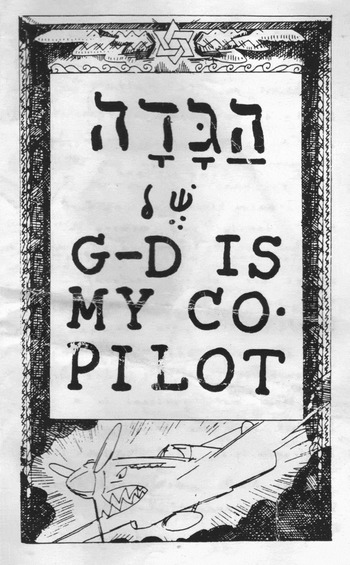
Interesting in its own right as a meaning-saturated musical miniature, “¡B'nai!” also allows us to consider in tandem an artist's musical and verbal engagement with RJC, for in collaboration with her fellow bandleader Craig Flanagin, who wrote and arranged much of GodCo's material, Topper created elaborate booklets for two RJC festivals, weaving together reminiscences, reflections about Judaism, and lyrics of the Hebrew and Yiddish songs the band performed in its typical absurdist-punk fashion (see Figure 2).Footnote 36
Program cover, “Haggadah Shel G-d Is My Co-Pilot” [G-d Is My Co-Pilot's Haggadah], Radical Jewish Culture Festival, Knitting Factory, New York City, 8–11 October 1992. ©1992 Sharon Topper and Craig Flanagin. Used by permission.

Although she called one of these booklets a “Haggadah,” it is not meant as a variant of the ritual text traditionally used during the seder service of the Passover holiday. The Passover Haggadah chronicles the Jewish exodus from Egypt and redemption from bondage (c. 13th century B.C.E.), but, as the contents of her booklets indicate, Topper has deployed the term haggadah (lit., telling) to denote the “telling” of her own Jewish story through performing with G-d Is My Co-Pilot.Footnote 37 Thus, the booklets include Topper's reminiscences about her childhood and a photograph “taken by my great aunt Hannah in 1932 @ Ave. C and 3rd St. [of] my great-great grandmother and her 2nd husband.” Given a gentle analytical tug, Topper's colloquially worded statements about music, memory, and identity in these booklets unspool into multiple narrative strands.
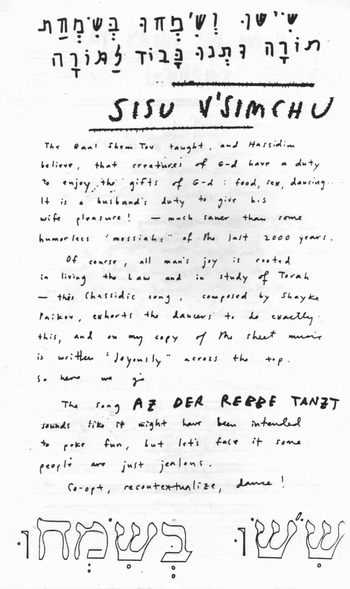
In her booklets, Topper offers a distinctive vision of RJC as a way for (Jewish) punk rockers and their audiences to claim Jewish tradition as their own by shaping it in their own image. She does so through personalizing her material: including handwritten lyrics and personal anecdotes about each song, musing on Judaism as a matrilineal religion with an ancestral goddess figure, writing new songs such as “‘Liz Cohen Caught Looking,’ a love song for Jewish lesbians everywhere,” and reassuring her readers that “there are no definitive versions of these songs—the most important thing is that we are singing them.”Footnote 38 She also lays claim to ḥasidic Jewish songs as vehicles for the sweaty ecstasy of the rock concert-qua-secular ritual of the Lower East Side. Ḥasidism (lit. pietism) is a mystical branch of ultra-Orthodox Judaism with roots in the teachings of Rabbi Israel ben Eliezer (c. 1700–1760), known as the Ba'al Shem Tov (Master of the Divine Name). Music and dance are central to ḥasidic worship, giving ordinary people a path to joyful communion with God.Footnote 39 Introducing two songs, Topper proffers an admiring (if self-serving) gloss on ḥasidic Judaism:
The Ba'al Shem Tov taught, and Hassidim believe, that creatures of G-d have a duty to enjoy the gifts of G-d: food, sex, dancing. It is a husband's duty to give his wife pleasure! . . . Of course, all man's joy is rooted in living the Law and in study of Torah—this Chassidic song . . . exhorts the dancers to do exactly this. . . . So here we go.
She then enjoins her audience to “Co-opt, recontextualize, dance!”Footnote 40 In the context of a virtual showdown between ḥasidic Judaism and New York–style punk transgression, this little exhortation takes on a dizzying burden of cultural work. Topper, whose bisexuality was an integral aspect of her self-presentation as a performer, inveighs her audience to appropriate selected ḥasidic mores in the spirit of rock's joyous anarchy. However, behind her exhortation to “co-opt” and “recontextualize” lies an understanding that in an ultra-Orthodox context, it is generally forbidden for a man to listen to a woman singing unless she is his wife.Footnote 41 Topper's embrace of ultra-Orthodox Jews as pious scholars with earthy down-home values may be earnest, but it is also selective, for this community—which shuns secular pursuits, condemns homosexuality, and enforces strict gender separation—would not return the compliment.
Like most celebratory rhetoric, Topper's advocacy of ḥasidic lifeways is both reductive and strategic: reductive in claiming the right to represent Ḥasidism in the absence of Ḥasids, and strategic in bringing Ḥasidism iconically into downtown's most iconic performance space. As such, it undercuts ultra-Orthodox claims to moral authority, insisting that Topper (and by extension her audience) can take part in the same sanctified relationship with Jewish religion as the most strictly observant members of the Jewish community. Topper is thus not so much joining forces with Ḥasidism as reclaiming the “deep Judaism” normally construed as off-limits to (and by) nonobservant Jews. In parallel fashion, by performing their punk rock versions of traditional Jewish songs, her band deftly exposed the unspoken social codes that governed rock music, where Jewish names and themes seemed jarringly inapt despite the genre's claims to directness, authenticity, and freedom from social convention. Topper's punk rock, DIY (do-it-yourself) aesthetic is also evident in the program's Hebrew and English handwriting, which is playfully amateurish and off-balance. Such transgressions of tradition, convention, and propriety might well have been received with skepticism in the Jewish communities Topper invokes as her inspirations. Nevertheless, through the looking-glass prism of downtown's aesthetic economy, performing familiar songs in a creatively daring way comprised not an ironic dismissal of those songs but, on the contrary, an inclusive tribute (see Figure 3).
“Sisu ve-Simḥu be-Simḥat Torah u-Tenu Kavod la-Torah” [Rejoice and Be Glad on Simḥat Torah and Give Honor to the Torah]. “G-d Is My Co-Pilot: What Kann You Mach? Es Ist Amerikeh!” [What Can You Do? It's America!]. Radical New Jewish Culture Festival, Knitting Factory, New York City, 7–11 April 1993. ©1993 Sharon Topper and Craig Flanagin. Used by permission.

On Mir Shlufn Nisht (1994) and Tight like Fist (1993), G-d Is My Co-Pilot projects an anarchic ideal of cultural pluralism through its reimagining of Russian, Finnish, Japanese, and many Yiddish and Hebrew songs: the Israeli national anthem, “Ha-Tikvah”; the Passover songs “Ḥad Gadya” [Aramaic] and “Dayyeinu” [It would have been enough] [H]; the Hannukah song “Mi Yimalel” [Who will recount] [H]; and “¡B'nai!” one of the above-mentioned “Hebrew musical relics of socialist Zionism.”Footnote 42 A publication roughly contemporaneous with RJC illuminates another project, undertaken several decades earlier, that suggests interesting parallels with G-d Is My Co-Pilot's intention to radically update this timeworn material. In the 1930s the Palestinian National Fund commissioned several composers—including Aaron Copland, Kurt Weill, and Stefan Wolpe—to write modern settings of Israeli folk songs, set for voice and piano, to bolster national pride in the Jewish community of Palestine. The practice of developing new songs and song settings for the national cause continued after the establishment of the State of Israel, and whereas GodCo's work may seem far removed from this context, the band had a similar purpose in its loose melding of avant-garde aesthetics with the rhythmic propulsion and primitivist energy of punk rock. Within a milieu that normally constructed itself as wholly secular and self-invented, GodCo's No Wave arrangements of traditional songs served as crucibles for a distinctively downtownish affirmation of Jewish community and continuity.Footnote 43
Throughout the recordings cited above and on GodCo's other recordings, Topper's vocal delivery is decidedly punk: untutored, unsupported, nasal, and always slightly off-key. She sometimes uses a throaty or screaming timbre, but she more often conveys a flat affect worthy of a Weimar-era chanteuse. It may seem fitting to read an implied critique of her texts into Topper's vocal style, but it should not be assumed that audiences would have heard these Dada-punk arrangements as ironic. Recall the affectionate homages to her grandmother Topper included in her booklets, and her exhortation to “co-opt, recontextualize, dance!” In a No Wave context, nasality and off-kilter intonation are idiomatic and aesthetically fitting. In normalizing the strange, No Wave creates an interpretive space in which critical distance or irony can be implied by vocal timbres that are smooth, rounded, or conventionally pretty. Likewise, G-d Is My Co-Pilot renders “¡B'nai!” not as an expansive anthem but as an unsentimental No Wave ditty whose affect could easily be interpreted as a symbolic undermining of the song's Zionist lineage and content. Indeed, such a subtext would not have been unexpected given the overall political tenor of the downtown music world. However, GodCo's interpretation of “Ha-Tikvah” is subject to many different readings. When I interviewed them in 2004, Flanagin (CF) and Topper (ST) explained their punk rendition of Israel's national anthem:
TB: If someone were to challenge you on your musical choices on “Ha-Tikvah,” how would you answer them? Your tone of voice, or the instrumentation?
ST: I think that [irreverence] makes it better. Because it adds an edge to it—otherwise maybe it would be completely kitschy.
CF: Yeah. Do we need another straight recording of “Ha-Tikvah?”
ST: It's probably what makes it great, actually. . . . [Humorously] I can't help it if I'm punk.
Indeed, Topper included “Ha-Tikvah” in her repertoire as a forthright expression of support for Israel, asserting, “The theory, the Land, is so important to us as a people. And it needs to be protected. . . . And maybe that's what I'm saying, that I think it is important for Jews to come forward—to question [Israeli political policies], maybe, but still, we need to protect its land.”
This sense of respect for their traditional material is evident on Mir Shlufn Nisht, where the band's creative strategies seem designed to call attention to each song's identity rather than obscuring or subverting it. Instead of the full-throttle onslaught preferred by many downtown thrash/noise bands, G-d Is My Co-Pilot's instrumentalists (on drum sets, acoustic and electric guitars, cello, bass guitar, and other instruments) improvise skittering exchanges, judiciously employing timbral extremes, quick shifts of texture, fleeting dissonances, and distortion. The album's texture is generally sparse, the recording is clear and carefully mixed, and the arrangements retain each song's original lyrics and melody, albeit often in attenuated form. Though the band's disjointed arrangements include interludes of unmetered free improvisation and noise, even in the busier, louder sections the texture remains for the most part pointillist, contrapuntal, and parsable, rather than overwhelmingly dense or noise-based. In sum, the recording projects an untutored, anarchic spirit of free exchange that upon close listening reveals itself as having been thoughtfully calibrated.
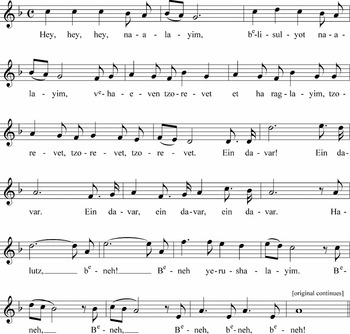
In keeping with early punk rock convention, most of the album's songs are short, ranging from twenty seconds to just over three minutes. Even within this context, G-d Is My Co-Pilot's version of “¡B'nai!” is starkly arranged and notably brief. The piece, just under one minute long, exhorts the “pioneer” (or Jewish immigrant to Palestine before the establishment of the Jewish state) to “build Jerusalem/emigrate and build” even when conditions seem unbearable. Written by Russian-born composer Joel Engel (1868–1927) in the mid-1920s and set to a text by Hungarian-born poet Avigdor Hameiri (1890–1970), “Halutz, Build On: Chalutz, Benëh” [Build On, Pioneer!] was part of a genre of Israeli pioneer songs popular in Zionist circles in the early twentieth century. In these songs, “images of young farmers tilling the soil of Palestine or . . . [texts] about nature encountered by the pioneers returning to Zion were not only symbols, but calls to explicit action.”Footnote 44 In her booklet, Topper even refers to her downtown audience as “pioneers,” suggesting that they can work to create their own kind of downtown-punk diasporic Jewish community: “As each of us is out of Egypt [i.e., in the Diaspora], each of us must build the homeland. B'nai, chalutzim!” (See Example 1.)
Melody, “Halutz, Build on / Chalutz, Benëh: Hay, Hay Naalayim” [Build On, Pioneer], mm.1–20. ©1942 Transcontinental Music Publications. Used by permission.

“¡B'nai!” is recorded as a duet for scraped idiophone and voice. The scraper, which opens the piece, has a frightening affect: Loud, low, and guttural, it saws and snorts like a wild animal. The scraper is also unruly. The only rhythm instrument, it keeps time badly and nearly destroys the duple meter in its projected enthusiasm for independent scraping. When Topper's voice enters, singing the words in oddly accented, sometimes garbled Hebrew in a clear and expressionless monotone, the scraper falls into rhythm with her voice, then out again, rushing ahead and adding embellishments and rhythmic figures. If the scraper's erratic phrasing suggests an eager but unschooled accompanist, Topper's performance emphasizes this lack of polish. She uses unsteady intonation to subvert the integrity of the melody line, and she concludes on an unstable interval that intensifies this sense of tonal dislocation rather than resolving it, as the scraper stops abruptly (audio example at www.journals.cambridge.org/sam2010005.)Footnote 45
Topper's vocal performance, although idiomatic to GodCo's style, offers a striking contrast to a version published in the United States in 1942 (in a choral arrangement by Avraham Soltes marked “Alla marcia vivo”) and recorded in a lusty performance by the Zadikov Workers Choir of the Tel Aviv Labor Council in 1960.Footnote 46 Both settings magnify the drama of the song's modest text, creating a narrative of struggle and redemption by using extreme dynamic contrasts and theatrical ritards, and building to a triumphant climax (marked triple fortissimo in the score). (The recorded arrangement is similar to GodCo's in one respect: It creates unresolved tension by ending on a half-cadence that occurs at a midway point in the published score.) In the absence of a full-voiced choir, martial instrumental accompaniment, or harmonic underpinning, GodCo flattens this narrative of struggle and perseverance. Rather, in keeping with her booklets—which display an interest in imperfection and a fidelity to the texture of personal experience—Topper, who learned the song from an elderly friend, mimics her homespun rendering of the song.
For downtown audiences, attuned to the visceral pleasure and artistic potential of punk rock and No Wave, “¡B'nai!” falls into place as an example of the ugly beauty, startling aesthetic turns, and resolutely unconventional affect embodied by G-d Is My Co-Pilot's whole oeuvre. In a No Wave/punk context, the musical syntax of “¡B'nai!” seems natural and normal, for G-d Is My Co-Pilot brought similar performance practices to its other recorded material, including songs whose texts about bisexuality and sexual freedom were an unequivocal part of the band's core identity. What is startling instead is the song's forthrightly Jewish aspect. Before the late 1990s, despite the central role of Jewish musicians in iconic bands—including the Velvet Underground, the Ramones, the Voidoids, and the Patti Smith band—Jewish qua Jewish voices were virtually absent within the realm of punk rock. This lack—coupled with the tangled relationship among punk rock, hardcore rock, and Nazi, fascist, and racist imagery—meant that the prevalent sense among downtown artists seemed to be that in order to achieve punk-rock authenticity, Jews needed to maintain a division between private life and public persona, or cast aside their Jewishness altogether to enter the ranks of the angry white ethnic.Footnote 47 Thus, several of my interviewees recalled their astonishment at learning that Lou Reed, perhaps the foremost icon of underground rock of the 1960s, was Jewish. Echoing Shelley Hirsch's comment above, clarinetist David Krakauer recalled: “I thought about that too, in the [Munich] Radical Jewish Culture festival, of Lou Reed, in particular, outing himself as a Jew. You don't think of Lou Reed as Jewish. And then suddenly he appears in this Radical Jewish Culture festival.” Through “¡B'nai!” and its other Jewish material, G-d Is My Co-Pilot makes a Jewish downtown-punk rock affect not only visible but also audible. As with its gay-positive songs, here G-d Is My Co-Pilot creates a radical intervention into rock music's unwritten social codes.
From the outset, the scene was astir with conflicting interpretations of the RJC idea. Indeed, musicians’ competing notions about what it all meant served as a key creative spur. As Coleman recalled of RJC's early years, “It was this incredible opening. Because it was this incredible questioning. . . . I felt so alive, you know?”Footnote 48 One brief piece of music can hardly represent such a diverse artistic milieu, and “¡B'nai!” is representative of RJC only in that it illustrates the complex semiotic terrain in which all artists involved in the scene were developing their own musical ideas. However, in this sense alone “¡B'nai!” is instructive. It helps us to understand how a straightforward creative act—bringing Jewish musical material into the scene's wide-ranging stylistic vocabulary—had surprisingly complicated consequences.
“The Mooche”
In the context of improvised musics that exhibit strong influences from Afrological ways of music-making, musical sound—or rather, “one's own sound”—becomes a carrier for history and cultural identity. “Sound” becomes identifiable, not with timbre alone, but with the expression of personality, the assertion of agency, the assumption of responsibility, and an encounter with history, memory, and identity.
—George LewisFootnote 49
Though we walk, breathe, and write music in the . . . historic center of [one of the world's] largest, oldest, uninterrupted urban Jewish culture[s], our creations are visible and audible as everything but the continuation of that culture's history. . . . And the music we normally play, while categorized by every other conceivable parameter . . . cannot be “read” as Jewish.
—Marc RibotFootnote 50
The downtown scene's particular sort of experimentalism derives from the very trait that renders the scene most resistant to description, that is, its artists’ interest in bringing disparate musical idioms and syntaxes into dialogue. Nevertheless, without flattening the scene's diverse creative topography, one can cite several influences that figure prominently throughout: European and American avant-garde concert music; free improvisation; rock and No Wave; noise; and jazz, especially, but not limited to the jazz avant-garde. All these idioms shape the scene not only stylistically, but also in regard to performance practices, aesthetic value systems, and compositional techniques. Jazz (in its many guises) is arguably the most ubiquitous idiom, and its influence derives not only from repertory and style but also from its system of meaning.Footnote 51
In “Gittin’ to Know Y'All,” Lewis theorizes the semiotics of sound in an “Afrological” context, citing sound's ability to invoke a community's historical memory, thus investing its performer with a kind of responsibility toward that community, that memory. In jazz, Lewis suggests, personal sound is a signifier and carrier of more than the personal, and of more than sound: Rather, personal sound in jazz is imbricated with the blues and with the Afrological musical value of “saying something” that is at once individual and resonant with African American historical experience.Footnote 52 Ethnomusicologists have explored the role of timbre and inflected sound in articulating cultural and national group identity, and embedding in music a discourse of collective self-recognition.Footnote 53 As Cornelia Fales argues, “Not only does timbre carry the most information about a source and its location, but of all parameters of music it . . . also carries the most information about the environment through which the sound has traveled.”Footnote 54 In the same vein, Lewis contends that personal sound, especially timbre and its ancillary “micromoves,” has a multilayered, multifaceted semiotic function in Afrological contexts, enacting “an encounter with history, memory, and identity.”Footnote 55
The interplay among a sound's personal dimension, its recorded history, and its inchoate “deep history” contribute fundamentally to jazz's semiotic richness. In Thinking in Jazz, Paul Berliner demonstrates that if a jazz musician is successful in developing a distinctive personal sound, this success reflects not only individual talent and years of disciplined work, but also a continuous interaction with jazz history—that is, the history of sounds developed by other musicians at other times and preserved in memory and on recordings. Sounds in jazz are further animated by “the vibrancy of the human connections that inhabit the piece—myriad inflections, personalities, voices, fingerings, and stances, coursing through the mind and into the musical performance.”Footnote 56 Of course, as personal sound in jazz is personal, the kinds of “connections coursing through the mind” may be intelligible only to the performer, and as jazz artists have always sought inspiration from a diverse array of sources, the referential possibilities for sounds in jazz are correspondingly far-reaching. Nevertheless, Lewis suggests that insofar as a “personal sound” is at once unique to the individual performer and idiomatic to jazz, it signifies more specifically upon jazz's lineage with African American or African diasporic expressive culture—for example, through indexing the vocal hoarseness typical of African American Pentecostal preaching or the black Southern speech cadence of street cries and field hollers. In adopting an Afrological way of music making, then, downtown musicians entered into a system of meaning that incorporated a multilayered dialogue with the recorded, performed, and deep (or projected) histories of the sounds and the music they played.
In the context of RJC, the formative role played on the scene by jazz posed an interesting challenge for musicians who were intent on exploring the semiotics of sound. In jazz's cosmopolitan history artists have often adapted elements from global idioms into their composing and improvising. It should have been straightforward enough for improvisers to follow this precedent by expanding their lexicon of scales, or perhaps incorporating Jewish melodic material or idiomatic klezmer syntax into an improvisatory passage. At the same time, in the Afrological context Lewis describes—a context in which “one's own sound” is not only all-important, but is also invested with a great deal of culturally specific content and weight—modifying one's timbral or syntactic palette also implied a move at the level of musical meaning. To incorporate Jewish-identified sounds, timbres, or micromoves into this ontological context was to propose those sounds as indexes for Jewish historical memory. Such a move was charged with unusual potency because to many musicians downtown, the Jewish historical experience being invoked was not easily apprehensible. As Ribot suggests in the epigraph above, before the advent of RJC, in the downtown context it had seemed incongruous to enact through personal sound a sustained encounter with Jewish history, memory, and identity. This sense of incongruity, though tricky to explicate, was voiced consistently among the Jewish musicians I interviewed.
Coleman, for one, used personal sound in a jazz context as both a compositional device and a catalyst for ontological reflection. His awareness of the multiple, shifting strata of real and implied meanings associated with timbre is evident in his discussion of what he wittily terms the “Jewish cry.” As Coleman explains in Claudia Heurmann's film Sabbath in Paradise, his mordantly titled band, Selfhaters,
started out from this thing of trying to reduce the [musical] language down to a few cries. When Schoenberg wrote about Webern's “Six Bagatelles for String Quartet,” he said that what Webern did was reduce a whole novel into a single sigh. So it was like we were trying to reduce a whole ethnic group into a single cry [laughs]. One little pathetic cry [does a sob/whine with a Yiddish inflection and timbre]. . . . And then we tried to build a [musical] language out of that. . . . There's such a thing as a blues guitar sound [demonstrates distorted electric guitar wail] and you don't need to hear more to feel the blues. [We were] trying to distill “Jewish” music in that sense.Footnote 57
In Selfhaters’ performance of Duke Ellington's “The Mooche”—so named for “a slow, shuffling dance, similar to the grind, that African Americans brought to New York in October 1928” combining “rubberlegs with rotating hips”—the Jewish cry enters into symbolic dialogue with the blues cry that Ellington's brass players both constructed and invoked over the piece's long performance history.Footnote 58 By ending Selfhaters with a Jewish parable set to the ensemble's characteristic syntax, Coleman makes clear the Jewish referents of the abstracted cries on the rest of the recording. Selfhaters’ mimetic moans and vocalizations contrast with the Ellington ensemble's gutbucket blues cries, which are gutsy, earthy, full, confident, virtuosically crafted, directional, rhythmically authoritative, and vibrant with timbral variation. The Jewish cries are wispy, enervated, undirected, thin, uncontrolled, strangled, or uncertain, and exploit a relatively narrow timbral range. Despite these contrasts, in the two pieces the blues cry and the Jewish cry are not wholly disparate. The high, pinched vocal and horn timbres on Selfhaters recall a muted jazz trombone at its wispiest, as it vocalizes at the far reaches of the blues-cry spectrum.Footnote 59 Moreover, at moments, when Ellington's “Mooche” departs from its original form, the ensemble breaks into a relatively static interval of free improvisation amid motivically disjunct, broken calls in the brass, and the blues cry, investigating what critical theorist Fred Moten calls “the lyricism of the surplus,” transmutes into an abstracted version of itself. These moments, in which the Ellington ensemble pushes “The Mooche” into the creative territory of the “New Thing” in jazz, share a family resemblance to Selfhaters in texture and overall affect.Footnote 60
“The Mooche” was central to Ellington's jungle music oeuvre, which he developed with trumpeter Bubber Miley and trombonist Sam Nanton during his late-1920s residency at the Cotton Club. The jungle music style enhanced the primitivist frisson of the club's salacious floor shows, but Ellington continued to perform the piece long after the fashion for primitivism—at least in that guise—had passed. Moreover, among the different arrangements of the piece he recorded over his long career, Ellington not only retained, but also expanded upon, the “jungle” elements, evidently encouraging his side-musicians to elaborate in their solos upon the cup- and plunger-muted growl, wah-wah, and vocalized brass timbres derived from New Orleans jazz sources—sources also frequently invoked in “The Mooche” by Barney Bigard's (or his successor's) clarinet lead and counter-melodies. From the performance history of “The Mooche” one can infer that Ellington and his musicians were invested in deploying the expressive resources of the “blues cry” to create a multivalent commentary not only on the piece at hand but also on the semiotics of sound. In some of these performances, the gutbucket blues cries are so exaggerated that they seem to strain the ability of signification to do its own work: They simultaneously imply a discursive exchange with themselves, their genre, and their multilayered historical referents.
The phrase “blues cry” denotes the mimetic vocalizations and timbral syntax scholars have identified as idiomatic to a lineage of African American music, and upon whose dramatic signification the poetics of “jungle music” depend. Musicologist Samuel Floyd asserts that the multitextured performance of the blues cry is central to the art of musical Signifyin(g), in which “the vernacular is used to read black formal products. In this way, Signifyin(g) is also criticism, since it validates and invalidates musical narrative through respectful, ironic, satirizing imitation and manipulation.”Footnote 61 Indeed, like Ellington's other “jungle” pieces, “The Mooche” couches its moments of overdetermined bluesiness amid a landscape of contrasting instrumental characters that achieve narrative coherence through enacting individual roles within a seamless formal plan.Footnote 62 It is within this formal context and cast of timbral characters that the blues cries take on an especially trenchant signifying role. It is not my intention here to parse what the blues cries are “saying,” but simply to note that as instrumental characters within the dramatic universe of “The Mooche,” it is their function to signify, and to do so extravagantly.
The blues cry has been romanticized, but its role in African American musical culture is also well documented. In The Power of Black Music, Floyd theorizes the blues cry—“the calls, cries, and hollers of field slaves and street vendors and from the spirituals of brush harbors and church houses,” which have been transposed into the blues—while illuminating the fantasies that have been projected upon it. Abstracting his discussion from dated discourse—references to “primitive ancestors,” “the hot crucible of jazz,” and “folk genius”—Floyd elucidates the “vocal quality and variations in timbre that make [early blues] distinctive and link it to an African American historical lineage: the nasal, foggy, hoarse texture that delivered the elisions, hums, growls, blue notes, and falsetto, and the percussive oral effects of [musicians’] ancestors.”Footnote 63 Whereas the notion of a Jewish “cry,” too, has real cultural and historical referents, as with the blues, the notion of the cry in Jewish music—the “tear in the voice”—has fueled fantasies of an imagined racial essence whose romantic, primitivist, and Orientalist aspects are as strong as the tear itself.Footnote 64 Moreover, as historian Jeffrey Melnick notes in A Right to Sing the Blues, pseudo-historians of jazz often posited that the music's character derived from its mixed Jewish and African American roots, as suggested by the crying timbres of its instruments: “In the first few decades of this century, the sense that African American music was defined by its pathos coincided and merged with a fixation on the melancholy of the Jewish musician. . . . This formulates a perfect Jewish analogue for Albert Murray's idea that African Americans often play the blues to get rid of the blues: Jews wail to relieve their melancholy.”Footnote 65 By engaging with the blues and Jewish cry, Selfhaters’ “Mooche” thus embeds itself in the historical currents that have repeatedly brought together Jewish and African American musicians, leading observers to create a body of criticism that seeks to parse this relationship along racial, cultural, and, often, essentialist lines.
In “The Mooche,” Coleman simultaneously explores Jewish antecedents while registering the downtown scene's debt to African American music and musicians (and his own debt to Ellington). He also directs our attention toward another issue—the way artists downtown sought not only to explore Jewish musical heritage, but also to inculcate that heritage into the scene's polycultural musical mien. Correspondingly, “The Mooche” begs the question of how the RJC phenomenon was implicated in the wider racial dynamics of the downtown music world. That world had long been home to artists in African American avant-garde circles who exerted a strong influence on improvisers downtown. The Knitting Factory scene was racially mixed, but the RJC scene, being made up almost entirely of Ashkenazi Jews, was basically white. (Musicians in all of these circles worked in an array of ensembles that varied in both style and racial demographics.) These circumstances—the abiding influence on the downtown scene of African American music and the racial diversity of the downtown music world beyond RJC, as well as Jews’ perennially perplexed affair with whiteness in the United States—make it tempting to frame “The Mooche” as symbolic commentary on the relationship between Jews and African Americans in jazz—both historically and on the downtown scene. However, as with the question of precisely what “The Mooche's” talking horns are saying as they signify, it is difficult to be specific in asserting how the piece comments on the issues it raises. Whereas Coleman puts his Jewish cry into conceptual dialogue with an African American blues cry, he does so in an abstract and fragmented musical landscape that resists the kind of dramatic interpretation that might be suggested, for example, by functional tonal harmony. Nevertheless, Coleman's comments here and elsewhere indicate that he is interested in the limits and complexities of the analogy described by Melnick, and that he is, indeed, invested in engaging it through a blend of humor and critique.
In addressing the name of his band, Selfhaters, Coleman explains:
There's one dream of what it can all mean. And then there is what is really there. And what I have tried to do is to look at what is really there. . . . My Jewish experience is a palimpsest. It's little bits of things. A song here, a comedy routine there. A coupla Yiddish words there. . . . I wanted to take the palimpsest nature of my Jewish experience as the what-really-is. . . . I go back to my love for [Samuel] Beckett, and [Anton] Webern, and Morton Feldman . . . What gave them a context [in Selfhaters] was this idea that . . . the Jewish experience is atomized. Funny, sad, pathetic, weak, broken—so there's a little rhythm here, a little phrase there—that's what Selfhaters were all about. That's why it's called Selfhaters. There was no other possible name for it to have!Footnote 66
The band's eponymous album Selfhaters includes eight pieces that explore the language to which Coleman alludes: halting, jerky, unpredictable rhythms and static rhythmic motives; attenuated, trailing phrases; sudden stops and starts; refracted textures; a nonteleological narrative; and the occasional augmented second embedded in an isolated scalar motive. The piece's texture and formal character are shaped by an unstable yet continuous and through-improvised call-response dialogue within the ensemble, whose cries are expressed through vocalizations by a male voice and instruments, primarily brasses and reeds. The cries occasionally mimic an idiomatic cantorial “moan” (though not the mimetic catch in the throat of the klezmer knechts), but more often they index the shofar—the ram's horn that is blown ceremonially in the synagogue on the High Holidays—in its approximate intonation and variably rich, breathy, ripped, wavering, wailing, and squeezed timbres. At times the cries are also evocative of the expressively lilting, trailing, creaky-hinge micromoves that typically animate spoken Yiddish. In developing a compositional/improvisational language out of these disjunct cries and bringing that language to bear on “The Mooche,” Coleman formally deconstructs and recomposes the piece while maintaining enough of its thematic integrity, and weaving enough of its familiar referents into the strange new canvas, to allow us to recognize its connection to the original.
Ellington's “The Mooche” is succinct and formally balanced, set in quadruple meter in the key of C minor. With some formal variation in different performances, it comprises an introduction; the distinctive “Mooche” theme (A), played twice; a passage (B) that serves as a transition to an interlude of gently swung stride in E-flat major, usually scored for solo piano or horn section in close harmony (C); two E-flat minor blues choruses (D), one scored for clarinet solo and the other for call-response duo, usually trumpet and alto saxophone; and a return to the opening C-minor material, sometimes after a longer succession of blues choruses and often with a coda. These choruses may be swung, set to the original ostinato accompaniment, or set to a boogie-woogie bass pattern, and they feature the piece's most extravagant growl techniques, stutters, and “wah-wah” vocalizations, in solo and call-response textures: [Intro(4)] A(8)A(8) B(8) C(12) D(12)D′(12) . . . A(8)A(8) B′(8) [coda].
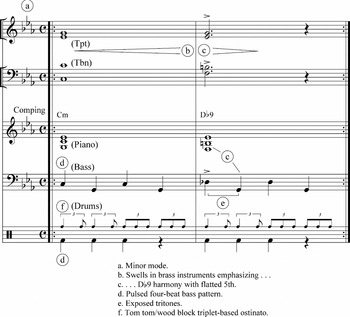
The “jungle” in “The Mooche” resides not only in these blues cries but also in many other musical parameters that index the exotic: harmony, modal mixture, melodic motion, rhythm, sonority, voicing, timbre, extremes of tessitura, and playing technique. For example, the marching, bass-heavy four-beat ostinato that underlies the opening section provides the requisite nod to Africa's throbbing tom-toms and features emphatically exposed tritones as it shifts between C-minor and D-flat-9 (with flatted fifth) harmonies. It is typically scored for plucked or martelé contrabass, punctuated brass, banjo or comping piano, and drums, often with an accompanying line played on wood block, or on tom-toms with felt mallets (see Example 2).
Exemplary traits of the “jungle” in the opening bars of “The Mooche.”

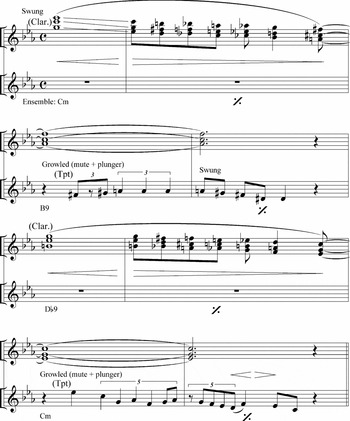
Cast in sharp relief against this accompaniment is the legato “Mooche” theme, which Ellington scored for three clarinets that outline a four-bar series of chromatically descending triads, answered by growling trumpets. The high tessitura and keening vocal quality of the clarinets, the sinuous chromatic descent of the melody line, and the striking harmonies (B9 and D-flat-9) are hallmarks of the piece's pointedly “exotic” character. Moreover, through low tessitura and florid ornamentation, the clarinet solo of the D section invokes a strange and rarefied realm, opening in the instrument's chalumeau register and featuring floaty, legerissimo runs, trills, and sustained tremolos (see Example 3).
The antiphonal “Mooche” theme. The Mooche (Duke Ellington/Irving Mills), Okeh 8623. Recorded 1 October 1928 in New York City.

Selfhaters transmute the piece's original affect and form it into a landscape of erratic entrances, irregular phrase shapes, unpredictable moments of silence, and an array of unexpected timbres that seem to hail from disparate worlds. The piece's fractured texture, fragmented syntax, and vocalized “cries” recall Coleman's explication of Selfhaters’ modus operandi. However, this version of “The Mooche” is far from unrecognizable, and repeated listening yields many surprising points of thematic continuity with the original. Whereas Coleman eschews functional harmony and embraces surface disorder, the piece is structured clearly. Aside from one section, it is set in quadruple meter, with offbeat accents provided by a gently closing high-hat cymbal, which has its referent in the original “Mooche,” where the same instrument subtly but persistently punctuates the piece's melodic phrases. Selfhaters also follow many aspects of the formal plan of “The Mooche,” beginning with a double statement of the opening theme (A). Immediately upon beginning the first few pitches of this melody, Selfhaters’ horns interrupt themselves with brassy bleats, which are answered not by a growled trumpet as in the original, but by a voice weakly declaiming a melodic fragment (drawn from the original's clarinet solo). Following is a partly unmetered section of about twenty-four bars (corresponding to the two blues choruses, D) in which the opening motive of the chalumeau-register clarinet theme is embedded fragmentally, accompanied by choked cries and warbles from the brass section. This section, although abstract, is rendered more coherent by the repetition, in different registers and by different instruments, of two melodic fragments: the chromatically descending line of opening theme, and the opening ascent (C–D–E-flat) of the clarinet solo, along with its retrograde. These fragments serve as a stable reference point to the original piece amid the ensemble's unpredictable textural shifts. Next, a restatement of the opening material (or Selfhaters’ version of it) includes a clarinet tremolo that, in a nod toward the original solo's Orientalist qualities, transmutes into a ululation. This section is followed by a comically broken-down extrapolation of the elegant stride interlude (C). A plodding ostinato leads off a twelve-bar blues chorus (complete with a subdominant chord in the piano), and the piece ends in a brief coda, with a pianissimo clarinet tremolo paired with a wailing male voice: A(8)A(8) “D”(24) A(8)A(8) C(12) D(12) + coda. With the exception of the eight-bar theme (B), which modulates between keys in the original—a function rendered unnecessary in Selfhaters’ version, which maintains a tonal center of C minor—Coleman has retained the piece's formal proportions while masking and reshuffling the order of the sections. In so doing he alludes to Ellington's later recordings of the piece, in which Ellington himself formally deconstructs and recomposes “The Mooche,” sometimes interpolating new sections, or putting the blues choruses first, extending them, and adding fermatas, then attenuating the rest of the form.Footnote 67 Ultimately, despite Selfhaters’ kaleidoscopic distortion of the piece, we remain in “Mooche” territory. (Audio example at www.journals.cambridge.org/sam2010006.)Footnote 68
By incorporating a “Jewish cry” into his version of “The Mooche” and fragmenting its language and texture, Coleman creates a symbolic dialogue not only among timbres, but also among signifying impulses and intentions. In so doing, he draws on the techniques of signification that inhere in the jazz lexicon, in which layers of real and imagined referents are read into instrumentalists’ timbral manipulations. It is not possible to parse this process precisely—indeed, one of the compelling features of musical signification is that, beyond a certain point of inference, it resists parsing. At the same time, it is clear that “The Mooche” offers an intervention into the downtown scene's creative cognizance of Jewish history, a history characterized by Ribot as both formative to the scene and frustratingly illegible as such. In their own unschematic way, Selfhaters grant that history symbolic entrée into downtown's creative realm. Moreover, by investigating, in Coleman's phrase, a new “language of signification,” Selfhaters explore RJC's potential to affect the syntax and the systems of meaning prevalent downtown. Finally, Coleman's work raises intriguing questions about how to engage in a rapprochement with the typically overheated notion of music as a vehicle for collective historical memory as vocalized through a racially marked vocal performance. Much of the music written and performed under the rubric of RJC was less adventuresome than “The Mooche,” but this piece is a good example of the way some artists used RJC to investigate creative and conceptual territory that was congruent with their most provocative work.
Conclusion: The Funky Thing
Most people looked for the funky thing in black music. Whether it was blues, or funk, or soul music, or different forms of jazz. . . . [S]ome of us . . . found the funky thing in other traditions, in other cultures, like in Asian music, or African music. . . . But the idea of finding the funky thing in Jewish music? . . . We all knew it was there, probably, but where was it? It was a mystery!
—Anthony ColemanFootnote 69
By the early 2000s the intensity of the first RJC festivals had waned, and the community of interest that had convened around the festivals had either drifted apart or broken ranks, disrupted by conflicts over the best purpose of RJC and how to achieve it. In 2002 several artists who had taken issue with the rubric—arguing that RJC had no connection to the history of Jewish involvement in radical politics—came together to organize two major “Artists against the Occupation” concerts at the Knit to raise money for organizations working toward Palestinian national autonomy in the West Bank and Gaza Strip. Five years later the downtown music world finally loosed its moorings from the Lower East Side with the closing of the club Tonic, which in 1998 had replaced the Knit as the scene's main performance space and community anchor. Nevertheless, even as New York's experimental music scene reconstitutes itself in new guises, it is evident that RJC has had a dramatic and lasting effect. By the 1990s, Jewish-themed concerts featuring downtown musicians had become a normative part of New York City's cultural establishment, and, correspondingly, downtownish improvisers continue to affirm the relevance—whether personal or artistic—of Jewish heritage in their creative conceptions. Moreover, Zorn's unwavering support has yielded an impressive body of new Jewish-identified music on Tzadik's RJC series. If some of it falls far short of the promise of its rubric, there remains a great deal of gripping, innovative work, including much by Zorn himself.
RJC also had an ontological impact. Coleman uses the phrase “funky thing” in the epigraph above to suggest that all musicians seek out riveting sounds that, whatever their cultural source, exert (and promise to confer on their makers and listeners) a unique, charismatic power. He also alludes to a dialectical relationship between sonic and semiotic “funkiness” in African American blues- and groove-based music. In the same vein, ethnomusicologist Cheryl Keyes analyzes the influence of funkiness and its close cousin, hip style, on the sound of hip hop, and, in a related argument, Ingrid Monson critiques the ways in which white musicians have framed African American “hipness” in problematically racialized and gendered ways.Footnote 70 The dialectics governing funky sound, hip style, symbolic meaning, and social relevance have proved a potent force in popular music. In the 1960s, African American music's daring creative mien was often linked, rhetorically and by association, with Civil Rights and other progressive social causes; in the late 1970s, punk rock gave voice to youth seeking to re-activate rock's anarchic energy and anti-authoritarian animus; and in the 1980s hip hop emerged as a powerful discourse among inner-city African Americans as prominent bands made the music a forum for black solidarity and social critique. To downtown's future émigrés, Jewish music—as they knew it from holiday songs, camp songs, Israeli folk songs, and the workaday renditions of klezmer music heard at weddings and Bar and Bat Mitzvahs—held little such symbolic or political promise. (A few musicians recall having been strongly affected by cantorial singing and Torah cantillation, either in synagogue or on recordings.)
Downtown musicians were heirs to historical forces that pulled many Jews away from religious observance and other means of communal cohesion and self-recognition, led to the post-Holocaust self-silencing discussed above, and yielded the mix of opportunity and loss that derived from Jews’ gradual admission into the ranks of racial whiteness. Moreover, they were drawn to rock, funk, and jazz, genres whose sounds and associative landscapes included virtually no allusions to Jewishness or to the Yiddishkeit that still permeates Ashkenazi Jewish expressive culture, albeit in diminished form. In a recent book that uses album covers to chronicle the postwar history of Jewish music in the United States, artist Maira Kalman recalls that these images, and the music they personified, once proffered “a fizzy cocktail of showbiz glamour and pride of origin. . . . And then a few years passed and they started to look embarrassing. Schlocky, not chic. . . . Now I look at these covers and some of them are so ridiculous and even more embarrassing than I remember.”Footnote 71 As demonstrated by scholarship in Jewish history as well as a spate of more recent work in Jewish cultural studies, a more sustained answer to the question of why Jewish music seemed expressively thin to the postwar generation must address not only the music's style and quality, but also the tangled relationship among constructions of diasporic Jewish identity (especially masculinity) in the United States, race, and the lure of the hip.
There is thus some truth to the glib phrase that the klezmer renaissance drew its energy from its promise to “make Jewish music ‘hip’ again.” As an edgy, bohemian Lower East Side art scene, however, the 1980s downtown music world suffered if anything from an excess of hip. For some musicians, then, RJC was powerful in that it made their world—their intrepid, venturesome art world—Jewish again. As Topper explained, “This identity stuff was hugely exciting to me. . . . It was like, ‘We can be proud of being Jewish!’ We can get on stage, and go, ‘This is who we are!’ We were at the forefront of the indie rock scene of the world, and it felt like everybody was watching us. It was very exciting.”Footnote 72 RJC not only made Jewish qua Jewish musicians more visible, but also led artists through a series of unpredictable interpretive moves that resulted in a salutary disorienting effect on the way they apprehended the downtown sounds they already knew.Footnote 73 Downtownish sounds could be reconsidered, their historical referents remapped, and connections made that had once been discounted. It may be in this elusive sense that RJC's impact has been the most compelling. As Ribot recalled, describing the first RJC festival:
Although I had heard most of these performers before, hearing them in this context seemed to add or reveal new layers of influences, meaning, or metaphor. At the festival, punk anger and abrasive dissonance were given [Jewish] historical context. . . . Collective improvisation . . . could be heard with its [roots in] New Orleans jazz and its possible roots in synagogue chant [i.e., congregational prayer]. . . . Lou Reed's famous deadpan voice could be heard in its New York Jewish hipster context, rather than simply generic hipster or ahistorically as just Lou Reed. At the Munich Festival, that voice, those experiences, that poetic tradition could be heard as inscribed in a newly understood history of Jewish music, a hearing that in no way prevented it from also being inscribed in the other histories it also addressed.Footnote 74
Sounds and musical practices, then, were semiotically contingent, and always had been. Music that in a downtown context had seemed far removed from the realm of “sounding Jewish” could be conceptually (and emotionally) recontextualized and heard in fundamentally new ways. So far, RJC has not led to “a beautiful, positive future for the Jewish people,” and its claim to radicalism, which caused a great deal of hair pulling in the early years, has proven insubstantial. It did, however, radiate a surfeit of artistic and intellectual energy that overran the bounds of its moment, and that continues to animate the most intriguing work created under its sign.