Implications
Various fat by-products of the food chain are included in feeds. Recycled cooking oils are not intended for feed uses in the European Union, although they might be used in other countries. However, oils recovered from industrial frying processes could show satisfactory quality for this purpose. Thus, here we studied how the addition of frying oils to feeds affects the lipid composition and the stability of meat and other animal tissues. Our results reveal an acceptable tissue oxidative stability, and slight effects on tissue composition. These findings may be useful for future regulatory policies regarding the quality and applications of frying oils.
Introduction
Animal feeds are commonly supplemented with fats in order to increase their energetic value. The amount of fat supplied can vary depending on the animal species and rearing conditions involved. However, an increasing amount of fat is being added to feeds in recent years, reaching up to a maximum of 100 g/kg, with certain exceptions depending on the species. For instance, fish have high energetic requirements and fat added to feeds can reach up to 400 g/kg (Wood et al., Reference Wood, Richardson, Nute, Fisher, Campo, Kasapidou, Sheard and Enser2004). These fats also provide essential fatty acids (EFA) and liposoluble vitamins. Moreover, fats have several digestive functions, for example serving as solvents and emulsifiers for several nutrients.
There is a wide range of fat products available in the market as feed ingredients (European Commission, 2011). These products include not only fats with well-defined composition, but also several co- and by-products of the food chain. Their characteristics might differ substantially from the composition and quality of their corresponding raw materials. Their quality vary depending on the production process and handling and storage conditions. In certain cases (i.e. recycled oils, acid oils, fish oils), the levels of undesirable compounds, such as lipid oxidation compounds and persistent pollutants, could be high enough to be critical control parameters for feeds including these ingredients (Ábalos et al., Reference Ábalos, Parera, Abad and Rivera2008; Nuchi et al., Reference Nuchi, Guardiola, Bou, Bondioli, Della Bella and Codony2009; Ubhayasekera and Dutta, Reference Ubhayasekera and Dutta2009). The European Union (EU) has recently imposed stringent regulations on the manufacturing processes by which some of these fat materials (such as animal fats) are produced (European Commission, 2010a and 2010b). However, there is still no standardization procedure for others, which implies that little attention is paid to assessing the degradation of these materials. The control of lipid oxidation, particularly in polyunsaturated fats (PUFA) in animal feed, deserves special attention (Nuchi et al., Reference Nuchi, Guardiola, Bou, Bondioli, Della Bella and Codony2009). Recycled cooking oils are not intended for feed uses according to the recent EU regulations (European Commission, 2003), but they are indeed currently used in some non-EU countries. However, oils recovered from industrial frying processes could show satisfactory quality for this purpose. In spite of the relevance of this subject, few studies have addressed their effects on animal performance, and meat composition and stability.
The fatty acid (FA) composition of feed influences the FA composition of meat and other animal products. In addition, the oxidative stability and shelf life of meat depend on the balance between certain FA (such as PUFA), pro-oxidants and antioxidants (Wood and Enser, Reference Wood and Enser1997; Bou et al., Reference Bou, Codony, Tres, Guardiola and Decker2009) and therefore can be also altered by the modification of the FA composition. Antioxidant vitamins, such as α-tocopherol (αT) and other tocols, contribute to decrease meat oxidability. Their contents in meat and other tissues depend on the balance between the tocol amount supplied by feed and the PUFA content of the same (Bou et al., Reference Bou, Codony, Tres, Guardiola and Decker2009; Dalle Zotte and Szendro, Reference Dalle Zotte and Szendro2011; Kouba and Mourot, Reference Kouba and Mourot2011).
The study presented here forms part of the European Commission project Feeding Fats Safety (Feeding Fats Safety, 2008), which addresses the inclusion of fat co- and by-products from the food chain in animal feed. In a preliminary study, more than 120 commercial fat products were characterized (Gasperini et al., Reference Gasperini, Fusari, Della Bella and Bondioli2007; Ábalos et al., Reference Ábalos, Parera, Abad and Rivera2008; Abbas et al., Reference Abbas, Fernández-Pierna, Codony, von Holst and Baeten2009; Nuchi et al., Reference Nuchi, Guardiola, Bou, Bondioli, Della Bella and Codony2009; Ubhayasekera and Dutta, Reference Ubhayasekera and Dutta2009; Van Ruth et al., Reference Van Ruth, Rozijn, Koot, Garcia, van der Kamp and Codony2010). Those containing the highest concentrations of several pollutants and undesirable compounds, including oxidation products, were selected for a series of experimental chicken and rabbit trials. Here we examined whether the inclusion of recovered frying oils in feed affects the FA and tocol composition and the oxidation and oxidative stability of meat, liver and plasma. The effects of these experimental diets on animal performance and health and on cholesterol and cholesterol oxidation products have been published by other research groups collaborating as partners in this European Commission project (Blas et al., Reference Blas, Cervera, Rodenas, Martínez and Pascual2010; Ubhayasekera et al., Reference Ubhayasekera, Tres, Codony and Dutta2010a and Reference Ubhayasekera, Tres, Codony and Dutta2010b).
Material and methods
Feed formulation and manufacture
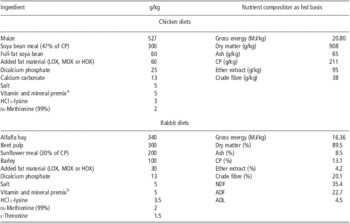
Experimental feeds were formulated following the corresponding nutritional requirements for chickens (National Research Council, 1994) and rabbits (De Blas and Wiseman, Reference De Blas and Wiseman1998). Chicken feed contained 60 g of added fat/kg; rabbit feed contained 30 g added fat/kg. The type of added fat varied depending on the dietary treatment. Feed ingredients and average nutrient performed compositions are given in Table 1. Chemical analysis of diets was as described in Blas et al. (Reference Blas, Cervera, Rodenas, Martínez and Pascual2010). In the case of rabbit feed, robenidine was included as a coccidiostatic drug. Batches of rabbit feed without this drug were also prepared and distributed during the last fattening week. All feeds were manufactured at the feed plant of the Universidad Politécnica de Valencia (Spain). For rabbit feed, a 3-mm sieve was used for grinding, and steam was added for meal conditioning to 18% to 20% humidity and 75°C to 80°C before pelleting. Chicken feeds were manufactured following the same procedure but were not pelleted.
Ingredients and average nutrient composition of the broiler chicken and rabbit diets

LOX = oil with a low degree of oxidation; MOX = oil with a medium degree of oxidation; HOX = oil with a high degree of oxidation.
aComposition of vitamin and mineral premix used in chicken feeds (1 kg of feed contained): Vitamin A, 6000 IU; Vitamin D3, 1200 IU; Vitamin E, 10 mg; Vitamin K3, 1.5 mg; Vitamin B1, 1.1 mg; Vitamin B2, 4 mg; Vitamin B6, 1.5 mg; Vitamin B12, 9 μg; Folic acid, 4 mg; Biotin, 50 μg; Pantothenic acid, 6 mg; Nicotinic acid, 21 mg; Choline, 360 mg; Mn, 75 mg; Zn, 50 mg; I, 0.18 mg; Fe, 30 mg; Cu, 6 mg; Se, 0.2 mg; Co, 0.2; Ethoxiquin, 16 mg. Addition of choline chloride 15 mg.
bComposition of vitamin and mineral premix used in rabbit feeds (1 kg of feed contained): Vitamin A, 8375 IU; Vitamin D3, 750 IU; Vitamin E, 20 mg; Vitamin K3, 1 mg; Vitamin B1, 1 mg; Vitamin B2, 2 mg; Vitamin B6, 1 mg; Nicotinic acid, 20 mg; Choline chloride, 250 mg; Mg, 290 mg; Mn, 20 mg; Zn, 60 mg; I, 1.25 mg; Fe, 26 mg; Cu, 10 mg; Co, 0.7; Butylhydroxianisole + Ethoxiquin, 4 mg.
Experimental design
A previous study in the first part of the Feeding Fats Safety project addressed the composition and oxidation of commercial fat co- and by-products (Nuchi et al., Reference Nuchi, Guardiola, Bou, Bondioli, Della Bella and Codony2009). The highest oxidation levels were found in a group of recycled cooking oil samples. Thus, a fat blend (sunflower oil/olive oil, 70 : 30, v/v) was collected at the end of a commercial potato chip frying process (at 170°C) and then heated again at 155 ± 10°C for 8 h. This second heating (at the same temperature as that used in frying) was conducted in order to reach a polymer value over 6%, approximately half of the limits established for discarding frying oils in most European countries (Firestone, Reference Firestone1996). This oil (HOX) was used to prepare the feed having the highest level of oxidation to be tested in the animal trials. An aliquot of the same fresh oil blend was taken before the commercial frying process to be used as a control treatment (low oxidized oil, LOX).
Chicken and rabbit trials included three dietary treatments: LOX, HOX and MOX. LOX treatment corresponded to the addition of LOX oil (fresh oil, low oxidation), at 30 g/kg (for rabbits) or 60 g/kg (for chickens). HOX treatment corresponded to the addition of HOX oil (see above, high oxidized oil), also at 30 g/kg for rabbit feed and 60 g/kg for rabbit and chicken feed. MOX treatment corresponded to an intermediate degree of oxidation (MOX) obtained by adding 15 g/kg of LOX oil + 15 g/kg of HOX oil for rabbit feeds, or 30 g/kg of LOX oil + 30 g/kg of HOX oil for chicken feed. The three treatments were replicated eight times. In the chicken trial, 96 7-day-old Ross 308 female broilers were randomly distributed into 24 experimental groups (3 dietary treatments × 8 replicates) under standard conditions of temperature, humidity and ventilation. The animals were housed in groups of four per cage, and feed and water were provided ad libitum during the study. When the broilers reached 47 days of age, they were slaughtered in a commercial abattoir. For the rabbit trial, a total of 144 rabbits (a cross of New Zealand and Californian rabbit) were housed in 24 collective cages (24 experimental groups, 3 treatments ×8 replicates × 6 animals per cage). In all cases, feed and water were provided ad libitum. At 63 days of age, rabbits were electrically stunned and killed by cutting carotids and jugulars. The experimental trials received prior approval from the Animal Protocol Review Committees of the Universitat Autònoma de Barcelona (Spain) and the Universidad Politécnica de Valencia (Spain). All animal housing and husbandry conformed to EU guidelines (Council European Communities, 1986).
Fat and feed sampling
The two oil samples (LOX and HOX) were taken as explained in the previous section and stored under N2 in glass vials, capped with Teflon caps, at −25°C until analysis. Feed samples were taken at the beginning of the trial. A 500-g aliquot from each of the 10 sacks was collected, thus reaching a total of 5 kg, which was homogenized. A sample of 1 kg was then taken, packed in a hermetic plastic bag and kept at −25°C. Before analysis, feed samples were ground in a mill to a particle size of 1 mm.
Meat, liver and plasma sampling
Chicken and rabbit carcasses were refrigerated at 4°C for 24 h after death. From each cage, one leg of each animal was taken and hand-deboned. Meat was pooled and ground. Meat samples were vacuum-packed in high-barrier multilayer bags (Cryovac BB325; permeability to O2, 25 cm3/m2 per day per bar at 23°C and 0% relative humidity, ASTMD-3985; Cryovac Europe, Sealed Air S. L., Sant Boi de Llobregat, Spain; ∼20 g meat/bag) and stored at −25°C until analysis. Chicken meat samples comprised dark meat with skin, whereas rabbit meat samples comprised leg meat only. The meat collection procedure differed for chickens and rabbits in order to simulate their usual edible portions. The main repercussion was that the lipid content was higher in chicken (mean value 10.4%) than in rabbit (mean value 2.8%).
Livers were removed from carcasses immediately after death. Livers from animals in each cage were pooled, ground and vacuum-packed in high-barrier multilayer bags (Cryovac BB325; ∼15 g liver/bag) and stored at −80°C until analysis.
Chicken plasma samples (around 5 ml) were obtained at day 37 from blood taken by syringes from jugular vein for the four birds in each cage. For rabbit plasma samples, around 20 ml of blood from carotids and jugulars was collected at the moment of sacrifice of four rabbits from each cage. All blood samples were collected in heparinized tubes and immediately centrifuged at 1450 g at 4°C for 10 min. Pooled plasma samples from the animals in each cage were homogenized and aliquots were transferred to plastic tubes (4.5 ml capacity) and stored at −25°C.
Reagents and standards
Butylated hydroxytoluene, αT, pyrogallol, thiobarbituric acid (TBA), p-anisidine and cumene hydroperoxide (CHP) were obtained from Sigma-Aldrich (St Louis, MO, USA). FA methyl esters were from Larodan Fine Chemicals AB (Malmo, Sweden) and Sigma-Aldrich. Tocopherol and tocotrienol standards were purchased from Calbiochem (La Jolla, CA, USA). Xylenol orange was from Scharlab (Barcelona, Spain). The methanol and ethanol used in the tocol analysis and in the ferrous oxidation-xylenol orange (FOX) method were of HPLC grade. Other reagents were of ACS grade.
Characterization of experimental fats
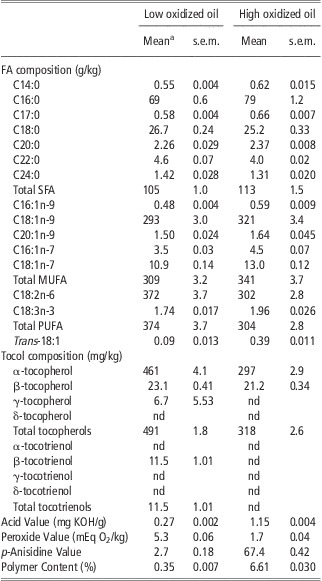
The two experimental oils (HOX and LOX) were characterized following Nuchi et al. (Reference Nuchi, Guardiola, Bou, Bondioli, Della Bella and Codony2009), including FA composition and tocol composition, Acid Value, Peroxide Value, p-Anisidine Value and Polymer Content. The values obtained are shown in Table 2.
Chemical composition of the sunflower/olive oil blend (70 : 30, v/v) before (lox oxidized oil) and after (high oxidized oil) its use in a commercial frying process (and subsequent heating at 165°C to 170°C for 8 h)

s.e.m. = standard error of the mean; FA = fatty acid; SFA = saturated FAs; MUFA = monounsaturated FAs; PUFA = polyunsaturated FAs.
aValues correspond to means (n = 2 for the FA composition, n = 5 for the tocol content, Acid Value, Peroxide Value, p-Anisidine Value and Polymer Content).
FA composition
The FA composition of feed, meat, liver and plasma was determined by gas chromatography, following Tres et al. (Reference Tres, Bou, Codony and Guardiola2009a), adjusted to the required sample amount. FA methyl esters were prepared following Guardiola et al. (Reference Guardiola, Codony, Rafecas, Boatella and Lopez1994).
Tocol content
Tocopherols and tocotrienols from feed, meat and liver were extracted after saponification following Bou et al. (Reference Bou, Guardiola, Tres, Barroeta and Codony2004). Plasma tocopherols and tocotrienols were extracted (without saponification) as described by Tres et al. (Reference Tres, Bou, Codony and Guardiola2009a). Tocopherol and tocotrienol composition was determined by HPLC with fluorescence detection, following a procedure adapted from Hewavitharana et al. (Reference Hewavitharana, Lanari and Becu2004).
Susceptibility to oxidation
The induced FOX method was used to assess susceptibility of meat and liver to oxidation, adapting the method of Grau et al. (Reference Grau, Codony, Rafecas, Barroeta and Guardiola2000a) to these samples. Plasma susceptibility to oxidation was also determined by the induced FOX method, as described in Tres et al. (Reference Tres, Bou, Codony and Guardiola2009a).
The measurement of the susceptibility to oxidation by means of induced methods, such as the FOX method applied in this study, is an estimation of the achievable oxidation of the sample (Tres et al., Reference Tres, Nuchi, Bou, Codony and Guardiola2009b). In the FOX-induced method, a methanolic extract of samples is mixed with the FOX reagents in glass cuvettes capped with Teflon caps. The mixture (the final volume of the reaction mixture was 2 ml) is then incubated in the dark to induce lipid hydroperoxide (LHP) formation until absorbance at 560 nm is steady. Absorbance is then measured with a spectrophotometer (Schimadzu UV-160A, Shimadzu, Kyoto, Japan) and the LHP value is determined by means of a calibration curve using CHP as standard.
TBA value
The TBA value of meats was determined by an acid aqueous extraction method with third derivative spectrometry, as described by Grau et al. (Reference Grau, Guardiola, Boatella, Barroeta and Codony2000b). The same procedure was used for liver and plasma but was adapted as in Tres et al. (Reference Tres, Bou, Codony and Guardiola2009a).
Statistics
Each cage was considered an experimental unit. One-way ANOVA was used to determine differences in FA and tocol composition, oxidation (TBA values) and susceptibility to oxidation (LHP values) of chicken (n = 24) and rabbit (n = 24) meat, liver and plasma caused by the factor ‘degree of oxidation of oil added to the feeds’. Multifactor ANOVA (n = 48) was used to determine whether the factor ‘degree of oxidation of oil added to the feeds’ differentially affected the FA and tocol composition, the oxidation (TBA values) and the susceptibility to oxidation (LHP values) in chickens and rabbits (factor ‘animal species’). In all cases, least-square means for the main factors that had a significant effect were separated by the Scheffe test, considering α ⩽ 0.05 as significant. The software used was SPSS 15.0 (version 15.0.1, SPSS Inc., Chicago, IL, USA).
Results and discussion
Effect of frying on oil composition and its oxidation status
The heating of the oil caused a decrease in its αT, βT and γT content (P < 0.05; Table 2). Total tocopherol content decreased about 35%. In contrast, the FA composition did not differ greatly between LOX and HOX oils, as only a slight decrease in the content of linoleic acid was observed (Table 2). The Acid Value of the oil increased from 0.27 to 1.15 mg KOH/100 g during frying, as a result of the hydrolytic alteration, which usually occurs when food products containing a certain amount of water (such as potatoes) are fried. In fact, the Acid Value has traditionally been used by industry to monitor the continuous frying process (Navas et al., Reference Navas, Tres, Bou, Codony and Guardiola2007). Furthermore, during frying the Peroxide Value of the oil showed a decrease (as the high temperature catalyses their decomposition), whereas the content of secondary oxidation compounds increased, reaching a p-Anisidine Value of 67 (Table 2). In addition, heating caused an increase in the Polymer Content up to 6.6% (w/w). These three parameters evaluate the thermo-oxidative alteration of the oil during frying, and the p-Anisidine Value and the Polymer Content have been proposed, among others, as complementary parameters to the measurement of the Acid Value to monitor industrial frying processes (Navas et al., Reference Navas, Tres, Bou, Codony and Guardiola2007). Furthermore, the p-Ansidine Value and the Polymer Content are more suitable control parameters than the Peroxide Value and the Acid Value for routine monitoring of the degradation status of fat products added to feeds (Nuchi et al., Reference Nuchi, Guardiola, Bou, Bondioli, Della Bella and Codony2009).
Feed FA composition
The FA composition of the chicken and rabbit feeds differed (Table 3) because they had been formulated with distinct ingredients in order to meet the specific dietary requirement of these two species (Table 1). As the amount of fat added to the chicken feed (60 g/kg) was higher than that added to rabbit feed (30 g/kg), the content of the main FA in oil (i.e. linoleic and oleic acids) was much higher in the chicken feed. However, the type of oil added (LOX, MOX and HOX) to feeds did not greatly alter the FA composition of rabbit or chicken feed (Table 3).
FA composition (mg/100 g feed) of the experimental feedsFootnote a
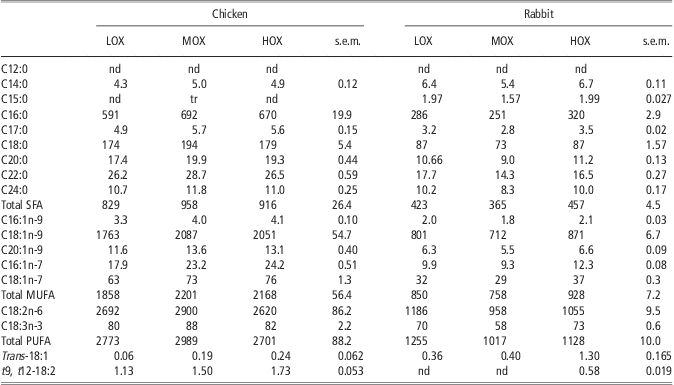
FA = fatty acid; LOX = feed containing oil with a low degree of oxidation; MOX = feed containing oil with a medium degree of oxidation; HOX = feed containing oil with a high degree of oxidation; tr = traces; SFA = saturated FAs; MUFA = monounsaturated FAs; PUFA = polyunsaturated FAs.
a Values correspond to means (n = 2); s.e.m., pooled standard error of the means for each animal species.
Meat, liver and plasma FA composition
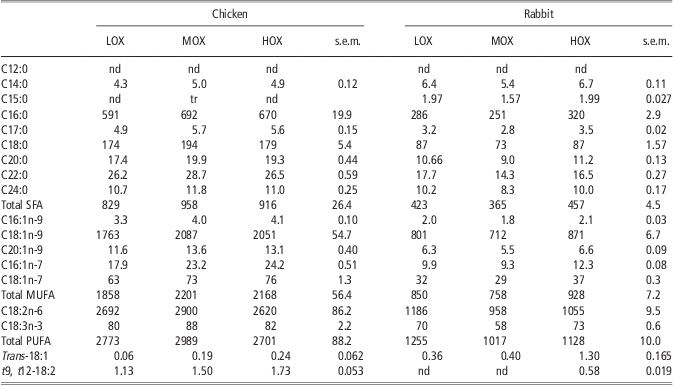
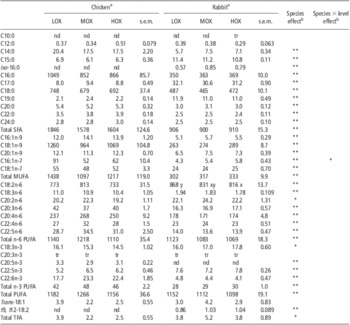
The overall results reveal that meat, liver and plasma FA composition varied between the chicken and rabbit (Tables 4, 5 and 6). The significant differences in meat FA composition between species (Table 4) were mainly due to the distinct fat content of chicken (10.4%, expressed as wet basis) and rabbit meat (2.8%, expressed as wet basis) samples, and to their tissue composition, as chicken samples consisted of a mix of muscle and adipose tissue (skin), whereas rabbit samples contained only muscle tissue. The different roles of muscular and adipose tissue in the FA metabolism might explain some of the different effects encountered between rabbit and chicken meat samples. For instance, in contrast to other monogastric species, lipogenesis in chicken does not take place in adipose tissue. In addition, differences between the digestive systems, the dietary habits and FA metabolism may also have contributed to the differences in FA content between these two species (Kouba and Mourot, Reference Kouba and Mourot2011). This fact was revealed by the higher presence of C15:0 and iso-16:0 in rabbit meat samples than in chicken meat samples, despite the higher fat content of the latter (Table 4), which led to a significant effect of the factor ‘animal species’ for these FAs in meat. This effect was also significant in liver and plasma, because odd-chain and branched-chain FAs were also higher in rabbit (Tables 5 and 6). Rabbit's dietary habits include coprophagy (Leiber et al., Reference Leiber, Meier, Burger, Wettstein, Kreuzer, Hatt and Clauss2008). Rabbits produce a particular kind of soft faeces, the caecotrophs. The FA profile of the caecotrophs is rich in saturated FA (SFA) and odd-chain and branched-chain FAs because of the microbial fermentation that takes place in the caecum. Thus, by ingestion of the caecotrophs, these FAs might be reabsorbed and reach tissues, although the overall impact of coprophagy on the general tissue FA composition is not substantial (Leiber et al., Reference Leiber, Meier, Burger, Wettstein, Kreuzer, Hatt and Clauss2008; Tres et al., Reference Tres, Bou, Codony and Guardiola2008).
FA composition of chicken and rabbit meat (mg/100 g of meat) in response to the level of oxidation (low, medium or high) of the oil added to feeds

FA = fatty acid; LOX = feed containing oil with a low degree of oxidation; MOX = feed containing oil with a medium degree of oxidation; HOX = feed containing oil with a high degree of oxidation; nd = not detected; tr = traces; SFA = saturated FAs; MUFA = monounsaturated FAs; PUFA = polyunsaturated FAs; TFA = trans FAs.
aValues correspond to means (n = 8); s.e.m., pooled standard error of the means of each animal species.
bMultifactor ANOVA (n = 48, chicken + rabbit) was conducted to study whether the factor ‘level of oxidation of oil added to feed’ led to different effects between animal species. *P ⩽ 0.05, **P ⩽ 0.01.
x, y, z: Values in the same row for a certain species bearing no common letters are statistically (P ⩽ 0.05) different according to one-way ANOVA conducted in each animal species (n = 24 for chicken, n = 24 for rabbit) to study the effects of the factor ‘level of oxidation of oil added to feeds’. Letters were obtained by means of the Scheffé's test (α = 0.05).
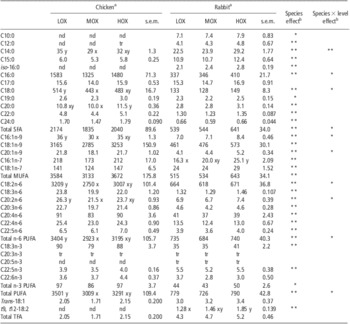
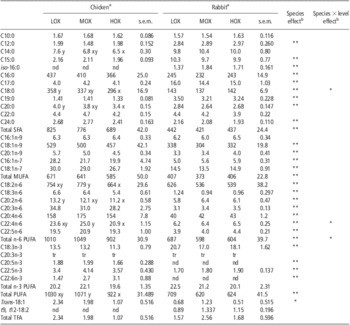
FA composition of chicken and rabbit liver (mg/100 g of liver) in response to the level of oxidation (low, medium or high) of the oil added to feeds

FA =fatty acid; LOX = feed containing oil with a low degree of oxidation; MOX = feed containing oil with a medium degree of oxidation; HOX = feed containing oil with a high degree of oxidation; nd = not detected; tr = traces; SFA = saturated FAs; MUFA = monounsaturated FAs; PUFA = polyunsaturated FAs; TFA = trans FAs.
aValues correspond to means (n = 8); s.e.m., pooled standard error of the means of each animal species.
bMultifactor ANOVA (n = 48, chicken + rabbit) was conducted to study whether the factor ‘level of oxidation of oil added to feeds’ led to different effects between animal species. *P ⩽ 0.05, **P ⩽ 0.01
x, y, z: Values in the same row for a certain species bearing no common letters are statistically (P ⩽ 0.05) different according to one-way ANOVA conducted for each animal species to study the effects of the factor ‘level of oxidation of oil added to feeds’. Letters were obtained by means of the Scheffé's test (α = 0.05).
FA composition of chicken and rabbit plasma (mg/l of plasma) in response to the level of oxidation (low, medium or high) of oil added to the feeds

FA = fatty acid; LOX = feed containing oil with a low degree of oxidation; MOX = feed containing oil with a medium degree of oxidation; HOX = feed containing oil with a high degree of oxidation; SFA = saturated FAs; MUFA = monounsaturated FAs; PUFA = polyunsaturated FAs; tr = traces; nd = not detected; TFA = trans FAs.
aValues correspond to means (n = 8); s.e.m., pooled standard error of the means of each animal species.
bMultifactor ANOVA (n = 48, chicken + rabbit) was conducted to study whether the factor ‘level of oxidation of oil added to feeds’ led to different effects between animal species. *P ⩽ 0.05, **P ⩽ 0.01.
x, y, z: Values in the same row for a certain species bearing no common letters are statistically (P ⩽ 0.05) different according to one-way ANOVA conducted for each animal species (n = 24 for chicken, n = 24 for rabbit) to study the effects of the factor ‘level of oxidation of oil added to feed’. Letters were obtained by means of the Scheffé's test (α = 0.05).
Liver and plasma FA composition also differed significantly between chickens and rabbits (Tables 5 and 6). Rabbits showed a higher tendency to incorporate n-6 PUFA in liver and plasma than chickens. Rabbit feed provided less n-6 PUFA than chicken feed (Table 3). However, in plasma (Table 6), and particularly in liver (Table 5), the difference in n-6 content between rabbit and chicken samples was less pronounced than in feeds (P < 0.05). Variations in the digestion process between species, their FA metabolic sites and in the activity of enzymes involved in FA metabolism between species might explain these differences (Benatmane et al., Reference Benatmane, Kouba, Youyou and Mourot2011; Kouba and Mourot, Reference Kouba and Mourot2011). Furthermore, the tendency of rabbit liver to incorporate higher PUFA than chicken is consistent with our findings in animals receiving a diet that was richer in SFA, supplied through hydrogenated palm FA distillates (Tres et al., Reference Tres, Nuchi, Magrinyà, Guardiola, Bou and Codony2012).
With regard to the effects of the dietary treatments, the addition of oxidized oil to feeds did not lead to major alterations in the FA composition of meat, liver or plasma (Tables 4, 5 and 6). The inclusion of oxidized oil in feed produced slight but significant effects on the content of C18:2n-6, C20:2n-6 and total n-6 PUFA content in chicken meat samples. MOX chicken meat samples presented the lowest content of these FA, and the same tendency, although non-significant, was observed for almost all the other FAs. However, this trend was not seen in feeds or in rabbit meat samples, which led to a significant interaction of the factors ‘animal species × level’ in meat (Table 4). Because of this, it is probable that this effect in chicken meat was related to a decrease in the overall FA content in MOX chicken meat. As no differences had been observed for digestibility between diets (Feeding Fats Safety, 2008; Blas et al., Reference Blas, Cervera, Rodenas, Martínez and Pascual2010), it seems quite evident that the cause might be found in the post-absorptive steps of the FA metabolism, for instance a lower FA storage. Furthermore, this significant interaction was only encountered in chicken meat, but not in liver or plasma. But although this interaction was significant, the magnitude of the differences between treatments (in terms of FA amounts) was quite low for most FA. In liver (Table 5), only a decrease in the C18:2n-6 content in rabbit was observed in response to HOX oil. In chicken plasma (Table 6), decreases in the content of total SFA and some n-6 PUFA such as C18:2n-6, C20:2n-6 and C22:4n-6 were observed when oxidized oils were added to feeds. The trend followed by FA contents in plasma was intermediate between that of meat and liver.
Although some slight (but significant) differences were observed for the tissue FA composition, overall, these results indicate that the FA composition of rabbit and chicken (meat, liver and plasma) was not greatly affected by the addition of recovered frying oils to feeds. However, in some cases the addition of highly oxidized oils (Sheehy et al., Reference Sheehy, Morrisey and Flynn1993) produced greater alterations in the FA composition of meat and liver. In contrast, other studies in which intermediate (more realistic) levels of feed oil oxidation were assayed, also showed none or very few effects on the FA composition of meat (Sheehy et al., Reference Sheehy, Morrisey and Flynn1993; Jensen et al., Reference Jensen, Enberg, Jakobsen, Skibsted and Bertelsen1997; Bou et al., Reference Bou, Codony, Baucells and Guardiola2005; Tres et al., Reference Tres, Bou, Codony and Guardiola2010a). In general, it appears that tissue FA composition is not affected by the addition of oxidized fats to feeds when these fats are used at suitable doses and when they are below the cut-off limit established for discarding frying oils (Firestone, Reference Firestone1996).
Feed tocol composition
Tocol (tocopherols + tocotrienols) content and composition in feed depended on the tocol content in the oil, on the mineral–vitamin premix added to feed formulation, and on the rest of the feed ingredients (Table 1). Thus, differences in tocol composition between feeds followed a different pattern depending on the tocol. The main tocopherol in the fat added to feed was αT, followed by βT (Table 2). As the fat added to feed was higher in chicken than in rabbit, the amount of αT supplied by the oil might be higher in chicken. However, owing to the different nutritional requirements of each species, the vitamin–mineral premix added to rabbit feeds supplied a higher α-T amount than in chicken feed. The combination of both tocol sources led to a higher αT content in rabbit feed than in chicken feed (Table 7).
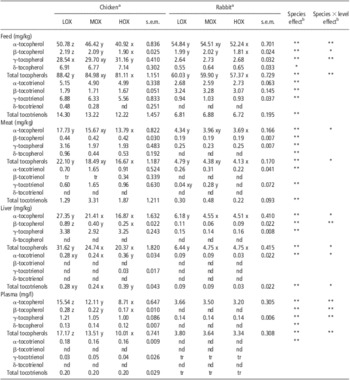
Tocol composition of meat, liver and plasma of chicken and rabbit in response to the level of oxidation of the oil added to feeds

LOX = feed containing oil with a low degree of oxidation; MOX = feed containing oil with a medium degree of oxidation; HOX = feed containing oil with a high degree of oxidation; nd = not detected; tr = traces.
aValues correspond to means (n = 8); s.e.m., pooled standard error of the means of each animal species.
bMultifactor ANOVA (n = 48, chicken + rabbit) was conducted to study whether the factor ‘level of oxidation of oil added to feed’ led to different effects between animal species. *P ⩽ 0.05, **P ⩽ 0.01.
x, y, z: Values in the same row for a certain tissue bearing no common letters are statistically different (P ⩽ 0.05) according to one-way ANOVA conducted for each species to study the effects of the factor ‘level of oxidation of oil added to feed’. Letters were obtained by means of the Scheffé's test (α = 0.05).
On the other hand, αT and βT contents decreased in chicken and rabbit feeds supplemented with LOX to HOX oils (Table 7). This might be attributed to the decrease of these substances in the HOX oil as a result of heating. Furthermore, the αT decrease was more prominent in chicken feed because of its higher amount of added fat. Other tocols in feed, such as α-tocotrienol, were supplied by the rest of feed ingredients, and because of this they were similar among the three treatments for rabbit and chicken.
Effects on the tocopherol and tocotrienol composition of meat, liver and plasma
The incorporation of αT in chicken and rabbit meat, liver and plasma was much lower than that of tocotrienols and other tocopherols (Table 7). Tocotrienols are absorbed by intestinal cells faster than tocopherols (Tsuzuki et al., Reference Tsuzuki, Yunoki and Yoshimura2007). However, in liver, αT is preferentially carried stereo-selectively by the cytosolic αT transfer protein to very-low-density lipoproteins and then released into the circulation (Schneider, Reference Schneider2005).
The inclusion of skin (adipose tissue) in chicken meat samples caused a higher tocol content than in rabbit meat samples. Nevertheless, the content of all tocols in plasma and liver was also higher in chicken than in rabbit (Table 7), although the fat content in these samples was similar for these two species. The higher content of βT, γT and tocotrienols in chicken feed explained the higher content of these compounds in chicken plasma and liver; however, the αT content in chicken feed was lower than in rabbit feed. Thus, chickens may have a greater capacity to absorb αT than rabbits. Indeed, the higher fat content added to chicken feed may have facilitated the absorption of liposoluble vitamins such as αT. Moreover, other unknown feed matrix effects may also contribute to these differences. Furthermore, differences in digestion processes and feed intake between chickens and rabbits might also influence the final αT content of their tissues.
The increase in the oxidative degree of the oils added to the feeds caused a reduction in the αT content of chicken plasma, liver and meat. In rabbit, the αT content of meat and liver also decreased as did that of plasma, but in this last case it was not significant, which led to a significant interaction of the factors ‘animal species’ × ‘level of oxidation’ for αT (and other tocols) in plasma, liver and meat (Table 7). Feed with MOX and HOX oils also presented a lower αT content than LOX feed, as a result of the loss of αT in the frying oil, which might contribute to the differences observed between tissues. However, the decrease in αT content observed in feed formulated with MOX and HOX oil was greater in tissues than in feeds, particularly in rabbit meat and in the liver and plasma of both animals (Table 7). Thus, we conclude that factors other than the amount of αT supplied by the feed affect the final tissue αT content. Previous studies attributed the reduction of tissue αT content also to a loss of this antioxidant in the gastrointestinal tract as a result of its reaction with radical species, thereby reducing the amount available for absorption (Sheehy et al., Reference Sheehy, Morrisey and Flynn1993). However, this was more evident when fats presented a higher content of primary oxidation compounds than in our study (Sheehy et al., Reference Sheehy, Morrisey and Flynn1994; Tres et al., Reference Tres, Bou, Codony and Guardiola2010b). These results highlight the relevance of a complete characterization of feed ingredients, including their composition and oxidation status, as these two parameters might affect the nutritional characteristics of meat and other animal products. Indeed, some studies have recommended supplementing diets with α-tocopheryl acetate to counteract the reduction of αT caused by the addition of oxidized oils to feeds (Bou et al., Reference Bou, Codony, Tres, Guardiola and Decker2009; Tres et al., Reference Tres, Bou, Codony and Guardiola2010b).
Effects on the oxidation levels and oxidability of meat, liver and plasma
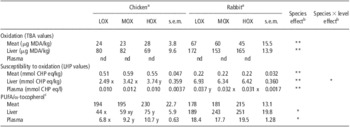
Oxidation (TBA values) and susceptibility to oxidation (LHP values) of meat, liver and plasma from chicken and rabbits fed oxidized oils were low (Table 8), even in samples from animals on diets including HOX oil, and they were similar to values obtained in other studies on heated oils in feed (Bou et al., Reference Bou, Codony, Baucells and Guardiola2005; Tres et al., Reference Tres, Bou, Codony and Guardiola2010b). The development of oxidation both in vivo and post mortem (meat) is related to a balance between substrates (such as PUFA), pro-oxidants (such as some inorganic elements) and antioxidants (such as αT; Erickson, Reference Erickson2007). In the present study, this balance led to low oxidation values in tissues. However, higher oxidation has been reported when animals receive a higher PUFA supply from the diet (Grau et al., Reference Grau, Guardiola, Grimpa, Barroeta and Codony2001; Bou et al., Reference Bou, Guardiola, Tres, Barroeta and Codony2004; Tres et al., Reference Tres, Bou, Codony and Guardiola2009a; Kouba and Mourot, Reference Kouba and Mourot2011).
Oxidation, susceptibility to oxidation and relationship between the content of polyunsaturated FAs and α-tocopherol in meat, liver and plasma, depending on the level of oxidation of oil added to feeds

LOX = feed containing oil with a low degree of oxidation; MOX = feed containing oil with a medium degree of oxidation; HOX = feed containing oil with a high degree of oxidation; TBA = thiobarbituric acid; nd = not determined; LHP = lipid hydroperoxide; CHP = cumene hydroperoxide; PUFA = polyunsaturated FAs.
aValues correspond to means (n = 8); s.e.m., pooled standard error of the means of each animal species.
bMultifactor ANOVA (n = 48, chicken + rabbit) was conducted to study whether the factor ‘level of oxidation of oil added to feed’ led to different effects between animal species. *P ⩽ 0.05, **P ⩽ 0.01.
cPUFA/α-tocopherol values were calculated by dividing the total PUFA content of each sample (expressed as mg of FA per 100 mg or 100 ml of tissue) by its α-tocopherol content (expressed as mg of α-tocopherol per kg or litre of tissue).
x, y, z: Values in the same row for a certain tissue bearing no common letters are statistically different (P ⩽ 0.05) according to one-way ANOVA conducted for each species to study the effects of the factor ‘level of oxidation of oil added to feed’. Letters were obtained by means of the Scheffé's test (α = 0.05). For liver LHP value, significance was found by Duncan′s test, but not by Scheffe′s test.
With regard to differences between species, rabbit meat and liver samples showed higher TBA values than the corresponding chicken samples (Table 8). This is in accordance with the lower αT content in rabbit than chicken samples (Table 7). The reduction of the formation of malondialdehyde is a well-known effect of αT (Frankel, Reference Frankel1991). Thus, compared with rabbit samples, the formation of malondialdehyde in chicken meat samples was retarded by the higher αT content, although chicken meat samples had a higher fat content. Nevertheless, as commented above, the TBA values found were low in all cases.
With regard to differences in the susceptibility to oxidation between species, chickens showed higher meat susceptibility to oxidation (LHP values) than rabbits (Table 8). However, their liver and plasma LHP values were lower than in rabbits (Table 8). The relative content of PUFA/αT in these types of samples would explain the differences observed between species in the susceptibility of each tissue to oxidation. This relative PUFA/αT was calculated by dividing the PUFA content in tissues (expressed as mg of FA per 100 mg or 100 ml of tissue/plasma) by the αT content (expressed as mg of αT per kg or litre of tissue/plasma). In liver and plasma, chicken presented lower PUFA/αT values than rabbit, and in meat samples chickens had higher (but non-significant) PUFA/αT values than rabbits (Table 8). An increase in the PUFA/αT value implies that there is less αT available to protect PUFA from oxidation and that, once started, oxidation might develop faster, reaching a higher final oxidation value. In our study, rabbit meat showed higher TBA values than chicken meat, but lower susceptibility to oxidation. Globally, this would indicate that because of the lower αT content the formation of malondialdehyde might have started before in rabbit meat. However, owing to the PUFA/αT balance, the final oxidation value that rabbit meat could potentially reach would be lower than that in chicken meat.
With regard to the effects of feed, the addition of LOX, MOX and HOX oils to feeds did not cause major changes in the oxidation degree of tissues (TBA values) or their susceptibility to oxidation (LHP values; Table 8). This finding thus indicates that raw meat from chickens and rabbits receiving feeds containing recovered frying oils showed acceptable oxidation status and susceptibility to oxidation. Only slight differences were observed for the LHP value of chicken liver (Table 8). These results are in agreement with previous studies in which the inclusion of oil heated at high temperatures did not enhance the oxidation of chicken and rabbit tissues or their susceptibility to this process (Grau et al., Reference Grau, Guardiola, Grimpa, Barroeta and Codony2001; Bou et al., Reference Bou, Codony, Baucells and Guardiola2005; Tres et al., Reference Tres, Bou, Codony and Guardiola2010b). Although the absorption of secondary oxidation compounds in the gastrointestinal tract has been reported (Kanazawa and Ashida, Reference Kanazawa and Ashida1998; Marquez-Ruiz et al., Reference Marquez-Ruiz, García-Martínez and Holgado2008), results from these and previous studies indicate that the effects on tissue oxidation are more related to the content of αT in tissues, which in turn may depend on its loss during oil heating and during digestion and on its antioxidant activity in vivo and post mortem. Indeed, most of the effects on tissue composition and oxidation described in previous studies on the addition of oxidized oils to feeds seemed to be explained by the use of highly oxidized fats, sometimes added at huge amounts to feed, which led to altered fat digestion and absorption, as well as to deficiencies in EFA and liposoluble vitamins, such as αT (Marquez-Ruiz et al., Reference Marquez-Ruiz, García-Martínez and Holgado2008). In contrast, the oxidation level of the oils that we tested was much lower and did not alter fat digestibility (Blas et al., Reference Blas, Cervera, Rodenas, Martínez and Pascual2010). However, results obtained in the same samples by another partner of the Feeding Fats Safety project showed significant increases in the content of cholesterol oxidation compounds in tissues as a result of the addition of HOX oil to feeds (Ubhayasekera et al., Reference Ubhayasekera, Tres, Codony and Dutta2010a and Reference Ubhayasekera, Tres, Codony and Dutta2010b).
General conclusions
In summary, the inclusion of recovered frying oils in rabbit and chicken feeds did not lead to major changes in the FA composition, oxidation status or susceptibility to oxidation of the meat, liver and plasma of these animals. Thus, the addition of these oils to feeds, at the amounts usually added for each species, may lead to a similar FA composition, oxidation status and stability of the final products to that achieved with the addition of a similar non-oxidized oil. However, the use of oxidized oils may lead to a decrease in the αT content of tissues and thus alter the nutritional quality of meat and other animal products. This could be avoided by supplementing feeds with αT. Oils recovered from frying industries show better characteristics than ‘recycled cooking oils’, which present a more complex and variable composition, higher levels of impurities and higher levels of degradation. Therefore, and according to our results, recovered frying oils could be useful for feed uses and provide safer characteristics, although further studies are still necessary.
Acknowledgement
This research was supported by the Feeding Fats Safety project (FOOD-CT-2004-07020), funded by the 6th Framework Programme for Research of the European Commission.