Introduction
Overfishing poses a significant global threat to the oceans, along with other human impacts such as pollution, deteriorating water quality, invasive species, and human-induced climate change (Arthington et al. Reference Arthington, Dulvy, Gladstone and Winfield2016), particularly in coastal areas worldwide (Halpern et al. Reference Halpern, Walbridge, Selkoe, Kappel, Micheli, D’Agrosa, Bruno, Casey, Ebert, Fox, Fujita, Heinemann, Lenihan, Madin, Perry, Selig, Spalding, Steneck and Watson2008). These activities harm target species, and profoundly altering the structure and functioning of marine food webs risks triggering trophic cascades, thus weakening ecosystem resilience (Bascompte et al. Reference Bascompte, Melián and Sala2005; Casini et al. Reference Casini, Lövgren, Hjelm, Cardinale, Molinero and Kornilovs2008; Jackson et al. Reference Jackson, Kirby, Berger, Bjorndal, Botsford, Bourque, Bradbury, Cooke, Erlandson, Estes, Hughes, Kidwell, Lange, Lenihan, Pandolfi, Peterson, Steneck, Tegner and Warner2001). One of the foundations of sustainable fisheries management is stock identification, essential for understanding stock structure (Cadrin Reference Cadrin2020; Cope and Punt Reference Cope and Punt2011; Cowen et al. Reference Cowen, Gawarkiewicz, Pineda, Thorrold and Werner2007; Hansell et al. Reference Hansell, Walter, Cadrin, Golet, Hanke, Lauretta and Kerr2020; Zemeckis et al. Reference Zemeckis, Martins, Kerr and Cadrin2014). This knowledge is invaluable for effective management strategies to rebuild fish stocks and promote sustainable fishing practices (Punt Reference Punt2023). A good stock assessment will enable efficient biological identification of the fish, which is important for understanding genetic diversity, population structure, and potential gene flow between neighboring populations of the same species (Begg et al. Reference Begg, Friedland and Pearce1999; Cadrin et al. Reference Cadrin, Goethel, Berger and Jardim2023). This information is important for conservation efforts, sustainable management practices, and the prediction of population resistance to environmental change (Kerr et al. Reference Kerr, Cadrin and Secor2010).
Conducting stock assessments is complex, even after correct stock identification (Punt Reference Punt2023). Fish are highly mobile, constantly moving to feed, migrate, and spawn, and direct counting is not feasible (Cadrin et al. Reference Cadrin, Goethel, Berger and Jardim2023). These factors can contribute to poor stock assessment and, consequently, to inefficient stock management practices, which can lead to the overexploitation of specific stocks (Ying et al. Reference Ying, Chen, Lin and Gao2011). To deal with these complexities, scientists use various data collection methods such as relying on fishing reports and deploying research vessels to monitor catch rates, studying fish biology, and estimating abundance.
A variety of different methods and techniques have been developed to assess stock identification. These include methods based on morphology, meristics, otolith-based, parasites as biological tags, and genetics (among others). These have been summarised in Cadrin et al. (Reference Cadrin, Kerr, Mariani, Cadrin, Kerr and Mariani2014). The use of parasites as biological tags for stock identification is well established (Timi and Mackenzie Reference Timi and Mackenzie2015) and shown to be effective (Poulin and Kamiya Reference Poulin and Kamiya2015). The theory behind the use of parasites as biological tags rests on the theory of decay of similarity where the similarity in parasite communities increases as the geographic distance between host populations decreases (Poulin Reference Poulin2003). It further relies on the geographic range of a host species overlapping with the endemic areas of some of its parasites (MacKenzie and Abaunza Reference MacKenzie and Abaunza1998). Nevertheless, for a parasite to be considered a tag, it must meet several criteria. The parasite must vary significantly in infection according to the regions studied; live for a long time in the host, the duration depending on the study; be easy to detect and identify to avoid wasting time; be easily detected, site-specific parasites being ideal; not alter host behavior through pathological effects (MacKenzie and Abaunza Reference MacKenzie and Abaunza1998).
Knowing which parameters influence the study area is essential to interpret suitable biological tags. Several factors can affect the distribution or diversity of parasites, including biotic parameters such as temperature, currents, and salinity (Bommarito et al. Reference Bommarito, Wahl, Thieltges, Pansch, Zucchetta and Pranovi2022). Changes in these parameters can influence the presence and prevalence of parasites. Iceland sits on the Greenland-Scotland Ridge, which forms a boundary between the southern/western and northern/eastern parts of the Iceland Shelf (Pampoulie et al. Reference Pampoulie, Brix and Randhawa2024). It is influenced by two major currents, forming distinct oceanographic regions along the northwest-southeast axis (Astthorsson et al. Reference Astthorsson, Gislason and Jonsson2007). Waters to the south of Iceland are influenced by the North Atlantic Current and are characterised as warmer and more saline than waters to the north of Iceland, which are more variable and shaped by the East Greenland Current (Astthorsson et al. Reference Astthorsson, Gislason and Jonsson2007). Given the dynamic environmental gradients and distinct oceanographic features characterising the waters to the north and south of Iceland, it is hypothesised that fish collected from these distinct areas are exposed to different environmental conditions and currents, and are thus likely feeding on different prey (or at least in different proportions) – factors potentially contributing to them harbouring different parasite faunas.
The European plaice (Pleuronectes platessa L.), a flatfish belonging to the family Pleuronectidae, is found in Icelandic waters. It is most abundant in the southwest and west of Iceland, mainly at depths of 200 m on sandy or muddy substrates (Jónsson and Pálsson Reference Jónsson and Pálsson2013). The species exhibits sexual dimorphism with females (~55 cm), reaching larger overall sizes than males (~45 cm), and length at maturity at 38 cm for females and 33 cm for males (MFRI 2024). Sexual maturity is defined by size, not age. Plaice migrate between feeding and spawning grounds between January and March, with spawning occurring at depths of 50–100 m, close to the coasts in areas of strong water movement between March and June (Dipper Reference Dipper and Dipper2022). Plaice initially feed on various small benthic organisms, particularly annelids, harpacticoid copepods, amphipods, and small decapods, transitioning to bivalves (molluscs) as they grow (De Raedemaecker et al. Reference De Raedemaecker, O’Connor, Brophy and Black2011).
In Iceland, the plaice is managed as a single stock (MFRI 2024), and those from the Icelandic and Faroese shelves are considered genetically distinct from those inhabiting other waters in the Northeast Atlantic (Hoarau et al. Reference Hoarau, Piquet, Van der Veer, Rijnsdorp, Stam and Olsen2004; Le Moan et al. Reference Le Moan, Bekkevold and Hemmer-Hansen2021). The Faroese shelf, which is located around the Faroe Islands, is situated in the North Atlantic Ocean, between Iceland and Norway (Figure 1).
Map of Iceland, including prevailing currents, showing the six different capture sites for each study group: North Summer N = 20, North Winter N = 27, South Summer N = 21, and South Winter N = 14. Note that two of the localities are similar in South Winter (see Table 1) and their points overlap completely.

In December 2019, ICES (International Council for the Exploration of the Sea) agreed with Iceland to include plaice in its assessment process and in 2022 decided to use a SAM (Stock Assessment Model in State Space). This new SAM model is a statistical catch-at-age model based on commercial data (since 1979), the Icelandic spring groundfish survey (from 1985), and estimated annual recruitment at three years old (MFRI 2024). Plaice fishing is concentrated mainly in the west, southwest, and northwest, using bottom and pelagic trawls, with few catches using gillnets and longlines (MFRI 2024). Catches of plaice have been relatively stable in the last 25 years, ranging between 4,926 mt (2001) and 8,678 mt (2021) (MFRI 2024). Nevertheless, spatial and temporal regulations have been put in place to protect its spawning areas (i.e., specific spawning grounds in the west and southwest of Iceland are closed to fishing during the spawning period in April).
Eight parasite species have been reported previously in Icelandic waters from the plaice: (1) the copepod Acanthochondria cornuta (Müller, 1776) in the gills (Kabata Reference Kabata1959); (2) the copepod Lepeophtheirus pectoralis (Müller, 1776) on the skin and fins (Stephensen Reference Stephensen1940); (3) the myxosporean Myxobolus platessae (Woodcock, 1904) found in the cartilage (from the southwest of Iceland) (Karlsbakk et al. Reference Karlsbakk, Kristmundsson, Albano, Brown and Freeman2017); (4) the larval nematodes Anisakis sp., (5) Contracaecum sp., (6) Hysterothylacium sp., and (7) Phocanema decipiens (Krabbe, 1878) in the muscles and the viscera (Hauksson Reference Hauksson1992); and (8) the adult trematode Podocotyle atomon (Rudolphi, 1802) (Brinkmann Reference Brinkmann1956). Although there has been no specific use of parasites as biological tag for assessing plaice stock dentification in Iceland, Hauksson and Ólafsdóttir (1996) did report a greater parasite abundance in plaice collected in the west relative to those collected from the east (supporting the Greenland-Scotland Ridge boundary). The nematode Cucullanus heterochrous Rudolphi, 1802, anisakid nematode larvae, and the myxosporean Myxobolus æglefini Auerback, 1906 (possibly M. platessae), have been suggested as potential biological tags for plaice from three different spawning grounds in the North Sea (Wickins and MacFarlane Reference Wickins and MacFarlane1973), a different region from the current study area.
This study aims to describe and quantify the parasite fauna of plaice and assess the potential of parasites as biological tags for stock identification of plaice in Icelandic waters, considering seasonal variations (winter, summer) and localities (north, south). The anticipated outcome is that abundance of certain parasites will vary across different seasons and localities, making some of these suitable biological tags and therefore providing insights into the stock structure of plaice in Icelandic waters.
Material and methods
Samples collection
A total of 82 plaice were sampled from fishermen in 2023 from six sites in Northern Iceland and along the Reykjanes Peninsula in the south, at depths ranging between 18 and 125 m (Figure 1; Table 1). Three northern sites were sampled twice in winter (February) and once in summer (August), while three southern sites were sampled twice in winter (March) and once in summer (October). The fish were grouped by location and season into four groups: north winter (NW; N = 27), south winter (SW; N = 14), north summer (NS; N = 20), and south summer (SS; N = 21). We had no control over the provenance and timing of our samples, as we relied solely on the generosity of local fishermen. During the necropsy, each fish was measured (total length [TL]; cm) and sexed (males, female, immature). The following organs/sites were examined for macroparasites: skin, fins, mouth, nares, gills, eyes, brain, body cavity, flesh, gonads, heart, liver, mesenteries, spleen, and digestive tract. All were examined fresh except for the gonads, liver, mesenteries, and digestive tract, which were placed individually in labelled bags and frozen at -30°C for later examination. All parasites found were collected and preserved in 96% ethanol for molecular analyses. For the digestive tract (stomach and intestine), parasites were separated into those collected from the external surface and from the mucosa. Additionally, otoliths were extracted and stored dry in envelopes, and genetic samples (gill filaments) were retained and stored in 96% ethanol (for future studies). Otolith contour reconstructions, based on the mean elliptical Fourier harmonics from the four sampled regions, revealed shape differences in the otoliths of the north winter group compared to the three other groups. However, the linear discriminant analysis (LDA) model yielded a relatively high classification error of 59.76%, indicating limited effectiveness in distinguishing among the four plaice populations. These results suggest that the current LDA model does not adequately classify the data and may require refinement; that is why we have chosen not to include it.
Overview of collection information and sample sizes for plaice sampled in this study (N = 82)

Molecular analysis
Genomic DNA was extracted from each parasite morphotype from the different organs, aiming for three extractions per morphotype per organ when feasible. Morphotypes were defined based on body shape, size, colour, and encystment shape. These were identified and recorded consistently between organs and between different individual fish. Individual samples of smaller parasites, like trematode metacercariae, were placed in distinct tubes for DNA extraction. In the case of nematodes, a small section (disc, approximately 1 mm thick) from the parasite’s central part was extracted (Devlin et al. Reference Devlin, Diamond and Saunders2004). A total of 36 distinct parasite forms were processed; the parasites were labeled based on the morphological identification conducted earlier (for instance, ‘nematode type 1’), indicating the specific organ in which they were discovered and whether they were located on the inside or outside of each respective organ. While copepods were counted and identified, they were not included in the molecular work. Small parasites, such as metacercariae, were placed individually in separate tubes, while a central section of larger parasites, such as nematodes, was used for extraction, with the remaining tissue preserved in ethanol as a hologenophores/paragenophores (Pleijel et al. Reference Pleijel, Jondelius, Norlinder, Nygren, Oxelman, Schander, Sundberg and Thollesson2008). Different gene regions were amplified via PCR for specific taxa. The ITS region was amplified using primers 93 and 94 (Nadler et al. Reference Nadler, D’Amelio, Dailey, Paggi, Siu and Sakanari2005) for nematodes, the 28S rDNA region using primers T01N and T13N (Harper and Saunders Reference Harper and Saunders2001) for unknowns (Cysts of Unknown Etiology; CUE), the 28S rDNA region using primers BD3 (Hernández-Mena et al. Reference Hernández-Mena, García-Prieto and García-Varela2014) and 536 (Stock et al. Reference Stock, Campbell and Nadler2001) for trematodes, and the mitochondrial COI region using primers LCO1490a (García-Varela and Pérez-Ponce de León Reference García-Varela and Pérez-Ponce de León2008) and HCO2198 (Folmer et al. Reference Folmer, Black, Hoeh, Lutz and Virjenhoek1994.) for acanthocephalans, using protocols described in Nadler et al. (Reference Nadler, D’Amelio, Dailey, Paggi, Siu and Sakanari2005; nematodes), García-Varela and Nadler (Reference García-Varela and Nadler2005; trematodes), and García-Varela and Pérez-Ponce de León (Reference García-Varela and Pérez-Ponce de León2008; acanthocephalans). PCR reactions (25 μL) contained 12.50 μL of MyTaq 2x Master Mix (New England Biolabs), 0.35 μL of both forward and reverse primers (50 nM), 0.5 μL of DNA template, and 11.30 μL of ddH2O. PCR products were visualised under UV light (1.5% agarose gel and Ethidium Bromide). Ten μL of each successful PCR product were purified using 2 μL of ExoSAP-IT (Applied Biosystems). Purified PCR were bi-directionally sequenced (Sanger sequencing) at Microsynth (Germany) using PCR primers (20 nM) and internal primers BD2 (Luton et al. Reference Luton, Walker and Blair1992) and 504 (García-Varela and Nadler Reference García-Varela and Nadler2005) for trematodes. Sequences were manually edited with Sequencher 5.4.6 (Gene Codes Corporation) and screened for orthology using BlastN (McGinnis and Madden Reference McGinnis and Madden2004).
Statistical analyses
Parasite abundance, mean intensity of infection, and prevalence were calculated according to Bush et al. (Reference Bush, Lafferty, Lotz and Shostak1997) for each parasite taxon for each organ. Statistical analyses were performed in R Software, version 4.0.5 (R Core Team 2021). Although we grouped August and October samples together under ‘Summer’ (i.e., both these months are not consecutive but are considered within the feeding season for plaice in Icelandic waters (Hjorleifsson and Pálsson Reference Hjorleifsson and Pálsson2001)), we performed a Mann-Whitney test to examine whether parasite abundance and the number of fish of the same sex differed between the two months. A three-factor ANOVA was used to examine the effects of sex, locality, and season (and their interactions) on fish size. Assumptions for normality (Shapiro-Wilk test) and variance homogeneity (Levene’s test) were validated, followed by post hoc Tukey tests for significant differences. A generalized linear mixed model (GLMM) using the packages lme4, MASS, and caret in R examined the effects of fish length, season, and locality on parasite abundance, with fish ID as a random effect to account for individual variation. Interaction terms were tested for ecological relevance, and variance inflation factors (VIFs) identified collinearity, leading to the exclusion of the gender variable. The best model, determined by the lowest Akaike Information Criterion corrected for small sample size (AICc), included fixed effects for length, season, and region. Diagnostic checks confirmed model assumptions. Linear Discriminant Analysis (LDA) was performed using klaR, psych, and MASS to identify the best combinations of individual parasite species abundance per organ to distinguish fish groups by season and region. For the LDA, only parasites present in at least 5% of sampled fish were considered (Osuna-Cabanillas et al. Reference Osuna-Cabanillas, Marín-Enríquez, Martínez-Falcón, Timi and Morales-Serna2024).
Results
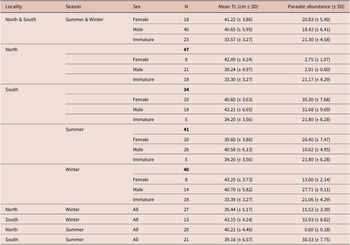
Sex was assigned for 81 plaice and grouped by region and season; the sex of one of the individuals could not be identified. Total length and parasite abundance data for plaice sampled in the north and south during the winter and summer seasons are summarized in Table 2.
Summary of mean total length (TL) and mean parasite abundance (with standard deviation; SD) per plaice (Pleuronectes platessa L.) (N = 81) sampled from the north and south of Iceland in both summer and winter

In summer, after a Mann-Whitney test with a p-value > 0.05 to see if there was a difference between the sexes in these two months (no difference here), we considered these two groups to form the summer group. However, there was a difference in parasite abundance with a Mann-Whitney test with a p-value < 0.001. Despite the differences in parasite abundance, we had to group the August and October samples to form the summer group because the number of samples was too small if they were split into their respective groups.
An ANOVA showed a significant difference in fish size across the four study groups: north summer (NS), north winter (NW), south summer (SS), and south winter (SW) (p < 0.001). Residuals deviated significantly from normality (Shapiro-Wilk, p < 0.001) but only due to extreme values (Q-Q plot not shown). Variances were homogeneous between groups (Levene’s test, p = 0.344). Tukey’s post hoc tests identified significant size differences between NW and NS (p < 0.05) and SW and NW (p < 0.001). Average sizes were 35.44 cm (± 5.17 cm) for NW, 40.20 cm (± 4.46 cm) for NS, and 43.15 cm (± 4.24 cm) for SW.
An ANOVA revealed a significant difference in fish size according to sex (p < 0.001). Residuals did not deviate significantly from normality (Shapiro-Wilk, p = 0.086), and variances were homogeneous (Levene’s test, p = 0.283). Tukey’s post hoc tests showed significant size differences between immature fish and females (adjusted p < 0.001) and between immature fish and males (adjusted p < 0.001), but not between males and females (adjusted p = 0.942). Average sizes were 40.65 cm (± 5.95 cm) for males, 41.22 cm (± 3.86 cm) for females, and 33.57 cm (± 3.27 cm) for immature fish.
In the south region, the GLMM showed the variation of the parasite abundance as a function of the TL to not be statistically significant (p = 0.410), and fish size explained only 2.1% of the variance in parasite abundance (R2 = 0.021). Similarly, in summer, the relationship was not statistically significant (p = 0.399), and fish size explained only 1.8% of the variance (R2 = 0.018). In winter, the relationship was not statistically significant (p = 0.829), with an R2 = 0.001. In the north region, however, the relationship was statistically significant (p = 0.006), and fish size explained 15.7% of the variance in parasite abundance (R2 = 0.157). Species richness as a function of total fish size reveals a non-significant relationship (p = 0.152) and a low coefficient of determination (R2 = 0.026), indicating that total fish size explained only 2.6% of the variance in species richness in our sample.
The identities of the following taxa were confirmed molecularly. A 1,760 bp sequence was obtained from the metacercaria from the eyes (GenBank accession number PV612099) and was assignable to the genus Apatemon (72% sequence coverage) with 99.7–99.8% sequence similarity with Apatemon sp. GenBank accession numbers LC599500, LC599501 (Nakao and Sasaki Reference Nakao and Sasaki2021), and PQ582086 (Kudlai et al. Reference Kudlai, Rakauskas, Baker, Pantoja, Lisitsyna and Binkiene2024). The adult trematodes from the intestine (1767,; GenBank accession number PV612653) were assignable to Zoogonoides viviparus (Olsson, 1868) (71% sequence coverage) with 100.0% sequence similarity with GenBank accession numbers AY222271 (Olson et al. Reference Olson, Cribb, Tkach, Bray and Littlewood2003) and OP956064–OP956067 (Kremnev et al. Reference Kremnev, Gonchar, Uryadova, Krapivin, Skobkina, Gubler and Krupenko2023). The larval nematodes from the gonads, liver, mesenteries, inner intestine, and outer intestine (968–984 bp; GenBank accession numbers PV671709–PV671734) were assignable to Anisakis simplex (Rudolphi, 1809) sensu lato (99–100% sequence coverage) with 99.0–100.0% sequence similarity with GenBank accession numbers PP189864, PP189865 (A. simplex) (Kumas et al. Reference Kumas, Al-Jubury, Kania, Abusharkh and Buchmann2024), and MT820019-MT820022 (Anisakis pegreffii Campana-Rouget & Biocca, 1955) (unpublished sequences). Larval nematodes from the heart, liver, mesenteries, and outer stomach, and adult nematodes from the intestine (909–1,055 bp; GenBank accession numbers PV671735–PV671750) were assignable to Hysterothylacium aduncum (Rudolphi, 1802) (95–100% sequence coverage) with 99.9–100.0% sequence similarity with GenBank accession numbers JQ934881 and JQ934883 (Vardić Smrzlić et al. Reference Vardić Smrzlić, Valić, Kapetanović, Kurtović and Teskeredžić2012). A single larval nematode from the liver (987 bp; GenBank accession number PV671708) was assignable to Contracaecum osculatum (Rudolphi, 1802) (97% sequence coverage) with 100.0% sequence similarity with GenBank accession numbers MT258496–MT258528 (Mohamed et al. Reference Mohamed, Zuo, Karami, Marnis, Setyawan, Mehrdana, Kirkeby, Kania and Buchmann2020). A single larval nematode from the liver (921 bp; GenBank accession number PV671707) was assignable to Phocanema decipiens (Krabbe, 1878) (99% sequence coverage) with 99.9% sequence similarity with GenBank accession numbers JQ673262 and JQ673263 (Buchmann and Kania Reference Buchmann and Kania2012). Adult nematodes from the stomach and intestine (1,023–1,097 bp; GenBank accession numbers PV671751–PV671755) were morphologically assigned to the cucullanid genus Dichelyne Jägerskiöld, 1902. These sequences (85–86% sequence coverage) had 91.5–91.8% sequence similarity with GenBank accession numbers KF470876, KF470877, and KF470880 (Li et al. Reference Li, Du, Xu, Guo, Wang and Zhang2014).
In the SW samples, the most abundant parasites were metacercariae of the trematode Rhipidocotyle sp. in the gills, with a mean abundance of 20.86, a prevalence of 42.86%, and a mean intensity of 48.67 per infected host. However, the nematode A. simplex s. l. in the liver also has a high prevalence of 57.14% (Table 3). In the NW samples, the most abundant parasite was the adult trematode Z. viviparus in the intestine, with a mean abundance of 11.00, 55.56% prevalence, and a mean intensity of infection of 19.80 (Table 4). In the SS, the most abundant parasite was Z. viviparus (adults) in the intestine, with a mean abundance of 27.52, a prevalence of 52.38%, and a mean intensity of infection of 52.55. However, the nematode in the liver, A. simplex, has a mean abundance of 0.33, a prevalence of 19.05%, and a mean intensity of infection of 1.75 (Table 5). In the NS, the parasite with the highest abundance was the cucullanid nematode in the intestine, with a mean abundance of 0.30, 20.00% prevalence, and a mean intensity of infection of 1.50 (Table 6).
Parasite community from the group South Winter of Pleuronectes platessa (N = 14) for each organ. Values correspond to mean abundance (prevalence %) [mean intensity of infection]. The parasite(s) may be located outside (Ext) or inside (Int) of the organ. ‘-’ corresponds to 0.00 (0.00) [0.00]. Organs not listed were uninfected

A, adult; C, cystacanth; CUE, cyst of unknown etiology; L, larvae; M, metacercariae; Mesent, mesenteries
Parasite community from the group North Winter of Pleuronectes platessa (N = 27) for each organ. Values correspond to mean abundance (prevalence %) [mean intensity of infection]. The parasite(s) may be located outside (Ext) or inside (Int) of the organ. ‘-’ corresponds to 0.00 (0.00) [0.00]. Organs not listed were uninfected

A, adult; C, cystacanth; CUE, cyst of unknown etiology; L, larvae; M, metacercariae; Mesent, mesenteries
Parasite community from the group South Summer of Pleuronectes platessa (N = 21) for each organ. Values correspond to mean abundance (prevalence %) [mean intensity of infection]. The parasite(s) may be located outside (Ext) or inside (Int) of the organ. ‘-’ corresponds to 0.00 (0.00) [0.00]. Organs not listed were uninfected.

A, adult; C, Cystacanth; CUE, cyst of unknown etiology; L, larvae; M, metacercariae; Mesent, mesenteries
Parasite community from the group North Summer of Pleuronectes platessa (N = 20) for each organ. Values correspond to mean abundance (prevalence %) [mean intensity of infection]. The parasite(s) may be located outside (Ext) or inside (Int) of the organ. ‘-’ corresponds to 0.00 (0.00) [0.00]. Organs not listed were uninfected.

A, adult; C, cystacanth; CUE, cyst of unknown etiology; L, larvae; M, metacercariae; Mesent, mesenteries
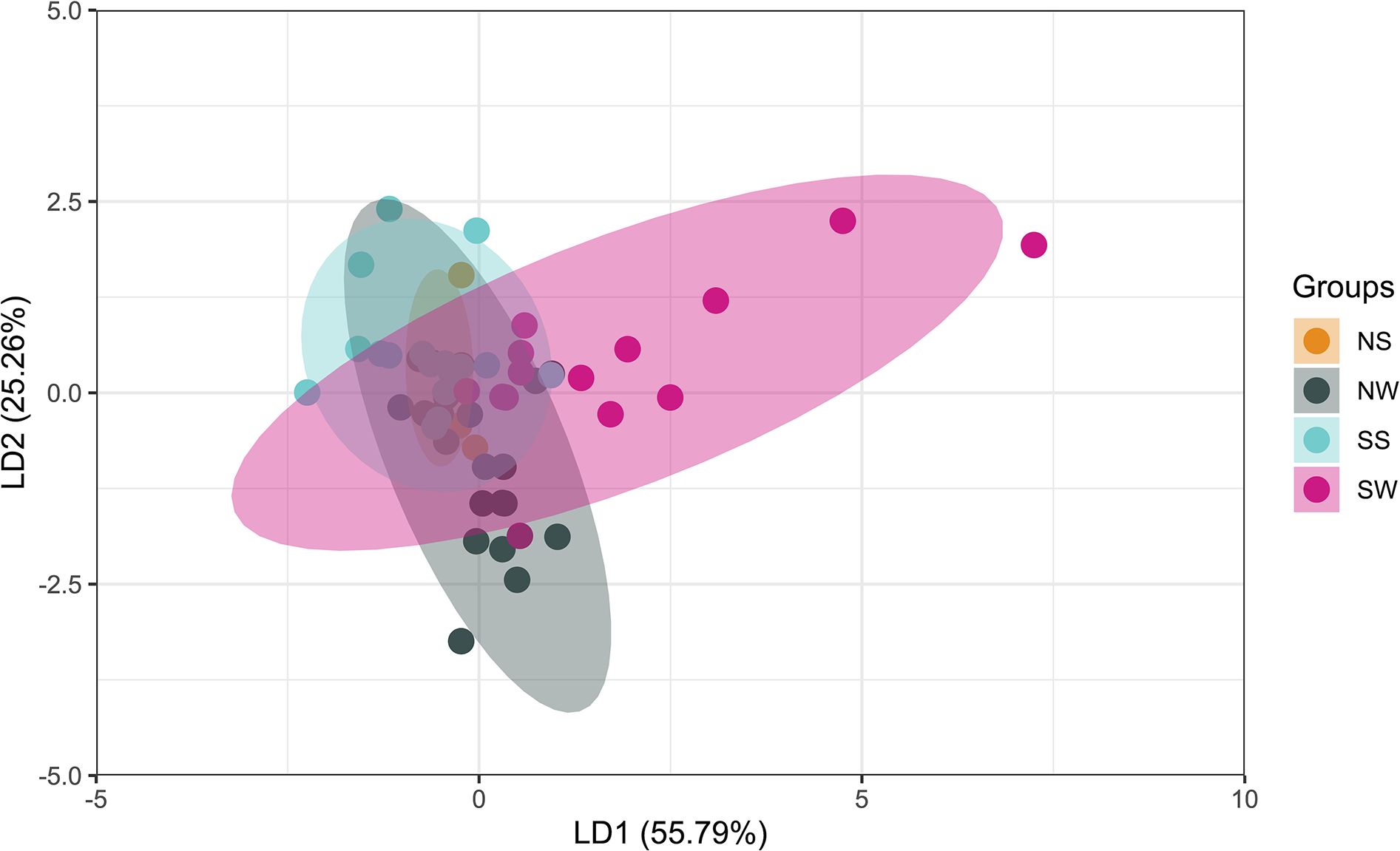
Linear discriminant analysis (LDA) revealed clustering based on parasite community composition among our four groups. The LD1 axis explains 55.79% of the variance, and the LD2 axis 25.26%. There was noticeable overlap between the four groups: NS, NW, SS, and SW. However, the SW shows differences in the parasite community along the LD1 axis due to A. simplex larvae in the liver, Z. viviparus adults in the intestine, and Dichelyne sp. in the intestine (Figure 2). Furthermore, the NW group shows differences in the parasite community along the LD2 axis due to H. aduncum larvae in the liver and Dichelyne sp. from the intestine (Figure 2).
Bi-plot of Linear discriminant analysis scores for the parasites of the Icelandic plaice (Pleuronectes platessa) by sampling region of the most abundant parasites (present at least 5% in each fish). The 95% ellipses illustrate the distribution and concentration of points associated with each group. The larger the ellipse, the greater the variability within the group (NS, north-summer; NW, north-winter; SS, south-summer; SW, south-winter).

Discussion
In this study, we identified several parasites in plaice, some of which had never been reported before from Icelandic waters from this host, such as the trematodes Z. viviparus (adults) and Rhipidocotyle sp. (metacercariae), in addition to the nematodes C. osculatum, Dichelyne sp., and H. aduncum. Furthermore, to our knowledge, Apatemon has not been recorded from plaice (P. platessa) previously. Non-specific records of Contracaecum and Hysterothylacium have been reported from plaice in Icelandic waters previously (see Hauksson Reference Hauksson1992). In this study, we used molecular tools to confirm the specific identifications for C. osculatum and H. aduncum, thus providing these new species records from plaice in Icelandic waters.
Otolith microstructure analysis of juvenile plaice sampled from 31 beaches around Iceland echoed the conclusion of local population structure of plaice in Icelandic waters (Gunnarsson et al. Reference Gunnarsson, Jónasson and McAdam2010). The low genetic diversity of plaice in Icelandic waters (see Hoarau et al. Reference Hoarau, Piquet, Van der Veer, Rijnsdorp, Stam and Olsen2004) is likely a result of some straying between spawning grounds (Sólmundsson et al. Reference Sólmundsson, Pálsson and Karlsson2005). At the very least, our results provide another line of evidence suggesting that the stock structure of plaice in Icelandic waters should be revisited. On their own, in this instance, tagging (Sólmundsson et al. Reference Sólmundsson, Pálsson and Karlsson2005), otolith microstructure analysis (Gunnarsson et al. Reference Gunnarsson, Jónasson and McAdam2010) and parasites might not provide sufficient information for fine-scale management of plaice in Icelandic waters. A tagging study based on 1,313 plaice tagged in the spawning grounds (183 recaptures) and 857 on the feeding grounds (55 recaptures) found strong spawning-site and feeding ground fidelity (94% and >90%, respectively), suggesting complex stock structure in Icelandic waters (Sólmundsson et al. Reference Sólmundsson, Pálsson and Karlsson2005). However, a targeted integrative approach should be employed to better understand the stock structure of this species and inform management. We found two parasite species demonstrating potential as biological tags in the south and north regions of Iceland – namely, the nematode A. simplex s. l and the trematode Z. viviparus due to their influence along the LD1 axis of the LDA. Dichelyne sp. was not considered a suitable biological tag due to variability in seasonal abundance (see below). Additionally, H. aduncum was not considered a suitable biological tag for stock identification due to its relatively low prevalence and abundance (Tables 3–6).
Anisakis simplex has been identified as a biological tag in several marine teleosts in the Northeast Atlantic to discriminate between stocks, such as beaked red fish (Sebastes mentella) (Klapper et al. Reference Klapper, Kochmann, O’Hara, Karl and Kuhn2016), herring (Clupea harengus) (Grabda, Reference Grabda1974), and horse mackerel (Trachurus trachurus) (Mattiucci et al. Reference Mattiucci, Farina, Campbell, MacKenzie, Ramos, Pinto, Abaunza and Nascetti2008), to name but a few. We recovered A. simplex s. l. on gonads, liver, outer intestine, and mesenteries. The ones found inside the intestine were likely passing through with digested prey. Anisakis simplex eggs are released into the water with the definitive host’s (marine mammals) fæces, hatching into L2 stage larvae and floating freely in the water (Nagasawa Reference Nagasawa, Ishikura and Kikuchi1990). Crustaceans, mainly euphausiids (krill), ingest them and develop into L3-stage larvae in these hosts (Klimpel and Palm Reference Klimpel, Palm and Mehlhorn2011; Lunneryd et al. Reference Lunneryd, Boström and Aspholm2015). Stage L3 larvae infect fish and cephalopods when they consume the infected crustaceans. Fish, cephalopods (Nagasawa Reference Nagasawa, Ishikura and Kikuchi1990), and seabirds (Johnston et al. Reference Johnston and Mawson1942; Shamsi et al. Reference Shamsi, Briand and Justine2017) can act as paratenic hosts, transmitting the larvae throughout the marine food web. Anisakis simplex has been recovered from plaice in the North Sea and west of Scotland (Levsen et al. Reference Levsen, Svanevik, Cipriani, Mattiucci, Gay, Hastie, Bušelić, Mladineo, Karl, Ostermeyer and Buchmann2018), Skattegat (Nielsen et al. Reference Nielsen, Køie, Székely and Buchmann2002), and the Faroe Islands (Køie Reference Køie1993), to name a few. In Iceland, A. simplex larvae have been recorded previously from plaice as Anisakis sp. (Hauksson Reference Hauksson1992) and A. simplex (Levsen et al. Reference Levsen, Svanevik, Cipriani, Mattiucci, Gay, Hastie, Bušelić, Mladineo, Karl, Ostermeyer and Buchmann2018). Additionally, several other marine teleost species (presented in alphabetical order based on common names) are known to harbour A. simplex in Icelandic waters: (1) anglerfish (Lophius piscatorius) (Eydal & Ólafsdóttir Reference Eydal and Ólafsdóttir2003); (2) the American plaice (Hippoglossoides platessoides) (Hauksson Reference Hauksson1992); (3) the vent of Atlantic salmon (Salmo salar) (Helgason et al. Reference Helgason, Slavko, Kristmundsson, Ingvarsson, Kristmundsson, Guðmundsdóttir, Eydal, Bergmann and Benediktsdóttir2008); (4) the musculature and visceral organs of beaked redfish (S. mentella) (Klapper et al. Reference Klapper, Kuhn, Münster, Levsen, Karl and Klimpel2015); (5) in the body cavity of the capelin (Mallotus villosus) (Palsson and Beverley-Burton Reference Pálsson and Beverley-Burton1984); (6) cod (Gadus morhua) (liver) (Klapper et al. Reference Klapper, Carballeda-Sangiao, Kuhn, Jensen, Buchmann, Gonzalez-Muñoz and Karl2018; Severin et al. Reference Severin, Yurchenko, Sørensen, Zuo, Karami, Kania and Buchmann2020); (7) saithe (Pollachus virens) filets, gills, and viscera (Hauksson Reference Hauksson1992; Højgaard Reference Højgaard1997); (8) three-spined stickleback (Gaterosteus aculeatus) (Richter Reference Richter2003); and (9) witch flounder (Glyptocephalus cynoglossus) (Hauksson Reference Hauksson1992). Marine mammals in Iceland, mainly harbour (Phoca vitulina) and grey (Halichoerus grypus) seals, will prey upon fish and cephalopods, allowing the development of the larvae into adult stages, completing the life cycle (Hauksson and Ólafsdóttir Reference Hauksson and Ólafsdóttir1995; Ólafsdóttir and Hauksson Reference Ólafsdóttir and Hauksson1998; Zuo et al. Reference Zuo, Kania, Mehrdana, Marana and Buchmann2018). Phocanema decipiens, another anisakid nematode, is considered more abundant in plaice collected from Hvalseyjar, in close proximity to grey seal colonies, relative to Snaefellsnes, where there is no grey seal colony (Hauksson and Ólafsdóttir Reference Hauksson and Ólafsdóttir1995). However, we did not explore this pattern for A. simplex, but it could explain the potential of this species as a biological tag in Iceland. As a future perspective, it might be worth considering distance to the nearest seal colony as a factor in assessing the potential of anisakid nematode parasites as biological tags.
The trematode Z. viviparus was recovered from plaice in Iceland for the first time in our study, but it has been collected previously from H. platessoides (Ólafsdóttir Reference Ólafsdóttir1999) and L. piscatorius (Eydal and Ólafsdóttir Reference Eydal and Ólafsdóttir2003) in Icelandic waters. The species is known to be abundant in Northeast Atlantic flatfishes (Køle Reference Køle1976) such as flounder Platichthys flesus (e.g., Schmidt et al. Reference Schmidt, Zander, Körting and Steinhagen2003), common dab Limanda limanda (e.g., Køie Reference Køie1983, Reference Køie2000), and plaice (e.g., Nicoll Reference Nicoll1915; Wickins and MacFarlane Reference Wickins and MacFarlane1973; Køie Reference Køie2000) and has been used previously to discriminate between stocks of Pla. flesus in the Northeast Atlantic (Gibson Reference Gibson1972) and in H. platessoides in the Northwest Atlantic (Scott Reference Scott1975) but not in plaice. Eggs of Z. viviparus are excreted by the fish definitive host into the water, where they hatch into miracidia larvae. The sporocysts are typically found in the gastropod Buccinum undatum L. (Lebour, Reference Lebour1918). The cercariae leave the gastropod and infect a secondary intermediate hosts, often polychaetes (Kremnev et al. Reference Kremnev, Gonchar, Uryadova, Krapivin, Skobkina, Gubler and Krupenko2023; Orrhage Reference Orrhage1974) or bivalves (Kremnev et al. Reference Kremnev, Gonchar, Uryadova, Krapivin, Skobkina, Gubler and Krupenko2023), where they encyst into metacercariae. The second intermediate host is ingested by a fish, where they transform into adults. As plaice feed mainly on benthic organisms (De Raedemaecker et al. Reference De Raedemaecker, O’Connor, Brophy and Black2011), they likely ingest an infected benthic intermediate host and become infected. The benthic bivalve and polychaete fauna comprising the stomach contents of plaice from both the north and south of Iceland should be examined quantitatively to gain insights into their respective diets and potential transmission routes for trophically transmitted parasites such as Z. viviparus.
The LDA result (Figure 2) shows that the winter groups are separated from the summer groups – south along the LD1 axis and north along the LD2 axis. The winter groups have a much greater abundance of the nematode Dichelyne sp. in the intestine of plaice (i.e., 2.14 and 2.30 in the north (Table 3) and south (Table 4), respectively) relative to the summer groups (i.e., 0.00 in the south (Table 5) and 0.30 in the north (Table 6), respectively). Dichelyne heterochrus is a nematode parasite described from plaice in the Northeast Atlantic such as in the English Channel (Baylis and Jone, Reference Baylis and Jones1933), the west coast of Scotland (MacKenzie and Gibson Reference MacKenzie and Gibson1970), the North Sea (Wickins and MacFarlane Reference Wickins and MacFarlane1973), and Faroese waters (Køie Reference Køie1993), to name but a few. Furthermore, it has been identified from Icelandic waters in H. platessoides (Ólafsdóttir Reference Ólafsdóttir1999). Although we cannot confirm the specific identification of our specimens, they are likely to be assignable to this species. The greater abundance of this species in winter is not surprising, as it has an annual life cycle – peak abundance in the fall and dying between late winter and summer (MacKenzie and Gibson Reference MacKenzie and Gibson1970). Lower water temperatures in Iceland could affect temporally the life cycle of D. heterochrus by slowing its growth and delaying mortality. Patterns of differing seasonal abundance for Z. viviparus are unclear but might be related to differing seasonal abundance of the gastropod or secondary intermediate hosts.
Metacercariae of the trematode genus Apatemon, identified as A. gracilis (Rudolphi, 1819), have been recovered previously from the eyes of Icelandic freshwater fishes – namely, G. aculeatus (Blair Reference Blair1973; Karvonen et al. Reference Karvonen, Kristjánsson, Skúlason, Lanki, Rellstab and Jokela2013; Richter Reference Richter2003), S. salar (Richter Reference Richter1982), sea tout (Salmo trutta) (Richter Reference Richter1982), and Arctic charr (Salvelinus alpinus) (Richter Reference Richter1982). We recovered two individuals from the eyes of plaice in fully marine environments. Plaice use shallow intertidal, subtidal, coastal, and estuarine habitats as nursery areas (e.g., Ciotti et al. Reference Ciotti, Targett, Nash and Geffen2014; Gunnarsson et al. Reference Gunnarsson, Jónasson and McAdam2010; Lauria et al. Reference Lauria, Vaz, Martin, Mackinson and Carpentier2011). It seems likely that the metacercariae were acquired by plaice in the nursery areas and retained subsequent to their ontogenetic migration.
Rhipidocotyle metacercariae have been recovered from plaice in British waters previously (e.g., MacKenzie and Gibson Reference MacKenzie and Gibson1970; Pulsford and Matthews Reference Pulsford and Matthews1984) but never before reported from Icelandic waters. Infections only affect age 0 and 1 plaice and are believed to be seasonal, occurring during the summer months (MacKenzie and Gibson Reference MacKenzie and Gibson1970; Pulsford and Matthews Reference Pulsford and Matthews1984). These metacercariae were recovered from plaice both in the north and south of Iceland, with greater abundance observed during the winter months. However, all of our plaice were >1 year of age (based on size distribution of our samples), suggesting that the observed infections were acquired in the past and retained.
The presence and abundance of rare parasite species can vary considerably between host populations, mainly when populations are geographically distant. Parasites that do not have a high dispersal capacity, which is often linked to the movement of their hosts, can be good tags because the similarity of their community decreases rapidly due to their distance (MacKenzie and Abaunza Reference MacKenzie and Abaunza1998). The rarity of some parasite species increases their discriminatory power in differentiating stocks; these species are more likely to be specific to specific regions or populations. These parasites are associated with particular host populations or environmental conditions, which can help distinguish stocks and identify fish populations’ ecological niches or migratory behaviours (MacKenzie and Abaunza Reference MacKenzie and Abaunza1998). However, the presence of these parasites in samples can cause variability and noise, making their results less reliable if the sample size is small (Sindermann Reference Sindermann1983). Herein, we excluded parasites that were rare (prevalence <5%) across our entire sample (Osuna-Cabanillas et al. Reference Osuna-Cabanillas, Marín-Enríquez, Martínez-Falcón, Timi and Morales-Serna2024), as these had a disproportionate effect on our results (LDA including all parasites, result not shown). Furthermore, it ensured that we had a greater sample size than parasite species for each group (see Tabachnick and Fidell Reference Tabachnick and Fidell2001). Common parasites are widely distributed, which allows for more robust datasets that are less prone to sampling errors than with rare parasites. Common parasites are ideal for large-scale studies with general trends over large geographic areas (MacKenzie and Abaunza Reference MacKenzie and Abaunza1998). However, due to their widespread presence, these parasites can mask subtle differences between closely related populations, thus reducing their effectiveness for fine-scale ecological differentiation (Marcogliese and Jacobson Reference Marcogliese and Jacobson2015).
Sampling for the summer group took place in August in the north of Iceland, with an additional sampling in October to the south of Iceland due to fishermen’s catch and availability. Despite the feeding season for plaice in Icelandic waters extending from June to November, including August and October samples in the summer group may distort parasite abundance data, as an ANOVA showed similar sex distributions between August and October but a significant difference in parasite abundance. Parasite abundance was 0.6 per fish in August and 33.0 in October. This difference could be explained by water temperature. Parasites are more abundant in warmer water (Klimpel and Palm Reference Klimpel, Palm and Mehlhorn2011). In October, sampling occurred in the south, influenced by the warm Atlantic current, while August sampling was in the north, affected by the cold East Greenland current (Astthorsson et al. Reference Astthorsson, Gislason and Jonsson2007; Pampoulie et al. Reference Pampoulie, Brix and Randhawa2024). Seasonal shifts in temperature, salinity, and currents from summer to autumn impact nutrient availability, phytoplankton production, and the food web, influencing parasite abundance (Marcogliese and Jacobson Reference Marcogliese and Jacobson2015). However, in the interest of keeping sample sizes consistent between groups, we made the informed decision of combining these August and October samples, while recognising that this might affect observed patterns.
ANOVA showed a significant difference in mean fish size between the north in summer and winter (p < 0.05) and between the south in winter (p < 0.001), and the north in winter (p < 0.001). The group with the largest fish size, south winter (43.15 cm), also has the highest parasite abundance (32.93). Environmental conditions can influence these size differences, as warmer temperatures in summer and in southern Iceland favor juvenile growth. Young fish grow best in waters between 7°C and 15°C, optimizing their metabolism (Fonds et al. Reference Fonds, Cronie, Vethaak and Van Der Puyl1992; van der Sleen et al. Reference van der Sleen, Stransky, Morrongiello, Haslob, Peharda and Black2018). However, this difference might be related to a greater proportion of immature fish (i.e., smaller) being sampled during the winter. Larger fish tend to host more parasites due to increased surface area, body volume, life span, and exposure to varied environments and prey (Bagge et al. Reference Bagge, Poulin and Valtonen2004; Kamiya et al. Reference Kamiya, O’Dwyer, Nakagawa and Poulin2014; Kuris et al. Reference Kuris, Blaustein and Alio1980; Morand and Poulin Reference Morand and Poulin1998; Poulin Reference Poulin1995; Rasmussen and Randhawa Reference Rasmussen and Randhawa2018). However, species richness per total fish length (cm) explains only 2.6% of the variance, indicating low explanatory power and no clear trend that larger fish systematically host more parasite species. Ideally, only mature fish would have been sampled but we were limited due to fishermen’s catch and availability. We did not repeat analyses on mature fish only due to the low number of samples per group this approach would have yielded (i.e., low statistical power).
The discriminative power of parasites was not evaluated in this instance. Despite sample size per group not impacting on the ability of parasites to discriminate between fish stocks (Poulin an Kamiya, 2015), it has been recommended that sample sizes of 50 per group be used in order to provide reliable estimates of covariance (see Tabachnick and Fidell Reference Tabachnick and Fidell2001). Therefore, a larger sample size of plaice is recommended for future studies, as this could reduce variability, enhance detection of biological signals for stock identification, and improve model robustness.
In conclusion, A. simplex and Z. viviparus show potential as biological tags for distinguishing northern and southern groups of plaice in Icelandic waters. To refine our findings, increasing sample size, standardizing samples, and expanding regional sampling to include east and west Iceland would improve the accuracy of our results. Additionally, collecting stomach contents during dissections would help identify each group’s diet, providing insights into their prey and contributing to information regarding potential transmission routes of the different parasites in the different marine ecoregions of Iceland.
Results based on parasite data herein are consistent with those for tagging and otolith microstructure. However, an integrative strategy to stock identification in plaice is required in order to provide fine spatial scale data required to inform fisheries managers.
Acknowledgements
We acknowledge the assistance of Hlynur Pétursson for helping us identify and contact fishermen who were willing to provide fish for this study from the areas we were targeting. We are especially thankful to the captain of the Benni Sæm GK26 for providing us with plaice landed in Sandgerði on several occasions.
Financial support
EMP is grateful for the financial support provided by an Erasmus+ traineeship grant, which greatly contributed to the realization of this study. This study was supported indirectly through a grant to HSR by the Eggerts Fund (Eggertssjóður), hosted at the University of Iceland, and the annual University of Iceland Contribution to Teachers’ Research Fund to HSR.
Competing interests
The authors declare none.
Ethical standard
Fish analysed in this study were collected from commercial capture; hence, no ethics protocols were required.