Introduction
Anxiety disorders are highly prevalent among older people (Bryant et al., Reference Bryant, Jackson and Ames2008) and are associated with substantial disability burden (Porensky et al., Reference Porensky2009). They occur commonly in comorbid relation to other mental and physical disorders (King-Kallimanis et al., Reference King-Kallimanis, Gum and Kohn2009; Teesson et al. Reference Teesson, Slade and Mills2009) and may worsen the prognosis of depression (Steffens and McQuoid, Reference Steffens and McQuoid2005). Epidemiological studies indicate that the prevalence of anxiety disorders in community-residing older people is 1.2%–15% and the prevalence of generalized anxiety disorder in particular is 1.3%–7.1% (Bryant et al., Reference Bryant, Jackson and Ames2008). Anxiety symptoms and anxiety disorders are more prevalent in women (Henderson et al., Reference Henderson, Jorm, Korten, Jacomb, Christensen and Rodgers1998). Anxiety commonly complicates mild cognitive impairment and dementia (Lyketsos et al., Reference Lyketsos, Lopez, Jones, Fitzpatrick, Breitner and DeKosky2002; Monastero et al., Reference Monastero, Mangialasche, Camarda, Ercolani and Camarda2009) and is found in about one quarter of caregivers of people with dementia (Cooper et al., Reference Cooper, Balamurali and Livingston2007). However, anxiety disorders are often unrecognized and untreated (Calleo et al., Reference Calleo2009).
In everyday clinical use in psychogeriatric and geropsychological settings, the 20-item Geriatric Anxiety Inventory (GAI; Pachana et al., Reference Pachana, Byrne, Siddle, Koloski, Harley and Arnold2007a) has gained rapid acceptance as a measure of generalized anxiety (Edelstein et al., Reference Edelstein2007; Rozzini et al., Reference Rozzini2009). With the assistance of colleagues, the GAI has been translated into several other languages, including Spanish, Portuguese, Dutch, Chinese, French, German and Polish. Although in psychiatric and psychological clinical practice there is usually little perceived difficulty in administering self-rated symptom severity measures containing 20 to 30 items to older people, this is often felt to be unfeasible in acute geriatric medical settings. In these latter settings, there is a need for a shorter version of the GAI that can be administered rapidly at the bedside. In such settings, clinicians may be looking for a screening test rather than for a scale to measure symptom severity in patients already known to suffer from an anxiety disorder.
In addition, the length of the GAI may preclude its incorporation in large-scale epidemiological surveys where number of items is a major issue. In such studies, it is commonplace for investigators to assemble questionnaires from short versions of multiple scales. Short versions of the Geriatric Depression Scale (GDS; Hoyl et al., Reference Hoyl1999) have been used in this context. Accordingly, we sought to develop a short form of the GAI and test its performance characteristics.
Methods
Study design
For this work we used the 2008 data collection wave (N = 284) of a prospective population-based study of the health of middle-aged and older women – the Longitudinal Assessment of Women (LAW) Study (Khoo et al., Reference Khoo, O'Neill, Travers and Oldenburg2008) – conducted in Brisbane, Australia. It was our aim to arrive at a short scale of four or five items from the original 20-item GAI. Items for preliminary analysis were selected from the full GAI on the basis of corrected item-total correlations. The authors reviewed identified items carefully to avoid including semantically or conceptually similar items. We sought to retain maximal power to distinguish older people with generalized anxiety disorder from those without this condition. To this end we iteratively checked the receiver operating characteristic (ROC) performance of several different combinations of items from the original scale.
Participants
Participants were women volunteers aged 60 years and over participating in the LAW Study. Recruitment details have been previously described in detail (Khoo et al., Reference Khoo, O'Neill, Travers and Oldenburg2008). Briefly, 511 randomly selected women between the ages of 40 and 79 were recruited from the electoral roll in 2001 and followed annually. Voting is compulsory in Australia. The participants described in this paper are from an entirely separate cohort to the participants described in our report of the development of the original 20-item version of the GAI (Pachana et al., Reference Pachana, Byrne, Siddle, Koloski, Harley and Arnold2007a).
Measures
Participants were sent mailed questionnaires during late 2008, which they returned in person when they attended our research centre for their annual LAW Study interviews. While most participants had no difficulty completing our questionnaires, a minority of women with sensory impairment or severe frailty required the assistance of a confederate, usually a family member. Research assistants checked questionnaires for missing data and asked participants to complete any missing data points. In addition, they administered the Mini-mental State Examination (MMSE; Folstein et al., Reference Folstein, Folstein and McHugh1975).
Each participant provided detailed sociodemographic data, including age, education, marital status and perceived income adequacy. They then completed a questionnaire that included the state subscale of the Spielberger State-Trait Anxiety Inventory (STAI; Spielberger et al., Reference Spielberger, Gorsuch and Lushene1970), which has been shown to have good psychometric properties in geriatric samples (e.g. Kvaal et al., Reference Kvaal, Laake and Engedal2001), as well as the GAI and the Geriatric Depression Scale (GDS-15; Sheikh and Yesavage, Reference Sheikh, Yesavage, Sheikh and Yesavage1986).
DSM-IV diagnoses of anxiety disorders were made during late 2008 or early 2009 using the Mini International Neuropsychiatric Interview, version 5 (MINI-5; Sheehan and Lecrubier, Reference Sheehan and Lecrubier2002), a fully structured diagnostic interview. Interviews were undertaken by trained research nurses. The mean interval between completion of the questionnaire and attendance for the face-to-face diagnostic interview was 6.7 (SD 7.6) weeks. The interview forms were independently checked for logical errors prior to data entry.
Ethics
The human research ethics committees of the University of Queensland and the Royal Brisbane and Women's Hospital approved this study. Each participant provided written informed consent. Participants exhibiting high levels of psychological distress at interview were referred for psychiatric review.
Data analysis
Data were entered into a computer database and then transferred to Stata/SE 11.0 for analysis. Prior to analysis, all data were checked and cleaned. Internal consistency was calculated using Cronbach's α. Spearman rank correlations were used, as the GAI-SF distribution was skewed to the right. Similarly, Kruskal-Wallis (KW) equality of populations rank tests were used in lieu of analyses of variance. Nonparametric receiver operating characteristic (ROC) analyses were used to estimate the sensitivity and specificity of various cut-points on the GAI-SF. All statistical tests were two-tailed and, where relevant, the Bonferroni correction was applied to minimize the risk of a Type 1 error.
Results
Data were available from 284 women aged 60 years and over in 2008. Their sociodemographic characteristics are summarized in Table 1. Participants ranged in age between 60 and 87 years. Most were married but only a minority had graduated from high school or university, reflecting historical educational patterns. A majority of women reported their income as adequate (i.e. “Not too bad”) or better. MMSE scores were available on 242 women, three of whom scored 23 or less, this being a widely used and accepted cutoff for the MMSE, signaling likely cognitive impairment (Crum et al., Reference Crum, Anthony, Bassett and Folstein1993). Two of these women scored 23 and one scored 22 and these three women were not included in any further analyses. The MMSE had a mean (SD; range) of 28.4 (1.5; 22–30) and a median of 29. The STAI-S had a mean (SD; range) of 34.4 (11.0; 20–78) and a median of 32. The GAI had a mean (SD; range) of 2.5 (4.2; 0–20) and a median of 0. The GDS had a mean (SD; range) of 2.2 (2.5; 0–13) and a median of 1. Ethnicity was not recorded although the overwhelming majority of women were of Anglo-Celtic origin, reflecting local demographic patterns.
Sociodemographic characteristics

Selection of items
The item selection strategy we employed was predicated on our knowledge that the GAI has a single underlying factor, so it was not necessary to select items representing several separate factors. GAI items 1, 5, 6, 8, 9, 10, 11, 13, 16, 17, 19 and 20 had adjusted item-total correlations of 0.6 or greater, and were selected for further consideration. However, GAI items 5, 16, 17 and 19 were endorsed by less than 10% of women and so were discarded. Combinations of the remaining GAI items (1, 6, 8, 9, 10, 11, 13 and 20) were used to form 5-item scales and iteratively tested against MINI-V/DSM-IV diagnoses of current Generalized Anxiety Disorder (GAD) in ROC analyses. Using this approach, five GAI items (1, 6, 8, 10, 11) were found to have the best ability to distinguish between participants with GAD and those without this diagnosis. These five items did not exhibit excessive semantic redundancy and were chosen to make up the short form of the GAI (GAI-SF), which was then tested further.
Psychometric properties of the GAI-SF
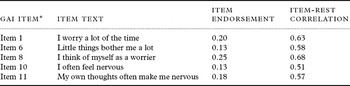
Item endorsements (mean = 0.18) and item-rest correlations (mean = 0.59) for each item in the GAI-SF are listed in Table 2. Cronbach's α for the GAI-SF was 0.81 (Cronbach's α of the GAI was 0.93). The GAI-SF total score was highly correlated with the 20-item GAI and the state half of the STAI (see Table 3). All five items in the GAI-SF were highly significantly correlated with the STAI-S, with point biserial correlation coefficients between 0.41 and 0.50 (all p-values < 0.0001 after Bonferroni correction). Thus, each GAI-SF item had good concurrent validity. We tested the predictive validity of the GAI-SF in 242 women aged 60 years and over (representing 85.2% of the 284 women tested above) who were available to be interviewed with the fully structured MINI-V diagnostic instrument. Women who were interviewed did not differ by age or marital status from those not interviewed. However, as anticipated, those who completed questionnaires but did not attend for an interview reported lower educational achievement (χ2 = 14.1, p < 0.01), lower income adequacy (χ2 = 15.4, p < 0.01) and higher GAI-SF scores (KW χ2 = 6.9, df = 1, p < 0.01) than those who completed both. We were not able to compare these groups on current cognitive function as only those who attended for interview were tested on the MMSE. Importantly, the GAI-SF was not correlated with age, educational level, MMSE score or perceived income adequacy. As expected, the GAI-SF was correlated with the GDS.
Geriatric Anxiety Inventory-Short Form (GAI-SF) item endorsement and item-total correlations

* Item numbers refer to items in the 20-item version of the GAI.
GAI and GAI-SF correlation matrix

*** p < 0.001; * p< 0.05; Spearman's ρ with Bonferroni correction.
GAI = Geriatric Anxiety Inventory; GAI-SF = Geriatric Anxiety Inventory – Short Form; GDS = Geriatric Depression Scale; STAI-state = State half of the Spielberger State Trait Anxiety Inventory; MMSE = Mini-mental State Examination.
Women with any current DSM-IV anxiety disorder (n = 25; 10.3%) had a much higher mean GAI-SF score than women without a current anxiety disorder (n = 217; 89.7%) [2.1 (SD 2.0), 0.7 (SD 1.2); KW χ2 = 12.1, p < 0.001]. Similarly, women with current GAD (n = 8; 3.3%) had a much higher mean GAI-SF score than women without current GAD (n = 234; 96.7%) [3.0 (SD 2.0), 0.7 (SD 1.2); KW χ2 = 13.1, p < 0.001].
As expected, the area under the ROC curve (AUC) for the GAI-SF for the detection of GAD was somewhat less than the AUC for the GAI (see Figure 1). However, the GAI-SF still had an AUC of 0.80 (SE 0.10) and the AUCs were not significantly different from one another (χ2 = 3.43, p = 0.06). The sensitivity and specificity trade-offs for different GAI-SF cut points are listed in Table 4. The cut-point of 2/3 (i.e. scores of three or greater out of a possible score of five) was optimal for the identification of DSM-IV cases of GAD. At this cut-point, the sensitivity was 75%, the specificity was 87%, the positive likelihood ratio (LR+) was 5.7 and the negative likelihood ratio (LR˗) was 0.3. At this cut-point, the Youden J index was 0.88 and 86% of participants were correctly classified.
Receiver Operating Characteristic (ROC) analysis of GAI versus GAI-SF against MINI-V/DSM-IV diagnoses of Generalized Anxiety Disorder

GAI-SF sensitivity and specificity at different cut-points

J Index = Youden Index (Sensitivity + Specificity – 1); LR+ = Positive Likelihood Ratio; LR˗ = Negative Likelihood Ratio; n.a. = not applicable.
Test-retest reliability
Although we were not able to estimate short-term test-retest reliability of the GAI-SF in our LAW sample of normal women as the participants were sent questionnaires annually, we had access to a separate community-residing convenience sample of 22 consenting women volunteers aged between 51 and 70 years [Mean (SD): 59.4 (4.7)] who completed the GAI on two occasions one week apart. In this group, the GAI-SF mean (SD) was 1.1 (1.3) on the first occasion and 1.2 (1.7) on the second occasion. Test-retest reliability for the five items making up the GAI-SF was high (rs = 0.80; p < 0.001).
Discussion
The five items chosen for the GAI-SF represent the best balance between scale cohesion (item-total correlation) and a reasonable rate of item endorsement (item difficulty). If rarely endorsed items had been chosen the resulting scale would have had greatly reduced sensitivity. The GAI-SF scale preserves internal consistency and concurrent validity while delivering satisfactory predictive validity. We retained the dichotomous response choice (agree/disagree), which should be suitable for use in a variety of acute clinical settings as well as being appropriate for epidemiological surveys. Importantly, in this community-residing population of older women, GAI-SF scale score was not correlated with either age or MMSE score. We adopted a rigorous approach to scale validation using structured diagnostic interviews and ROC analyses. We used a population-based cohort, rather than a clinical population, in order to better reflect one of the key settings in which the short-form of the GAI is likely to be used.
We acknowledge some limitations to our study. We only studied women, but women have a much higher prevalence of anxiety disorders than men (Bryant et al., Reference Bryant, Jackson and Ames2008). Moreover, worldwide, women outnumber men at higher age ranges. We did not test the GAI-SF in a psychogeriatric population, as we believe the short form is less likely to be used in such settings, where there is usually both the time and the motivation to use the original and more psychometrically robust 20-item version of the GAI. Responses to five items in the context of 20 items may be different from responses to the same five items presented as a separate instrument. Although not formally assessed, our sample appeared relatively ethnically homogeneous, potentially limiting the generalizability of our findings. We acknowledge that the GAI-SF requires further testing in a variety of clinical as well as cognitively impaired samples.
Conclusions
We have developed and undertaken initial testing of a short but psychometrically sound version of the GAI for use by health care workers in a wide variety of settings. We also believe it may be useful in epidemiological research on anxiety. The GAI-SF worked well in our population-based cohort of older women and it is likely to be of utility also in geriatric medical settings, including primary care, to screen for anxiety, which is often under-recognized in older populations. Positive scores on this screening test should be a prompt for further evaluation of mental health needs. However, we would recommend use of the original 20-item version of the GAI in pharmacological and non-pharmacological intervention trials, as this version of the scale is likely to better demonstrate clinical change (Pachana et al., Reference Pachana, Woodman and Byrne2007b).
Conflict of interest
None.
Description of authors' roles
G. Byrne designed the study, obtained the funding, supervised data collection, analyzed the data and wrote the paper. N. Pachana designed the study, obtained the funding, supervised data collection and edited the paper.
Acknowledgments
We thank Elizabeth Arnold, Christine Egan, Daniela Goncalves, Ann Hanson, Soo Keat Khoo, Ada Lo, Sheila O'Neill, Cynthia Ramirez, Ann-Maree Selwood, Helen Siddle, Karen Spatuzzo, Kate Thompson, Michelle Tyack and Antony Winkel for their essential assistance. We also thank the participants in the Longitudinal Assessment of Ageing in Women Study for their continued participation. The work reported in this paper was supported in part by a grant from the National Health and Medical Research Council (ID 456182) and the Ageing Mind Initiative, University of Queensland. The Royal Brisbane and Women's Hospital Research Foundation and several private benefactors provided initial funding for the LAW study.
Note: The Geriatric Anxiety Inventory (GAI) and its short form (GAI-SF) are available free of charge from the authors for use by clinicians and researchers undertaking non-commercial research. Commercial uses of the Geriatric Anxiety Inventory and the Geriatric Anxiety Inventory – Short Form are licensed through UniQuest (http://www.gai.net.au/page7.html).