New products of milk are often based on alternative feeding of cows to obtain a larger proportion of unsaturated milk fat. The composition of milk fatty acids is influenced by type of grass and legumes offered to the cows (Collomb et al. Reference Collomb, Bütikofer, Sieber, Jeangros and Bosset2002). Moreover, during the indoor silage-based period, the concentration of polyunsaturated fatty acids in milk declines compared with the summer period (Butler et al. Reference Butler, Nielsen, Slots, Seal, Eyre, Sanderson and Leifert2008).
The composition of milk fat is complex, e.g. it contains at least 400 different fatty acids of which 12 are present in proportions >1% (Jensen, Reference Jensen2002). The milk fatty acids containing 4–14 carbon atoms are synthesized in the mammary gland from acetate and β-hydroxybutrate originating from carbohydrate fermentation products in the rumen. This pathway is called synthesis de novo. A portion of palmitic acid (16:0) is also synthesized de novo while another portion is extracted from blood and originates from the diet or from adipose tissue. Fatty acids containing >16 carbon atoms are extracted by the mammary glands from blood. Palmitic (16:0) and stearic (18:0) acids pass through the rumen unchanged whilst unsaturated fatty acids are subjected to biohydrogenation by the reducing environment caused by the microorganisms in the rumen, resulting mainly in stearic acid together with a smaller amount of trans isomers of oleic acid (18:1). Furthermore, stearic acid derived from the diet is partly converted to oleic acid by stearoyl CoA desaturase (SCD) in the intestines and in mammary tissue.
The role of SCD is to regulate cell membrane fluidity by catalysing Δ9-cis desaturation of a range of fatty acids (Paton & Ntambi, Reference Paton and Ntambi2009). In the mammary tissue of cows, the main substrate for SCD is stearic acid.
Other important enzymes in the mammary tissue are acetyl-CoA carboxylase (ACC) and fatty acid synthase (FAS) which are central in fatty acid synthesis de novo. ACC catalyses the formation of malonyl-CoA which is the committed step in fatty acid synthesis, and malonyl-CoA is an intermediate in the elongation process in fatty acid synthesis (Smith, Reference Smith1994; Brownsey et al. Reference Brownsey, Boone, Elliot, Kulpa and Lee2006).
Lipids in milk exist as globules, and the milk fat globules (MFG) are formed in the secretory cells of the mammary gland. Precursors of milk lipid globules are formed at the endoplasmic reticulum and are transported through the cytosol as small droplets of triglycerides covered by a non-bilayer of polar phospholipids and proteins. During transport, the droplets grow in size apparently due to droplet-droplet fusion (Deeney et al. Reference Deeney, Valivullah, Dapper, Dylewski and Keenan1985).
It is expected that cows grazing large amounts of legumes will produce more polyunsaturated milk fatty acids (Butler et al. Reference Butler, Nielsen, Slots, Seal, Eyre, Sanderson and Leifert2008) and it has been shown that abomasal infusion of conjugated linoleic acid (18:2 trans10cis12) alter the transcription of enzymes involved in milk fat synthesis (Baumgard et al. Reference Baumgard, Matitashvili, Corl, Dwyer and Bauman2002). Therefore, it is hypothezised that the transcription of the enzymes involved in milk fat synthesis will be affected by grazing fresh forage rich legumes which contain large concentrations of polyunsaturated fatty acids. Furthermore, the MFG size is affected by the fat production and can be regulated via the long-chain fatty acids derived from the feed (Wiking et al. Reference Wiking, Stagsted, Björck and Nielsen2004) and thus relations between MFG size and transcription of the enzymes involved in milk fat synthesis are hypothesized. The objective of the present study was to examine whether fatty acid composition, MFG size and transcription of SCD, ACC and FAS in milk from cows were affected when cows were fed either high proportions of fresh white clover, red clover, lucerne or silage.
Methods and Materials
Experimental feeding
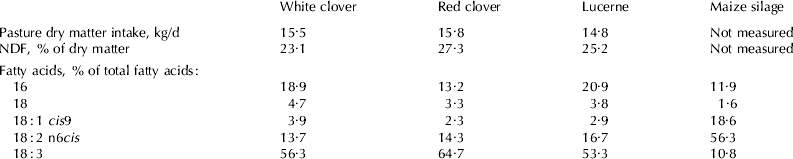
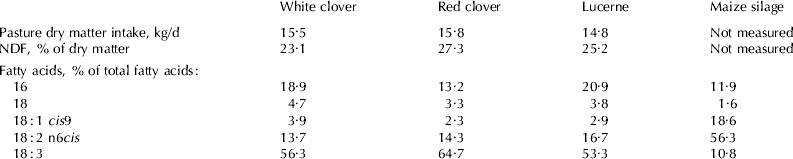
The experiment was performed at the organic research station Rugballegaard, Horsens, Denmark. Forty-seven Holstein-Friesian cows were allocated to four groups according to milk yield, parity and stage of lactation. Three groups were grazing swards containing perennial ryegrass (Lolium perenne) mixed with a high proportion of (i) white clover (Trifolium repens, var. Milo) [47% white clover and 26% ryegrass in the total dry matter (DM) of the ration], (ii) red clover (Trifolium pratense, var. Rajah) (56% red clover and 17% ryegrass in the total DM of the ration) and (iii) lucerne (Medicargo sativa, var. Pondus) (51% lucerne, 11% ryegrass and 10% white clover in the total DM of the ration), respectively. The cows were on pasture for 20 h daily and fed a supplement of 6·0 kg DM/cow daily (82% oats, 16% hay, 2% mineral mix) after milking. The fourth group of 11 cows was offered a diet composed of 59% maize silage, 35% grass silage, 6% oats and 0·2% mineral mix ad libitum, and this group was housed in the barn. The pasture intake and fatty acid composition of the diets are described in Table 1. Fatty acid composition of grass silage was not measured.
Pasture intake, neutral detergent fibre (NDF) and fatty acid composition of the different legume diets and maize silages
Sampling
On day 11 after the introduction of experimental feeding, milk yield was recorded and samples were collected for analysis of total milk fat content (MilkScan 4000 instrument, Foss Electric A/S, Hillerød, Denmark). On days 16 or 17 after introduction of experimental feeding, milk samples were collected. Mammary tissue biopsies for 27 out the 48 cows were collected and stored essentially as described by Sorensen et al. (Reference Sorensen, Nørgaard, Theil, Vestergaard and Sejrsen2006) until analysis for mRNA abundance. Just before udder biopsises were collected, milk samples for milk fat globules size and fatty acid analysis were taken 6–8 h after morning milking. Analysis for milk fat globule size was conducted the next morning while samples for fatty acid analysis were stored at −20°C until analysis.
Real time RT-PCR
Sample preparation and quantification of mRNA abundance were carried out as described by Theil et al. (Reference Theil, Sørensen, Therkildsen and Oksbjerg2006) . Briefly, RNA was purified using the RNeasy mini kit (Qiagen, Albertslund, Denmark). Total RNA was assessed using a NanoDrop ND-1000 spectrophotometer (Thermo Fisher Scientific, Roskilde, Denmark). Purified RNA was reversely transcribed with oligo-dT and random primers and Superscript II RNase H reverse transcriptase kit (Invitrogen, Taastrup, Denmark). Reverse transcribed material (1 μl) was amplified with TaqMan Universal PCR Master Mix (Applied Biosystems, Stockholm, Sweden). Details of primers and probe designs were described for the target genes by Nørgaard et al. (Reference Nørgaard, Baumgard, Nielsen, Theil, Sørensen and Sejersen2008) and for the housekeeping genes by Poulsen et al. (Reference Poulsen, Young, Theil, Kolko, Oksbjerg and Lambert2006) . All target genes were analysed in duplicate and housekeeping genes in triplicate using ABI 7900HT detection system (Applied Biosystems, Stockholm, Sweden). The relative mRNA quantity was calculated essentially by using the formula: Relative quantity=2−ΔΔCt, although PCR efficiencies <100% were taken into account, as described by Theil et al. (Reference Theil, Sørensen, Therkildsen and Oksbjerg2006) .
Fatty acid composition
Prior to GC separation and quantification, milk lipids were trans-esterified to methyl esters in a sodium methylate solution (2 g/l methanol). Analysis of the fatty acid methyl esters was carried out with a GC (Hewlett-Packard Co. Palo Alto CA 94304, USA) using an FFAP column (terephthalic acid modified polyethylene glycol 25 m×200 μm×0·30 μm) and helium as carrier gas and a flame ionization detector. Injection was splitless with an injector temperature of 250°C. The detector temperature was 300°C. The initial column temperature was 40°C, which was held for 4 min. The temperature was then raised at 10 deg C/min to 240°C and held for 1 min. Fame mix(Supelco) was used as an external standard.
Determination of size distribution of milk fat globules
Particle size distributions were determined by integrated light scattering using a Mastersizer 2000 (Malvern Instruments Ltd., Malvern, UK) as described by Wiking et al. (Reference Wiking, Stagsted, Björck and Nielsen2004) .
Statistical analyses
Different stages of lactation were accounted for by including a linear and a quadratic effect of days in milk (DIM), and the following normal model (GLM procedure of SAS Institute, Cary NC, USA) was used to describe dietary effects on variables related to MFG, milk yield, milk fat and fatty acid contents, and relative mammary transcription levels:

where Yic represents the variables related to milk/mammary characteristics for the Cth cow (c=1,2 … 27), μ is the overall mean, αi is the fixed effect of the diet (i=red clower, white clover, lucerne, silage), β and γ are the regression parameters, DIMijk is the days in milk, and εijk are normally distributed residuals. Residual errors were assumed to be independent and normally distributed and their expectations were assumed to be zero. Standard contrasts were applied for evaluating treatment differences between silage and legumes. P<0·05 was used as the significance threshold.
Results and Discussion
Fatty acid production
Effects on milk yield, milk fat content and milk fat yield of dairy cows fed high proportions of fresh white clover, red clover and lucerne, respectively, or combined maize/grass silage, are shown in Table 2. Feeding high proportions of white or red clover significantly (P<0·05) decreased the milk fat concentration compared with the diet where the roughage was offered as maize/grass silage. Lucerne-rich feeding tended (P=0·07) to decrease the milk fat concentration compared with the maize/grass silage. Milk and milk-fat yield were not affected by the experimental feedings.
Average daily milk yield, fat %, daily milk fat yield and days in milk of cows grazing a high proportion of different legumes or offered maize/grass silage. Values are LS means with se

† Values without a common superscript indicated significant differences (P<0·05)
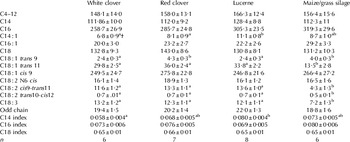
Compared with the silage diet, the diets rich in fresh legumes affected the production of individual milk fatty acids (Table 3). Significantly (P<0·05) lower daily outputs of 18:1 trans11, 18:2 cis9-trans11, 18:2 trans10-cis12 and 18:3 were observed for the cows fed the maize/grass silage diet compared with the different legume diets. Among the diets composed of high proportions of white clover, red clover and lucerne, no significant differences in individual milk fatty acids were observed, except for the production of 18:1 trans9 which was significantly (P<0·01) larger for the cows given red clover and maize/grass silage than for the diet rich in lucerne or white clover. Output of the fatty acids originating from synthesis de novo (C4–C16) was not affected by diet. The present findings are in general accordance with other studies, where higher contents of 18; 18:1; 18:2 and 18:3 were found in milk fat from cows grazing legumes compared with a silage diet (van Dorland et al. Reference Van Dorland, Kreuzer, Leuenberger and Wettstein2008; Timmen & Patton, Reference Timmen and Patton1988; Whiting et al. Reference Wiking, Stagsted, Björck and Nielsen2004). Fatty acid concentration and composition of different legumes differ. Red clover contains more polyunsaturated fatty acids than lucerne and white clover (Table 1). However, a similar variation was not found in milk fatty acid composition between milk from cows fed the diets rich in legumes. In general, silages contain less fatty acids, and especially maize silage has smaller proportions of 18:3 but more 18:1 and 18:2 than fresh forage (Table 1). Therefore, the smaller concentration of 18:3 in the milk from cows offered maize/grass silage can be ascribed the fatty acid composition of feed whereas rumen biohydrogenation presumably inhibited other feed-derived effects. Recently, a study by Slots et al. Reference Slots, Butler, Leifert, Kristensen, Skibsted and Nielsen2009 showed that the proportion of 18:3 in milk fat increased with the level of fresh forage and maize silage in the diet but decreased with the level of grass silage. Moreover, they (Slots et al. Reference Slots, Butler, Leifert, Kristensen, Skibsted and Nielsen2009) found no significant effect on 18:2n6 in milk fat from fresh forage or maize silage. This is in agreement with the present study where maize silage dominated the combined maize/grass silage diet, resulting in lower output of 18:3 and unaffected output of 18:2 compared with the diets rich in fresh legumes.
Milk fatty acid output (g/d) of cows grazing a high proportion of different legumes or offered maize/grass silage. Values are LS means with se

† Values without a common superscript are significantly different (P<0·05)
Mammary transcription of FAS tended to be highest in cows fed the diet rich in lucerne and lowest in cows fed maize/grass silage, and mammary transcription of SCD was numerically lower in cows fed maize/grass silage, although differences did not reach significance (P=0·13) (Table 4). When tested using a standard contrast, mammary transcription of SCD was significantly (P<0·05) lower in cows fed maize/control silage as compared with cows grazing high proportions of legumes. Mammary transcription of ACC was not affected by dietary treatments (P=0·31) (Table 4).
Relative mRNA abundance of fatty acid synthase (FAS), stearoyl CoA desaturase (SCD) and acetyl CoA carboxylase (ACC) in mammary tissue of cows grazing a high proportion of different legumes or offered maize/grass silage. Values are means for dietary groups [with lower and upper 95% confidence intervals]

† SCD transcription lower in maize/silage group as compared to cows grazing legumes using standard contrast (P=0·02)
‡ Values without a common superscript are significantly different (P<0·05)
The main product from FAS is C16 (Knudsen, Reference Knudsen1972). In the present study, feeding treatments did not affect C16 output and no correlation between relative mRNA abundance of FAS and C16 output was found (r 2=0·06, P=0·75).
An increase in the content of 18:2 trans10-cis12 in the milk fat, which is recognized as an indication for milk fat yield depression, has been reported to reduce mRNA abundance of mammary SCD, ACC, FAS and other lipogenic genes (Peterson et al. Reference Peterson, Matitashvili and Bauman2003). In the present study, the diets including high levels of legumes all caused a significant (P<0·05) increase in production of 18:2 trans10-cis12 from 0·5 to 0·7 g/d, although not enough to reduce either the transcription of SCD, ACC or FAS or milk fat yield. Milk-fat percentage was significantly lowered in milk from feeding rich in white and red clover compared with milk from cows offered maize/grass silage. The most efficient way of decreasing the transcription of SCD, ACC and FAS is abomassal infusion of 18:2 trans10-cis12 (Baumgard et al. Reference Baumgard, Matitashvili, Corl, Dwyer and Bauman2002). This demonstrates that the biohydrogenation of unsaturated lipids in the rumen is highly responsible for the fatty acid composition of milk. Dewhurst et al. (Reference Dewhurst, Fisher, Tweed and Wilkins2003a, Reference Dewhurst, Evans, Scolland, Moorby, Merry and Wilkinsb) calculated that red clover silage reduced the biohydrogenation of 18:3n3 compared with grass and white clover silage. In the present study, cows offered maize/grass silage produced significantly (P<0·01) less trans isomers of 18:1 than cows fed the diets with a high proportion of fresh legume, which indicates a different fermentation pattern and thereby a different level of biohydrogenation upon different roughage types. Furthermore, the significantly larger content of 18:2 cis9-trans11 and trans10-cis12 in milk derived from the fresh legume-based diets (Table 3) reflects that both changes in biohydrogenation activity and the increase in transcription of SCD are contributing to milk fatty acid changes, since conjugated fatty acids are products of both biohydrogenation and SCD activity.
Only a few studies have directly measured the desaturase activity in the mammary gland tissue. In goats, feeding a high level of plant oil led to decreased SCD activity in mammary tissue and a lower proportion of cis-9 milk fatty acids as compared with the substrate fatty acids; but the relative mRNA abundance was not affected by the diets (Bernard et al. Reference Bernard, Rouel, Leroux, Ferlay, Faulconnier, Legrand and Chilliard2005; Bernard et al. Reference Bernard, Leroux, Faulconnier, Durand, Shingfield and Chilliard2009). Likewise, other studies reported no effect on relative mRNA abundance of SCD by using dietary plant oils even though desaturase indices were affected (Delbecchi et al. Reference Delbecchi, Ahnadi, Kennelly and Lacasse2001). As in the present study, Nørgaard et al. Reference Nørgaard, Baumgard, Nielsen, Theil, Sørensen and Sejersen2008 recently measured relative mRNA abundance of mammary ACC, FAS, SDC upon roughage manipulation and found no effect of silage type or dietary energy levels. All together, literature and the present study indicate that dietary manipulation does not impose major alterations in SCD, FAS and ACC expression, if any.
Many studies have used ratios of product/non-catalysed substrate as an indication for desaturase activity in mammary tissue and often the index between milk 14:1 and 14 [(14:1)/(14+14:1)] is used to study effects of dairy breed, feed and days in lactation (Garnsworthy et al. Reference Garnsworthy, Masson, Lock and Mottram2006; Soyeurt et al. Reference Soyeurt, Dehareng, Mayeres, Bertozzi and Gengler2008), since neither 14 nor 14:1 are derived from the feed via the blood. In the present study the 14:1/14 index was significantly lower in milk from feeding high proportions of white clover compared with lucerne; however, this was not supported by the mammary transcription of SCD. The main substrate for SCD is C18, and in the present study, the index between 18:1cis9/18 was around 0·65 whereas 14:1/14 index was 0·07 and 16:1/16 index was 0·07 (Table 3). Similar ratios are reported by Garnsworthy et al. (Reference Garnsworthy, Masson, Lock and Mottram2006) . This demonstrates that SCD is highly substrate selective and therefore the C14 index is giving little information about SCD activity in mammary tissue. Furthermore, only concentrations in milk and not the real substrate concentration in a non-steady state in the blood are measured in the mentioned studies. In the present study, no significant relation was found between the transcription of SCD and indexes of C14, C16 and C18. The role of SCD is to secure lipid fluidity of membranes; however, the melting point of milk fat can vary by up to 5°C (Ortiz-Gonzales et al. Reference Ortis-Gonzalez, Jimenz-Flores, Bremmes, Clark, DePeters, Schimdt and Drackley2007) indicating that the SCD is not a fine-tuned system, as variation is allowed.
Effect on milk fat globule size
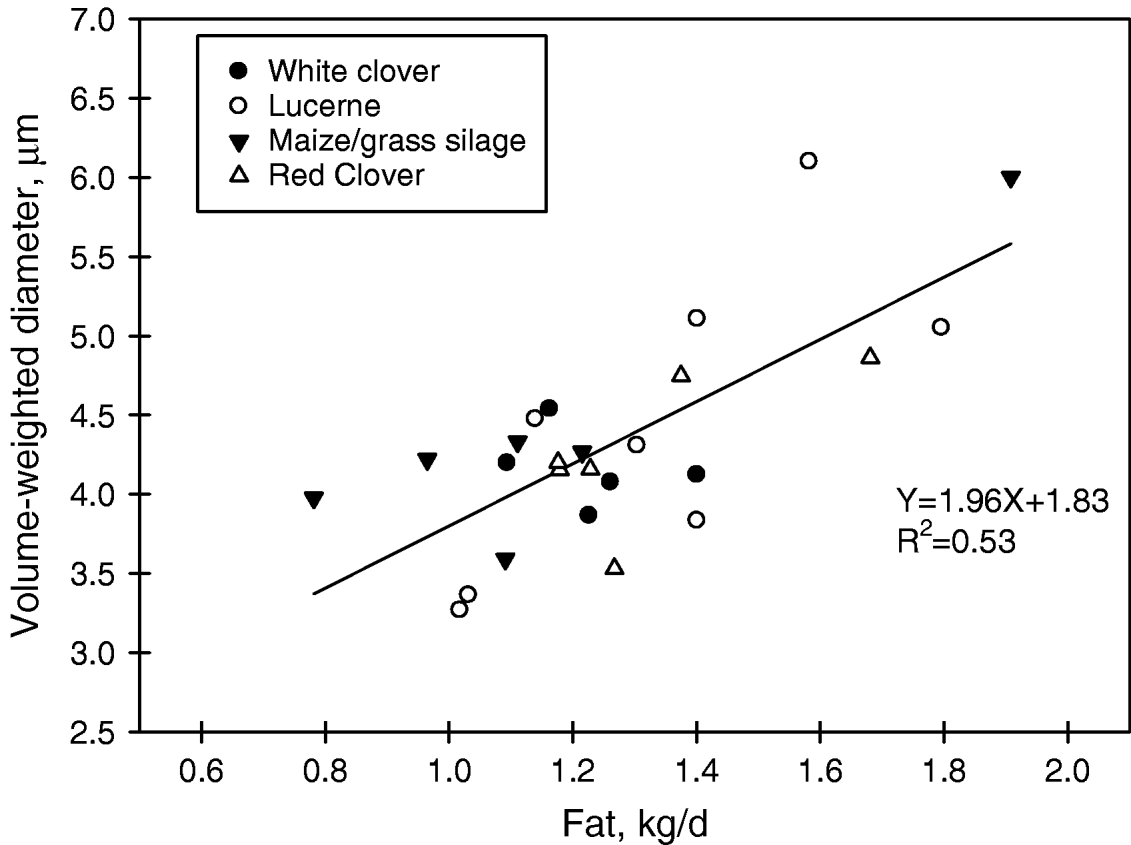
The experimental diets did not affect the average MFG diameter (Fig. 1). The long-chain saturated and mono-unsaturated fatty acids positively correlate with average MFG diameter together with the daily fat yield (Wiking et al. Reference Wiking, Stagsted, Björck and Nielsen2004). The mentioned fatty acids and the fat yield were not affected by the diets used in the present study and this could explain the insignificant effect on MFG size. Variation in average MFG diameter has been obtained via fat supplementation (Wiking et al. Reference Wiking, Björck and Nielsen2003; Weisbjerg et al. Reference Weisbjerg, Wiking, Kristensen and Lund2008) and maize silage v. pasture diets (Courvreur et al. Reference Couvreur, Hurtaud, Marnet, Faverdin and Peyraud2007) and in both cases fat yield was simultaneously affected.
Relationship between daily fat yield and average volume-weighted diameter of milk fat globules (n=25 cows). Correlation is made across dietary treatments. Parameter estimate: Slope=1·96±0·38; Intercept=1·83±0·49.
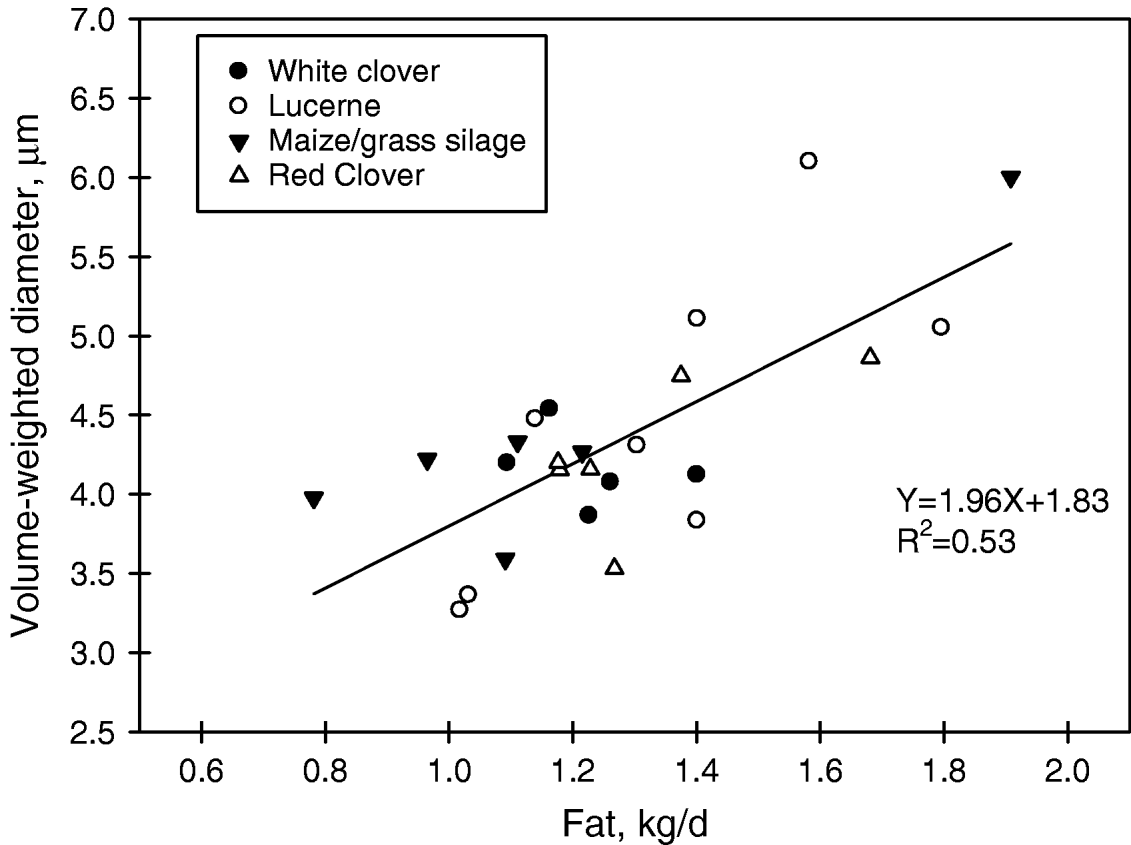
Across treatments, the daily milk fat yield of cows positively correlated with the average diameter of milk fat globule (Fig. 1). The slope and intercept of the calculated linear relationship are close to the estimate reported in our previous study (Wiking et al. Reference Wiking, Stagsted, Björck and Nielsen2004) and hereby the present study confirms the validity of our model interpreting correlation between daily milk fat yield of cows and average diameter of MFG, even though the R 2-value (=0·54) is moderately low.
This research was financially supported by the DARCOF III programme.