The ability of international courts (ICs) to make decisions independently from state governments is a long-debated question at the crossroads of international relations and international law.Footnote 1 On the one hand, the significance of international law hinges on judges being able to “speak law to power,” and being more than coordinating agents of state interests. On the other hand, fear of “juristocracy,” and threats to the integrity of legitimately derived domestic law requires accountability of international judicial decision making.Footnote 2 However, rather than moving toward a coherent understanding of the role state governments play in international adjudication, the scholarly debate has become more divided in recent years. Although most scholars subscribe to the view that ICs normally act with “bounded discretion”Footnote 3 in relation to state governments, the scope of that discretion, and the determinants of its boundaries, are highly contested.Footnote 4
Part of the disagreement concerns the application of theoretical models that were developed to explain judicial independence and accountability at the domestic level to ICs.Footnote 5 In particular, the central mechanism in separation-of-powers (SOP) models of judicial politics—the possibility of legislative override—has raised controversy. Although the standard SOP model pictures a relationship between judicial decisions, and a function of political preferences and the rules governing political collective action,Footnote 6 students of ICs have often dismissed override as a noncredible scenario because of what is perceived as insurmountable information deficiencies (on behalf of judges) and mobilization costs (on behalf of governments). According to the trustee model of ICs, for example, the discretion of ICs can be wide, and set more by the willingness and ability of substate actors to support court decisions, than by state governments' preferences.Footnote 7
Our contribution relates both to ICs' scope of discretion, and to the factors determining their boundaries. We argue, in contrast both to the SOP model and its loudest critics, that judges make decisions under uncertainty concerning the probability and direction of political reactions to their decisions. In most cases, judges will not have enough information either to engage in sophisticated strategic action (as the SOP model assumes) or to rule out override as a plausible risk (as the critics assume). We also propose that acknowledging that judicial decision making takes place under uncertainty has important implications for our expectations of judges' behavior. On the one hand, uncertainty makes override a latent risk for courts, which they find difficult to ignore and therefore seek information about. Cautious judges are therefore likely to be attentive to, and act on, signals that contain information about the probability of adversarial political reactions to their decisions. On the other hand, taking uncertainty into account also implies that misjudgments of the political risks are likely to be made by the judiciary, leading either to actual overrides (in contrast to the prediction of SOP models) or “unnecessarily” constrained judicial activism (in contrast to the prediction of attitudinal and trustee models), depending on how risk averse the judges are.
The court will treat the political signals it receives as proxies for the underlying zone of discretion, even if these are only incomplete representations of the true state. Therefore, our argument suggests that the possibility of override is a significant factor affecting judicial behavior—and one that has been underestimated in much of the literature on ICs—but also that it is a fairly blunt mechanism for balancing the independence and accountability of courts. Although the uncertainty is likely to be higher at the international level, the difference between international and domestic courts in this respect is one of degree rather than of kind.Footnote 8
Empirically, we apply our argument to the Court of Justice of the European Union (CJEU), which has long been at the center of research and theory development regarding the “legalization” of world politics,Footnote 9 and the rise of “new-style” ICs.Footnote 10 By 2011, the CJEU had issued 18,511 binding rulings, about half of all IC rulings delivered until that year.Footnote 11 It has also become a template for many of the design features of the wave of post–Cold War ICs.Footnote 12 The debate about international judicial independence has been most heated in regard to the CJEU, which has regularly been described as a most difficult case for the override mechanism.Footnote 13
The empirical analysis is based on data collection of previously unavailable reports, containing summaries of the (unpublished) briefs of EU governments to the CJEU in the period between 1997 and 2008. Our results demonstrate a strong correlation between member states' signaled preferences and the decisions of the CJEU, in a pattern that goes beyond legal merit, and that is difficult to explain without reference to the override mechanism. We conclude, therefore, that state governments are still crucial parts of the broader audience that defines the political boundaries of the courts' discretion.
The SOP Model and Its Critics
SOP models of judicial politics focus in particular on the possibility of overriding court decisions.Footnote 14 The approach assumes that judges are motivated to a large extent by preferences that refer to the policy implications of their decisions. Furthermore, in promoting these preferences judges act strategically, taking into account the probable actions of other actors with power over policy, and the long-term effects of their decisions on the collective outcome of the political system as a whole.
The model was originally developed in the American judicial politics literature, but the basic idea has also been applied to ICs.Footnote 15 It suggests a sequential game in which the positions of the pivotal legislators/contracting states are set and known, the court makes the first move, and the legislature responds. Whether an override takes place or not depends on whether the court's decision is a structure-induced equilibrium, that is, whether there exists a majority willing and able to pursue an override.
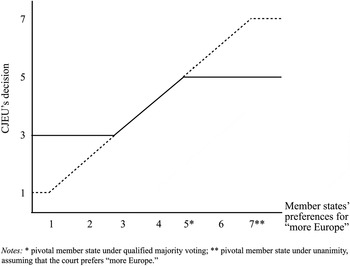
Consider the situation depicted on the x axis in Figure 1, which describes an intergovernmental political body with seven members (MSi) that have Euclidean preferences in a one-dimensional policy space.Footnote 16 The court's decision is a function of the preferences of the judges, the member states, and the decision-making rule. Under qualified majority rule (QM = 5/7) the court's decision (CD) will correspond to a structure-induced equilibrium if CD ∈ [MS3, MS5], that is, if it is situated somewhere in the range between the pivotal members 3 and 5. If unanimity rule applies, the condition is CD ∈ [MS1, MS7]. Thus, the part of the curve that has a nonhorizontal slope indicates the court's zone of discretion under qualified majority (solid line) and unanimity (dashed line). An override takes place if CD is placed outside these ranges because the member states will then be able to assemble the necessary votes.
The CJEU's decision as a function of its own preferences and those of the EU governments

Under the qualified majority rule, if the court's ideal policy preference is to the left of MS3, it will choose the ideal point of MS3 because this is the closest viable option to its own preferred decision. If it prefers a point in the range [MS3, MS5] it will simply choose its ideal. Should the court's ideal point be to the right of MS5 it will choose MS5. Applied to the EU, and assuming that the policy space in question is the more-less European integration scale and that the CJEU prefers the highest level possible of “more Europe,” its decision will be MS5 under qualified majority (*) and MS7 under unanimity (**).
The implication of the SOP model is that courts are systematically constrained by the latent risk of override. Strategic policy-seeking judges must consider the preferences and decision procedures of the political actors and institutions. If they find themselves preferring an outcome outside the zone of discretion they are forced to choose a decision that is suboptimal to avoid an even worse outcome as a result of an override, such as a shift of status quo “backward”—for example, toward more national sovereignty in the case of ICs—or a stop to further progress in the preferred direction.Footnote 17
The main challenger to the SOP model in the American judicial politics literature is the attitudinal model.Footnote 18 It shares the SOP model's assumption that judges are policy seekers, but differs in its predictions of how limiting the political constraints are. Although couched in different terminologies—and with surprisingly little cross-referencing—the central arguments of the SOP and attitudinal models are key also in the IR literature on ICs, and in the debate on the power and independence of the CJEU. The rational-expectations argument of the SOP approach has been referred to as “principal-agent theory” and/or “rational choice institutionalism”Footnote 19 or to the “executive control thesis”Footnote 20 in the literature on ICs, and to “intergovernmentalism” in the EU literature.Footnote 21 The critique against the SOP model is part of both the attitudinal model in the US literature, the trustee model of ICs,Footnote 22 and the neofunctionalist theory of legal integration in the EU,Footnote 23 although these models differ in other respects.Footnote 24
The critics have raised two important objections against the SOP model. The first is directed toward the implicit assumption of an unlimited collective action capacity on the political side. It has been frequently argued that the zone of discretion available to courts most often is so wide that the judges' preferred decision is unlikely to be positioned outside the limits, where an override would be possible. Too many veto points with conflicting views within the political bodies work against any attempt at collective action against the court in question to make it a credible threat.Footnote 25
Furthermore, the simplest SOP model, as described in Figure 1, assumes perfect information with respect to preferences and decision-making processes within the political institutions, which is highly unrealistic. According to Segal, the US Supreme Court will “at best, have some form of probability distribution as to the preferences of Congress, with some vague notions about the costs to Congress of override and the benefits to Congress of override.”Footnote 26 Lupu argues that the informational problem is even more severe for ICs: “Judges on national courts face fewer hurdles in overcoming these information problems, so they are better able to ascertain the preferences of their audiences than are judges on international courts.”Footnote 27 If the court does not know what sophisticated strategic action would entail, the argument goes, it will not be able to engage in it.Footnote 28
The conclusions drawn from these objections have often been quite definitive. For example, Stone Sweet and Brunell argue that the CJEU is “effectively insulated from member state override,”Footnote 29 whereas Scharpf claims that any political corrections of the CJEU's decisions are “in theory improbable and in practice nearly impossible.”Footnote 30 Similar conclusions are drawn with respect to other ICs. According to Voeten, “for most international court judgments, the threat of legislative override is small.”Footnote 31 Similarly, students of US politics emphasize that the difficulty of passing laws through Congress prevents it from reacting to Supreme Court decisions. Segal argues that “if the support of the Judiciary chairs in both chambers is needed for override legislation, then the Court will be almost completely immune from congressional interference.”Footnote 32
Judicial Decision Making Under Political Uncertainty
Although we find the critique against the SOP approach regarding complete information and costless collective action principally valid, we believe that the implications have been exaggerated. Instead, we argue that an assumption of incomplete information may be integrated into the SOP approach to generate more realistic predictions of judicial behavior. Our argument assumes that judges are likely to be both concerned and uncertain about the probability of override, and therefore sensitive to cues about the state of play in the political institutions.
When estimating its zone of discretion a court faces two main sources of uncertainty regarding the political bodies; the preferences (direction and salience) of the key political actors, and the process (formal and informal) by which these are aggregated. A number of factors will affect a court's ability to overcome this informational problem.
Information on decision-making rules and norms (such as voting rules, number of veto players, coalition-building practices, consensus norms) will provide some guidance to the general collective action capacity of the political institutions. Different political systems and international organizations will be more or less easy to read in this respect. A court working within a unitary Westminster-type system, with a single-party government that has a majority in the parliament, will be aware that legislative action is relatively easily executed (although certainly not costless) and will be able to locate whose preferences count. For ICs, however, and for domestic courts in more complex separation of powers systems, it is unlikely that the judges will be able to make very precise judgments.
Furthermore, ICs face specific informational hurdles compared with domestic courts. For example, interstate negotiations are often less transparent than domestic politics, ICs will need to consider the preferences of several rather than just one legislature, and international judges are likely to be less well attuned to policy debates in countries other than their own. However, the differences are of degree rather than of kind, and political uncertainty will vary also between ICs.
The institutional design of the court and its proceedings will affect both the general probability of override and the level of uncertainty in specific cases. Besides rules governing the collective action capacity of the political bodies, other procedures also affect the likelihood that the court encounters highly salient governmental preferences. Alter distinguishes between new-style and “old-style” ICs, with new style having compulsory jurisdiction and private litigant initiation rights (directly or via preliminary references).Footnote 33 Although an old-style court (such as the International Court of Justice) may be relatively confident that highly controversial cases are filtered out by the member states,Footnote 34 new-style courts are more likely to be handling hot political potatoes initiated by nonstate litigants.Footnote 35
Other rules of procedure will influence courts' ability to gain information on political preferences in specific cases. For example, Steinberg notes that the World Trade Organization (WTO) Appellate Body (AB) has developed procedures that “assist it in generating information on members' preferences,” a type of action that he considers “consistent with a judicial body's concern not to run afoul of politics. For example, it has set forth an expansive definition of standing, maximized the extent to which third parties may participate in the appeals process, permitted panels to accept amicus curiae submission by nonstate actors, permitted representation of members by private counsel, and obliged members to disclose facts requested by panels.”Footnote 36
However, although political uncertainty will vary between courts and cases, it is likely to be substantial in most cases, in particular for ICs. An important implication of such uncertainty is that courts can rarely, with a high degree of confidence, rule out the risk of override. As long as the political institutions cannot reasonably be assumed to lack collective action capacity all together,Footnote 37 there will be a latent risk for override should the court step out of its zone of discretion. The more likely reaction from the court's side, rather than dismissing that risk, in our view, is to seek information about it.
Furthermore, a scenario in which the court has no information about the sentiments and capabilities of the political actors may indeed lead (non-risk-averse) judges to decide according to their preferences, given that they would have no way to anticipate the political reaction. But that situation is equally as unrealistic as the complete information scenario. Judges are likely to be uncertain, but they will normally not be entirely in the dark about what is going on in the relevant political bodies. Some information on preferences is likely to reach the court one way or the other—through formal briefs, informal communications, or public debates—and the judges will be aware of at least the formal decision-making rules regulating political action, and probably some of the informal norms and bargaining dynamics as well.
Thus, our argument contrasts with both the simplest version of the SOP model and with the competing attitudinal and trustee models. Although the simple SOP version makes strong assumptions about the information available to judges, and the collective action capacity of international organizations and legislative institutions in separation of powers systems, so does the claim that courts do not care about the threat of override. The trustee model must assume either that the political institutions are more or less permanently grid-locked, or that the court has enough information to conclude that override is not plausible, or so little information that there is nothing for the judges to act on but their own attitudes. Instead, we believe that in most situations the judges are likely to be uncertain, and attentive to the pieces of information they can pick up from the political side.
The predictions one can make about judicial decision making under uncertainty are obviously less precise than those given by the SOP model of Figure 1. With complete information there is a clear equilibrium for each voting rule, and no override takes place. If, on the other hand, the court would have no information at all on the political preferences and process, and for that reason would decide only according to its sincere preferences, override would occur every time the court had a preference outside the zone of discretion. In the more realistic incomplete information scenario the court's decision will depend on the information it receives. What is predictable then is that more information in one direction—toward a higher or lower probability of override—leads to a higher or lower probability of judicial activism. If, for example, in Figure 1 the court receives information only from member state 2, the probability that the court moderates its decision compared with its sincere preference for more integration increases, compared with if it had no information.
Actual instances of override pose a puzzle for SOP models that assume complete information. Epstein and Knight ponder the relatively high number of congressional overrides of US Supreme Court decisions. They note that “it is possible that the Court does not know with certainty what the other government actors will do. In these situations, the justices can only form estimates, which, like all estimates, may be wrong.”Footnote 38 On a similar note, Steinberg argues with respect to the WTO AB, that “the predictability of political reactions to any particular judicial decision is limited by information and cognitive models about politics in the WTO and in members' domestic systems. A judicial body such as the Appellate Body may not be well suited to making difficult political calculations.” Nevertheless, he concludes that the WTO AB has not only actively sought but also paid careful attention to the political signals it receives.Footnote 39
This is an important implication of uncertainty. When the court acts on incomplete information it is likely to misjudge the political dynamics from time to time, leading both to actual cases of override and to “unnecessarily” constrained judicial activism, depending on how risk-averse the judges are. Following Ferejohn and Kramer, the latter scenario may be the most common; “judges are, generally speaking, a cautious lot, which is hardly surprising for officials whose decisions deal with controversial public matters but who lack access to most normal channels for acquiring political capital.”Footnote 40
Adding uncertainty to the SOP model, therefore, makes override more blunt as a mechanism for balancing judicial independence and accountability, but not necessarily less consequential. A better-informed court is not automatically more or less constrained—that depends on the content of the information—but will be able to make a more sophisticated strategic choice.
Situating Override in the Political Toolbox
Override is not the only mechanism by which judicial independence and accountability may be balanced. For our purposes, situating override in the political toolbox is important to address the problem of observational equivalence in the empirical research design, which is a serious hurdle for many studies of judicial independence.Footnote 41 Furthermore, the importance of override will partly depend on the effectiveness of other complementary instruments.
Other factors that may influence judges to take into account social and political preferences other than their own include the procedures for selection and retention of judges,Footnote 42 the risk of noncompliance,Footnote 43 rhetorical persuasion,Footnote 44 control of the court's jurisdiction and budget,Footnote 45 and the need to nurture diffuse legitimacy in society.Footnote 46 These mechanisms affect different aspects of judicial independence. Although judge selection and retention procedures concern the autonomy of judges, override and noncompliance relate to the effectiveness of judicial decisions.Footnote 47 Judges who are highly autonomous in their decision making may still be largely irrelevant for policy outcomes if their decisions are regularly overruled or ignored.Footnote 48
US research on appointments largely confirms that the ideology of the Supreme Court justices can be predicted by a function of the president's and the Senate's ideologies, although other factors such as patronage, interest groups, and public preferences also play a role.Footnote 49 Although the politicization of the nomination process in the United States may be extreme, the selection of judges to ICs is also “widely considered to be highly political.”Footnote 50 Empirical evidence on this account comes both from the European Court of Human Rights (ECtHR)Footnote 51 and the WTO,Footnote 52 whereas “there is shockingly little written on the process through which CJEU justices are appointed.”Footnote 53
As Dahl noted, an appointment process in which judges are closely scrutinized with respect to their ideologies implies that even if they act solely on their personal policy preferences these will be roughly in line with those of the legislature at the time of the nominations.Footnote 54 However, the CJEU's record over the years on what is often described as the most salient conflict dimension with respect to legal integration—deeper European integration versus preserved national sovereignty—suggests that the appointment procedure has not eliminated the risk for agency shirking. The CJEU judges have not been shy to display “a certain idea of Europe.”Footnote 55 In fact, one thing that EU scholars seem to agree on is that the CJEU has a bias in favor of more European integration. Pollack notes that “there is virtual consensus, among otherwise diverse disciplines and otherwise hostile schools of thought, that the Court should be studied as a unitary actor with a consistent, decades-long preference for European integration.”Footnote 56
The sources of this more Europe bias have been identified as the institutional interest of the court in strengthening EU law over national law,Footnote 57 and as the ongoing socialization of judges into a European judicial esprit de corps.Footnote 58 One should caution against too simple descriptions of the CJEU as a fundamentalist supporter of the dismantling of European nation states.Footnote 59 Nevertheless, the judge selection mechanism clearly does not seem to have made other political tools—such as override—redundant in the EU.
Override is not more important than these other instruments. The tools are complementary, for example, in the sense that if the judge selection process fails to produce a court with roughly similar preferences as the principals—which may be the case for the CJEU given its purported more Europe bias—override may come to the rescue on specific policies. If override also fails as a result of collective action problems, unilateral noncompliance (or even exit) may be an option of last resort.Footnote 60 A crucial part of our research design is that we are able to distinguish the effect of override from these other mechanisms.
Previous Empirical Research and Debate on the Override Mechanism
Empirical research on the SOP model is most advanced with respect to the US case. A variety of different specifications of the model, including different assumptions about the legislative process and who the pivotal players are, have been tested, often by means of statistical analysis of large-N data over long periods of time. Most studies so far on the US case have been unable to find support for the predictions of the SOP model on judicial behavior,Footnote 61 although some have found mixedFootnote 62 or substantively weak support.Footnote 63
Among the ICs the CJEU is clearly the most researched.Footnote 64 Nevertheless, after decades of research and debate, there are still highly divergent views on the validity of the separation-of-powers approach and the significance of override in the EU case. According to several historically influential accounts, the CJEU's activism in the early years of European integration amounted to a “quiet revolution,”Footnote 65 which happened more or less without the consent (or even comprehension) of the member states.Footnote 66 Recent historical research gives a partly different picture of the Court's brave moves in the early period.Footnote 67 Summarizing a review of this “new EU legal history,” Pollack finds that the Court “was profoundly conscious of strongly held national preferences and a possible member-state backlash, and strategically tailored its rulings during the early years to what it believed the member states would tolerate.”Footnote 68
The temperature in the debate reached an all-time high in the exchanges between Stone Sweet and Brunell and Carrubba, Gabel, and Hankla.Footnote 69 The latter provided empirical support for the SOP approach in a large-N study of CJEU decision making in 1987–97. They concluded that “small shifts in the number of governments aligned on one side of a legal issue or another have large substantive effects on the CJEU's likely decision.”Footnote 70 Both override and noncompliance were raised as possible explanatory factors driving the correlation, although the authors maintained that the threat of noncompliance was likely to be more important because it would be easier to implement.
Stone Sweet and Brunell, on the other hand, found Carrubba, Gabel, and Hankla's study “flawed in fundamental respects.”Footnote 71 They argued that there are no significant cases of override in the history of the European Union, and that the CJEU has no reason to take member state governments' preferences into account other than at the margins because override was not a credible scenario and noncompliance would not weaken the court. They also raised concerns about the data analysis. In their response, Carrubba, Gabel, and Hankla rejected these claims, and they pointed to several examples of override in the literature, including cases in the areas of social security benefits, environmental policy, and patients' rights.Footnote 72
This is not the place to review the details of that debate. However, because our study relates directly to the core of the dispute—the extent to which a SOP approach is useful for studying the CJEU, and by implication many other international and constitutional courts, and whether the override scenario is an important source of constraint for courts—we will discuss how our research design and findings connect to that debate as we proceed.
Distinguishing the Override Mechanism Empirically
Based on the previous discussion, we assume that CJEU judges respond to signals that provide information on the likely political reaction to their decisions. We also assume that they react to the signals they receive in proportion to how much these are able to reduce their uncertainty. Our hypotheses are based on the fact that some signals about governments' preferences carry more information than others, depending on the judges' preferences and the political decision-making process.
A key source of information on governments' preferences for the CJEU is the written and oral “observations” (amicus curiae briefs) submitted. Furthermore, the EU Treaties contain information on the political process required for an override (including the voting rules in the Council of Ministers and the role of the European Parliament). Both these sources of information are clearly limited. Only a few member states file observations in each case, and the EU Treaties cover only the formal aspects of the process, whereas decision making is to a large extent based on informal bargaining.Footnote 73 Nevertheless, the two sources of information are likely to be important to the CJEU when evaluating the probability of override, and our research design builds on connecting the variation in the level of uncertainty that they generate, to the behavior of the Court.
For the EU to come to a legislative decision two or three major veto points must be overcome, depending on the procedure. In all cases of secondary (statutory) legislation the European Commission has a monopoly on making proposals, whereas the Council must be able to assemble the required majority of governments. In more sensitive policy areas, such as taxation and police cooperation, unanimity is normally required in the Council. In other fields, such as environmental policy, agriculture, and internal market issues, a qualified majority is sufficient. Under the previous rules (revised in November 2014), about 74 percent of the governments' weighted votes were needed for a qualified majority. Furthermore, if the so-called ordinary legislative procedure applies, the European Parliament must also approve the act, introducing a third veto player. For primary law (treaties), the member states alone decide, but unanimity and ratification at the national level is needed.
When unanimity applies—formally—it takes only one member state with similar preferences to the CJEU to block an override. This means that for an override to occur one of two scenarios must be realized. Either the member states are unanimous in their disagreement with the Court, or those member states that favor an override are willing and able to mobilize the others through persuasion and/or side payments. Under qualified majority, on the other hand, the chances that those who oppose the Court's preferred decision will succeed in assembling an override are better. Consequently, because the information that the CJEU has about the political process indicates a higher risk for override, the judges should be more attentive to member states' observations when qualified majority rule applies.
H1
Member states' observations will have a larger influence on the CJEU's decisions when override can be pursued with a qualified majority in the Council.
Correspondingly, the risk for override should be lower when the European Parliament is introduced as an additional veto player:
H2
Member states' observations will have a larger influence on the CJEU's decisions when override can be pursued in the Council without the approval of the European Parliament.
An additional implication of our argument is that the CJEU will weigh differently the information on member states' preferences, depending on the direction of these in relation to the Court's preferences. In practice—under supra-majoritarian rules—friends of the Court carry more weight than foes, in terms of reducing uncertainty about the likely outcome. The reason is that the Court needs only a minority of friends to block the efforts of the foes.
To derive the third hypothesis we adopt the common assumption that the CJEU tends to prefer more European legal integration to preserved national sovereignty. If that is the case, a government's observation in favor of preserved national sovereignty will increase the risk for an override by Vms/74, where Vms is the share of votes that the signaling member state has in the Council. If the observation instead encourages the CJEU to proceed with its preferred decision to increase legal integration, that signal will decrease the risk for an override by Vms/26, which is a change in uncertainty for the Court about three times larger than that given by the observation in favor of preserved national sovereignty. For example, if the Netherlands, which has had about 4 percent of the votes in the Council, submits an observation in defense of the national law that is being reviewed, the risk for an override will increase with 4/74 = 5 percent. If the Dutch government instead would argue for more Europe, that information would decrease the risk for an override by 4/26 = 15 percent. Our third hypothesis therefore is the following:
H3
Member states' observations in favor of more Europe have a larger influence on the CJEU's decisions than those in favor of preserved national sovereignty.
The three hypotheses are based on the SOP approach, taking incomplete information into account. Importantly, they also distinguish the override mechanism from the main alternatives in the political toolbox that we previously discussed. First, there is no reason to expect the attitudes of judges (as derived from strategic appointments) or the persuasiveness of arguments (as in a deliberative trustee model) to vary systematically depending on the decision procedure.
Second, if anything, both diffuse legitimacy concerns and threats of noncompliance are likely to be less acute in policy areas including qualified majority voting in the Council and veto right for the European Parliament. The reason is that the decision-making rule is partly endogenous to the political sensitivity of the policy area. Unanimity has been retained in more sensitive policy areas, where member states have been less willing to expose themselves to the risks involved with pooling and delegating power.
This means that if the CJEU is indifferent to override on specific issues, but it does care about compliance and/or its more general legitimacy, it should tread lightly especially in these more sensitive areas, and therefore be more responsive to observations under unanimity. Kelemen notes that “as EU law expands into more sensitive areas of national policy, such as healthcare, education and taxation, the CJEU is pressed to step into terrain where its decisions are more likely to spark public outcries and political reprisals.”Footnote 74 Noncompliance of activist court decisions should therefore be more likely in policy areas where unanimity applies.
Because the threat of noncompliance and the concern about diffuse legitimacy are likely to be working in the opposite direction compared with our hypotheses, and given the common descriptions of the CJEU as an unusually powerful and independent international court,Footnote 75 the test of the override mechanism conducted here should be a conservative one.Footnote 76
Data and Research Design
The empirical analysis focuses on the preliminary reference procedure, which is the most important source of cases for the CJEU. The vast majority of the cases involve a complaint by a private litigant at a national court concerning a national statute that it claims to be in breach with EU law. The national court may refer the case to the CJEU for a preliminary reference, which then guides the national court on the interpretation of EU law. In practice, this amounts to an indirect form of supranational judicial review of national law.
Our data contain the positions of all actors involved in all questions referred to the CJEU in 84 percent of the preliminary rulings that arrived on the CJEU's desk between 1997 and 2008. This amounts to 1,599 cases including 3,845 questions raised by national courts. Missing cases are those in which no oral hearing was held at the CJEU. During this period an oral hearing would always be held if one member state so requested, which means that the missing data are unlikely to include politically salient cases.
When there is no oral hearing there is also no Report for the Hearing, which is our source of governments' observations. These are documents made by the reporting judge as part of the court's preparations in the case. The reports contain the original questions posed by the national court as well as summaries of the main arguments of the parties, the General-Advocate, the European Commission, and any member state government that submitted an observation in the case. The extent to which member states submit observations varies. In our data, 91 percent of the cases contain at least one government observation, 62 percent at least two observations, and 37 percent three or more observations. The most active government during the period was the UK, which submitted observations in about one third of the issues. The CJEU did not publish the observations, and after 1993 the Reports for the Hearing also were not published any more. This means that it is in practice difficult to collect systematic data on the member states' observations after 1993 based on public records. Fortunately, we were able to gain access to the reports in the archives of the Swedish foreign ministry, on the condition that they would be used only for research purposes.
The coding of the positions proceeded in the following way. First, we identified the key legal issues involved in the questions posed by the national court. These are often formulated as a question that can be answered yes or no. The next step was to define which answers were given to this question by all actors involved in the process, and the CJEU itself in its final judgment. Sometimes only two positions—yes or no—were argued for. In many cases, however, more than two positions existed, often in the form of “yes, but …” or “no, but …” The statements of the different actors were subsequently coded as supporting one of these identified positions.
The positions were also coded according to their implication for legal integration. If a position implied that EU law restricted the autonomy of member states it was given the code 2 (we will refer to that as “more Europe”). If no clear implication in terms of legal integration could be drawn from the position the code was 1 (ambivalent). If the position implied that EU law should not be interpreted as constraining the member states in the particular case at hand the code would be 0 (preserved national sovereignty).
The case C-293/2006 Deutsche Shell illustrates. One of the issues raised by the national (German) court in this case was the following:
Is it contrary to Article 52 and Article 58 EC for Germany, as the State of origin, to treat a currency loss of a German controlling company resulting from the repatriation of so-called start-up capital granted to an Italian establishment as being part of that establishment's profits and to exclude that loss, on the basis of the exemption under Articles 3(1), 3(3) and 11.1(c) of the Double Taxation Convention between Germany and Italy from the basis of assessment for German tax?Footnote 77
In more simple terms, the German court is asking the CJEU whether the German tax authorities can treat this particular tax issue in this particular way, or whether they are precluded from doing so by EU law. Two distinct positions were noted in the documented responses from the different parties and actors involved—yes or no. Because the question was negatively formulated (“Is it contrary to … ?”) “yes” implies more Europe and “no” means preserved national sovereignty in this case. The German and Dutch governments argued “no” and submitted observations. The European Commission and the Advocate General, on the other hand, argued for “yes.” The CJEU in its judgment decided for “yes.”
The intercoder reliability test shows that the coding is reliable.Footnote 78 We recoded 91 legal issues, including 658 actors' positions. The test shows an intercoder agreement of 89 percent for the coding of the actors' positions, which is good given the relatively complicated material. The more Europe variable has 83 percent intercoder agreement, which is also clearly acceptable according to established conventions.Footnote 79 Furthermore, almost all the differences between the coders on this variable were such that one coder had indicated more Europe or preserved national sovereignty, whereas the second coder had indicated ambivalent. Only three cases (2 percent) of contradictory coding were found, where one coder indicated more Europe whereas the other coder had noted preserved national sovereignty.
Our empirical research design is similar to Carrubba, Gabel, and Hankla's in some respects. However, apart from the fact that our data concern a more recent period and therefore may tell us more about the judicial politics of a deeper and wider EU, they also have some other advantages. First, because they did not have access to the Reports for the Hearing, Carrubba, Gabel, and Hankla were not able to code all member states' observations after 1994. For the years 1995 to 1997, therefore, they had to use the references to the observations in the CJEU judgments (and the opinions of the Advocate General) for their coding. This is problematic because the CJEU does not refer to all member states. It is likely that the Court chooses to refer to those observations that are aligned with its own position, which biases the findings in favor of a positive correlation.
Second, as the dependent variable, Carrubba, Gabel, and Hankla coded whether the CJEU favors the position of the plaintiff or not. Although clearly useful as a yardstick for measuring whether the actors are in agreement, the extent to which the Court's judgment is in line with the position of the plaintiff is not of substantive interest in itself. Nor is it a reliable proxy for positions favoring more European legal integration.Footnote 80 Whether the member states and the CJEU take positions in favor of more or less European integration is a core question in the EU research. With our data we can study the actual positioning on this dimension.
That is not to say that the political conflicts raised in these cases only—or even mainly—concern ideas about the proper balance between national and supranational power. The cases often have clear implications also for substantive ideological conflicts concerning the degree of market regulations, including company, labor, consumer and environmental regulatory standards, member states' ability to raise taxes and control access to their welfare systems, protectionist versus free trade policies, etc. Sometimes the more Europe dimension is intertwined with these substantive issues, such as when the conflict concerns higher regulatory standards at the national level versus lower standards harmonized at the European level.Footnote 81
Empirical Analysis
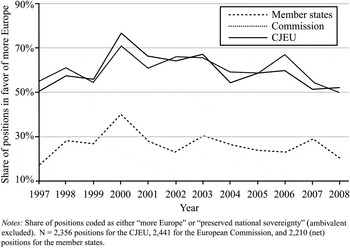
We start by looking at how the CJEU, the European Commission, and the member states have positioned themselves on the more Europe dimension over time and across policy areas. Figure 2 shows the proportion of positions favoring more Europe in the observations submitted by the member states and the Commission, and the judgments of the CJEU for cases submitted in the period 1997 to 2008. The pattern indicates that the CJEU and the Commission consistently have a higher share of positions in favor of more Europe than the member states. This picture confirms a view of the preliminary reference procedure as one where those member states that file observations on average try to hold back the CJEU from further restricting national sovereignty.
Share of positions in favor of more legal integration over time

Figure 2 also shows that although the CJEU persistently decides in favor of more Europe more often than the member states, the two seem to follow a similar trend over the years. This is what we would expect from a separation-of-powers model where the court takes cues from the member states' observations, while at the same time uses its zone of discretion to advance its preference.
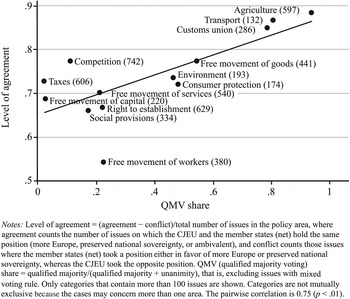
Figure 3 shows the distribution of issues across policy areas, the level of agreement between the CJEU and the member states, and the share of issues where an override would require a qualified majority rather than unanimity. Most cases relate to the common market (for example, competition policy, right to establishment and the free movement of goods, workers, capital, and services), agriculture, and taxes (in particular value-added taxes), whereas somewhat fewer cases concern transport, consumer protection, and environmental policy.
Level of agreement and voting rule across policy areas

The y axis shows the level of agreement, measured as the share of issues within each policy area where the (net) position of the member states is in agreement with the CJEU's judgment on the more Europe dimension. The x axis indicates the share of issues in which the European law being interpreted by the court could be amended with a qualified majority vote in the Council. As we would expect from H1, there is a strong relationship between the level of agreement and the dominant voting rule of the policy area. The most contentious policy area—where the CJEU seems to be most at risk for an override—is the free movement of workers, whereas the least tension is found in agriculture, transport, and trade policy.Footnote 82
Multivariate Analyses
To control for the impact of law we use the same strategy as Carrubba, Gabel, and Hankla and include the position of the Advocate General in our statistical model. The role of the Advocate General is to investigate the legal issues in the case and present an independent position before the CJEU. By including the Advocate General's position we reduce the risk that any relationship between the governments and the court's decision is simply a result of similar interpretations of the law. Although we cannot preclude strategic behavior on behalf of the Advocate General, it seems unlikely that it would systematically omit the legal merits.Footnote 83
Another potentially important actor that needs to be taken into account is the European Commission, which initiates legislation. Generally it is uncontroversial to assume that the Commission has a supranational bias and would prefer more European legal integration ceteris paribus. Excluding the Commission might therefore cause omitted variable bias. But including the Commission is not unproblematic either. Although the Advocate General supplies the CJEU with legal arguments, several authors have argued that the Commission fills a role as the CJEU's informant concerning the political preferences of the member states.Footnote 84 The Commission, according to this argument, monitors the social and political circumstances in the member states and signals to the court how far these may be pushed toward more integration. “Court watchers have long understood that the ECJ uses the EC Commission as a political bellwether. In any given case, the ECJ looks to the Commission's position as an indicator of political acceptability to the member states of a particular result or a line of reasoning.”Footnote 85 Including the Commission along with the member states in a multivariate analysis may therefore underestimate the effect of the member states. For that reason, we include models both with and without the Commission.
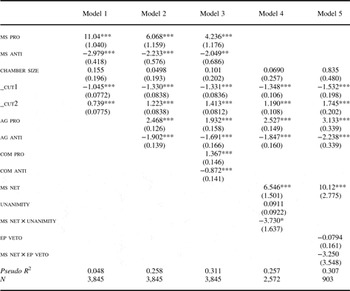
We use ordered logistic regression analysis to estimate the effects of the member states' positions on the variable cjeu judgment, that is, the propensity of the CJEU of ruling in favor of more Europe, preserved national sovereignty, or taking a position that cannot be interpreted as either of the two (ambivalent). The first two hypotheses are tested by examining the interaction effects of voting rule (unanimity) and veto right for the European Parliament (ep veto), respectively, and a variable denoting the net member state vote share in favor of more Europe (ms net). The member states positions are weighted by their voting power in the Council, so that larger states weigh heavier than smaller states.Footnote 86 ms net takes the share of Council votes signaled by observations in favor of more Europe and preserved national sovereignty, and subtracts the latter from the former. Our data include 990 legal issues where a revision of the main European legal statute at stake required qualified majority in the Council, and 1,582 where unanimity was required (including both primary and secondary law).Footnote 87 To control for the fact that veto right for the European Parliament almost always coincides with qualified majority rule (but not vice versa), H2 is tested only on issues with qualified majority rule.
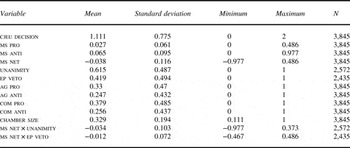
The third hypothesis is tested by comparing the effect of two variables, one summarizing the weighted observations made in favor of more Europe (ms pro) and one summarizing observations in favor of preserved national sovereignty (ms anti). Both range from 0 to 1, denoting the share of Council votes supporting more Europe and preserved national sovereignty, respectively. For the Advocate General and the European Commission dummy variables denoting whether they are in favor of more Europe (ag pro, com pro), preserved national sovereignty (ag anti, com anti), or ambivalent (reference category) are used. We also include a variable denoting chamber size (chamber), coded as the share of the full judge collective sitting in on the case, to control for the salience of the case.Footnote 88 Table 1 includes the summary statistics.
Summary statistics

The results are presented in Table 2. The first model includes only the two variables summarizing the weighted observations in favor of more Europe, preserved national sovereignty, and chamber size, whereas Models 2 and 3 include controls for the Advocate General and the European Commission. All three models demonstrate substantial and significant effects of the member states' observations on the CJEU's decisions, both when arguing for more Europe and for preserved national sovereignty. Furthermore, and in accordance with H3, the effect of member states' observations is substantively stronger when the signal from the member states is more Europe rather than preserved national sovereignty: 6.07 and −2.23, respectively, in Model 2.
The impact of member states' positions and decision rules on the CJEU's rulings on the more Europe scale (ordered logistic estimates)

Notes: Results from ordered logistic regressions. Standard errors in parentheses, observations clustered by case. *p < .05; **p < .01; ***p < .001 (two-tailed).
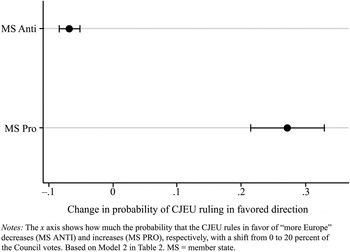
Figure 4 shows graphically the stronger effect of member states' observations in favor of more Europe. Based on Model 2, it illustrates a shift from 0 to 20 percent of the Council votes in the two variables ms pro and ms anti. At 0, that is, when the member states' net opinion is ambivalent concerning more Europe or preserved national sovereignty, the predicted probability that the CJEU will rule in favor of more integration is 0.23. A shift from 0 to 20 percent of the Council votes explicitly favoring preserved national sovereignty—which corresponds to observations from approximately two large (or four medium-sized) states—decreases the probability that the CJEU will rule in favor of more Europe to 0.16 or by 30 percent. The same shift in favor of more Europe increases the likelihood that the court goes in that direction from 0.23 to 0.50—by 117 percent. Thus, the effect of observations in favor of more Europe is almost four times larger than those that try to hold back the court.Footnote 89
Comparing the effect of member states' observations in favor of ‘more Europe’ and ‘preserved national sovereignty’

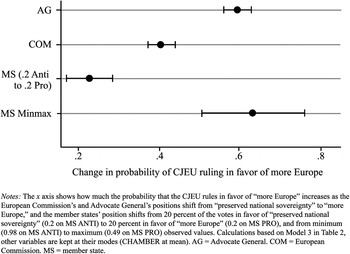
Figure 5 compares the impact of the member states' observations with those of the European Commission and the Advocate General (based on Model 3). It addresses a point of disagreement in the literature concerning the relative importance of the commission and the member states for the CJEU's decisions. Stone Sweet and Brunell argue that to the extent that the member states have an impact at all, it is marginal compared with the Commission's. In their view, this constitutes support for a neofunctionalist interpretation of the development of legal integration in Europe, in which the supranational institutions weigh heavily compared with the member states.Footnote 90 Carrubba, Gabel, and Hankla rejected the empirical strategy on which Stone Sweet and Brunell based their argument. They showed instead that when the Advocate General was also included in the model, a shift from lowest to highest observed value in the respective variables indicated that the member states had a comparable impact with that of the Advocate General, and a similar, or larger (when a member state government was a litigant in the case), effect as the commission.Footnote 91
Comparing the effects of the observations of the member states, the European Commission, and the Advocate General

However, the result one gets from this type of analysis depends a lot on the values that are assumed, both with respect to the variables that are held constant (as Carrubba, Gabel and Hankla point out) and with respect to the shift in the independent variable that is analyzed. While the lowest and highest observed values (that is, from preserved national sovereignty to more Europe) are empirically frequent both for the Commission and the Advocate General, they are exceptional for the member states as a collective.
Figure 5 shows that when this extreme shift in member states' preferences (from 0.98 in ms anti to 0.49 in ms pro) is compared with a shift in the position of the European Commission and the Advocate General from preserved national sovereignty to more Europe, the impact of the member states is indeed on par with the Advocate General, and larger than the Commission's, although the uncertainty is relatively high. Analyzing instead a more realistic shift in the governments' positions, from 20 percent in favor of preserved national sovereignty to 20 percent in favor of more Europe, we find a more modest member state effect compared with the Advocate General (in particular) and the Commission, in line with Stone Sweet and Brunell's argument.
However, although the effect of the member states' observations is more modest in comparison, it is still quite substantive. The projected shift from 20 percent in favor of preserved national sovereignty to 20 percent in favor of more Europe more than doubles the chances that the CJEU decides in favor of more Europe (from a probability of 0.14 to 0.37), even when controlling for the legal merit (Advocate General) and the potential bellwether function of the European Commission.
Interaction Effects
The two hypotheses concerning the interactive effects of the decision-making rules are tested in Models 4 and 5. As expected, Model 4 shows a significant negative interaction effect of unanimity rule (−3.731). This means that the CJEU is more likely to follow the revealed preferences of the member states under qualified majority rule compared with when unanimity applies, that is, under conditions where a legislative override is more easily assembled in the Council. Model 5 analyzes the effect of a veto right for the European Parliament in the legislative process. Here we fail to find support for the hypothesized interaction effect. The interaction term has the expected negative sign (−3.24), but the uncertainty is too high to support the hypothesis. This means that we cannot conclude that the member states' observations have less impact when the European Parliament is a veto player.Footnote 92
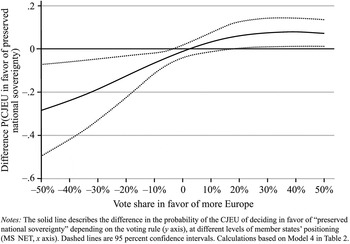
Figure 6 illustrates the difference in the impact of member states' observations depending on the voting rule in the Council. On the x axis we have the net share of Council votes in favor of more Europe (ms net), and on the y axis the difference in the probability that the CJEU decides in favor of preserved national sovereignty, when shifting from qualified majority to unanimity. For example, when 20 percent of the Council votes (net) defend a position in favor of preserved national sovereignty the predicted probability that the CJEU agrees with this position is 0.48 under qualified majority and 0.29 under unanimity, a difference of 0.19 (or 49 percent).
Difference in probability of the CJEU deciding in favor of “preserved national sovereignty,” depending on the voting rule and the member states' positioning

The stronger effect of member states' observations under qualified majority is statistically significant in the whole negative range of the ms net variable, and from 20 percent of the votes in the positive range. The interval between 0 and 20 percent in favor of more Europe, where the interaction effect is more uncertain, contains 1,371 issues or 53 percent of the issues analyzed in Model 4. Of these, 976 are issues where no member states filed observations, or where the votes for more Europe and preserved national sovereignty equaled each other out, which means that the CJEU did not receive a (net) member state signal in any direction. Thus, in about 47 percent of the total number of issues—or in 75 percent of the issues where the member states expressed a positive or a negative (net) signal—the voting rule significantly moderates the effect of member states preferences. This means that it is clearly not an effect outside the “convex hull” (to use King and Zeng's terminology).Footnote 93
In sum, we hypothesized that if legislative override is a plausible but uncertain possibility for the CJEU, and something that it strategically takes into account in its decision making, the effect of member states' observations should be strongest when they argue in favor of more Europe, when qualified majority voting (QMV) applies, and when the European Parliament lacks veto power. Although a lack of veto power was not confirmed with statistical certainty, the overall pattern found in the data does conform to the expectations.
Conclusion
According to a recent review of the research on international judicial independence, there is “scholarly consensus that most international courts enjoy a degree of autonomy within a defined sphere.”Footnote 94 However, the latest debates have shown widely contradicting perceptions of the scope of that sphere, little agreement on the factors and mechanisms defining its boundaries, and diverging views of the usefulness of applying domestic theories of judicial behavior to ICs. This demonstrates that the specificities of the bounded discretion exercised by ICs are not yet sufficiently understood.
Our study has focused specifically on the central mechanism of SOP models of judicial politics—the possibility of legislative override—which has been widely dismissed as ineffectual in relation to ICs. The key point of our argument is that judges are both concerned with—and uncertain of—what the political reactions to their decisions will be. Uncertainty implies that they are rarely able to make such precise calculations of the underlying zone of discretion as assumed in the standard SOP model, but also that it is difficult to ignore the possibility of override, as the competing attitudinal and trustee models argue. As a consequence, judges—international and domestic—with policy preferences are likely to be attentive to, and act on, signals that contain political information that relates to the probability of override.
A court that is better informed will make fewer mistakes, in terms of underestimating its strategic space (the most likely scenario for risk-averse judges) or provoking overrides. However, although the level of uncertainty will vary between courts and cases, as we have discussed, it is likely to be substantial in many cases, and in particular for ICs. This means that override is a less sophisticated mechanism for matching state preferences with judicial decisions than the standard SOP model assumes. It also means that those governments that make themselves heard stand a good chance of being listened to, even if their preferences are only incomplete representations of the true underlying zone of discretion.
The CJEU has been at the center of scholarly attention and theory development on the legalization of world politics, and the rise of ICs. It is both a forerunner in terms of independence, access, and embeddedness,Footnote 95 and an institutional model for many new-style ICs (such as the Central American Court of Justice, the Andean Tribunal of Justice, the Court of Justice of the West African Economic and Monetary Union and the East African Community Court of Justice)Footnote 96 . Although the population of ICs is highly diverse and case studies are difficult to generalize from, the fact that the CJEU is at the high end of legalization and independence means that it should be a tough case for the override mechanism. If it matters here, it is likely to be important in many other contexts too, including both international and domestic courts with significant powers of judicial review.
Our argument led us to hypothesize that if the CJEU is uncertain about the risk for override it should be more attentive to signals that carry more information about that risk, and under circumstances when the risk is higher. Although our expectations concerning the European Parliament as a veto player were not supported with sufficient certainty,Footnote 97 the voting rule in the Council and the content of the observations on the more Europe scale made a difference in the predicted direction. Furthermore, like Carrubba, Gabel, and Hankla, we find a substantive effect of EU governments' expressed preferences on the decisions of the CJEU, which goes beyond legal merit and any possible bellwether function of the European Commission. Importantly, this is the case even though our research design differs from theirs in several ways, using a different dependent variable and data from a deeper and wider EU, in a more recent time period. On this ground, we find it difficult to defend a pure attitudinal or trustee model in the case of the CJEU—where the court is pictured as an “effectively insulated”Footnote 98 runaway agent with a zone of discretion that is “close to unlimited.”Footnote 99
Our evidence amounts to more than a simple correlation between revealed government preferences and judicial decisions.Footnote 100 None of the alternatives in the political toolbox can account for the systematic variation we find with respect to voting rules and the direction of the positions taken on the more Europe scale. That does not mean that these other mechanisms are unimportant—or even that override is more important—but it indicates that the significance of override has been underestimated, and that it is indeed one of the factors determining the CJEU's strategic space.
We also find that EU governments frequently support further legal integration, and that their voices have a larger impact on the CJEU's decisions when they do. Furthermore, our analysis shows that only when the member states demonstrate an exceptional unity in the court will they match the impact of the European Commission's and the Advocate General's observations. Thus, emphasizing the role played by state governments in the development of EU case law does not necessarily imply subscribing to a stylized realist executive control thesis in which judges are merely diplomats in robes coordinating the interests of powerful states, which are cautiously guarding their sovereignty. But it means acknowledging that—even in the case of the CJEU, where legalization of international affairs has gone the furthest—governments are still crucial parts of that broader audience that defines the political boundaries of international judicial discretion.
Supplementary Material
Supplementary material for this article is available at http://thedata.harvard.edu/dvn/dv/ and http://dx.doi.org/10.1017/S0020818316000047.