Introduction
Many studies indicate that common mental disorders, such as mood, anxiety and substance-use disorders, may have adverse effects on work functioning (Kessler & Frank, Reference Kessler and Frank1997; Kouzis & Eaton, Reference Kouzis and Eaton1997; Elinson et al. Reference Elinson, Houck, Marcus and Pincus2004). Working people that experience such disorders report more ‘work cutback days’ and ‘work loss days’ than their colleagues who are not identified as having these mental disorders (Broadhead et al. Reference Broadhead, Blazer, George and Tse1990; Dewa & Lin, Reference Dewa and Lin2000; Lim et al. Reference Lim, Sanderson and Andrews2000; Druss et al. Reference Druss, Schlesinger and Allen2001).
Another line of research has found that the quality of work functioning is also connected to various personality characteristics. Reviews show, for instance, that higher self-esteem, a perceived internal locus of control and emotional stability are strongly associated with better functioning at work and greater work satisfaction (Andrews, Reference Andrews1998; Judge & Bono, Reference Judge and Bono2001; Judge et al. Reference Judge, van Vianen and de Pater2004). Meta-analyses have demonstrated that neuroticism – the opposite pole of emotional stability – is strongly linked to impairments in work functioning and low job motivation (Salgado, Reference Salgado1997; Judge & Ilies, Reference Judge and Ilies2002). High neuroticism, low self-esteem and an external locus of control are often regarded as indicators for a personality trait labelled as ‘psychological vulnerability’ (Ormel et al. Reference Ormel, Oldehinkel, Nolen and Vollebergh2004b). Others have characterized these traits as core to the higher-order personality construct ‘negative self-concept’ (Erez & Judge, Reference Erez and Judge2001; Judge & Bono, Reference Judge and Bono2001).
So far these two fields of research have evolved separately. This is intriguing because a large number of studies have shown that personality traits such as neuroticism, perceived mastery and self-esteem are significantly linked to the course of common mental disorders (de Graaf et al. Reference de Graaf, Bijl, Ravelli, Smit and Vollebergh2002; Krabbendam et al. Reference Krabbendam, Janssen, Bak, Bijl, de Graaf and van Os2002; Kendler et al. Reference Kendler, Kuhn and Prescott2004; Ormel et al. Reference Ormel, Oldehinkel, Nolen and Vollebergh2004b). Nevertheless, the question remains whether impaired work functioning might be better understood by studying mental disorders and personality characteristics together as potential determinants, rather than each of these two separate.
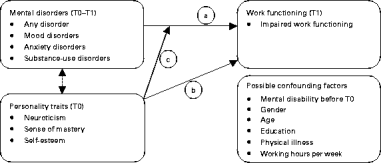
Understanding both of these factors might be important because it may help employers as well as their employees to better understand the relationship between persons and their work environment in order to keep people healthy at work. More knowledge about the determinants of impaired work functioning could support the development of comprehensive and effective reintegration interventions. The present study focuses on the factors that lead to reduced productivity or poor work functioning, rather than to work absence, exploring four different issues (see Fig. 1).
Conceptual model of the relationship between personality traits, mental disorders and work functioning. (a) Mental disorders affect work functioning; (b) personality traits independently affect work functioning (and possibly explain some influence of mental disorders); (c) personality traits may have moderating effects in addition to, or instead of (b), on the relationship between mental disorders and work functioning. T0, baseline (first wave); T1, follow-up (second wave).

Research questions
The four research questions are:
(1) Are common mental disorders linked to subsequent impairments in work functioning?
(2) Are the personality traits neuroticism, mastery and self-esteem associated with subsequently impaired work functioning?
(3) If (1) and (2) are confirmed, are common mental disorders also independently associated with subsequently impaired work functioning after adjustment for the personality traits?
(4) Do the personality traits have moderating effects on the expected association between mental disorders and impaired work functioning?
Method
Sample
Data were obtained from the first two waves of the Netherlands Mental Health Survey and Incidence Study (NEMESIS), described in detail elsewhere (Bijl et al. Reference Bijl, Ravelli and van Zessen1998b; Laitinen-Krispijn & Bijl, Reference Laitinen-Krispijn and Bijl2000). NEMESIS is a prospective epidemiological survey on the mental health of the Dutch adult general population aged 18 to 64 years, with three waves in 1996, 1997 and 1999. It was based on a multi-stage stratified random sampling procedure. In the first wave (T0), 7076 persons participated, a response rate of 69.7%. This sample adequately represented the Dutch population in terms of gender, civil status and urbanicity (Bijl et al. Reference Bijl, Ravelli and van Zessen1998a). Of these 7076 persons, 5618 (79.4%) were included in the second wave (T1). Having psychopathology was not significantly linked to sample attrition (de Graaf et al. Reference de Graaf, Bijl, Smit, Ravelli and Vollebergh2000).
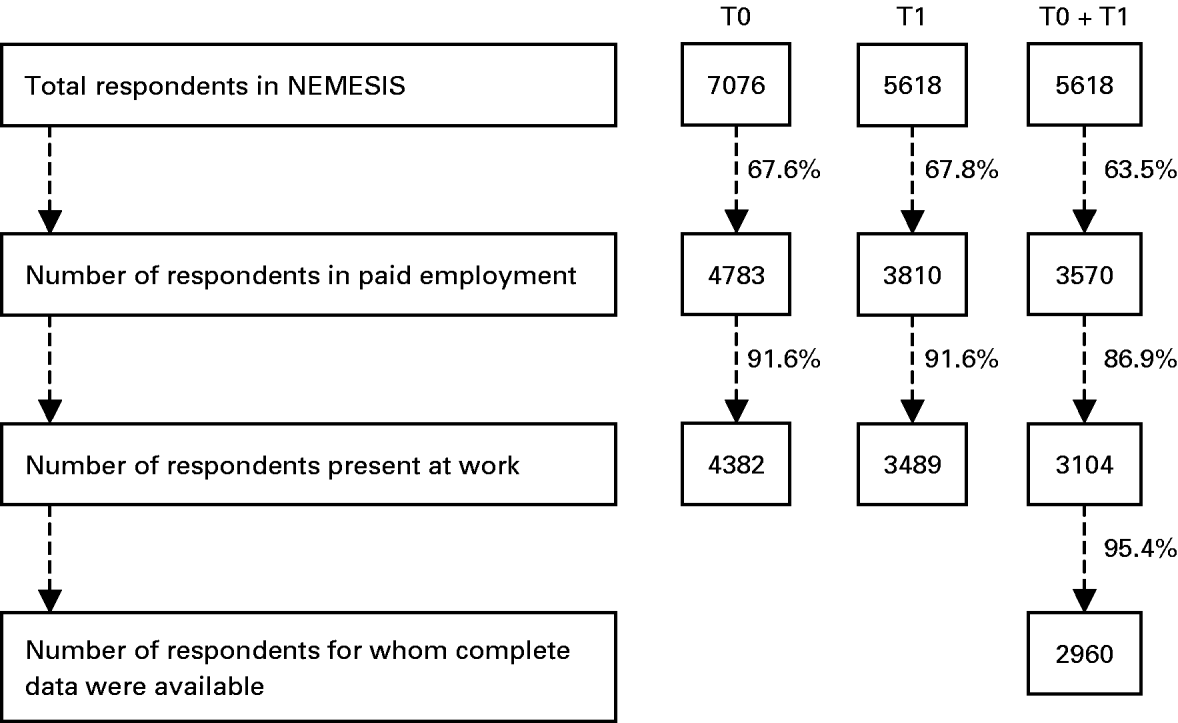
The first wave included 4783 respondents in paid employment (67.6% out of 7076) and the second wave 3810 (67.8%) out of 5618 respondents. Employed respondents who remained in the study were more highly educated: attrition was associated with low education (odds ratio 0.69, 95% confidence interval 0.60–0.80). The study reported here confined itself to the 3570 of these respondents who were in paid employment at both baseline (T0) and follow-up (T1). Main analyses were carried out in the subsample of 3104 employees who were present at work at least partly in the two periods during which impairments in work functioning were measured. Fig. 2 shows a response flow.
Response flow. NEMESIS, Netherlands Mental Health Survey and Incidence Study; T0, baseline (first wave); T1, follow-up (second wave).

Measures
Work functioning
The outcome variable work functioning was assessed at both points in time, using the eight-item Employment Scale of the Groningen Social Disability Schedule (GSDS), self-report version (Wiersma et al. Reference Wiersma, de Jong and Ormel1988). The GSDS was initially developed for use in people with enduring mental disorders. Here the GSDS showed sufficient reliability and validity (de Jong et al. Reference de Jong, van der Lubbe, Wiersma, Moscarelli, Rupp and Sartorius1996; de Jong & van der Lubbe, Reference de Jong and van der Lubbe2001). In the NEMESIS study the Employment Scale of the GSDS had a Cronbach's α of 0.65. This scale first asks whether the subject was in paid employment during the month preceding the interview and next whether the person was really working in the past 4 weeks. Subjects without work or who were absent from work for the past 4 weeks due to any reason do not complete the rest of the scale. The scale does not distinguish between reasons for work absence. Those present at work answer the next eight items, taking the past 4 weeks into account. The items include ‘I had trouble keeping to the daily routine at work’, ‘My performance was good’ and ‘My boss or client was dissatisfied about my performance’. Each item has four answer options: 1, never; 2, sometimes; 3, often; 4, always. The summary score (range 8–32) is obtained by summing the scores on the separate items, after reverse-scoring the positively worded items. A high summary score indicates greater impairment in work functioning. This summary score, as measured at T1, is the outcome measure in the present study.
Mental disorders
Mental disorders were assessed using the World Health Organization-authorized Dutch version of the Composite International Diagnostic Interview (CIDI), auto version 1.1, to assign Diagnostic and Statistical Manual of Mental Disorders (DSM)-III-R diagnoses of mental disorders to appropriate respondents (APA, 1987; WHO, 1990; Smeets & Dingemans, Reference Smeets and Dingemans1993). The CIDI has acceptable inter-rater reliability and test–retest reliability for the diagnoses of interest in this study (Wittchen, Reference Wittchen1994). The following DSM-III-R diagnoses were recorded in the NEMESIS dataset: mood disorders (bipolar disorder, major depression, dysthymia), anxiety disorders (panic disorder, agoraphobia, simple phobia, social phobia, generalized anxiety disorder, obsessive-compulsive disorder), psychoactive substance-use disorders (alcohol or drug abuse and dependence, including sedatives, hypnotics and anxiolytics), eating disorders, schizophrenia and other non-affective psychotic disorders.
In this study we distinguish three main categories: mood disorders, anxiety disorders and substance-use disorders. The analyses are based on the prevalence of these ‘common mental disorders’ in the 11 months between baseline and follow-up (excluding the twelfth month, to ensure that all disorders existed prior to our assessment of the outcome variable work functioning). The term ‘any disorder’ encompasses all diagnoses detected by the CIDI, including schizophrenia and other non-affective psychotic disorders, eating disorders, as well as the ‘common mental disorders’. The former three categories are not analysed separately here because the numbers were too low.
We also explored the influence of co-morbidity of common mental disorders (11-month prevalence). For this purpose respondents who were not diagnosed with a common mental disorder during follow-up received a score of 0, and respondents who were diagnosed with one of the three types of common mental disorders were assigned a score of 1. Those who suffered from two or three types of these disorders (e.g. both a mood and an anxiety disorder) were assigned a score of 2.
Having relatively high scores on neuroticism and low scores on self-esteem and mastery might be residual symptoms or scar effects (i.e. negative personality change that develops during a depression and persists beyond remission) of previous mental illness (Ormel et al. Reference Ormel, Oldehinkel, Nolen and Vollebergh2004a, Reference Ormel, Oldehinkel and Volleberghb), rather than an indication of more or less stable personal characteristics. To avoid that a possible link between personal characteristics and work functioning could be interpreted as a spurious correlation masking an effect of pre-existing mental illness, we also controlled for the influence of any mental disorder in the year preceding baseline (T0).
Personality characteristics
Personality characteristics were assessed at baseline (T0) using three questionnaires. The instructions and item wordings of the three scales frequently contain terms like ‘in general’ and ‘usually’, which implies a time-frame of several months or more (Ormel et al. Reference Ormel, Oldehinkel, Nolen and Vollebergh2004b).
Neuroticism was assessed with the 14-item short-form of the neuroticism scale from the Amsterdam Biographical Questionnaire (ABV; Ormel et al. Reference Ormel, Oldehinkel, Nolen and Vollebergh2004b). This scale gives an indication of neurotic instability by assessing ‘psychoneurotic symptoms’ (range 14–42), with a high score implying high emotional lability. The ABV is based on the Maudsley Personality Inventory (Eysenck, Reference Eysenck1959). Items include questions like ‘Do you often feel grumpy and dissatisfied?’ and ‘Do you often take disappointments so hard that you can't get them off your mind?’. The internal consistency (Cronbach's α) of the neuroticism scale in this study was 0.80). We recoded the data so that a high score indicated high neuroticism.
Mastery was assessed with the Pearlin & Schooler's Five-item Mastery Scale (Cronbach's α in this study was 0.81) (Rotter, Reference Rotter1966; Pearlin & Schooler, Reference Pearlin and Schooler1978). Mastery is a unidimensional construct that reflects the extent to which people perceive the control or responsibility for the events in their lives as lying in their own hands (internal locus of control) or in the hands of others, ‘the outside world’ or ‘chance’ (external locus of control). One of the five items is, for instance, ‘I often feel helpless in dealing with the problems of life’. This scale has a range of 5–25, with higher scores indicating a more external locus of control (a lower sense of mastery).
We assessed self-esteem with the 10-item Rosenberg Self-Esteem Scale (RSE; Rosenberg, Reference Rosenberg1965). The RSE assesses self-concept in terms of self-esteem (or self-worth). Self-esteem is a component of a person's self-concept and is the overall, subjective outcome of the comparison that a person makes between his or her own personal aspirations and actual functioning (Andrews, Reference Andrews1998). It is associated with psychological well-being. This scale has a range from 10 to 40. We recoded the data so that a high score indicated low self-esteem (Cronbach's α in this study was 0.86).
Potential confounders
Gender and age were included as potentially confounding variables, as many studies have suggested rather complex relationships between these factors and mental disorders, personality traits and work functioning (Andrews, Reference Andrews1998; Griffiths, Reference Griffiths2000; Laitinen-Krispijn & Bijl, Reference Laitinen-Krispijn and Bijl2000; Costa et al. Reference Costa, Terracciano and McCrae2001).
Physical illnesses are associated with mental disorders, personality traits and work functioning (Kessler et al. Reference Kessler, Greenberg, Mickelson, Meneades and Wang2001; Buist-Bouwman et al. Reference Buist-Bouwman, de Graaf, Vollebergh and Ormel2005). They were assessed at T0 using a questionnaire that listed 31 chronic physical disorders and asked whether subjects had received treatment for these in the preceding 12 months (Buist-Bouwman et al. Reference Buist-Bouwman, Ormel, de Graaf and Vollebergh2004, Reference Buist-Bouwman, de Graaf, Vollebergh and Ormel2005). In this study we used a dichotomous score, assigning a 1 for one or more treated physical illnesses.
Previous analyses of the NEMESIS data have shown that education and the length of the working week were associated both with the prevalence of mental disorders and with work functioning: persons employed full-time or higher educated were less likely to have a mental disorder and less likely to be impaired in their work functioning (Laitinen-Krispijn & Bijl, Reference Laitinen-Krispijn and Bijl2000). We determined education at T0 (high versus low) and the working week at T1 (dichotomously as full-time versus part-time).
Analysis
Bivariate relationships between the hypothesized determinants and the outcome variable work functioning (T1) were explored using linear regression analyses while controlling for baseline work functioning (T0). To investigate the independent associations between common mental disorders and subsequent impairment in work functioning, we performed multiple linear regression analyses, controlling for baseline work functioning (Twisk, Reference Twisk2003) as well as for all potential confounders. Separate multiple linear regression analyses were run for each common mental disorder, as well as for disorder co-morbidity. As disorder co-morbidity is a nominal measure consisting of three categories (none, one, two or more types of disorders), this variable was entered in the analyses as two dichotomous dummy variables (first dummy: score 1 represents one type of common mental disorder, as opposed to 0=otherwise; second dummy: score 1 represents two or three types of disorders, as opposed to 0=otherwise).
To investigate the independent associations between the three personality characteristics and impaired work functioning, we then performed multiple linear regression analyses, again controlling for baseline work functioning as well as for common mental disorders and selected confounders, with separate analyses for each common mental disorder grouping. Scores on the personality characteristics were standardized to enable comparison of the weights of any contributions these variables made to the relationship with impaired work functioning.
Finally, to analyse whether personality characteristics moderated the association between mental disorders and impaired work functioning, we added interaction terms to the multiple linear regression models to explore all possible interactions between personality characteristics and common mental disorders. To simplify interpretation of the interaction terms, we computed them using dichotomized scores on the three personality questionnaires, all based on median splits.
Analysis of n
As a consequence of missing values, the number of cases in the multivariate analyses came to 2960 (83% of the total study sample, n=3570).
Results
Study sample
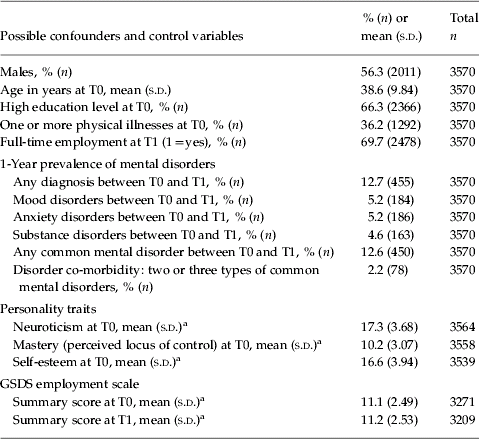
Table 1 characterizes the study sample. About 13% suffered one or more mental disorders in the period studied (all CIDI diagnoses included). In comparison with the 1-year prevalence rate of 21% of any disorder amongst employed respondents in the sample at baseline (T0) (Bijl et al. Reference Bijl, Ravelli and van Zessen1998a), mental disorders were clearly less prevalent in the sample studied here. Mood, anxiety and substance disorders were about equally frequent (in 5.2, 5.2 and 4.6% of respondents) and in total 12.6% had one or more of these three disorders. The mean scores on the three personality traits neuroticism, mastery and self-esteem in the present sample (17.3, 10.2 and 16.6 respectively) were virtually the same as those for all employed respondents at T0, with no significant differences.
Sample characteristics: potential confounders or control variables and determinants

s.d., Standard deviation; T0, baseline (first wave); T1, follow-up (second wave); GSDS, Groningen Social Disability Schedule.
a Higher scores indicate higher neuroticism, more external locus of control, lower self-esteem and higher impaired work functioning.
Employment scale
Within the employees sampled at T1, 3285 out of 3570 employees (92.0%) had been at work and filled in the subsequent items of the scale; 217 of 3570 employees (6.1%) were excluded because they had not been at work for 4 weeks or longer, leaving 68 missing cases (1.9%). Logistic regression analysis showed that employees who had a mood disorder or had co-morbid mental disorders (two or three common mental disorders) within the 11 months before measuring work functioning at follow-up (T1) were significantly more often excluded at T1 because of work absence than those with respectively no mood disorders or no co-morbid mental disorders [exp (B)=2.5, p=0.003 for mood; exp (B)=6.1, p=0.000 for co-morbid disorders; reference group no mental disorders]. Each of the other mental disorders was not significantly related to T1 work absence, and neither were the baseline personality traits.
Table 1 shows that the GSDS summary scores for impairments in work functioning in subjects who were working at both T0 and T1 are the same, 11.1 and 11.2 respectively (a table containing item scores is available).
Mental disorders and subsequently impaired work functioning (research question 1)
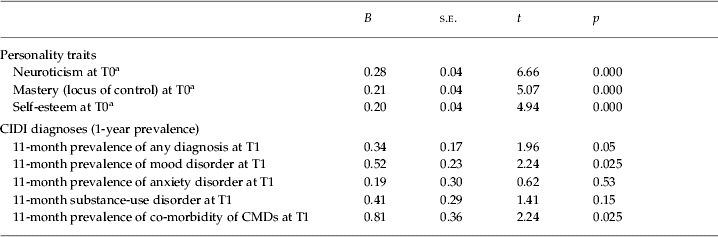
At follow-up, all three personality characteristics as well as three out of five mental disorder measures showed significant separate (bivariate) associations with work functioning (Table 2). Anxiety and substance-use disorder were not associated with work functioning at follow-up.
Bivariate (crude) relationships between determinants and subsequent impairment in work functioning

s.e., Standard error; T0, baseline (first wave); CIDI, Composite International Diagnostic Interview; T1, follow-up (second wave); CMD, common mental disorder.
a Scores on the personality traits were standardized. Higher scores indicate higher neuroticism, more external locus of control and lower self-esteem.
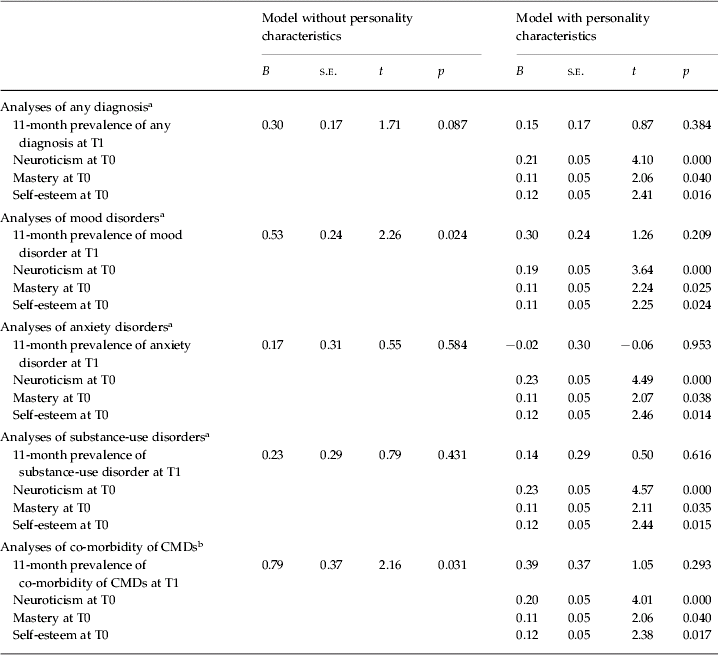
Table 3 (model without personality characteristics) shows that, according to multiple linear regression analysis, mood disorders and co-morbidity of disorders were significantly linked to subsequent impairment in work functioning when gender, age, education, physical illnesses and working week (full-time versus part-time) were held constant. Subjects suffering from any mental disorder within the follow-up period only tended to report poorer work functioning at follow-up than subjects with no disorder. Employees diagnosed with anxiety or substance-use disorders were not functioning significantly worse than other subjects at follow-up.
Mental disorders and psychological vulnerability characteristics as determinants of subsequent impairment in work functioning

s.e., Standard error; T1, follow-up (second wave); T0, baseline (first wave); CMD, common mental disorder.
a n=2960. Five separate multiple linear regression analyses based on each disorder grouping and incorporating the three personality traits as determinants (using standardized scores), controlled for gender, age, education and physical illnesses at baseline (T0), length of working week at follow-up (T1), and score on impaired work functioning at baseline (T0). Adjusted r 2 for all models=0.30 (rounded).
b Disorder co-morbidity was measured with a dummy variable (value 1=two or three types of CMDs, reference group: no CMD). Here we also controlled for having one type of CMD.
Mental disorders, personality traits and work functioning (research questions 2 and 3)
Higher neuroticism scores, more external locus of control and lower self-esteem scores at baseline were significantly associated with stronger impairment in work functioning 1 year later, irrespective of 11-month prevalence of (co-morbidity of) common mental disorders (Table 3, model with personal characteristics). Each of these traits contributed uniquely to the explained variance in work impairments at follow-up. The connection between neuroticism and subsequent impairment was twice as strong as those for mastery and self-esteem.
The relationship between the mental disorders and subsequent impairment of work functioning weakened once the influence of the personality characteristics was brought into the analysis. To illustrate, the B coefficient found for mood disorders decreased from 0.53 to 0.30 (Table 3); in other words, the ‘weight’ of mood disorders in explaining impaired work functioning was reduced by about half.
Findings of a series of sensitivity analyses were very similar to those described here: major depression substituted for mood disorders; mood disorders excluding bipolar disorders which are regarded as severe mental illnesses rather than a common mental disorder; separate analyses with the most frequently prevailing anxiety disorders, i.e. simple phobia, social phobia and panic disorder; substituting alcohol-use disorder for substance-use disorders. Substituting dichotomized scores for the continuous scores on the personality traits yielded very similar results as described here. Again the relationship between disorders and work impairments weakened (the average decrease of B coefficients was 35%).
Interaction between mental disorders and personality traits (research question 4)
An additional series of multiple regression analyses, structured identically to the previous ones, yielded no additive effects of interactions between the mental disorders and the personality traits. This implies that high levels of neuroticism, an external locus of control, or low self-esteem in employees who also have developed a mental disorder do not ‘result’ in stronger work impairments ‘additional’ to the independent influence of the personality traits. Sensitivity analyses with alternative computations of the interaction terms did not yield substantially different results.
Discussion
This study shows a significant link between personality characteristics related to ‘vulnerability’ or ‘negative self-concept’ characteristics – high neuroticism, perceived external locus of control and low self-esteem – and subsequent impairments in work functioning, independent of any effects that mental disorders might have. The connection between neuroticism and later impaired work functioning was especially strong, about twice as strong as the associations between work functioning and self-esteem and locus of control. Although mood disorders and co-morbidity of two or three common mental disorders were weakly but significantly associated with later impairment in work functioning, these associations were no longer significant once the ‘influence’ of those personality traits was taken into account. We also found no evidence that the personality traits had any moderating influence on the relationship between mental disorders and impaired work functioning. This implies that high levels of neuroticism, an external locus of control, or low self-esteem in employees who also have developed a mental disorder do not ‘result’ in stronger work impairments ‘additional’ to the independent influence of the personality traits. Our study lends further support for developing vocational rehabilitation interventions for (ex-) employees with mental health problems that focus on strengthening psychological resources such as mastery, self-esteem and individual coping styles (see also van der Klink et al. Reference van der Klink, Blonk, Schene and van Dijk2000; Schene et al. Reference Schene, Koeter, Kikkert, Swinkels and McCrone2007).
It is interesting that we were unable to detect an independent influence of mental disorders on subsequent work functioning, after taking personality traits into account. Several other longitudinal large-scale studies have reported that mental disorders, especially depressive disorders, do adversely affect work functioning (Broadhead et al. Reference Broadhead, Blazer, George and Tse1990; Kouzis & Eaton, Reference Kouzis and Eaton1997; Laitinen-Krispijn & Bijl, Reference Laitinen-Krispijn and Bijl2000; Druss et al. Reference Druss, Schlesinger and Allen2001).
In itself it is not surprising that the relatively stable traits are stronger related to subsequent work functioning than the relatively temporal or fluctuating disorders, which by nature are not chronic in many people. A more intriguing and essential issue here is whether the personality traits we involved here and the mental disorders are to be viewed as separate constructs, as it is well known that particularly those who are more strongly ‘prone’ to neuroticism and who have less self-confidence run a greater risk of developing mental disorders (de Graaf et al. Reference de Graaf, Bijl, Ravelli, Smit and Vollebergh2002; Kendler et al. Reference Kendler, Kuhn and Prescott2004; Neeleman et al. Reference Neeleman, Bijl and Ormel2004; Ormel et al. Reference Ormel, Oldehinkel, Nolen and Vollebergh2004b).
One explanation for the findings here could be that the traits included are merely measures of mental illness (severity), in line with the ‘subclinical’ or ‘spectrum’ model of the relationship between personality traits and mental disorders (Klein et al. Reference Klein, Wonderlich, Shea, Klein, Kupfer and Shea1993). However, the very findings of this study suggest that such an interpretation would need more evidence. First, all three measured traits are independently related to later impaired functioning, while within the spectrum model measuring neuroticism alone would seem to be sufficient. Second, we controlled for the influence of mental disorders in the year prior to the measurement of the traits. This indicates that the chance that the personality trait effects do result from pre-existing mental illness (e.g. scar effects) is low. However we cannot exclude that these traits are scars from mental illness respondents were suffering from more than a year before our T0 assessment.
Moreover, literature thus far substantiates that there is no ‘one-model explanation’ for the relationship between traits as studied here and the mental disorders. Klein et al. (Reference Klein, Wonderlich, Shea, Klein, Kupfer and Shea1993)have distinguished as many as five different alternative models besides the spectrum model to explain this relationship as far as depression is concerned. Amongst these are the ‘predisposition’ or vulnerability model (factors such as neuroticism and self-esteem are risk factors for the development of mental disorders; see also Kahn et al. Reference Kahn, Jacobson, Gardner, Prescott and Kendler2005), ‘pathoplasty’ or ‘exacerbation’ models (the presence of one condition influences course or outcome of the other) and ‘complication’ or ‘scar’ models (residual effects associated with one condition, which has remitted, influence the course of the other) (Klein et al. Reference Klein, Wonderlich, Shea, Klein, Kupfer and Shea1993; Ormel et al. Reference Ormel, Oldehinkel and Vollebergh2004b, Reference Ormel, Rosmalen and Farmerc). Still others view the traits measured here both as risk factors as well as sources for coping with disorders, e.g. self-management strategies, being part of psychological competencies varying relatively independent from the course of any disorder (Anthony & Liberman, Reference Anthony and Liberman1986; see also van der Klink et al. Reference van der Klink, Blonk, Schene and van Dijk2000; Judge et al. Reference Judge, van Vianen and de Pater2004; ten Have et al. Reference ten Have, Oldehinkel, Vollebergh and Ormel2005). However, none of these models and views can yet be ruled out, neither based on existing empirical evidence (Klein et al. Reference Klein, Wonderlich, Shea, Klein, Kupfer and Shea1993; Ormel et al. Reference Ormel, Oldehinkel and Vollebergh2004b, Reference Ormel, Rosmalen and Farmerc), nor because of the findings reported here.
Limitations and strengths
Various limitations of the present study warrant attention. One of these is the lack of a measure of mental disorder severity, which makes it impossible to fully adjust for this severity. Another problem might be that we confined our study to people's functioning in the workplace itself, whereas other studies have also used absenteeism as an outcome measure. Including absenteeism would not necessarily have undermined our findings, though, as several studies have found that mental disorders had a stronger negative effect on subsequent work functioning (e.g. in terms of more work cutback days) than on absenteeism (e.g. work loss days) (Broadhead et al. Reference Broadhead, Blazer, George and Tse1990; Druss et al. Reference Druss, Schlesinger and Allen2001).
Our study design could have also contained a source of bias, as we studied only subjects who were employed at the time of both assessments and who were also present at work in at least part of the month preceding the second assessment. This caused us to miss an unknown number of people who were unemployed or on extended sick leave at the second assessment due to illness or problems at work. As a consequence our results are probably an underestimation of the ‘true relationship’ between the traits and work functioning.
An additional methodological limitation is that both the personality traits and the work functioning were assessed using self-report instruments. Although the data were gathered prospectively at different points in time, one cannot rule out that subjects scoring more unfavourably on the personality traits might rate their work functioning more negatively than other subjects, irrespective of their actual performance.
This study nonetheless has its strong points, such as its prospective nature, its focus on well-defined DSM diagnoses to assess common mental disorders, and the representative nature of the sample, which enhances the validity of the findings. Further research is warranted to gain deeper insights into how personality factors and mental disorders may affect work functioning. This would include a longer duration of follow-up and more encompassing assessments of the personality traits, work functioning (e.g. both work impairment measures and absenteeism), and consideration of the severity of mental disorders.
Acknowledgements
This study was funded by the Trimbos Institute and the Altrecht Institute for Mental Health Care. We would like to express special thanks to Jos Twisk (VU University Medical Center, EMGO Institute), who commented on an earlier version.
Declaration of Interest
None.