INTRODUCTION
Worries about the assimilation of the Mexican-originFootnote 3 population have long attracted attention from academics and policymakers in the United States. These concerns came to a head during debates in 2006–2007 over legislation to overhaul the nation's immigration laws. Mexican immigrants, who make up roughly 30% of the foreign-born population and more than one-half of unauthorized immigrants, were the focal point of discussions in the halls of Congress, in the streets of U.S. cities, and on the airwaves. But this debate was only partly about who should be admitted to the United States and under what circumstances. Weighing equally heavy on the minds of many Americans was the question of assimilation: Will Mexican immigrants and their descendants assimilate into U.S. society, and, if they do, what kind of Americans will they become?
Political pundits and academics have sounded the alarm in response to these questions. At one extreme, some argue that the Mexican-origin population constitutes a separatist group, whose ethnic allegiances and inability to assimilate are tearing at the American national fabric (Buchanan Reference Buchanan2006; Huntington Reference Huntington2004b). Mexican immigration is tantamount to the importation of an underclass, which, because of its size, historical ties to the Southwest, and common language, fails to buy into the Anglo-Protestant values that putatively form the legal and cultural bedrock of American identity (Huntington Reference Huntington2004a). Conclusions about delayed assimilation among people of Mexican origin have been echoed in social science research. Much of the recent empirical and theoretical work on Mexican-origin assimilation argues that low levels of human capital, a postindustrial economy that rewards brains over brawn, and a hostile host society combine to drive Mexican-origin individuals (particularly the second generation) on a path of downward assimilation into a “rainbow underclass” (López and Stanton-Salazar, Reference López, Stanton-Salazar, Rumbaut and Portes2001; Portes and Rumbaut, Reference Portes and Rumbaut2001; Telles Reference Telles2006). Beyond the second generation, scholars note that prospects for later-generation Mexican Americans look no better, as educational attainment and wages seem to stall or even decline into the third generation (Bean et al., Reference Bean, Chapa, Berg, Sowards, Edmonston and Pasell1994; Huntington Reference Huntington2004a; Livingston and Kahn, Reference Livingston and Kahn2002; Wojtkiewicz and Donato, Reference Wojtkiewicz and Donato1995). Whether they believe that the blame lies with Mexican-origin individuals themselves, or that discrimination in U.S. society is the culprit, there is a consensus that something is amiss with this population's assimilation.
This paper aims to provide a corrective to the prevailing view by reconceptualizing how social scientists analyze the data that inform these discussions. We argue that current approaches to the study of Mexican-origin assimilation are unsuited to a group that is rather exceptional in comparison to any other in U.S. society. A more revealing analysis of Mexican-origin assimilation requires temporal and spatial reorientations. Where time is concerned, the continual replenishment of a Mexican-immigrant population for the last hundred years dramatically alters what generation—the conventional temporal gauge of assimilation—reveals about assimilation. The large and continuous presence of an immigrant population replenishes the group with a fresh “supply” of ethnic raw materials from the ethnic homeland and sharpens the boundaries that distinguish groups. Immigrant replenishment obscures popular perceptions of Mexican-origin assimilation, and sows confusion among researchers about whether or not the Mexican-origin population is “becoming American” at the same speed as are European-origin groups. While many Mexican Americans and European Americans are of the same generation, most have come of age during historical periods that have conferred dramatically different opportunities and constraints. Analytically, a more complete temporal picture of Mexican-origin assimilation requires that social scientists attend to both birth distance from the immigrant point of origin (i.e., generation) and the historical contingencies that condition opportunity for advancement for people born in the same period (i.e., birth cohort).
A better picture of Mexican-origin assimilation emerges when we expand the spatial field of analysis as well. Populations in the host society (normally non-Hispanic WhitesFootnote 4 and Blacks) are the most commonly used benchmarks of assimilation, but the Mexicans who have remained in Mexico are an equally revealing reference group. As Mexican immigrants and their descendants become similar to other Americans, they become dissimilar from the nonmigrant Mexicans who stay behind. This spatial reorientation moves beyond the analysis of variation within the host country to take account of how immigration produces dissimilation from those who remain in the ethnic homeland. The differences that develop between migrants and their descendants, on the one hand, and those who stay in Mexico, on the other, are often much greater than the small differences in the United States upon which scholars of assimilation focus their microscopes.
Reorienting how we view Mexican-origin assimilation provides a fuller understanding of assimilation, one which is more relevant to the factors that distinguish the Mexican-origin population from other groups in the United States. This reorientation may also ultimately quiet the alarm about Mexican-origin assimilation now sounding loudly in many corners of the academy and which has been echoed by pundits of different political hues.
THEORETICAL PERSPECTIVES
The conventional pessimism regarding the prospects of Mexican-origin assimilation follows from a set of theoretical perspectives originally developed to study race, ethnicity, and inequality among other populations. Existing approaches fully appreciate neither how the continual replenishment of an immigrant population shapes assimilation, nor the analytical restrictions flowing from a political philosophy that privileges the study of inequality within the boundaries of a national community. We outline five perspectives that explain the differences and similarities between immigrants and various reference populations, in addition to two alternative perspectives that guide our temporal and spatial reorientation.
Racialization
A first theoretical perspective holds that the Mexican-origin population is akin to a racialized minority group, similar to African Americans. Popularized in the 1960s and 1970s, this view emphasizes the historical experience of colonization that produced the involuntary origin of the first Mexicans in the United States. In this view, Mexican-origin individuals do not assimilate into U.S. society, but rather are an “internally colonized” group that suffers from persistent discrimination and exploitation at the hands of an Anglo majority (Acuña Reference Acuña1972; Barrera Reference Barrera1979; Blauner Reference Blauner1969; Gutiérrez Reference Gutiérrez2004). Blocked mobility is seen as a permanent feature of life, regardless of time spent in the United States, with temporal measures mattering very little. The empirical applications of this perspective appear not only in research that includes Hispanics or Mexicans alongside Whites and Blacks as independent variables in quantitative models, but also in ethnographic studies that emphasize disadvantage and discrimination as a constant (Menchaca Reference Menchaca1995; Ochoa Reference Ochoa2004). The assumption is that Mexicans, like Blacks and Whites, constitute a racial group whose members experience a similar set of life circumstances because of their racialized status.
Assimilation
Massive inflows of Mexican immigrants in the last twenty years have spurred a renewed social scientific interest in the experience of immigrants and their descendants. Researchers have resuscitated assimilation as an analytical concept, noting that the theory's core insights are still relevant (Alba and Nee, Reference Alba and Nee2003; Brubaker Reference Brubaker2001). Unlike the racialization perspective, newer theories of assimilation focus on factors that explain the fading of ethnic distinctions over time. From this perspective, variables associated with the immigrant experience—language, human and social capital, and legal status—shape the social, political, and economic position of people of Mexican origin. In the United States, there are three major versions of the assimilation perspective:
Classical Assimilation
In the classical accounts of “straight-line” (Glazer and Moynihan, Reference Glazer and Moynihan1964) or “bumpy-line” assimilation (Gans Reference Gans1992a), the question is whether immigrants and their offspring eventually become like native Whites, who are presumed to experience almost no restrictions to full participation in U.S. society based on their ethnic origins. It may take years to judge the final outcome, which will depend on the characteristics of the immigrant population and their treatment in the host country.
Intergenerational Assimilation
Most contemporary accounts in the assimilation literature focus on process, the intergenerational direction, and pace of change (Alba and Nee, Reference Alba and Nee2003; Bean and Stevens, Reference Bean and Stevens2003). Rather than focusing on an endpoint measured by the status of native Whites, this perspective emphasizes the position of each generation born in the United States relative to the previous generation of coethnics. Assimilation is assumed to be taking place if ethnic distinctions become less discernible across generations, even if the later generation has not reached parity with its White counterparts.
Segmented Assimilation
The segmented assimilation perspective is also concerned with generational processes, but is distinguished by its assertion that the target toward which immigrants assimilate is differentiated by race and class, and immigrants and their descendants may thus assimilate into different segments within U.S. society. Portes and Rumbaut (Reference Portes and Rumbaut2001) and Zhou (Reference Zhou1997) point out that immigrants can assimilate not only toward native Whites but also toward native minority groups, thus forming part of a “rainbow underclass” (López and Stanton-Salazar, Reference López, Stanton-Salazar, Rumbaut and Portes2001). Second-generation Mexican Americans are said to be the “ideal-type case” of segmented assimilation, since, more than other major group, they display negative outcomes in the second generation (Portes and Rumbaut, Reference Portes and Rumbaut2001).
Migrant Selectivity
The literature on migrant selectivity grows out of econometric studies of migrant decision making that quantifies how migrants differ from nonmigrants in the sending society. The assimilation literature in all of its variations is concerned with these processes because of the notion that there has been a decline in migrants' “quality”—a crude term which takes the notion of human-capital endowments all too literally. Borjas (Reference Borjas1999) argues that immigrant skill levels, as measured by the proxy of years of education, have declined over time, thus inhibiting assimilation. The gap between the median education of natives and the contemporary cohort of immigrants is higher than that between natives and previous cohorts. The reasons for this gap are twofold. First, post-1965 immigrants tend to come from poor countries in Latin America and Asia, and they arrive with lower levels of education relative to native-born Whites than did the European-origin immigrants who formerly dominated migration to the United States. Second, new countries of origin tend to have high levels of domestic inequality, such that skills earn a greater premium at home than they do in the United States. Thus, the skilled stay home while the unskilled seek work abroad. Feliciano (Reference Feliciano2005) directly challenges the latter thesis by showing that in major source countries of U.S. immigration, migrants have more education than do those who stay behind.
A TEMPORAL AND SPATIAL REORIENTATION
The preceding perspectives on racialization, assimilation, and selectivity provide views of assimilation from diverse angles, but significant blind spots remain with respect to the effects of time and space. We argue for greater attention to immigrant replenishment and the shifting boundary between migrants and nonmigrants in the sending country. Temporally, the nearly continuous replenishment of Mexican immigrants over the last hundred years suggests that generation, the conventional temporal gauge of assimilation, should be assessed in conjunction with birth cohort, which better captures the historical circumstances that shape assimilation. Spatially, looking beyond national boundaries shows how the process of assimilation necessarily entails the making of difference, or dissimilation, from those who remain in the sending society. The homeland dissimilation perspective reveals the dramatic advancement of the descendants of Mexican immigrants, which has been overlooked by orthodox accounts of assimilation.
A Temporal Reorientation
Beyond slowing assimilation, the continual replenishment of a Mexican-immigrant population over the last hundred years has sown confusion about Mexican-origin progress in U.S. society. The perpetual presence of a significant immigrant population means that there is continually a group of Mexican-origin individuals whose lack of English proficiency, high concentration in ethnic neighborhoods, low socioeconomic status, and lack of legal documentation make them highly visible to a host population that has never been welcoming to Mexican newcomers. The continuity of Mexican immigration also means that there is a later-generation Mexican American population whose assimilation is often hidden under the shadow of the large immigrant population.Footnote 5
Researchers have been slow to see this hidden assimilation because of the tendency to apply heuristics based on the experiences of Blacks and Whites, the United States' two archetypal racial groups. But, as others have pointed out (Bean and Stevens, Reference Bean and Stevens2003; Massey Reference Massey1993), since Mexicans fall into neither category, applying a Black-White framework to the study of Mexican assimilation bears less than ripe analytical fruit. Viewing the Mexican-origin population as a racialized group also excludes any consideration of temporal changes. While the first Mexican Americans were incorporated involuntarily into the United States, the overwhelming majority of the Mexican-origin population traces its American roots to immigration, not colonization. What's more, across generations there are significant signs of assimilation along an array of dimensions, including intermarriage (Macias Reference Macias2006; Perlmann and Waters, Reference Perlmann, Waters, Foner and Frederickson2004; Rosenfeld Reference Rosenfeld2002), educational attainment (Reed et al., Reference Reed, Hill, Jepsen and Johnson2005; Smith Reference Smith2003, Reference Smith2006), residential mobility (South et al., Reference South, Crowder and Chavez2005), and language (Alba Reference Alba2004; Rumbaut et al., Reference Rumbaut, Massey and Bean2006; Telles Reference Telles2006).
Assimilation approaches, as applied to the Mexican-origin population, are not without flaws, however. Taking into account generational change allows for a more fine-grained understanding of Mexican-origin assimilation, but some assumptions about the temporal aspects of assimilation do not make sense for a population that experiences ongoing immigrant replenishment. Contemporary understandings of assimilation, despite fresh thinking (Alba and Nee, Reference Alba and Nee2003; Portes and Rumbaut, Reference Portes and Rumbaut2001), still take as their touchstone the experiences of European-origin groups that came to the United States between roughly 1880 and 1920. While the assimilation of these groups is similar in some respects, differences between the duration of immigrant waves from Europe and Mexico call for a different temporal orientation. The virtual halt of European immigration created by restrictive laws in the 1920s, the Depression, and World War II meant that each generation born in the United States came of age in a society that was decreasingly characterized by immigration from the ethnic homeland. Since mass European immigration took place during a discrete period of time, each subsequent generation born in the United States experienced U.S. society as members of not only the same generation but also the same cohort. Each generation thus shared a common set of experiences related to their generational status and their birth cohort (Alba Reference Alba and Riley1988). In more concrete terms, the European-origin second generation simultaneously shared the turbulence and discord associated with being the children of immigrants along with the constraints and opportunities emanating from important historical events such as the Great Depression, World War II, and the economic prosperity of the 1950s. Likewise, the third generation negotiated U.S. society together as the grandchildren of immigrants, but also as baby boomers, flower children, and victims (or beneficiaries) of deindustrialization. In short, the relative hiatus in European immigration meant that, because of the high correlation between immigrant generation and birth cohort, using generation as the sole temporal measure of assimilation was generally adequate for understanding how those groups progressed.
The replenishment of Mexican immigrants calls for a temporal approach that considers how assimilation proceeds for a given generation within the same cohort. The exceptionally long duration of Mexican immigration (relative to earlier waves of European immigration) means that the correlation between immigrant generation and birth cohort is weak. Using only generation as a temporal marker of assimilation is thus not enough. Each generation of Mexican-origin individuals is made of people from a mix of birth cohorts, and each birth cohort contains individuals from many immigrant generations. The historical circumstances associated with the birth cohort from which they descend shape their assimilation in ways that are perhaps as important as their generational status. For example, the children of Mexican immigrants who escaped the Mexican revolution from 1910–1920 and the children of Mexican migrants who arrived in the 1980s are all “second generation,” but they have come of age in radically different historical periods. Life for the first group was shaped by the Great Depression, Jim Crow-like racism in many parts of the Southwest, and World War II; life for the second group has been defined by rising income inequality, deindustrialization, multiculturalism, and an increasingly global economy.Footnote 6
Immigrant replenishment also means that there are differences in the circumstances under which various waves of Mexican immigrants came to the United States, and the “quality” of their human capital varies over time. As Alba (Reference Alba2006, p. 290) points out, the problem with using generational comparisons alone is that different cohorts of Mexican immigrants have arrived with significantly different levels of education. Within Mexico, average educational attainment has been rising over the last century, and that rise is reflected in the growing number of years of education among Mexican immigrants in each successive cohort. Thus, Mexican Americans who descend from earlier waves of immigration trace their roots to a population that entered the United States with far fewer years of education than the population to whom Mexican Americans from more contemporary immigrant streams trace their roots. The old third generation may have less education than the new second generation has simply because the old third generation's grandparents started out with less education than did the new second generation's parents. Using generational comparisons that lump these populations together may create an illusion of second-generation stagnation or decline, when, in fact, the fortunes of each cohort's descendants are improving, relative to their predecessors.
Simultaneously capturing factors internal to the group that shape assimilation (measured by a generation) and the effect of circumstances external to a group (within a birth cohort) requires the use of both temporal measures. As we shall show later, employing both of these temporal gauges is important for understanding the empirical case of Mexican-origin educational attainment, as well as other dimensions of assimilation.
A Spatial Reorientation
The counterpart to assimilation, the process of groups or individuals becoming similar, is dissimilation, the process of becoming different. Like assimilation, dissimilation has numerous modalities. For Yinger (Reference Yinger1981), dissimilation is a strict reversal of an earlier process of assimilation. For example, he viewed the resurgence of Native American ethnic pride as a process of dissimilation from the larger U.S. society, which had previously been assimilating Native Americans. Yet an exclusive focus on differences within the United States belies a territorially constrained assumption about the field of interaction where assimilation and dissimilation unfold. The result is a truncated view of ethnic boundaries that occludes efforts to construct a nation-state society. Waldinger and Lichter (Reference Waldinger and Lichter2003) have forcefully argued that the study of the assimilation of immigrants in the United States ignores the ways that the same processes include the making of national difference between the United States and the rest of the world. As immigrants become similar to other Americans, they become dissimilar from foreigners. The importance of dissimilation can be appreciated further by extending the analysis to particular fields of interaction where migrants and nonmigrants in both sending and receiving countries engage one another.Footnote 7
Migration from the Global South to the North is driven by wage gaps and other differentials that make it possible for poor southerners to improve their life circumstances through migration. Such improvements can be measured not only over the life-spans of migrants but also in the growing differences between migrant families and those who remain in the home country. Why is the homeland dissimilation perspective usually ignored by migration studies concerned with uncovering differences that often turn out to be relatively minor, as in the debate over Mexican-immigrant selectivity? First, most scholars of international migration are based in the receiving countries of the Global North. Sociologists and anthropologists tend to be fundamentally sympathetic with immigrants, and half of U.S. immigration scholars are of immigrant stock themselves (Rumbaut Reference Rumbaut1999). Nonetheless, academic research on assimilation shares many of the unstated assumptions of states seeking to control populations (Favell Reference Favell, Aleinikoff and Klusmeyer2000). In crude terms, assimilation researchers and policymakers both ask, “What is to be done about the problem of foreigners in this country?”
Second, political orientations can create analytic blinders for the study of inequality and dissimilation. Philosophers since Plato have sought to minimize the intergenerational reproduction of inequality of opportunity, and states have used estate taxes and public education as policy tools to advance that goal. Historically, international migration has slightly increased inequality within receiving countries while significantly decreasing it between countries (Hatton and Williamson, Reference Hatton and Williamson2005). A liberal universalist goal of reducing inequality overall would perhaps best be served by allowing massive migration from poor to rich countries. But few of even the most committed liberals would really want to see each generation start its global scramble for resources afresh. In practice, the goal of equal resources for all would mean a dramatic decline in the fortunes of children in the Global North. One reason why this mechanism for reducing inequality receives so little sociological attention may lie in liberalism's classic problem with defining community membership. It is fundamentally illiberal to allow the ascriptive accident of country of birth to determine an individual's life chances so thoroughly.Footnote 8 On the other hand, defenders of exclusion at the borders of the liberal state argue that liberalism can only flourish in a particular cultural community with a shared sense of justice. By definition, community means that some are let in while others are kept out (Walzer Reference Walzer1983). The implication of this argument is that inequality is more normatively egregious in relations among members of the club than in relations between members and outsiders. The focus on internal inequality in the literature on assimilation suppresses hard moral questions about the proper boundaries of community. The answer is clearly not to ignore domestic inequalities within receiving and sending states—which migration may sometimes exacerbate on both sides—but, rather, to systematically link them to the international inequalities that drive migration. That project must highlight emigrants' spectacular upward mobility relative to those who stay behind.
EDUCATIONAL STRATIFICATION SEEN THROUGH HOMELAND DISSIMILATION AND REPLENISHMENT
Our temporal and spatial reorientation gains clarity by considering an empirical application. To illustrate, we turn to educational attainment for males measured in years of schooling. Education is one of the most important dimensions of assimilation and dissimilation because it captures the human capital necessary for full social, political, and economic participation in a society. Comparing levels of educational attainment between groups is also a broad gauge of the strength of ethnic boundaries. We look first at the homeland dissimilation perspective and then at replenishment.
Assimilation and dissimilation are inherently relational concepts that allow for multiple points of comparison. No single pairing is more valid, a priori, than another, but each pairing implies a choice that opens some analytical doors while closing others. The disparate conclusions that are reached about the pace and direction of boundary change can be illustrated by examining different perspectives on the educational attainment of Mexicans and Mexican Americans. Table 1 shows the average number of years of education for men (from 24 to 64 years of age) in eight populations from 1996 to 1998: Mexicans in Mexico; Mexican-origin individuals in the United States; first-, second-, and third-plus-generation Mexican Americans; native-born Whites; and third-plus-generation Whites and Blacks.
Mean Years of Education of Eight Groups of Males, Ages 24–64, 1996–1998

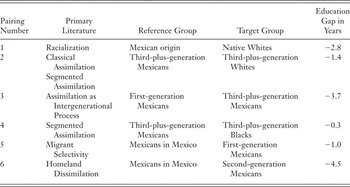
Table 2 shows the gaps in average education between these different comparison groups, gaps which are emphasized by the major perspectives on racialization, migrant assimilation, selectivity, and dissimilation. Viewing educational attainment through the lens of racialization (pairing #1) reveals a relatively bleak picture. Mexicans as a group obtain on average only 10.2 years of education, less than is required for a high school diploma, and 2.8 years short of parity with native Whites. But aggregation of all Mexicans into a single racial category glosses over important differences within the Mexican-origin population.Footnote 9 With an average of just over eight years of education, the 41% of the Mexican-origin population who are foreign-born bring down the mean for the entire group.
Comparative Education Gaps among Males, Ages 24–64, 1996–1998

Theories of assimilation suggest a somewhat brighter picture of Mexican-origin educational attainment. According to a model allowing three generations to determine the final outcome of assimilation (pairing #2), third-plus-generation Mexican Americans lag only 1.4 years behind their White counterparts. Given the low levels of education with which first-generation Mexican immigrants start, and what we know about the generational transmission of inequality (Fischer et al., Reference Fischer, Hout, Jankowski, Lucas, Swidler and Voss1996), such a gap is hardly surprising. Indeed, it would be analytically surprising—albeit normatively desirable—were there no gap at all.
The assimilation literature focused on intergenerational processes (pairing #3) sees an even more hopeful story in these figures. Later-generation Mexican Americans have 3.7 years more education than do their first-generation counterparts. This is evidence that, despite ongoing inequality, the life chances of the Mexican-origin population are generally improving from one generation to the next (Alba and Nee, Reference Alba and Nee2003; Smith Reference Smith2003, Reference Smith2006).
The segmented assimilation perspective reminds us that immigrants may assimilate into different segments of a society divided by race and class. Pairing #4 weakly supports the hypothesis that later-generation Mexican Americans are converging with third-plus-generation African Americans, since the gap between these groups is only 0.3 years of education. This perspective contrasts the experience of later-generation Mexican Americans with their White counterparts (pairing #2). Here, the gap of 1.4 years suggests that, true to the theory, later-generation Mexican Americans are closer to Blacks than to Whites in their average education. Yet a gap of only 1.4 years of education hardly seems alarming by itself, especially considering that third-plus-generation Mexican Americans have on average more than a high school degree, and given that the gap has been closing over the course of generations. Waldinger and Feliciano (Reference Waldinger and Feliciano2004) provide further evidence that the specter of a “rainbow underclass” experiencing “downward assimilation” may be overstated (cf. Gans Reference Gans1992b). Still, few would deny the broader analytic utility of more carefully specifying the target with respect to which a reference group becomes “similar.”
Pairing #5 illustrates how variation in educational attainment is interpreted from the migrant-selectivity perspective. These data support Feliciano's (Reference Feliciano2005) position that Mexican migrants are positively selected, but what is most striking about the single-year gap between the general Mexican population and Mexican migrants is how small it is. Small empirical differences are fought over because of the great political prize. If immigrants were negatively selected, however minor the difference, the conventional policy implication in receiving countries would be to restrict their entry, as governments presumably want to build up stocks of human capital and avoid welfare expenditures associated with the low skilled (Borjas Reference Borjas1999).
Educational Dissimilation
Finally, the data from the homeland dissimilation perspective (pairing #6) paint quite a different picture from that of the dominant academic and policy perspectives. Second-generation Mexican Americans average 4.5 years more education than do Mexicans in Mexico. Simply by virtue of having been born in the United States, they are dramatically better situated vis-à-vis their Mexican peers. Even a high school dropout in the United States would count as “highly educated” in Mexico, where only about one-fifth of adults have graduated from high school.Footnote 10 The remarkable improvement in the life chances of migrants' children is no secret, certainly not to the migrants who make tremendous sacrifices to achieve that gain, but it has been strangely ignored in most of the academic literature on migration. The homeland dissimilation perspective, which asks how the children of migrants are becoming different from their peers who stayed behind, reveals that international migration generates changes in levels of both intergenerational and international inequality.
Replenishment's Effects on Education
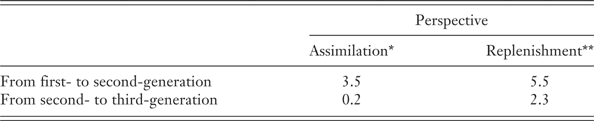
The replenishment perspective similarly represents a break from the way that social scientists have conventionally analyzed the data. Assimilation theories take seriously the notion of generational change, and only recently have social scientists begun to recognize the importance of cohort analysis that tracks assimilation in concert with generation (Alba Reference Alba2006; Alba et al., Reference Alba, Abdel-Hady, Islam, Marotz, Waters and Albaforthcoming; Duncan et al., Reference Duncan, Hotz, Trejo, Tienda and Mitchell2006; Perlmann Reference Perlmann2005; Smith Reference Smith2003, Reference Smith2006; Waters and Jiménez, Reference Waters and Jiménez2005). Table 3 shows the mean years of educational advancement for Mexican and Mexican American males obtained from applying the conventional measure of assimilation, i.e., generation, and when employing measures implied by the replenishment perspective, i.e., generation and cohort combined.
Mean Years of Educational Advancement for Mexican and Mexican American Males, by Theoretical Perspective
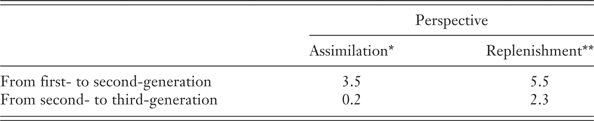
Controlling for generation in Mexican-origin educational attainment alone reveals advancement in each generation born in the United States. The second generation improves on this measure by an average of 3.5 years, but the third generation makes only modest advancement over the second, gaining just 0.2 years, suggesting that intergenerational assimilation may be stalled after the second generation.
The second column in Table 3 accounts for both generation and cohort to gauge progress in educational attainment. These figures are based on estimates that Alba et al. (Reference Alba, Abdel-Hady, Islam, Marotz, Waters and Albaforthcoming) calculate from the National Longitudinal Study of Youth (NLSY) of 1979, for cohorts born between 1957 and 1964. The NLSY data allow for direct comparison between individuals' educational attainment and that of their parents. Using these real cohort estimates shows that each new generation born in the United States dramatically improves on the educational attainment of the previous generation. The male offspring of immigrants advance an average of 5.5 years of schooling beyond their fathers, and educational advancement does not stall after the second generation. Rather, the third generation adds more than two years to their (second-generation) fathers' educational attainment. This analysis differs from the previous (which employs only generation), in that it does not lump together individuals who share the same generation, but who may belong to different cohorts, and who therefore lived through historical periods that may significantly shape their educational attainment. Instead, the replenishment approach reveals the weak correlation between generation and birth cohort created by immigrant replenishment, by examining the collective impact of birth distance from the immigrant generation and the historical period during which individuals have come of age.
These suggestive results from Alba's real cohort estimates are ideal for empirical applications of the replenishment approach, but they are by no means the only approach. Smith (Reference Smith2003, Reference Smith2006) employs an alternative strategy, using decennial census and Current Population Survey (CPS) data to construct synthetic cohorts. This strategy assumes that each generation covers roughly twenty-five years. Smith then compares each generation from a given birth cohort to the previous generation and cohort of individuals, who are likely to be the parents of the generation and cohort of interest. This approach also shows people of Mexican-origin to be making significant intergenerational (and intercohort) progress.
Analysis of educational attainment from the replenishment perspective provides strong evidence for assimilation when viewed as an intergenerational process, but provides less evidence if we understand assimilation as a final outcome after three generations. Mexicans Americans have not caught up with native Whites in their levels of educational attainment: even under the rosiest scenario, the deficit is 1.4 years. Two explanations have been put forth to explain this progress without parity (Alba Reference Alba2006). It may be that the most upwardly mobile people of Mexican origin “drop out” of the population over time. Duncan and Trejo (Reference Duncan and Trejo2005) show that attrition from the Mexican American population in survey data is positively associated with education and income. The fact that, as they move up the socioeconomic ladder, some people of Mexican origin cease to identify themselves as “Mexican” on surveys may downwardly bias estimates of the entire population's progress (also see Alba and Islam, Reference Alba and Islamforthcoming). Others have suggested that differences in assimilation between the Mexican-origin population and other groups have more to do with time than with direction. Given that nearly all people of Mexican origin start their assimilation journey in the United States with very low levels of education, and most without legal documentation to boot, it may take more than the usual three generations for Mexican Americans to reach assimilatory parity with other ethnic groups (Bean and Stevens, Reference Bean and Stevens2003; Perlmann Reference Perlmann2005; also see Reed et al., Reference Reed, Hill, Jepsen and Johnson2005).
REPLENISHMENT AND DISSIMILATION: OTHER APPLICATIONS
The analytical reach of the replenishment and homeland dissimilation perspectives extends beyond the study of educational attainment to include self-identification, marriage patterns, and gender roles as well.
If assimilation is “the decline of an ethnic distinction and its corollary cultural and social differences” (Alba and Nee, Reference Alba and Nee2003, p. 11), then the replenishment of Mexican immigrants maintains the vitality of Mexican culture and the social boundaries that animate ethnic distinctions. The replenishment perspective suggests that individuals do not, as the analysis of survey data alone would seem to imply, step on an “assimilation escalator” and climb into the U.S. mainstream on discrete steps ahead of individuals who arrived after them. Instead, assimilation is much more like a wide staircase in which individuals have ample opportunity to interact with others positioned in front of, next to, and behind them. Since immigration has been continuous, people of Mexican origin from different generations and cohorts share a common assimilation staircase. The presence of a large immigrant population means that even later-generation individuals have abundant access to the ethnic raw materials—language, customs, cuisine, etc.—necessary for the practice of ethnicity. Far from fading into the twilight of ethnicity, Mexican culture in the United States thrives on the continual influx of Mexican immigration, which infuses ethnicity into daily life in the form of interpersonal interaction, media, cuisine, and the culturally relevant practices that firms employ to attract spending from the “Hispanic” market (Dávila Reference Dávila2001; also see Macias Reference Macias2006). This infusion makes ethnicity a vibrant and accessible part of life for people of Mexican origin. Mexican-immigrant replenishment also makes more salient the ethnic boundaries that circumscribe groups. The replenishment perspective suggests that the persistence of these boundaries is rooted in a nativist backlash against Mexican immigrants. When there is a continual supply of poor, non-English-speaking, and often unauthorized immigrants, there is a correlative nativist backlash visited most directly upon immigrants, but which also affects the native-born. “Mexicanness” and “foreignness” become intimately linked in the public imagination, despite the long history of Mexican settlement in the United States (Ochoa Reference Ochoa2004; Jiménez Reference Jiménez2008). The coupling of these identities has made nativism a permanent feature of the Mexican-origin experience in the United States.
The utility of the replenishment approach is also apparent in the formation of ethnic identity. In addition to generational status, the historical period during which individuals come of age profoundly affects ethnic identity formation. For example, second-generation Mexican Americans who are the children of the earliest Mexican immigrants came of age during a time when Americanization—“a consciously articulated movement to strip the immigrant of his native culture and attachments and to make him over into an American along Anglo-Saxon lines” (Gordon Reference Gordon1964, p. 99)—was the guiding ideology related to ethnic identity. Policies and practices were informed by Americanization and communicated to the Mexican Americans who lived through its reign that success in U.S. society meant shedding any remnants of their ethnic roots (Ochoa Reference Ochoa2004, Chapter 4). Today's second generation, on the other hand, is coming of age in a period of multiculturalism, which champions ethnic difference and diversity, however superficially, as values in a democratic society. These historical shifts in the acceptability of ethnic difference have shaped ethnic identity formation differently for the contemporary second generation as compared to the second generation from an earlier era.
Immigrant replenishment also alters the social structure that shapes assimilation's preeminent yardstick: intermarriage. Since intermarriage rates are a function of the availability of particular partners in a given “marriage market,” and not just a matter of preference (Blau Reference Blau1977), immigrant replenishment continually restocks the pool of potential Mexican-descent marriage partners. While interethnic marriage produces the thinning salience of ethnic identity, intergenerational, intraethnic marriage may have the opposite effect. Later-generation Mexican Americans have access to immigrant- and second-generation marriage partners, making ethnicity more salient for those most generationally distant from their own immigrant roots (Duncan and Trejo, Reference Duncan and Trejo2005; Macias Reference Macias2006; Qian and Lichter, Reference Qian and Lichter2007).
The utility of the homeland dissimilation lens is also illustrated in other domains of ethnic difference. One puzzle is that, while immigrants' adoption of urban and gang-inflected youth culture in the United States is identified by the classical assimilation literature as a failure of assimilation (Gans Reference Gans1992b), the same is viewed in Mexico as evidence of Americanization! When 1.5- or second-generation young men return to their rural sending communities in Mexico to visit, they often stand apart from their peers who never left. Their tattoos, body piercings, baggy pants, shaved heads, and fondness for gothic letters telegraph their transformative U.S. experience (Smith Reference Smith2005; Fitzgerald Reference Fitzgeraldforthcoming). Nonmigrants commonly claim that migrants “No son de aquí ni de allá [are neither from here nor from there]”. In other words, migrants have dissimilated from the Mexican mainstream, but they do not belong in the U.S. mainstream either. The segmented assimilation literature observes that migrants may adopt norms of segments of U.S. society that most analysts do not consider to be mainstream. Together, the segmented assimilation and homeland dissimilation perspectives capture an important slice of migrant reality that is missed by adopting the perspective of only the sending or only the receiving country.
The homeland dissimilation perspective also sheds light on one of the fundamental questions in the literature on gender and migration: Do migrant women gain more power in their relationships with men through the process of migration and settlement? Most researchers have found that immigrant women become more empowered, in part because of their assimilation into U.S. norms of relatively greater expectations of gender equality (Grasmuck and Pessar, Reference Grasmuck and Pessar1991; Grimes Reference Grimes1998; Hondagneu-Sotelo Reference Hondagneu-Sotelo1994; Kibria Reference Kibria1993). Jennifer Hirsch (Reference Hirsch2003) reports this sort of empowerment of women who migrate from Mexico to the United States, but she warns that women are gaining a greater say in household decision making and are entering companionate marriages throughout Mexico. What appears to be assimilation in the United States may in fact, simply be a continuation of a secular process already happening in Mexico, one which is driven by broader economic and cultural transformations. Sending communities are not stagnant ponds. The homeland dissimilation perspective brings the sending community out of tradition and into dynamic history. By measuring the extent to which migrant women are actually dissimilating from the shifting norm in their communities in Mexico, researchers would be in a better position to establish whether they are assimilating in the United States. Greater attention to temporal change on both the sending and the receiving ends of the migration stream helps to avoid a misleading, modernist narrative according to which the assimilation of global southerners into the developed North drives all social change.
CONCLUSION
The making and unmaking of group difference cries out for explanation, and nowhere in the contemporary narrative of U.S. immigration is this more urgent than in the explanation of Mexican assimilation. We have argued that, in order to fully appreciate the direction and pace of that change, it is necessary to attend to the shifting historical circumstances under which successive generations of foreigners arrive in the United States, and how their assimilation into the host country makes them appear as foreigners from the perspectives of those who stayed in the country of origin. Operationally, this means disaggregating immigrant generation from the effects of belonging to a particular birth cohort, and comparing the experiences of migrants with those who never leave home.
When applied to Mexican educational attainment, these analytic perspectives suggest that fears about the assimilation of the Mexican-origin population are exaggerated. The children of Mexican immigrants do better than their parents, and the grandchildren do better still. The children of Mexican migrants are even better off when compared to their peers back in Mexico. When analysts venture outside the national box, they see a story of dramatic intergenerational mobility. None of the foregoing negates the social significance of continued ethnic stratification in areas such as education, or the policy value of efforts to create greater equality of opportunity within the United States by addressing differential high school completion rates and university enrollments. Rather, we have tried to sketch analytic perspectives that provide more sociologically grounded ways of measuring the attainment of different populations and offer explanations for those differences.
The homeland dissimilation perspective could be usefully applied to any immigrant population. Migrants change as they confront new systems, and the advantages to be gained by entering another system drive migration. The relevance of replenishment is more contextually variable, because not all migrations continue indefinitely. In the U.S. context, the almost uninterrupted centenarian migration of Mexicans is anomalous, yet other migrations which experienced long hiatuses at midcentury and have been recently reinvigorated suggest a similar dynamic. Though Japanese immigration ended in the early part of the previous century, large waves of immigrants from Asia contribute to the way in which later-generation Japanese Americans are racialized as Asians (Tuan Reference Tuan1998). Polish immigration to particular U.S. destinations, including Chicago, took place during three different periods in the twentieth century, contributing to a formation of ethnic politics in Chicago's Polonia that fractured along generational lines (Erdmans Reference Erdmans1998).
Replenishment and homeland dissimilation are closely related. From the U.S. perspective, ongoing Mexican migration is a source of difference that replenishes Mexican ethnicity in two senses. First, it raises ethnic boundaries by contributing to a folk sense that Mexicans are foreigners, and it injects more ethnic “stuff” into the U.S. milieu. Second, from a Mexican perspective, ongoing migration to the United States is a source of difference within the sending community, for migrants do not only leave. They also return, at least occasionally, with foreign ideas, resources, and customs. These influences, along with commercial and media flows, change the sending communities in part through increasing the difference between migrants and nonmigrants. The dramatic upward mobility that migrants and their children achieve is on public display as they telegraph their material success to show that they “made it” in the United States. Such displays raise consumptive expectations in the sending community, which in turn prompts even more Mexicans to migrate, thus increasing the supply of newly arrived Mexicans in the United States (Massey et al., Reference Massey, Arango, Hugo, Kouaouci, Pellegrino and Taylor1998). Replenishment and homeland dissimilation feed off one another, and their importance in generating further migration is a function of the level of circularity in the migration flow. Patterns of assimilation are thus intimately tied to the broader fabric of the migration experience. Following these threads through space and time, as we have suggested here, reveals the dynamics of ethnic difference, the progress made thus far in reducing inequality, and the challenges that lie ahead.