


Introduction
Schizophrenia is a chronic disorder causing major deterioration in an individual's ability to attain employment, independent living and adequate social relationships. Social cognition has been shown to be an important predictor of social functioning (Fett et al., Reference Fett, Viechtbauer, Dominguez, Penn, van Os and Krabbendam2011). The most recognized domains of social cognition are emotion perception, Theory of Mind (ToM) and attributional style, and patients with schizophrenia have been shown to have abnormalities in these domains (Penn, Sanna and Roberts, Reference Penn, Sanna and Roberts2008). Training people with schizophrenia in these social cognitive skills may be a feasible way to improve their social functioning.
Social Cognition and Interaction Training (SCIT) is a manualized group treatment that targets social cognitive deficits and biases in schizophrenia (Roberts and Penn, Reference Roberts and Penn2009). SCIT has shown positive effects on these domains and also social functioning in several studies mainly from the USA (Combs, Adams et al., Reference Combs, Adams, Penn, Roberts, Tiegreen and Stem2007; Roberts and Penn, Reference Roberts and Penn2009), but also, for example, from China (Wang et al., Reference Wang, Roberts, Xu, Cao, Yan and Jiang2013). More studies on feasibility and acceptability of SCIT in different cultural contexts are still needed.
The objective of this study was to evaluate the feasibility and acceptability of a Finnish translation of SCIT with Finnish patients. Second, we collected social cognitive outcome data as a preliminary assessment of the potential efficacy of SCIT in this population.
Method
Participants
Participants comprised both in- and outpatients from Aurora Hospital, Helsinki, Finland, whose chart diagnosis was psychotic disorder. Inpatients were from rehabilitation wards, outpatients were mainly from a supported housing program, and all were in stable condition. SCIT was offered as a regular clinical group, and more patients expressed interest than could be accommodated. Social cognition measures were administered to interested patients and a subset of 40 were selected for SCIT participation based on poor test performance or clear social dysfunction as evaluated by clinician observation. These 40 patients were offered research participation and 33 consented to participate in the current study. During the study intervention period, some patients proceeded from rehabilitation wards to supported housing or back home.
Procedures
All participants were fully explained the procedures of the study. The study was accepted by the Ethical boards of Helsinki University Central Hospital and City of Helsinki Health Services. The authors assert that all procedures contributing to this work comply with the ethical standards of the relevant national and institutional committees on human experimentation and with the Helsinki Declaration of 1975, as revised in 2008.
All the study patients received the SCIT intervention in addition to standard care. SCIT groups were delivered for 5–6 patients at a time by a pair of clinicians who were trained to use SCIT by the developers of the intervention. Group leaders were psychologists and occupational therapists. Groups were provided once or twice per week for 22–24 sessions. Participants completed measures of social cognition both before and after SCIT intervention. Measures were administered by clinical psychologists some of whom also provided the SCIT groups.
The SCIT intervention
The SCIT manual was translated to Finnish by clinical psychologists and psychiatrists, and the audio-visual material was reproduced in Finnish by local theatre school students. Minor modifications were made to the manual and stimuli for language and cultural appropriateness.
All patients had practice partners, mostly clinical nurses, who helped them to practise SCIT skills between group sessions. The main focus of each SCIT session was explained briefly via e-mail to practice partners and the practice partners’ main role was to ask the patient about the group and provide help with homework if the patient wanted.
Measures
After the SCIT intervention, written anonymous feedback was collected with a questionnaire. Items included statements such as “The SCIT exercises and homework were clear and understandable”; “The SCIT group was useful to me”; “The SCIT group helped me to better understand social situations” and “The SCIT group helped me to better understand other people”. Participants rated each item on a scale from 1 (completely disagree) to 4 (completely agree). The questionnaire also included a section for informal written feedback. The anonymous feedback was collected from all patients who attended SCIT groups and therefore because of practical reasons we could not separate the feedback that was from the study patients who gave written consent.
Full description of efficacy measures can be found in the online extended report of this article. Emotion perception was measured with the Facial Emotion Identification Task (FEIT), ToM with the Hinting Task, and Attributional bias with the Ambiguous Intentions Hostility Questionnaire-Ambiguous items (AIHQ-A). In addition, we used the Social Cognition Screening Questionnaire (SCSQ) as a broad-based measure of social cognitive accuracy (including subscales for ToM, schematic inference and verbal memory) and social cognitive bias (including attributional bias and metacognitive overconfidence [the tendency to overvalue the accuracy of one's judgments, as occurs in Jumping to Conclusions]). All the measures were translated into Finnish and back-translated. Changes in total scores for the FEIT, Hinting Task, the three subscales of AIHQ-A and the SCSQ were analysed separately using paired samples t-test in IBM SPSS Statistics version 21. After the SCIT intervention and the post measurements we also arranged individual interviews, where the patient, practice partner and the group leaders discussed the patients’ and practice partners’ individual impressions of the group.
Results
Of the 33 participants, two had their data excluded due to a sudden and dramatic deterioration in their clinical condition. The deterioration was clinically concluded as not being related to SCIT and these patients did not considerably differ from the rest of the study population. Eighteen of the final participants were males and there were 13 females; all were native Finnish and the age range was 18–56 years (mean 31 years). Seven participants had the clinical diagnosis of ICD-10 F29 Unspecified nonorganic psychosis, seventeen had F20.3 Undifferentiated schizophrenia, six had F20.0 Paranoid schizophrenia and one had F25.1 Schizoaffective disorder, depressive type. At the start of the study participation approximately 2/3 of the participants were inpatients at rehabilitation wards and 1/3 were outpatients. Of the outpatients all except one were from supported housing.
The mean attendance rate in the study population was 94.76% (SD = 5.36; range 82.6% - 100%). Regarding attrition, no participants dropped out of the SCIT group. Fifteen patients returned the anonymous feedback form. Typical comments in the written feedback section include the following: “Thanks for a great group!”; “The content of the SCIT-group was versatile and good. Getting homework to do was a good thing. The facilitators knew how to explain the things in an understandable manner.” and “SCIT-group was a nice place to study different social situations.” On structured feedback items, participants indicated that they found SCIT exercises and homework to be clear and understandable (mean = 3.33), that the SCIT group was useful to them (mean = 3.13) and that the SCIT group helped them to better understand social situations (mean = 3.13) and other people (mean = 3.2). In the individual interviews after the intervention many participants requested an ongoing group to continue working on social cognition skills and also practice partners gave positive feedback about SCIT.
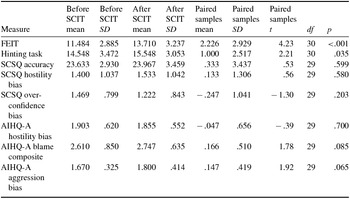
Results of paired-samples t-tests of outcome measures are displayed in Table 1. Analyses showed a statistically significant pre to posttest improvement on the FEIT and the Hinting Task. For the AIHQ-A, change in the Hostility Bias scale was not significant, the Blame Composite score approached significance with an increase following SCIT, and the Aggression Bias score also showed a trend towards increased scores. SCSQ results were not significant for the accuracy or bias scales.
Paired samples t-tests of social cognition measures before and after SCIT

Notes: Possible scores in FEIT range from 0 to 19 with higher scores indicating better functioning.
Possible scores in Hinting Task range from 0 to 20 with higher scores indicating better functioning.
Possible scores in SCSQ accuracy scale range from 0 to 30 with higher scores indicating better functioning.
Possible scores in SCSQ hostility bias scale range from 0 to 5 with higher scores indicating lower functioning.
Possible scores in SCSQ overconfidence bias scale range from 0 to 3 with higher scores indicating lower functioning.
Possible scores in AIHQ-A hostility bias and aggression bias subscales range from 1 to 5 with higher scores indicating lower functioning.
Possible scores in AIHQ-A blame composite range from 1 to 5.33 with higher scores indicating lower functioning.
Two of the 31 participants had missing data, one in SCSQ and the other in AIHQ-A, and had to be excluded from these two segments of analysis respectively.
Discussion
Our results support the feasibility of our translated SCIT intervention and its acceptability to patients. Based on the high interest in participating in SCIT and the high group attendance rate in participants, the motivation to work with social cognitive problems was quite high in our patient population. The patients’ and practice partners’ experiences with SCIT seemed to be very positive according to anonymous written feedback and individual interviews after the intervention. Based on patient requests, six of the study patients who were still at the rehabilitation wards or supported housing in spring 2013 participated in a SCIT continuation group consisting of 13 sessions (75 minutes/session).
This uncontrolled study also provided initial evidence that SCIT may improve emotion perception and Theory of Mind. These results are consistent with previous research (Combs, Adams et al., Reference Combs, Adams, Penn, Roberts, Tiegreen and Stem2007; Wang et al., Reference Wang, Roberts, Xu, Cao, Yan and Jiang2013). Regarding hostile attributional bias, the results were interesting. In previous research some studies have found significant improvements in attributional biases (Combs, Adams et al., Reference Combs, Adams, Penn, Roberts, Tiegreen and Stem2007), but some have not (Roberts and Penn, Reference Roberts and Penn2009). We found that the AIHQ-A Blame composite and the Aggression bias increased at a statistical trend level, although the aim of SCIT is to decrease the tendency to blame others and act aggressively. It is notable that the average scores in these bias scales were quite low in our participants both before and after SCIT (Combs, Penn, Wicher and Waldheter, Reference Combs, Penn, Wicher and Waldheter2007). This apparent floor effect may be due to participants “faking good” in order to appear non-aggressive or non-paranoid (Roberts and Penn, Reference Roberts and Penn2009). It could also indicate actual low levels of bias in this sample, which would be consistent with the finding that hostility bias is only present in a subset of schizophrenia patients. On the SCSQ, analyses showed null results across broad-based social cognitive accuracy, hostility bias, and overconfidence bias. As the SCSQ is a new measure with uncertain psychometric properties, it is unclear whether this result is due to the limitations of the measure or to real null effects of SCIT on aspects of social cognition measured by the SCSQ.
A strength of this study is that it was conducted in real-world mental health treatment settings, including both longer-stay wards and supported housing. The limitations include lack of a control group, small study size and no use of measures of symptoms.
Conclusions
SCIT seems to be a feasible and well-accepted intervention with the potential to remediate social cognitive dysfunction in people with severe psychotic disorders and Finnish cultural background.
Acknowledgements
Conflict of interest: David Roberts is a developer of SCIT. He conducts training and consultation in SCIT implementation. All money earned from this work is donated to his university.
Greta Voutilainen teaches Finnish clinicians working with psychiatric patients to utilize SCIT in Finland.
Tiina Tupala and Jorma Oksanen have no conflict of interest with respect to this publication.
Supplementary material
An extended version is also available online under the Brief Clinical Report Supplementary Materials tab in the table of contents. Please visit http://dx.doi.org/10.1017/S1352465816000151




Comments
No Comments have been published for this article.