INTRODUCTION
The two species of the genus Eugymnanthea are commensal hydroids associated mainly with Mytilus galloprovincialis and other bivalves inhabiting shallow waters. The medusae of E. inquilina occurring in the Mediterranean Sea and E. japonica from Japanese waters are morphologically similar and sometimes hard to distinguish (Kubota Reference Kubota2000, Reference Kubota2004; Govindarayan et al., 2005). Kubota et al. (Reference Kubota, Pagliara and Gravili2008), however, found that these medusae are remarkably different in their microscopic fluorescence patterns and thus are completely separable; namely, bright green auto-fluorescence was detected in the umbrellar margin of a spent medusa of E. inquilina, in contrast to subumbrellar fluorescence in E. japonica. The fluorescence distribution patterns were thus shown to be a reliable taxonomic character in some hydroids.
In the present study, we examined the fluorescence pattern of Eutima japonica, one of the ancestral and most closely related species to Eugymnanthea japonica (Kubota, Reference Kubota2000). We assumed that the fluorescence pattern of Eutima japonica would be more similar to that of Eugymnanthea japonica inhabiting the same geographical region than to that of E. inquilina remotely isolated from both of them. Moreover, we checked whether the auto-fluorescence is due to green fluorescent protein (GFP) or another fluorescent substance, as essential data for the future study of this novel character.
MATERIALS AND METHODS
Two populations of Eutima japonica associated with Mytilus galloprovincialis were observed, one from Minami-Sanriku town, Miyagi Prefecture, Japan, collected in August 2004, and the other from Tsingtao, China, collected in September 2007. Polyps were cultured at the Seto Marine Biological Laboratory in Shirahama town, Wakayama Prefecture, Japan, being kept in filtered seawater and fed with newly hatched Artemia larvae for two weeks in the former case, and for seven months in the latter. The released medusae were identified on the basis of their morphology as the northern form of Eutima japonica (Kubota, Reference Kubota1992, Reference Kubota2008). Seven one-day-old medusae (six Japanese specimens and one Chinese specimen) and eight 14-day-old immature medusae (seven Japanese specimens and one Chinese specimen) were observed under a fluorescent microscope (BX51, Olympus, Japan) with excitation of ultraviolet (330–385 nm) and blue-violet (420–440 nm) wavelength, at the Kobe University Research Center for Inland Seas. In vivo fluorescence spectra were measured with a fluorescence microscope equipped with an ultra-high sensitivity multi-channel photodiode array detector (PMA-11, Hamamatsu Photonics, Japan) (Murakami et al., Reference Murakami, Miyashita, Iseki, Adachi and Mimuro2004). The fluorescence pattern of a medusa of Eugymnanthea japonica originating from Mytilus galloprovincialis collected at Shirahama, Japan, in June 2007 was also confirmed for comparison (Kubota et al., Reference Kubota, Pagliara and Gravili2008).
RESULTS
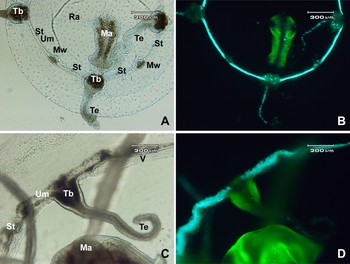
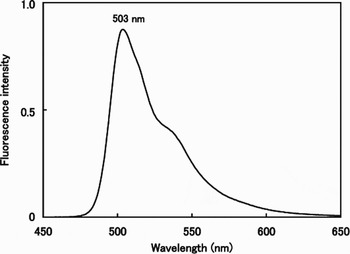
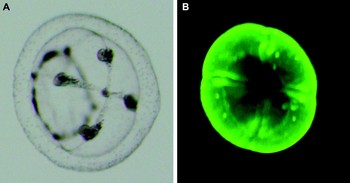
Bright green auto-fluorescence was detected in different parts of body such as the umbrellar margin, umbrellar marginal warts, tentacular bulbs, tentacles, and manubrium of the laboratory-reared immature (1–14 days old) medusae of Eutima japonica from Japan (13 specimens) and China (two specimens) (Figure 1A–D). Fluorescence emission spectra with an emission maximum at 503 nm indicated the contribution of GFP (Figure 2). No fluorescence was observed in the remaining body parts such as cirri, statocysts, radial canals, or subumbrella of these medusae (Figure 1A–D). In contrast, in the subumbrella of a mature medusa of Eugymnanthea japonica from Japan (Figure 3A–B), green fluorescence was observed as has been described previously (Kubota et al., Reference Kubota, Pagliara and Gravili2008), but in a different pattern than that shown in a photomicrograph in the previous paper (Kubota et al., Reference Kubota, Pagliara and Gravili2008; Figure 1D).
Photomicrographs of immature medusae of Eutima japonica from Miyagi Prefecture, Japan (A, B: 1-day-old; C, D: 14-day-old), showing various body parts: tentacles (Te), tentacular bulbs (Tb), umbrellar marginal wart (Mw), manubrium (Ma), umbrellar margin (Um), velum (V), and statocysts (St). Auto-fluorescence images under blue light excitation (B, D) and transmitted light images (A, C) of the same two individuals.

In vivo fluorescence emission spectra of green fluorescent protein in a 14-day-old immature medusa of Eutima japonica from Tsingtao, China; excitation wavelength: 435 nm.

Microphotographs of a spent medusa of Eugymnanthea japonica from Shirahama, Wakayama Prefecture, Japan. Bright-field image (A) and auto-fluorescence image under blue light excitation (B) of the same individual of which umbrellar diameter is 0.93 mm.

DISCUSSION
Microscopic fluorescence spectra indicated that the green auto-fluorescence of Eutima and Eygymnanthea may be derived from GFP. Green fluorescent protein was first discovered in the hydromedusan Aequorea (Shimomura et al., Reference Shimomura, Johnson and Saiga1962) and has also been found in other cnidarians, i.e. sea anemones and corals (Ward, Reference Ward, Chalfie and Kain1998; Shimomura, Reference Shimomura2006), as well as amphioxus (Deheyn et al., Reference Deheyn, Kubokawa, McCarthy, Murakami, Porrachia, Rouse and Holland2007). The physiological and ecological functions of GFP and GFP-like proteins (Belogurova et al., Reference Belogurova, Kudryasheva, Alieva and Sizykh2008) have not been resolved to date, but these substances are presumed to function in the generation of warning or masking coloration and can be used as fluorescent markers in cell and molecular biology (Yanushevich et al., Reference Yanushevich, Shagin, Fradkov, Shakhbazov, Barsova, Gurskaya, Labas, Matz, Lukyanov and Lukyanov2005). In bioluminescent medusae emission spectra will differ according to ecological factors, as was shown by Haddock & Case (Reference Haddock and Case1999), but bivalve-inhabiting hydrozoans such as Eutima japonica, Eugymnanthea japonica and Eugymnanthea inquilina are not bioluminescent species (Kubota, unpublished data).
Green fluorescent protein distribution patterns in tissues and organs of some hydromedusans are variable among closely related species, as reported by Kubota et al. (Reference Kubota, Pagliara and Gravili2008) and this study. The fluorescence distribution pattern of Eutima japonica more closely resembles that of Eugymnanthea inquilina from the Mediterranean Sea than that of the Japanese Eugymnanthea japonica, even though the latter represents an advanced form derived from the present ancestral species. This is against our expectation and implies that the similar fluorescence pattern may be a convergent character related to its physiological and/or ecological role, although the real function of the fluorescence has almost never been resolved. Although the distribution patterns of GFP may have no phylogenetic significance, they are useful and important as taxonomic markers.
The maximum emission wavelength of GFP is different in each of the three geographically widely separated species of amphioxus studied by Deheyn et al. (Reference Deheyn, Kubokawa, McCarthy, Murakami, Porrachia, Rouse and Holland2007). Similarly, the maximum emission wavelength of GFP in the present species (503 nm) is slightly different from that of Aequorea victoria and Renilla reniformis (508–509 nm), as well as those of the hydromedusae of Halistaura, Mitrocoma, and Phialidium (497–498 nm) (Shimomura et al., Reference Shimomura, Johnson and Saiga1962; Ward, Reference Ward, Chalfie and Kain1998; Shimomura, Reference Shimomura2006). Such differences among species imply that the maximum emission wavelength of the GFP is species-specific, at least within a limited taxonomic group such as Leptomedusae. Further study is required, including a comparison of the maximum emission wavelength of GFP and the fluorescence pattern among ordinary medusae with tentacles and a mouth like the present species.
ACKNOWLEDGEMENTS
We thank Dr Katsuhiko Tanaka for his kind help in collecting mussels from Miyagi Prefecture, Japan, and Dr Mark J. Grygier for his critical reading and emendation of the manuscript.