Both adults and children learning English as a second language (L2) have difficulties learning to mark English verbs for past tense (Andersen & Shirai, Reference Andersen and Shirai1994; Bardovi-Harlig, Reference Bardovi-Harlig1999; Collins, Reference Collins2002; Paradis, Reference Paradis2011). Many L2 learners of English pass through a phase of using unmarked or bare verbs (e.g., I run) to refer to past events (Bardovi-Harlig, Reference Bardovi-Harlig1999; Collins, Reference Collins2002). There is some evidence that L2 English learners whose first language (L1) is a tenseless language (like Chinese) have a particularly hard time learning to mark English verbs for tense (Brebner, McCormack, & Rickard Liow, Reference Brebner, McCormack and Rickard Liow2016; Goad, White, & Steele, Reference Goad, White and Steele2003; Lardiere, Reference Lardiere1998; Paradis, Reference Paradis2011; cf. Leung, Reference Leung2006). For example, Paradis (Reference Paradis2011) showed that child L2 learners of English were better at marking for tense if they spoke an L1 that marked for tense than if they did not. Similarly, Lardiere (Reference Lardiere1998) reported that a Chinese L1 speaker used mostly bare verbs in English in contexts in which tense marking was obligatory even after 18 years of living in the United States. These results suggest that there are properties of L1 Chinese that contribute to L2 English speakers’ difficulty with tense marking. The purpose of the present study was to test two explanations for Chinese–English bilinguals’ difficulties with tense marking in English: (1) morphophonological transfer, and (2) influence from Chinese aspect marking.
One possible reason for the lack of tense marking in English among Chinese L1 speakers is morphophonological (Bayley, Reference Bayley, Gass, Cohen and Tarone1994; Goad et al., Reference Goad, White and Steele2003; cf. Hawkins & Liszka, Reference Hawkins, Liszka, van Hout, Hulk, Kuiken and Towell2003). In Chinese, only a few simple codas are allowed (Duanmu, Reference Duanmu2007). Chinese L1 speakers who learn English as an L2 have been shown to avoid complex codas (Hansen, Reference Hansen2001). In English, adding the regular past tense morpheme –ed to verbs can result in a complex coda (e.g., hop → hopped). In contrast, many irregular past tense forms in English are realized internally, such as through a vowel change (e.g., run → ran) and might therefore be less affected by morphophonological properties of Chinese (Song, Sundara, & Demuth, Reference Song, Sundara and Demuth2009). In support of this prediction, Nicoladis, Song, and Marentette (Reference Nicoladis, Song and Marentette2012) found that five- to twelve-year-old Chinese–English bilinguals were more accurate with irregular verbs than regular verbs in English (see also Brebner et al., Reference Brebner, McCormack and Rickard Liow2016; Woon, Yap, Lim, & Wong, Reference Woon, Yap, Lim and Wong2014). This result is particularly surprising because monolingual English-speaking children show the reverse pattern: that is, they are more likely to produce regular past tense forms accurately than irregular past tense forms between the ages of three and twelve years (Marchman, Reference Marchman1997; Marcus, Pinker, Ullman, Hollander, Rose, & Xu, Reference Marcus, Pinker, Ullman, Hollander, Rose and Xu1992; Nicoladis, Palmer, & Marentette, Reference Nicoladis, Palmer and Marentette2007; Nicoladis et al., Reference Nicoladis, Song and Marentette2012). Thus, English monolingual children likely learn that –ed is the default way of marking verbs for tense. In the present study, we tested whether Chinese–English bilinguals were more accurate with irregular verbs than regular verbs in English, as in Nicoladis et al. (Reference Paradis2012), with somewhat younger children who had only started learning English. If so, these results would be consistent with morphophonological transfer from L1 Chinese.
Another possible reason for omitting tense marking in English is influence from the Chinese aspectual system (Hawkins & Liszka, Reference Hawkins, Liszka, van Hout, Hulk, Kuiken and Towell2003; Lardiere, Reference Lardiere1998). Chinese does not mark for tense, but it does mark verbs for aspect, including –le (completion), -zai (ongoingness), and -zhe (duration) (Chen & Shirai, Reference Chen and Shirai2010; Yang, Reference Yang2014). The perfective –le usually appears on telic verbs, like accomplishments or achievements (e.g., painting a picture), while the other aspect markers are more likely to occur on atelic verbs like activities and statives (Chen & Shirai, Reference Chen and Shirai2010; Yang, Reference Yang2014). There is some evidence that bilinguals sometimes use –ed and –le as translation equivalents. Some studies have shown that adult L2 learners of Chinese used –le to mark a past event rather than perfective aspect (Bayley, Reference Bayley, Gass, Cohen and Tarone1994; Yang, Reference Yang2014). Furthermore, Liu (Reference Leung2015) found a positive correlation between the number of times Chinese–English bilingual children's produced English –ed and Chinese –le on a sentence repetition task. In the present study, we test the possibility that young sequential Chinese–English bilinguals interpret English –ed as an aspect marker (i.e., a translation of –le, marking completion).
This study
In this study, we tested two possible explanations for Chinese–English early sequential bilingual children's tense omission in English. We asked the children to watch a cartoon and tell the story back. Previous research has shown that children generally tell the story of a cartoon in the past tense (Hoang, Nicoladis, Smithson, & Furman, Reference Hoang, Nicoladis, Smithson and Furman2016; Nicoladis et al., Reference Nicoladis, Palmer and Marentette2007). We first tested whether there is morphophonological transfer from L1 to L2. If so, the bilingual children would be more accurate with irregular verbs than regular verbs. In contrast, we predicted that the English monolingual children would be more accurate with regular verbs than irregular verbs, as has often been found in previous studies (e.g., Marcus et al., Reference Marcus, Pinker, Ullman, Hollander, Rose and Xu1992).
We next tested whether the bilingual children use –ed in English as an aspect marker of completion. To do that, we first verified that, in Mandarin, the bilingual children used –le equally often as monolinguals and largely on telic verbs. We expected that they would, as aspect marking is acquired early in Chinese (Chen & Shirai, Reference Chen and Shirai2010). To test if –ed is used as an aspect marker, we predicted that the bilingual children would use –ed primarily on telic verbs. We further predicted that the bilinguals would use –ed in English equally often as –le in Mandarin, equally often on telic verbs, and that their use of –ed in English would correlate with their use of –le in Mandarin (Liu, Reference Liu2015).
Methods
Twenty-seven Mandarin–English bilingual children were included in the analyses for this study, averaging in age 5;7 (SD = 0;9; range 4;0–6;7). Forty bilingual children originally participated, but thirteen did not tell a story in English that included at least one verb (i.e., one child simply said “a cat” and then laughed as her entire story; twelve others simply claimed that they did not remember the story; see Nicoladis and Jiang [Reference Nicoladis and Jiang2018] for a discussion of the differences between the children who did and did not tell the story). The children were living in Edmonton, Alberta, Canada when they participated. According to parental report, the children had learned Mandarin as a first language from both parents and subsequently started learning English between the ages of two and five years, usually in the context of daycare or preschool. We recruited children who had a minimum of six months of exposure to English. The average length of exposure to English was 1.3 years (SD = 0.6). According to parental report, the children were Mandarin-dominant at the time of participation.
The Chinese monolinguals were living in Beijing, China. We included in the analyses the 27 children (out of 38) who were closest in age to the bilingual children. The average age among the children included ranged from 4;0 to 6;5 (M = 5;6; SD = 0;7). Having matched on age, there was no significant difference between the monolingual group and bilingual group on age in months (t < 1).
The English monolinguals were living in Edmonton, Alberta, Canada. We included in the analysis the 27 children (out of 79) whose ages most closely matched the bilingual children's. The range of age for those children was 3;11 to 6;3 (M = 5;5; SD = 0;7). These children's age in months did not differ significantly from either the bilingual children's or the Chinese monolinguals’ (ts < 1).
Material
The participants were asked to watch a 4-minute segment of a Pink Panther cartoon titled In the Pink of the Night. In this segment, the Pink Panther gets annoyed at a cuckoo bird that is trying to wake him up. He throws the bird into the river and goes back to bed. He then starts to feel guilty for having killed the bird and runs back to the river to save him. Meanwhile, the bird returns to the Pink Panther's house. When the Pink Panther returns home and finds the bird alive, they fall asleep together in bed. This same cartoon was shown in both language sessions for the bilingual children.
To measure the children's receptive vocabulary in English, we used the Peabody Picture Vocabulary Test-III (PPVT), Version A (Dunn & Dunn, Reference Dunn and Dunn1997). The children's Mandarin vocabulary was measured by administering a translated version of the PPVT, Version B. The translated Mandarin version has not been standardized. One study showed that the raw scores on this translated version were correlated with age among Mandarin-speaking monolingual children (Barbosa, Jiang, & Nicoladis, Reference Barbosa, Jiang and Nicoladis2019), suggesting some degree of validity. In the present study, we used the raw scores in the analyses, as we were interested in individual differences across children.
Procedure
This study was part of a larger study, and the children participated in a battery of tasks assessing language and cognition. The bilingual children participated in two language sessions, with an experimenter who was a native speaker of the target language of the session and who spoke only that language throughout the session. The order of the two language sessions was counterbalanced and the two sessions were separated by approximately a week.
For both monolingual and bilingual children, within a language session, the order of the tasks varied according to the experimenter's judgment of the child's interest and engagement. Tasks requiring more passive participation (like the PPVT) were usually presented earlier within a session, and tasks requiring more active participation (like the cartoon retell) were presented later.
The PPVT was administered and the scores calculated according to the examiner's manual (Dunn & Dunn, Reference Dunn and Dunn1997). For the cartoon retell, the children watched the cartoon on a computer screen turned away from the experimenter. When the cartoon was done, the experimenter asked the children to tell what they had seen in the cartoon (e.g., “What happened in the cartoon you just saw?”). When the children paused in their retelling, the experimenter asked the children open-ended questions, like, “Then what happened?” or “Was there anything else?”. The children's stories were videotaped for later transcription and coding.
Transcription and coding
The children's stories were transcribed orthographically in the target language. Each verb that they used was coded for whether it was used as a telic (i.e., the action had an endpoint) or atelic verb. This coding was done on the children's use of the verbs in context so that it was not simply the choice of a particular verb but the use in context. For example, “he threw flowers all around” was coded as atelic while “he threw flowers into the ocean” was coded as telic. A second coder independently coded the verbs of 11 randomly selected children for telicity. Out of the 276 verbs produced by these children, the two coders agreed on 92% of the classifications, with a Cohen's kappa of .772, conventionally characterized as excellent agreement. The disagreements were mostly due to the second coder identifying more telic verbs than the first coder. For example, the second coder coded “he didn't see anything” as telic while the first coder classified this as atelic. In order to be consistent with the first coder's more conservative coding, we retained the first coder's judgments for the analyses.
In English, we coded for the accuracy of regular and irregular past tense forms (e.g., jumped as the past tense of the regular to jump, and was as the past tense of the irregular to be). For each child, we calculated a percentage of accurate regular and irregular verbs out of the total number of verbs produced, excluding any verbs that were marked with a third person –s (mean number of verbs in present = 1.7, SD = 2.6). We excluded the present tense because we reasoned that children could choose to tell the story in the present tense (even adults do sometimes; see Hoang et al., Reference Hoang, Nicoladis, Smithson and Furman2016), so the choice of present tense could not be considered incorrect.
In English we also coded the suppliance of –ed on telic and atelic verbs. In Mandarin, we coded both telic and atelic verbs with and without suppliance of –le. We included in the analyses two percentages measuring suppliance: the percentage of telic verbs marked by either –ed or –le and the percentage of –ed or –le that appeared on telic verbs. These percentages measure a slightly different but related construct about suppliance. We consider each of these measures in turn.
The percentage of telic verbs marked by either –ed or –le addresses the frequency with which telic events were marked for past or completion, respectively. In English, since many high-frequency verbs are irregular (Marcus et al., Reference Marcus, Pinker, Ullman, Hollander, Rose and Xu1992), only a small percentage of telic verbs might be marked by –ed for monolingual children, and the bilingual children might produce even less –ed since they may produce bare verbs. In Mandarin, since aspect marking for completion is optional, we anticipated that only a minority of telic verbs would be marked –le and that there would be no difference between bilinguals and monolinguals.
The percentage of –ed or –le that appeared on telic verbs captures something about children's interpretation of the function of the morpheme. In English, we expected monolingual children to use a minority of –ed on telic verbs because –ed marks past tense for them and so the use would be unrelated to telicity. In contrast, bilingual children might use –ed as an aspect marker, in which case the majority of their uses of –ed would be on telic verbs. As for the percentage of –le that appears on telic verbs in Mandarin, previous studies have shown a link between perfective aspect and telicity (Andersen & Shirai, Reference Andersen and Shirai1994; Chen & Shirai, Reference Chen and Shirai2010), so we expected that the majority of uses of –le by both monolingual and bilingual children would be on telic verbs.
Analytic approach
In Chinese, parametric statistics could be used for all analyses since the variance in the two groups was equivalent. In English, for accuracy, variances were equivalent so parametric statistics were used. For other measures, there were often differences in variance between the two groups (usually the bilingual children were more variable than the monolingual children). When this was the case, we used Mann–Whitney non-parametric tests to compare the two groups.
Results
In English, the bilingual children's raw PPVT scores were significantly lower (M = 35.3 (SD = 22.5) than the monolinguals’ (M = 95.5 (SD = 27.6)) (t(52) = 8.73, p < .001). This result is not surprising, given how little exposure to English the bilinguals had had. In Chinese, the bilinguals’ vocabulary scores were also significantly lower (M = 107.9 (SD = 14.7)) than the monolinguals’ (M = 125.4 (SD = 5.5)) (t(52) = 4.80, p < .001).
Accuracy of regular/irregular verbs in English
We first consider the possibility of morphophonological transfer. The monolingual children used, on average, 11.0 (SD = 7.3) irregular verbs and 2.2 (SD = 2.0) regular verbs. The bilinguals used an average of 17.5 (SD = 17.6) irregular verbs and 3.0 (SD = 3.6) regular verbs (see Table 2 for the total number of verbs used in English). There were no significant differences between groups on Mann–Whitney tests, for irregular (p = .30) or regular verbs (p = .94).
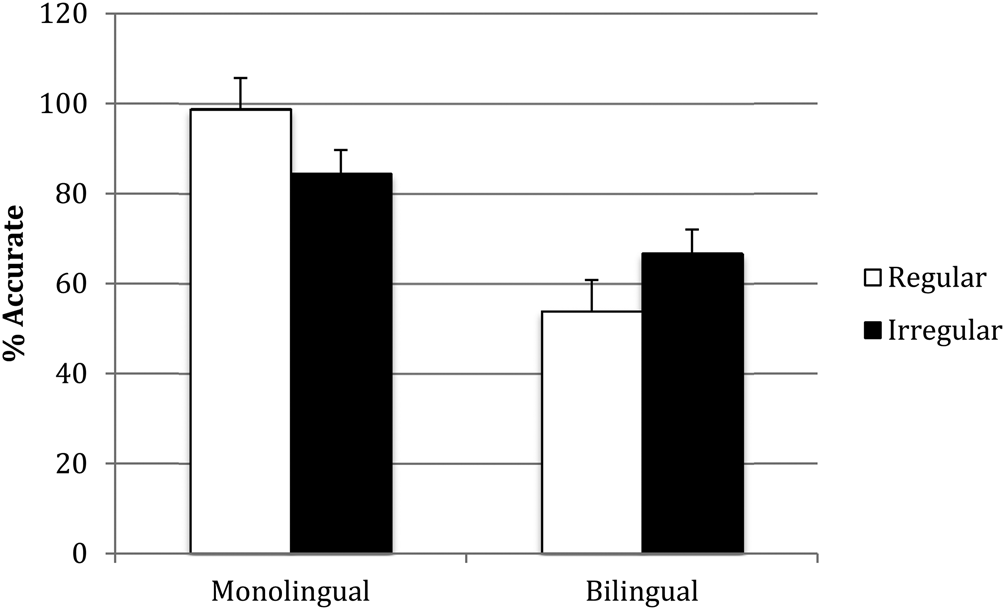
Figure 1 summarizes the accuracy of regular and irregular verbs by the two groups. On a 2 × 2 [Group × Verb Type] ANOVA with Verb Type as a repeated measure, there was no main effect of Verb Type (F < 1, p = .94, η 2p = .001). There was a main effect of Group (F(1,40) = 18.77, p < .001, η 2p = .319): the bilinguals were less accurate than the monolinguals. There was also a significant interaction between Group and Verb Type (F(1,40) = 7.59, p = .009, η 2p = .160). As can be seen in Figure 1, the source of that interaction is that the monolinguals were more accurate with regular verbs than with irregular verbs, while the bilinguals showed the reverse pattern. We did not systematically analyze children's errors, but the bilingual children produced more bare verbs (M = 3.8, SD = 4.2) than the monolingual children (M = 0.3, SD = 0.6).
Average percentage accurate production of regular and irregular past tense verbs in English by monolingual and bilingual children. Error bars show standard error around the mean.

For the bilingual children, accuracy was not significantly correlated with age for either regular (r(25) = 0.368, n.s.) or irregular verbs (r(25) = 0.342, n.s.). Accuracy was not correlated with Chinese vocabulary scores for either regular (r(25) = 0.407, n.s.), or irregular verbs (r(25) = 0.330, n.s.). Accuracy was, however, significantly correlated with English vocabulary scores for both regular (r(25) = 0.447, p < .05) and irregular verbs (r(25) = 0.513, p < .01).
Chinese aspect use
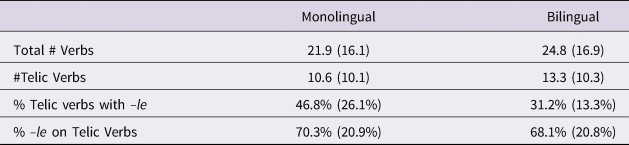
We next verified that the bilingual children demonstrated age-typical usage of –le in Chinese. Table 1 summarizes the number of verbs used to tell the stories and the suppliance of –le. There was no difference between the groups on the total number of verbs used (F < 1, p = .52, η 2p = .008), the number of telic verbs (F < 1, p = .84, η 2p = .001), and the percentage of –le on telic verbs (F < 1, p = .72, η 2p = .003). The monolingual children did, however, use a significantly higher percentage of telic verbs with –le than bilinguals (F(1,47) = 7.54, p = .008, η 2p = .129). Thus, for the most part, the bilinguals were using –le like the same-aged monolinguals.
Average (SD) number of verbs and –le production in Mandarin

English tense use
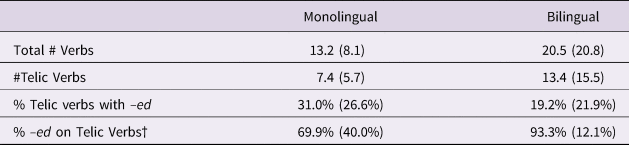
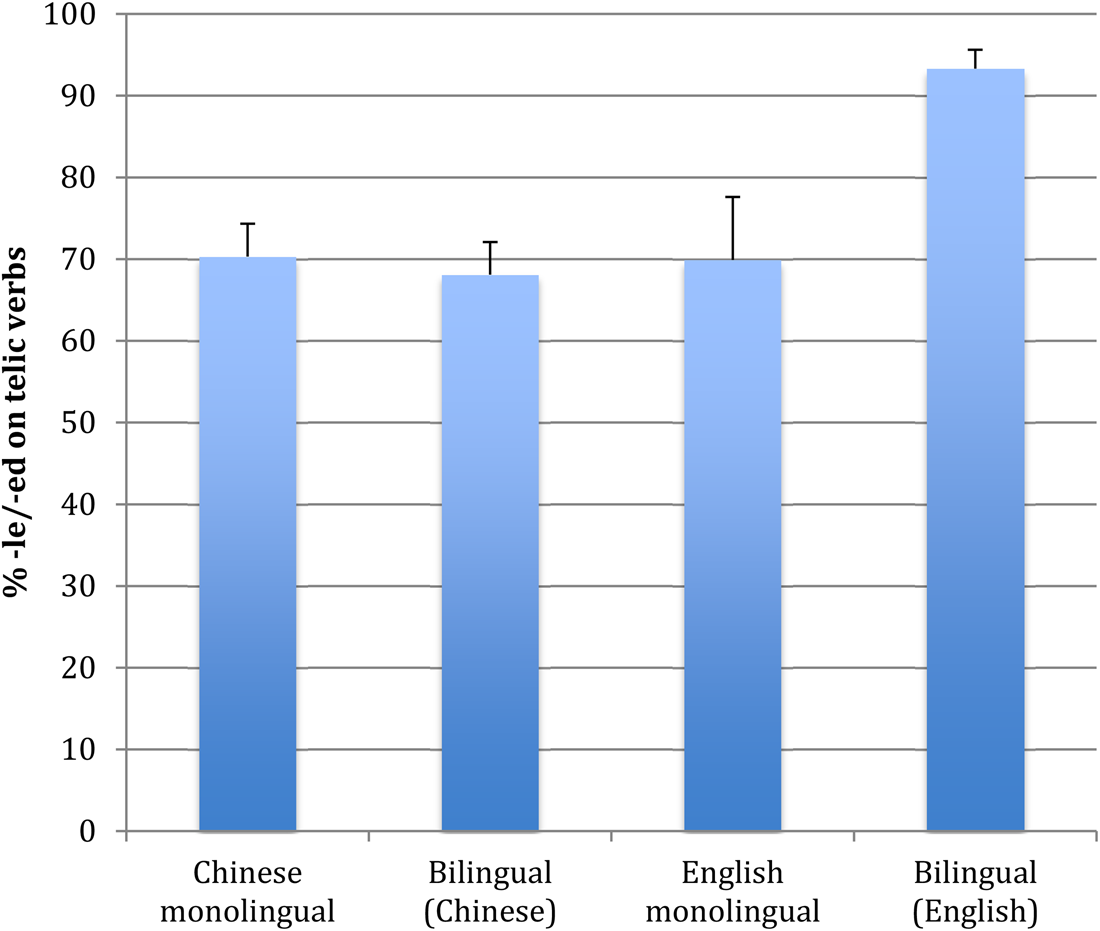
Table 2 summarizes the number of verbs, and –ed in English. Mann–Whitney tests revealed no significant differences between the two groups on the number of verbs they used (p = .44), the number of telic verbs (p = .32), or the percentage of telic verbs with –ed (p = .18). There was a trend for the bilingual children to use a greater percentage of –ed on telic verbs than the monolingual children (p = .08). As shown in Table 2 and Figure 2, when the bilingual children supplied –ed, they almost always did so on telic verbs.
Average (SD) number of verbs and –ed production in English

Note. † Based on the 22 monolingual children and the 19 bilingual children who produced –ed at least once.
Average percentage of –le or –ed suppliance on telic verbs. Error bars show standard error around the mean.

Bilingual children: Differences and similarities between –le and –ed
To see if the bilingual children used –le and –ed differently, we compared their performance in the two languages with paired t-tests. The bilingual children produced significantly more telic verbs marked for –le in Mandarin than telic verbs marked for –ed in English (t(25) = 2.22, p = .036) (see Tables 2 and 3). They produced more –ed on telic verbs in English than they did –le on telic verbs in Mandarin (t(17) = 4.72, p < .001) (see Figure 2). These results suggest that they are using –ed differently from –le.
Correlations between age/vocabulary and suppliance of –le and –ed

The percentage of telic verbs marked for –le was not correlated with the percentage of telic verbs marked for –ed (r(24) = –0.193, p = .35). And the percentage of –le produced on telic verbs was not correlated with the percentage of –ed produced on telic verbs (r(17) = 0.128, p = .60). These results further suggest that they are using –ed differently from –le.
Correlations to age and vocabulary scores
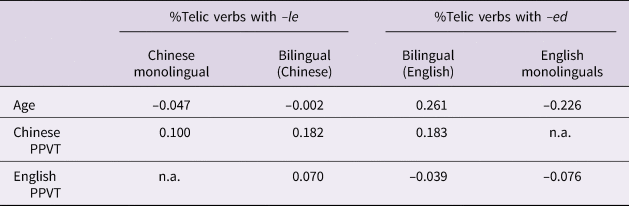
Table 3 summarizes the Pearson correlations for age/vocabulary and the percentage of telic verbs on which the children added –le or –ed. None of these correlations reached significance.
Discussion
The purpose of this study was to test two reasons why Mandarin–English bilingual children might show difficulties with –ed in English: (1) morphophonological transfer from Mandarin, and (2) interpretation of –ed as an aspect marker of completion like –le in Mandarin.
We found evidence in line with the prediction of morphophonological transfer. As has been found in other studies (Nicoladis et al., Reference Nicoladis, Song and Marentette2012), the Mandarin–English bilingual children in this study produced irregular past tense forms more accurately than regular forms. Recall that the addition of –ed on an English verb can often result in complex codas that do not appear in Mandarin. The bilingual children may therefore be attempting to avoid complex codas. Due to the small number of regular verbs produced in this study, we could not perform a systematic phonological analysis to verify this interpretation. Such an analysis awaits future research that elicits many regular verbs from participants.
As for the prediction that bilingual children might initially interpret –ed as an aspect marker of completion like the Mandarin –le, some results appeared consistent with this prediction, supporting some previous research (Collins, Reference Collins2002). For example, the vast majority of their suppliance of –ed (93%) was on telic verbs, suggesting that when they used it, they meant to mark completion. Moreover, as seen in Figure 2, the suppliance of –ed on telic verbs in English was higher than any other group.
However, it was not clear that the bilingual children were using –ed as a translation of –le (cf. Liu, Reference Liu2015). The suppliance of –ed on telic verbs was higher than the suppliance of –le on telic verbs in Mandarin. Moreover, the percentage of telic verbs marked with –ed was significantly lower than for –le, and the percentages were not correlated across languages (cf. Liu, Reference Liu2015). One possible explanation for these results is that the input in English allows the interpretation that –ed is an aspect marker (Andersen & Shirai, Reference Andersen and Shirai1994). In line with this explanation, the majority of the English monolingual children's suppliance of –ed (70%) was on telic verbs. Since regular verbs in English often appear less frequently than irregular verbs (Nicoladis et al., Reference Nicoladis, Palmer and Marentette2007), L2 learners of English may receive little evidence in the early phases of L2 acquisition that –ed does not mark aspect. Future studies can test this explanation by analyzing the input to L2 learners.
This interpretation of the results is compatible with the Aspect Hypothesis (Andersen & Shirai, Reference Andersen and Shirai1994). According to this hypothesis, language learners are highly sensitive to and therefore learn early semantic characteristics of their input (like aspect). Anderson and Shirai argue that distributional characteristics in the input to even English monolingual children bias them to use past tense marking as aspectual marking of completeness when they first start producing it. If so, then the present results are consistent with the argument that bilinguals acquire the past tense in English through the same process as monolinguals, but lag behind due to less exposure (Jia, Reference Jia2003; Nicoladis et al., Reference Nicoladis, Palmer and Marentette2007; Nicoladis et al., Reference Nicoladis, Song and Marentette2012; Shirai, Reference Shirai2003). In a case study, Gavruseva (Reference Gavruseva2002) showed that a Russian–English sequential bilingual child initially produced bare verbs in English before starting to mark for tense in English, following the same developmental patterns that have been reported for English monolingual children (Marchman & Bates, Reference Marchman and Bates1994). Indeed, even in the present study, we showed that the bilingual children's accuracy was correlated with their English vocabulary scores, suggesting that they improve as their exposure to English increases.
There are a number of limitations to this study. The study included only a small number of participants so it is important to replicate the results using larger samples. The present study relied on an indirect measure of morphophonological transfer (i.e., accuracy with regular and irregular verbs). As noted earlier, the children only produced a small number of regular verbs. Future studies can elicit more regular verbs with greater control over the allophonic variations of –ed as well as irregular verbs that include targeted codas that could be difficult for L1 Chinese speakers. Finally, of particular import to testing the argument that these results are consistent with the Aspect Hypothesis, future studies should include analyses of the distributional properties of tense and aspect marking in the input to bilingual children (Andersen & Shirai, Reference Andersen and Shirai1994).
Despite these limitations, the data presented here are consistent with the argument that Mandarin–English sequential bilinguals have difficulties with –ed in English at least in part because of morphophonological transfer from Mandarin. In addition, they may initially interpret –ed as an aspect marker rather than a tense marker. We have interpreted the results as being in line with the Aspect Hypothesis, suggesting that the children may not have had sufficient exposure to English to learn –ed as a tense marker. However, we cannot entirely rule out the possibility that the bilingual children interpreted –ed as a translation of the Chinese aspect marker –le with the present results. Future research can test for the origin of children's interpretation of –ed as an aspect marker.
Acknowledgments
This study was funded by a Discovery Grant (#2018-04978) from the Natural Sciences and Engineering Research Council of Canada to the first author. Many thanks to all the families who participated. Catherine Zoleta helped with recruitment and testing for the English monolingual children.