I. INTRODUCTION
Recent developments in wide-bandgap power electronics have led to significant improvements in the power to size ratio. However, the passive magnetic components have shown less significant changes in recent years and now represent a disproportionate amount of space and weight in the system.Reference Hurley and Wolfle1 This has become a pressing issue for modern applications, e.g., small sizes and high switching frequencies are needed for notebook computers. Furthermore, reduction in power consumption and enhancing overall efficiencies has become more imperative as the drive for a low-carbon economy continues. Rapid advancement in soft magnetic materials for the next generation of power electronics is therefore sorely needed. Currently, carbonyl iron and associated ferrites are used extensively as powder cores for inductor applications in high-power circuits. However these are characterized by losses from remanent magnetization and eddy current formation, effects that are particularly evident at high switching frequencies. More highly desired magnetic properties include high saturation magnetization and permeability, low conductivity (to avoid eddy current losses), and low magnetic hysteresis. Ultimately, the goal is to combine high magnetic saturation, M sat, with a nearly flat permeability response from DC up to several MHz, performance superior in terms of permeability and loss behavior to that offered by soft ferrites.Reference Beatrice, Dobak, Ferrara, Fiorillo, Ragusa, Fuzer and Kollar2
All of these design criteria can be met by an appropriately designed soft magnetic material which avoids the common sources of loss. Superparamagnetic nanoparticles are a class of material that have seen intense research interest in fields including drug delivery, bimodal imaging, biosensing, and heavy metals recovery.Reference Mandel, Hutter, Gellermann and Sextl3–Reference Zhu, Wang, Wei, Zhu, Li, Tu, Su, Wu, Zhu and Yan6 Superparamagnetism is a phenomenon that occurs in single domain particles, where the collective behavior of atomic spins leads to a giant vector spin that can randomly orient with sufficient thermal energy, leading to a net zero magnetization for the particle ensemble. Superparamagnets are defined by an absence of magnetic hysteresis, which makes them especially suitable for high switching frequency applications. The size of the particle required for superparamangetism to emerge is also relatively small, which eliminates the contribution from eddy current loss, as the nanoparticles themselves are too small to support eddy currents. Therefore, superparamagnetic iron nanoparticles, in theory, should completely remove the two major sources of loss when compared to conventional core materials.
A strong candidate for effective application are iron nanoparticles. Iron is low-cost, being the fourth most abundant element, and is nontoxic. It possesses the highest room temperature M sat of any element (218 Am2/kg @ 293 K), while also possessing a very low magnetocrystalline anisotropy, meaning superparamagnetism can be observed at larger nanoparticle sizes.Reference Cullity7 This is important when optimizing the material M sat as magnetization reduces with decreasing nanoparticle size. This is typically due to the formation of magnetically inert layers at the surface arising from spin-glass formation, or from surface electronic effects.Reference Huber8
To take advantage of superparamagnetic iron nanoparticles in core applications, it is necessary to separate the particles and prevent magnetic interactions. For example, magnetic dipole–dipole interactions can introduce hysteresis into a superparamagnetic ensemble.Reference Knobel, Nunes, Socolovsky, De Biasi, Vargas and Denardin9 Separation has previously been achieved by the formation of a polymer nanocomposite, in which the nanoparticles are suspended in a polymer matrix.Reference Pyun10,Reference Stone, Hipp, Barden, Brown and Mefford11 Polymer nanocomposites have attracted significant research interest due to facile formation, light weight, and low cost of the matrix fraction. Furthermore, the plethora of different polymer and nanoparticle species available allows for the design of materials with tunable mechanical, magnetic, optical, and electrical properties.Reference Wakayama and Yonekura12–Reference Chen, Zhang, Jin and Zhao14 This has led to a number of useful applications for nanocomposites including sensor applications, conducting membranes for fuel cells, and fire retardants.Reference Pyun10 Polymeric nanocomposites can also be applied relatively easily to molds and also see promise in additive manufacturing.Reference de Leon, Chen, Palaganas, Palaganas, Manapat and Advincula15 The real promise of nanocomposites however lies in their multifunctionality and the possibility of realizing unique combinations of properties unachievable with traditional, bulk, materials. The inherent challenges in their formation include control over the distribution in size and dispersion of the nanostructured constituents as well as tailoring and understanding the role of interfaces on the emerging bulk properties. Phase separation is also a well-established concern, which for a magnetic nanocomposite would eliminate the benefits of superparamagnetism due to the formation of ferromagnetic domains.Reference Hooper and Schweizer16 However, polymers typically have very large molecular weights and are usually benign in terms of functionality. This means that in a nanocomposite, the functional component becomes the minority fraction, which limits performance. Increasing this fraction to achieve high nanoparticle loadings, while still possessing control over the interparticle spacing and magnetic interactions would significantly increase the performance and applicability of nanocomposites.
Recently, a supramolecular building block approach for the preparation of a new family of nanocomposites has been presented. These nanocomposites are comprised of nanoparticles cross-linked by covalently bound organic bridges, eliminating the need for a polymer matrix.Reference Mochalin, Neitzel, Etzold, Peterson, Palmese and Gogotsi17,Reference Dach, Rengifo, Turro and Koberstein18 The nanoparticles are separated by the functionalized surfactant molecules bound to their surfaces, which are then covalently bound to neighboring nanoparticles through their corresponding surface functionalization. In doing so, a “matrix-free” nanocomposite is formed. These nanocomposites are not prone to the nanoparticle aggregation effects that plague conventional nanocomposites and provide exceptionally high strength and toughness.Reference Mochalin, Neitzel, Etzold, Peterson, Palmese and Gogotsi17
A promising approach to form matrix-free nanocomposites is by employing epoxy chemistries, as this is well-known to provide strong mechanical properties in a cross-linked environment. Epoxy resins are a class of thermosetting polymers that are ubiquitous as coatings, adhesives, and in structural repair and are recently seeing application in additive manufacturing applications.Reference Compton and Lewis19,Reference Jin, Li and Park20 They have also been used on numerous occasions to form traditional nanocomposite materials. Carbonyl iron-epoxy magnetic cores have recently been used for large-current inductors mounted directly onto a chip.Reference Sugawa, Ishidate, Sonehara and Sato21 They showed that good dispersion within the epoxy matrix lead to lower losses at high frequencies due to less large magnetic agglomerates present in the system. Gu et al. surface functionalized magnetite nanoparticles with conductive polyaniline to increase the epoxy–nanoparticle interaction and strengthen the nanocomposite mechanical properties.Reference Gu, Tadakamalla, Huang, Colorado, Luo, Haldolaarachchige, Young, Wei and Guo22 Incorporation of the functionalized nanoparticles led to better thermal stability as well as increased dispersion of magnetic fraction. Zhu et al. formed magnetic epoxy nanocomposites with Fe@FeO core–shell nanoparticles.Reference Zhu, Wei, Ryu, Sun, Luo and Guo23 They used a commercially available epoxy system and formed nanocomposites with nanoparticle packing fractions of between 1 and 20 wt%. They measured an M sat of 108 Am2/kg for the Fe@FeO nanoparticles themselves, which was reduced to 17 Am2/kg when incorporated into the epoxy network. Pour et al. also showed improved mechanical properties when incorporating surface modified maghemite α-Fe2O3 nanoparticles into a DGEBA-based epoxy matrix.Reference Pour and Ghaemy24 This was due to improved nanoparticle dispersion and increased interfacial adhesion between the DGEBA and α-Fe2O3. However maximum nanoparticle loading was only 11 wt%. While good examples of the usefulness an epoxy network in the formation of nanocomposites, these approaches mimicked the use of polymers in that the nanoparticles were embedded in an epoxy matrix. Furthermore, relatively low nanoparticle loadings were responsible for a reduction in the overall magnetic performance of the resulting nanocomposites. Combining the strong cross-linking environment of the epoxy network with the matrix-free approach to increase nanoparticle loading would build on these previous efforts, forming the next generation of magnetic nanocomposites.
In terms of the nanoparticle fraction, control over the size and shape is essential to produce an effective superparamagnetic nanocomposite. For example, a finite size distribution leads to a distribution in relaxation times, which can adversely affect performance in high frequency switching applications.Reference Naughton, Majewski and Clarke25 When considering shape, any deviation from an ideal sphere can introduce higher-order multipole terms in the magnetic dipole interaction energy, leading to deviations from the expected magnetic behavior.Reference Mikuszeit, Vedmedenko and Oepen26 Controlling interparticle spacing is imperative; too close and interparticle interactions can lead to hysteresis and losses, too far and porosity can reduce the maximum achievable magnetic fraction; reducing the overall M sat of the nanocomposite.Reference Naughton, Majewski and Clarke25 Finally, the magnetic nanoparticles used in the formation of the nanocomposite must be synthesized in sufficiently large quantities. This is especially important when considering application of the nanocomposite in inductor and transformer technologies, where the form-factor for testing can vary significantly.
In the present study, we have developed gram-scale syntheses of strongly magnetic Fe/FexOy core–shell nanoparticles and used them as the magnetic fraction in the formation of a matrix-free superparamagnetic nanocomposite. The nanoparticles are synthesized using a reversible agglomeration mechanism, which is scalable and has recently been shown to yield a magnetic nanoparticle ensemble with good shape control and tight size distribution.Reference Bleier, Watt, Simocko, Lavin and Huber27,Reference Fellows, Sandler, Livingston, Fuller, Nwandu, Timmins, Lantz, Stefik and Mefford28 We then perform a ligand exchange procedure in situ, replacing the growth directing surfactants with a diamine ligand, thereby expressing an amine functionality into the environment. This is then cross-linked with a triepoxide to yield a matrix-free nanocomposite. By covalently linking the magnetic nanoparticles together with a cured epoxy network, we can significantly reduce the organic fraction to achieve high nanoparticle loadings. We then confirm that the nanocomposite contains a well separated nanoparticle fraction, leading to a nanocomposite with strong magnetic properties.
II. EXPERIMENTAL SECTION
A. Materials
Iron pentacarbonyl (≥99.99%), oleylamine (OLA) (technical grade, 80%), trioctylphosphine (TOP) (97%), 1-octadecene (1-ODE) (technical grade, 90%), n,n-diglycidyl-4-glycidyloxyaniline, 1,6-diaminohexane (98%), 1,8-diaminooctane (98%), 1,12-diaminododecane (98%), fluorescamine (≥98%), chloroform (≥99.5%), and tetrahydrofuran (≥99.9%) were all purchased from Sigma Aldrich. All reagents were used as supplied, without further purification.
B. Scale up syntheses of Fe/FexOy NPs using reversible agglomeration mechanismReference Bleier, Watt, Simocko, Lavin and Huber27
1 g. A three-necked reaction flask was charged with 16 mL 1-ODE, 2 mL OLA (6 mmol), and 2.7 mL TOP (6 mmol). This was transferred to an air-free Schlenck line under a nitrogen atmosphere and heated to 250 °C with stirring at 300 rpm, using a magnetic stir bar. The reaction solution was prepared by diluting 5 mL iron pentacarbonyl (Fe(CO)5) (37 mmol) in 15 mL 1-ODE. The reaction solution was injected into the reaction flask at a rate of 100 µL/min via a syringe pump. The reaction was carried out for a further 30 min at 250 °C, following the completion of the drip. The reaction was then cooled to room temperature and the product was isolated from the magnetic stir bar and resuspended in 1-ODE. The surface was allowed to oxidize passively, leading to Fe/FexOy core–shell nanoparticles. We observed no increase in the thickness of the oxide layer over time, indicating that it is effective in passivating the zero-valent iron core. For magnetic measurements, an aliquot of the nanoparticles was sealed under vacuum in an NMR tube. For size characterization by high resolution transmission electron microscopy (HRTEM) and small angle X-ray scattering (SAXS), an aliquot was purified by washing three times with chloroform and isopropanol before being suspended in hexane.
10 g. A three-necked reaction flask was charged with 80 mL 1-ODE, 10 mL OLA (30 mmol), and 13.6 mL TOP (30 mmol). This was transferred to an air-free Schlenck line under a nitrogen atmosphere and heated to 240 °C with stirring at 300 rpm using an overhead stirrer. The reaction solution was prepared by diluting 25 mL Fe(CO)5 (185 mmol) in 75 mL 1-ODE. The reaction solution was injected into the reaction flask at a rate of 0.33 mL/min using a peristaltic pump [Cole Palmer MasterFlex Model 70 13-20, Tygon Fuel and Lubricant Tubing L/S 13 (06401-13)]. The reaction was reacted for a further 30 min at 240 °C, following the completion of the drip. The reaction was then cooled to room temperature and the product was isolated and resuspended in 1-ODE. The surface was allowed to oxidize passively, leading to Fe/FexOy core–shell nanoparticles. We observed no increase in the thickness of the oxide layer over time, indicating that it is effective in passivating the zero-valent iron core. For size characterization by HRTEM and SAXS, an aliquot was purified by washing three times with chloroform and isopropanol before being suspended in hexane.
C. Formation of matrix-free superparamagnetic nanocomposite
To form the nanocomposite, 100 mg of Fe/FexOy NPs (1.8 mmol) were added to 71.6 mg of n,n-diglycidyl-4-glycidyloxyaniline (0.25 mmol) and 23.4 mg of 1,6-diaminohexane (0.2 mmol) dissolved in 3 mL CHCl3. The mixture was first vortex mixed then subjected to ultrasonication for 15 min at 60 °C to ensure complete dispersion of the magnetic nanoparticle fraction. Then, the majority of CHCl3 was removed by rotary evaporation, leaving behind a viscous, workable liquid. This was then dropcast onto a glass slide and cycled under vacuum three times to remove any trapped air. The nanocomposite was then cured overnight at 60 °C. To investigate the effect that the alkyl chain of the diamine curing agent had on the magnetic properties of the nanocomposite, 1,6-diaminohexane was substituted with either 1,8-diaminooctane (29.0 mg, 0.2 mmol) or 1,12-diaminododecane (404 mg, 0.2 mmol) and subjected to the same preparation.
D. Ligand exchange experiments
100 mg of Fe/FexOy NPs (1.8 mmol) were added to 23.4 mg of 1,6-diaminohexane (0.2 mmol) and 20.2 mg hexylamine (0.2 mmol) in 2 mL CHCl3. The mixture was first vortex mixed then subjected to ultrasonication for 15 min at 60 °C to ensure complete dispersion of the magnetic nanoparticle fraction and to allow ligand exchange to take place at the surface. The nanoparticles were then washed three times with chloroform and isopropanol using magnetic separation, before being suspended again in chloroform to form a 5 mg/mL solution.
1 mL of the nanoparticle solution was then mixed with 400 µL of a 5 mg/mL solution of fluorescamine in THF and allowed to react overnight on a shaker table. When the reaction was complete, the particles were pulled down with a strong permanent magnet and excess fluorescamine solution decanted from the vial. The particles were then washed three times with hexanes, before carrying out fluorescence measurements to ensure any signal is due to fluorescamine that has reacted with diamine bound to the nanoparticle surface.
E. Characterization
Size analysis of the nanoparticle products was performed using transmission electron microscopy (TEM) and SAXS. TEM samples were prepared by dropcasting a chloroform dispersion on a carbon-coated copper grid. Images were collected using a Philips Tecnai TEM (FEI, Hillsboro, Oregon) operating at 300 keV. HRTEM images were taken on an FEI Titan ETEM 800-300 (FEI, Hillsboro, Oregon) with Image C s corrector, operating at 300 keV. SAXS analysis was performed by injecting concentrated solutions of samples suspended in hexanes into glass capillary tubes with 1.0 mm diameter (Charles Supper Company, Natick, Massachusetts). The samples were analyzed using a Rigaku SmartLab II diffractometer system with SmartLab Guidance system control software (Rigaku, The Woodlands, Texas). Data analysis was performed using Rigaku NANO-Solver v.3.5 software (Rigaku, The Woodlands, Texas), assuming a spherical form factor and Gaussian size distribution, as observed in TEM. DC magnetization curves were recorded from −2.38 × 10⁶ A/m to 2.38 × 10⁶ A/m at 50 K using a Quantum Designs Versalab vibrating sample magnetometer (VSM). The precise iron mass of each sample was determined destructively by heating the sample in a 600 °C furnace for 1 h to incinerate the organic material and then dissolving the iron-containing residue in hydrochloric acid. A phenanthroline/Fe2+ complex was formed in solution and spectrophotometrically quantified. Zero-field cooled (ZFC) magnetization curves were obtained by cooling the sample to 50 K with no applied field, then applying a field of 796 A/m, and recording the magnetization from 50 to 400 K. With the field still applied, the sample was then cooled from 400 to 50 K to obtain the field-cooled (FC) magnetization. Thermogravimetric analysis (TGA) and differential scanning calorimetry (DSC) curves were carried out by heating an alumina crucible containing nanocomposites to 900 °C on a Netzsch STA 449 F1 Jupiter instrument (Netzsch Group, Selb, Germany). Fluorescence experiments were performed on a Nanolog instrument from Horiba Scientific (Edison, New Jersey) with an excitation wave length of 390 nm.
III. RESULTS AND DISCUSSION
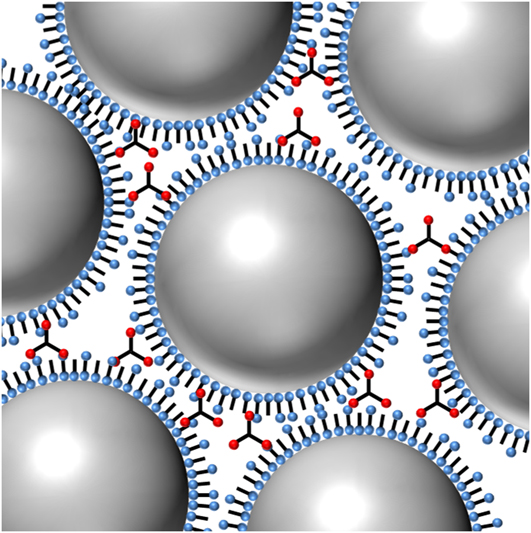
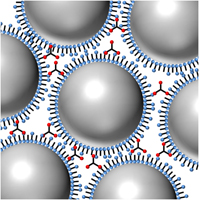
Figure 1 shows a schematic of the matrix-free superparamagnetic nanocomposite. Fe/FexOy core–shell nanoparticles are first formed via solvothermal synthesis using TOP and OLA as surfactants, with 1-ODE as the high boiling point solvent. Solvothermal synthesis was chosen as it is known to give significantly better control over the synthesis of iron nanoparticles when compared to other techniques, e.g., reduction of iron salts.Reference Huber8 We have previously shown that magnetic nanoparticles with a uniformly spherical shape and an incredibly tight size distribution could be formed reproducibly and predictably in an extended LaMer synthesis.Reference Vreeland, Watt, Schober, Hance, Austin, Price, Fellows, Monson, Hudak, Maldonado-Camargo, Bohorquez, Rinaldi and Huber29 Here, continuous addition of the reaction precursor leads to a steady state growth regime which eliminates Ostwald ripening, a known source of polydispersity. This method was then extended to grow strongly magnetic zero-valent iron nanoparticles, in what has been named the reversible agglomeration mechanism.Reference Bleier, Watt, Simocko, Lavin and Huber27 In this approach, magnetic nanoparticles nucleate and grow until a critical susceptibility is reached. At this point, magnetic dipole interactions overcome dispersive forces leading to a magnetic agglomeration event. This is followed by the precipitation of the agglomerated nanoparticles and a phase change in the system, giving an example of true thermodynamic reaction control in nanoparticle synthesis. As the onset of agglomeration is directly a result of an increase in particle susceptibility, nanoparticle growth is arrested within a very small size window, yielding a strongly magnetic nanoparticle ensemble with a tight size distribution. With the continued addition of precursor, a second nucleation event can then occur, leading to subsequent growth and a second agglomeration/precipitation event. By continuously adding precursor, multiple reversible agglomeration steps can be performed indefinitely, meaning the mechanism is unique in its scalability. This was an important aspect when choosing this synthetic approach in the current study as for effective application of a useful nanocomposite, greater than typical lab-scale quantities need to be produced. The nanoparticle product can then be resuspended in most common organic solvents through the addition of sufficient energy, e.g., heat or sonication, confirming the reversibility of the mechanism. In the synthesis of iron nanoparticles, solvents and reagents are typically dried and degassed to remove oxygen and avoid oxidation. This is reasonable for research scale quantities, however when dealing with the larger quantities required for scale-up, this can become impractical. Therefore, the following nanoparticle products were all formed using the solvents and reagents as received directly from the supplier.
Schematic showing the as-synthesized matrix-free superparamagnetic nanocomposite. Fe/FexOy core–shell magnetic nanoparticles are synthesized using TOP and OLA as surfactants. A ligand exchange procedure is then performed in situ, attaching an alkyl chain diamine to the nanoparticle surface. The amine expressed superparamagnetic nanoparticles are then cross-linked with a triepoxide, n,n-diglycidyl-4-glycidyloxyaniline (red). By cross-linking directly to a covalently bound stabilizer species, we substantially reduce the amount of organic fraction in the nanocomposite when compared to polymer matrices and increase the packing fraction of the magnetic component. The interparticle distance can then be tuned easily by varying the alkyl chain length of the diamine.

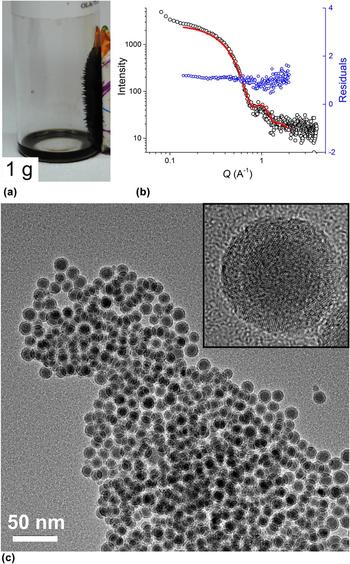
The results of scale-up synthesis of superparamagnetic nanoparticles are shown in Fig. 2. Figure 2(a) shows 1 g of Fe/FexOy core–shell nanoparticles synthesized using the reversible agglomeration mechanism, separated from solution by the application of an external magnetic field. Ensemble SAXS size analysis is given in Fig. 2(b), showing the raw data overlaid with the model fit and corresponding residuals. The model was applied assuming noninteracting nanoparticles, with a spherical shape and Gaussian size distribution as observed in TEM [Fig. 2(c)]. The model fits well with no significant deviations and with low residuals, indicating that the nanoparticles are well suspended in solution. SAXS gave an average size of 15.2 ± 1.2 nm for the nanoparticle ensemble. The resulting Gaussian curve of the size distribution is given in Fig. S1(a). TEM analysis showed the nanoparticles to be uniformly spherical, with an iron oxide shell 2.5 nm thick which forms after the nanoparticle product is exposed to air post-synthesis (inset). The iron oxide shell could be indexed to the (220) and (311) planes of the cubic spinel phase, a characteristic of either magnetite (Fe3O4) or maghemite (γ-Fe2O3) (see Supplementary Material Fig. S2). Unfortunately, TEM is not able to distinguish between the two phases.
(a) 1 g of Fe/FexOy core–shell nanoparticles synthesized using OLA and TOP as surfactants, attracted to an applied external magnetic field. (b) Ensemble SAXS analysis performed on an aliquot of nanoparticles measured an average diameter of 15.2 ± 1.2 nm. (c) Corresponding TEM image. (Inset) High-resolution TEM image showing partial surface oxidation has occurred during the sample preparation step.

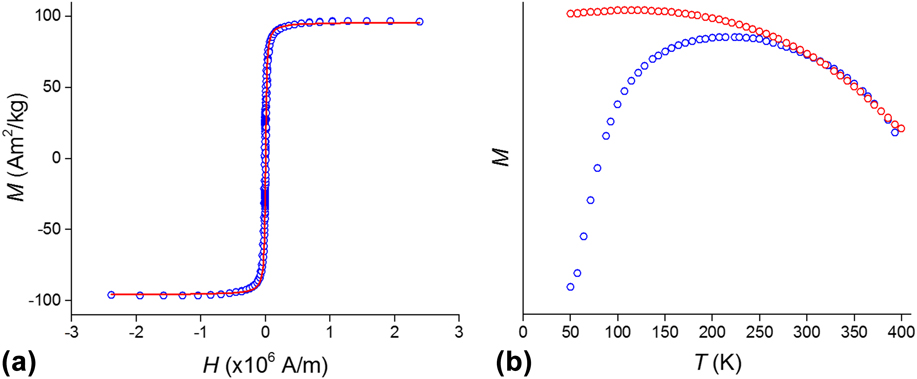
The magnetic properties of the 15.2 ± 1.2 nm Fe/FexOy core–shell nanoparticles were then investigated using vibrating sample magnetometry (VSM), with the results given in Fig. 3. Saturation magnetization, M sat, of the nanoparticles was measured to be 96 Am2/kg at 50 K [Fig. 3(a)]. This is larger than the value expected for magnetite (92 Am2/kg) or maghemite (76 Am2/kg), indicating the presence of a zero-valent iron core. We then fit the M sat curve using the Langevin equation, with the fit shown in Fig. 3(a). The fit gave a magnetic diameter of 10.2 nm, which is consistent with what is observed for the zero-valent iron core observed in TEM.Reference Unni, Uhl, Savliwala, Savitzky, Dhavalikar, Garraud, Arnold, Kourkoutis, Andrew and Rinaldi30 HRTEM (Fig. S1) did not observe lattice spacings of the iron core characteristic of the bcc crystal structure of α-Fe, indicating that the nanoparticles possess either an amorphous core or a distorted lattice.Reference Monson, Ma, Stevens, Lavin, Leger, Klimov and Huber31 Both of which are known to reduce M sat when compared to α-Fe. An additional factor reducing the M sat may be the strong iron–phosphine interaction introducing a magnetically dead layer at the surface.Reference Huber8 ZFC–FC experiments were then performed to identify the blocking temperature, T B, and the corresponding onset of superparamagnetism [Fig. 3(b)]. The measurement time chosen was 100 s, as is typical for DC magnetometry.Reference Concas, Congiu, Muscas and Peddis32 The peak is relatively broad and centered with a T B of 233 K, which is significantly reduced when compared to zero-valent iron nanoparticles of a similar size, due to the presence of the oxide shell.Reference Watt, Bleier, Austin, Ivanov and Huber33 Here, oxidation is beneficial as it ensures that the nanoparticles are superparamagnetic at room temperature. The broadness of the peak indicates that there may be some interparticle interactions occurring in the nanoparticle ensemble, which is a reasonable assumption as the product is measured as an agglomerated magnetic pellet, as is produced from the reversible agglomeration mechanism.Reference Bleier, Watt, Simocko, Lavin and Huber27 At higher frequencies, hysteresis may be observed, and understanding their performance under such switching environments will be essential for their eventual application.Reference Yun, Kim, Paik, Meng, Jo, Kikkawa, Kagan, Allen and Murray34
Magnetic characterization of the 15.2 ± 1.2 nm Fe/FexOy core–shell nanoparticles performed using a VSM. (a) Magnetic moment versus field plot shows that the nanoparticles have a saturation magnetization, M sat, of 96 Am2/kg at 50 K. The M sat curve was fit using the Langevin equation, indicating that the nanoparticles had a magnetic diameter of 10.2 nm. (b) Zero field, cooled-field cooled (ZFC–FC) plot showing a blocking temperature of 233 K, which indicates that the nanoparticles are superparamagnetic at room temperature.

The reversible agglomeration mechanism is characterized by the nucleation and growth of nanoparticles followed by agglomeration and renucleation steps, a cycle that can be repeated indefinitely to reach large scale synthesis.Reference Bleier, Watt, Simocko, Lavin and Huber27 Therefore, to calculate the number of reversible agglomeration cycles needed to synthesize 1 g of Fe/FexOy nanoparticles, we first determine the critical nuclei radius at the reaction temperature of 523 K. The critical nuclei radius is defined byReference Park, Joo, Kwon, Jang and Hyeon35
 $${r_{\rm{c}}} = - {{2\gamma } \over {{G_{\rm{V}}}}}\quad ,$$
where γ is the surface free energy of iron, which at 523 K is equal to 2.3 J/m2.Reference Schonecker, Li, Johansson, Kwon and Vitos36,Reference Grochola, Russo, Yarovsky and Snook37 G v is the Gibbs energy per volume of iron, which in the molten state of Fe(0) nuclei at high temperatures is equal to −1.57 × 10⁹ J/m3.Reference Park, Joo, Kwon, Jang and Hyeon35 As the nanoparticles are being formed under an inert atmosphere and the evolution of CO gas by the decomposition of Fe(CO)5 creates a reducing environment, the nuclei can be assumed to be truly zero-valent iron. Therefore, the critical nuclei radius for Fe(0) at 523 K is 2.93 nm. If we assume that the first drop of precursor nucleates and all iron is consumed by surviving nuclei, then we can calculate how much additional precursor is needed to grow the nanoparticles to their maximum size, before agglomeration occurs. Each individual drop has a volume of ∼10 μL.Reference Tripp, Good, Motta, Kass and Murphy38 Therefore, as we are introducing a 3:1 ODE:Fe(CO)5 precursor mixture, each drop contains 2.5 μL of Fe(CO)5, which equates to 1.06 mg of Fe(0). Taking a nuclei size of 2.93 nm and a density of 7874 kg/m3, we can calculate that each drop contains 1.28 × 10¹⁵ nuclei. Then, for a 1 g reaction, the maximum size before agglomeration is 15.2 nm. Each maximum-sized nanoparticle is therefore calculated to have a mass of 1.45 × 10⁻²⁰ kg. Then, if we consider that each of the 1.28 × 10¹⁵ nuclei has grown to this maximum size, we can calculate that one reversible agglomeration cycle has consumed 1.85 × 10⁻⁵ kg, or 0.0185 g, of Fe(0). Taking the above assumptions and knowing that the final mass of Fe(0) nanoparticles formed is 1 g, we can calculate that a minimum of 54 cycles of reversible magnetic agglomeration have occurred.
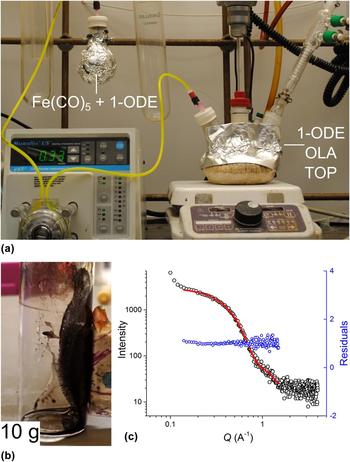
Figure 4 shows the results from scaling-up the reversible agglomeration mechanism by an order of magnitude, to 10 g. At this large scale, a peristaltic pump was needed to deliver sufficient quantities of Fe(CO)5 precursor solution to the reaction flask [Fig. 4(a)]. Likewise, the size of the reaction flask dictates that magnetic stirring is not sufficient, and an overhead stirring setup was required. This introduces challenges with controlling an air-free environment; however, this was achieved by maintaining a positive pressure of flowing nitrogen throughout the reaction. Specific Tygon tubing was chosen with low gas permeability and high chemical resistance, to protect against premature decomposition of the Fe(CO)5. Figure 4(b) shows 10 g of Fe/FexOy core–shell nanoparticles synthesized using the reversible agglomeration mechanism attracted to an external magnetic field. SAXS analysis gave an average diameter of 13.7 ± 2.5 nm for the nanoparticle ensemble [Fig. 4(c)]. Again, the raw data were model fit assuming a spherical shape and Gaussian size distribution [Fig. S1(b)]. TEM analysis showed a slight loss of size and shape control, which can be attributed to thermal and concentration gradients associated with the larger reaction vessel required to carry out the synthesis (Fig. S3). It is also important to note here that the slight deviation from a spherical shape will lead to an increase in the calculated size distribution from the SAXS analysis.Reference Li, Senesi and Lee39 We can then apply the same calculations as above to determine the number of reversible agglomeration cycles needed to synthesize 10 g of 13.7 nm nanoparticles. We calculate that 1.36 × 10⁻⁵ kg of Fe(0) is required for each cycle, therefore the 10 g scale-up reaction is the result of a minimum of 735 cycles of reversible magnetic agglomeration. The number of cycles needed has increased by more than an order of magnitude due to the reduction in overall nanoparticle size. Despite the slight loss of size and shape control, the magnetic properties of the ensemble are expected to be uniform as arresting of nanoparticle growth by magnetic agglomeration is defined by particle susceptibility, not shape.Reference Bleier, Watt, Simocko, Lavin and Huber27
(a) Experimental setup to increase mass output to 10 g; a peristaltic pump is required to deliver such large volumes of iron precursor. (b) 10 g of Fe/FexOy nanoparticles attracted to an external magnetic field. (c) SAXS analysis gave an average size of 13.7 nm ± 2.5 nm.

The 15.2 ± 1.2 nm Fe/Fe3O4 core–shell nanoparticles formed in the 1 g reaction were then used as the magnetic fraction for the formation of a matrix-free superparamagnetic nanocomposite. The nanoparticles are subjected to a ligand exchange procedure in situ, replacing the monoamine OLA and TOP with an alkyl-diamine ligand (1,6-diaminohexane). We fully expect the amine on the surface to be replaced by adsorption dynamics, whereas the TOP has previously been shown to be replaced by ligands with amine functionality.Reference Xu, Qin, Palchoudhury and Bao40 The ligand exchange procedure means the nanoparticles now express an amine functionality into the environment, which is known to be reactive toward cross-linking epoxides. The aminated nanoparticles are then reacted with a triepoxy (n,n-diglycidyl-4-glycidyloxyaniline) in chloroform. The solvent is subsequently removed to give a viscous, workable liquid that can then be cured at elevated temperatures to yield a cross-linked epoxy network characterized by covalent linkages between the magnetic nanoparticles. By crosslinking directly to a species that is covalently bound to the nanoparticle surface, the amount of organic fraction can be reduced substantially when compared to polymeric matrices. This allows for a significant increase in the magnetic fraction, optimizing the magnetic properties of the resulting nanocomposite. This approach also means that the interparticle spacing can be easily tuned, with the choice of alkyl chain length directly determining the distance between particles.
To confirm that the nanoparticles are undergoing a ligand exchange procedure at the surface, we performed ex situ experiments on the Fe/FexOy core–shell nanoparticles to mimic the conditions found during nanocomposite formation. To do this, an aliquot of purified nanoparticles were reacted with a solution containing 1,6-diaminohexane, in chloroform. The aminated nanoparticles were then washed thoroughly to remove any excess ligand not covalently bound to the surface of the particles. We then introduced a small quantity of fluorescamine, which is a spiro compound that forms highly fluorescent pyrrolinones upon reaction with primary and secondary amines.Reference Nakamura and Tamura41,Reference Eastwood, Fernandez, Yoon, Sheaff and Wai42 Following the reaction with fluorescamine, the nanoparticles were washed thoroughly with hexane and methanol using magnetic separation to remove any unreacted fluorescamine. The nanoparticles were then measured using a spectrofluorometer with an excitation wave length of 390 nm. An emission peak at 468 nm was observed, which is a characteristic of the as-formed pyrrolinones (Fig. S4), clearly indicating the presence of covalently bound diamine on the surface of the nanoparticles.Reference Gore43
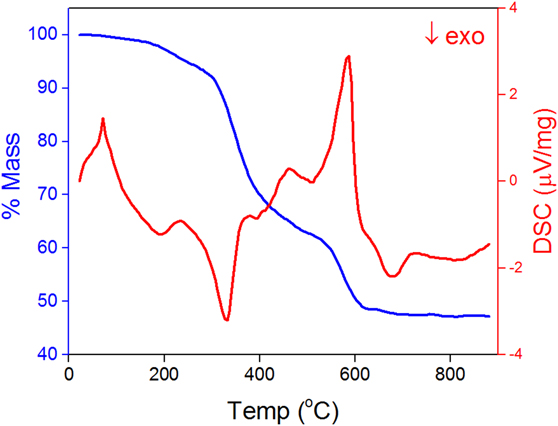
To characterize the nanocomposite, we carried out TGA along with DSC, with the results given in Fig. 5. TGA showed that our nanocomposite possessed 62 wt% of Fe/FexOy nanoparticles, significantly larger than what has previously been reported for magnetic nanoparticles in an epoxy system.Reference Puig, Hoppe, Fasce, Perez, Pineiro-Redondo, Banobre-Lopez, Lopez-Quintela, Rivas and Williams44 This value is also significantly larger than that has previously been prepared by covalent linkage to a nanoparticle surface; Mochalin et al. incorporated up to 14 wt% of nanodiamonds into a covalently linked epoxy-amine network in a similar fashion.Reference Mochalin, Neitzel, Etzold, Peterson, Palmese and Gogotsi17 In the TGA/DSC given in Fig. 5, we observe a number of different features corresponding to the various components that make up the nanocomposite. At around 210 °C, we observed an endothermic peak in the DSC which corresponds to boiling of 1,6-diaminohexane. TGA shows that this fraction accounts for 7 wt% of the nanocomposite, where the slightly higher temperature indicates that this is most likely uncrosslinked diamine that is bound to the nanoparticle surface. At 300 °C, we observe a strong exothermic peak in the DSC, which can be attributed to the high temperature fully completing the curing of the epoxy network.Reference Kessler45 This is followed by a large mass loss observed in the TGA between 300 and 460 °C, which can be attributed to the complete removal of the organic fraction (a further 31 wt%). From 460 to 620 °C, a number of endothermic processes can be observed in the DSC which can be assigned to the evaporation of molecular oxygen from the oxide shell of the nanoparticles. The peak shape matches well with previous observations of iron oxide reduction in alumina.Reference Gao, Shen, Hsia and Chen46 Here, the peak at 460 °C, the shoulder on the peak at 600 °C and the peak at 600 °C correspond to the reduction profile; α-Fe2O3 → Fe3O4 → α-Fe. The peaks are shifted to slightly lower temperatures than previously reported due to the high curvature of the 15.2 nm nanoparticles.Reference Gao, Shen, Hsia and Chen46
TGA and DSC analysis of the cured nanocomposite formed using 1,6-diaminohexane.

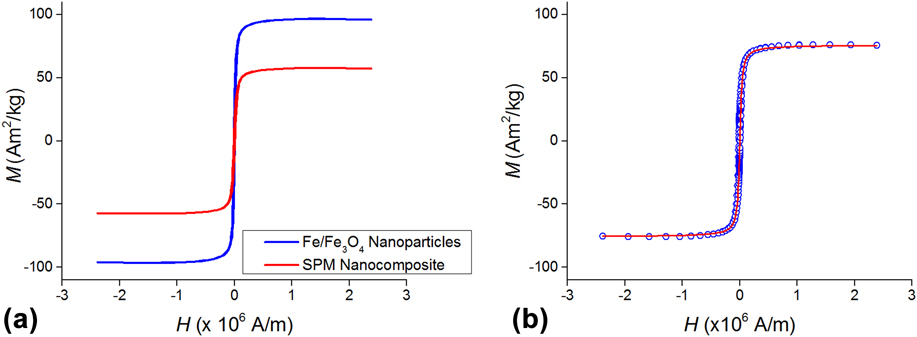
The cured nanocomposite was then characterized using VSM magnetometry, with the results given in Fig. 6. Saturation magnetization, M sat, of the nanocomposite cured using 1,6-diaminohexane was measured to be 58 Am2/kg at 50 K. Initial mass susceptibility of the nanocomposite was observed to reduce from 1.0 × 10⁻³ m3/kg for the Fe/FexOy core–shell nanoparticles to 5.2 × 10⁻⁴ m3/kg for the cured nanocomposite. Using the known mass percentages from TGA, we can then calculate the saturation magnetization of the magnetic nanoparticles themselves in the cured composite, giving a value of 76 Am2/kg [Fig. 6(b)]. The drop in M sat when compared to the as-synthesized nanoparticles indicates that there has been an increase in the magnetically dead layer at the surface. This is most likely due to a further increase in the thickness of the oxide shell, although other factors may be present. Iron catalysts are known to be active in epoxide ring opening transformations, which may lead to irreversible binding at the surface of the nanoparticle and the introduction of a magnetically dead layer.Reference Bolm, Legros, Le Paih and Zani47 While we fully expect the ligand shell to prevent access of the epoxide to the surface, the high liability of the 1,6-diaminohexane, due to the relatively short 6 carbon chain, may allow some finite residence time. To investigate whether the magnetically dead layer has increased during nanocomposite formation, we fit the M sat curve in Fig. 6(b) with the Langevin equation. We calculated that the magnetic diameter had decreased from 10.2 to 9.5 nm.Reference Unni, Uhl, Savliwala, Savitzky, Dhavalikar, Garraud, Arnold, Kourkoutis, Andrew and Rinaldi30 This indicates an increase in the thickness of the oxide shell from 2.5 to 2.9 nm, which also accounts for the overall reduction in initial mass susceptibility as iron oxides possess a lower susceptibility than zero-valent iron.
VSM magnetometry of the as-cured nanocomposite, compared to the as-synthesized Fe/FexOy core–shell nanoparticles. The nanocomposite has an M sat of 58 Am2/kg, compared to 96 Am2/kg for the nanoparticles. The initial mass susceptibility has decreased from 1.0 × 10⁻³ m3/kg to 5.2 × 10⁻⁴ m3/kg. (b) M sat of the magnetic fraction of the nanocomposite only, giving a reduced value of 76 Am2/kg. The M sat curve was fit with the Langevin equation which indicates that the magnetic diameter of the nanoparticles has reduced from 10.2 to 9.5 nm during the curing process.

To investigate the influence on interparticle spacing on the magnetic properties of the superparamagnetic nanocomposite, we then substituted 1,6-diaminohexane with longer alkyl chain diamines, namely 1,8-diaminooctane and 1,12-diaminododecane. Saturation magnetizations, M sat, for the new nanocomposites were measured to be 60 Am2/kg and 62 Am2/kg for 1,8-diaminooctane and 1,12-diaminododecane, respectively. These values are similar to what was observed with 1,6-diaminohexane albeit slightly higher. The slight increase in M sat may be due to the lower water solubility values observed as the alkyl chain length of the diamine increases, which reduces the extent of oxidation during nanocomposite preparation.
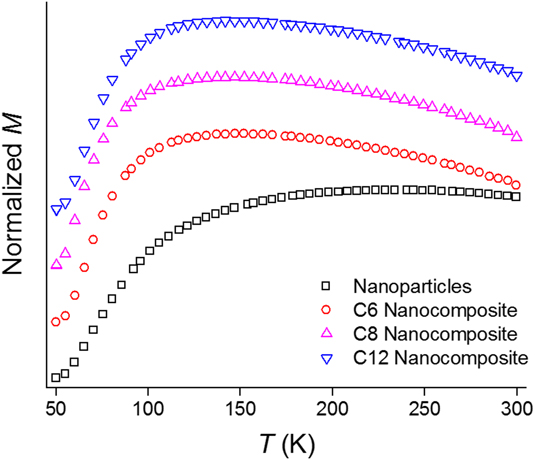
We then performed ZFC experiments to compare the onset of superparamagnetism in various nanocomposites, with the results shown in Fig. 7. The Fe/FexOy core–shell nanoparticles possessed a blocking temperature, T B = 233 K. In comparison, the as-cured nanocomposites possessed blocking temperatures of T B = 147 K, 142 K, and 146 K for 1,6-dimainohexane, 1,8-diaminooctane, and 1,12-diaminododecane, respectively. The reduction in T B is consistent with an increase in the size of the oxide shell on the nanoparticles. The lack of variation in the blocking curves indicates that increasing the alkyl chain length from C6 to C12 still does not significantly change the particle interaction behavior. In fact, this indicates that an alkyl chain length as short as 6 carbons results in good separation of the magnetic fraction, as any magnetic interactions present in the system tends to drive T B higher.Reference Kin, Kura and Ogawa48 The well-defined blocking temperatures located below room temperature indicate that the nanocomposite is still superparamagnetic and there is no evidence for the formation of ferromagnetic domains.
ZFC curves performed using VSM magnetometry. The Fe/FexOy nanoparticles show a broad peak with a blocking temperature, T B, of 233 K indicating that they are superparamagnetic at room temperature. When cured into the superparamagnetic nanocomposite, we observe a reduction in T B to 147 K, 142 K, and 146 K for nanocomposites formed using 1,6-diaminohexane, 1,8-diaminooctane, and 1,12-diaminododecane, respectively.

IV. CONCLUSIONS
In summary, we have developed the synthesis of superparamagnetic Fe/FexOy core–shell nanoparticles in a predictable and reproducible manner such that up to 10 g of the material can be formed in a single reaction. The nanoparticles have high saturation magnetizations and are superparamagnetic at room temperature, thereby addressing the two major requirements for magnetic components in power electronics. We then subject the nanoparticles to a ligand exchange procedure in situ, which replaces the growth directing surfactants with a long alkyl chain diamine ligand. The newly aminated nanoparticles are then able to react with a triepoxide, leading to a covalently bound cross-linked network between the nanoparticle fraction. By using this matrix-free approach, we are able to significantly reduce the organic fraction, leading to 62 wt% loading of Fe/FexOy core–shell nanoparticles, a substantial increase to previous studies. The nanocomposite is superparamagnetic at room temperature and has a large saturation magnetization, despite the observation of further oxidation of the nanoparticle surface. We then show that changing the alkyl chain length of the diamine does not affect the magnetic properties of the resulting nanocomposite, indicating that the magnetic fraction is well separated in the nanocomposite. The resulting superparamagnetic nanocomposite is therefore an exciting candidate as a core material for inductor and transformer technologies.
Supplementary Material
To view supplementary material for this article, please visit https://doi.org/10.1557/jmr.2018.139.
ACKNOWLEDGMENTS
This work was supported by the Laboratory Directed Research and Development program at Sandia National Laboratories. This work was performed, in part, at the Center for Integrated Nanotechnologies, an Office of Science User Facility operated for the U.S. Department of Energy (DOE) Office of Science. Sandia National Laboratories is a multimission laboratory managed and operated by National Technology and Engineering Solutions of Sandia, LLC., a wholly owned subsidiary of Honeywell International, Inc., for the U.S. Department of Energy's National Nuclear Security Administration under contract DE-NA-0003525. The views expressed in the article do not necessarily represent the views of the U.S. Department of Energy or the United States Government.