Introduction
The emerald ash borer, Agrilus planipennis Fairmaire (Coleoptera: Buprestidae), is an invasive pest of ash (Fraxinus Linnaeus; Oleaceae) that probably arrived in North America via contaminated shipping materials from its native range in Asia in the 1990s and went undetected until 2002 (Haack et al. Reference Haack, Jendek, Liu, Marchant, Petrice, Poland and Ye2002; Siegert et al. Reference Siegert, McCullough, Liebhold and Telewski2014). Since its arrival, A. planipennis has killed millions of ash trees in Canada and the United States of America and threatens to spread throughout planted and natural ranges of ash throughout North America (Poland and McCullough Reference Poland and McCullough2006). Deleterious ecological effects, such as canopy gap formation and shifts in biodiversity, are anticipated in infested areas (Gandhi and Herms Reference Gandhi and Herms2010a, Reference Gandhi and Herms2010b; Gandhi et al. Reference Gandhi, Smith, Hartzler and Herms2014). Economic costs related to A. planipennis management in Canada and the United States of America are projected to be CAD$1.5 billion and US$10.7 billion, respectively (Kovacs et al. Reference Kovacs, Haight, McCullough, Mercader, Siegert and Liebhold2010, Reference Kovacs, Haight, Mercader and McCullough2014; McKenney et al. Reference McKenney, Pedlar, Yemshanov, Lyons, Campbell and Lawrence2012). Various long-term management strategies, including chemical and biological control, have been proposed and executed (Herms and McCullough Reference Herms and McCullough2014). Insecticide treatments of individual trees in urban areas have been shown to be effective in preventing A. planipennis establishment (McCullough and Mercader Reference McCullough and Mercader2012). Due to prohibitive costs associated with application, however, widespread use in high-density sites such as forests is not yet possible (Poland and McCullough Reference Poland and McCullough2006). In such areas, biological control using wasp parasitoids may be a more cost-effective and environmentally sound management tactic (Poland and McCullough Reference Poland and McCullough2006; Bauer et al. Reference Bauer, Liu, Miller and Gould2008).
Surveys conducted in China shortly after the discovery of A. planipennis in North America identified three hymenopteran parasitoids – Tetrastichus planipennisi Yang (Hymenoptera: Eulophidae), Spathius agrili Yang (Hymenoptera: Braconidae), and Oobius agrili Zhang and Huang (Hymenoptera: Encyrtidae) – that attack the beetle; these have since been studied and reared, and all of which have been released in several states in the United States of America (Liu et al. Reference Liu, Bauer, Gao, Zhao, Petrice and Haack2003; Bauer et al. Reference Bauer, Liu, Miller and Gould2008; United States Department of Agriculture, Animal and Plant Health Inspection Service 2015). Two species, O. agrili and T. planipennisi, have been released in Canada (D.B.L., personal observation). Although surveys in 2003 showed natural enemy parasitism to be low (Liu et al. Reference Liu, Bauer, Gao, Zhao, Petrice and Haack2003), recent studies in Ontario and several states in the United States of America indicated that parasitism of A. planipennis by indigenous parasitoids has increased substantially (Duan et al. Reference Duan, Fuester, Wildonger, Taylor, Barth and Spichiger2009, Reference Duan, Ulyshen, Bauer, Gould and Driesche2010, Reference Duan, Bauer, Abell and Van Driesche2012; Lyons Reference Lyons2010). In southwestern Ontario, natural enemy surveys suggest that the koinobiont endoparasitoid Phasgonophora sulcata Westwood (Hymenoptera: Chalcididae) attacks A. planipennis regularly and may be a possible candidate for use as an augmentative biological control agent (Lyons Reference Lyons2010). Phasgonophora sulcata attacks native buprestids, including A. anxius Gory (Loerch and Cameron Reference Loerch and Cameron1983), A. liragus Barter and Brown (Barter Reference Barter1965), A. bilineatus (Weber) (Haack et al. Reference Haack, Benjamin and Schuh1981), and Chrysobothris Eschscholtz (Bouček et al. Reference Bouček, Halstead, Gibson, Huber and Woolley1997), and is estimated to parasitise ~40% of A. planipennis in some sites in southwestern Ontario (Lyons Reference Lyons2010). Consequently, studies evaluating the potential effectiveness of this parasitoid as an augmentative biological control agent were recently initiated (Roscoe Reference Roscoe2014).
For a parasitoid species to be used in a biological control programme, its basic natural history as it pertains to the target host must be determined (DeBach and Rosen Reference DeBach and Rosen1991). Adult longevity, fecundity, emergence times, and flight period are essential for both insect production and evaluating parasitoid efficacy in the field (Huffaker and Messenger Reference Huffaker and Messenger1976). Although adult longevities, sex ratios, and emergence times for P. sulcata reared from A. bilineatus are known (Haack et al. Reference Haack, Benjamin and Schuh1981), its interactions with A. planipennis are completely unknown. Parasitoid development is greatly influenced by the species from which it is reared (Quicke Reference Quicke1997; Arakawa et al. Reference Arakawa, Miura and Fujita2004), therefore it is essential that evaluations of P. sulcata as a biological control agent for A. planipennis are based on life-history aspects of individuals reared from the target host. Observations of temporal and spatial distributions of natural populations are also important, as temporal and spatial asynchrony of the adult parasitoid with preferred host stage can limit wasps from effecting appreciable amounts of mortality required for pest management (DeBach and Rosen Reference DeBach and Rosen1991; Collier and van Steenwyk Reference Collier and van Steenwyk2004). This information for P. sulcata does not exist, and must be acquired if the usefulness of P. sulcata as an effective natural enemy is to be established.
Herein, we analyse several life-history traits for P. sulcata in relation to A. planipennis in the laboratory and the field. We examined adult longevity, sex ratios, age-specific fecundity, and the presence of superparasitism and multiparasitism in P. sulcata in specimens reared in the laboratory from A. planipennis, and observed flight periods and emergence times for P. sulcata collected from several sites over several years in southwestern Ontario. We also observed distributions of P. sulcata within infested trees and the immature development of both P. sulcata and A. planipennis during the season. These results will provide important information that will be useful in developing potential rearing programmes using P. sulcata and for determining the potential effectiveness of this indigenous natural enemy in areas affected by A. planipennis.
Methods
Emergence, parasitism, sex ratio, and longevity
To determine the emergence pattern of P. sulcata relative to its host A. planipennis, the sex ratio of emerging parasitoids, and the rate of parasitism at emergence, infested logs were collected from sites in southwestern Ontario in December 2009 and 2010 and returned to the laboratory in Sault Ste. Marie, Ontario. Green ash (Fraxinus. pennsylvanica Marshall) trees were felled in a plantation at the W. Darcy McKeough Dam Floodplain, Duthill, Ontario (latitude/latitude: 42.69467°N, 82.40414°W) in 2009. In 2010, green ash trees were felled in a private woodlot (42.65918°N, 81.59400°W) 4.4 km west of Dutton, Ontario. The main boles of the trees were cut into ~40 cm long bolts for ease of handling and shipping. Bolts were stored in a shipping container out of doors until March of the following year and then moved indoors into a controlled environment chamber at 4 °C until required. Periodically, samples of bolts were taken out of cold storage and housed at 21 °C with a 16:8 (light:dark) photoperiod to allow beetles and their parasitoids to emerge. The length of time to emergence at 21 °C and the sex of the adult insect were recorded. The percentage of parasitoids that were female and the percentage parasitism were determined.
To obtain adults for longevity determination, parasitoids were reared from ash bolts collected from five locations in Essex County, Ontario, Canada in 2008 (42.06297°N, 82.82562°W; 42.06576°N, 82.89115°W; 42.06257°N, 82.89026°W, 42.11445°N, 82.92274°W; 42.06290°N, 82.82612°W), and from both the W. Darcy McKeough Dam Floodplain and the Sarnia Golf and Curling Club, Sarnia, Ontario (42.99265°N, 82.39883°W) in 2009 and 2010. Following emergence from the log bolts, adults were kept in sex-specific groups in 355-mL plastic cups, with up to eight parasitoids per cup. Cups were covered with plastic lids with the centres removed and replaced with aluminum mesh screens to facilitate air circulation. Insects were held at 21 °C and a 16:8 (light:dark) photoperiod. These were parameters were used as they replicated the approximate environmental conditions at the southern Ontario sites from where the insects were collected. Parasitoids were provided with water from a 12-mL vial plugged with two cotton dental wicks and a strip of synthetic fabric, and a few drops of honey smeared onto the wire mesh of the lid. Water and honey were both replaced every 2–3 days. Parasitoids were observed every 1–2 days, and time from emergence to death was recorded. Parasitism was calculated by dividing the number of emerged wasps by the total number of beetles and wasps recovered.
Age-specific potential fecundity
Females of P. sulcata aged 0 (i.e., newly emerged), 5, 10, 15, 20, 25, 30, 45, and 50 days old reared largely from material retrieved from the W. Darcy McKeough Dam Floodplain site in 2010 were freeze-killed by holding them at −20 °C for 10 minutes. Between 11 and 15 females were examined for each age class. Parasitoids were dissected underneath a dissecting microscope. The abdomen was first removed from the female and then cut open dorsally using a pair of micro-scissors. The ovaries were removed from the abdomen using an insect pin and were placed on a glass microscope slide. A drop of 1% acetocarmine was applied to the ovaries using a bulb pipette. Acetocarmine stained immature eggs purple, whereas mature eggs remained white as their thicker chorions prevented absorption (Edwards Reference Edwards1954). After one minute of absorption, the ovaries were rinsed with saline solution on the microscope slide, and a cover slip was placed over them. All eggs undergoing reabsorption, identified by the presence of degenerating chorions, and mature eggs, identified by the presence of complete chorions, were counted to determine the total mature egg complement for each ovary. The length of five mature eggs from each female was also measured using an ocular micrometer attached to a compound microscope to determine their dimensions.
Flight period
Monitoring of the adult flight periods of A. planipennis and P. sulcata was conducted at the W. Darcy McKeough Dam Floodplain site in 2010. Sticky band traps consisted of 50-cm-wide bands of plastic shrinkwrap (Catalogue Number 498385, Staples, Business Depot, Markham, Ontario, Canada) wrapped about three times around the trunks of 30 ash trees, with a mean (±SE) diameter at breast height (DBH) of 11.7±0.41 cm (size range 7.8–18.0 cm). The bottom edge of the band was approximately 1.4 m above the ground. Bands were coated with Pestick (Catalogue Number 4002, Phytotronics Inc., Earth City, Missouri, United States of America) applied by hand. Traps were deployed on 11 May 2010 and sampled on 1 June, 16 June, 28 June, 12 July, 26 July, 16 August, and 12 September, when they were removed. Adults of A. planipennis and P. sulcata were collected off the traps using forceps and placed into vials containing a solvent (Histo-Clear II, National Diagnostics, Atlanta, Georgia, United States of America) to dissolve the Pestick. Upon return to the laboratory, vials were immersed in water in a heated ultrasonic cleaner (Model FS30H, Fisher Scientific Company, Ottawa, Ontario, Canada) to remove the glue from the insects. Insects were sexed and counted, then pinned or stored in vials containing 70% ethanol.
Within-tree and seasonal distributions of Phasgonophora sulcata
Within-tree and temporal distributions of P. sulcata were investigated at the W. Darcy McKeough Dam Floodplain site from 27 May 2010 to 28 August 2010. The site consisted of rows of green ash, silver maple (Acer saccharinum Linnaeus; Sapindaceae), and poplar (Populus Linnaeus; Salicaceae) planted along a central gravel road. Tree rows adjacent to the road were silver maple, the next four rows were ash and the last rows beyond were poplar. Trees were planted in 1984 at regular intervals on a north–south axis and contained 30 ash trees in each row. At the time of sampling, the mean (±SE) height of ash trees in the stand was 10.4±0.3 m (n=29), and mean (±SE) DBH was 10.8 cm±0.5 (n=24). Mean (±SE) tree bark thickness at 30 cm was 6.0±0.2 mm (n=29).
On each sampling date, three trees that showed beetle signs and symptoms, such as epicormic shoots, canopy dieback, and “D”-shaped exit holes (de Groot et al. Reference de Groot, Biggs, Lyons, Scarr, Czerwinski and Evans2006), were selected and dissected. Infestations were confirmed by dissection. Selected trees were felled, and DBH recorded. Beginning at the base of the main trunk, trees were cut into eight 60-cm-long logs (labelled sequentially from “1” to “8”). Each log section represented a height level, beginning with height level “1” at 0–60 cm, and increasing in 60-cm increments to height level “8” at 420–480 cm. For each log, the top and bottom diameters were recorded, and each was debarked with a drawknife (Veritas Carver’s, Lee Valley Tools, Ottawa, Ontario, Canada) to collect all insects.
All A. planipennis and P. sulcata individuals from larval galleries and pupal chambers were collected from each log. Current-year A. planipennis and P. sulcata exit holes were also counted. A “current” exit hole was associated with a larval gallery that contained tightly packed, light-coloured frass and displayed very little or no callous tree tissue (Timms et al. Reference Timms, Smith and De Groot2006). “Old” exit holes, containing loosely packed, dark frass and large amounts of callous tissue, were not counted. The determination of exit holes as either “current” or “old” was based on visual inspection.
All A. planipennis larval specimens were placed in 20-mL scintillation vials (Kimble Chase, Vineland, New Jersey, United States of America) containing 70% ethanol. Each vial was labelled with the date of collection and the log from which they were removed. Specimens from pupal chambers were placed in single wells of a 12-well culture plate (BD Biosciences, San Jose, California, United States of America), identified by log. All insects were classified and counted by log using the categories: A. planipennis larva (first, second, third, and fourth instar), pupa, or adult; and P. sulcata early/mid-instar larva, larva-pupa, and pupa-adult. Specimens designated “early/mid-instar larva” were retrieved from A. planipennis larval specimens, all of which were dissected with microscissors within three to five days after collection to determine if they contained a P. sulcata larva. Specimens were designated as “larva-pupa” and “pupa-adult” according to the degree of sclerotisation of the thorax and abdomen: (1) larva-pupa=no visual sclerotisation, and (2) pupa–adult=sclerotisation. Host larval instar was determined by measuring peristoma width using a micrometer (Loerch and Cameron Reference Loerch and Cameron1983). All P. sulcata early/mid-instars were found within A. planipennis larvae, whereas larva-pupa and pupa-adult P. sulcata were all recovered from host pupal chambers.
To minimise any potential effects of time or multiple parasitoid generations on our calculations, spatial distributions were calculated using only trees sampled before peak adult emergence from 27 May to 28 June. Total parasitism within a height level was determined by dividing the sum of all P. sulcata recovered by the sum of all A. planipennis (parasitised and non-parasitised) recovered within each height level. To determine the seasonal distribution of A. planipennis and P. sulcata, all life stages for each species were converted to a proportion of the total number of insects by date. Current-year exit holes were included for within-tree analysis but were not taken into account for the temporal analysis. The proportions of superparasitised/multiparasitised hosts out of all parasitised hosts were also determined.
Statistics
All data analyses were conducted using SigmaPlotTM 12.0 (Systat Software Inc., San Jose, California, United States of America). To compare median emergence times between A. planipennis and P. sulcata, and between males and females of P. sulcata, Mann–Whitney rank sum tests were used. Longevity times for adults of P. sulcata that emerged from ash bolts collected in all three years (2008–2010) were pooled for analysis. The survival curves were compared using Kaplan–Meier survival analysis with a Gehan–Breslow test.
A one-way analysis of variance (ANOVA) was used to determine if the mean number of viable mature eggs was significantly affected by parasitoid age. Means were compared using post hoc Tukey tests. To determine if parasitoid age had an effect on the mean number of reabsorbed eggs, a Kruskall–Wallace one-way analysis of variance on ranks test was used, with means compared using Dunn’s method. Spatial distributions of P. sulcata were compared against height using a Kruskall–Wallis one-way analysis of ranks. A significance level of P<0.05 was assumed for all statistical results.
Results
Emergence, sex ratio, parasitism, and longevity
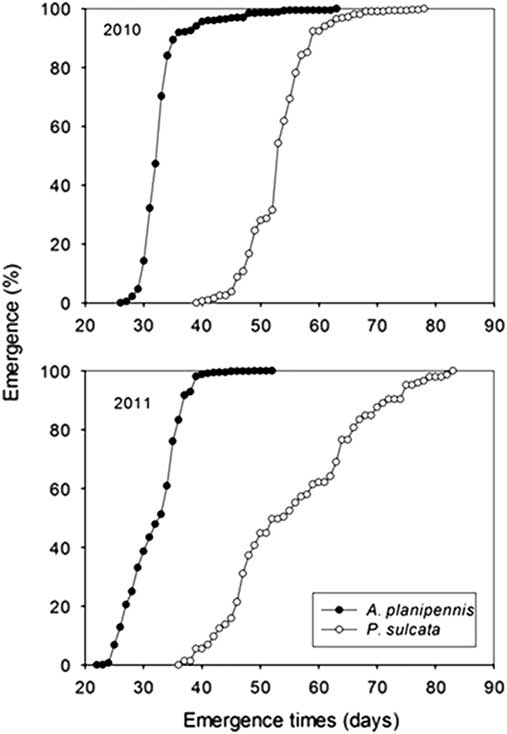
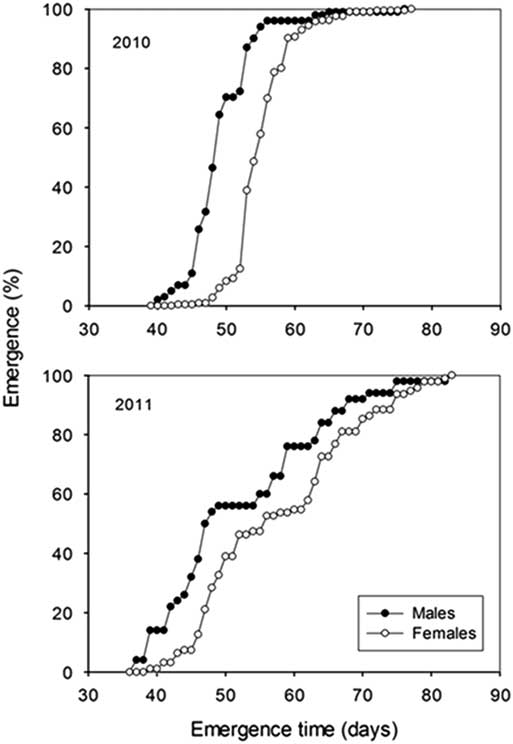
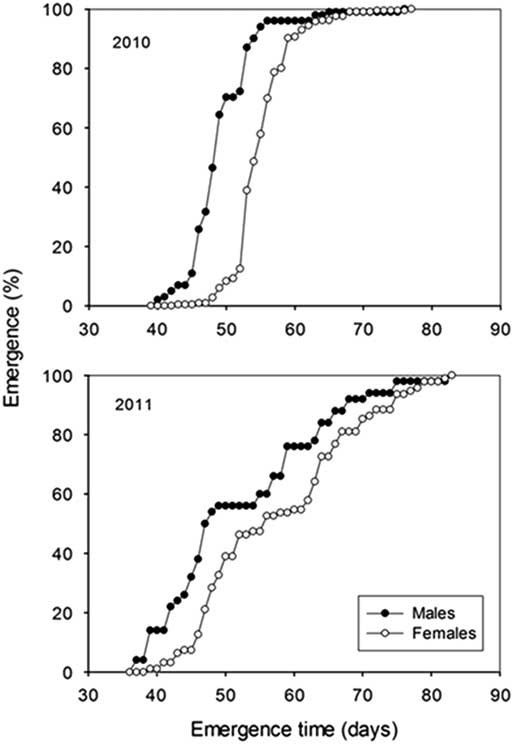
Totals of 604 and 1373 adults (including dead adults that were detected in rearing cages at the end of rearing periods) of A. planipennis emerged in 2010 and 2011 from the log bolts collected in 2009 and 2010, respectively. Mean (±SE) emergence times for the two years were 33.3±0.18 days (n=596) and 32.2±0.21 days (n=1334), respectively (Fig. 1). In 2010, 317 adults (101 males and 216 females) of P. sulcata emerged from the bolts, with a mean emergence time of 53.5±0.30 days (49.6±0.50 days for males (n=101) and 55.4±0.29 days for females (n=216)) (Fig. 2). In 2011, 182 adults (60 males and 122 females) of P. sulcata emerged from the bolts with a mean emergence time of 56.1±0.96 days (52.5±1.62 days for males (n=50) and 57.9±1.14 days for females (n=95)) (Fig. 2). The percentage of females emerging from 2009 and 2010 collections was 61.8% and 67.0%, respectively. Percent parasitism of A. planipennis by P. sulcata at emergence for the two years was 34.4% for log bolts collected in 2009 and 11.7% for log bolts collected in 2010. For both years, the median emergence date for P. sulcata was significantly later than the median emergence date for A. planipennis (2010, Mann–Whitney U statistic=2356.5, P<0.001; 2011, Mann–Whitney U statistic=908.0, P<0.001) (Fig. 1). Adults of P. sulcata displayed protandrous emergence, with the median male emergence time significantly earlier than the median female emergence time in both years (2010, Mann–Whitney U statistic=3096.5, P<0.001; 2011, Mann–Whitney U statistic=1641.0, P=0.002). Although mean emergence dates of P. sulcata for the two years were similar, emergence in 2011 was more protracted than emergence in 2010 (Fig. 2). The mean longevity times for males (n=150) and females (n=295) of P. sulcata were 23.8±1.10 and 28.9±1.11 days, respectively. The survival curves for males and females were not significantly different (Gehan–Breslow statistic=3.693, df=1, P=0.055).
The cumulative emergence patterns, in the laboratory at 21°C, for adults of Agrilus planipennis and Phasgonophora sulcata from ash bolts collected in southwestern Ontario, Canada in December 2009 and 2010.

The cumulative emergence patterns, in the laboratory at 21°C, for males and females of Phasgonophora sulcata from ash bolts collected in southwestern Ontario, Canada in December 2009 and 2010.
Potential and age-specific fecundity
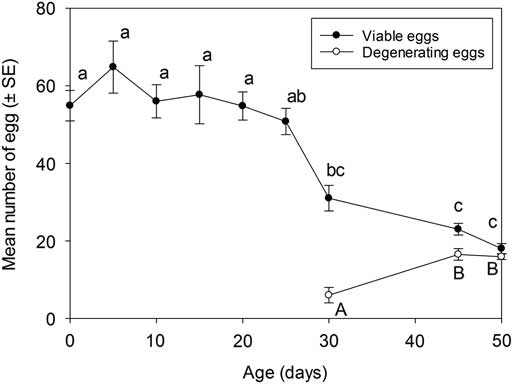
Mean total mature egg complement was not significantly different from emergence (0 days) to 50 days old (one-way ANOVA, P>0.05). Mean viable egg complement (±SE) for adult females of P. sulcata at emergence (0 days old) was 55.7±2.9 eggs (Fig. 3). At 50 days, mean viable egg complement (±SE) (34.6±1.67 eggs) was significantly less than that at emergence. This was significantly less than that at 25 days, but was not significantly less than egg loads at 30 days (Fig. 3).
The effect of age on mature viable egg load (mean±SE) and number of eggs (mean±SE) undergoing oosorption in adult female Phasgonophora sulcata. Different letters indicate significant (one-way ANOVA, P<0.05) differences between age categories. Capital letters represent significant differences between age categories for eggs undergoing oosorption, and lower-case letters represent significant differences between age categories for the mean number of mature viable eggs.

Oosorption was not observed until parasitoids were 30 days old (Fig. 3). The mean number of reabsorbed eggs at 30 days was significantly less than the mean number at 45 (16.5±1.5 eggs) and 50 days (15.9±0.7 eggs) (Kruskall–Wallace analysis of ranks P<0.05). There was no significant difference between egg complements at 45 and 50 days (P<0.05). Mature eggs of P. sulcata adult females were sausage shaped and hymenopteriform. When viewed under a dissecting microscope, the eggs appeared to be smooth, white, and opaque. Mean (±SE) egg length was 417.7±0.01 μm (n=30). Eggs were approximately three times as long as they were wide.
Flight period
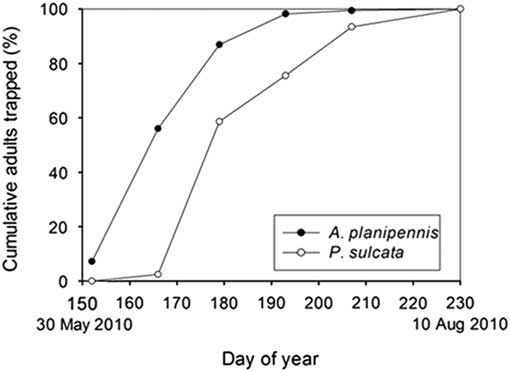
The cumulative captures of A. planipennis and P. sulcata on sticky band traps are shown in Figure 4. A total of 687 adults (164 males and 525 females) of A. planipennis and 1170 adults (735 males and 435 females) of P. sulcata were captured on the traps. Based on these samples alone, parasitism rates would be estimated to be 63.0%, but these figures probably represent differential behaviour responses of males and females to the traps. In addition, the lower percentage of females (37.2%) of P. sulcata captured on the traps compared with males is very different than the proportion of females at emergence that we report here. The interpolated estimate of peak flight (50%) for A. planipennis (14 June) is 13 days earlier than the estimated peak flight of P. sulcata (29 June). Interpolated 95 percentile of the flight period was completed by 8 July and 1 August for the host and the parasitoid, respectively. A few stragglers of each species were captured after 16 August.
The flight period of Agrilus planipennis and Phasgonophora sulcata as indicated by the cumulative capture of adults on sticky-band traps at the W. Darcy McKeough Dam Floodplain, Duthill, Ontario, Canada in 2010.

Within-tree distribution of Phasgonophora sulcata and incidence of superparasitism
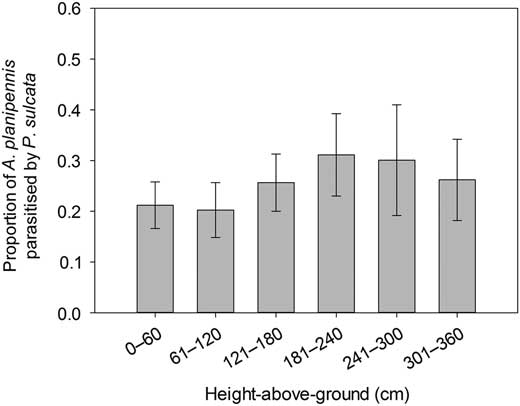
Parasitism by P. sulcata was observed at all heights up to 360 cm, but was not observed at the 360–420 and 420–480-cm height levels (Fig. 5). Parasitism was not significantly different across height levels up to 360 cm (Kruskall–Wallis one-way analysis of ranks H statistic=1.34, P=0.931, df=5). Mean overall parasitism across all height levels was 23.1±2.80%. At the McKeough Dam in 2010, 1.6% of A. planipennis parasitised by P. sulcata were superparasitised (n=180). Multiparasitism was never observed at any site.
Mean (±SE) proportion of Agrilus planipennis parasitised by Phasgonophora sulcata at different height levels above the ground in ash trees at the W. Darcy McKeough Dam Floodplain, Duthill Ontario, Canada from 27 May to 29 June 2010.

Seasonal distributions of Agrilus planipennis and Phasgonophora sulcata
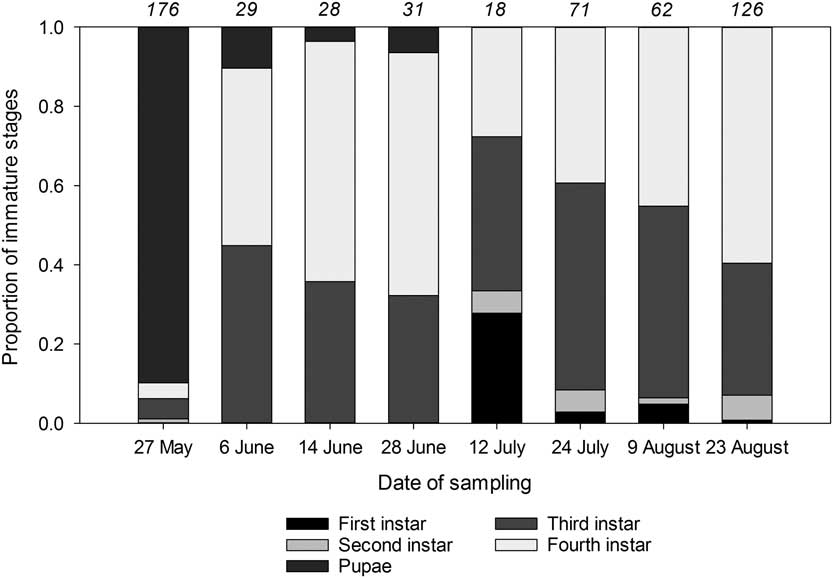
On 27 May, 89.6% of A. planipennis were pupae residing in pupal chambers constructed in the either the bark or sapwood (Fig. 6); the remaining 10.4% were second instars, third instars, or fourth instars that had overwintered as feeding A. planipennis larvae. By 6 June, many A. planipennis pupae had emerged as adults; A. planipennis remaining in trees on this date were either overwintered larvae or a few remaining pupae yet to emerge. These proportions remained unchanged until 12 July, when early instar progeny of the adult population emerging that year (2010) were first observed. From this point until the end of the summer, the proportion of early instar A. planipennis larvae decreased as they grew into third instars and fourth instars. On the final sampling date, 93.4% of A. planipennis were third instars or fourth instars, with the remaining proportion being first instars and second instars.
Proportion of Agrilus planipennis within ash trees by sample date at the W. Darcy McKeough Dam Floodplain, Duthill, Ontario, Canada in 2010. The numbers above each sample bar represents the total number of A. planipennis individuals recovered from within sampled trees.

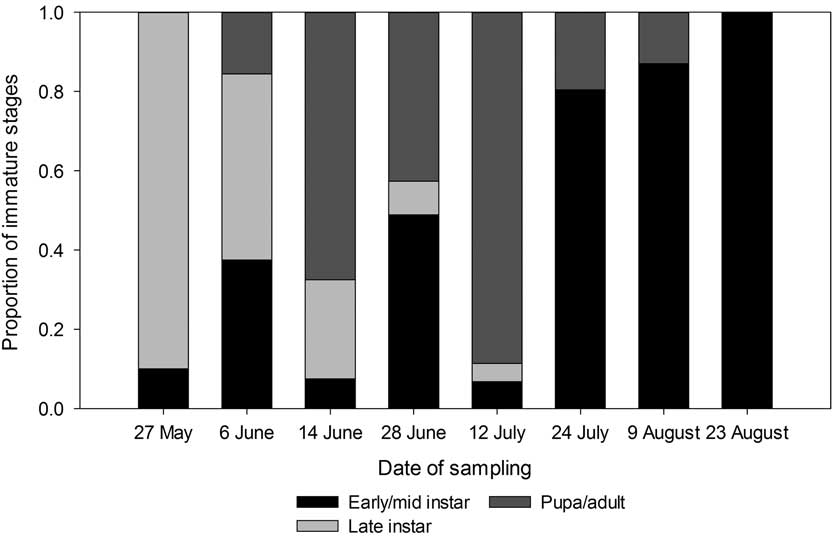
On 27 May, 90.0% of P. sulcata were found as larvae-pupae inside the A. planipennis pupal chambers (Fig. 7); the remaining were early instar endoparasitoids of the overwintering A. planipennis larval cohort. Pupa-adult P. sulcata were first observed on 6 June; they comprised 67.5% of the sampled population by 14 June. On 28 June, the progeny of the emerging P. sulcata were first observed as early instar parasitoids in A. planipennis larval hosts; similar proportions were also seen on 12 July. By 24 July, 80.4% of within-tree P. sulcata were early instar endoparasitoids of A. planipennis larvae; the remaining parasitoids were pupa-adult P. sulcata yet to emerge. The early instar proportion continued to grow in subsequent sampling events until 23 August, when they comprised 100% of the within-tree P. sulcata population.
Proportion of Phasgonophora sulcata within Agrilus planipennis-infested ash by sample date at the W. Darcy McKeough Dam Floodplain, Duthill, Ontario, Canada in 2010. The number above each sample bar represents the total number of P. sulcata individuals recovered from within sampled trees.

Discussion
We observed several life-history attributes of P. sulcata reared from A. planipennis, including adult survival, sex ratios, emergence patterns, and age-specific fecundities. We also described the developmental cycle, within-tree distributions, and adult flight periods of naturally occurring populations. Our results represent some of the first detailed biological information on P. sulcata in relation to A. planipennis, as well as some of the first detailed documentation of a natural enemy attacking A. planipennis in Canada. This information will be useful in determining if P. sulcata is to be reared and potentially used as an augmentative biological control agent for A. planipennis.
Parasitism rates by P. sulcata at some sites, specifically the W. Darcy McKeough Dam Floodplain site, were comparable to classical biological control agents currently being used in the United States of America. In the native range of A. planipennis, parasitism by T. planipennisi and S. agrili is 22.4% and 30–50%, respectively (Yang et al. Reference Yang, Strazanac, Marsh, Van Achterberg and Choi2005; Liu et al. Reference Liu, Bauer, Miller, Zhao, Gao and Song2007). In release plots in Michigan, United States of America, parasitism by T. planipennisi was 21% in treatment plots (Duan et al. Reference Duan, Bauer, Abell, Lelito and Van Driesche2013a), whereas parasitism by S. agrili was 18% at one release site in Michigan in 2008 (Gould et al. Reference Gould, Fraser, Yang, Wang, Mastro and Williams2009) but has rarely been recovered since (Duan et al. Reference Duan, Bauer, Abell, Lelito and Van Driesche2013a). Parasitism by another classical biological control agent, the egg parasitoid O. agrili, was 19% in treatment plots (Abell et al. Reference Abell, Bauer, Duan and Van Driesche2014). As rates were similar or in some cases higher than those for classical biological control agents released in Michigan, and in some cases in China, it appears that P. sulcata could be extremely useful as an augmentative biological control agent. An important reason behind the substantial amounts of parasitism is the synchronisation of P. sulcata emergence with the availability of the preferred early instar host stage. At the W. Darcy McKeough Dam Floodplain, we observed that peak adult flight period was highest at the end of June just before the presence of early instars of A. planipennis in early July. As mean female longevity is approximately 30 days, and mean potential fecundity is still near its maximum levels at 10–15 days old, it appears that P. sulcata is both temporally and reproductively synchronised with the availability of the preferred early instar host larval stage. Protandrous emergence, whereby males emerged earlier than females, is also present, thus maximising the potential that females will be mated and can produce female eggs when attacking hosts. Synchronisation between adult parasitoid emergence and availability of the preferred host stage ensures an interaction between the two insects and is critical for the success of a biological control programme (Huffaker and Messenger Reference Huffaker and Messenger1976; Collier and van Steenwyk Reference Collier and van Steenwyk2004). Our emergence data are also consistent with emergence times of P. sulcata reared from North American Agrilus Curtis, such as A. bilineatus, which emerge ~20 days after host emergence (Haack et al. Reference Haack, Benjamin and Schuh1981). Synchronisation with native Agrilus is also important for sustaining natural enemy populations in areas where the target host is not present or if target host densities are low (DeBach and Rosen Reference DeBach and Rosen1991; Van Driesche and Bellows Reference Van Driesche and Bellows1996). It is possible that high P. sulcata densities associated with A. planipennis populations could result in adverse non-target effects on native buprestids, however, the host from which a parasitoid was reared from has been observed to influence host preference of the adult parasitoid (Storeck et al. Reference Storeck, Poppy, van Emden and Powell2000; Li et al. Reference Li, Miller and Sun2009). It may be possible that P. sulcata adults reared from A. planipennis could prefer the host which they were reared from over alternate hosts. Future studies analysing the non-target effects of P. sulcata on native buprestids are required to explore these potential effects.
Our results suggest that, whereas naturally occurring populations may parasitise large numbers of A. planipennis, mass rearing of P. sulcata may not be possible. Based on the solitary peak in capture of adult P. sulcata on 29 June and distributions in the development of immature stages thereafter, it is likely that P. sulcata is univoltine. Mass rearing of multivoltine gregarious parasitoids is preferred due to the ability to generate large numbers of parasitoids from relatively few hosts over a short amount of time. For example, the Chinese parasitoids S. agrili and T. planipennisi possess generation times of ~25 and 28 days, respectively (Wang et al. Reference Wang, Yang, Wu, Liu, Wang and Bai2007; Duan et al. Reference Duan, Oppel, Ulyshen, Bauer and Lelito2011). Hosts parasitised by T. planipennisi can produce up to 122 individuals per host, each adult can be stored for up to 10 weeks (Duan et al. Reference Duan, Oppel, Ulyshen, Bauer and Lelito2011). Based on these parameters, many thousands of these parasitoids can be produced and stored until required (United States Department of Agriculture, Animal and Plant Health Inspection Service 2012). Our results suggest that P. sulcata requires ~10 months to complete one generation, with mass rearing being further hampered by the 1:1 ratio of parasitoid to host. Therefore, other means of insect production and dissemination should be investigated if P. sulcata populations are to be augmented. One possible method may be the attraction and/or retention of populations using attractive semiochemicals, several of which have already been observed to elicit behavioural responses in P. sulcata females (Roscoe Reference Roscoe2014). This strategy has been effective in aggregating parasitoids to and increasing parasitism in areas of low natural enemy densities (Gross et al. Reference Gross, Lewis, Jones and Nordlund1975; Lewis et al. Reference Lewis, Jones, Nordlund and Sparks1975; James Reference James2003) and could be useful for increasing local P. sulcata population densities where required. Another possible strategy is the dispersal of logs containing parasitoids, a strategy that has been successfully used in the dispersal and establishment of parasitoids of Sirex noctilio Fabricius (Hymenoptera: Siricidae) (Haugen and Underdown Reference Haugen and Underdown1990) in Australia. Studies investigating both methods of augmentation are currently underway.
Apart from heights above 360 cm where A. planipennis was rarely found (L.E.R., personal observation), we observed that P. sulcata parasitism was not statistically affected by tree height. Although parasitoid communities can vary across tree heights (Van Laerhoven and Stephen Reference Van Laerhoven and Stephen2002), the most influential factor in parasitism of wood-boring hosts is bark thickness. Concealed hosts can only be accessed if the adult female parasitoid can penetrate the substrate in which the host resides (Quicke Reference Quicke1997). With the exception of species that forage through host-generated tunnels, parasitism rates will decrease if substrate thickness exceeds ovipositor length (Udayagiri and Welter Reference Udayagiri and Welter2000; Wang et al. Reference Wang, Johnson, Daane and Yokoyama2009). Measurements of a number of ovipositors excised from P. sulcata adults showed that ovipositor length was ~6.4 mm, with the maximum length being 7.1 mm (Roscoe Reference Roscoe2014). We observed here that mean bark thickness for trees at this site was 6.0±0.2 mm. Therefore, as ovipositor length exceeds bark thickness, the lack of height effect observed in this study would be expected. Trunk bark thickness in ash trees correlates strongly with tree size (Timms et al. Reference Timms, Smith and De Groot2006), thus it is likely that parasitism by P. sulcata in the lower boles of larger trees will decrease as tree size increases. Spatial asynchrony could be a contributing factor to lower amounts of P. sulcata parasitism observed at the Dutton site in 2010, where trees were considerably larger, and potentially at other sites of similar composition (Liu et al. Reference Liu, Bauer, Gao, Zhao, Petrice and Haack2003; Duan et al. Reference Duan, Fuester, Wildonger, Taylor, Barth and Spichiger2009, Reference Duan, Taylor, Fuester, Kula and Marsh2013b). Within-tree studies similar to ours at other sites are necessary to confirm this. In sites containing trees similar in height (10.4±0.3 m) and age (~26 years old) or smaller to those sampled here, P. sulcata parasitism should not be limited by bark thickness.
Although three exotic parasitoids in the United States of America have been studied and released for use against A. planipennis, little information concerning natural enemies in Canada exists. Our study represents one of the first detailed descriptions of the interactions between a natural enemy and A. planipennis in Canada. Although mass rearing is unlikely due to the long developmental cycle, the relatively high amounts of parasitism and synchrony between natural populations of P. sulcata and the preferred host stage are strong indicators of potential applicability. Although projects including the development of effective detection techniques using semiochemicals are currently underway, studies that determine the influence of stand-level characteristics such as density, species composition, and host density are required as P. sulcata parasitism greatly varies between sites (Liu et al. Reference Liu, Bauer, Gao, Zhao, Petrice and Haack2003; Duan et al. Reference Duan, Fuester, Wildonger, Taylor, Barth and Spichiger2009, Reference Duan, Ulyshen, Bauer, Gould and Driesche2010; Roscoe Reference Roscoe2014). Investigations into the compatibility of using P. sulcata in conjunction with other biological control agents are also necessary. Results from these studies will further contribute to predicting the usefulness of indigenous natural enemy populations in A. planipennis management in Canada and beyond.
Acknowledgements
The authors thank G. Jones (Natural Resources Canada, Canadian Forest Service) for technical assistance, and R. van Driesche, T. Smith, D.C. Darling, P. Kotanen, C. Simpson for commenting on an earlier version of the manuscript. The authors also thank S. White of the St. Clair Regional Conservation Authority for site assistance. We would also like to thank J. Lilley and C. Ortner for permission to cut trees on their properties. This work was funded by the Ontario Ministry of Natural Resources, Natural Resources Canada, and the Faculty of Forestry, University of Toronto.