Despite voluminous research with males, relatively little is known about factors associated with the long-term developmental outcomes of females with attention-deficit/hyperactivity disorder (ADHD). Although early research viewed ADHD as a time-limited, male disorder, there is now wide consensus that ADHD is a chronic condition, prevalent among girls and strongly predictive of subsequent psychiatric disability and functional impairment in both sexes (Hinshaw et al., Reference Hinshaw, Owens, Zalecki, Huggins, Montenegro-Nevado and Schrodek2012; Nigg, Reference Nigg2013). For instance, Biederman et al. (Reference Biederman, Petty, Monuteaux, Fried, Byrne and Mirto2010) prospectively followed a predominantly Caucasian sample of girls with and without ADHD and found that by young adulthood (M age = 22 years), the girls with ADHD were at a comparatively high risk for antisocial, addictive, mood, anxiety, and eating disorders (see also Biederman, Petty, O'Connor, Hyder, & Faraone, Reference Biederman, Petty, O'Connor, Hyder and Faraone2012). In another sample, by 20 years of age girls with ADHD experienced more interpersonal difficulties and depressive symptoms than did a comparison group, but differences did not emerge in job performance, substance use, or self-reported ADHD symptomatology (Babinski et al., Reference Babinski, Pelham, Molina, Gnagy, Waschbusch and Yu2011). Hinshaw et al. (Reference Hinshaw, Owens, Zalecki, Huggins, Montenegro-Nevado and Schrodek2012) followed carefully assessed girls with and without ADHD into young adulthood and found serious negative outcomes for the ADHD sample, (e.g., psychiatric comorbidity, global and academic impairment, high service utilization, and high risk for self-harm).
Within a developmental psychopathology framework, ADHD is believed to be a heterogeneous neurodevelopmental condition, the trajectory of which is influenced by multiple biological and environmental factors (Galera et al., Reference Galera, Cote, Bouvard, Pingault, Melchior and Michel2011). ADHD is familial and highly heritable in children (Nikolas & Burt, Reference Nikolas and Burt2010), yet the heritability in adults is less clear (Franke et al., Reference Franke, Faraone, Asherson, Buitelaar, Bau and Ramos-Quiroga2012). There is growing awareness that certain environmental risk factors are likely to influence the course and alter the outcomes of ADHD over the life span (Biederman, Faraone, & Monuteaux, Reference Biederman, Faraone and Monuteaux2002; Overmeyer, Taylor, Blanz, & Schmidt, Reference Overmeyer, Taylor, Blanz and Schmidt1999; Richards, Reference Richards2012). As one salient example, converging cross-sectional and epidemiological evidence indicates an important association between ADHD and childhood maltreatment, as reviewed next.
Maltreatment is a potent psychosocial risk factor for a wide array of adverse mental and physical health outcomes (Anda et al., Reference Anda, Felitti, Bremner, Walker, Whitfield and Perry2006; Briere & Jordan, Reference Briere and Jordan2009; Cicchetti & Toth, Reference Cicchetti and Toth2005; Dube et al., Reference Dube, Anda, Felitti, Chapman, Williamson and Giles2001, Reference Dube, Felitti, Dong, Chapman, Giles and Anda2003; Edwards, Holden, Felitti, & Anda, Reference Edwards, Holden, Felitti and Anda2003; McCrory, De Brito, & Viding, Reference McCrory, De Brito and Viding2010). Lifetime prevalence rates of childhood maltreatment, such as sexual or physical abuse and neglect, range from 10% to 20% and are somewhat higher in girls than in boys (CDC, 2012a). Furthermore, the consequences of early maltreatment on psychological and behavioral functioning may be stronger for girls than for boys (e.g., Lansford et al., Reference Lansford, Dodge, Pettit, Bates, Crozier and Kaplow2002). Moreover, in a large, nationally representative sample of adults, Sugaya et al. (Reference Sugaya, Hasin, Olfson, Lin, Grant and Blanco2012) found that physical abuse in childhood was associated with elevated odds of multiple adult psychiatric disorders, with ADHD showing the strongest association (see also Beers & De Bellis, Reference Beers and De Bellis2002; Gunnar et al., Reference Gunnar, Wenner, Thomas, Glatt, McKenna and Clark2012; Ouyang, Fang, Mercy, Perou, & Grosse, Reference Ouyang, Fang, Mercy, Perou and Grosse2008). Evidence also indicates that children with ADHD are more likely to have experienced maltreatment compared to those without ADHD (Carroll et al., Reference Carroll, Yi, Liang, Pang, Leeper-Woodford and Riccardi2012; Ford et al., Reference Ford, Racusin, Ellis, Daviss, Reiser and Fleischer2000), suggesting both parent–child and child–parent reciprocal causal pathways.
In an earlier cross-sectional study, utilizing childhood data from the present sample, our research group found that school-aged girls with ADHD were three times more likely to have experienced maltreatment than were matched comparison girls without ADHD (14.3% vs. 4.5%, M age = 9 years; Briscoe-Smith & Hinshaw, Reference Briscoe-Smith and Hinshaw2006). Furthermore, the abused subgroup of girls with ADHD displayed higher rates of externalizing behaviors and peer rejection than the nonabused subgroup, but no differences in internalizing problems or cognitive deficits emerged.
Research on the long-term consequences of co-occurring maltreatment in individuals with ADHD, especially females, is scarce. De Sanctis, Nomura, Newcorn, and Halperin (Reference De Sanctis, Nomura, Newcorn and Halperin2012) retrospectively assessed maltreatment status in a sample of 88 young adults (M age = 18.4 years) diagnosed with ADHD in childhood, finding that moderate-to-severe childhood maltreatment was associated with increased risk of young adult criminal outcomes such as arrest and recidivism. Outcomes were limited to criminality, however, and the sample was predominantly male (88%; see also De Sanctis et al., Reference De Sanctis, Trampush, Harty, Marks, Newcorn and Miller2008). Although not focused on maltreatment per se, Biederman, Petty, Spencer, et al. (Reference Biederman, Petty, Spencer, Woodworth, Bhide and Zhu2012) found that a diagnosis of posttraumatic stress disorder occurred more frequently in a mixed-sex ADHD sample than in a comparison sample and was associated with a range of negative outcomes. Still, much remains to be learned about the long-term impact of childhood maltreatment on and functional outcomes among individuals with ADHD, particularly females.
Herein, we examine whether females' exposure to maltreatment in childhood or adolescence, defined as physical abuse, sexual abuse, and/or neglect, predicts subsequent impairments in early adulthood. Drawing on a large and well-characterized sample of females with ADHD, we focus on an array of criterion domains derived from the prospective investigation of Hinshaw et al. (Reference Hinshaw, Owens, Zalecki, Huggins, Montenegro-Nevado and Schrodek2012), including externalizing symptoms, internalizing symptoms, substance use, eating disorder symptoms, academic achievement, subjective well-being, self-harm, and service utilization. Our hypotheses are based, first, on the general finding that youth maltreatment is characterized by multifinal outcomes (Cicchetti & Toth, Reference Cicchetti and Toth2005). The principle of multifinality contends that a given vulnerability or exposure can result in divergent patterns of behavioral outcomes, depending on unfolding processes in the person and context over time (Cicchetti & Rogosch, Reference Cicchetti and Rogosch1996). Although not all individuals exposed to maltreatment develop impairments, there is a strong and graded association between childhood maltreatment and a number of important outcome domains, including poorer educational outcomes (Slade & Wissow, Reference Slade and Wissow2007) and lower IQ (Tomoda et al., Reference Tomoda, Suzuki, Rabi, Sheu, Polcari and Teicher2009); disturbances in self-esteem and interpersonal relationships (Briere & Jordan, Reference Briere and Jordan2009); externalizing behaviors and lower global assessments of functioning (Silverman, Reinherz, & Giaconia, Reference Silverman, Reinherz and Giaconia1996); eating disturbances (Bardone-Cone et al., Reference Bardone-Cone, Maldonado, Crosby, Mitchell, Wonderlich and Joiner2008); and high rates of mood and anxiety disorders, substance use, disruptive behavior disorders, and psychosis (Anda et al., Reference Anda, Felitti, Bremner, Walker, Whitfield and Perry2006; Green et al., Reference Green, McLaughlin, Berglund, Gruber, Sampson and Zaslavsky2010; Keyes et al., Reference Keyes, Eaton, Krueger, McLaughlin, Wall and Grant2012; Sugaya et al., Reference Sugaya, Hasin, Olfson, Lin, Grant and Blanco2012). Thus, our initial prediction is that the sample with childhood ADHD will display higher rates of maltreatment than will the comparison sample.
Second, within the ADHD group, we hypothesize that the maltreated subsample will display wide-ranging impairments compared to the nonmaltreated subsample. Our analyses within an ADHD sample, already known to have high risk for functional impairment (e.g., Hinshaw, Reference Hinshaw2002; Hinshaw et al., Reference Hinshaw, Owens, Zalecki, Huggins, Montenegro-Nevado and Schrodek2012), provide a stringent test of the specific incremental risk incurred by maltreatment.
Third, we predict that relative to the nonmaltreated group, the maltreated subsample will display particularly worse young adult functioning in the domains of internalizing symptomatology and self-harm (see, in particular, Dube et al., Reference Dube, Anda, Felitti, Chapman, Williamson and Giles2001; Silverman et al., Reference Silverman, Reinherz and Giaconia1996; Sugaya et al., Reference Sugaya, Hasin, Olfson, Lin, Grant and Blanco2012). This hypothesis draws from work by Keyes et al. (Reference Keyes, Eaton, Krueger, McLaughlin, Wall and Grant2012), who suggest that for females, the long-term correlates of maltreatment are mediated through females' tendencies to internalize, placing them at high risk for mood and anxiety disorders. We control for key childhood characteristics (demographic, family status, and prenatal) in our analyses, along with childhood measures of the criterion domain of interest, in order to increase confidence in the potential specificity of the predictive validity of maltreatment per se. Although the present sample size does not afford examination of specific maltreatment type (e.g., physical abuse, sexual abuse, or neglect), these types of maltreatment frequently co-occur and appear to exert rather nonspecific patterns of risk (e.g., Anda et al., Reference Anda, Felitti, Bremner, Walker, Whitfield and Perry2006; Dong et al., Reference Dong, Anda, Felitti, Dube, Williamson and Thompson2004; Keyes et al., Reference Keyes, Eaton, Krueger, McLaughlin, Wall and Grant2012; but see also Lansford et al., Reference Lansford, Dodge, Pettit, Bates, Crozier and Kaplow2002).
Because of limited statistical power in the comparison (i.e., non-ADHD) sample and because of our core interest in examining the long-term correlates of maltreatment within an already at-risk ADHD sample, we restrict analyses of the comparison group to (a) a contrast with the ADHD group in terms of overall rates of maltreatment (see initial hypothesis), and (b) an examination of whether clinical status (ADHD vs. comparison) moderates the risk for any of the long-term criterion variables of interest.
Method
Overview of procedure
Data were drawn from the Berkeley Girls with ADHD Longitudinal Study (BGALS), an ongoing prospective longitudinal study of ADHD symptomatology and psychosocial functioning in females with childhood diagnoses of ADHD and age-matched comparison girls. Between 1997 and 1999, San Francisco Bay Area girls aged 6–12 years were recruited from local physician offices, mental health centers, school districts, and through direct advertisements to participate in research summer programs. The programs included recreational activities and were not designed as therapeutic interventions, given the priority of collecting ecologically valid data. Overall exclusionary criteria included IQ less than 70; overt neurological damage, psychosis, or pervasive developmental disorder; and medical conditions precluding participation in the summer program.
Following a rigorous screening and diagnostic assessment procedure, 140 girls with ADHD (93 with combined type, 47 with inattentive type) and 88 comparison girls were enrolled (Hinshaw, Reference Hinshaw2002). ADHD and comparison girls were mixed and grouped by age at the camps, which included classroom, art, drama, and outdoor activities. In addition, validated multiple-method, multiple-informant measures were used to collect information about participants' psychological, cognitive, social–emotional, and behavioral functioning. Participants previously taking stimulant medication were assessed while unmedicated. Baseline information collected immediately before and during the camps comprises the baseline (Wave 1) database.
We invited all participants for prospective follow-up 5 years (Wave 2; Hinshaw, Owens, Sami, & Fargeon, Reference Hinshaw, Owens, Sami and Fargeon2006) and 10 years after the summer programs (Wave 3; Hinshaw et al., Reference Hinshaw, Owens, Zalecki, Huggins, Montenegro-Nevado and Schrodek2012). At both Waves 2 and 3, participants and parents came to the University of California, Berkeley, campus for two half-day assessment sessions. When necessary (e.g., if a participant had moved to another state), we performed telephone interviews or home visits. Detailed study methodology has been previously reported (Hinshaw, Reference Hinshaw2002; Hinshaw et al., Reference Hinshaw, Owens, Sami and Fargeon2006, Reference Hinshaw, Owens, Zalecki, Huggins, Montenegro-Nevado and Schrodek2012). Assessors were highly trained postbaccalaureate research assistants or graduate students in clinical psychology; they were not informed of the participants' diagnostic status. In addition, the use of objective measures (i.e., academic testing and computerized structured interviews) in addition to subjective measures (i.e., self-report questionnaires and interview questions) helped to mitigate bias. All procedures were approved by the University of California, Berkeley, Committee for the Protection of Human Subjects.
Participants
Participants in this study were the 140 young women originally diagnosed with ADHD in childhood. Table 1 displays demographic and background characteristics of the sample at Wave 1. Mean age was 9.6 years (SD = 1.7). The sample was ethnically diverse, with 56% Caucasian, 28% African American, 11% Latina, 4% Asian American, and 1% Native American. Total annual household income ranged from less than $10,000 to more than $75,000 (M = $50,000–$60,000). Fifteen percent of households collected some form of public assistance (e.g., Temporary Assistance for Needy Families, Supplemental Security Income, or food stamps). Maternal educational attainment ranged from less than a high school diploma (1%) to advanced degrees (26%), with 74% of mothers having at least a college degree. This level of income and education is reflective of populations in the San Francisco Bay area. Nearly two-thirds of participants (66%) came from households headed by two parents; 22% had either been adopted or were in the foster care system. With respect to their diagnostic status, 47 participants (34%) had ADHD–inattentive type whereas 93 (66%) had ADHD–combined type. The comparison sample was statistically equal for all demographic variables, except Asian American ethnic status (16%) and adopted/foster status (5%).
Childhood maltreatment frequency

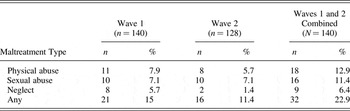
Note: “Any” maltreatment refers to the total number of participants experiencing one or more maltreatment type at a given wave (ns do not add up because some participants experienced more than one maltreatment type). The ns in the Waves 1 and 2 Combined column represent unique participants experiencing a given maltreatment type or “Any” maltreatment.
Retention rates were high at both subsequent assessment time points (Hinshaw et al., Reference Hinshaw, Owens, Sami and Fargeon2006, Reference Hinshaw, Owens, Zalecki, Huggins, Montenegro-Nevado and Schrodek2012): 91% (128) of the initial 140 participants with ADHD completed follow-up assessments at Wave 2, when the age range was 11–18 years (M age = 14.3 years), and 93% (130) at Wave 3, when the age range was 17–23 years (M age = 19.7); age and retention rates were comparable for the comparison group. To evaluate the representativeness of the retained sample, we contrasted 15 Wave 1 demographic and symptom measures for the 10 participants lost to the Wave 3 follow-up versus those retained. The nonretained group had a significantly lower gross household income, t (135) = 2.55, p = .01, d = 0.86, and marginally lower Weschler Intelligence Scales for Children—Third Edition full-scale IQ scores, t (137) = 1.74, p = .08, d = 0.57. There were no baseline differences as a function of maltreatment status, suggesting that the retained sample was generally representative of the overall ADHD sample. Only two comparison girls were not followed up at Wave 3.
Measures
Predictor measure: Maltreatment
The predictor variable was determined via thorough chart review (see Assessing Childhood Maltreatment Section) using the Background Information Questionnaire (BIQ), Family Information Profile (FIP), Hot Sheet, and Report from the University of California, Berkeley, Summer Program. When available, other relevant psychological and/or medical reports and Child Protective Services reports were also included.
The BIQ, a parent-reported measure, was devised for the BGALS study. Administered at Wave 1 (Hinshaw, Reference Hinshaw2002), it includes basic demographic information about the participant and her family, and circumstances surrounding the participant's gestation and delivery, health, educational background, and family psychiatric history. It contains information about maltreatment incidents that contributed to out-of-home placement. The covariates of age, socioeconomic status, prenatal risk, and adopted/foster care status were obtained from this measure (see Covariates Section).
The FIP was administered to the caregiver (Wave 2) or caregiver or participant (Wave 3). The FIP is a yearly chart of changes in the participant's living circumstances, family characteristics, school situation, cognitive/educational functioning, as well as physical and mental health, since the previous assessment. Although the measure does not specifically query maltreatment, it provides space for written descriptions of life changes, which may involve maltreatment (e.g., why a participant has moved into foster care).
The Hot Sheet, a clinician-reported measure initially devised for the BGALS study by Briscoe-Smith and Hinshaw (Reference Briscoe-Smith and Hinshaw2006) and included at all three waves, highlights whether information accumulating in a participant's file documents “known” or “possible” abuse, dates of abuse and age of the participant at the time of abuse, relationship of the abuser to the participant, and a description of the abuse. Thus, it consolidates information from other measures toward the end of ascertaining maltreatment. Only instances categorized as “known” were counted as maltreatment.
In addition, an individualized Report from the University of California, Berkeley, Summer Program was available for each participant. Written by staff and licensed psychologists, the report describes the participant's background history, cognitive functioning, and ratings of her behavior at camp. The reports, available at Wave 1 only, could include qualitative information about maltreatment that may not have been captured by other questionnaires.
Criterion measures
Each of the following instruments has extensive reliability and validity data, which we report only selectively because of space limitations.
Externalizing symptoms and internalizing symptoms
These two domains were assessed using the computerized Diagnostic Interview Schedule for Children—Fourth Edition (DISC-IV Young Adult version; Shaffer, Fisher, Lucas, Dulcan, & Schwab-Stone, Reference Shaffer, Fisher, Lucas, Dulcan and Schwab-Stone2000), as well as the Adult Behavior Checklist (ABCL) and the Adult Self-Report (ASR; Achenbach & Rescorla, Reference Achenbach and Rescorla2003) at Wave 3. The DISC-IV is a well-validated, highly structured diagnostic interview, designed to assess psychiatric disorders occurring in youth using DSM-IV qualifications (American Psychiatric Association, 1994). Parallel versions exist for parents and young adults. The instrument was administered by trained research staff to parents at Wave 1 and to participants at Wave 3. Wave 1 administration yielded the key covariates for externalizing and internalizing behavior (see Covariates Section). Wave 3 administration contributed externalizing (oppositional defiant disorder [ODD] and conduct disorder [CD]) and internalizing (depression/dysthymic disorder and anxiety disorder) criterion measures.
The ABCL and the ASR are widely used parallel forms designed to facilitate comparisons between self-reported functioning (ASR, completed by the participants) and reports of functioning by informants (ABCL, completed by caregivers). Both the ABCL and the ASR have good to excellent reliability and validity (Achenbach & Rescorla, Reference Achenbach and Rescorla2003). Each constituent item is rated on a 0 to 2 metric; we used internalizing and externalizing T scores in our analyses.
Within the externalizing symptoms domain, we also included self-reported delinquency (Elliott, Huizinga, & Ageton, Reference Elliott, Huizinga and Ageton1985), an instrument in which participants describe their delinquent activities, including property damage, theft, assault, and substance use. We utilized a previously developed score (Hinshaw et al., Reference Hinshaw, Owens, Zalecki, Huggins, Montenegro-Nevado and Schrodek2012) that reflects the variety of antisocial acts in which the participant had engaged in the previous 6 months.
Within the internalizing symptoms domain, we also included the Beck Depression Inventory—II (BDI-II; Beck, Steer, Ball, & Ranieri, Reference Beck, Steer, Ball and Ranieri1996), a commonly utilized and extensively validated 21-question multiple-choice self-report inventory measuring depression severity in adults. It has excellent psychometric properties.
Substance use
This domain was assessed using the Substance Use Questionnaire (Molina & Pelham, Reference Molina and Pelham2003), a structured interview that includes both quantity and frequency items for lifetime and current use of licit and illicit substances, as well as inappropriate or nonprescribed use of medications. It is modeled after similar substance use measures in longitudinal and national survey studies of alcohol and other drug use (Jessor, Donovan, & Costa, Reference Jessor, Donovan and Costa1989; National Household Survey on Drug Abuse, 1992). Kappas for 2-week test–retest reliability for “ever trying” one of five substances averaged 0.84. We created a severity score based on variety and frequency of substance usage in the past year; this score is moderately correlated with DISC-IV substance use/dependence symptom levels (r = .45 to .53; Hinshaw et al., Reference Hinshaw, Owens, Zalecki, Huggins, Montenegro-Nevado and Schrodek2012).
Eating disorder symptoms
This domain was assessed using the Eating Disorders Inventory (EDI-2; Garner, Reference Garner1991) and the Eating Attitudes Test (EAT-26; Garner, Olmstead, Bohr, & Garfinkel, Reference Garner, Olmstead, Bohr and Garfinkel1982). These are well-validated, self-report measures of symptoms and concerns characteristic of eating disorders. For the EDI-2, we analyzed the drive for thinness, bulimia, and body dissatisfaction scales, which are the most strongly correlated with eating-related pathology (Hurley, Palmer, & Stretch, Reference Hurley, Palmer and Stretch1990). The EDI-2 scales have a mean internal consistency of 0.87; test–retest reliabilities range from 0.77 to 0.97. For the EAT-26 we analyzed the total score. The EAT has good validity, differentiating individuals with and without anorexia nervosa (Garner & Garfinkel, Reference Garner and Garfinkel1979).
Academic achievement and service utilization
The academic achievement domain was assessed using the word reading and math reasoning subtests of the Wechsler Individual Achievement Test, Second Version (WIAT-II; Wechsler, Reference Wechsler2001), a psychometrically sound, widely used standardized test of academic achievement. Established test–retest reliabilities for the reading and math scores on the WIAT-II range from 0.93 to 0.95 (Wechsler, Reference Wechsler2001). WIAT-II testing was conducted on a separate day of assessment in which the participant was not on any stimulant medication. In addition, we quantified each participant's years of education received from the FIP. The FIP also yielded information regarding service utilization: we counted (1 vs. 0) the use of special education services at school (e.g., restricted placement, classroom aides, pull-out services, and onsite mental health services). For nonschool services we counted (1 vs. 0) participation in psychotherapy in the community and psychiatric hospitalizations.
Well-being
This domain was assessed using the Self-Perception Profile for Adolescents (Harter, Reference Harter1988), a self-report measure on which adolescents/young adults rate their perceived competence in several domains. We analyzed the subscales. Internal consistencies of these subscales ranged from 0.75 to 0.84, with test–retest reliabilities ranging from 0.69 to 0.80 (Harter, Reference Harter1982) for social acceptance, scholastic competence, and global self-worth.
Self-harm
This domain was assessed using the Barkley Suicide Questionnaire (Barkley, Reference Barkley2006) and the Self-Injury Questionnaire. The Barkley Suicide Questionnaire is a three-item scale that asks whether the respondent has ever (a) considered suicide, (b) attempted suicide, or (c) been hospitalized for an attempt. If the respondent answers “yes” to any question, it is followed up with a frequency question. We analyzed the dichotomous suicide attempts item. In addition, there was one instance in which a suicide attempt was detailed on the FIP, but not on the Barkley Suicide Questionnaire; we added this individual to the count of attempted suicide.
We also assessed variety and frequency of nonsuicidal self-injury (NSSI) using a modification of Claes, Vandereycken, and Vertommen's (Reference Claes, Vandereycken and Vertommen2001) Self-Injury Questionnaire, which has sound psychometric properties when used within eating-disordered samples. Participants were asked whether they had engaged in certain deliberately self-injurious acts (e.g., scratched or cut their skin with objects, burned themselves, hit themselves hard, or pulled hair out) and if so, how often (1 = only once, 6 = a couple of times per day). We created a dichotomous self-injury variable indicating whether or not a participant had ever intentionally injured herself.
Assessing childhood maltreatment
A master coder along with three undergraduate and postbaccalaureate raters thoroughly reviewed the participants' charts for indications of physical abuse (e.g., a participant's babysitter frequently hit and dragged her or a mother's boyfriend physically assaulted the participant), sexual abuse (e.g., a participant was molested by her father or a participant was raped by a stranger at gunpoint), and neglect (e.g., biological parents failed to provide participant with adequate nutrition). The charts did not indicate the ADHD status of the participant. Only the master coder was aware of study hypotheses. The charts contained a standard set of measures, selected for their potential to yield trauma-relevant data and representing participant, caregiver, and assessor information.
To develop a coding scheme, the team conducted a comprehensive literature review to familiarize themselves with prevailing definitions of maltreatment. There was broad reliance on definitions of child maltreatment (<age 18) outlined by the Centers for Disease Control and the National Center for Injury Prevention (Leeb, Paulozzi, Melanson, Simon, & Arias, Reference Leeb, Paulozzi, Melanson, Simon and Arias2008). An event qualified as physical abuse if it involved “the intentional use of physical force against a child that results in, or has the potential to result in, physical injury” (Leeb et al., Reference Leeb, Paulozzi, Melanson, Simon and Arias2008), and the perpetrator was an adult (>age 18), caregiver, or romantic partner. Sexual abuse was coded if there was any completed or attempted sexual act or sexual contact with a child by a caregiver, peer, stranger, or acquaintance. Because of the age of the sample at Waves 1 and 2 and because of the absence of sufficient background information, we did not include sexual harassment (e.g., creating a hostile environment because of comments or attention of a sexual nature) or noncontact sexual abuse (e.g., intentional exposure of a child to pornography). Finally, neglect was defined as a clear failure by a caregiver to meet a child's basic physical, medical/dental, and/or educational needs. A single event could be coded for multiple forms of maltreatment. Because we lacked consistent data across participants regarding emotional neglect, verbal or psychological abuse, or exposure to violent environments (e.g., domestic or community violence), we excluded these potential categories. Simply having been in foster care or adopted, having lived in a chaotic home, or having been exposed to alcohol or drugs in utero did not automatically qualify as maltreatment, nor did participant behavior that was only suggestive of maltreatment (e.g., aggression, sexual precocity, or posttraumatic stress). In short, our aim was to avoid overascription of maltreatment in the absence of clear evidence.
We devised a 3-point scale to code for the presence of documented physical abuse, sexual abuse, or neglect (0 = not present, 1 = possibly present, or 2 = definitely present). The 1 category was reserved for instances in which raters were unsure of whether the incident met strict criteria, or there were conflicting statements regarding maltreatment from different reporters, or a reporter noted that there was possible abuse without providing further evidence.
After initial rater calibration on a set of 10 charts, each rater coded approximately one-third of the charts. The master rater coded all charts. Thus, each chart was double-coded, once by the master rater and once by another rater. Raters assigned a code for each chart, with respect to each type of maltreatment, at both Waves 1 and 2. Wave 3 measures were included in the review solely for the purpose of capturing maltreatment that may have occurred prior to Waves 1 or 2, but that had not actually been disclosed or documented until Wave 3. Instances of maltreatment were coded for the wave closest to the time at which the maltreatment occurred.
For reliability purposes, 1 codes were counted as 0 scores. Across Waves 1 and 2, the mean κ for presence of any documented childhood maltreatment was 0.78 (range = 0.64–0.89), signaling good to excellent reliability (Bakeman & Gottman, Reference Bakeman and Gottman1997; Fleiss, Reference Fleiss1981).
In order to create a dichotomously coded maltreatment variable (ever/never maltreated) to serve as the independent variable for the study, all cases unanimously coded as 2 were automatically considered as positively maltreated. Coding disagreements involving codes of 1 and 2 (comprising 5 cases out of the 32 final ADHD participants designated as “ever maltreated”) were resolved by obtaining a third rater and consensus discussion to break the tie. Cases in which raters assigned only 1s and/or 0s were treated as “never maltreated” for the purposes of the independent variable.
Covariates
To ascertain whether young adult symptoms and impairments were associated specifically with the participants' maltreatment status rather than with potentially confounding factors, we used four key measures obtained at Wave 1 from the BIQ as covariates in all adjusted analyses: age, given the 6- to 7-year age span across the sample; socioeconomic status, a composite variable derived from demographic data (family's self-reported income and maternal education); prenatal risk; and adopted or in foster care versus raised by a parent, stepparent, or other relative (coded 0 or 1). The prenatal risk composite was created from three variables indexing the participants' prenatal and perinatal experience: biological mother's use of tobacco and illicit drugs while pregnant, and low birth weight (<2500 g). This covariate ranged from 0 to 3 based on the presence or absence of each of the three constituent items.
We also controlled for conceptually linked Wave 1 variables where applicable. Full-scale IQ from the Weschler Intelligence Scales for Children—Third Edition (Wechsler, Reference Wechsler1991) was utilized as a covariate for analyses of criterion measures within the academic achievement domain. For criterion measures within the externalizing domain, we controlled for comorbidities from the Wave 1 DISC-IV, coded as 1 versus 0 for the presence versus absence of ODD or CD. For criterion measures within the domains of internalizing, well-being, and self-harm, we controlled for comorbidities from the Wave 1 DISC-IV, coded as 1 versus 0 for the presence versus absence of depression/dysthymic disorder or anxiety disorder (the latter had to include the presence of one or more conditions beyond specific phobias). The goal was to ascertain the specific predictive validity of maltreatment, unconfounded by early functioning in the criterion domain of interest.
Data analytic plan
First, we conducted a chi-square test to ascertain whether there were higher rates of maltreatment in the group of participants with childhood ADHD than in the comparison group. Second, to examine whether childhood maltreatment status was associated with each of the eight criterion domains and specific measures included in each domain, we conducted univariate analyses of variance (for continuous criterion variables) and chi-square tests (for categorical criterion variables). (See Table 2 for a complete listing of the eight criterion domains and specific measures included within each.) Effect sizes were calculated using the Cohen d for continuous criterion variables and odds ratios for categorical criterion variables. Within each criterion domain yielding at least one significant p value, we used the Benjamini–Hochberg (BH) procedure for multiple testing correction (Benjamini & Hochberg, Reference Benjamini and Hochberg1995). The BH method adjusts for multiple comparisons by controlling false discovery rate; it has been shown to be a preferred method of protecting against Type I error (What Works What Works Clearinghouse, 2008; Williams, Jones, & Tukey, Reference Williams, Jones and Tukey1999).
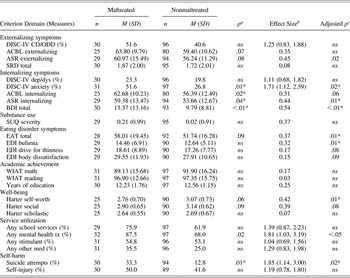
Young adult functioning across domains by childhood maltreatment status

Note: Y, Young Adult Self-Report; P, parent's report on young adult; DISC-IV, Diagnostic Interview Schedule for Children, Fourth Edition; ACBL, Adult Behavior Checklist; ASR, Adult Self-Report; SRD, Self-Report of Delinquency; BDI, Beck Depression Inventory—II; SUQ, Substance Use Questionnaire; EAT, Eating Attitudes Test; EDI, Eating Disorder Inventory—2; WIAT, Wechsler Individual Achievement Test—II; SIQ, Self-Injury Questionnaire; Mental health tx, mental health treatment; Any other med, nonstimulant psychotropic medication; DISC-IV dep/dys, DISC-IV major depressive episode/dysthymia diagnosis.
a Significance: one-way ANOVA for continuous variables; Pearson chi-square statistic for categorical variables.
b Effect sizes: Cohens d for continuous variables and odds ratio (95% confidence interval) for dichotomous variables, computed using unadjusted means.
c Covariates: age, socioeconomic status, prenatal risk, adopted, or in foster care. For all academic achievement measures, Wave 1 full scale IQ is also included as a covariate. For all externalizing symptoms measures, Wave 1 ODD or CD is also included as a covariate. For all internalizing, well-being, and self-harm measures, Wave 1 depression/dysthymic disorder or anxiety disorder is also included as a covariate.
*Significant at p < .05 after within-domain Benjamini–Hochberg false discovery rate correction.
To determine whether childhood maltreatment contributed to later functioning independent of confounding risk factors, we performed (a) analyses of covariance for each continuous dependent measure and (b) binary logistic (Wald) regressions for each categorical dependent measure. Four covariates (age, socioeconomic status, prenatal risk, and adopted/foster care) were utilized in all of the adjusted analyses. As noted, we also controlled for full-scale IQ for academic achievement; ODD or CD for externalizing symptoms; and depression/dysthymic disorder or anxiety disorder for internalizing symptoms, well-being, and self-harm. (When we conducted alternate covariance analyses using continuous measures of externalizing or internalizing behaviors, instead of the categorical ODD/CD or depression/dysthymic/anxiety disorder variables, results were almost identical in significance and effect size.)
Finally, in order to ascertain whether associations between maltreatment and criterion variables were different across ADHD and comparison groups, we repeated our analyses with all participants, using diagnostic group as both a predictor variable and a moderator (i.e., adding the interaction term between diagnostic group and maltreatment last).
All statistical analyses were performed with SPSS for Mac OS, Version 20 (IBM Corp., 2011).
Results
Descriptive statistics and Wave 1 characteristics
At Wave 2, 11 participants were missing data on their maltreatment status; we included them using only their Wave 1 maltreatment exposure. Out of the 140 probands with ADHD, 32 (22.9%) were positive for childhood maltreatment of any type (physical abuse: 12.9%; sexual abuse: 11.4%; or neglect: 6.4%; Table 1). Of these 32, 21 (65.6%) had experienced maltreatment by Wave 1, with 11 (34.4%) additional participants experiencing maltreatment between Wave 1 and Wave 2. The majority (71.9%) of those who experienced maltreatment had a single type of maltreatment, whereas 9 (28.1%) had experienced a combination of two or all three types of maltreatment.
Within the comparison group, 10 participants (11.4%) had experienced childhood maltreatment of any type. Results from the chi-square test revealed that participants with ADHD were more likely to have experienced maltreatment relative to comparisons, χ2 (1, N = 228) = 4.75, p = .02.
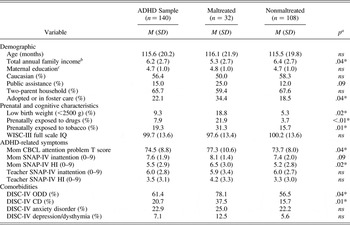
Within the ADHD group, compared to nonmaltreated participants, maltreated participants were significantly more likely at Wave 1 to have a lower total annual family income and were more likely to have been adopted or placed in foster care, born at a low birth weight, and exposed to tobacco and other substances during gestation (Table 3). Maltreated participants were also significantly more likely to have a higher mother-reported Child Behavior Checklist attention problems T score and a higher count of mother-reported hyperactivity/impulsivity symptoms, as well as a DISC-IV diagnosis of ODD or CD. Yet no significant differences emerged with respect to depression/dysthymia or anxiety disorder (Table 3).
Wave 1 characteristics of overall ADHD sample plus comparisons between maltreated and nonmaltreated subgroups

Note: WISC-III, Wechsler Intelligence Scale for Children-III; CBCL, Child Behavior Checklist; SNAP-IV, Swanson, Nolan, and Pelham rating scale (see Swanson, Reference Swanson1992); HI, Hyperactivity/Impulsivity; DISC-IV, Diagnostic Interview Schedule for Children, Fourth Edition.
a Maltreated group versus nonmaltreated group. Significance: one-way ANOVA for continuous variables; Pearson chi-square statistic for categorical variables.
b For total annual family income, 1 ≤ $10,000; 9 ≥ $75,000.
c For maternal education, 1 = less than 8th grade; 6 = advanced or professional degree.
*Significant at p < .05.
Young adult criterion measures
The unadjusted analyses indicate that of the eight criterion domains, significant differences between maltreated and nonmaltreated participants emerged in two (internalizing symptoms and self-harm), after applying the BH correction for multiple comparisons. Specifically, within the internalizing symptoms domain, all measures except DISC-IV depression/dysthymia yielded significant findings, with medium effect sizes. For DISC-IV anxiety disorder, maltreated participants had a rate of 52%, nearly double that of their nonmaltreated counterparts (27%), χ2 (1, N = 128) = 6.56, odds ratio (OR) = 1.71, 95% confidence interval (CI) = 1.12, 2.59; p = .01. For the ACBL internalizing scale (reported by parent), the maltreated group had higher scores than the nonmaltreated group, F (1, 103) = 5.24, p = .02, d = 0.51; in parallel, for ASR internalizing (reported by participant), maltreated participants scored higher than those without, F (1, 121) = 4.38, p = .04, d = 0.44. Maltreated participants also had higher BDI-II total scores than did nonmaltreated participants, F (1, 121) = 7.02, p < .01, d = 0.54.
Within the self-harm domain, differences emerged on suicide attempts, with 33% of maltreated participants endorsing having attempted suicide, compared to 13% of nonmaltreated participants, χ2 (1, N = 124) = 6.59, OR = 1.85, 95% CI = 1.14, 3.00; p = .01. Participants with and without maltreatment did not differ significantly on the self-injury measure.
Regarding service utilization, participants with maltreatment were more likely to endorse utilization of mental health services compared to nonmaltreated participants (88% vs. 68%), χ2 (1, N = 129) = 4.61, OR = 1.81, 95% CI = 1.03, 3.19; p = .02. However, this finding did not attain significance after applying the BH correction.
Covariates
Analyses of covariance and logistic regression analyses with covariate adjustment revealed significant linkages to maltreatment status in four of the eight young adult domains (internalizing symptoms, self-harm, self-worth, and eating disorder symptoms) after applying the BH correction (Table 2). In particular, within the internalizing symptoms domain, maltreated participants reported significantly higher BDI-II total symptoms, F (1, 114) = 7.81, p < .01, as well as higher ASR internalizing, F (1, 113) = 6.71, p = .01. They were also more likely to receive a DISC-IV anxiety disorder diagnosis (Wald = 5.71, p = .02). Within the self-harm domain, maltreated participants reported greater suicide attempts (Wald = 5.55, p = .02), but did not differ significantly from the nonmaltreated participants on the self-injury measure.
Two additional domains emerged as significant with covariate adjustment. Within the eating disorder symptoms domain, both the EAT total score and the EDI bulimia subscale were higher for maltreated compared to nonmaltreated participants, F (1, 112) = 6.82, p = .01, and F (1, 111) = 6.81, p = .01, respectively. Within the well-being domain, the maltreated participants had lower scores than the nonmaltreated participants on self-worth, F (1, 106) = 6.86, p = .01.
With the inclusion of covariates and the application of the BH correction, the differences between maltreated and nonmaltreated participants in the domains of externalizing symptoms, substance use, academic achievement, and service utilization were not significant.
Moderation analyses
Linear regression analyses revealed a significant interaction between maltreatment and group status for one criterion variable, such that following maltreatment, participants with ADHD were more likely than comparisons to receive a DISC-IV diagnosis of anxiety disorder at Wave 3 (F change = 5.22, p = .02, R 2 change = .02), even with covariate adjustment. For the remaining 25 criterion variables, the interaction term was not significant. These findings indicate that, overall, long-term negative consequences of maltreatment were parallel in the ADHD and comparison groups.
Discussion
Our objective was to examine the long-term correlates of child and adolescent maltreatment with respect to young adult functioning in a diverse and well-characterized sample of females with ADHD. Our findings revealed that nearly 23% of the sample had experienced at least one documented type of maltreatment (physical abuse, sexual abuse, or neglect) by the adolescent (Wave 2) follow-up assessment. This rate was double that of our comparison group and is higher than national estimates (10%–20%), consistent with past research indicating that youth with ADHD are at increased risk for maltreatment (Briscoe-Smith & Hinshaw, Reference Briscoe-Smith and Hinshaw2006; Carroll et al., Reference Carroll, Yi, Liang, Pang, Leeper-Woodford and Riccardi2012; Ford et al., Reference Ford, Racusin, Ellis, Daviss, Reiser and Fleischer2000). According to our findings, four of eight young adult functioning domains showed at least one significantly elevated measure of impairment among maltreated participants relative to nonmaltreated participants, when adjusting for demographic, prenatal, and conceptually linked baseline variables, and with control of false discovery rate. The most salient pattern was of increased internalizing and self-harm-related symptoms, including elevated suicide attempts, higher levels of bulimia/eating disorder symptoms, and lower self-esteem among maltreated participants. These findings clearly support the contention that child or adolescent maltreatment specifically is an important risk factor for maladaptive functioning in young adulthood among women with childhood ADHD, particularly with respect to internalizing symptoms and suicidal behavior. We did not find evidence that these findings were unique to the ADHD participants, but given the small number of comparison participants with maltreatment, our moderational tests were underpowered.
The impairments of the maltreated participants are conceptually and empirically interrelated. In both the adjusted and nonadjusted analyses, the maltreated subgroup showed elevations on nearly all of the internalizing measures in young adulthood, including increased risk for anxiety disorder and greater depressive symptoms. These are in line with the findings of Keyes et al. (Reference Keyes, Eaton, Krueger, McLaughlin, Wall and Grant2012) that underlying vulnerability to internalizing symptomatology mediates the link between certain types of childhood maltreatment and mental health in women. Strikingly, the maltreated participants also displayed a higher rate of suicide attempts, as well as lower self-esteem and greater eating disorder and bulimia symptoms. These domains are clearly interlinked in women (Casper, Reference Casper1998; Waxman, Reference Waxman2009). The findings extend prior research (Chronis-Tuscano et al., Reference Chronis-Tuscano, Molina, Pelham, Applegate, Dahlke and Overmeyer2010; Hinshaw et al., Reference Hinshaw, Owens, Zalecki, Huggins, Montenegro-Nevado and Schrodek2012) by suggesting that the particularly high risk of internalizing and self-harmful behavior patterns found in girls and women with ADHD may be related, at least in part, to experiences with childhood maltreatment. Of course, without a male comparison group, we cannot claim that this pattern of findings is unique to females. Still, the findings indicate that, among females with ADHD, maltreatment-related impairments concentrate in the domains of internalizing and self-harm.
Within the self-harm domain, however, no significant differences emerged with respect to NSSI behavior; within the internalizing symptoms domain, risk for diagnosis of a depressive disorder did not differ significantly by maltreatment status. NSSI, which involves deliberate bodily self-harm with the absence of lethal intent (Nock, Reference Nock2009), was common in the sample (43.7%), and it is plausible that differences among the maltreated and nonmaltreated participants were detectable only in the more extreme domain of actual suicidal behavior. Despite the extensive comorbidity between depression and anxiety, it is unclear why the maltreated and nonmaltreated groups did not differ with respect to categorical depression. It is possible that one or more “third variables,” such as peer victimization (e.g., Hamilton et al., Reference Hamilton, Shapero, Stange, Hamlat, Abramson and Alloy2013), or a certain type of abuse, might provide specific risk for major depressive disorder.
In addition, within the externalizing symptoms domain, significant differences did not emerge. Externalizing behavior was common in this sample; we may have lacked the power to detect significant findings related to maltreatment in this domain. This finding stands in contrast to the increased maltreatment-related CD and delinquency found in De Sanctis et al.'s (Reference De Sanctis, Nomura, Newcorn and Halperin2012) mostly male ADHD sample, suggesting the importance of considering gender in maltreatment-related outcomes for individuals with ADHD. Consistent with findings showing sex differences in manifestations of externalizing behavior (e.g., Archer, Reference Archer2004; Crick & Grotpeter, Reference Crick and Grotpeter1995), one study found that maltreatment was associated with relational aggression (e.g., covert manipulation and bullying) in girls, and physical aggression in boys (Cullerton-Sen et al., Reference Cullerton-Sen, Cassidy, Murray-Close, Cicchetti, Crick and Rogosch2008). That study suggested that maltreated children may be especially likely to engage in aggressive behaviors typical of their same-sex peer groups. Thus, it is plausible that our externalizing measures failed to capture the specific behaviors suited to our female sample.
In addition, the measures in substance use, academic achievement, and service utilization did not attain significance in either the unadjusted or the adjusted analyses after applying the BH correction. Still, without exception, all measures examined were in the expected direction (i.e., indicating greater impairment) for maltreated as compared to the nonmaltreated participants.
Although naturalistic designs do not allow for testing direction of effects, the findings raise important etiological questions about the directionality of the association between maltreatment and ADHD. More than half of the instances of maltreatment preceded the ascertainment of ADHD status at Wave 1. Thus, the extent to which ADHD symptoms in such cases were a product of the maltreatment is unclear. ADHD and child maltreatment share a number of risk factors, such as family disorganization and parenting stress, poor parent–child relationships, parental substance abuse and/or mental health issues, and parental characteristics, such as low education, single parenthood, and low income (CDC, 2012b; Johnston, Mash, Miller, & Ninowski, Reference Johnston, Mash, Miller and Ninowski2012). Moreover, several potential bidirectional or interactive relationships could explain the link between childhood maltreatment and ADHD. ADHD may predispose some children to a greater likelihood of maltreatment, because of ADHD-related interpersonal and self-regulatory problems that can be stressful for parents and potentially precipitate negative parenting practices such as abuse (Deault, Reference Deault2010; Ford et al., Reference Ford, Racusin, Ellis, Daviss, Reiser and Fleischer2000; Glatz, Stattin, & Kerr, Reference Glatz, Stattin and Kerr2011). Conversely, however, it is possible that maltreatment may place children at risk for symptomatic profiles paralleling those in ADHD, such as difficulty concentrating and physiological hyperreactivity (Ford et al., Reference Ford, Racusin, Ellis, Daviss, Reiser and Fleischer2000). Symptoms of maltreatment, such as hypervigilance or extreme passivity, may sometimes be inappropriately attributed to “attention deficit” (Stirling & Amaya-Jackson, Reference Stirling and Amaya-Jackson2008). Evidence from neurobiology and neuroimaging studies demonstrates overlapping brain–behavior pathways observed in ADHD and child maltreatment (Dahmen, Putz, Herpertz-Dahlmann, & Konrad, Reference Dahmen, Putz, Herpertz-Dahlmann and Konrad2012; Tomoda et al., Reference Tomoda, Suzuki, Rabi, Sheu, Polcari and Teicher2009).
Nevertheless, the present findings have several important clinical and public health implications for girls and young women. Clinicians would profit from consistently assessing childhood maltreatment in patients with suspected or diagnosed ADHD, especially those presenting with considerable comorbid internalizing symptoms. Whereas mental health professionals sometimes lack awareness of the signs of child maltreatment and fail to recognize it (Gilbert et al., Reference Gilbert, Kemp, Thoburn, Sidebotham, Radford and Glaser2009), the systematic use of screening tools and specialized training has been shown to increase the detection rate (Carter, Bannon, Limbert, Docherty, & Barlow, Reference Carter, Bannon, Limbert, Docherty and Barlow2006; Louwers et al., Reference Louwers, Korfage, Affourtit, Scheewe, van de Merwe and Vooijs-Moulaert2012). The proactive use of screening procedures by clinicians may reveal otherwise undetected child maltreatment in especially vulnerable populations such as girls with ADHD. In addition, considering that treatment approaches for ADHD and childhood trauma differ substantially, screening for maltreatment should help guide therapeutic interventions aimed at individuals with co-occurring ADHD and maltreatment. For instance, medication is typically indicated as a front-line treatment for ADHD (American Academy of American Academy of Pediatrics, 2011; Santosh et al., Reference Santosh, Taylor, Swanson, Wigal, Chuang and Davies2005), whereas psychosocial interventions have been prioritized for treatment of child maltreatment and posttraumatic stress disorder (American Academy of Child & Adolescent Psychiatry & Cohen, Reference Cohen1998). Furthermore, compared to their nonmaltreated counterparts, children with histories of maltreatment have been shown to present and respond differently to therapy (Lau & Weisz, Reference Lau and Weisz2003), so modifications of existing treatments may be needed in order to address their unique needs. Finally, the findings underscore the importance of providing support not only to the child with ADHD but also to her caregivers, in order to reduce the risk of child maltreatment. Parent interventions for children with both ADHD (e.g., Zwi, Jones, Thorgaard, York, & Dennis, Reference Zwi, Jones, Thorgaard, York and Dennis2011) and maltreatment (e.g., Prinz, Sanders, Shapiro, Whitaker, & Lutzker, Reference Prinz, Sanders, Shapiro, Whitaker and Lutzker2009) have been shown to mitigate risk factors for maltreatment, such as parental stress.
Because of our conceptual interest in examining correlates of maltreatment in an already high-risk group (i.e., girls/young women with ADHD) and because the small size of our maltreated comparison group reduced statistical power to examine correlates of maltreatment in it, our evaluation of differential predictions from maltreatment to impairments in the ADHD versus comparison samples was exploratory. We found that the direction and effect sizes of predictions to impairment in the comparison group were quite similar to those in the ADHD group (additional data available on request).
Certain limitations of the current study should be considered in interpreting the findings. First, the sample was not designed to be representative of the population, although it may reasonably reflect the demographic nature of ADHD in the San Francisco Bay Area (see Hinshaw, Reference Hinshaw2002). Second, although the overall retention rate was high (93%), certain measures had more loss of data, and the few participants lost to follow-up were poorer and had marginally lower IQ scores. Third, there may have been misclassification bias, because maltreatment was not directly or systematically queried at the outset of this longitudinal investigation. We determined maltreatment status via chart review, which may have led to false negatives in terms of ascertaining maltreatment status. Furthermore, all forms of information relating to maltreatment (i.e., parent reports, youth self-reports, and official records) are subject to biases and limitations (Cicchetti & Toth, Reference Cicchetti and Toth2005). For instance, parents may underreport maltreatment histories because of shame, denial, and fear of future legal consequences, as well as limited awareness or inaccurate recall of the abusive event (Chan, Reference Chan2012; Cicchetti & Olsen, Reference Cicchetti, Olsen, Lewis and Miller1990). In turn, youth may underreport or minimized abuse because of a sense of loyalty to the perpetrator or psychological processes, such as dissociation, that may hinder recall of the maltreatment event (Chan, Reference Chan2012). Official records also have been found to underreport maltreatment (Tyler, Smith, & Ellis, Reference Tyler, Smith and Ellis2006), in part because authorities are not privy to all acts of maltreatment. Although any single information source may have been imperfect, we relied whenever possible on multiple sources of information to determine maltreatment status; this multipronged approach tends to yield the most accurate account of maltreatment (Cicchetti & Toth, Reference Cicchetti and Toth2005). Fourth, although the sample is the largest of females with childhood ADHD in existence to our knowledge, the maltreated subsample was of modest size, limiting power to detect more subtle long-term correlates of maltreatment.
In order to isolate the sequelae of maltreatment, we utilized stringent covariates in our analyses. Because, however, of the above-noted timing of maltreatment in relation to ADHD (i.e., many maltreatment instances were contemporaneous with or preceded our Wave 1 ADHD diagnoses), covariates linked to demographics, birth-related circumstances, and childhood comorbidities are an imperfect strategy. Wave 1 comorbidity covariates could represent partial consequences of maltreatment rather than any truly preexisting characteristics. Overall, the selection of covariates required a judicious but imperfect balance between seeking specificity of maltreatment-related impairments versus guarding against statistical overcontrol.
The low frequencies of the “pure” individual maltreatment types made it impossible to examine the separate correlates of physical abuse, sexual abuse, and neglect. In addition, important aspects of maltreatment (e.g., severity and chronicity) could not be reliably coded. Moreover, additional traumas such as emotional abuse and exposure to domestic violence were not amenable to reliable coding. Future investigations could analyze the long-term implications of maltreatment on other criterion domains such as neurocognitive functioning, as well as possible mediators of outcome (e.g., social relationships) and protective factors that spur resilient functioning.
Still, few studies have examined the consequences of maltreatment among individuals with ADHD; to our knowledge, this is the first to do so with a longitudinal, all-female sample. The well-characterized, carefully diagnosed, and ethnically and socioeconomically diverse nature of the sample increases the generalizability of the findings, as does the high retention rate (93% over the 10-year interval). In addition, the inclusion of multiple-source, multiple-informant instruments and a broad range of criterion variables enabled examination of the diffuse correlates of maltreatment as well as patterns across symptoms and impairments. Finally, the longitudinal design and stringent application of covariates suggests that the adjusted results reflect the independent correlates of maltreatment rather than related confounds, given the caveats noted above. The use of BH corrections in both the unadjusted and the adjusted analyses militates against the likelihood of Type 1 error.
In summary, although explicit sex-comparison investigations are necessary, some of the serious psychosocial problems experienced by women with ADHD, particularly in terms of internalizing symptomatology and suicide risk, may be in part attributable to experiences with maltreatment. We argue for the need for improved detection of and intervention with childhood abuse and neglect in females with ADHD.