Background
Mental health disorders are a major and growing global disease burden, and the World Health Organization estimates their lifetime prevalence to be 18.1–36.1% worldwide (Kessler et al. Reference Abbing-Karahagopian, Huerta, Souverein, de Abajo, Leufkens, Slattery, Alvarez, Miret, Gil, Oliva, Hesse, Requena, de Vries, Rottenkolber, Schmiedl, Reynolds, Schlienger, de Groot, Klungel, van Staa, van Dijk, Egberts, Gardarsdottir and De Bruin2009). They represent the largest contributor to disease burden in Europe, and effect up to a third of Europeans annually (Wittchen et al. Reference Bellantuono, Arreghini, Adami, Bodini, Gastaldo and Micciolo2011). Mental illness represents a large cost to healthcare budgets, and is associated with shorter lifespans, co-morbidities and chronic ill health (Wykes et al. Reference Brijnath, Xia, Turner and Mazza2015). The European Commission emphasised the prevention of depression and suicide as one of the five key priorities for mental health in EU member states (European Commission, 2008). Over 800 000 people die due to suicide each year, and it is the second leading cause of death among 15–29 year olds worldwide (World Health Organization, 2015). In Ireland, there were 451 deaths due to suicide in 2015 (Central Statistics Office, 2015). In 2014, 3187 inpatients and 517 day patients with mental diseases or disorders were discharged from acute public hospitals, with a mean length of stay of 7.5 days (Healthcare Pricing Office, 2014).
Most patients with mental health disorders are treated in primary care (World Health Organization, Reference Hansen, Sondergaard, Vach, Gram, Rosholm and Kragstrup2001; McDaid, Reference Hart2013). The most common mental health issues treated in primary care are depression, anxiety and substance abuse (World Health Organization, Reference Hansen, Sondergaard, Vach, Gram, Rosholm and Kragstrup2001). The prescribing of psychotropic drugs in general practice has risen in recent years. A UK review of 138 general practices found that antidepressant prescribing more than doubled between 1995 and 2011 (Mars et al. 2017). The United States saw a similar growth in antidepressant prescribing rates, from 6.5% to 10.4% between 1999 and 2010 (Mojtabai & Olfson, Reference Hughes and Erskine2014). There has also been a growth in the prescription of antipsychotic drugs in a number of countries (Verdoux et al. Reference Hughes, Raitt, Riaz, Baldwin, Erskine and Graham2010). The cause of this rise in prescribing remains unclear (Munoz-Arroyo et al. Reference Hull, Aquino and Cotter2006), though studies suggest it may be attributable to new drug classes such as selective serotonin reuptake inhibitors (Mars et al. 2017), an increase long-term psychotropic treatment of mental illness (Moore et al. Reference Hull, Cornwell, Harvey, Eldridge and Bare2009) or a lack of proactive medication review (Johnson et al. Reference Hyde, Calnan, Prior, Lewis, Kessler and Sharp2017).
A number of studies have found variation in psychotropic prescribing rates between general practices. Factors found to influence prescribing rates include patient factors such as age (Hull et al. Reference Johnson, Dougall, Williams, MacGillivray, Buchanan and Hassett2005), ethnicity (Morrison et al. Reference Johnson, Williams, MacGillivray, Dougall and Maxwell2009) and educational level (Mackenzie et al. Reference Kessler, Aguilar-Gaxiola, Alonso, Chatterji, Lee, Ormel, Ustün and Wang1999); GP factors such as gender (Morrison et al. Reference Johnson, Williams, MacGillivray, Dougall and Maxwell2009) and country of qualification (Hull et al. Reference Johnson, Dougall, Williams, MacGillivray, Buchanan and Hassett2005); and population factors such as ethnic density (Schofield et al. Reference Mackenzie, Buckingham, Wankowski and Wilcock2016) and social deprivation (Walters et al. Reference Mant, Broom and Duncan-Jones2008). Many of such studies only documented variation in single sites (Mant et al. Reference Marston, Nazareth, Petersen, Walters and Osborn1983; Bellantuono et al. Reference Mars, Heron, Kessler, Davies, Martin, Thomas and Gunnell1989) or from national-level data without analysing differences between practices (Butterworth et al. 2013; Marston et al. Reference McDaid2014; Hughes & Erskine, Reference Mayne, Ross, Lihai, McCarn, Steffes, Weiwei, Margolis, Azuine, Gotlieb, Grundmeier, Leslie, Localio, Wasserman and Fiks2016). As the diagnosis and treatment of mental illness continues to evolve, and its care increasingly moves to primary care, it is important to understand the variation in prescribing rates between general practices, and to determine the social and demographic factors that influence this variation. This narrative review aimed to identify and review studies examining the variables that cause variation in prescribing rates for psychotropic drugs between general practices, and to determine how much of this variation could be explained by known factors.
Methods
Method
This narrative review used the Preferred Reporting Items for Systematic Reviews and Meta-Analysis (PRISMA) statement (Moher et al. Reference Moher, Liberati, Tetzlaff and Altman2009). To identify all potentially eligible studies, an electronic search was conducted using the following databases: OVID MEDLINE, EMBASE (Elsevier), CINAHL Plus (EBSCO) and Science Direct. Reference lists of included studies were screened to identify any further relevant studies. Results of this search were then refined by applying inclusion and exclusion criteria. The search was conducted in January 2018, and no date range was imposed for included studies.
Search terms and outcome
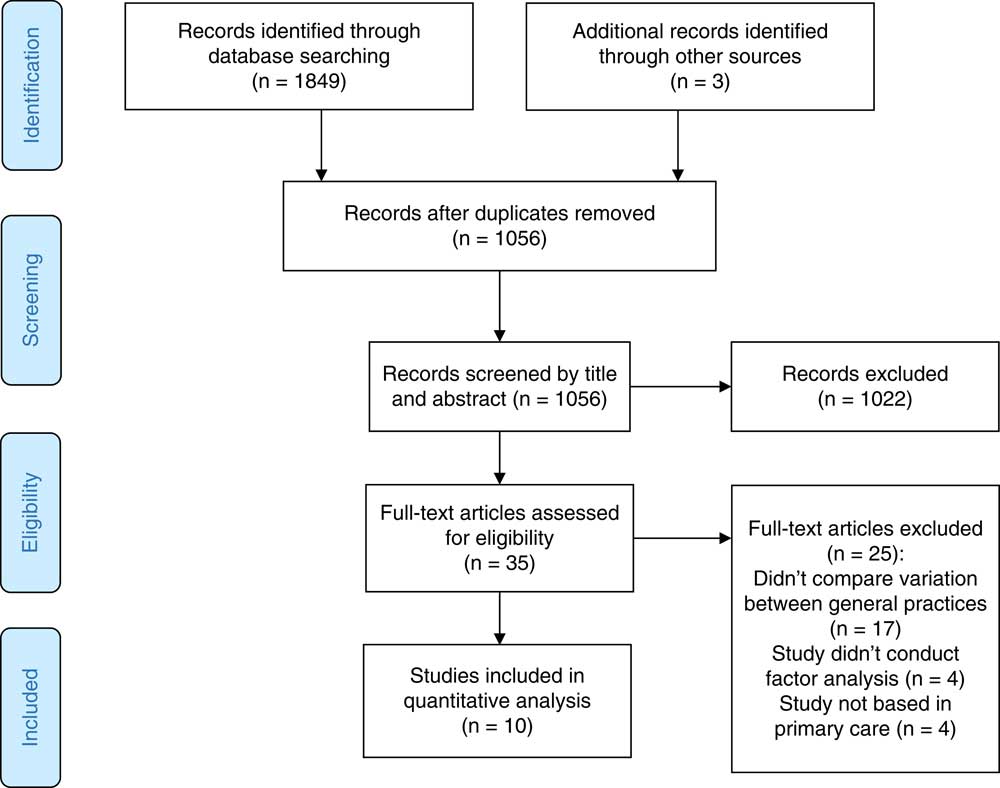
The electronic database search in titles and abstracts included three main terms and their variations: general practice (family practice, primary care); prescribing (prescription); and mental health (mental illness, mental disorders) or psychotropic, antidepressants, anxiolytics, hypnotics or sedatives. An example of the search strategy for one electronic database is as follows: ((general practice OR family practice OR primary care) AND (prescribing OR prescription) AND (mental health OR mental illness OR mental disorders OR psychotropic OR anti-depressant* OR anxiolytic* OR hypnotic* OR sedative*)) [Title/Abstract]. The search yielded 1849 studies. Duplicates were removed and the lead author reviewed 1056 titles and abstracts according to the inclusion and exclusion criteria listed below (Fig. 1).
Study selection flow diagram.

Inclusion criteria
1. Studies of factors affecting prescribing rates for mental illness in primary care
2. Studies that compared variation between at least two general practice sites
3. Studies that conducted a statistical factor analysis to investigate the causal factors of variation
4. If more than one profession is studied, GP results are reported separately
5. Published before January 2018
6. English language
7. Published in peer-reviewed publications.
Exclusion criteria
1. Studies in secondary care settings
2. Studies based in a single general practice setting.
At the title and abstract screening, 1022 records were excluded based on the above inclusion and exclusion criteria. The full text of 35 studies was assessed for eligibility, and 24 were excluded: 17 did not compare variation between at least two general practices; four did not conduct factor analysis to investigate causal factors of variation; and three were not based in primary care settings. A total of 10 papers were included for quantitative analysis.
Results
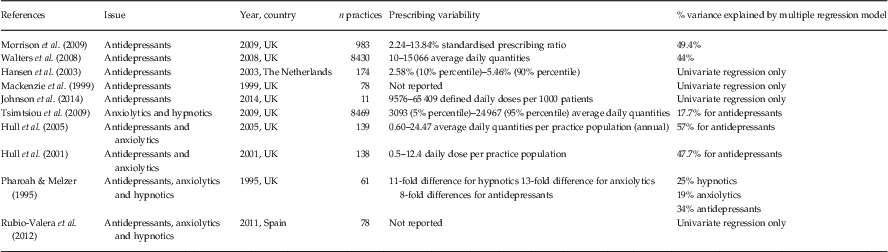
A total of 10 studies met the inclusion and exclusion criteria and were included in this review. Their key characteristics are presented in Table 1. Five related to antidepressant prescribing (Mackenzie et al. Reference Kessler, Aguilar-Gaxiola, Alonso, Chatterji, Lee, Ormel, Ustün and Wang1999; Hansen et al. Reference Mojtabai and Olfson2003; Walters et al. Reference Mant, Broom and Duncan-Jones2008; Morrison et al. Reference Johnson, Williams, MacGillivray, Dougall and Maxwell2009; Johnson et al. Reference Moore, Yuen, Dunn, Mullee, Maskell and Kendrick2014), one to anxiolytics and hypnotics (Tsimtsiou et al. Reference Morabia, Fabre and Dunand2009), and four to multiple psychotropic medications (Pharoah & Melzer, Reference Munoz-Arroyo, Sutton and Morrison1995; Hull et al. Reference Morrison, Anderson, Sutton, Munoz-Arroyo, McDonald, Maxwell, Power, Smith and Wilson2001, Reference Johnson, Dougall, Williams, MacGillivray, Buchanan and Hassett2005; Rubio-Valera et al. 2012). All were based in one of three European countries: eight related to UK general practices (Pharoah & Melzer, Reference Munoz-Arroyo, Sutton and Morrison1995; Mackenzie et al. Reference Kessler, Aguilar-Gaxiola, Alonso, Chatterji, Lee, Ormel, Ustün and Wang1999; Hull et al. Reference Morrison, Anderson, Sutton, Munoz-Arroyo, McDonald, Maxwell, Power, Smith and Wilson2001, Reference Johnson, Dougall, Williams, MacGillivray, Buchanan and Hassett2005; Walters et al. Reference Mant, Broom and Duncan-Jones2008; Morrison et al. Reference Johnson, Williams, MacGillivray, Dougall and Maxwell2009; Tsimtsiou et al. Reference Morabia, Fabre and Dunand2009; Johnson et al. Reference Moore, Yuen, Dunn, Mullee, Maskell and Kendrick2014), one to Dutch practices (Hansen et al. Reference Mojtabai and Olfson2003) and one to Spanish practices (Rubio-Valera et al. 2012). The data were relatively old, with only five of the studies published in the last decade (Walters et al. Reference Mant, Broom and Duncan-Jones2008; Morrison et al. Reference Johnson, Williams, MacGillivray, Dougall and Maxwell2009; Tsimtsiou et al. Reference Morabia, Fabre and Dunand2009; Rubio-Valera et al. 2012; Johnson et al. Reference Moore, Yuen, Dunn, Mullee, Maskell and Kendrick2014). Sample sizes ranged from 11 to 8469 general practices.
Research settings

Prescribing rates were measured differently across studies. Some measured average daily quantities, whereas others measured patient population percentages or standardised prescribing ratios. Where reported, prescribing rates between the highest and lowest practices varied considerably. The highest rate of variation was 10–15 066 average daily quantities (Walters et al. Reference Mant, Broom and Duncan-Jones2008). Six of the studies carried out multivariate regression (Pharoah & Melzer, Reference Munoz-Arroyo, Sutton and Morrison1995; Hull et al. Reference Morrison, Anderson, Sutton, Munoz-Arroyo, McDonald, Maxwell, Power, Smith and Wilson2001, Reference Johnson, Dougall, Williams, MacGillivray, Buchanan and Hassett2005; Walters et al. Reference Mant, Broom and Duncan-Jones2008; Morrison et al. Reference Johnson, Williams, MacGillivray, Dougall and Maxwell2009; Tsimtsiou et al. Reference Morabia, Fabre and Dunand2009) and four carried out univariate regression only (Mackenzie et al. Reference Kessler, Aguilar-Gaxiola, Alonso, Chatterji, Lee, Ormel, Ustün and Wang1999; Hansen et al. Reference Mojtabai and Olfson2003; Rubio-Valera et al. 2012; Johnson et al. Reference Moore, Yuen, Dunn, Mullee, Maskell and Kendrick2014). The multivariate models explained from 17.7% to 57% of variance in antidepressant prescribing rates.
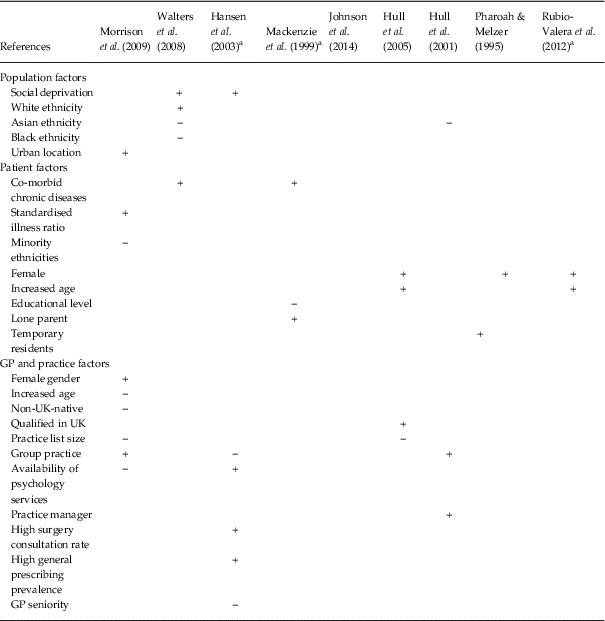
Factors explaining variation were inconclusive. One study of antidepressants, the most studied psychotropic drug from the identified articles, found population characteristics such as social deprivation to be the most important (Walters et al. Reference Mant, Broom and Duncan-Jones2008; Johnson et al. Reference Moore, Yuen, Dunn, Mullee, Maskell and Kendrick2014), while others reported patient (Pharoah & Melzer, Reference Munoz-Arroyo, Sutton and Morrison1995; Mackenzie et al. Reference Kessler, Aguilar-Gaxiola, Alonso, Chatterji, Lee, Ormel, Ustün and Wang1999; Rubio-Valera et al. 2012) or GP (Hansen et al. Reference Mojtabai and Olfson2003; Morrison et al. Reference Johnson, Williams, MacGillivray, Dougall and Maxwell2009) characteristics as primary causal factors (see Table 2). Of the population factors, social deprivation, urban location and the proportion of the population with White ethnicity appear to have positive associations with antidepressant prescribing. Patients with comorbid chronic diseases, female gender and increased age were reported to have higher rates of antidepressant prescriptions, as were lone parents and temporary residents. Minority ethnicities and those of lower educational levels had lower rates of antidepressant prescribing.
Explanatory factors for variation in antidepressant prescribing

+, increased prescribing; −, decreased prescribing.
a Univariate regression only.
GPs who were female, younger, more junior, native to and qualified in the country in which they were practicing had higher prescribing rates. Practices with smaller patient list sizes, a practice manager and high general prescribing and consultation rates also had higher antidepressant prescribing rates. There were some conflicting findings: group practices and the availability of psychology services were both positively and negatively associated with rates of prescription.
Discussion
Summary of main findings
A total of 10 articles exploring the causal factors for variation in psychotropic prescribing rates between general practices were found. Eight were from the United Kingdom, all from Europe, and half were over a decade old. The most common drugs studied were antidepressants and anxiolytics. A large variation was found between practices for rates of psychotropic medication prescribing. There was no consensus on the factors that explained this inter-practice variation in prescribing rates, and the current literature has some conflicting findings. The reviewed studies identified a large number of explanatory variables, and no regression model explained >57% of the variance. Some studies suggested that patient and GP characteristics are the primary predictors (Hull et al. Reference Morrison, Anderson, Sutton, Munoz-Arroyo, McDonald, Maxwell, Power, Smith and Wilson2001; Hull et al. Reference Johnson, Dougall, Williams, MacGillivray, Buchanan and Hassett2005; Morrison et al. Reference Johnson, Williams, MacGillivray, Dougall and Maxwell2009); others found that social deprivation and population ethnicity were more important (Pharoah & Melzer, Reference Munoz-Arroyo, Sutton and Morrison1995; Walters et al. Reference Mant, Broom and Duncan-Jones2008; Johnson et al. Reference Moore, Yuen, Dunn, Mullee, Maskell and Kendrick2014).
Comparisons to existing literature
Variation in psychotropic prescribing has been identified more widely in the scientific literature, including studies which did not meet inclusion criteria of this review. Variation has been identified in other settings such as paediatric primary care practice (Mayne et al. Reference Pharoah and Melzer2016) and hospital clinics (Morabia et al. Reference Rubio-Valera, Fernández, Luciano, Hughes, Pinto-Meza, Moreno-Küstner, Palao, Haro and Serrano-Blanco1992), and in descriptive papers which did not carry out factor analysis to explore causation (Hughes et al. Reference Tsimtsiou, Ashworth and Jones2016; Brijnath et al. Reference Schofield, Das-Munshi, Mathur, Congdon and Hull2017). Despite the potential consequences of this for patient care, the mechanism of how these factors influence prescribing rates is unclear.
Social deprivation may be an important factor – its association with higher rates of prescribing ‘inverse care law’, whereby patients in deprived areas receive poorer care (Hart, Reference Verdoux, Tournier and Begaud1971). Of the studies in this review, Walters et al. (Reference Mant, Broom and Duncan-Jones2008) found higher prescribing and illness rates in areas with high social deprivation. Tsimtsiou et al. (Reference Morabia, Fabre and Dunand2009) suggested that the higher rates of anxiolytic and hypnotic prescribing they found in deprived areas may represent a coping strategy for dealing with disadvantage and higher rates of physical illness. More affluent areas may also have more access to psychotherapies and alternative treatments for mental disorders (Tsimtsiou et al. Reference Morabia, Fabre and Dunand2009).
Patient ethnicity also appears significant – Walters et al. (Reference Mant, Broom and Duncan-Jones2008) suggest that higher ethnic minority density might confer a protective mental health benefit to minority populations, reducing both depression prevalence and its psychotropic treatment. Hull et al. (Reference Morrison, Anderson, Sutton, Munoz-Arroyo, McDonald, Maxwell, Power, Smith and Wilson2001) likewise found that Asian ethnicity was negatively associated with prevalence rates, which may be due to cultural differences in symptomatic experiences or practical difficulties in diagnosis and management.
GPs themselves may differ in their ideas about depression and whether it is predominantly social or biological, affecting their prescribing patterns (Hyde et al. Reference Walters, Ashworth and Tylee2005). Patient gender, economic status and expectations for treatment may also bias GPs’ prescribing patterns (Hyde et al. Reference Walters, Ashworth and Tylee2005; Brijnath et al. Reference Schofield, Das-Munshi, Mathur, Congdon and Hull2017), and patients with longer-term disorders may become ‘experts’ in their conditions, choosing to seek higher medication doses or longer treatment duration (Johnson et al. Reference Moore, Yuen, Dunn, Mullee, Maskell and Kendrick2014).
Limitations of current research
The studies identified in this review measured and incorporated into regression analysis for different variables – some measured population statistics gathered from census data, while others used GP and patient data only. This, therefore, affected the range of factors that were identified as significant. Different measures were used for patient and GP characteristics between studies, and so the results are not directly comparable. Only six conducted multiple regression analysis, and of these, no model predicted >57% of variance.
Many had small sample sizes and were carried out in specific populations such as east London (Hull et al. Reference Morrison, Anderson, Sutton, Munoz-Arroyo, McDonald, Maxwell, Power, Smith and Wilson2001, Reference Johnson, Dougall, Williams, MacGillivray, Buchanan and Hassett2005) or Catalonia (Rubio-Valera et al. 2012); their results may not be generalisable to other areas. Research suggests that antidepressant rates vary by country – one multicountry comparison found higher rates in the United Kingdom than in the Netherlands, Spain, Denmark or Germany (Abbing-Karahagopian et al. Reference Wittchen, Jacobi, Rehm, Gustavsson, Svensson, Jönsson, Olesen, Allgulander, Alonso, Faravelli, Fratiglioni, Jennum, Lieb, Maercker, van Os, Preisig, Salvador-Carulla, Simon and Steinhausen2014) – and so the profile of psychotropic prescribing, its variation between practices and the causes of variation may differ. In addition, this review was a narrative review, rather than a systematic review. While a search strategy was used, and all eligible papers included, this review may not be a comprehensive summary of all studies on inter-practice variation in psychotropic prescribing. Formal risk of bias assessment was not carried out; this may reduce the validity of this paper’s conclusions.
Implications for future research and clinical practice
Suicide and mental health problems are major public health issues (Wykes et al. Reference Brijnath, Xia, Turner and Mazza2015), and their prevention and management in primary care is an important yet understudied area (McDaid, Reference Hart2013). This review identified a wide and only partially explained variation in prescribing rates for psychotropic medications. Though some of the variation may simply be random, the findings of this study do suggest differences in patient care, with major implications for patients, health professionals and health systems. To date, most of the studies of inter-practice variation have been conducted in countries with centralised electronic health records (Netherlands Institute for Health Services Research, 2018; Clinical Practice Research Datalink, 2018); however, the growing adoption of electronic health records worldwide would allow researchers to determine whether this variation exists in other health systems, and explore the explanatory factors if so. Population factors such as social deprivation appear to be significant when included in analysis models, and new mapping technologies and publically available population datasets would allow complex models exploring causal factors to be developed and tested. The impact of prescribing variation on patients’ health outcomes for patients is also a potential area for future research.
Conclusions
A wide variation in psychotropic prescribing in general practice exists, and it remains unclear which factors explain this variation. Scientific knowledge has not progressed much in the past decade, and most research has been carried out in a single country. Only some studies incorporated population statistics such as deprivation into their analysis, though it was found to be a significant factor in those that did. This review found that a wide and complex range of population, patient and GP variables appear to influence variation. Updated research in a wider range of countries and health systems is needed to identify the variables that explain prescribing rates for psychotropic medications. The impact of the significant variation seen in the existing research also needs urgent research attention.
Acknowledgements
Financial Support
This study was funded by the UCD School of Medicine.
Conflicts of Interest
The authors declare that there are no conflicts of interest.
Ethical Standards
The authors assert that all procedures contributing to this work comply with the ethical standards of the relevant national and institutional committee on human experimentation with the Helsinki Declaration of 1975, as revised in 2008. The authors assert that ethical approval for publication of this review article was not required by their local Ethics Committee.