Introduction
Rumour has it that Prati di Castello, the neighbourhood north-east of the Vatican, was intentionally designed so that, walking through the streets, one can never catch sight of St Peter’s dome (Maurano Reference Maurano1964, 2: 97; Tagliaferri Reference Tagliaferri1994, 8). To this day, millions of tourists bound for St Peter’s Square notice that, until they come in sight of the Vatican walls, Michelangelo’s massive piece of architecture stays hidden behind the buildings. Though there is no evidence that this effect was intentional, every legend has a kernel of truth. Prati – one of the first neighbourhoods created after the annexation of Rome by Italy in 1870, and by 1921 its most densely populated quarter (Ufficio statistica 1960) – was not meant to be just another middle-class district. It was soon perceived as a symbol of the challenge posed by the state to the old order represented by the Catholic Church. The urban fabric of Prati, as its name suggests once an area of meadows, menaced the pope’s last citadel.
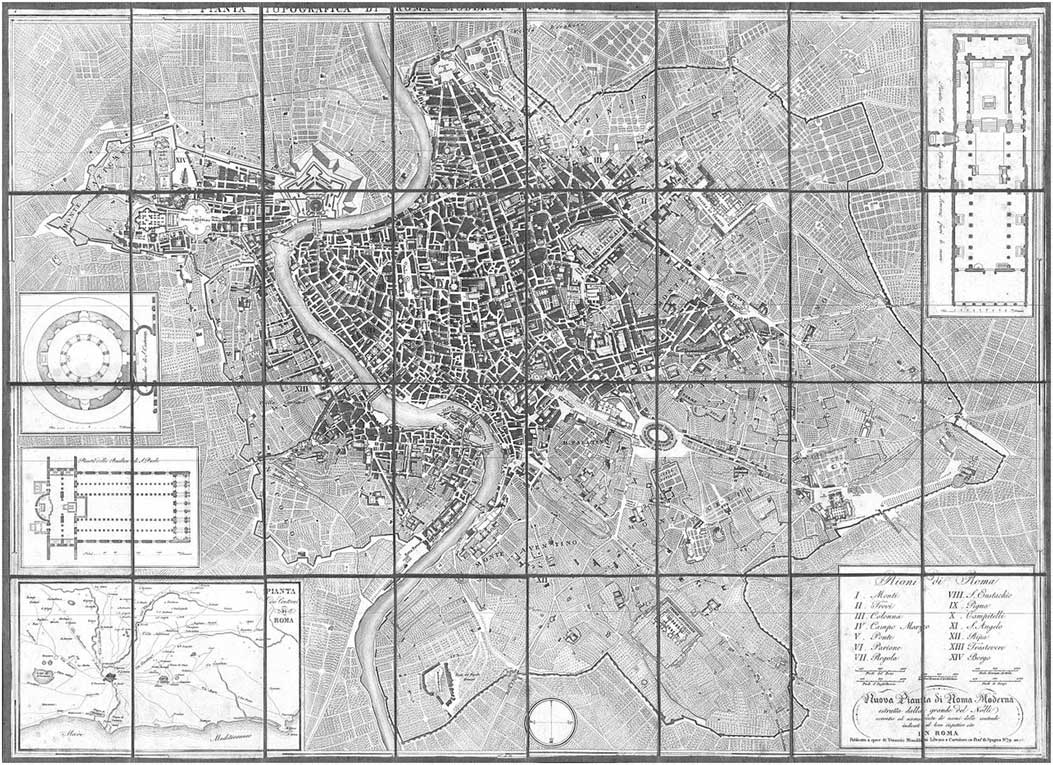
When the Italian army seized Rome in September 1870, the city could not have been further distant from a modern European capital city (Fig. 1). The process of urban expansion that followed, while reshaping the face of the city, also brought about a cultural transformation. However, traditional historiography, mainly influenced by the works of Alberto Caracciolo and Italo Insolera, primarily focused on Rome’s physical reshaping and identified real estate speculation as its leading force, paying less attention to other factors (Caracciolo Reference Caracciolo1984; Insolera 2011). Caracciolo, a Marxist historian, and Insolera, an urban planner, published their books respectively in 1956 and Reference Insolera1962, when, at the height of Italy’s post-Second World War ‘economic miracle’, Rome was experiencing the greatest wave of speculation-led expansion in its history. It was comparable only with the one that had started in 1870 and had been abruptly interrupted at the end of the 1880s by a severe economic crisis (Della Seta Reference Della Seta1954). Whether worried that unbridled speculation could again lead to such a catastrophic outcome or concerned about the deterioration of the urban environment in the name of private economic interests, Caracciolo and Insolera looked back at late nineteenth-century urbanisation through the lens of speculation, implicitly encouraging their contemporaries to follow a different path.Footnote 1
Rome in 1843 in a map by Venanzio Monaldini. Prati di Castello is the unbuilt area north-east of the Vatican.

Only recently have historians emphasised the role played by cultural and symbolic forces in the urbanisation of Rome after 1870 (Tobia Reference Tobia1991, Reference Tobia1998; Dickie Reference Dickie1994; Brice Reference Brice1997, Reference Brice1998; Dau Novelli Reference Dau Novelli2011). This is not to say that speculation was not one of the leading factors of this process, but alone it cannot account for the dynamics of the new Italian capital’s creation, as this study of Prati’s emergence between 1870 and the 1890s shows. Prati was in a very convenient location, adjacent to the city centre, across the Tiber, and its urbanisation had been repeatedly envisioned throughout the nineteenth century. Nonetheless, because of the cultural and political significance that the process of urban expansion assumed after 1870, the creation of a new district in the area did not unfold in a linear fashion. The first master plan of modern Rome, approved in 1873, did not include Prati. Only a second master plan, drafted in 1883, placed the area on one of the principal axes of urban expansion. Speculation can hardly be considered the only reason for this shift. Rather, in order to build a new neighbourhood in Prati, the Roman city council had to be strong enough to engage in a cultural battle with the Church over the control of a deeply symbolic urban space. As amanuenses writing on a palimpsest, municipal administrators had to superimpose new meanings on a cityscape that already had a strong political identity because of its physical proximity to the Vatican. Thus, the delayed start of the urbanisation of Prati and the way it was carried out mirror a broader transformation of Italian politics – from the separatist attitude epitomised by Cavour’s motto, ‘a free Church in a free State’ (libera Chiesa in libero Stato), to a more antagonistic involvement of the state in the ‘culture war’ against the public presence of religion from the late 1870s onwards (Clark and Kaiser Reference Clark and Kaiser2003).
In order to shed light on the role of these factors in the building of the new Rome, this article argues that in the eyes of planners, politicians, and administrators Prati was not just a set of cadastral parcels, but also a political landscape, in which competing powers articulated their aspirations and values, negotiated their respective authorities, and transmitted political ideas (Smith Reference Smith2003; Keene Reference Keene2005; Christie, Bogdanović and Guzmán Reference Christie, Bogdanović and Guzmán2016). It first shows how Risorgimento intellectuals framed the creation of a ‘third Rome’ as an absolute necessity. It then details how in 1870 the urbanisation of Prati seemed imminent, underlining that the decision to push it back was due to politico-cultural rather than economic reasons. Finally, it describes how the urbanisation of Prati, once begun, was carried out with the greatest deployment of cultural and symbolic means, in order to turn the new district into an embodiment of the values of the new Italian state. Italy’s shift towards an aggressive attitude towards the Catholic Church, famously embodied by monuments such as the statue of Giordano Bruno, inaugurated in 1889, and the monument to Victor Emmanuel II, whose construction began in 1885, was epitomised also by an entire neighbourhood, and ultimately by the very fabric of the city.
The myth and reality of the third Rome
The myth of the third Rome was one of the key features of Risorgimento political imagination. In Giuseppe Mazzini’s words, there could be no Italy without Rome; therefore, the city’s liberation was the ultimate goal of the patriots. The new Italian Rome, after those of the Caesars and of the popes, would serve as a living representation of national values. The city gained even more symbolic importance after the fall of the Roman Republic in 1849. Garibaldi and Mazzini’s courageous defence of Rome was soon inscribed in the collective memory and reinforced the city’s role as the focal point of national aspirations (Chabod Reference Chabod1965).
Conservative liberals did not share Mazzini’s enthusiasm for republican ideals but were still fascinated by the myth of Rome and widely identified the city as Italy’s future capital. On 25 March 1861, a handful of days after the proclamation of the Kingdom of Italy, Prime Minister Camillo Cavour asserted before parliament that Rome would sooner or later become the capital of the new state; ‘strong moral reasons’ made this an absolute necessity (Galasso Reference Galasso1970, 73–74). True, there was a strategic rationale for this option, since Rome alone, because of its historical prominence, could prevail over the ambitions of other cities that had been capitals of pre-unification states and aimed to serve as the capital of the newborn kingdom as well. Moreover, moderates could not afford to surrender to democrats alone such a powerful rhetorical tool as the myth of Rome. However, there is little doubt that this myth was of great influence on politicians of all stripes (Chabod Reference Chabod1965; Djament-Tran Reference Djament-Tran2009; Bartolini Reference Bartolini2016).
As Mazzini made clear in 1866, ‘Rome [was] not a city; it [was] an idea’ (Bartolini Reference Bartolini2016, 72). Indeed, in 1870 Rome was more similar to a country town than to other burgeoning European metropolises. Novelist Edmondo De Amicis, who was then working as a journalist and entered the city with the soldiers, euphorically hailed the conquest and was astounded by Rome’s historical heritage but had to acknowledge that great transformations were needed in order to make it a European capital city (De Amicis Reference De Amicis1870, 63–72). Rome had a population of around 240,000 inhabitants and was almost completely isolated from the rest of the Peninsula. Its economic structure, mainly dependent on ecclesiastical and administrative functions, agriculture, pilgrimages, and tourism, was still largely pre-modern. Besides small textile and brick factories, there was no noteworthy manufacturing plant within the city boundaries, nor were commercial activities more significant. The urban fabric was equally obsolete and disorderly. Under the popes, the city had expanded piecemeal, and the last significant attempt to plan the urban development dated back to the first half of the seventeenth century; even the projects of urban renewal elaborated during the Napoleonic occupation had almost entirely remained on paper. As a result, Rome lacked arterial roads, markets, public transportation, proper street lighting, and modern sewerage (Pietrangeli Reference Pietrangeli1970; Grispigni Reference Grispigni1988; Toscano Reference Toscano1994; Pagnotta Reference Pagnotta2002, 204–212; Vidotto Reference Vidotto2006, 64; Bartolini Reference Bartolini2008, 12–13; Brilli Reference Brilli2010, 71–72).
The main settlement areas were located on the left bank of the Tiber. The oldest and more densely populated had been built during the Renaissance in the main meander of the river and bordered another populous neighbourhood centred around Piazza di Spagna and Via del Corso. Lower-class people also resided in the Suburra, an area on the Viminal Hill, and in two districts across the Tiber, Trastevere and Borgo. In its entirety, Rome was divided into 14 districts (rioni), which altogether covered just one third of the area within the Aurelian walls; most of the urban area was still unbuilt (Hibbert Reference Hibbert1985; Casciato Reference Casciato2002, 126–137). Thus, not only there were no edifices suitable for housing the new state administrations, but there were not enough apartment buildings for the incoming civil servants and their families. All these needs had to be urgently addressed.
The insufficient financial capability of the state and the laissez-faire policies of the government paved the way for private interests and speculative activities to take up a major role in the process of urban expansion (Melograni Reference Melograni1957; Crialesi Reference Crialesi2011; Salsano Reference Salsano2012, Reference Salsano2013a). However, the management of this process was not left to speculators alone; it was also conditioned by two other factors.
On the one hand, Italy’s influential Minister of Finance, Quintino Sella, unwaveringly championed the idea that a new town centre should be built east of the existing city, in the area of the Viminal and Esquiline Hills and Castro Pretorio. For Sella, who translated Cavour’s ‘a free Church in a free State’ into urbanistic terms, the new Rome had to turn its back on the papal town. As far as it could be from the historic centre but also from the Vatican and its self-styled ‘prisoner’ (Kertzer Reference Kertzer2004), the new city would be a world capital of science and the home of academies and international cultural institutions. The distance – both physical and functional – between the new national centre and the places that had long been shaped by what Sella regarded as the Church’s obscurantism had to serve as a visual representation of the break with the past. On 9 September 1871, Sella convinced the Council of State to fund the construction of a new headquarters for the Ministry of Finance (Palazzo delle Finanze) on the former Via Pia, now Via XX Settembre – the street between Porta Pia and the Quirinal Palace, the new royal residence in Rome. This building, whose imposing mass allegedly symbolised the strength of the national state, was supposed to serve as a catalyst for the urbanisation of the area east of the city centre (Schroeter Reference Schroeter1978; Caracciolo Reference Caracciolo1984, 83–90; Allegrezza Reference Allegrezza2000, 23–25; Salsano Reference Salsano2013b).
On the other hand, over the last years of papal rule, this area had been involved in the projects of urban expansion promoted by a Belgian prelate, François-Xavier de Mérode. A minister of Pope Pius IX, de Mérode was convinced that Rome had to catch up with the major European cities. Accordingly, in 1862 he started the construction of a railway station in the area facing the Baths of Diocletian (Terme di Diocleziano); the station, named Termini after the Terme, was inaugurated in 1863. Convinced that Termini would soon become the new centre of gravity of the city, de Mérode purchased the bulk of the building lots between the station and the Quirinal Palace and started planning the creation of a new neighbourhood centred around a wide Paris-like avenue linking Termini to the city centre. De Mérode’s projects were still on paper in 1870, yet the prelate did not give up his hopes. On 28 February 1871, he reached an agreement with the city council for the construction of the neighbourhood that he had long envisaged. Over the following years, the text of the agreement (convenzione) between de Mérode and the council would serve as a model for other agreements of the same kind. Landowners were authorised to build on their lots; in exchange, they ceded the areas necessary for the creation of streets, sewers, and lighting systems: it was up to the municipality to cover the expenses for these services. The first arterial road of modern Rome, which took the name of Via Nazionale, was created exactly where de Mérode had planned (Tafuri Reference Tafuri1959; Vannelli Reference Vannelli1979, 211–233; Pasquarelli Reference Pasquarelli1984; Agnew Reference Agnew1995, 33–34; Casciato Reference Casciato2002, 131–133; Insolera (1962) 2011, 21–25).
Much ado about nothing: Prati and the master plan of 1873
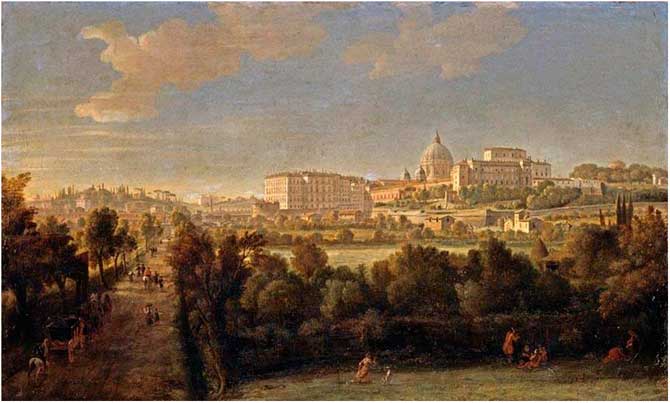
In 1870, Prati di Castello (literally, Castle Meadows) was still a largely unbuilt country area right outside the city walls (Fig. 2). Its southern and western borders were respectively marked by Castel Sant’Angelo, Borgo, and the Leonine Wall, which surrounded the Vatican. Some scattered farmhouses serving as inns dotted an otherwise continuous fabric of vegetable gardens and vineyards. Villa Altoviti, in the south-east corner, was the only building of significant dimensions on the horizon. From the city centre, Prati could be accessed only through Ponte Sant’Angelo, south of the castle. Going up the river, there were no other bridges for more than two miles (Pesci Reference Pesci1907, 722–726; Cuccia Reference Cuccia2006, 9–12). As the philologist Manfredi Porena later recalled in his memoirs, the Romans used to spend some of their free time in Prati, having picnics on the grass or just wandering around and admiring the sunset. Artists looking for inspiration went there to contemplate the shape of the castle and of St Peter’s dome from a distance (Porena Reference Porena1957, 15–16).
Gaspar van Wittel, View of St Peter’s and the Vatican seen from Prati di Castello, second half of seventeenth century.

Rome’s urbanisation after 1870 wiped out this little corner of unspoiled countryside. However, Prati had already attracted the interests of urbanists, architects, and speculators since at least the Napoleonic occupation of the city (1809–1814). Napoleon was resolved to turn Rome into the second city of his empire and conceived grandiose projects of urban renewal, including the embankment of the Tiber and the construction of a new bridge to Prati at the height of the Porto di Ripetta. Architect Raffaele Stern suggested the creation of a new residential neighbourhood in Prati as well, but Napoleon’s downfall frustrated his plans (Capogrossi Guarna Reference Capogrossi Guarna1879, 236; La Padula Reference La Padula1969, 126, 171; Guidoni Reference Guidoni1987, 442; Brice Reference Brice2009, 55–66). The urbanisation of Prati came under discussion again in 1830, when Pope Pius VIII invited architects to present plans for a new lower-class neighbourhood to accommodate the need for new housing facilities fostered by a steady wave of immigration from the countryside (Felisini Reference Felisini2006; Sanfilippo Reference Sanfilippo2007). Architect Domenico Cacchiatelli identified Prati as the ideal location for the new district, but his project was dropped after Pius VIII’s sudden death in November 1830 (Capogrossi Guarna Reference Capogrossi Guarna1879, 237–238, 261; Bordini Reference Bordini1978). In the following years, architect Giuseppe Valadier again advised Gregory XVI to promote the urbanisation of Prati, but no new initiatives were taken until 1847, when Pius IX announced his will to fund three new iron bridges on the Tiber. The creation of new districts across the river seemed imminent, but every expectation was betrayed and the bridges were never realised (Bartoloni and De Nicolò Reference Bartoloni and De Nicolò2000, 153–157; Brice Reference Brice2009, 100). Nonetheless, on the eve of the annexation, the urbanisation of Prati still appeared to be only a matter of time. It is no coincidence that the area won even the attention of de Mérode, who purchased Villa Altoviti in 1864.Footnote 2 However, before 1870 both public authorities and private investors had failed to launch the construction of the new district. This task was bequeathed to the new Italian state.
The drafting of a master plan for Roma capitale was the main goal of the municipal administrations in the immediate aftermath of the annexation (Insolera Reference Insolera1959b; Kostof Reference Kostof1976; Pavone Reference Pavone2001, 3–88). The commission charged with the elaboration of the first blueprint for a plan, forced to take into account the agreement between the city council and de Mérode for the creation of a neighbourhood around Via Nazionale, ratified the eastward urbanisation, while reaffirming at the same time that a simultaneous westward expansion in Prati was possible (Atti 1871, 812–813). However, the plan drafted by civil engineer Alessandro Viviani in November 1871, based on the commission’s report, did not include Prati.
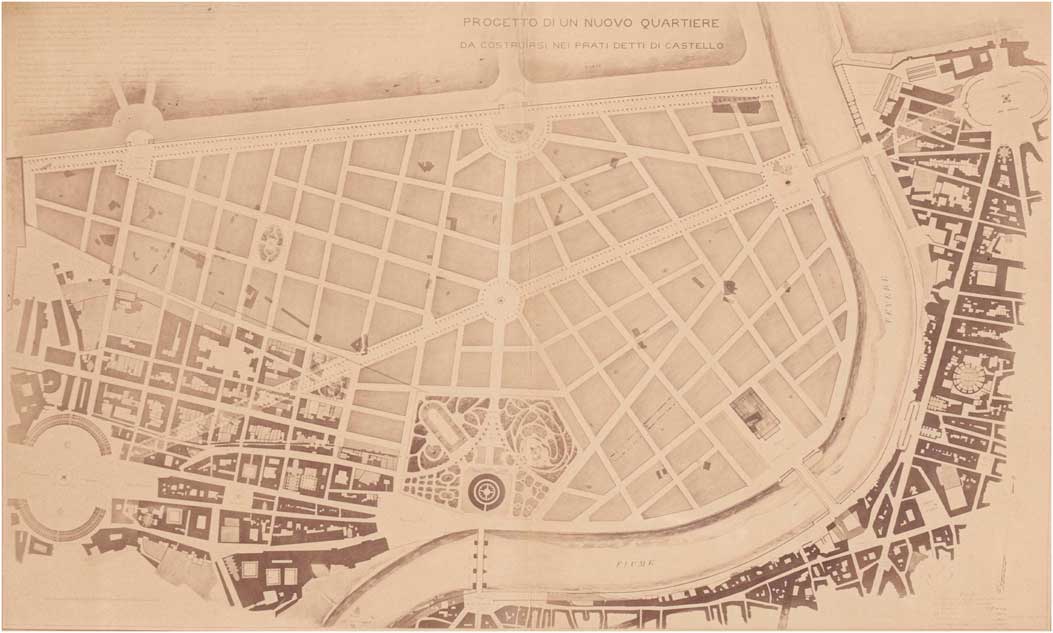
In response, the owners of lots on the right bank of the Tiber, led by a Belgian Jewish financier, Edoardo Cahen, started lobbying to get a new convenzione approved by the city council, and entrusted engineer Antonio Cipolla with the preparation of a project (Fig. 3).Footnote 3 In Cipolla’s plan, the new neighbourhood, structured around a boulevard running from Piazza del Popolo to St Peter’s Square, would house approximately 30,000 inhabitants and counterbalance the eastward expansion of the city, so that the old centre would remain the fulcrum of the new Rome (Natali Reference Natali1874, 16).Footnote 4 Viviani himself had words of praise for Cipolla’s plan;Footnote 5 however, when on 13 July 1872 the project came under the scrutiny of the city council, the majority opposed it, arguing that the urbanisation of Prati could not begin until the passing of a comprehensive plan for the embankment of the Tiber.Footnote 6
Cipolla’s plan for a new district in Prati, 1872; Archivio Storico Capitolino.

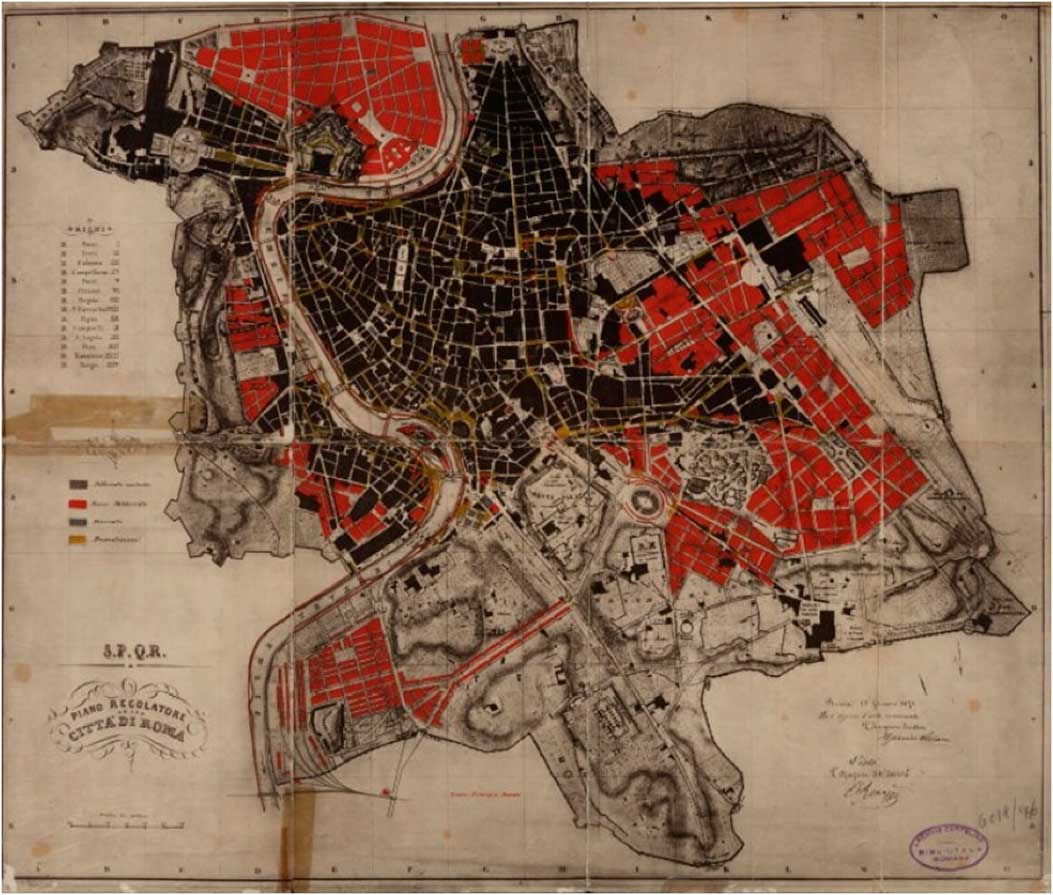
Things seemed about to change when the leftist Count Luigi Pianciani was appointed mayor in November 1872. An anticlerical, freemason, and former disciple of Mazzini, Pianciani argued that in order to efface the memory of the papal town, Rome should grow westward; the new neighbourhood in Prati, besieging the Vatican, would physically challenge the remains of papal authority (Pianciani Reference Pianciani1882, 62–65; Orsini Reference Orsini1971; Varni Reference Varni1988; Mazzonis Reference Mazzonis1992, 80–81; Toschi Reference Toschi1992; Ugolini Reference Ugolini1992; Caracciolo Reference Caracciolo1993, 7–9; Toschi Reference Toschi1996). This project was diametrically opposed to Sella’s, hitherto supported by the municipality, but Pianciani managed to have Prati included in Viviani’s second draft of the master plan (Atti 1873, 1: 924–925, 933–935; Fig. 4).Footnote 7 Unsurprisingly, Viviani’s project met with success among the progressive wing of the city council, but it also provoked the opposition of the clerics, voiced by the rightist Camillo Ravioli. When the final draft of the master plan came into discussion on 10 October 1873, the argument over Prati was particularly harsh (Atti 1873, 2: 308–311, 324–329). Eventually, on 14 October, Viviani’s project for Prati was passed but expunged from the master plan and classified as a ‘special expansion plan’ (Atti 1873, 2: 339–341). Theoretically, this meant that the plan was approved, but that its implementation was to be regulated at a later time. In practice, the urbanisation of the right bank was deferred until a date to be set.
Viviani’s master plan, 1873; Archivio Storico Capitolino.

Ironically, the master plan was never ratified by the minister of public works. After Pianciani’s downfall in 1874, his successors chose not to take the necessary steps to get the plan formally approved by the national government. This decision did not invalidate Viviani’s work, which had been sanctioned by the city council, but it was a clear sign that the municipality had no trouble in exerting a firm control over the city’s expansion. As a result, in 1875 the owners of lots in Prati constituted a limited company, the Società del Ponte di Ripetta, for the construction of an iron bridge connecting the left bank to the area where the new neighbourhood was to be built. The bridge was inaugurated in 1879. In the immediate aftermath, the first scattered buildings started to appear along the new Via Reale, later renamed Via Vittoria Colonna.Footnote 8 The urbanisation of Prati, therefore, began outside the municipality’s control.
‘Fever’, crisis and recovery: conquering Prati
The ‘parliamentary revolution’ of 1876, which brought the Historical Left to power for the first time, marked the beginning of a new phase in the urbanisation of Rome (Carocci Reference Carocci1956; Cammarano Reference Cammarano1999, 140–183). Right-wing politicians were advocates of economic liberalism and had opposed extensive government interventions in Rome’s renovation. For them, national authorities should finance the creation of offices for the state administration, but every other intervention of urban renewal should be up to the local powers. The leaders of the Left had a very different stance. During their electoral campaigns, both Agostino Depretis and Benedetto Cairoli, respectively the first and the second left-wing prime ministers, asserted that the national treasury should support Rome’s expansion. Once in power, they promoted a law regulating the state’s involvement in the capital’s renewal. According to this law, eventually passed in 1881, the Rome city council was supposed to approve a new master plan including ‘national’ buildings – a general hospital, three barracks, and a new Palace of Justice for the Supreme Court of Cassation, the highest court of appeal. The national government would support the plan’s implementation, contributing 50 million lire in 20 annual instalments (Curri Reference Curri1956, 11–15; Bonadonna Russo Reference Bonadonna Russo1970; Bartoccini Reference Bartoccini1991; Carbone Stella Richter Reference Carbone Stella Richter1993; Caravale Reference Caravale1996; Ciampani Reference Ciampani1996, Reference Ciampani1998).
Anticlericalism, too, played a major part in the ideology of the Left, particularly when, in the early 1880s, Depretis inaugurated the politics of trasformismo and turned the opposition to the ‘clerical threat’ into one of the factors that held his diverse coalition together. Anticlerical hostility became even harsher in 1887, after Crispi’s appointment as prime minister. Such political dynamics had evident repercussions on the relations between Church and state on a national scale. Cavour’s separatist principles were set aside and replaced by open hostility and direct confrontation. Among other measures, the school reform of 1877 abolished compulsory religious education in primary schools, and charitable institutions were secularised in 1890. The shift towards a more aggressive anticlericalism also influenced Rome’s municipal life (Ciampani Reference Ciampani2000, 290–292). The urban fabric of the city, which Crispi purported to nationalise and de-Christianise, emerged as a major battlefield of the ‘culture war’ between Church and state. Crispi himself encouraged projects of urban renewal and the creation of new national monuments, such as the statue of Giordano Bruno (Cammarano Reference Cammarano1999, 210–211, 259–260; Duggan Reference Duggan2002, 545–548). Prati’s urbanisation reflected this new political climate.
Since the creation of a new district had already begun after the inauguration of the Ponte di Ripetta, it was out of the question that the new master plan should regulate the urbanisation of the right bank. However, Viviani’s project was definitively put aside. In the new plan, the district of Prati, structured around two ‘tridents’ of roads, was twice as big as that envisaged by both Viviani and Cipolla. Moreover, it was soon identified as the best location for the Palace of Justice. The creation of the new building was meant to serve as the driving force for the development of the whole area. It would attract civil servants and legal professionals, who would give the district the middle-class identity that it still preserves today (Atti 1882, 1: 342–380; Calvo Reference Calvo1882, 3–6).Footnote 9 Thus, when the approval of the master plan by the city council on 26 June 1882 and its ratification by the king in March 1883 sparked the so-called ‘building fever’, Prati soon emerged as one of its epicentres (Insolera Reference Insolera1959a; Fig. 5).
The master plan of 1883; Archivio Storico Capitolino.

Speculation was undoubtedly one of the leading forces of the ‘fever’. In Prati, the new plan reinforced the upward trend in land values. In 1872, part of the area of Villa Altoviti had been sold for 7 lire per square metre. In 1875, the remaining part had been ceded for approximately 14 lire per square metre. In 1884, the same lots were worth 64 lire per square metre; in little more than a decade, their value had increased almost tenfold (Atti 1884, 1: 7–8).Footnote 10 This trend was the consequence of the monopolistic control of land by a small group of investors, most of whom also took part in the formation of a consortium for the cooperative management of some lots.Footnote 11 Some of them, such as Cahen and the Protestant bankers Meuricoffre, had already participated in the urban renewal of Naples (Mancini Reference Mancini2011, 28–29), while others were simultaneously involved in the creation of new districts elsewhere in Rome. The Swiss financier Ulrich Geisser, the founder of the Società Italiana di Lavori Pubblici and a shareholder of the Banca Tiberina and the Compagnia Fondiaria Italiana – among the main companies owning land in Prati – was also a stockholder of the Società dell’Esquilino, which had promoted the urbanisation of the Esquiline Hill (Polsi Reference Polsi1993; Bocci Reference Bocci1998; Palermo Reference Palermo2006); the Società Generale Immobiliare, of which Meuricoffre and Cahen were co-founders, was also involved in the renewal of the old city centre (Marinelli Reference Marinelli2003; Puzzuoli Reference Puzzuoli2005). Sella, Pianciani, and some members of the city council, had considered eastward and westward expansion as mutually exclusive; evidently, investors did not.
Landowners did not personally engage in the construction of new buildings. Rather, they sold their land to building contractors and financed the contractors’ activities through loans. The absence of any control on the borrowers’ reliability created the conditions for the outbreak of the ‘fever’ and the ensuing crisis. Plenty of loans were granted to makeshift entrepreneurs, who planned to pay back their debts with their future earnings. Hundreds of building permits were granted throughout the city. In 1887, however, when the ‘fever’ was at its height, things suddenly changed. The difficulties encountered by the Italian army in the Eritrean war, largely financed by bank loans, the downturn of the German economy, and the tariff war between Italy and France produced a sudden contraction of the credit system. Contractors, no longer able to obtain loans, were declared insolvent, and construction works stopped (Valenti Reference Valenti1890; Arbib Reference Arbib1895, 195; Vendittelli Reference Vendittelli1984, 264; Pagnotta Reference Pagnotta2002, 223–224). Slightly over 200 building permits were granted in Prati between 1884 and 1890, while the certificates of habitability issued between 1886 and 1895 were less than half that number, many building sites having been abandoned.Footnote 12 Émile Zola, who visited Rome in 1894, wrote in his travel journal that Prati seemed a city ‘dead before having lived’ (Zola Reference Zola2013, 41; see also Catini Reference Catini2002).
When the effects of the crisis waned in the second half of the 1890s, Prati soon became one of the hearts of the new bourgeois city. However, erecting new apartment buildings and laying out new roads was not enough. The urban landscape had to be not only physically occupied, but also symbolically conquered; it had to become the visual expression of the values at stake in the conflict between the state and the Church, in order to embody the new national identity (Brice Reference Brice1997; Atkinson and Cosgrove Reference Atkinson and Cosgrove1998). It was not easy to fulfil this task in the shade of St Peter’s dome: Prati was an empty space, but it was not a space devoid of political meaning. Moreover, at the end of the 1880s, Pope Leo XIII was still envisaging the reconstitution of a small papal state, including the immediate surroundings of the Vatican (Cammarano Reference Cammarano1999, 261–262). Thus, it was crucial to construct the new neighbourhood as a national and anticlerical space.
Street names were widely used to resignify urban spaces. Traditional Italian toponymy, dating from the medieval and early modern periods, usually referred to religious figures and buildings, landmarks, and commercial and industrial activities. On the contrary, during the Risorgimento, toponymy came to be regarded as a commemorative and pedagogical tool, and streets were frequently renamed after national figures and historical events (Tobia Reference Tobia1991, 95–96; Raffaelli Reference Raffaelli2010; Treccani Reference Treccani2011; de Stefani Reference de Stefani2011). Unsurprisingly, Risorgimento toponymy played an important part in the reshaping of Rome as the Italian capital, and even more so in Prati, where there were no streets to rename. At least from this perspective, the new neighbourhood was a blank slate on which political meanings could be inscribed from scratch. Several streets were named after ancient Roman figures or scientists, musicians, artists, and persons of letters. The main squares were called Piazza della Libertà, Piazza Cavour, and Piazza del Risorgimento, and the three boulevards departing from Piazza del Risorgimento commemorated anti-papal figures such as Crescenzio, the rival of Pope Benedict VIII, Stefano Porcari, the leader of a 1453 rebellion against Pope Nicholas V, and Cola di Rienzo, who led the Roman revolt of 1347 and was largely considered a precursor of modern anticlericalism (Atti 1885, 1: 526–529). In this way, street names embodied an aggressive left-wing version of anticlericalism and represented the Risorgimento as a struggle against papal authority. Liberty was now celebrated not far from the place where it had been condemned by Pius IX’s 1864 Syllabus of Errors. Adding insult to injury, street names suggested a direct connection between the first and the third Rome, overlooking the history of the papal city.
Piazza Cavour, the location of the new Palace of Justice, became the visual fulcrum of the neighbourhood. Until the creation of the monument to Victor Emmanuel II in Piazza Venezia, the Palace would remain the largest ‘national’ building in Rome. According to its designer, architect Guglielmo Calderini, the Palace’s imposing mass exemplified the new Italian architectural style, based on Renaissance models, and embodied the strength of the national state (Kirk Reference Kirk2005, 246–252). Giuseppe Zanardelli, Minister of Justice in several left-wing cabinets and the main promoter of the Palace’s creation, also conceived it as a symbol of the secular state, representing a visual and conceptual alternative to St Peter’s. The secular cathedral of law confronted the cathedral of faith (Kirk Reference Kirk1997).
Before the construction of the Palace started, Piazza Cavour was also selected as the location for a statue commemorating the first Italian prime minister (Berggren and Sjöstedt Reference Berggren and Sjöstedt1996, 16–19, 83–86, 94–98, 243–245; Francescangeli Reference Francescangeli2014, 67–71; see also Porciani Reference Porciani1993). The creation of a statue of Cavour in Rome had been debated ever since the annexation, but only in 1883 did the city council announce a competition for the creation of the monument.Footnote 13 The commission appointed to evaluate the projects selected the one elaborated by sculptor Stefano Galletti. In this design, Cavour stood at the centre of the monument and was surrounded by four allegorical figures: two of them represented Thought and Action, the instruments through which Cavour had promoted Italy’s unification; the third was a lion, entrusted with the protection of the box containing the ballots that had ratified Rome’s annexation; the fourth portrayed Rome and Italy as armed women.Footnote 14 Altogether the statues commemorated Cavour not just as a statesman, but as the promoter of the conquest of the Eternal City and of the end of the papal rule. The monument was inaugurated by King Umberto I on 22 September 1895, while the construction of the Palace of Justice was still in progress (Arbib Reference Arbib1895, 179–181; Francescangeli Reference Francescangeli1997). Together, the monument, the Palace, and the street names communicated that the legitimacy of the new Italy no longer resided in the separation of Church and state. Rather, it lay in their hostile confrontation and ultimately in the supremacy of the latter. This message was further reiterated when, in the 1910s, Piazza Cavour became the location of a Waldensian church, one of the largest non-Catholic places of worship in Rome.
Conclusion
In 1903, the painter Giulio Ferrari visited Rome and lingered in the Valle dell’Inferno, west of Prati, contemplating the city’s advance towards the Vatican:
The new streets of Prati di Castello, with their glorious Italic names, move forward and wipe away every rustic sadness. The wooded glacis of the Vatican, luxuriantly green yet doleful, observes the high kiln chimneys, which warn the intransigents of the Vatican that the new Rome and the new Italy will not allow their resurrection. In the silent Valley, the clash between civilisation and human obstinacy is solemn and eloquent. (Ferrari Reference Ferrari1904, 105)
As Ferrari made clear, the birth of a neighbourhood in Prati had never been just a matter of urban development or economic interest. It is no coincidence that already in 1894 a Catholic magazine, La vera Roma, presented ‘the wretched neighbourhood of Prati di Castello’, then ravaged by the effects of the economic crisis, as the most compelling evidence of the injustice perpetrated by ‘those who wrested our city from the Pope’ (Album illustrato della Vera Roma 1894, 29–33).
Whether to create a new district around the Vatican was a choice with many far-reaching implications, reflecting the way the new Italian government was taking over the city long ruled by the popes. Was the national state willing and strong enough to engage in a battle with the Church over the control of the urban landscape? Either way, the space of Prati, in spite of being physically empty, was laden with political and cultural significance. As a result, the development of a new neighbourhood on the right bank of the Tiber, which seemed imminent already in the last years of papal rule, was postponed for more than a decade. The political culture of the Historical Right, hinging on Cavour’s ‘a free Church in a free State’, made a frontal confrontation impossible. On the contrary, the coming to power of the Historical Left in 1876 marked the beginning of a brand-new phase in which the urbanisation of Prati emerged as a symbol of the struggle between an aggressively anticlerical state and the Church. The new neighbourhood, embodying notions of secular authority and power, reflected the political culture that had made its creation possible. Well before its reshaping under the Fascist regime, the urban fabric of Rome had already become a symbol of national ambitions and values.
Acknowledgements
I am grateful to Alberto Mario Banti, Daniele Menozzi, Silvana Patriarca, and Rosemary Wakeman for their insightful comments on earlier drafts of this article. I also wish to thank the members of the ASMI Committee, who awarded the ASMI Postgraduate Essay Prize to the piece upon which this article is based, and Modern Italy’s anonymous reviewers for their helpful feedback.
Glauco Schettini is a PhD student in European History at Fordham University and holds an MA in History from the Scuola Normale Superiore and the University of Pisa. His research interests focus on the political and intellectual history of the eighteenth and nineteenth centuries and on the relationship between religion and politics. His works have appeared in Società e storia, Contemporanea, Rivista di storia e letteratura religiosa, and in several edited volumes.