




No CrossRef data available.
On Simplicius’ Testimony Regarding Eudoxan Lunar Theory
Published online by Cambridge University Press: 01 September 2003
Abstract
Argument
The past five years have seen revisions of what had been regarded as the single definitive reconstruction of Eudoxus’ homocentric sphere theory. Crucial to these revisions, which present alternative constructions for the moon (Mendell 1998a, 1998b) and the five planets (Yavetz 1998), is a careful assessment of Simplicius’ testimony regarding the Eudoxan theory. The purpose of this paper is to show that even though we can account for lunar motion by means of two distinct homocentric models, both models involve forced and ambiguous readings of Simplicius’ account. Both reconstructions adequately accommodate the lunar month and the 18.5-year precession of the lunar nodes in a homocentric model that fits the general spirit of Eudoxus’ approach to the problem. Both are also in full accord with Aristotle’s short, general account of the Eudoxan system. However, since neither of them can be naturally reconciled with Simplicius’ text, and since we know of no other appropriate alternatives, it seems to follow that Simplicius’ account may suffer from serious technical inadequacies, and that only limited historical weight can be given to his testimony regarding the details of the system.
Information
- Type
- Articles
- Information
- Copyright
- 2003 Cambridge University Press
A. Introduction
In 1998, Henry Mendell showed a new, hitherto unnoticed possibility of constructing a homocentric model for lunar motion, which is observationally indistinguishable from the standard model, and which fully accords with Aristotle’s description of the Eudoxan system (Mendell 1998a, 186-187, 193-194). Beyond enriching the possibilities of inquiring into the modes of thought that characterize the earliest Greek attempts at a sophisticated mathematical theory of the heavens, the new model seems to have the added advantage of rescuing Simplicius’ account from a long-standing crucial difficulty. Closer examination, however, sheds a considerably less optimistic light on that assessment. To appreciate the difficulties that Simplicius’ text poses for attempts at detailed reconstructions of the Eudoxan lunar theory, both the standard model and Mendell’s alternative will be outlined here with their respective failures to accommodate Simplicius’ account in a simple and natural manner. The underlying requirements that guide both reconstructions are that they accord with Aristotle’s account (Aristotle, Book 12, 1073b;) and that they adequately represent the lunar monthly period as well as the 18.5-year period of the precession of the moon’s nodes around the ecliptic. The 24-hour rotation of the entire sky around the earth is ignored throughout the discussion, and only lunar motion relative to the fixed stars is considered.
B. The Standard Reconstruction
Ignoring the daily rotation of the sky, the standard lunar model consists of two spheres. The pole of the first of these – actually the middle sphere in the complete model – is perpendicular to a plane that bisects the zodiacal belt. This accords with Aristotle’s explicit requirement that the second sphere “moves about the circle which passes through the middle of the signs of the zodiac” (Heath 1981, 194), and with Simplicius to the effect that the second sphere “turns about an axis which is at right angles to the plane through the middle of the zodiac” (Simplicius, 494.26-28; Mendell 1998a, 189). In the Eudoxan theory, this plane is very close to the ecliptic, but not identical to it. For the purposes of the present discussion the difference is irrelevant, and this sphere will be referred to as the ecliptic sphere. The inner sphere’s pole is inclined relative to the pole of the ecliptic sphere by an unspecified angle according to Aristotle, and by an angle that equals the moon’s maximum deviation from the plane through the middle of the zodiac according to Simplicius. The standard model orients the spheres in accordance with these requirements. It accommodates the lunar month and the 18.5 year cycle by placing the moon on the equator of the inner sphere, applying to the inner sphere a rotation of about a one-month period, and applying to the ecliptic sphere a rotation of about an 18.5-year period. The resulting lunar motion is obviously a rotation around a slowly precessing circle, such that the perpendicular to this precessing circle always coincides with the pole of the inner sphere. This accords with the way Simplicius’ text speaks of the inner sphere as rotating “about an axis at right angles to the plane of the circle which is conceived as drawn by the center of the moon” (Mendell 1998a, 189). The precise periods of the inner and ecliptic spheres must be calculated to provide, after superposition, the proper values for the month and the 18.5-year cycle.
Since Aristotle provided information on orientations only, and said not a word about the speed of rotation, this model obviously accommodates his text perfectly. Simplicius, however, went a step beyond Aristotle, and did discuss rotation speed. While he did not specify numbers explicitly, he wrote that the inner sphere spins slowly. This has traditionally been taken as an inadvertent reversal of the speed of the inner and ecliptic spheres. The reason is that application of fast motion to the ecliptic sphere and slow motion to the inner sphere would result, under the traditional model, in a moon that slowly spirals to and from the ecliptic, and cuts it once every 9.5 years or so, which is, of course, blatantly out of accord with the moon’s observed motion. A few historians said the error went all the way back to Aristotle and Eudoxus. Most historians attributed the error to Simplicius or one of his secondary sources. The obvious result was a reduction in the perceived reliability of Simplicius’ testimony.
C. The Alternative Lunar Model
The standard reconstruction of the Eudoxan lunar model emerges quite naturally when Aristotle’s and Simplicius’ testimonies are considered with lunar motion in the direct, mechanistic terms of interlinked homocentric spheres. The possibility of an alternative is not so easily perceived under these terms. The alternative, however, is clearly revealed by examination of the problem in the more analytical terms of the model’s plane projection. Consider an epicycle carried on a deferent such that the epicycle is internally tangent to the deferent (see fig. 1). In other words, if the deferent’s radius is R, and the epicycle’s is r, then the epicycle’s center is R − r away from the center of the deferent. Measure the epicycle’s rotation relative to the radius vector that connects its center to the center of the deferent. If the epicycle spins in the opposite sense of the deferent, at exactly twice the deferent’s angular speed, then a point on the epicycle will trace an ellipse. The ellipse’s semi-major axis will be R, and its semi-minor axis will be R − 2r. This is a well-known special case of epicyclic motion that teaches the only way to draw precisely the elliptical projection of an inclined circle by a deferent and single epicycle. However, for small inclinations that result in projections into ellipses of small eccentricity, another epicyclic arrangement may be used which, while not precise, can yet provide a good likeness of the perfectly elliptical figures created by the first system. The approximate alternative consists of a deferent and epicycle that rotate in the same direction, with the epicycle spinning twice as fast as the deferent. If now in both arrangements the motion of the deferent is made slightly less or slightly more than half the epicycle’s speed, the resulting motion will be a true precessing ellipse in the first case, and an approximate precessing ellipse in the second case.
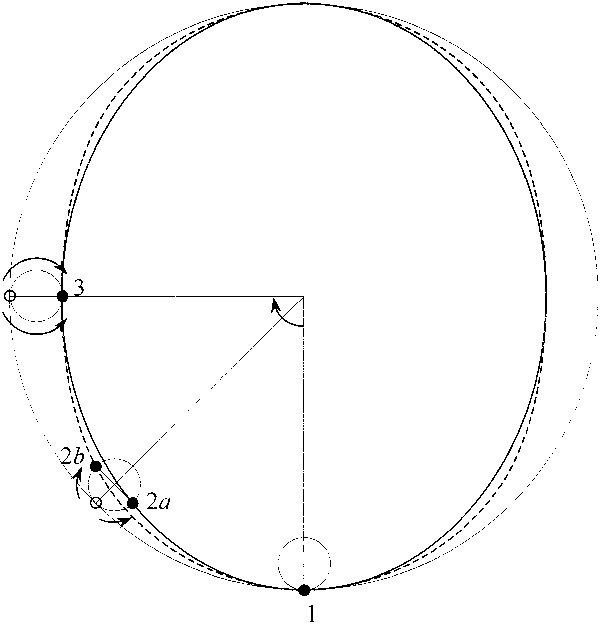
Figure 1. A deferent of radius R carries an internally tangent epicycle of radius r. When the epicycle spins counter the deferent at twice the deferent’s angular speed, the pair creates an ellipse (solid line through 1, 2a, 3). The ellipse’s semi-major axis is R, its semi-minor axis is R − 2r. Reversing the direction of the epicycle creates a closed curve (dotted line through 1, 2b, 3) that is not an ellipse but remains close to it as long as the epicycle is small relative to the deferent. Note the difference in position of the drawing points in the two cases after the deferent rotated by 45°. Had the ecliptic projection of lunar motion required such a large epicycle, the discrepancy between the models could have been settled observationally.
If the deferent in both of the above arrangements is conceived as the equator of a sphere, then the epicycle can be thought of as the projection on the sphere’s equatorial plane of a Eudoxan hippopede drawn on the surface of the sphere, with its mid-point on the equator (see fig. 2). The first epicyclic arrangement above describes a perfect ellipse on the equatorial plane. Therefore, the associated hippopedal arrangement draws a precise great circle on the sphere, inclined relative to the equatorial plane by an angle defined by the ratio of the ellipse’s semi-minor and semi-major axes. Now, for small epicycles the second arrangement described above produces an approximate likeness of an ellipse. Therefore, the associated hippopedal arrangement will draw on the sphere a good likeness of the great circle created by the first arrangement. Again, if in both arrangements the deferents’ rotation period is slightly more or slightly less than twice the rotation period of the epicycles, the resulting traces on the sphere will precess slowly. For an inclination angle of 5°, the difference between the two motions is negligible at the observational accuracy of lunar motion in Eudoxus’ day. This is the key to Mendell’s alternative reconstruction, whose projection on the plane of the ecliptic is identical to the second arrangement described above. It may be noted that the standard model projects into the first epicyclic arrangement above.

Figure 2. Extrusion onto a sphere of the epicyclic arrangements in fig. 1 transforms into a hippopede carried by its midpoint on the sphere’s equator, which in this case coincides with the ecliptic. The sphere rotates about its vertical axis at the deferent’s speed and direction, while the drawing point on the hippopede remains directly above the drawing point on the epicycle. As in fig. 1, the sequence 1, 2a, 3 marks the motion of the standard arrangement; the sequence 1, 2b, 3 marks the motion of the alternative. The two motions coincide only at the axes of symmetry. In the intermediate positions along the first and third quarters the alternative arrangements pulls ahead of the standard, and lags behind it in the second and fourth quarters. On the sphere, only the standard arrangement results in motion along a precise great circle. The drawing point of the alternative trace is always closer to the ecliptic – below the standard circle in the first and second quarters, above in the third and fourth. The discrepancy between the models in both time and form increases with the size of the epicycle, hippopede, and inclination of the standard great circle from the ecliptic.
It remains now to extract from the epicyclic elements of the second arrangement the explicit homocentric arrangement associated with it. Consider, now, that a stationary hippopede is created by two mutually inclined homocentric spheres, spinning at equal and opposite directions.1
This characterization of speeds is made for the sake of brevity. It cannot be overemphasized that taken on its own, it is an ambiguous characterization. For an outside observer, the inner sphere does not appear to move at the speed and opposite direction of the outer. Rather, it appears to wobble in place. The above characterization should be taken as an abbreviated form of the following: with the outer sphere stationary and the axes of the spheres exactly aligned, spin the inner sphere at some speed in a given direction, then spin the outer one at the same speed in the opposite direction. Now incline the axes of the rotating spheres as necessary. Also implicit in this characterization is that the inner sphere receives the motion of the outer one, and superposes it on its own rotation.
D. Difficulties
At first sight, the new alternative seems to rescue Simplicius’ text, for it provides adequate lunar motion with the ecliptic sphere spinning faster than the inner one, just as Simplicius required. On further examination, however, some difficulties present themselves. To begin with, Simplicius’ concluding observation regarding Eudoxus’ lunar model introduces an element of uncertainty with respect to the speed of the third sphere:
And so he supposed the first sphere because of its orbit from east to west, the second because of its advance motion which appears under the zodiac, and the third due to the fact that when [the moon] is most northerly and most southerly it does not always appear on the same points of the zodiac, but instead such points of the zodiac always move towards the leading signs [in regression, east to west]. Hence too he supposed this sphere moves towards the same points as the non-planetary stars, but because this transit is extremely small in each month, the westward motion of its aforementioned points is very slow. (Mendell 1998a, 189)
Further ambiguity arises with respect to the spatial orientation of the third sphere. To see how this comes about, consider figures 3 and 4.

Figure 3. The standard (a) and alternative (b) reconstructions start out from identical situations with the moon at its highest above the plane through the middle of the zodiac. The equator of the outer sphere is in this plane. In both cases, the poles of the inner spheres coincide with the perpendicular to the moon’s precessing circle. For clarity’s sake the angle between the poles of the inner and outer spheres is increased from the real 5° to 10°.

Figure 4. A quarter of a draconitic month later the inner sphere of the standard reconstruction (a) has spun 90° counterclockwise, bringing the moon to the descending node. The slight clockwise rotation of the outer sphere shifts the moon in its nodal position impreceptibly to the left. Throughout the motion, the pole of the inner sphere remains practically perpendicular to the arc drawn by the moon. At the same time, the alternative reconstruction (b) brings the moon to the exact same position using a 90° clockewise spin of the inner sphere, and a nearly 180° counterclockwise spin of the outer sphere. The arc drawn by the moon is practically the same in both cases. However, because the outer sphere in the alternative reconstruction has a large rotation, the pole of the inner sphere is swept away from the perpendicular to the arc drawn by the moon.
Figures 3a and 3b freeze the standard and alternative lunar arrangements in identical states with the moon at its highest position above the ecliptic (the angle has been exaggerated to 10° instead of a realistic 5° for the sake of clarity). The poles of the inner spheres in both arrangements coincide with the perpendicular to the plane of a circle that is also inclined to the ecliptic by 10° in such a way that the moon is found on its circumference. The plane of this lunar circle intersects the ecliptic along the moon’s line of nodes as shown, and it coincides with the equators of the inner spheres in the starting positions as depicted in figures 3a and 3b. Figures 4a and 4b show the state of the arrangements one-quarter of a draconitic month later. Both arrangements carried the moon to its descending node as the phenomena require, but they did so in different ways. In the standard arrangement the inner sphere spun counter-clockwise until it brought the moon exactly to the ecliptic plane. At the same time the outer sphere – whose pole is perpendicular to the ecliptic plane – spun very slightly clockwise, giving the equator and poles of the inner sphere a motion equal to the slow precession of the line of nodes around the ecliptic, and bringing the moon to a descending node located a little to the left of where it would have been had the outer sphere been stationary. The lunar trace shown in figure 4a was created by an inner sphere that completes 20 revolutions about its pole while the outer sphere completes a single revolution. To match reality, the outer sphere would have to spin about ten times more slowly. In other words, the figure exaggerates the precession of the lunar nodes by an order of magnitude, but it is still nearly imperceptible.2
It can be seen by carefully comparing the position of the line of nodes relative to the earth’s stationary pole in the two figures. Had the figures been drawn with a realistic precession for the lunar nodes, the difference would have been impossible to see.
The operation of the alternative arrangement may be clarified by breaking its continuous motion into two discrete steps. From its initial position in figure 3b, the alternative arrangement first brings the moon to a descending node at the back of the figure by a 90° clockwise rotation of the inner sphere. Then the outer sphere is turned counterclockwise by an angle just short of 180° to bring the moon on its descending node to the front position depicted in figure 4b, matching this final position with the slow clockwise precession of the line of nodes. The moon traces the path shown in figure 4b when the two spheres execute their motion simultaneously. The speeds of the two spheres have been calculated to give the moon and the line of nodes the same periods that they receive from the standard reconstruction depicted in figure 4a. Owing to the small angle of inclination (10°) between the two spheres, the trace of the moon’s motion in 4b is practically indistinguishable from its trace in 4a, in keeping with the demonstration in the previous section.3
For inclinations of over 60° between the poles of the spheres, the alternative moon would become retrograde twice a month and diverge significantly from the 60° inclined great circle produced by the standard model.
Perhaps Simplicius wished to say that the third sphere rotates about a pole at right angles to the latitude circle that marks the moon’s position on its carrying sphere relative to the pole. The statement merely makes the redundant observation that a sphere rotates about its rotational pole, without providing any useful indication about the pole’s spatial orientation relative to any external reference. This is hardly as useful as reading the reference to a circle drawn by the center of the moon in the manner associated above with the standard reconstruction, which orients the third lunar sphere quite clearly with respect to the fixed stars. Still, there is nothing to prevent us from ascribing the alternative meaning to Simplicius, whose mathematical sophistication is put in doubt by other aspects of his brief commentary on the Eudoxan models. If the alternative reading further insults Simplicius’ mathematical acumen, at least it allows for a reconstruction that makes sense of the speed assignments that he recorded. Unfortunately, things cannot be left at that. In other places in his commentary, Simplicius described the orientation of a sphere’s rotational pole by reference to a circular plane, without repeating the useless triviality that the alternative reading ascribes to him. He consistently described the second sphere for the various arrangements as a sphere that “turns about an axis which is at right angles to the plane through the middle of the zodiac.” This identifies the sphere’s pole as coincident with the perpendicular to a plane defined by reference to the fixed stars – a plane which we recognize as lying close to the ecliptic plane. Regarding the third sphere for a planetary arrangement, Simplicius wrote that its pole is in the circle through the middle of the signs of the zodiac, which fixes the sphere’s equatorial plane at right angles to the zodiacal plane. True, Simplicius did not record specific inclination angles between the poles of the third and fourth spheres for the planetary arrangements and described the fourth sphere rather uselessly as turning “about the poles of the inclined circle carrying the planet.” However, there is no ready natural external reference relative to which the orientation of the planetary fourth sphere may be specified. Accordingly, Simplicius did not direct his readers to conceive of a circle traced by the planet’s center, and merely referred the planet’s location on its carrying sphere to the sphere’s pole. In the moon’s case, by contrast, we have seen that reference to the circle traced by the center of the moon may be usefully employed to specify the orientation of the third lunar sphere relative to the fixed stars. This might account for the particular mode of expression that Simplicius chose for the moon, despite the unfortunate ambiguity inherent in this mode of expression.
None of these ambiguities flatly contradicts the reconstruction sketched in figure 4b, which must be considered a plausible alternative to the standard one. However, a commentator capable of producing such ambiguities is just as capable of inverting the order of speed assignments for the standard reconstruction.
E. Conclusions
Simplicius’ text contains two explicit requirements regarding the moon’s third sphere: a) the third sphere spins slower than the ecliptic sphere, and b) the third sphere spins about an axis that is perpendicular to the plane of the circle traced by the center of the moon. The standard model accommodates the second requirement, but violates the first; the alternative model accommodates the first, but requires a significant interpretive stretch of the mind to satisfy the second. Either way, it seems impossible to account for lunar motion and at the same time accommodate Simplicius’ text in a straightforward natural manner. The second requirement above suggests to me that Simplicius did conceive of lunar motion as generated by a slowly precessing inclined circle. The only way to produce this sort of motion precisely is by the standard model. However, that Simplicius conceived of lunar motion in this manner does not mean that Eudoxus did so. Eudoxus considered lunar motion in terms of interconnected homocentric spheres, and/or in analytical terms of hippopedal motion on a carrying circle, and/or in deeper analytical terms of epicyclic motions on a plane. All of these terms allow for synthesizing lunar motion using the alternative model, and there is no historical reason to prefer the standard reconstruction over the new one. This presents us with several interpretive possibilities.
- Eudoxus attributed the standard model to the moon, and Simplicius inadvertently interchanged the speed specifications for the second and third lunar spheres.
- Eudoxus attributed the alternative model to the moon, and Simplicius incoherently described it as containing an inner sphere that spins about the perpendicular to the plane of the circle drawn by the center of the moon.
- Eudoxus actually considered both models, and left the decision as to which one is preferable open, since proper choice required observations that exceeded the available precision.4Simplicius might have encountered a description of both models, and in his account combined selective elements of both, without noticing that they are, in fact, irreconcilable.
That several alternatives were available is indicated by Aristotle’s comment that “if those who apply themselves to these matters come to some conclusion which clashes with what we have just stated, we must appreciate both views, but follow the more accurate” (Aristotle, 1073b15).
- Simplicius’ account of the Eudoxan lunar theory is correct in all aspects, and Eudoxus did not create the model to incorporate the monthly and 18.5-year periods simultaneously. Neither of the reconstructions discussed in this paper captures the historical lunar theory of Eudoxus.
Of these possibilities, I consider the fourth least likely. I find the third most likely, but not by a large margin over the first two. Be that as it may, one of two things must happen before we can settle confidently on an unambiguous reconstruction of the Eudoxan system: either new documents will be discovered that clearly verify one option over the others, or a new interpretation will be suggested that avoids all the disharmonies in the currently available ones. In the absence of such developments, I find that for the purpose of elucidating the details of possible Eudoxan models, only limited historical weight can be attributed to the technical elements in Simplicius’ testimony.
References
Aristotle . Metaphysics, Book 12.
Heath, T. L.1981. Aristarchus of Samos: The Ancient Copernicus. New York: Dover.
Mendell, Henry.1998a. “Reflections on Eudoxus, Callippus and their Curves; Hippopedes and Callippopedes.” Centaurus 40: 177-275.Google Scholar
Mendell, Henry.1998b. “The Trouble with Eudoxus.” In Ancient and Medieval Traditions in the Exact Sciences, edited by P. Suppes, J. M. Moravcsikand H. Mendell, 59-138. Stanford.
Simplicius . In Aristotelis de Caelo Commentaria. In Commentaria in Aristotelem Graeca, edited by I. L. Heiberg. Vol. VII.
Yavetz, Ido.1998. “On the Homocentric Spheres of Eudoxus.” Archive for History of Exact Sciences 53:221-278.Google Scholar
Figure 1. A deferent of radius R carries an internally tangent epicycle of radius r. When the epicycle spins counter the deferent at twice the deferent’s angular speed, the pair creates an ellipse (solid line through 1, 2a, 3). The ellipse’s semi-major axis is R, its semi-minor axis is R − 2r. Reversing the direction of the epicycle creates a closed curve (dotted line through 1, 2b, 3) that is not an ellipse but remains close to it as long as the epicycle is small relative to the deferent. Note the difference in position of the drawing points in the two cases after the deferent rotated by 45°. Had the ecliptic projection of lunar motion required such a large epicycle, the discrepancy between the models could have been settled observationally.
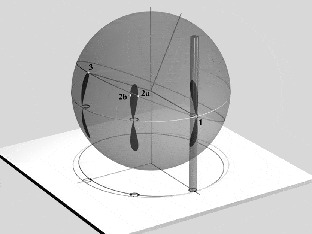
Figure 2. Extrusion onto a sphere of the epicyclic arrangements in fig. 1 transforms into a hippopede carried by its midpoint on the sphere’s equator, which in this case coincides with the ecliptic. The sphere rotates about its vertical axis at the deferent’s speed and direction, while the drawing point on the hippopede remains directly above the drawing point on the epicycle. As in fig. 1, the sequence 1, 2a, 3 marks the motion of the standard arrangement; the sequence 1, 2b, 3 marks the motion of the alternative. The two motions coincide only at the axes of symmetry. In the intermediate positions along the first and third quarters the alternative arrangements pulls ahead of the standard, and lags behind it in the second and fourth quarters. On the sphere, only the standard arrangement results in motion along a precise great circle. The drawing point of the alternative trace is always closer to the ecliptic – below the standard circle in the first and second quarters, above in the third and fourth. The discrepancy between the models in both time and form increases with the size of the epicycle, hippopede, and inclination of the standard great circle from the ecliptic.
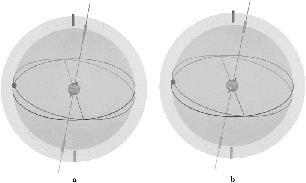
Figure 3. The standard (a) and alternative (b) reconstructions start out from identical situations with the moon at its highest above the plane through the middle of the zodiac. The equator of the outer sphere is in this plane. In both cases, the poles of the inner spheres coincide with the perpendicular to the moon’s precessing circle. For clarity’s sake the angle between the poles of the inner and outer spheres is increased from the real 5° to 10°.
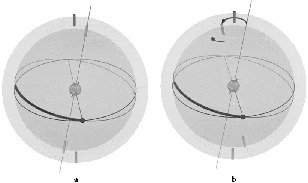
Figure 4. A quarter of a draconitic month later the inner sphere of the standard reconstruction (a) has spun 90° counterclockwise, bringing the moon to the descending node. The slight clockwise rotation of the outer sphere shifts the moon in its nodal position impreceptibly to the left. Throughout the motion, the pole of the inner sphere remains practically perpendicular to the arc drawn by the moon. At the same time, the alternative reconstruction (b) brings the moon to the exact same position using a 90° clockewise spin of the inner sphere, and a nearly 180° counterclockwise spin of the outer sphere. The arc drawn by the moon is practically the same in both cases. However, because the outer sphere in the alternative reconstruction has a large rotation, the pole of the inner sphere is swept away from the perpendicular to the arc drawn by the moon.
 You have
Access
- 4
- Cited by