1. Introduction
Consider what happens when a listener first encounters an unfamiliar work of electroacoustic music. Whether novice or expert, the listener spontaneously starts orienting him- or herself, finding landmarks, catching the gist of things – experiencing feelings and emotions. Whatever sense the listener makes of the work, whatever the listener experiences, that is the meaning of the work for that listener, whether novice or expert. This pragmatic view locates meaning within the individual listener, expressly in the listener's mental processes. By this definition, meaning must be evidenced in human perception and cognition. This view also seeks to avoid the problem of privileging one form of listening or one kind of thinking over another, but it does leave open for examination the exact mechanisms by which the phenomenon of meaning arises when listening.
Electroacoustic music, sonic arts, in fact all of the arts intend to produce a result, often a new sense of possibilities, even if that sense is ineffable – ineffable because the integration of new experiences becomes an unobservable part of the listener's cognitive unconscious, a change in the cognitive-perceptual capacities of the listener. And while we all undergo changes in the course of our everyday life (welcomed or not), we invite to ourselves the changes that art fosters in us. Whether it is shifting our mood or shocking our senses, we open the door for art. And feeling is an intrinsic part of new artistic integrations; in fact, for art, feeling qualities are often at the very core of what is new and meaningful. The new integration could be as simple as a novel gestural shape. I experienced this the first time I heard the filter sweeps in the opening section of Francis Dhomont's Novars (Reference Dhomont1989). Or it could be originality in the overall conception of a work. I had this experience the first time that I heard Barry Truax's Riverrun (Reference Truax1980). These experiences are absorbed into our blood stream, so to speak. They seemingly become part of our body. They expand our world, not just with new information, but, most importantly, with new feeling capacities.
How surprising then that when we come to the role of feeling and emotion in electroacoustic music, professional discourse has been so aloof. Its historic literature is dominated by technical discussions and inclined toward abstract theories of sound that preference a detached intellect over feeling and emotion. If anything, feeling and emotion are not to be trusted as too subjective, too illusive, or simply not the point of the matter. This predisposition has its roots back in the genesis of electroacoustic music after the Second World War, when cultural currents carried a deep distrust of emotion into the arts. Discourse on electronic music was wrapped in the vocabulary of acoustics, philosophy, mathematics or other dispassionate, and therefore trustworthy, endeavours (Born Reference Born1995). The music's capacity for meaning was a captive of the objective sound. Equally distorting is the notion that we can disassociate feeling and emotion from the act of perception. Perception is too often treated as a recording system for physical events, albeit an imperfect one. The objectivity claimed by the physical-acoustic perspective can thus be stretched to embrace a translation from physics to psychophysics. But, in the actual flow of human mental activity, perceiving and feeling are simultaneous, co-mingled, and fused in the experience of the moment.
It is the goal of this essay to explicate the mental processes whereby feeling and emotion become meaningful in listening to electroacoustic music. In support of this goal, we will introduce the concept of the feeling blend, an extension of blend theory as presented by Fauconnier and Turner (Reference Fauconnier and Turner2002). In fact, listening to a piece of music illustrates just how integrated feeling and emotion can be in the flow of ongoing experience. And while it may seem useful to some kinds of cognitive research to isolate and study just one component of the emotion–feeling complex at a time, the experience of art illuminates how these components coalesce into larger, emergent units. Listening to music gives rise to a confluence of feelings and emotions, sensations and thoughts all at once and constantly changing. In large part, this ongoing confluence occurs because mental activity unfolds in multiple, simultaneous layers.
The essay that follows is divided into three sections. The first surveys a broad range of ideas and research about feeling and emotion with an eye toward artistic experience. The second summarises a model of mental layers developed for electroacoustic listening (and to be more thoroughly discussed in a forthcoming article (Kendall Reference Kendall2014)). The third section introduces and develops the concept of the feeling blend.
2. Feeling and Emotion in the Context of the Arts
2.1. Essential definitions
Let us start by describing how we will use these often-overlapping words: feeling and emotion. Generally, feeling is defined to be the subjective experience of emotion and other affective qualities. We will use feeling as an umbrella term for all these qualities experienced as part of our internal state and available to conscious awareness, including both what are commonly regarded as basic human emotions and what we will later discuss as phenomenal qualities. This is intentionally a rather broad definition that opens up space for our consideration of a wide range of subjective sensations that can be elicited by artistic experience.
2.2. Emotion
Importantly, we know that emotion is intimately connected to biology (Damasio Reference Damasio2000). Emotions affect our heart rate, skin conductivity, breathing and so on (Hodges Reference Hodges2010), and they arguably have a biological function, which is to aid survival by shifting the state of the physical body in alignment with perceived circumstances. Emotional responses are sometimes conditioned by past experiences – dangerous or rewarding? And, while emotion can be viewed as a primitive survival mechanism, it is also woven into our daily life, part of our evolutionary biology. And even with this fundamental biological connection, our emotional state can be clearly influenced by high-level cognitive activity such as what we choose to think about. As Frijda (Reference Frijda1999: 191) says, emotions are about something.
At a fundamental level, basic emotions are broadly categorical, most likely reflecting a neurological differentiation (LeDoux Reference LeDoux1998). This is probably reflected in how quickly we are able to recognise basic emotional states in other people by reading their facial expressions (Ekman Reference Ekman1994). It is no surprise then that emotions are an integral part of our social life, especially in attuning our emotional state to the people around us. And even when we encounter artistic depictions of emotions in other cultures or from other historical periods, we recognise some essential commonality with our emotional experience, a commonality that appears anchored in our shared biology. Silvan Tomkins (Reference Tomkins1962) describes the basic emotions of facial expressions as falling into eight primary headings: surprise, interest, joy, rage, fear, disgust, shame and anguish, while Ekman, Friesen and Ellsworth (Reference Ekman, Friesen and Ellsworth1972) identified six: happiness, sadness, fear, anger, disgust and surprise. So, we see that the vocabulary of the basic emotional categories and their number is an unresolved issue, even if certain emotions are always present (fear and surprise) and others are expressed with different words (joy/happiness and rage/anger). These basic emotions are integral to common mammalian activities, but experiencing music is not in itself one of those activities that we have in common with other mammals. When listening to classical and popular music, the most frequently reported emotions produce yet another list: happiness, calm, nostalgia, love, sadness, interest, hope, excitement and longing (Juslin Reference Juslin2009). Especially in the case of terms like nostalgia, longing and hope, these emotions appear to be linked certain archetypical circumstances – that is, these emotional terms encompass contextual circumstances as well as feelings.
One way of resolving all this apparent inconsistency is offered by Robert Plutchik (Reference Plutchik1980), who proposes that many emotions for which we have words and which are a part of social life are in fact blends of basic emotions. His idea is similar to a colour wheel in which there are primary mixtures of closely related emotions (joy + acceptance = friendliness) ranging to more distant combinations called secondary (sadness + anger=sullenness) and tertiary mixtures (anticipation + fear = anxiety). Terrence Deacon (Reference Deacon2006: 38–9) echoes this idea and further suggests that mixtures of typically oppositional emotions produce ‘emergent emotional states’ that ‘are transformed by their interactive relationship’. For example, ‘awe may juxtapose both the joy of appreciation and the terrifying recognition of fragility’. That complex emotional states are, in fact, blends touches on the broader topic of feeling blends to be addressed below.
An important insight into the emotion of everyday life is to view it as reflecting an assessment of how our perceived circumstances affect our wellbeing (Arnold Reference Arnold1960; Prinz Reference Prinz2004). In this sense, our emotional state is often a read-out of how we assess our personal situation. In our everyday lives, we may or may not be overtly conscious of our ongoing assessment, but it is most certainly influencing us from within our cognitive unconscious, where it helps to shape our conscious thoughts. And, while we may experience emotions ‘in the moment’, assessment necessarily draws upon previous experience and our long-term memory. It might be that features of the current situation evoke a conditioned emotional response, or that patterns based on past experience predict future outcomes with emotional significance. In either case, assessments must be made within the context of domain knowledge that includes such factors as the environmental and social backdrop. From this perspective, we can see how practical it is to characterise emotions in terms of their arousal (intensity level) and valence (pleasure or negativity) (Lang, Bradley and Cuthbert Reference Lang, Bradley and Cuthbert1997), although a two-dimensional view of emotion is hardly sufficient to elucidate feeling in the arts.
In musical contexts, assessment has been related to musical expectation (Meyer Reference Meyer1956; Huron Reference Huron2006). In fact, music's manipulation of expectation is central to its experience as a temporal art. Musical anticipation would appear to evoke an emotional response that is akin to anticipation in everyday life. Anticipation during the flow of listening arouses the bi-polar feelings of certainty and uncertainty, as fundamental to human experience as the basic emotions and as easily characterised in terms of arousal and valence. But, while there may be rather practical consequences to anticipation in everyday life, musical anticipation is fundamentally about musical patterns and musical outcomes. In popular and classical music, melodic, rhythmic and harmonic patterns establish the foundation for expectation. We experience the progressive stages of anticipation much like basic emotions. In fact, this is central to Meyer's (1956) theories of music and emotion (which focus on manipulating expectations of traditional musical patterns) and Huron's (2006) extended ITPRA model (Imagination, Tension, Prediction, Reaction and Appraisal). In electroacoustic music, the possible bases of expectation in assessing sonic patterns are far less well understood or discussed. Kendall (Reference Kendall2010: 72) suggests that Event schemas are at least one basis on which electroacoustic music takes ‘part in a broad tradition in the temporal arts of manipulating anticipation as part of the artistic content’.
2.3. Phenomenal qualities
It should be clear now that the listener's feelings include much more than basic emotions. Bharucha and Curtis (Reference Bharucha and Curtis2008: 579) put it this way:
Musical feelings need not be about something, may or may not be valenced, and, unlike emotions (which are nameable, e.g., sad and happy), may not be readily nameable. Yet, they may have an affective quality in that they are felt and not just perceived.
I want to use the words phenomenal qualities for those subjective sensations that first and foremost lack the categorical property of basic emotions. Think of phenomenal qualities as the way in which the mind is able to integrate complex sensations without pigeonholing. Phenomenal qualities eschew the categorical generalising of basic emotion in favour of particularity and continuous gradations. Like emotions, we can relate phenomenal qualities to a biological foundation, especially in assessing sensory information about the body. Phenomenal qualities are themselves generally a blend of sensations, and the resulting compression facilitates bodily sensations being more easily apprehended and remembered as blended qualities rather than as a collection of components. Pooling together many diverse sensations enables the mind to make qualitative assessments about the state of the body. For example, I recognise the blend of sensations I feel in my legs as something I call fatigue, and I can also sense the degree of the fatigue. And by shifting the frame of my attention, I can access the sensations in just my toes. The frame that delimits the blending could also be conceptual, such as the blend of sensations that one experiences as a summer wind. In this way we observe that framing a group of sensations and discriminating the qualities of the blend are fundamental to experience.
We perceive these phenomenal qualities whether they are internal or external to the body. Consider that I could dip my hand into a stream to feel the dynamic quality of its energy flow, or I could simply listen to its sound. In this way, we recognise that phenomenal qualities are also intrinsic to how we comprehend auditory sensations. When I listen to an event in the environment, I automatically have a phenomenal sense of its energy flow, a feeling of how energy interacts with physical objects and so on. Auditory scene analysis (Bregman Reference Bregman1990) tells us a great deal about how the ear routinely frames auditory sensations, and, while much basic auditory organisation is involuntary, within this organisation the listener has the voluntary capacity to attend to a particular auditory stream while ignoring others.
In this view, the range of phenomenal qualities includes qualia, the components of perception sometimes described as raw sense sensations: colour, pitch, warmth and so on. But whereas qualia are often discussed as singular, static properties, what we are describing as phenomenal qualities also includes a wide range of dynamic sensations associated with the temporal flow of experience. Especially important for electroacoustic music is the in-the-moment flow of acoustic energy, what Kendall (Reference Kendall2010: 66) calls flow dynamics, ‘a sense of the texture of the energy flow that could be captured with words such as rough, bumpy, grainy, smooth or flowing’. Energy flow can also be related to Lakoff's and Johnson's image schemas, which capture our recurring patterns of forces, objects and motion as assimilated in a body–mind combination (Johnson Reference Johnson1987; Lakoff Reference Lakoff1987; Lakoff and Johnson Reference Lakoff and Johnson1999). Importantly, these are felt as well as understood as patterns. For example, the image schema Removal-Of-Restraint is understood as an embodied pattern of tension and release interacting with physical objects. Once the pattern is codified as a schema, it can be associated with events that persist beyond the normal time frame of physical gesture. So, for example, a section of music might be understood in terms of Removal-Of-Restraint and still retain its sense of physical tension and release even if it is minutes long.
3. The Five Mental Layers in Relation to Feeling
3.1. The model of the five mental layers
As with all human endeavours, the listener's mental activity takes place in numerous simultaneous layers. Most activity is part of the cognitive subconscious and largely unobservable. Up to this point, we have been discussing feelings that originate in different layers of mental processing without clarifying their relationship to these layers. Making these layers explicit is important to addressing the multi-layer nature of how feelings become blended. We will employ a model of five mental layers (adapted from Brandt Reference Brandt2004, Reference Brandt2006) that provides a simple framework for unpacking mental activity and makes explicit what is often opaque. The question is not whether five is the right number of layers, but simply that layering needs to be taken into account. The five layers can be summarised as follows:
-
• Layer 1. Sensations: Perceptual organisation and constancy of immediate sensation.
-
• Layer 2. Gist: Framework of things and space extended over several seconds enabling sustained awareness in the short term.
-
• Layer 3. Locus: Self-governing actions in response to situations in the ‘perceptual present’ and slightly beyond.
-
• Layer 4. Contexts: Framework for enlisting and assessing medium- and long-term, event-oriented schemas and expectations over an extended time frame.
-
• Layer 5. Domains: Frameworks of background knowledge providing long-term constancy.
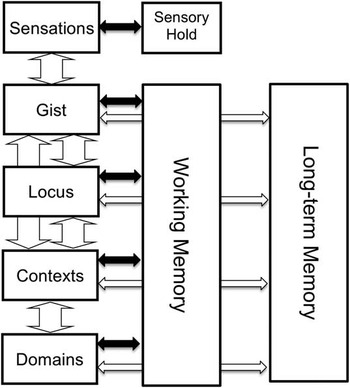
The five layers start with the simplest sensory layer, here called Sensations, which aggregates the processes by which immediate sensation is organised (see Figure 1). In audition, these processes include the largely involuntary perceptual binding and grouping processes that result in perceptual events, auditory streams and their perceptual attributes (Bregman Reference Bregman1990). The ‘auditory present’ has a time frame of around 250 milliseconds and the apparent constancy of perceptual organisation depends on the very short-term memory called sensory hold.
Five layers in relation to memory systems.

Each seceding mental layer can be characterised by the unique kinds of mental productions it manages proceeding up to the most synoptic and abstract layers. The second layer, Gist, can be related to the kind of mental organisation that would be captured in a brief glimpse: objects, forces, spatial relationships including foreground/background relationships and so on. Gist connects sensory organisation with schemas for things and space. Thus, an auditory event that was high pitched and bright would be understood by Gist as a trumpet. This kind of schematic knowledge is accessed from long-term memory, and the present moment's active schemas are held in working memory.
Locus is the name for the mental activities of immediate self-governance. We can think of Locus as the mental layer in which we react to immediate situations and execute responses strategies like physical gestures. It is also the level at which we anticipate patterns on the timescale of gesture. Thus, if Gist reveals a trumpet player, Locus moves us closer to listen. Locus accesses schemas from long-term memory that are then held in working memory and which guide our actions. This is the layer in which people are focused in most everyday tasks, and, importantly for us, the layer that manages immediate listening strategies. The functional time frame of Locus is the ‘perceptual present’, which varies between 2 and 8 seconds depending on the processing load and demand on working memory (Pöppel Reference Pöppel1997, Reference Pöppel1998).
A broader view of our current situation is managed by the layer named Contexts, which provides continuity in the flow of experience beyond the perceptual present. In everyday life we have schemas for extended events like work, dinner and concerts, just as in listening we have schemas for musical and auditory patterns that can extend beyond the perceptual present. Contexts is the layer in which we predict what is ahead. If our trumpet player begins to perform, we expect the performance to continue and we anticipate how it will go. These schemas are stored in long-term memory and held in working memory while Contexts evaluates how well these extended-term schemas match current situations. We adjust our expectations when the trumpet's style changes. Domains is the layer of long-term, background knowledge – that is, meta-knowledge that provides the broadest sense of context. So, a sense of what is normal in city life or what to expect from a jazz trumpet would be domain knowledge of this kind. Contexts and Domains both have functional time frames much longer than Gist or Locus.
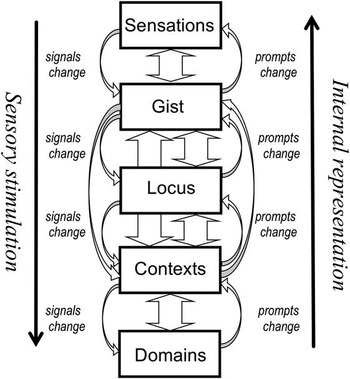
Thus, we can see that each layer constructs meaning in a different way. Each layer has typical productions, usually instantiated schemas of a certain kind. We can also see that each layer is transforming and compressing the productions of the previous layer in a particular way. For example, sensory input is compressed to schemas for object-events (Gist), and configurations of object-events trigger schemas for actions (Locus) and so on. But for ongoing experience to have any consistency, these ‘meanings’ must be harmonised to create a self-consistent view. As Figure 1 illustrates, the layers are seen to be dynamically interacting with one another. (Locus sits astride a direct connection between Gist and Contexts.) And as Figure 2 shows, we can view one side of the process as driven by the onrush of sensory stimulation and another driven by the systemisation of internal representation. Each layer is producing potential meanings, some of which will be reinforced by neighbouring layers. From within the interaction of these dynamic processes, tentative productions are constantly percolating, out of which dominant meanings will emerge.
Harmonisation within the five-layer model.

3.2. Differentiation with respect to feeling
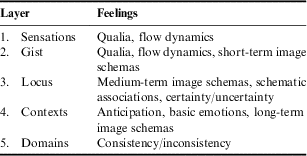
We can now connect the mental layers with our previous discussion of feeling. Most important to our inquiry, each layer is differentiated with respect to feeling, as shown in Table 1. Sensations is the layer of immediate perception registering qualia and flow dynamics. Gist links qualia and flow dynamics with schemas for things as well as to short-term image schemas. Locus takes up Gist's things, which may have schematic associations to conditioned emotive responses. Locus also registers the patterns of tension and release linked to medium-term image schemas, especially for events whose time frame is within the scope of physical gesture. It also exhibits certainty and uncertainty. Contexts is the layer in which extended-term anticipation emerges. It manifests what we have discussed about basic emotions in response to assessment of the future, as well as the tension/release of long-term image schemas. And the consistency of events with background knowledge is reflected in Domains. We can consider each of these layers to be relatively autonomous and active in parallel, while mutually affecting each other (for example, Domains influencing the kinds of feelings that are typical in a certain context). Therefore, ongoing experience can give rise to feelings in all the mental layers simultaneously.
The differentiation of the five layers with respect to feelings

4. The Feeling Blend
two … ways in which I would augment blend theory to be in better consonance with … aesthetic cognition-emotion. The first is to link it to a theory of emergent emotional states – that is, to recognize the inescapable interweaving and interdependency of the dimensions of mind we divide into cognition and emotion. The second is to recast it in dynamic terms … (Terrence Deacon (Reference Deacon2006: 41))
This idea expressed by Terrence Deacon is exactly what we will be pursuing here as the feeling blend. The feeling blend is not about linguistic metaphors for emotion, as when Lakoff (Reference Lakoff1987) discusses anger. It is also not simply a conceptual integration as described by Fauconnier's and Turner's blend theory (2002). The feel of blends has largely been passed over, even though the role of blends in art itself has not (Turner Reference Turner2006). In his essay entitled ‘The Aesthetic Faculty’, Terrence Deacon (Reference Deacon2006) links blend theory with his notion of symbolically mediated emotion in the arts. Deacon's ideas are deeply influenced by Arthur Koestler's theory of bisociation (Reference Koestler1964), which anticipates blend theory and also integrates some elements of particular importance to music: time and emotion.
We have already touched on blends of emotion and blends of phenomenal qualities in section 2. These precedents now open the way for a broader assessment of the feeling blend as a fundamental capacity of human beings – that is, to integrate complex experience and to feel it, incongruences and all. Viewed this way, the feeling blend makes perfect sense as an advantage for human survival and also as a way of experiencing meaning that is harnessed by the arts.
4.1. Rethinking the mental space
Fundamental to blend theory is the concept of the ‘mental space’, originally introduced by Fauconnier (Reference Fauconnier1994) and extended by Fauconnier and Turner (Reference Fauconnier and Turner2002: 104), who say, ‘A mental space consists of elements and relations activated simultaneously as a single integrated unit. Often, a mental space will be organized by what we have called a conceptual frame.’ A mental space, or simply a ‘space’, is also a temporary working sketch that is inherently incomplete, a partial representation of domain knowledge shaped by the individual's repeated experiences. For Deacon, the contents of spaces are primarily symbolic tokens, and the simplest concept of emotional blend would be to assume that ‘symbolic fusion forces a bisociation of any emotional attachments associated with the contributed … spaces’ (Deacon Reference Deacon2006: 51). His main exception to the essentially symbolic content of spaces lies with music that involves ‘sound iconisms and contrasts’ (2006: 49) that are similar to symbolic references and may also evoke emotional blending.
Thus, any attempt to account for emotional blending points back to the key question:, What constitutes a mental space? And also: How do auditory and musical phenomena figure into this picture? To explore these questions, let's imagine an auditory sensory event and envision the mental spaces invoked progressively at each layer. The auditory event typically invokes an object-event schema at the level of Gist. Can we then say that Gist's object-event instantiates a mental space? This kind of compression of sensory information is fundamental to all perception and antecedes symbolic thinking. In fact, this may well be the Ur-ground of the mental space, because then the space of the symbolic token can be seen as a direct outgrowth of the space of the object-event. Thus, we can distinguish a particular kind of mental space at the level of Gist that can embody the simplest integrated unit of perception – including auditory and musical object-events that are unmediated by further symbolic compression. Gist's mental space may hold schematic knowledge about the object-event, as well as all of the feelings discussed earlier, including phenomenal qualities, flow dynamics, simple image schema and so on.
What to do about the content of Gist's mental spaces is negotiated at the level of Locus, whose schemas are primarily response patterns to immediate events. Locus’ mental spaces represent lines of activity, active action scripts that unfold in time. Consequently, Gist's and Locus’ mental spaces are not necessarily in a one-to-one relationship. And thus Locus’ mental spaces contribute some functional organisation and levels of significance to Gist's spaces. Locus’ mental spaces may also invoke emotions of anticipation and certainty/uncertainty.
Gist and Locus are functionally bound to short-term and near-term time spans. Gist responds immediately to sensory information, and Locus responds within the perceptual present. Like them, Contexts has schemas for object-events and sequential patterns, but these are a step removed from the immediate onrush of perceptual information and can address time spans divorced from the perceptual present – that is to say, time in the abstract. Contexts’ mental spaces typically receive inputs from the other two layers (see Figsure 1 and 2), and its schemas provide broad contextualising frames around Gist's and Locus’ productions. This provides a level of abstraction, the critical step for symbolic and abstract thinking. In fact, Contexts is the level at which theories of conceptual blending are typically focused. Conceptual blending in traditional music at this level has been discussed by Zbikowski (Reference Zbikowski2002) and in electroacoustic music by Kendall (Reference Kendall2010). Both cases illustrate musical thinking that is analogous to traditional domains of symbolic thinking. Contexts is the level at which assessments, including those of auditory-musical patterns, evoke emotions and the emotional blends previously mentioned in section 2.
Domains’ mental spaces hold background information on what is normative and thereby guide the other layers’ range of activity to be consistent with previous experience. It is likely the case that such background knowledge includes meta-knowledge of stylistic norms and their patterns of feeling. Thus, the listener anticipates musical and auditory patterns that fit the current context, and experiences inconsistency if stylistic and feeling norms are violated.
We have discussed mental spaces at four different mental layers. At each level, the mental space fulfils the essential definition, and at the same time there is differentiation according to the layer. Most importantly, too, we have recognised how the spaces in each metal layer accommodate different properties of auditory and musical materials, varying from essential auditory events to complex musical/auditory patterns. The functional differentiation of the mental spaces of each layer plays a crucial role in how the same perceptual event can be simultaneously understood in different ways, each appropriate to the perspective of a layer. For instance, Gist may instantiate an object-event schema (impulsive hit on wood) that also connects to an object-event schema instantiated by Contexts (Japanese temple block performed in ritual). We can imagine similar dual levels of schemas for Locus (pay attention to wood-hit and follow foreground) and Contexts (anticipating likely patterns of continuation). Importantly, these multiple mental spaces are simultaneously available in working memory, and the listener's perspective can shift effortlessly from one to another. In fact, it is a normal and unconscious aspect of everyday experience that these multi-level spaces are connected across the layers, including their emotions and phenomenal qualities. This multi-levelled nature of experience is frequently exploited by art; for example, the artistic object can represent its literal self as well as having symbolic meaning.
4.2. Triggers
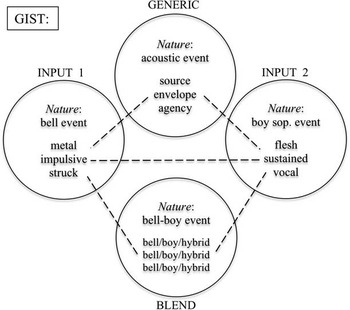
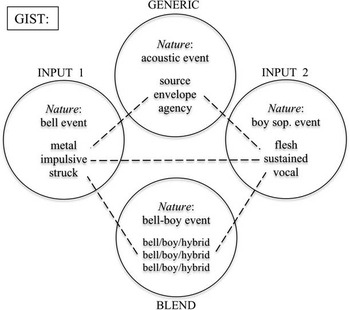
Another key issue for blend theory is what triggers the blend. In section 2, we mentioned the framing of bodily sensations as an example of how sensory phenomena become blended. For auditory stimuli, much sensory framing is largely automatic (Bregman Reference Bregman1990) with projections leading to the level of Gist where sensory, auditory events are connected to the mental spaces that instantiate schemas for object-events. A blend may be triggered at the level of Gist when such an auditory event invokes multiple object-event schemas. An example is the blending of church bells and a boy soprano in Jonathan Harvey's Mortuos Plango, Vivos Voco (Harvey Reference Harvey1981), where, by the magic of digital signal processing, the auditory attributes of the two sources are mixed in various combinations. What forces the blend is the singularity of the sensory events. A prototypical model of these blends is represented in Figure 3, where phenomenal qualities such as the physical material, the energy flow and the sound excitation can be extracted from the bell or the boy, or become hybridised. At the level of Gist, the blended result is a bell–boy presented by Harvey in many variations. Gist's blend is also a coincidence of the conceptually incompatible, and the singularity of Gist's blend compels a conceptual blend at the level of Contexts. In this case, the boy and the church bell become symbols for the animate and the inanimate, resulting in a conceptual blend that can only be accommodated in the domain of the spiritual (Dirks Reference Dirks2012).
Prototype of the many blends of chu rch bells and the boy soprano in Jonathan Harvey's Mortuos Plango, Vivos Voco.
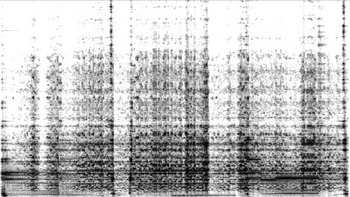
Let us consider another example. Figure 4 shows a sonogram of a short excerpt from Francis Dhomont's Novars. The essence of this excerpt is that two contrasting layers of sound are simultaneously present: one is a continuous cloud of short snippets from Machaut's Masse de Notre Dame and the other is an irregular series of filter-swept chords. Each of these layers is quite distinctive. The fragmentation of Machaut's music presents an interesting combination of the medieval and the modern, while the filter sweeps have a novel gestural shape. The reference to Machaut in particular gives rise to a potential conceptual blend in which Dhomont and his French antecedent collaborate on an electroacoustic work (Kendall Reference Kendall2010). This conceptual blend might evoke some feeling (depending on how one identifies with the implicit French patriotism), but what about its relationship to the other layer? At the sensory level these two layers are distinct and automatically segregated into two auditory streams. Each has distinct phenomenal qualities; among other things, the Machaut fragmentation is jagged and continuous, while the filter sweeps are bold and detached. We might imagine a unique blend being formed at the level of Gist with these contrasting sets of phenomenal qualities, but the streams are so self-contained at this level that nothing impels us to form such a blend. Envision instead that these attributes are framed within separate mental spaces for each stream.
Sonogram of Francis Dhomont's Novars from 2′58′′ to 3′35′′.

This passage is very reminiscent of modernist works in its use of juxtaposition with irregular rhythm (see Kendall's Reference Kendall2006 discussion of Varèse's Poème électronique, Reference Varèse1957–8). At the level of Contexts, there is no sense of longer-term evolution, just stasis. And the extended presentation of this material without further elaboration communicates that the juxtaposition of the two streams is itself the principal idea! How do we make sense of their combination? It is our attempt to assimilate and to integrate the experience of this passage that triggers a blend at the level of Contexts: mental spaces for each element must be blended to capture the sense of the passage as a whole. The emergent feeling quality of this blend is the juxtaposition of two distinct groups of phenomenal qualities in the context of stasis, strong contrasting dynamism within a static frame. This reinforces one of Deacon's insights into such blends: ‘The principal emotional architecture of the multilevel blend is … one of tension’ (Deacon Reference Deacon2006: 48).
4.3. Temporal frameworks
An important feature of Koestler's bisociation theory lauded by Deacon (Reference Deacon2006) is how it provides a framework for the temporal evolution of an aesthetic experience leading to resolution, as a release of cognitive tension (jokes), the eureka experience (scientific discoveries) or catharsis (arts). The joke is a simple example where there is a sudden shift from one of two competing organisational frames to the other; the shift releases the cognitive tension. In electroacoustic music, something analogous could be said to happen at the entrance of the Northumbrian bagpipes in Denis Smalley's Pentes (Reference Smalley1974) (Kendall Reference Kendall2010).
In electroacoustic music, there are multiple dynamic frameworks operating at multiple levels, many of which contain an element of release or resolution. We have already touched on a few of these: some image schemas (such as Source–Path–Goal or Removal-Of-Restraint) and event schemas lead to resolution and possibly closure. The most concrete examples occur at the level of Gist, where sensory stimulation is compressed into object-events with endings. Very importantly, such schemas are anchored to phenomenal qualities that are evolving in time, here within the perceptual present. And image schemas and event schemas can be also instantiated at the level of Contexts, where time may be abstracted but the sense of tension and resolution is retained (Kendall Reference Kendall2008). A very similar multi-levelled idea is what Denis Smalley calls ‘morphological archetypes’ (Reference Smalley1986). Essential to all these frameworks is their reliance on embodied knowledge of tension and release.
Deacon believes that emotive states themselves can function like other symbolic tokens. Therefore, conflicting emotions can be held simultaneously and blended to create emergent emotions. He points to Koestler's theory that sustained juxtaposition can lead to catharsis. We might think of the Novars excerpt and its sustained juxtapositions in this regard, where sonic resolution is withheld and there is no basis for releasing tension (at least within this section). Is the resolution in dynamic flux? This is Deacon's model of the ‘blend structure of aesthetic experiences’, the dynamism of conflicting emotions (Deacon Reference Deacon2006: 46). The stasis of the passage provides no possible resolution other than to seek a blend, a union of its conflicting elements, and that provides some sense of catharsis, even at this early stage of the piece.
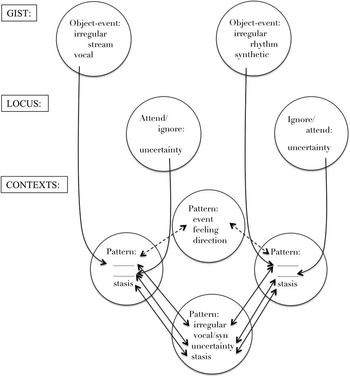
But, are there conflicting emotive states as Deacon describes? For this example, I would propose that the conflict is largely one of phenomenal qualities originating at the level of Gist. There are certainly also elements of uncertainty at the level of Locus and anticipation at the level of Contexts, but there are no basic emotions here to blend. If there is an emergent feeling sense of the passage (and I believe that this is true for most listeners), then it is a multi-level feeling blend, not a conceptual blend or simply a blend of emotions. The structure of the blend is represented in Figure 5. At the level of Gist, there are two mental spaces, each of which compresses the properties of one of the perceptual streams of auditory events within an object-event schema. Locus invokes a listening strategy that is in one way relatively simple: attend to one stream at a time. But the irregular rhythm of the filter sweeps (which are well within the time frame of physical gestures) makes it impossible to anticipate any pattern. There is uncertainty. Contexts inherits projections from the mental spaces of the two prior layers. It must instantiate mental spaces for the two contrasting elements, and it must also attempt to find a pattern beyond the simple contrast of the streams, especially a pattern that anticipates the future evolution of the passage. But there are no changes in any properties that consistently point in any direction. There is stasis: anticipation is stuck in suspension. The mental space of the final blend represents a compression of feelings at multiple levels, an irresolvable admixture of phenomenal qualities, uncertainty and unresolved anticipation, something that is very much in the spirit of Deacon's theory, here adapted to a real-life example of electroacoustic art. And if there is not the kind of emotional catharsis that we are accustomed to in nineteenth-century music, there is a kind of coalescence of elements that inspires us to integrate new possibilities with our domain of artistic experience.
Structure of the feeling blend associated with Francis Dhomont's Novars from 2′58′′ to 3′35′′.

4.4. The contemporary sensibility
One of the important ways that historical and contemporary musics are so different from each other is in their felt quality. As a broad generalisation, contemporary arts (and by this I mean the arts since the 1980s) have placed much more emphasis on phenomenal qualities than on emotions. The fine discernment, differentiation and blending of phenomenal qualities have come to dominate the artistic palette. Consider that reduced listening is still an attractive concept to many young electroacoustic composers, probably not because they identify with Schaeffer's ambition to divorce electroacoustic music from everyday listening, but rather because the most important artistic innovation of Schaeffer's phenomenology is its privileging of phenomenal qualities over other aspects of listening (as illustrated by his Étude aux allures, Reference Schaeffer1958). Of course, there are counter-examples, but there is a significant underlying trend here, possibly resolving the distrust of emotion in favour of phenomenal qualities.
Our discussion here has carefully avoided excluding of any kind of feeling. All feelings are grist for the mill of art, but most electroacoustic music has little in common with the basic emotional categories: happiness, sadness, fear and so on, while it is rich in feelings. And while Huron convincingly supports the proposition that music is ‘motivated primarily by pleasure’ (Huron Reference Huron2006: 373), we must acknowledge that much recent music has evolved a distinctly contemporary sense of pleasure in the exploration of phenomenal qualities. I also think that there is a distinctly contemporary sense of ‘non-emotion’ as an emotional state, so to speak. We can think of this in two ways. In some cases emotion may be irrelevant to the concerns of a work (like stereotypical cerebral electronic music). In other cases the listener experiences non-emotion as liberating. By non-emotion I mean that the work is free of patterns that invoke basic emotions. Take as exemplars Alvin Lucier's I Am Sitting In A Room (Reference Lucier1990), Barry Truax's Riverrun or Luc Ferrari's Presque rien no. 2 (Reference Ferrari1977). Free from assessment and valence, the listener can explore emergent feelings, especially in response to phenomenal qualities, and literally transcend basic emotions.
5. Conclusion
It is a familiar adage that the answer to a question depends upon where you look for the answer. Asking questions about the nature of emotion and feeling in the domain of electroacoustic music leads to answers that might not arise in other contexts, not even in studies of music and emotion where the focus is typically on historical and popular music. Our inquiry here started with a broad examination of feeling in the context of electroacoustic music, spanning from basic emotions to nuanced phenomenal qualities. We also touched on the notion of mental layers and how they help us to parse the multi-levelled nature of meaning, especially in this case, meaning that is felt as well as comprehended. These were necessary steps before turning to specific passages of electroacoustic music and considering how feeling participates in meaning. Audio technology's capacity to manipulate signals, and consequently auditory perception (as happens with the object-events in Harvey's Mortuos Plango, Vivos Voco), has enabled this art form to guide the listener's mental processes in new and unique directions. Then too, the technology's capacity to mix and juxtapose sounds from disparate origins guides the listener toward new artistic integrations and novel blends of feelings (as witnessed in Dhomont's Novars). And by carefully examining how feeling participates in the meaning of such passages, we are led to a fresh outlook on feeling in relation to artistic experience, and maybe to something universal for the arts.
It is difficult to imagine how we should understand the feeling qualities of artistic experience without the concept of the feeling blend. The feeling blend appears to be an intrinsic aspect of being human, an almost obvious capacity given the human proclivity for feeling. Our large vocabulary of words for describing our feelings and inner states gives evidence to how easily we blend and label the multi-levelled feelings of everyday life – ephemeral and yet whole. We do this typically without being self-conscious and without reflecting on the richness of the feeling qualities we experience. It is the creative artists who are probably most adept at thinking in feeling blends.
Art is something and it is about something. Untangling how the ‘is about something’ is embedded in the ‘is something’, has led us to the feeling blend, a core ingredient of artistic experience. We all understand that art is ‘representational’, with the same ease that children understand that ‘playing house’ is representational. Importantly, we are able to enter into uncharted and extraordinary blends of feeling without getting mired in practicalities. As an important element of culture, art enables us to participate in a collective exploration of feeling qualities, especially in relation to our shared cultural symbols and patterns. In this way, art breaks free of everyday limitations and is able to create a world of feeling that is both a product and a part of culture. In fact, we expect art to have significance in this way. The arts are the primary cultural vehicles through which we engage the feeling blend as a higher mental capacity.