INTRODUCTION
The benefits of the Green Revolution, which greatly improved food security and reduced poverty in Asia and Latin America, largely bypassed most of sub-Saharan Africa (SSA). Dependence on uncertain rainfall and exposure to climate risk characterize the livelihoods of roughly 70% of the region's population; and frustrate efforts to sustainably intensify agricultural production, reduce poverty and enhance food security.
Forecasting climate fluctuations at a seasonal lead time is possible because of the interaction between the atmosphere and the slowly varying ocean surfaces. While early advances in seasonal climate forecasting were largely driven by climate science and by investment in ocean monitoring and climate modelling, the promise of using information to better manage agriculture and food security has been part of the rationale for sustained investment. Interest in targeting African agriculture was stimulated in part by a study by Cane et al. (Reference Cane, Eshel and Buckland1994), who showed that Pacific sea surface temperatures, associated with the El Niño/Southern Oscillation (ENSO), were more strongly correlated with maize (Zea mays) yields than with seasonal total rainfall in Zimbabwe. Expectations may have also been tempered by an early landmark study by Glantz (Reference Glantz1977) that emphasized constraints to responding to seasonal forecasts in the West African Sahel. The strong and highly visible 1997/98 El Niño event prompted a surge of field research on the potential use and value of seasonal forecasting for agriculture in SSA. Coincidentally, Regional Climate Outlook Forums (RCOFs) were initiated in southern, eastern and West Africa in 1997/98, although planning was initiated before the El Niño event was anticipated.
This paper presents an overview of what we have learned about the use and value of seasonal climate forecasting for agriculture in SSA. We survey (a) the basis and geographic distribution of predictability at a seasonal lead time, (b) existing mechanisms to support delivery and use of seasonal forecasts for agriculture, (c) evidence of the value of seasonal forecasting for agriculture and (d) constraints to use and benefit. Our focus, however, is on opportunities to overcome constraints, to expand the range of applications, and to realize more of the potential benefits of seasonal prediction to agriculture and rural livelihoods – opportunities that we hope will shape the future direction of seasonal forecasting for agriculture in SSA.
PREDICTING SEASONAL CLIMATE FLUCTUATIONS
The idea that the climate may be predictable at seasonal timescales may seem counter-intuitive, given that weather does not appear to be predictable with much accuracy beyond a few days at most. Errors in forecasting weather a few days in advance can be attributed to uncertainty about the timing or intensity of specific phenomena (a storm arrives earlier and is stronger than expected, for example), and can be represented by producing an ensemble of many model predictions (Harrison, Reference Harrison2005). Beyond about a week, the errors become so large that there is no longer anything but an accidental resemblance between any ensemble member and the observed conditions. Because forecast errors tend to grow faster in the topics than in the mid-latitudes, and because of the relatively poor density of observations in SSA needed to initialize weather forecasts, many weather services in SSA do not issue weather forecasts for more than 24 hours in advance.
Beyond about a week it is possible to provide information, based on a different source of predictability than for weather forecasting, about whether particular types of weather systems are more or less likely than usual, but not about when such systems are likely to occur (Harrison, Reference Harrison2005; Mason, Reference Mason, Thomson, Garcia-Herrera and Beniston2008; Troccoli, Reference Troccoli2010). Given that the atmosphere is predominantly heated from the earth's surface rather than directly from the sun, and given that the atmosphere receives its moisture from the earth's surface, changes in the earth's surface, particularly the sea surface temperature distribution, can influence the atmosphere (Palmer and Anderson, Reference Palmer and Anderson1994). Any significant departure of the earth's surface from its normal conditions can disrupt weather patterns over a prolonged period. These disruptions are likely to be strongest in the tropics where sea-surface temperatures are warmest. Since ocean temperatures tend to change slowly relative to the atmosphere because of their high heat capacity, knowing the current state of the oceans may provide some degree of predictability of how weather patterns may be disrupted. Thus, while it is harder to forecast the weather in SSA than in Europe or North America, it tends to be easier to predict the seasonal climate (Quan et al., Reference Quan, Webster, Moore and Chang2004), although predictability at seasonal timescales is highly dependent on location and the time of year.
The most important feature of sea temperature variability that can cause large-scale weather disruptions is El Niño, and its counterpart, La Niña – a near basin-wide warming and cooling of the equatorial Pacific Ocean, known as ENSO (Goddard et al., Reference Goddard, Mason, Zebiak, Ropelewski, Basher and Cane2001). Not only are El Niño and La Niña highly persistent, lasting typically about nine months, but the ocean and atmosphere processes that generate and dissipate these phenomena are fairly well understood and so their occurrence can be predicted with reasonable accuracy a few months in advance (Zebiak, Reference Zebiak1999). Their impacts extend well beyond the tropical Pacific Ocean, and are important for predicting seasonal climate fluctuations over SSA. El Niño and La Niña tend to peak in the boreal winter, and usually begin around the boreal spring, but can sometimes delay until well into the summer. Their onset is particularly difficult to predict, and so predictions made in the early part of the calendar year tend to be rather poor. This seasonality has important implications for predicting climate fluctuations over SSA, as areas with rainfall seasons in the boreal summer, such as the Sahelian belt, are likely to be harder to predict more than a few weeks in advance than are areas with rainfall seasons in the boreal winter such as southern Africa.
The actual predictability of seasonal climate fluctuations over SSA is considerably more complicated than the annual cycle of El Niño and La Niña might suggest because these phenomena are only one of many influences on year-to-year climate variability in the region. For the Pacific Ocean to have an influence on Africa at all, some mechanism for transmitting an atmospheric impact to the other side of the world, known as a ‘teleconnection’ (Glantz et al., Reference Glantz, Katz and Nicholls1991), is required. In eastern and southern Africa, for example, the tropical Indian Ocean will typically warm up during El Niño because of associated changes in wind patterns, and this warming in turn can affect rainfall patterns over Africa, with excess rainfall occurring over eastern Africa from about October onwards (Mutai et al., Reference Mutai, Ward and Colman1998), and over southern Africa from about December (Mason and Jury, Reference Mason and Jury1997). Even then, however, an impact is not guaranteed, either because of compounding influences of other ocean basins, or because the atmosphere is not completely constrained and may bring rain even when the oceanic conditions would tend to favour drier conditions (e. g. Lyon and Mason, Reference Lyon and Mason2009).
Statistical models, and general circulation models (GCMs) that simulate the physical processes and dynamic interactions that govern the climate, can provide skilful forecasts of seasonal rainfall in several agriculturally important regions and seasons (Figure 1). Significant predictability coincides with cropping seasons in Sudano-Sahelian West Africa (extending east through at least Sudan), southern Africa up to southern Zambia, and in the October–December ‘short rains’ in East Africa (much of Kenya, eastern Uganda and northern Tanzania). There is established but weaker predictability for the boreal spring ‘long rains’ in East Africa, and the boreal winter in the coastal countries of West Africa. Skilful forecasts can be produced more than a month before the normal start of the growing season for the short rains in eastern Africa and the main rainy season in southern Africa. In West Africa, a rapid decline in forecast skill with increasing lead time seemed to seriously limit the potential for farm-level applications (Ndiaye et al., Reference Ndiaye, Goddard and Ward2009; Ward, Reference Ward1998). However, recent work based on a coupled ocean–atmosphere GCM shows promise for extending the lead time of skilful forecasts to well before the start of the normal planting window (Ndiaye et al., in press).
Geographic and seasonal distribution of potential predictability of rainfall in Africa, based on correlations of seasonal climate anomalies with preceding sea-surface temperature anomalies. Source: Mason (Reference Mason, Thomson, Garcia-Herrera and Beniston2008), Fig. 2.4, page 20, © Springer Science + Business Media B. V. 2008. Reprinted with kind permission of Springer Science and Business Media.

Seasonal forecasting methods can provide information beyond seasonal average conditions over large areas. For example, there is limited evidence that seasonal forecasts that are skilful at an aggregate scale can be downscaled to individual points with only modest loss of skill (Gong et al., Reference Gong, Barnston and Ward2003; Moron et al., Reference Moron, Robertson and Ward2006). Total rainfall for a season is the product of frequency (i.e. number of days with rainfall) and mean intensity (i.e. rainfall amount). Because rainfall occurrence is spatially more coherent (i.e. correlated among neighbouring stations) than the amount of rain during a rain day, most of the predictability of seasonal rainfall total at a local scale is due to predictability of the frequency of days with rain (Hansen and Indeje, Reference Hansen and Indeje2004; Mishra et al., Reference Mishra, Hansen, Dingkuhn, Baron, Traoré, Ndiaye and Ward2008; Moron et al., Reference Moron, Robertson and Ward2007; Robertson et al., Reference Robertson, Moron and Swarinoto2009).
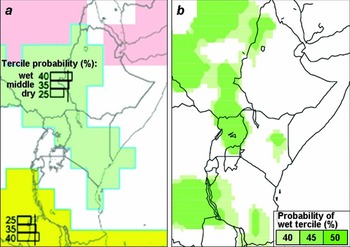
Dynamic downscaling involves using a relatively high resolution regional climate model (RCM), driven by the output of a relatively low resolution GCM, to simulate small-scale features over a limited region. The use of regional models to downscale seasonal climate in Africa has been able to provide climate information with useful local detail, including realistic extreme events (Sun et al., Reference Sun, Semazzi, Giorgi and Ogallo1999; Sylla et al., Reference Sylla, Gaye, Pal, Jenkins and Bi2009). To illustrate, Figure 2 compares an International Research Institute for Climate and Society (IRI) forecast for the 2006 short rains season in the Greater Horn region with a forecast downscaled by the Intergovernmental Authority on Development Climate Prediction and Application Center (ICPAC) using a regional climate model, which we re-generated in a probabilistic tercile format to aid comparison. The one-month lead downscaling forecast made in August 2006 indicates enhanced probabilities for above-normal precipitation in Uganda, Sudan, central Kenya, southern Tanzania and eastern Congo. In SSA, ICPAC and the South Africa Weather Service have used RCMs to downscale IRI global forecasts over the Greater Horn of Africa since 2004 and Southern Africa since 2006, respectively. The prospect of using RCMs to provide advance information about higher-order weather statistics, such as wet and dry spell distributions, that are relevant to agriculture (Sun et al., Reference Sun, Moncunill, Li, Moura and De Assis De Souza Filho2005), is a promising area for further research in the African context.
IRI probabilistic rainfall forecast for eastern Africa, October–December 2006, issued September, (a) expressed at a GCM scale as the IRI Net Assessment, and (b) downscaled using a the regional spectral model RCM.

CURRENT PRODUCTS AND DELIVERY MECHANISMS
Regional climate outlook forums
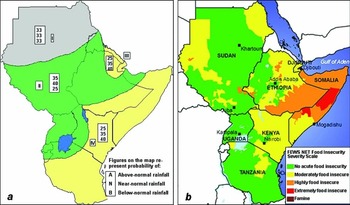
The SSA region has the longest continuous history of RCOFs of anywhere in the world, and the timing of the forums has been defined primarily with the needs of the agricultural sector in mind. Since their inception in 1997, RCOFs have been the focal point of international efforts to produce and deliver seasonal forecasts to stakeholders in climate-sensitive sectors in Southern (SARCOF), Eastern (GHACOF), West (PRESAO) and Central Africa (PRESAC), and in other parts of the globe (Buizer et al., Reference Buizer, Foster and Lund2000; Ogallo et al., Reference Ogallo, Bessemoulin, Ceron, Mason and Connor2008). With backing from the World Meteorological Organization (WMO), and support from WMO Global Producing Centers and other international climate centres (e. g. IRI, UK Met Office, Météo-France), the RCOFs bring national meteorological services (NMS) and various users from a region together to develop, distribute and discuss potential applications of a consensus forecast of rainfall and sometimes other variables for the coming season. The RCOF usually involves a 1–2-week pre-forum meeting in which national forecasts are constructed using primarily statistical regression-based approaches. The forecasters sometimes receive training in new forecasting methods, software or verification. The forum itself is generally a two-day affair, during which the rainfall of the previous season is reviewed and compared to its respective forecast; the impacts of the previous rainfall season are considered, and decisions made in response to the forecast are reviewed with participating stakeholders; recent climate conditions around the world are discussed, and the current forecast is presented. Sectoral break-out groups discuss contingency planning, while media representatives discuss dissemination strategies and challenges. Consensus forecasts for seasonal rainfall total are expressed as very coarse-scale maps of probabilities of rainfall falling within the dry, middle or wet terciles of the historic distribution (Figure 3a). This format has changed little since the inception of the RCOFs, although the basic climate forecasts from GHACOF and PRESAO have recently been supplemented by expected impacts of rainfall anomalies on, e. g. food security at a higher resolution (Figure 3b) based on a forecast interpretation tool (Husak et al., In press).
Example of (a) RCOF forecast and (b) food security outlook produced by FEWSNet, for the eastern Africa short rains (October–December) season, 2010. Source: (a) Statement from the Twenty Sixth Greater Horn of Africa Climate Outlook Forum, 2–3 September 2010, Kisumu, Kenya; and FEWSNet (http://www.fews.net/pages/region.aspx?gb=r2).

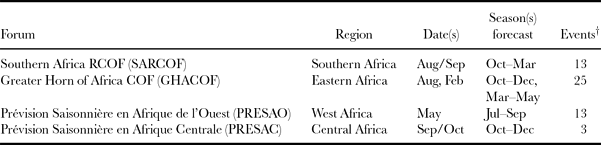
Table 1 summarizes the RCOFs in SSA. PRESAO releases forecasts that target the monsoon season of the Sahelian belt, and produces monthly updates, but does not service the rainfall seasons of the southern coastal region of West Africa. Like PRESAO, the timing of the GHACOF meetings is best suited to only part of the region, although monthly updates are produced through June to August to target the rainy season of the more northern parts of the region. Because of the extended lead-time of the SARCOF forecasts (released August or September and extending to the following March), a mid-season correction meeting had been held in December to update the forecast for the January–March period. The mid-season correction meeting has been discontinued due to lack of funding, but monthly updates continue to be produced throughout the season. The PRESAC meetings were initiated in 2002 but have been held only irregularly.
Overview of regional climate outlook forums (RCOFs) in SSA.

† Number of forum events from inception until June 2010.
Apart from a review of the previous season's forecast that is conducted faithfully at each RCOF, most RCOF products have not been comprehensively verified, primarily because of the need for a reasonable sample of forecasts. However, after the first decade of SARCOF, GHACOF and PRESAO forecasts, a preliminary review based on satellite-based observational data was conducted at the African Centre of Meteorological Application for Development (ACMAD) with support from IRI (Chidzambwa and Mason, Reference Chidzambwa and Mason2008), with a follow-up station-based verification of the GHACOF forecasts conducted through a workshop. In all three regions, the RCOF forecasts show some evidence of positive skill, but also demonstrate clear evidence of systematic errors. The most common error is to hedge forecasts toward high probabilities on the middle tercile, apparently because it seems like a ‘safe’ forecast as the observed tercile category can never be more than one category away from the tercile with the highest forecast probability. The RCOFs are beginning to correct this tendency. There is weaker evidence that the below-normal category is frequently given probabilities that are too low because of fear of causing alarm over the potential for drought. This aspect of hedging is at least partly responsible for a failure to indicate the predominance of below-normal rainfall that occurred over approximately the last decade in the Greater Horn in both seasons, in West Africa for the July–September season, and in Southern Africa for January–March. Another common error is that variations in the probability on the middle tercile do not provide any useful information about changes in the actual frequency of occurrence of rainfall conditions in this category. This error has also been recognized in seasonal forecasts from a number of climate centres (Barnston et al., Reference Barnston, Li, Mason, DeWitt, Goddard and Gong2010; Wilks, Reference Wilks2000; Wilks and Godfrey, Reference Wilks and Godfrey2002). Shifts in forecast probabilities of the dry and wet tercile categories are more informative, with the respective category generally occurring more frequently (infrequently) as its probability increases (decreases). However, the shifts in the forecast probabilities of the outer terciles tend to be too strong, indicating over-confidence by the forecasters.
Media. Newspaper, radio and television are traditional mechanisms for transmitting current weather observations and weather forecasts to the general public, including agricultural stakeholders, and have played a prominent role in disseminating seasonal forecast information in SSA. The relative importance of the various forms of media varies greatly by region and country, but radio has received the most attention as the key means for delivering climate information to rural communities. Responding to criticism of inaccurate, sensationalized coverage of the 1997/98 El Niño event (Dilley, Reference Dilley2000; Phillips, Reference Phillips, O'Brien and Vogel2003; Ziervogel and Downing, Reference Ziervogel and Downing2004), communities of journalists have organized around the RCOFs in East and Southern Africa, with the goal of improving the effectiveness and quality of media coverage of climate-related information. In eastern Africa, the Network of Climate Journalists of the Greater Horn of Africa (NECJOGHA) was established during the ninth GHACOF in 2002. NECJOGHA remains active, and is seeking to develop a regional resource centre to support media-based communication activities.
The RANET (Radio and Internet for the Communication of Hydro-Meteorological and Climate Related Information) was initiated in 1997 by ACMAD as a way to improve communication and overcome some of the limitations of dissemination via radio (Boulahya et al., Reference Boulahya, Stewart-Cerda, Pratt and Sponberg2005). RANET combined WorldSpace digital satellite technology, weather and climate information, low-cost community-owned radio stations, and wind-up radio receivers, to provide climate and other information to remote communities in several African countries. The digital radio technology offered the capability to send radio and one-way internet anywhere within Africa to users with a low-cost WorldSpace receiver, adapter card and Windows-based computer. Its strong network of NMS and development partners, and emphasis on community ownership of both the communication infrastructure and content, have enabled RANET to continue and adapt despite the recent loss of the digital satellite platform (Kelly Sponberg, UCAR, personal communication).
National meteorological services
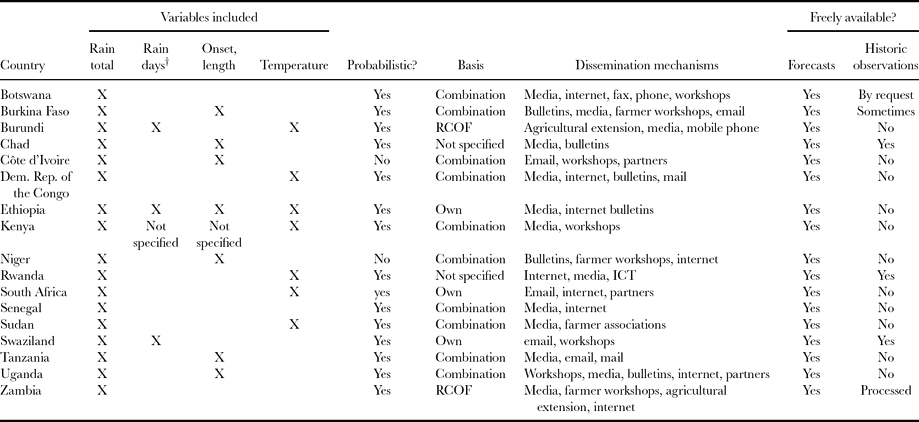
The RCOF model was conceived as a way to support NMS, which were expected to downscale consensus forecasts and tailor them to the needs of stakeholders within their countries. There is anecdotal evidence that, at least in the early years of the RCOFs, seasonal forecasts typically reach national stakeholders in essentially the same form, format and scale as the consensus forecasts, although probabilistic information was often collapsed into a deterministic forecast of the most probable tercile category. In order to get a picture of current support for seasonal forecast use for agriculture, we (the first author) sent a semi-structured email questionnaire (see Appendix) to 28 NMS in SSA for which we had contact information. All 17 that responded (Table 2) participate regularly in the RCOFs. Based on responses, NMS generally go well beyond the RCOF process to improve seasonal forecasts and disseminate them to agricultural stakeholders such as farmers, agricultural extension officers, public and non-governmental agricultural research and development organizations, ministries of agriculture and agribusiness. Methods reported for disseminating forecast information vary by country; and include media (radio, television, newspaper), bulletins delivered by post and email, websites, and workshops for farmers and other stakeholders. The dissemination strategy often includes partnership with agricultural extension (e. g. Botswana, Ethiopia, South Africa, Swaziland, Zambia) or agribusiness (e. g. Burkina Faso, Senegal). Responses noted that Niger and Uganda translate seasonal forecasts into multiple local languages. Although all of the respondents make seasonal forecasts freely available to the general public, only Chad, Rwanda and Swaziland reported that farmers have free access to raw historic observations, while Zambia provides processed historic records.
Seasonal forecasts information and support by national meteorological services in SSA, based on questionnaire responses (Appendix).

† Includes ‘rainfall frequency’ and references to ‘rainfall distribution.’
A majority of surveyed NMS provides seasonal forecasts that are based on a combination of the RCOF consensus forecast and their own analyses. South Africa and Ethiopia produce their seasonal forecasts independently of the RCOFs. Ethiopia started issuing seasonal forecasts in 1987 – ten years before the first RCOF – and targets seasons that do not coincide with the GHACOF calendar. Uganda also produces forecasts for the northern part of the country that fall outside the GHACOF calendar. South Africa produces multi-model ensemble forecasts for the entire southern Africa region.
Most NMS include forecast information beyond seasonal rainfall total, such as the start and duration of the rainfall season, rainfall frequency or distribution, and temperature. Ethiopia and Rwanda forecast several additional agriculturally-important variables (e. g. evapotranspiration, humidity, wind, solar radiation, crop water requirements). Several noted that they package seasonal forecasts with other historic and monitored agrometeorological information (Burkina Faso, Chad, Ethiopia, Rwanda, Senegal, Sudan, Uganda), anticipated impacts on agriculture and natural resources (Côte d'Ivoire, Ethiopia, Kenya, Uganda), or agricultural management advisories (Botswana, Burkina Faso, South Africa, Tanzania, Uganda, Zambia) – often in partnership with ministries of agriculture. South Africa and Rwanda mentioned that they update seasonal forecasts regularly through the growing season. Fifteen of the seventeen respondents present forecast information in probabilistic terms. Those that provided detail use the RCOF convention of forecasting tercile probability shifts. While several countries provide forecasts at a finer resolution than the RCOFs, none of the respondents reported downscaling to individual stations. Station-scale seasonal forecasts produced and disseminated by the Southern Province office of the Zambia Meteorological Service, following a training workshop in 2005, were well received by the agricultural sector (IRI, 2005; Durton Nanja, pers. commun.). South Africa uses multi-model ensembles to produce tercile forecasts on a high resolution grid.
EVIDENCE OF VALUE
The value of information is commonly defined as the expected improvement in economic outcome of management that incorporates the new information. Evidence of the value of seasonal forecasts comes from a combination of understanding of how climatic uncertainty impacts agriculture, model-based ex-ante analyses, subjective expressions of demand or value, and the few empirical ex-post evaluations of actual use and resulting benefits to farmers in SSA. It is difficult to support strong generalizations from the available evidence, first because quantitative economic methods have only rarely been employed for this purpose. Second, by focusing on available operational forecast products and services, research has tended to confound the value of seasonal prediction with any communication failures that might constrain use and value in the given context. Obstacles to use and value, and potential opportunities to overcome those obstacles, are discussed in a subsequent section.
The cost of climatic uncertainty
Understanding how year-to-year climate variability impacts agricultural decision making provides a basis for understanding how advance information in the form of seasonal forecasts may benefit agriculture. The consequences of climate variability go beyond the direct impacts of shocks, such as drought or flooding, on production, incomes and assets. Limited evidence suggests that the opportunity cost associated with climatic uncertainty is substantial – perhaps greater than the direct, ex-post cost of shocks (Elbers et al., Reference Elbers, Gunning and Kinsey2007). The uncertainty associated with the variability of seasonal rainfall creates a moving target for management that reduces efficiency of input use and hence profitability. In rainfed conditions, crop responsiveness (Anderson, Reference Anderson1984; Christianson and Vlek, Reference Christianson and Vlek1991; Myers and Foale, Reference Myers and Foale1981; Pala et al., Reference Pala, Matar and Mazid1996), and hence optimal rates and profitability of inputs such as fertilizer and seed (Hansen et al., Reference Hansen, Mishra, Rao, Indeje and Ngugi2009; Jones et al., Reference Jones, Hansen, Royce and Messina2000; Piha, Reference Piha1993), vary considerably as a function of variable rainfall. Management that is optimal for average climatic conditions can be far from optimal for the growing season weather experienced in most years. For two semi-arid locations in southern Kenya, Hansen et al. (Reference Hansen, Mishra, Rao, Indeje and Ngugi2009) estimated the cost of uncertainty for the profit-maximizing maize farmer at 15–30% of the average gross value of production and 24–69% of average gross margin, depending on location and on how household labour is accounted.
Because farmers tend to be averse to risk, they do not optimize management for average conditions, but for adverse conditions. In the face of year-to-year climate variability, risk aversion on the part of decision makers causes substantial additional loss of opportunity beyond the ‘moving target effect’ as a result of the precautionary strategies that vulnerable farmers employ ex ante to protect against the possibility of catastrophic loss in the event of a climatic shock. These precautionary strategies include selection of less risky but less profitable crops and cultivars, shifting household labour to less profitable off-farm activities, and avoiding investment in production assets and improved technology (Barrett et al., Reference Barrett, Moser, McHugh and Barison2004; Dercon, Reference Dercon1996; Fafchamps, Reference Fafchamps2003; Kebede, Reference Kebede1992; Marra et al., Reference Marra, Pannell and Ghadim2003; Rose, Reference Rose2001; Rosenzweig and Stark, Reference Rosenzweig and Stark1989). Given the strong link between widespread soil nutrient depletion and declining per-capita food production across SSA, growing evidence that climate risk is a disincentive to fertilizer use (Dercon and Christiaensen, Reference Dercon and Christiaensen2007; Morris et al., Reference Morris, Kelly, Kopicki and Byerlee2007; Simtowe, Reference Simtowe2006) is a particular concern. Evidence from ICRISAT village studies in India and Burkina Faso shows that the cost of climate risk is much greater for those who are relatively poor and hence least able to tolerate risk (Rosenzweig and Binswanger, Reference Rosenzweig and Binswanger1993; Zimmerman and Carter, Reference Zimmerman and Carter2003).
The impacts of climate-related risk and risk aversion appear to extend beyond the farm-gate to market institutions. Because spatially correlated losses from climate shocks can exceed their reserves, rural financial institutions often do not serve smallholder rainfed farmers unless their risk is reduced, e.g. through collateral or insurance (Hellmuth et al., Reference Hellmuth, Osgood, Hess, Moorhead and Bhojwani2009; Hess and Syroka, Reference Hess and Syroka2005; Miranda and Glauber, Reference Miranda and Glauber1997; Poulton et al., Reference Poulton, Kydd and Dorward2006a). In landlocked, drought-prone countries, climate drives volatility of prices of staple crops, which increases transaction costs for the entire agricultural supply chain (Poulton et al., Reference Poulton, Kydd, Wiggins and Dorward2006b). If they are not targeted and managed well, the actions (e.g. food aid, emergency seed distribution) that governments and aid organizations take in response to climate shocks can create disincentives for private sector market development and even for governments to invest in agricultural research and development (Abdulai et al., Reference Abdulai, Barrett and Hazell2004; Kelly et al., Reference Kelly, Adesina and Gordon2003). When constraints such as climate-related risk impact institutions operating at a more aggregate scale, the impact can further constrain opportunities and reinforce poverty traps at the farm level (Barrett and Swallow, Reference Barrett and Swallow2006; Carter and Barrett, Reference Carter and Barrett2006).
Reported use and value
Pilot projects in which extended interaction between farmers and researchers reduced communication barriers, have reported reasonably high rates of use and benefits from responding to forecast information. In Burkina Faso, after farmer workshops with researchers that covered the interpretation and management implications of forecast information, most of the workshop participants (91%) and non-participants (78%) reported changing at least one management strategy in response to forecast information (Roncoli et al., Reference Roncoli, Jost, Kirshen, Sanon, Ingram, Woodin, Somé, Ouattara, Sanfo, Sia, Yaka and Hoogenboom2009). Workshop participation positively influenced whether farmers changed management and the number of changes implemented. Participants were encouraged to disseminate forecast information to non-participants, and two-thirds of non-participants interviewed had received forecast information. In a study of smallholder farmers in four villages in Zimbabwe (2002/03 and 2003/04 growing seasons, n = 500), of the 75% of farmers who reported receiving seasonal forecast information, 57% reported changing their management – primarily time of planting and cultivar selection – in response (Patt et al., Reference Patt, Suarez and Gwata2005). Participants in pre-season training workshops on the probabilistic nature of forecasts and potential management responses were about five times more likely than non-participants, who received forecast information through other channels, to change management in response. Based on elicited crop yields, normalized relative to elicited historic ranges, farmers who reported changing management based on forecast information experienced a 19% yield benefit in 2003/04, and a 9% benefit averaged across years, relative to farmers who did not respond to forecast information.
Studies that did not intervene in rather weak forecast communication systems still sometimes reported substantial use of forecasts by farmers. In the Machakos District of Kenya, the majority of farmers surveyed in 2001 (n = 240) who had received forecast information reported adopting management recommendations that were based on the forecasts (Ngugi, Reference Ngugi2002). In South Africa, the majority of commercial farmers surveyed reported changing management in response to the 1997/98 El Niño (79%), and the 1998/99 and 1999/2000 La Niña forecasts (>80%) (Klopper and Bartman, Reference Klopper, Bartman, O'Brien and Vogel2003). In Zimbabwe, of the 95% of surveyed communal farmers (n = 225) who heard the 1997/98 seasonal forecast, the majority reported plans to adjust area planted, crop or cultivar, or planting date (Phillips et al., Reference Phillips, Unganai, Makaudze, Rosenzweig, Boote, Hollinger, Iglesias and Phillips2001). Although only 35% (n = 450) heard the 1998/99 forecast, about half of surveyed farmers reported plans to change management due in part to indigenous indicators of increased rainfall (Phillips et al., Reference Phillips, Deane, Unganai and Chimeli2002). Shifts in cultivated area statistics were consistent with farmers’ reported intentions. Extrapolation to subsequent years suggests that widespread response to seasonal forecasts would likely increase average cereal production, but also increase its year-to-year variability (Phillips et al., Reference Phillips, Deane, Unganai and Chimeli2002).
Further evidence of value comes from several studies in which farmers express a high level of interest in forecast information and identify a range of promising management responses (Hansen et al., Reference Hansen, Baethgen, Osgood, Ceccato and Ngugi2007; Ngugi, Reference Ngugi2002; Phillips, Reference Phillips, O'Brien and Vogel2003; Roncoli et al., Reference Roncoli, Jost, Kirshen, Sanon, Ingram, Woodin, Somé, Ouattara, Sanfo, Sia, Yaka and Hoogenboom2009; Tarhule and Lamb, Reference Tarhule and Lamb2003; Ziervogel, Reference Ziervogel2004). A small group of commercial farmers in South Africa, who were asked to identify their decision strategies in response to climate information and apply them retrospectively to past growing seasons, indicated that they would have benefited from forecasts in one-third of past years and on average, and would have been worse off from using forecasts in only 5% of years (Klopper et al., Reference Klopper, Vogel and Landman2006).
Model-based ex-ante valuation
Ex-ante estimation, using biological simulation models coupled with economic decision models, offers advantages that complement information about observed use and value where forecasts have been available in a useful form sufficiently long to allow ex-post evaluation. Model-based methods can sample many past seasonal predictions and outcomes and can assess impacts of changes to the forecast system and farmers’ decision environment, but the simplifying assumptions required sacrifice some degree of realism. Efforts to understand the value of seasonal climate prediction for agriculture have tended to use qualitative methods more and quantitative ex-ante methods less in Africa than elsewhere in the world (Meza et al., Reference Meza, Hansen and Osgood2008).
Hansen et al. (Reference Hansen, Mishra, Rao, Indeje and Ngugi2009) used statistically downscaled GCM hindcasts integrated with crop simulation and enterprise budgeting to estimate the potential value of seasonal forecasts for maize management at two semi-arid locations in southern Kenya. Under a simple expected profit maximization rule, GCM predictions increased simulated average net income 24% at Katumani and 9% at Makindu, or about a third of the value of perfect foreknowledge of the upcoming season's weather. They considered GCM hindcasts based on both observed and persisted (i.e. forecast by extending observed anomalies onto long-term averages in subsequent months) sea surface temperatures (SST) because hindcasts based on the best operational SST forecasts were not available at the time. Thornton et al. (Reference Thornton, Fawcett, Galvin, Boone, Hudson and Vogel2004) used an ecosystem simulation model to simulate optimum livestock stocking rates, on average and adjusted for ENSO (i.e. El Niño v. non-El Niño) state, for representative commercial and communal livestock farmers in Northwest Province, South Africa. Reducing stocking rate in El Niño years increased average simulated income substantially for the commercial farmer, but also increased the variance of income. They concluded that the modelled adjustments to stocking rates are inconsistent with the objectives of communal farmers, and that acceptance by commercial farmers would depend on their risk tolerance.
UNDERSTANDING AND OVERCOMING OBSTACLES
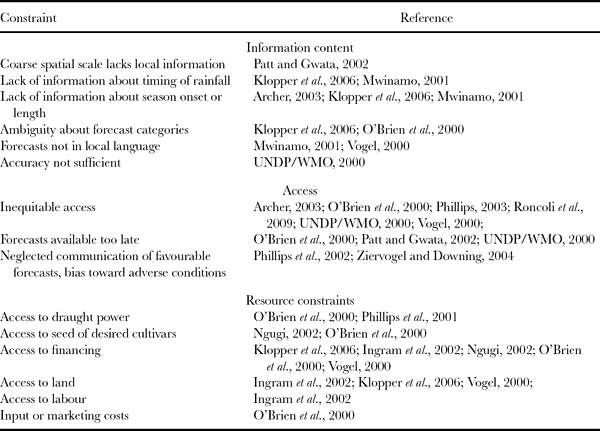
Several early publications argued that serious obstacles prevent African smallholder farmers from using or benefiting directly from seasonal forecasts. In perhaps the first serious discussion of the implications of seasonal forecasts for African agriculture – specifically pastoralism in the West African Sahel – Glantz (Reference Glantz1977) argued that constraints associated with inadequate infrastructure and governance would preclude obvious drought interventions such as adjusting stocking rates. Other influential publications that predate most empirical research argued that smallholder farmers and pastoralists are unlikely to benefit directly from seasonal forecasts due to lack of predictability of climate and crop response at a farm scale (Barrett, Reference Barrett1998; Hulme et al., Reference Hulme, Biot, Borton, Buchanan-Smith, Davies, Folland, Nicholds, Seddon and Ward1992), inadequate infrastructure to inform and support producers’ choices (Hulme et al., Reference Hulme, Biot, Borton, Buchanan-Smith, Davies, Folland, Nicholds, Seddon and Ward1992), inability to adjust management in response to new information (Blench, Reference Blench1999; Hulme et al., Reference Hulme, Biot, Borton, Buchanan-Smith, Davies, Folland, Nicholds, Seddon and Ward1992) and inability to tolerate the risk of a wrong forecast (Blench, Reference Blench1999; Hulme et al., Reference Hulme, Biot, Borton, Buchanan-Smith, Davies, Folland, Nicholds, Seddon and Ward1992). Subsequent empirical research, following the 19977/98 El Niño event and advent of RCOFs, expanded our understanding of these and other constraints (Table 3), and in some cases challenged the conclusions of the earlier assessments. Pilot research projects have provided many useful insights about how to overcome the obstacles identified, but seldom had the range of partners or level and duration of funding required to do so. With the possible exception of constraints to farmers’ ability to adjust management, the constraints discussed in this section are at least partially symptomatic of inadequate policies and institutional process, and are therefore amenable to intervention.
Constraints to seasonal forecast use and benefit by farmers in SSA, identified through empirical research.

Cash et al. (Reference Cash, Clark, Alcock, Dickson, Eckley, Guston, Jager and Mitchell2003) argued that credibility (i.e. perceived technical quality and authority of the information), salience (i.e. perceived relevance to the needs of decision makers) and legitimacy (i.e. perception that the information service seeks the users’ interests) are key prerequisites for a public information service to influence action. Like others (Cash and Buizer, Reference Cash and Buizer2005; Cash et al., Reference Cash, Borck and Patt2006; Crane et al., Reference Crane, Roncoli, Paz, Breuer, Broad, Ingram and Hoogenboom2010; Meinke et al., Reference Meinke, Nelson, Kokic, Stone, Selvaraju and Baethgen2006), we see particular need and opportunity to enhance the benefits of climate forecast information for agriculture by improving salience and legitimacy.
Salience
There is a significant gap between the information needed to support farm decision-making and the seasonal forecast information that is routinely available. While farmers are heterogeneous and their information needs vary, experience in a wide range of contexts reveals that farmers can best respond to forecast information when it: (a) is downscaled and interpreted locally; (b) includes information about growing season weather beyond the seasonal average; (c) expresses accuracy in transparent, probabilistic terms; and (d) is interpreted in terms of agricultural impacts and management implications (Archer et al., Reference Archer, Mukhala, Walker, Dilley and Masamvu2007; Childs et al., Reference Childs, Hastings and Auliciems1991; Ingram et al., Reference Ingram, Roncoli and Kirshen2002; Jochec et al., Reference Jochec, Mjelde, Lee and Conner2001; Klopper et al., Reference Klopper, Vogel and Landman2006; Letson et al., Reference Letson, Llovet, Podesta, Royce, Brescia, Lema and Parellada2001; Madden and Hayes, Reference Madden and Hayes2000; O'Brien et al., Reference O'Brien, Sygna, Otto Naess, Kingamkono and Hochobeb2000; Nelson and Finan, Reference Nelson and Finan2000; Ngugi, Reference Ngugi2002; Podestá et al., Reference Podestá, Letson, Messina, Royce, Ferreyra, Jones, Hansen, Llovet, Grondona and O'Brien2002; Ziervogel, Reference Ziervogel2004).
Despite the substantial limitations that the climate system imposes on predictability at a long lead time, it is feasible to provide much more useful seasonal forecast information than is available through the RCOFs and most NMS. For example, although the coarse spatial scale of operational forecasts was once assumed to represent a fundamental constraint of the climate system and occasionally used to argue that forecasts should not target local decision makers, we now know that regionally skilful seasonal forecasts can be downscaled to individual stations with only modest loss of skill (e.g. Gong et al., Reference Gong, Barnston and Ward2003; Moron et al., Reference Moron, Robertson and Ward2006). The relatively high predictability of rainfall frequency (Hansen and Indeje, Reference Hansen and Indeje2004; Mishra et al., Reference Mishra, Hansen, Dingkuhn, Baron, Traoré, Ndiaye and Ward2008; Moron et al., Reference Moron, Robertson and Ward2006; Moron et al., Reference Moron, Robertson and Ward2007; Robertson et al., Reference Robertson, Moron and Swarinoto2009) provides a degree of predictability of dry spell distributions (Ndiaye et al., Reference Ndiaye, Hansen and Robertson2008; Robertson et al., Reference Robertson, Moron and Swarinoto2009; Sun et al., Reference Sun, Li, Ward and Moncunill2007), with obvious relevance to the soil water balance and its effects on crops and pastures. The timing of the onset of growing season rainfall – a high priority for rainfed agriculture in dryer environments – shows significant predictability based on seasonal predictors in parts of Southeast Asia (Moron et al., Reference Moron, Lucero, Hilario, Lyon, Robertson and DeWitt2009, Reference Moron, Robertson and Qian2010; Robertson et al., Reference Robertson, Moron and Swarinoto2009), but unfortunately appears to have at best weak predictability where it has been explored in Africa. Whether through quantitative methods or a subjective process, raw climate information must be translated into information about impacts and management implications if it is to be used. Contrary to earlier assumptions (e.g. Barrett, Reference Barrett1998), there is evidence that crop yields and forage conditions may be more predictable than growing season rainfall (Cane et al., Reference Cane, Eshel and Buckland1994; Hansen et al., Reference Hansen, Potgieter and Tippett2004b; Indeje et al., Reference Indeje, Ward, Ogallo, Davies, Dilley and Anyamba2006; Rosenzweig, Reference Rosenzweig1994), due to the influence of initial soil moisture storage and early rainfall on final yield, and to the predictability of rainfall frequency and associated dry and wet spells which influence the soil water balance and plant response.
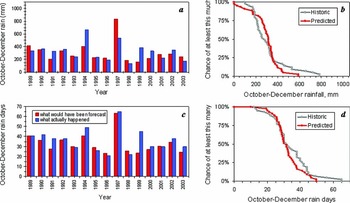
While genuine participation is vital for both the legitimacy and salience of climate forecast information services, enough is known to suggest a reasonable starting point for developing seasonal forecast information for farmers and other local agricultural decision makers. Consistent with Hansen et al. (Reference Hansen, Baethgen, Osgood, Ceccato and Ngugi2007), we suggest a minimum set of locally downscaled forecast information that includes: (a) a forecast probability distribution of seasonal rainfall total plotted against the climatological distribution; (b) time series of historic climate observations and hindcasts; and (c) the same information for number of rain days (Figure 4). They expressed the forecast as a shifted probability-of-exceedance graph instead of the standard tercile format on the grounds that (a) tercile probability shifts discard distribution information; (b) probability-of-exceedance does not suffer from some of the interpretation difficulties associated with categorical probability formats (Coventry, Reference Coventry2001; Fischhoff, Reference Fischhoff1994; McCrea et al., Reference McCrea, Dalgleish and Coventry2005; O'Brien et al., Reference O'Brien, Sygna, Otto Naess, Kingamkono and Hochobeb2000; Patt and Schrag, Reference Patt and Schrag2003); and (c) it is fairly straightforward to map historic climatic outcomes onto a cumulative distribution or probability-of-exceedance graph (Hansen et al., Reference Hansen, Marx and Weber2004a). These forecast formats are meant to communicate the accuracy of locally relevant information as transparently as possible, and in a way that helps farmers relate formal probability formats with their memory of past rainfall variations. Transparency should help shift the object of trust from the forecast provider to the farmers’ own evaluation of the data. Feedback has been positive when forecast information packaged this way was evaluated with farmers in Florida, USA (Hansen et al., Reference Hansen, Marx and Weber2004a) and Kenya (Hansen et al., Reference Hansen, Baethgen, Osgood, Ceccato and Ngugi2007), and implemented in an experimental seasonal forecast bulletin in southern Zambia (IRI, 2005).
Downscaled forecast of 2004 October–December rainfall total (a, b) and frequency (c, d) for Katumani, Kenya, presented to participating farmers in August 2004.

Legitimacy
We argue that the difficulty in meeting the climate information needs of farmers and other agricultural decision makers reflects institutional arrangements that have given the agricultural sector too little ownership or effective voice in climate information products and services. The RCOFs in Africa were initially designed to enhance the credibility of forecasts by strengthening NMS and by reconciling multiple and sometimes conflicting information sources (Dilley, Reference Dilley, Basher, Clark, Dilley and Harrison2001; Orlove and Tosteson, Reference Orlove and Tosteson1999; Patt et al., Reference Patt, Ogallo and Hellmuth2007). They have come to be viewed as a mechanism to provide information tailored to the needs of African farmers (WMO Secretary-General Michel Jarraud, 14 May 2008 statement to the UN Commission on Sustainable Development), and have shaped the way most African NMS provide seasonal forecast information. An international review of the RCOFs, in Pretoria, South Africa, in 2000, described the RCOFs as ‘a hub for activation and coordination of regional climate forecasting and applications activities. . .’ (Basher et al., Reference Basher, Clark, Dilley and Harrison2001, p. 13). The climate community (international and regional climate centres and NMS) took on the central role of designing and producing information, and inviting and educating a range of ‘users’ – an arrangement which has given the agricultural sector little influence over the design of products and services (at a cost to salience), and arguably provided little ownership of the process at a cost to legitimacy (Cash et al., Reference Cash, Borck and Patt2006; Patt et al., Reference Patt, Ogallo and Hellmuth2007).
Lack of ownership and effective voice by the agricultural sector seems to have limited the ability of the RCOFs to remove major bottlenecks to the use and value of seasonal forecasts for agriculture. The 2000 Pretoria review of the RCOFs highlighted the need to strengthen engagement with users, and made several recommendations to strengthen the voice of users and salience of the information (Basher et al., Reference Basher, Clark, Dilley and Harrison2001). There are some examples of progress on the Pretoria review recommendations, such as a growing body of research on forecast needs, constraints and value for agriculture; food security outlooks incorporated into the GHACOF; and the media taking a more active role. Within the meteorological community, the RCOFs have been recognized as a successful attempt to communicate cutting-edge climate information to user communities, and were showcased at the World Climate Conference-3 as an example of climate service best practice that should be reinforced. Yet a tenth anniversary review of the RCOFs, in Arusha, Tanzania, November 2008, noted some of the same weaknesses that the Pretoria review highlighted, and reiterated similar recommendations for strengthening the dialogue between the meteorological and user communities, and for improving the relevance of information products and communication processes to better meet user needs. NMS have apparently responded to expressed needs of agriculture, for example by adding new forecast variables and contextual information (see National meteorological services above), but mechanisms are lacking for agriculture to influence major changes to information products and services.
It is not always clear what institutional arrangements will best give agriculture the ownership and effective voice needed to achieve the potential benefits of climate forecast information, but the malaria outlook forums (MALOFs) (Da Silva et al., Reference Da Silva, Garanganga, Teveredzi, Marx, Mason and Connor2004; Hellmuth et al., Reference Hellmuth, Moorhead, Thomson and Williams2007) offers relevant lessons. As part of a regional malaria early warning system, MALOFs meet periodically in southern (since 2004) and eastern Africa (since 2006) to review climate and other malaria risk factors, and plan control measures. The MALOFs build on and coordinate with the RCOFs, but are an autonomous process owned, designed, convened and led by a user community. Food security outlooks are a regular part of the GHACOF. As part of the Nairobi Plan of Work, the World Food Program proposed an independent agriculture and food security outlook forum for each of Africa's sub-regions, that builds on the lessons of the MALOFs.
Access
Results of research on forecast dissemination and farmers’ access, following the 1997/98 El Niño, were mixed, and almost certainly reflected the early stage of widespread investment in seasonal forecasts through the RCOF process. The majority of farmers surveyed in Namibia and Tanzania did not access forecast information that year (O'Brien et al., Reference O'Brien, Sygna, Otto Naess, Kingamkono and Hochobeb2000). Ngugi (Reference Ngugi2002) found that the proportion of farmers in the Machakos District of south-central Kenya who accessed seasonal forecasts increased steadily from 1997 to 1999. On the other hand, the proportion of communal farmers in Zimbabwe who had access to seasonal forecast information dropped from >90% during the highly publicized 1997/98 El Niño, to <50% during the 1998/99 La Niña (Phillips, Reference Phillips, O'Brien and Vogel2003). Studies that reported problems accessing forecast information generally regarded other factors, such as information content or constraints to changing management, as more constraining. One exception is Tarhule and Lamb (Reference Tarhule and Lamb2003), who reported that the majority of survey respondents from rural communities in Sudano-Sahelian West Africa (n = 566) have a high regard for seasonal forecasts, and identified a range of viable management responses, but difficulty accessing information prevented use. Unfortunately, most published information about farmers’ access to seasonal forecasts is at least several years old; and reveals little about the degree to which the vigilance about disseminating forecast information, apparent in our survey (see Media above), may have led to improved access and use of information by smallholder farmers.
Several studies have highlighted inequitable access to climate information due to wealth, gender or ethnicity. In South Africa, Vogel (Reference Vogel2000) found that ethnicity influenced access to forecast information. Roncoli et al. (Reference Roncoli, Jost, Kirshen, Sanon, Ingram, Woodin, Somé, Ouattara, Sanfo, Sia, Yaka and Hoogenboom2009) found that marginalized ethnic groups and women in Burkina Faso had difficulty accessing information and participating in participatory forecast communication workshops, despite the project's efforts to ensure equitable participation. Archer's (Reference Archer2003) work in Limpopo Province, South Africa showed that gender and position within the household influenced access to information and the preferred delivery mechanism. In Phillips’ (Reference Phillips, O'Brien and Vogel2003) survey of communal farmers in Zimbabwe, wealth influenced access to forecasts in 1998/99 (a La Niña year), but not in 1997/98 when the El Niño received a great deal of media attention. Yet wealth did not influence use among those who received forecasts. This suggests that wealth has a greater effect on access than on capacity to respond, and that aggressive dissemination may overcome the potential wealth bias.
The challenge of effective, equitable and timely delivery of climate information parallels the challenge of providing other information and services to smallholder farmers and is complicated by their large numbers, remoteness, the poor state of rural communication infrastructure and weakness of many national agricultural extension systems in SSA. The ideal combination of delivery mechanisms is likely to vary with context, but includes some combination of human interaction, media and ICT. Since facilitated group interaction appears to be the most effective method to communicate seasonal forecast information in a way that farmers can use, climate information should ideally be a routine part of agricultural extension services where they are functional. Agribusiness and non-governmental organizations also have potential to serve as communication intermediaries, although there could be incentive to manipulate the delivery or interpretation of information to protect business interests (Ingram et al., Reference Ingram, Roncoli and Kirshen2002).
Media and ICT-based communication (radio, cell phones, internet) offer potential to support timely delivery of climate information to rural communities at relatively low cost. Rural radio has been considered the most effective vehicle for delivering climate information to rural communities at a large scale, at least in eastern and southern Africa. The proliferation of mobile phone use over the past half decade is opening new opportunities for low-cost, timely delivery of information tailored to farmers’ needs and locations. Yet pilot-scale successes with other forms of information for agriculture have so far been difficult to sustain or scale up. Internet-based ‘village knowledge centres’, which the M. S. Swaminathan Research Foundation and others promote in India as a vehicle for rural information services and means to empower women trained to operate them, is an attractive model for delivering climate information (Rengalakshmi, Reference Rengalakshmi, Sivakumar and Hansen2007), but the poor state of internet connectivity seems to limit its application in SSA at least in the near term. Media and ICT seem to have more advantages for short-lead climate information, such as weather forecasts and flood warning, than for seasonal prediction. They cannot easily replace the trust, visual communication of location-specific information, feedback and mutual learning that face-to-face interaction provides. Facilitated radio listening groups, tested in Uganda, combine the benefits of media-based dissemination and facilitated group interaction, and offer a potential mechanism to obtain feedback to improve content (Orlove and Roncoli, Reference Orlove and Roncoli2006; Phillips and Orlove, Reference Phillips and Orlove2004). Investment in rural communication infrastructure is also needed to streamline information transfer to communication intermediaries (e.g. district agricultural offices).
Understanding
Effective use of seasonal forecasts places substantial demands on management skill, as it involves using new information presented in new formats to adjust possibly many interrelated decisions. The probabilistic nature of seasonal forecasts presents a significant challenge – not because farmers have difficulty making decisions in the face of uncertainty, but because formal probability formats must be mapped onto their mental models for dealing with uncertainty. Yet experience in Burkina Faso, Zimbabwe, Kenya and Ethiopia demonstrates that, with some help, smallholder farmers are able to understand and incorporate probabilistic forecast information into their decision process (Ingram et al., Reference Ingram, Roncoli and Kirshen2002; Luseno et al., Reference Luseno, McPeak, Barret, Little and Gebru2003; Lybbert et al., Reference Lybbert, Barrett, McPeak and Luseno2007; Patt, Reference Patt2001; Suarez and Patt, Reference Suarez and Patt2004). There is also evidence that farmers’ ability to use climate forecast information improves with experience. Forecast information should be packaged with education and technical guidance to accelerate the learning process and reduce the risk of disillusionment from an early forecast that is perceived as poor.
Hansen et al. (Reference Hansen, Marx and Weber2004a, Reference Hansen, Baethgen, Osgood, Ceccato and Ngugi2007) developed a process to help farmers interpret and respond to probabilistic climate forecasts, expressed as probability-of-exceedance, in a manner that is consistent with the way they deal with variability in the absence of forecasts. It involves first eliciting participants’ collective memory of past rainfall conditions, allowing them to plot observations for the same period and validate them against their collective memory. Participants then sort the time series onto a blank probability-of-exceedance graph with quantity (e. g. seasonal rainfall) on the x-axis and frequency (e. g. ‘Years with at least this much rain’) on the y-axis, and discuss how past relative frequency relates to probability for the upcoming season. Expressing probability as equivalent relative frequency reduces some of the biases that plague the use of probabilistic information (Gigerenzer and Hoffrage, Reference Gigerenzer and Hoffrage1995). Discussing hypothetical shifts and using analogies of locations that farmers identified as somewhat wetter (dryer) aids understanding of the implications of shifts to the right (left) from the climatological distribution. The distribution for analogue (e. g. El Niño or La Niña) years is derived and compared with the climatological distribution years to convey the notion that a forecast shifts the climatological distribution. The final step is to provide opportunity (e. g. in breakout groups) to discuss management implications of forecasts.
Other published experience suggests three additional ways to improve understanding. First exploit the benefits of a group process. There is growing evidence that group interaction among farmers contributes to understanding, and to willingness and ability to act on forecast information (Marx et al., Reference Marx, Weber, Orlove, Leiserowitz, Krantz, Roncolia and Phillips2007; Roncoli et al., Reference Roncoli, Jost, Kirshen, Sanon, Ingram, Woodin, Somé, Ouattara, Sanfo, Sia, Yaka and Hoogenboom2009). Second, provide accelerated experience through decision games. Well-designed games that link real or imaginary payouts to decisions and sampled probabilistic outcomes allow farmers to learn from repeated experience in a short time (Suarez and Patt, Reference Suarez and Patt2004; Roncoli et al., Reference Roncoli, Jost, Kirshen and Hoogenboom2005). Third, build on the near-universal use of indigenous climate indicators, and on culturally relevant analogies of decisions under uncertainty into the climate communication process (Phillips and Orlove, Reference Phillips and Orlove2004; Suarez and Patt, Reference Suarez and Patt2004).
Capacity to respond
Do smallholder farmers have the capacity to respond to climate forecasts? Economic, technical, policy and social constraints keep many smallholder farmers trapped in poverty and frustrate agricultural development efforts. Several authors offer thoughtful arguments that these constraints prevent smallholder farmers in West (Glantz, Reference Glantz1977; Hulme et al., Reference Hulme, Biot, Borton, Buchanan-Smith, Davies, Folland, Nicholds, Seddon and Ward1992; Traoré et al., Reference Traoré, Kouressy, Vaksmann, Tabo, Maikano, Traoré, Cooper, Sivakumar and Hansen2007) and southern Africa (Blench, Reference Blench1999, Reference Blench, O'Brien and Vogel2003; Vogel, Reference Vogel2000) from exploiting forecast information. However, accumulating empirical evidence suggests that resource constraints often limit desired responses but generally do not preclude smallholder farmers from responding to forecasts. Although Phillips et al. (Reference Phillips, Unganai, Makaudze, Rosenzweig, Boote, Hollinger, Iglesias and Phillips2001) identified lack of access to draught animals and credit as constraints to responding, a large proportion of farmers did adjust management in the 1997/98 and 1998/99 seasons (Phillips et al., Reference Phillips, Deane, Unganai and Chimeli2002), and response was unaffected by resource endowment for those farmers who could access the information (Phillips, Reference Phillips, O'Brien and Vogel2003). Patt et al. (Reference Patt, Suarez and Gwata2005) also found no relationship between farmers’ response to forecasts and resource endowment in Zimbabwe. In Burkina Faso, obstacles to desired forecast responses varied by location and farming system, and included limited access to labour, credit, production inputs and markets; debt; competition for quality land; and disruption to traditional lines of authority (Ingram et al., Reference Ingram, Roncoli and Kirshen2002). Despite these constraints, farmers identified a range of promising responses, and follow-up work showed that the vast majority of farmers who had access to forecast information changed management in response (Roncoli et al., Reference Roncoli, Jost, Kirshen, Sanon, Ingram, Woodin, Somé, Ouattara, Sanfo, Sia, Yaka and Hoogenboom2009).
Opportunities to benefit from forecast information appear to be more limited for small-scale livestock farmers and particularly for pastoralists, than in crop-based and mixed farming systems. Luseno et al. (Reference Luseno, McPeak, Barret, Little and Gebru2003) attributed limited management responses among Kenyan and Ethiopian pastoralists who received, understood and trusted external forecasts of season onset (24%) and rainfall total (9%), to a poor match with the pastoralists’ use of migration in response to observed rainfall to manage risk, and to their reluctance to adjust the size of herds that represent wealth. In contrast to crop farmers and agro-pastoralists in the region, pastoralists in the Sahelian region of Burkina Faso did not identify viable management responses to seasonal forecasts beyond altering fodder storage, due to constraints to adjusting herd management (Ingram et al., Reference Ingram, Roncoli and Kirshen2002). In Northwest Province, South Africa, communal farmers reportedly see livestock as wealth and are reluctant to adjust herd sizes; although they do buy fodder when facing drought, and are more open than commercial farmers to using forecast information (Hudson and Vogel, Reference Hudson, Vogel, O'Brien and Vogel2003).
In answer to the question that opens this section, resource limitations associated with widespread chronic poverty clearly do reduce the use and value of seasonal forecasts for farming decisions. However, expanding the use of seasonal forecasts beyond the farm scale to include, for example, providers of technology, production inputs, advice, financial services and market access (see Extending the range of applications below), might alleviate some of the constraints. We suggest that a more useful question is, ‘Can seasonal forecasts play a synergistic role in ongoing efforts to invest in rural livelihoods through technology, markets, policy, rural infrastructure and human capital?’
Risk of a ‘wrong’ forecast
Are relatively poor, risk-averse farmers unable to use seasonal forecast information because they cannot bear the risk of a ‘wrong forecast’, as several (e. g. Blench, Reference Blench1999, Reference Blench, O'Brien and Vogel2003; Broad and Agrawala, Reference Broad and Agrawala2000; Hulme et al., Reference Hulme, Biot, Borton, Buchanan-Smith, Davies, Folland, Nicholds, Seddon and Ward1992; Lemos and Dilling, Reference Lemos and Dilling2007; Traoré et al., Reference Traoré, Kouressy, Vaksmann, Tabo, Maikano, Traoré, Cooper, Sivakumar and Hansen2007) have suggested? Given the surprising lack of empirical research for a concern that seems so pervasive, we focus on assumptions that appear to underlie this concern. Farmers must routinely make critical livelihood decisions that are sensitive to probabilistic future climatic conditions. Skilful forecast information could increase exposure to risk only if a farmer made decisions quite differently with and without the additional information. Skilful seasonal forecasts are not fundamentally different from the climatological distribution that farmers routinely face, but merely shift the distribution for the upcoming season. A climatic outcome in the tail of a reliable (in the statistical sense of properly calibrated) probabilistic forecast does not imply a ‘wrong forecast’ any more than an outcome in the tail of the climatological distribution would imply that climatology is ‘wrong’. New information alone does not change the objectives or constraints that shape a farmer's decisions. There is no reason to assume that the risk-averse farmer who employs conservative risk management in the face of year-to-year climate variability would abandon caution in the face of a predicted probability shift.
A few plausible situations might lead a farmer to make decisions differently with and without seasonal forecast information. The first is the very real danger that probabilistic information about the forecast distribution could be lost or distorted somewhere in the forecast generation, dissemination, interpretation and application process. Underestimating uncertainty can lead to excessive responses that are inconsistent with decision makers’ risk tolerance, and can damage the credibility of the forecast provider (Changnon, Reference Changnon2002; Hammer et al., Reference Hammer, Hansen, Phillips, Mjelde, Hill, Love and Potgieter2001; Nicholls and Kestin, Reference Nicholls and Kestin1998; Orlove and Tosteson, Reference Orlove and Tosteson1999). Second, the process of learning to use the new information in new ways could increase risk. Omamo and Lynam (Reference Omamo and Lynam2003) make a useful distinction between substantive (related to stochastic states of nature) and procedural (related to knowing how to apply a technology) uncertainty. As with any new, management-intensive technological innovation, skilful seasonal forecasts may add procedural uncertainty during the process of learning and adaptation, even though they necessarily reduce substantive uncertainty. However, the procedural component of risk decreases with learning, and learning can be accelerated with appropriate education and technical guidance. Finally, policy interventions that promote particular forecast responses could force farmers to apply different decision criteria and thereby increase their risk exposure if they are designed without adequate farmer participation. One well-documented example is the Hora de Plantar (‘Time of Planting’) programme in northeast Brazil, which sought to influence farmers’ cultivar and planting date decisions by releasing seed based on seasonal forecasts (Lemos et al., Reference Lemos, Finan, Fox, Nelson and Tucker2002; Meinke et al., Reference Meinke, Nelson, Kokic, Stone, Selvaraju and Baethgen2006; Orlove and Tosteson, Reference Orlove and Tosteson1999). The programme reportedly was widely resented for constraining farmers’ planting decisions, and hurt the credibility of the forecast provider.
While responding to skilful forecasts should generally benefit a rational farmer in the long run, returns could be lower for management based on forecasts than for management based on climatology in particular years. In their model-based study of the value of seasonal forecasts for maize management in Kenya, (Hansen et al., Reference Hansen, Mishra, Rao, Indeje and Ngugi2009) showed that the substantial chance (25% at Katumani, 34% at Makindu) that responding to seasonal forecasts would reduce income in a given year would not be a disincentive for the rational farmer regardless of degree of risk aversion, as losses from responding to forecasts tended to be more frequent and severe in relatively high-income years when farmers can better handle them. Given rationality and unbiased expectations, the study's constraint that farmers maximize expected income represents a worst-case scenario.
Data scarcity
Using seasonal forecasts for agricultural decisions depends on historic records that are sufficiently long to support downscaling, and allow skill to be assessed and probability shifts to be calibrated; and spatially complete at a resolution that is consistent with the scale of decisions. Observing infrastructure over most of the continent is seriously inadequate and reporting of observations has been declining (Washington et al., Reference Washington, Harrison, Conway, Black, Challinor, Grimes, Jones, Morse, Kay and Todd2006). Because NMS are often oriented toward commercial sectors such as transportation, which is able to pay for their services, data coverage tends to be poorest in rural areas. New investment in observing infrastructure cannot address gaps in the historic record. Ongoing investment is making some headway in rescuing and digitizing paper archives. Satellite remote sensing provides a complementary source of rainfall estimates with complete spatial and temporal coverage, but available satellite-based data sets are limited by some combination of short duration, and coarse spatial and temporal (monthly or 10-daily) resolution. With modest investment and cooperation of NMS, it is feasible to process older METEOSAT geostationary satellite images – which extend back to 1978 with full spatial coverage of Africa at a frequency of at least two images per hour and a spatial resolution of roughly 3–6 km – and calibrate them with available observations to produce a ≥ 30-year, 10 km gridded, daily rainfall time series across SSA.
Investment in meteorological data will not contribute to development unless the data are available to those who need it. Structural reform policies, imposed on developing countries by global development donors beginning in the late 1980 s, downsized NMS across SSA and created incentives for them to treat data as a source of revenue rather than a public good. Restrictive data policies in most countries in SSA (Table 2) limit the development benefits of investment in observing systems and in seasonal climate prediction. There is an urgent need to consider policy that treats meteorological data as a public good and a resource for development.
EXTENDING THE RANGE OF APPLICATIONS
Efforts to promote and support the use of seasonal forecasts for agriculture and food security in SSA have typically targeted either farmers or various institutional users, but have seldom explicitly looked for synergies between the different levels of decision making. Although evidence is lacking, it seems likely that more effective systematic use of advance information about climate and its impacts on agriculture may also offer opportunities to improve management of input and credit supply, production and price volatility (e. g. through food trade), food crises and insurance – in ways that reduce risks and increase opportunities at the farm level.
Coordinating input and credit supply
Some of the resource constraints to farm-level responses to advance information might be alleviated if the information would also enable market institutions to profitably coordinate supply of financing and key production inputs to demand by farmers. There is anecdotal evidence that some agricultural input suppliers in SSA already factor seasonal forecasts into their operations. SeedCo, a seed producer and supplier operating in southern Africa, reportedly factors seasonal forecasts into their recommendations to farmers, using different animals to represent the climatic sensitivity of groups of maize cultivars (Malusalila, Reference Malusalila2000). Faida Seeds, which contracts farmers in Kenya to produce maize and sunflower seed, avoids climate-related losses by scaling down production and emphasizing drought-tolerant cultivars when RCOF forecasts show enhanced probability of drought (C. Ng'ang'a, Managing Director, 2004, personal communication). While seasonal forecast information should be able to serve the needs of both farmers and input suppliers, input markets need longer lead time than farmers if they are to adjust supply to changing demand in response to the information. On the other hand, input supply chains should benefit from the greater predictability that exists at aggregate spatial scales (Gong et al., Reference Gong, Barnston and Ward2003).
Advance information should, in principle, offer opportunity to improve the availability and terms of credit on average (due to institutional risk aversion), and particularly in low-risk years when crops are more responsive to production inputs and risk of default is reduced. Yet experience in southern Africa during the 1997/98 El Niño event is often cited as a basis for concern that forecasts will hurt farmers by making credit less available when predicted adverse conditions do not materialize (Glantz, Reference Glantz2001; Patt et al., Reference Patt, Ogallo and Hellmuth2007, Reference Patt and Schrag2001; Phillips et al., Reference Phillips, Deane, Unganai and Chimeli2002; Vogel, Reference Vogel2000). Incorporating forecast information into the design of index-based insurance may offer a more robust approach to managing credit supply in response to advance information (see Weather index insurance below).
Food crisis management
Effective management of food crises for long-term food and livelihood security involves a tradeoff between targeting and timeliness. Assistance can protect the productive assets of vulnerable households, encourage investment and intensification through its insurance effect, and stimulate development of the value chain for agricultural products – if it is targeted and managed well both in terms of recipients and instruments (e. g. food aid distributed through markets, cash transfers, food for work) (Abdulai et al., Reference Abdulai, Barrett and Hazell2004; Barrett, Reference Barrett, Gardner and Rausser2002). On the other hand, assistance that is poorly targeted or allows substantial leakage to unintended beneficiaries can contribute to price fluctuations, discourage production and market development, and foster dependency. Institutional procedures typically require verifiable consumption or health impacts to ensure that assistance is well targeted. However, delay can greatly increase the humanitarian and persistent livelihood impacts of the crisis, and the cost of delivering food aid (Barrett et al., Reference Barrett, Barnett, Carter, Chantarat, Hansen, Mude, Osgood, Skees, Turvey and Ward2007; Broad and Agrawala, Reference Broad and Agrawala2000; Haile, Reference Haile2005). Early response is therefore essential to effective food crisis management, and the availability of quality early warning information is a precondition.
Several international organizations (e. g. FEWSNet, FAO, JRC, AGRHYMET, SADC/RRSU) implement food security early warning tools that incorporate, for example, rainfall monitoring, satellite vegetation monitoring, and simple water balance models that incorporate historic and monitored weather data in order to anticipate crop or forage production shortfalls. Seasonal forecasts improve accuracy particularly early in the growing season (e. g. Hansen et al., Reference Hansen, Potgieter and Tippett2004b; Mishra et al., Reference Mishra, Hansen, Dingkuhn, Baron, Traoré, Ndiaye and Ward2008), but for the most part have not been systematically incorporated into operational food security early warning systems.
While early warning does not necessarily translate into early response, there is evidence of progress in learning to use seasonal forecast information to manage crises. Forecasts of enhance risk of drought and food insecurity in Ethiopia in 1999 proved to be reasonably accurate, but the international humanitarian assistance community reportedly was unprepared to change its reactionary processes and delayed action until a food crisis had already unfolded (Broad and Agrawala, Reference Broad and Agrawala2000). However, a similar forecast in 2002 prompted the formation of an emergency management team and donor commitments before the situation in Ethiopia turned into a crisis (Hellmuth et al., Reference Hellmuth, Moorhead, Thomson and Williams2007). The International Federation of the Red Cross took unprecedented anticipatory actions in 2008; including requesting and securing relief funds, pre-positioning disaster relief supplies across West Africa, and alerting communities at risk and decision makers across the region; purely in response to the PRESAO forecast of enhanced probability of above-normal rainfall (Tall et al., Submitted).
Managing price fluctuations
Price fluctuations associated with climate shocks can lead to acute food insecurity for the relatively poor, who spend the great majority of their incomes on food, even if total food availability is sufficient to meet a region's needs. The use of advance information to manage regional trade and storage to stabilize prices is therefore an important part of food security management, particularly in drought-prone, landlocked countries. Because of the lead time involved in international trade, the use of forecasts several months before harvest can be expected to improve the management of trade and storage (Chen et al., Reference Chen, McCarl and Chang2008; Hallstrom, Reference Hallstrom2004; Hill et al., Reference Hill, Mjelde, Love, Rubas, Fuller, Rosenthal and Hammer2004), with considerable potential benefits to both producers and consumers (Arndt and Bacou, Reference Arndt and Bacou2000; Arndt et al., Reference Arndt, Bacou, Cruz, O'Brien and Vogel2003). In many African countries the management of price volatility through trade is complicated by problems such as public-private sector coordination problems stemming from incomplete implementation of structural reform policies (Byerlee et al., Reference Byerlee, Jayne and Myers2006; Jayne et al., Reference Jayne, Zulu and Nijhoff2006), poor transportation infrastructure and informal barriers resulting from poor border enforcement. On the other hand, sub-regional economic communities (e. g. COMESA ECOWAS, SADC) are reducing the political obstacles to intra-regional trade, and provide a mechanism to coordinate trade regionally.
Weather index insurance
Weather index insurance is an innovation that triggers payouts based on a meteorological index (e. g. rainfall) that is correlated with crop losses, rather than observed losses. Because it avoids the key problems that make traditional crop insurance unviable in most of the developing world, recent innovations have prompted a resurgence of interest in managing risk for smallholder agriculture through insurance (Barrett et al., Reference Barrett, Barnett, Carter, Chantarat, Hansen, Mude, Osgood, Skees, Turvey and Ward2007; Hellmuth et al., Reference Hellmuth, Osgood, Hess, Moorhead and Bhojwani2009). Insurance and prediction play complementary roles in agricultural risk management. By providing a safety net, insurance may support more aggressive adaptive management in response to forecast information. Seasonal rainfall forecasts are sometimes seen as a threat to weather index insurance, allowing farmers to selective purchase insurance only in years with enhanced drought risk and probability of payout (Hess and Syroka, Reference Hess and Syroka2005; Luo et al., Reference Luo, Skees and Marchant1994). However, theoretical arguments and a numeric example from Malawi suggest that factoring forecast information into the design of the contract could increase the efficiency and livelihood benefits of index insurance, at least where it is designed to support access to credit and intensified, market-oriented production (Carriquiry and Osgood, Reference Carriquiry and Osgood2008; Osgood et al., Reference Osgood, Suarez, Hansen, Carriquiry and Mishra2008), but the theoretical arguments have not yet been tested in pilot implementations.
Emerging initiatives
The surge of activity surrounding seasonal forecasts in SSA that followed the 1997/98 El Niño event waned in recent years, but several major emerging initiatives are likely to re-invigorate support for seasonal forecast information services for agriculture. Several initiatives focused on climate change adaptation for African agriculture are investing in climate information as a way to manage current climate risk and foster resilience (CCAFS, 2009; Rockefeller Foundation, 2010).
At the World Climate Conference 3 (Geneva, 31 August-4 September 2009), delegates representing 155 nations endorsed a Global Framework for Climate Services (GFCS) ‘to strengthen the production, availability, delivery and application of science-based climate prediction and services’ (WMO, 2009). Proposed objectives include advancing understanding and management of climate risks and opportunities, improving climate information; meeting the climate-related information needs of users, and promoting effective routine use of climate information. The GFCS is motivated by the challenges caused by both year-to-year climate variability and change, and will include prediction at lead times from seasons to decades. The WMO is charged with convening a high-level independent task force to develop a plan for implementing the GFCS, in consultation with governments and other stakeholders, by January 2011.
Climate for Development in Africa (ClimDev-Africa) is a new programme of the African Development Bank, the African Union and the UN Economic Commission for Africa (UNECA) that seeks to overcome the lack of necessary climate information, analysis and options required by policy and decision makers at all levels (AfDB, 2009). Its objectives are to build the capacity of African climate institutions to generate and disseminate useful climate information (beginning with regional climate centers: ACMAD, AGRHYMET, ICPAC, SADC-DMC); enhance the capacity of end-users to mainstream climate into development; and implement adaptation and mitigation programmes that incorporate climate-related information. ClimDev-Africa is, in part, a response to a multi-stakeholder, cross-sectoral assessment of the use of climate information in Africa that attributed a pervasive gap between the existing use of information and the needs of development to ‘market atrophy’ resulting from the interplay between ineffective demand by development stakeholders and inadequate supply of relevant climate information services (IRI, 2006).
CONCLUSIONS
Climate-related risk is an obstacle to improving food security and rural livelihoods in sub-Saharan Africa. The international agriculture community is working aggressively to reduce the technology, market, institutional and policy constraints to food security and rural prosperity in Africa, but effective management of climate risk remains an underexploited yet critical piece of a comprehensive approach. The ability to anticipate climate fluctuations and their impact on agriculture months in advance should, in principle, enable several opportunities to manage risk. Within an enabling environment, it offers the farmer opportunity to adopt improved technology, intensify production, replenish soil nutrients and invest in more profitable enterprises when conditions are favourable; and to more effectively protect families and farms against the long-term consequences of adverse extremes. More effective systematic use of advance information about climate and its impacts on agriculture may also offer opportunities to improve management of input and credit supply, production volatility (through food trade and strategic grain reserves), food crises and insurance – in ways that reduce risk and increase opportunities at the farm level.
Results of field research targeting smallholder farmers in SSA suggests that latent demand for relevant climate information seems to be widespread, and that farmers can and do act on seasonal forecasts. It also shows that widespread uptake is constrained, and the potential benefits are largely unrealized in part because of widespread communication failures. Based on survey responses, many national meteorological services seem to have made considerable progress in making information more accessible to farmers and other agricultural stakeholders through multiple channels. Yet because agriculture lacks effective voice in climate information services, forecast information and services remain poorly designed for their needs.
There are several technically feasible avenues for providing climate information that is more useful for agriculture. As a starting point, seasonal forecasts should: (a) be downscaled onto available stations or projected onto high-resolution, gridded, merged satellite-station data; (b) include relevant and predictable information about ‘weather-within-climate’ such as the number of rain days; (c) express uncertainty in transparent probabilistic terms, including the full forecast and climatological distributions; and (d) be packaged with historic observations and hindcasts of the forecast variables. Probabilistic forecasts of agricultural impacts (e. g. crop or forage yields), updated through the growing season, would serve multiple climate risk management interventions involving a range of decision makers. However, we argue that weaknesses in current climate information products and services are symptoms of inadequate institutional arrangements. We suggest five key institutional and policy changes that will greatly enhance the benefits of seasonal forecasting to agriculture. The first is to mainstream climate information, including seasonal forecasting, into agricultural research and development strategy. The second, closely-related challenge is to develop capacity to use and effectively demand climate information, perhaps beginning with champions within national agricultural research systems. Third, the agricultural sector and particularly farmers must be given a degree of ownership and an effective voice in climate information products and services. Fourth, in many cases NMS need to be realigned, resourced and trained as providers of services for development and participants in the development process. Finally, meteorological data should be treated by national policy as a free public good and a resource for sustainable development across sectors. While these changes are likely to be more challenging than the technical issues related to climate information, they are not intractable. Given the pervasive influence that climate risk has on food and livelihood security in SSA, they seem worthwhile targets for investment and advocacy. We hope that new initiatives such as ClimDev-Africa and GFCS will help overcome the inertia of supply-driven climate information services, and foster needed change.
Acknowledgements
We thank guest editors Peter Cooper, Roger Stern and Richard Coe for constructive comments that greatly improved the clarity and completeness of the paper, and Joseph Mutemi (ICPAC) for providing the downscaled forecast data that went into Fig. 2b. We are grateful to the NMS respondents who graciously provided detailed information about how they support the use of seasonal forecasts for agriculture in their countries: Mesho Radithupa (Botswana), Judith Sanfo and Pascal Yaka (Burkina Faso), Mbaiguedem Gedeon (Chad), Bernard Kouakou (Côte d'Ivoire), Peter Kabamba (Democratic Republic of the Congo), Diriba Korecha (Ethiopia), Charles Mutai and David Gikundu (Kenya), Aissatou Sita (Niger), Jean Baptiste Uwizeyimana (Rwanda), Cherif Diop (Senegal), Kentse Setshedi (South Africa), Mduduzi Gamedze (Swaziland), Emmanuel Mpeta and Venerabilis Kululetera (Tanzania), Deus Bamanya (Uganda), Anderson Mulambu (Zambia); and anonymous respondents from Burundi and Sudan. This work was supported with the financial assistance of the donors to the CGIAR Challenge Program on Climate Change, Agriculture and Food Security (CCAFS): European Union, Canadian International Development Agency, World Bank, New Zealand Ministry of Foreign Affairs and Trade, and Danida, and with the technical support of IFAD; and by a grant/cooperative agreement NA67GP0299 from the National Oceanic and Atmospheric Administration. The views expressed herein are those of the authors, and do not necessarily reflect the views of any of these agencies.
Appendix: National Meteorological Service Questionnaire
1. Do you regularly provide seasonal climate forecasts to the agricultural sector or to the general public?
2. Who are the main agricultural users of seasonal climate forecast information?
3. What is the spatial scale of the seasonal forecasts?
4. What climate variables (i.e., precipitation, temperature, others?) are included in the seasonal forecasts?
5. For seasonal precipitation forecasts, do you provide any additional information about rainfall distribution (e.g. timing of onset or cessation, frequency, dry or wet spells) beyond the seasonal total?
6. Do you express the uncertainty of the forecast in probabilistic terms?
7. Do you package seasonal climate forecast information with any other type of information?
8. Would you please describe anything else that you do to make seasonal forecasts more useful to farmers and other agricultural stakeholders?
9. Do you participate regularly in regional climate outlook forums?
10. Are your seasonal forecasts based on the regional climate outlook forum forecast, your own analyses or a combination? If they incorporate your own analyses, could you please briefly describe the data and analyses that go into the forecasts?
11. What mechanisms do you use to disseminate forecast information to farmers and other agricultural stakeholders?
12. Do you partner with any other government agencies or non-governmental institutions to provide seasonal climate forecasts to the agricultural sector?
13. Are seasonal forecasts freely available to the general public or to agricultural stakeholders?
14. Are historic observation records freely available to the general public or to agricultural stakeholders?