


In 1974, Elaine Noble was elected to the Massachusetts House of Representatives, becoming the first openly LGBT nonincumbent candidate elected to an American legislature. Throughout her pioneering election, she experienced extreme violence and discrimination from voters because of her sexual identity. In an interview with Out and Elected in the USA, Noble recounted protesters breaking windows at her campaign headquarters, destroying her car, and harassing supporters at her campaign office. Despite encountering overt prejudice and violence from some of her constituents, Noble displayed the characteristics of a highly effective lawmaker throughout her two terms in office. She championed issues such as school desegregation and LGBTQ rights and, as a testament to her performance in office, won nearly 80% of the district vote share in the following election (Secretary of the Commonwealth of Massachusetts 1974).
During the 50 years since Noble’s election, LGBTQ candidates have increasingly run for and won elections to local, state, and federal offices. Although the election of LGBTQ candidates has increased their numeric representation in American political institutions, LGBTQ politicians remain underrepresented at all levels of government. Although 7.1% of the American population, and 20% of Americans born between 1997 and 2003, identify as LGBTQ, only 13 lawmakers in the 118th Congress identify as lesbian, gay, or bisexual (Jones Reference Jones2022; Schaeffer Reference Schaeffer2023). Likewise, only 1.1% of state legislators identify as LGBTQ. The leading explanation for why LGBTQ lawmakers are underrepresented in American legislatures is voter discrimination (Haider-Markel Reference Haider-Markel2010; Magni and Reynolds Reference Magni and Reynolds2021).
Despite facing discrimination in elections, LGBTQ lawmakers at both the state and federal levels have demonstrated a record of effective lawmaking. In the U.S. Congress, LGB lawmakers have persistently championed policies promoting marriage equality and nondiscrimination protections. For four consecutive Congresses (114th–117th), David Cicilline, an openly gay representative from Rhode Island, sponsored the Equality Act. The Equality Act would have enshrined gender and sexuality-based nondiscrimination protections into federal law and prohibited discrimination in some public accommodations (Kurtzleben Reference Kurtzleben2021). Although this legislation ultimately died in the Senate, Tammy Baldwin, the first openly lesbian senator, negotiated a deal with Republican senators in the 117th Congress to pass the Respect for Marriage Act. Though narrower in scope than the Equality Act, this bill repealed the Defense of Marriage Act (DOMA) and requires all states to recognize same-sex marriages that are legally performed in any state (Jalonick Reference Jalonick2022). The legislative successes of LGBTQ lawmakers have been even more apparent at the state level. In California, where more than 10% of the upper chamber identifies as LGBTQ, lawmakers have passed legislation directed at increasing preexposure prophylaxis (PrEP) access, promoting economic equality for same-sex couples, and developing antidiscrimination measures and training for employers and LGBTQ youth (EqualityCalifornia 2023).
We argue that the legislative successes of Elaine Noble and other LGBTQ lawmakers are not a coincidence but rather one result of voter discrimination directed at LGBTQ candidates. In this article, we build on existing theories linking discrimination toward underrepresented groups to their performance in office (Anzia and Berry Reference Anzia and Berry2011). We argue that if LGBTQ candidates perceive or experience voter discrimination, only the most qualified and experienced will run for and win elective office. As a result, LGBTQ legislators will be more effective lawmakers than non-LGBTQ legislators. To test our expectations, we identify more than 22,500 state legislators’ sexuality identity (Haider-Markel Reference Haider-Markel2010) and pair this with their state legislative effectiveness scores (SLES; Bucchianeri, Volden, and Wiseman Reference Bucchianeri, Volden and Wiseman2025).
We argue that if LGBTQ candidates perceive or experience voter discrimination, only the most qualified and experienced will run for and win elective office. As a result, LGBTQ legislators will be more effective lawmakers than non-LGBTQ legislators.
This article offers two unique contributions to the existing literature on elections and effective lawmaking. First, we analyze an understudied identity group in legislatures—LGBTQ lawmakers. Although a small and growing literature studies LGBTQ politics (Brant and Butcher Reference Brant and Butcher2022; Haider-Markel Reference Haider-Markel2010; Hansen and Treul Reference Hansen and Treul2015), we still know relatively little about the legislative behavior of LGBTQ lawmakers. Additionally, LGBTQ lawmakers are a good test of our theory given that we are interested in how discrimination in elections is related to lawmakers’ performance in office. Recent research suggests that approximately 30% of the American population would oppose an openly gay or lesbian candidate for local, state, and federal office (Haider-Markel et al. Reference Haider-Markel, Miller, Flores, Lewis, Tadlock and Taylor2017). More than 35% of the American population would never vote for a transgender candidate (Haider-Markel et al. Reference Haider-Markel, Miller, Flores, Lewis, Tadlock and Taylor2017), suggesting that discrimination from voters continues to be a challenge experienced by LGBTQ candidates.
Second, after empirically demonstrating that LGBTQ lawmakers are more effective than non-LGBTQ lawmakers, we conduct a variety of tests linking LGBTQ legislators’ policy-making success to voter discrimination. In one test, we construct a novel data set capturing the election year that LGBTQ lawmakers “came out.” Unlike observable descriptive identities, such as race and gender, individuals’ LGBTQ identity is not immediately obvious. As a result, we can leverage variation in when voters learn that a lawmaker identifies as LGBTQ. This enables us to address a methodological challenge inherent to studies concerning race and gender: we can measure an LGBTQ legislator’s effectiveness before and after they publicly reveal their LGBTQ identity. Descriptive statistics and model estimates indicate that LGBTQ lawmakers are considerably more effective than non-LGBTQ lawmakers. Publicly out LGBTQ legislators are more effective than LGBTQ legislators who are not publicly out.
How Voter Discrimination Produces Effective LGBTQ Lawmakers
Although it is unclear whether LGBTQ candidates face electoral biases in fund-raising, party recruitment, or news coverage, they do experience significant discrimination from voters.Footnote 1 National and state survey data indicate that approximately 25% of the U.S. adult population is unwilling to support an LGBTQ political candidate (Haider-Markel Reference Haider-Markel2010). Magni and Reynolds (Reference Magni and Reynolds2021) administered a conjoint experiment asking respondents to cast a (fictional) vote for a set of candidates. They then randomize candidates’ attributes, including their sexual identity, and find that, on average, LGBT candidates in the United States face a 6.7-percentage-point electoral penalty relative to non-LGBTQ candidates.
We build on Anzia & Berry’s (Reference Anzia and Berry2011) theory of electoral selection and argue that voters’ biases toward LGBTQ candidates affect whether LGBTQ individuals run for and win elective office (Anzia and Berry Reference Anzia and Berry2011; Ashworth, Berry, and Bueno de Mesquita Reference Ashworth, Berry and de Mesquita2024; Lollis Reference Lollis2024). If LGBTQ individuals perceive or experience discrimination, they will be less likely to run for and win legislative office. This creates a selection effect where only the most experienced and qualified LGBTQ candidates win elections. LGBTQ individuals with less experience or qualifications either never emerge to run or lose their election. As a result, LGBTQ legislators tend to be more experienced and qualified than their non-LGBTQ counterparts, which is one reason they are more effective lawmakers.
Electoral selection effects can occur in two ways. First, if LGBTQ individuals perceive that voters are biased against LGBTQ candidates, they will be less likely to enter the electoral arena. LGBTQ individuals are likely aware that voters may discriminate against them (Wagner Reference Wagner2021). If this is the case, only the most ambitious, qualified, and experienced LGBTQ individuals capable of overcoming voters’ biases will emerge to run for office. This suggests that among political candidates, LGBTQ candidates are more ambitious, qualified, and experienced.
Indeed, Haider-Markel (Reference Haider-Markel2010; Haider-Markel et al. Reference Haider-Markel, Gauding, Flores, Lewis, Miller, Tadlock and Taylor2020) finds that LGBTQ candidates are more likely than non-LGBTQ candidates to have prior political experience and party work and to be a known figure in their community. LGBTQ candidates are also more likely to run in jurisdictions that are demographically amenable to electing an LGBTQ candidate (Haider-Markel Reference Haider-Markel2010). This evidence indicates that LGBTQ candidates are aware that voters may discriminate against them and, therefore, are strategic about if and where they enter electoral races.
Second, the ambitious, qualified, and experienced LGBTQ candidates who do run for office likely still experience overt discrimination during their elections. This results in an additional selection effect where only the most qualified and experienced LGBTQ candidates win elections. To date, existing work has not examined whether LGBTQ candidates systematically experience disproportionate fund-raising challenges, biased news coverage, or neglect from their party relative to non-LGBTQ candidates during their elections. If LGBTQ candidates do experience these forms of discrimination, there is even more reason to suspect that electoral selection effects result in LGBTQ legislators who are more qualified and experienced. It is clear, however, that LGBTQ candidates face overt discrimination from voters during their campaigns. Magni and Reynolds (Reference Magni and Reynolds2021) find that gay candidates face a 6-percentage-point electoral penalty relative to straight candidates, transgender candidates experience an 11-percentage-point penalty relative to cisgender candidates, and Republican and Black LGBTQ candidates face additional penalties relative to their Democratic and white LGBTQ counterparts.
Our theory suggests that regardless of whether LGBTQ candidates perceive or experience discrimination during elections, the result is the same: if elected, LGBTQ lawmakers will be more experienced and qualified than their non-LGBTQ colleagues. As a result, we expect that LGBTQ legislators will outperform non-LGBTQ legislators in various ways. Anzia and Berry (Reference Anzia and Berry2011) test legislators’ performance by examining the amount of federal spending legislators secure for their districts. We operationalize legislators’ performance in office by examining their legislative effectiveness, specifically, their ability to get their sponsored legislation passed into law.
Importantly, our argument suggests that candidate selection, not survival, explains why LGBTQ lawmakers are more effective than non-LGBTQ lawmakers. Our theory posits that LGBTQ lawmakers are more effective than non-LGBTQ lawmakers because they have to be more qualified and experienced to win their elections (i.e., selection). A competing explanation could be that LGBTQ legislators combat voter discrimination in upcoming elections by engaging in effective lawmaking (i.e., survival). We suspect that LGBTQ lawmakers’ effectiveness primarily stems from selection rather than survival for two reasons. First, existing evidence finds that LGBTQ candidates are more qualified and experienced than non-LGBTQ candidates (Haider-Markel Reference Haider-Markel2010; Haider-Markel et al. Reference Haider-Markel, Gauding, Flores, Lewis, Miller, Tadlock and Taylor2020). If candidate quality is correlated with legislative performance (Anzia and Berry Reference Anzia and Berry2011), LGBTQ lawmakers would be more effective than non-LGBTQ lawmakers. Second, evidence from survey experiments suggests that voters do not know whether their representative is an effective lawmaker (Butler et al. Reference Butler, Hughes, Volden and Wiseman2023). As a result, effective lawmaking is not the most strategic way to survive a reelection campaign.Footnote 2
H1 (LGBTQ Legislative Effectiveness): LGBTQ legislators are more effective lawmakers than non-LGBTQ legislators.
Does voter discrimination explain LGBTQ lawmakers’ effectiveness? To link our findings to voter discrimination, we leverage variation in the intensity of voter discrimination across four different tests. If LGBTQ lawmakers are more effective when elected from high-discrimination environments, we can be more confident that LGBTQ lawmakers’ effectiveness stems from electoral selection effects. No test alone confirms that voter discrimination causes LGBTQ lawmakers’ effectiveness; however, leveraging variation in discrimination across four tests collectively builds evidence that voter discrimination is at least one factor contributing to LGBTQ lawmakers’ effectiveness.
First, we argue that if voter discrimination is one cause of LGBTQ lawmakers’ effectiveness, we should expect publicly out LGBTQ lawmakers to be more effective than those who are not yet out. As non-out LGBTQ lawmakers have not disclosed their identity to voters, there is little reason to suspect that they would face voter discrimination. If voter discrimination is responsible for producing effective lawmaking, we should observe a “coming out” boost in LGBTQ lawmakers’ effectiveness. It may be the case that LGBTQ lawmakers who are not publicly out are more effective than non-LGBTQ lawmakers because they know that LGBTQ individuals face discrimination (which could also be a reason why they have not yet come out). If LGBTQ lawmakers experience an additional boost in effectiveness after coming out, despite already being more effective than their non-LGBTQ counterparts, voters’ awareness of their LGBTQ identity is likely driving the boost in effective lawmaking.
Second, discrimination toward LGBTQ individuals varies by state. LGBTQ candidates are more likely to face discrimination in Republican-dominated states than in Democratic-dominated states (Haider-Markel Reference Haider-Markel2010; Magni and Reynolds Reference Magni and Reynolds2021). As a result, if voter discrimination drives effective lawmaking, LGBTQ legislators elected in deep red states (e.g., Idaho, North Dakota, Wyoming) should be more effective than LGBTQ legislators elected in blue states (e.g., California, Massachusetts, Vermont).
Third, discrimination toward LGBTQ individuals has varied over time. In 1996, only 27% of the American public supported the legalization of same-sex marriage, whereas by 2023, over 70% indicated support (McCarthy Reference McCarthy2023). We use this evolving public opinion to test whether LGBTQ lawmakers were more effective during periods of higher discrimination. We expect that LGBTQ lawmakers were more effective before the Supreme Court’s ruling in Obergefell v. Hodges (2015), which guaranteed the constitutional right to marry for all same-sex couples. By the time of the Obergefell ruling, public opinion on LGBTQ rights had evolved significantly, making it a reasonable cut point for our analysis. If voter discrimination explains LGBTQ lawmakers’ effectiveness, those elected before the ruling should be more effective than those elected afterward. Furthermore, if discrimination drives effectiveness, LGBTQ lawmakers elected in recent decades should be less effective than those elected in the 1990s and 2000s.
Fourth, in some state legislative districts, voters have elected more than one publicly out LGBTQ lawmaker. We expect that voters will be most intolerant toward the first LGBTQ lawmaker elected from a district. As a result, subsequent lawmakers will experience less discrimination. If discrimination fosters effective lawmaking, out LGBTQ lawmakers who are not the first LGBTQ lawmaker to be elected from their district should be less effective than out LGBTQ lawmakers who are the first to be elected by their district.Footnote 3
H2 (Voter Discrimination Tests):
-
• Out LGBTQ lawmakers are more effective than non-out LGBTQ lawmakers.
-
• LGBTQ lawmakers elected from red states are more effective than LGBTQ lawmakers elected from blue states.
-
• LGBTQ lawmakers elected after Obergefell are less effective than LGBTQ lawmakers elected prior to the ruling. And LGBTQ lawmakers elected in recent decades are less effective than LGBTQ lawmakers elected in the 1990s and 2000s.
-
• Publicly out LGBTQ lawmakers who are not the first LGBTQ lawmaker to be elected from their district are less effective than LGBTQ lawmakers who are the first to be elected by their district.
Data and Methods
To test our hypotheses, we pair data on state legislators’ LGBTQ identity for more than 22,500 unique state legislators (Haider-Markel Reference Haider-Markel2010) with Bucchianeri, Volden, and Wiseman’s (Reference Bucchianeri, Volden and Wiseman2025) state legislative effectiveness scores (SLES). The data set includes SLES for 80,344 legislator-term-specific observations for 49 states from 1987 to 2017. Of these observations, 946 (or 1.1% of our sample) identify as LGBTQ.Footnote 4
State legislative effectiveness scores capture the weighted average of a legislator’s actions throughout five stages of the lawmaking process: bill introduction (BILL), action in committee (AIC), action beyond committee (ABC), passing one chamber (PASS), and becoming law (LAW; Bucchianeri, Volden, and Wiseman Reference Bucchianeri, Volden and Wiseman2025). Therefore, these scores evaluate effectiveness throughout the entirety of the legislative process rather than only considering final passage votes. Additionally, SLES are weighted to reflect the substance and significance of legislation. Commemorative and substantive legislation influences a legislator’s effectiveness score less than substantive and significant legislation.Footnote 5
The primary independent variable, “LGBTQ,” is a dichotomous variable coded as 1 if a legislator identifies as lesbian, gay, bisexual, transgender, or queer (LGBTQ). We use Haider-Markel’s (Reference Haider-Markel2010; Haider-Markel et al. Reference Haider-Markel, Gauding, Flores, Lewis, Miller, Tadlock and Taylor2020) data set to code state legislators’ LGBTQ identities, which includes every LGBTQ state legislator elected from 1975 to the present. Additionally, we construct a novel data set indicating the election year that LGBTQ lawmakers publicly came out. From this data set, we create a dichotomous variable, “out during election,” that indicates whether a legislator was out during each legislative term.Footnote 6 Finally, for each test related to our second hypothesis, we create a series of binary variables: “Red State” takes on the value of 1 if a legislator is from a state where less than 40% of the state voted for the Democratic presidential nominee; “Blue State” is coded as 1 if a legislator is from a state where more than 60% of the state voted for the Democratic presidential nominee; “Pre-Obergefell” is coded as 1 if a legislator ran in an election prior to the 2015 Supreme Court decision, and “Not First LGBTQ from District” takes on the value of 1 if the legislator is not the first out LGBTQ lawmaker elected from their district.
We condition on several covariates that likely influence legislators’ effectiveness including demographic and chamber controls (Bucchianeri, Volden, and Wiseman Reference Bucchianeri, Volden and Wiseman2025; Volden and Wiseman Reference Volden and Wiseman2014). We also control for the percentage of LGBTQ- and out-LGBTQ legislators within a given state, term, and chamber to ensure that the estimated relationship persists regardless of how many (out) LGBTQ lawmakers are in a legislature. Finally, we include various arrangements of state, term, district, and legislator fixed effects to control for variation specific to each state legislature, term, district, and legislator.Footnote 7
Results
To predict the relationship between legislators’ LGBTQ identity and their legislative effectiveness, we estimate an ordinary least squares (OLS) regression model with state, term, and district fixed effects that includes clustered standard errors.Footnote 8 Figure 1 displays the results from this regression model, with SLES as the dependent variable and LGBTQ as the independent variable.Footnote 9 The model shows that, all else equal, LGBTQ lawmakers have an effectiveness score 0.27 units higher than non-LGBTQ lawmakers who are elected from the same district (p<0.001). To contextualize this finding, the effectiveness boost for LGBTQ lawmakers is nearly as large as the effectiveness advantage associated with being in the majority party (0.32) and is comparable to the effectiveness boost associated with 10 additional terms of seniority.
The effectiveness boost for LGBTQ lawmakers is nearly as large as the effectiveness advantage associated with being in the majority party (0.32) and is comparable to the effectiveness boost associated with 10 additional terms of seniority.
LGBTQ Legislators Are More Effective Lawmakers
Note: Dots indicate coefficients estimated from an OLS regression found in table 4.1 (in section 4 of the online Appendix). Estimated with 95% confidence intervals. Model includes state, term, and district fixed effects.

Does voter discrimination produce effective lawmaking?
To test whether voter discrimination explains LGBTQ lawmakers’ effectiveness, we analyze variation in LGBTQ lawmakers’ effectiveness based on (a) whether they are out, (b) whether they were elected from a red or blue state, (c) the period they ran for office, and (d) whether they are the first LGBTQ lawmaker elected from their district. If voter discrimination accounts for differences in effectiveness, we would expect to observe the following: Out LGBTQ lawmakers should be more effective than LGBTQ lawmakers who are not out, LGBTQ lawmakers elected from red states should be more effective than those elected from blue states, lawmakers elected more recently should be less effective than those elected in earlier periods, and LGBTQ lawmakers who are not the first to be elected from their district should be less effective than the first LGBTQ lawmaker from their district.
Figure 2 presents the results of the “Out” test.Footnote 10 We estimate an OLS regression model with clustered standard errors, including state and term fixed effects.Footnote 11 We regress SLES onto the variable “out during election,” our independent variable of interest. The coefficient for out during election is 0.44 (p<0.01), indicating that publicly out LGBTQ lawmakers have an effectiveness score 0.44 units higher than their counterparts who are not publicly out. Substantively, this suggests that an out-LGBTQ legislator’s effectiveness is comparable to that of a committee chair. The coefficient on out during election is the largest covariate in the model, apart from majority party status.
Out Legislators Are More Effective Lawmakers
Note: Dots indicate coefficients estimated from an OLS regression found in table 4.2 (in section 4 of the online Appendix). Estimated with 95% confidence intervals. Model includes state and term fixed effects.

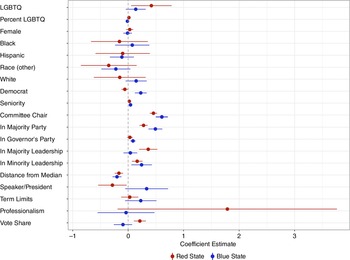
Figure 3 reports the results for the red and blue state test.Footnote 12 Using an OLS regression model, we regress our LGBTQ variable onto SLES and subset the data by whether the legislator was elected from a red state or a blue state. The model includes clustered standard errors and state and term fixed effects. The coefficient for red state LGBTQ lawmakers is 0.42 (p<0.05), whereas the coefficient for blue state LGBTQ lawmakers is 0.14 and is not statistically significant. This suggests that LGBTQ lawmakers elected from red states—where voter discrimination toward LGBTQ candidates is more prevalent—are meaningfully more effective than non-LGBTQ lawmakers elected from red states. LGBTQ lawmakers elected from blue states, however, are no more or less effective than non-LGBTQ lawmakers in blue states.
LGBTQ Legislators from Red States Are More Effective Lawmakers
Note: Dots indicate coefficients estimated from an OLS regression found in table 4.3 (in section 4 of the Appendix). Estimated with 95% confidence intervals. Model includes state and term fixed effects. The red coefficients are LGBTQ lawmakers from red states (i.e., Arkansas, Idaho, Kentucky, North Dakota, Oklahoma, Tennessee, Utah, West Virginia, and Wyoming). The blue coefficients are LGBTQ lawmakers from blue states (i.e., California, Hawaii, Massachusetts, New York, and Vermont).

The coefficients estimated for the Obergefell, time, and replacement tests are included in table 1. The dependent variable in column 1 is the SLES of LGBTQ lawmakers, and the independent variable is a binary variable coded 1 if the lawmaker was elected prior to the Obergefell ruling. The coefficient is 2.32 (p<0.001), suggesting that LGBTQ lawmakers elected prior to the Obergefell ruling have a legislative effectiveness score that that is 2.32 units higher than that for LGBTQ lawmakers elected after the ruling. Columns 2–4 display the results from the period test, where the dependent variable is lawmakers’ SLES if they were serving during the 1980s–1990s (column 2), 1990s–2000s (column 3), or 2010–2018 (column 4). All coefficients on the LGBTQ variable are positive and significant, suggesting that LGBTQ lawmakers are more effective than non-LGBTQ lawmakers. As predicted, the coefficient is largest for the 1980–1990s period (0.394, p<0.05), smaller for the 2000s period (0.312, p<0.001), and the smallest for the most recent period (0.205, p<0.01).
Obergefell, Period, and Replacement Tests

Standard errors in parentheses.
+ p < 0.1, * p < 0.05, * * p < 0.01, * * * p < 0.001.
Finally, column 5 of table 1 estimates the relationship between LGBTQ lawmakers’ SLES and a binary variable coded 1 if the lawmaker is not the first LGBTQ lawmaker elected from a district. As expected, the coefficient is negative and statistically significant, suggesting that LGBTQ lawmakers who are not the first elected from their district have an effectiveness score 0.26 units (p<0.1) lower than the first LGBTQ lawmaker elected from a district. Again, no single mechanism test that we offer is conclusive. Collectively, however, we leverage variation in voter discrimination in four unique ways, and across each of the four tests the finding is consistent—when LGBTQ lawmakers experience or perceive more discrimination from voters, they are more effective lawmakers.Footnote 13 To assess the robustness of our findings, we also examine whether LGBTQ lawmakers outperform non-LGBTQ lawmakers in areas beyond effective lawmaking. The full results are reported in section 7 of the online appendix. We find that LGBTQ lawmakers raise more money in their elections (Boncia Reference Boncia2023), are more likely to be committee chairs, and introduce more substantive and significant legislation than their non-LGBTQ counterparts (Bucchianeri, Volden, and Wiseman Reference Bucchianeri, Volden and Wiseman2025).
Conclusion
We provide a novel empirical test of Anzia & Berry’s (Reference Anzia and Berry2011) argument by demonstrating that voter discrimination produces effective LGBTQ lawmakers. We conduct four mechanism tests, all of which support our expectation that voter discrimination is driving LGBTQ lawmakers’ effectiveness. Studying the legislative performance of LGBTQ lawmakers is important for at least two reasons. First, although voters likely discriminate against LGBTQ candidates for many reasons, one plausible explanation is that voters suspect that LGBTQ lawmakers will be bad at their job. Our findings suggest exactly the opposite—LGBTQ legislators are more effective lawmakers than non-LGBTQ legislators. Second, if the descriptive representation of an identity group improves substantive representation, our findings suggest that LGBTQ lawmakers have the legislative tools and skills necessary to substantively represent LGBTQ Americans.
Given that LGBTQ lawmakers win as often and legislate as well, what factors explain their numeric underrepresentation in legislatures? We highlight two potential causes of LGBTQ underrepresentation that scholars should empirically evaluate. First, LGBTQ Americans may be less likely than non-LGBTQ Americans to consider running for political office (Fox and Lawless Reference Fox and Lawless2004). If a sexuality-based political ambition gap exists, it could be the case that, although they are equally as qualified, LGBTQ Americans do not consider running for office. Second, political gatekeepers (political parties, activists, politicians) may be less likely to recruit LGBTQ candidates, despite their being qualified for the job (Fox and Lawless Reference Fox and Lawless2010).
Presenting empirical evidence demonstrating that LGBTQ lawmakers are capable of winning elections and effectively legislating is necessary to dismiss discriminatory arguments that LGBTQ candidates are in some way less capable than other candidates. Identifying the cause(s) of LGBTQ underrepresentation—whether it be a lack of political ambition, political recruitment, or some other factor—is necessary to increase LGBTQ representation in American politics.
Presenting empirical evidence demonstrating that LGBTQ lawmakers are capable of winning elections and effectively legislating is necessary to dismiss discriminatory arguments that LGBTQ candidates are in some way less capable than other candidates. Identifying the cause(s) of LGBTQ underrepresentation—whether it be a lack of political ambition, political recruitment, or some other factor—is necessary to increase LGBTQ representation in American politics.
SUPPLEMENTARY MATERIAL
To view supplementary material for this article, please visit http://doi.org/10.1017/S1049096525000101.
ACKNOWLEDGMENTS
We thank Jen Lawless, Craig Volden, Pat Egan, participants at the 2023 Center for Effective Lawmaking Conference, and participants at the Junior Americanist Workshop Series for helpful comments on drafts of this article. We also thank the Center for Effective Lawmaking and Don Haider-Markel for generously sharing data.
DATA AVAILABILITY STATEMENT
Research documentation and data that support the findings of this study are openly available at the Harvard Dataverse at https://doi.org/10.7910/DVN/T5V3CH.
CONFLICTS OF INTEREST
The authors declare no ethical issues or conflicts of interest in this research.




 Open access

