Introduction
This article examines the transition from the Victorian to the Edwardian municipal park in Manchester. It focuses on the acquisition and development of the 650-acre Heaton Park by Manchester City Council during the years 1902–12. The park was the former family seat of the earls of Wilton and had cost the city £230,000. The study argues that the purchase of the park marked the transition from the Victorian idea of parks as improving spaces for ‘rational recreation’ to the Edwardian idea that parks offered spaces for many diverse activities centred around active citizenship and social responsibility. Although this represented a re-framing of many Victorian ideas about leisure, it also resulted in a redefinition of the role of a municipal park in the Edwardian city from a place for ‘rational recreation’ to one in which the individual citizen takes on a more active role.
Beaven and Griffiths have suggested that citizenship in the Edwardian period was refocused away from the urban arena and on to the empire.Footnote 1 This article contests this view and demonstrates that active urban citizenship remained a potent social force in the landscape of the urban park. Such parks offered the opportunity both to establish and to display not only a sense of civic pride in the city, but pride in the collective ownership of that space. Municipal parks, therefore, represented a place where urban citizenship could be continually forged and contested, both by park authorities and by park visitors. This article will demonstrate how Heaton Park set the agenda for subsequent municipal park development in Manchester and how this new agenda was driven by evolving ideas about citizenship and social responsibility.
Manchester provides a useful example of the development of open space in an urban environment. It was without a resident aristocracy from the early nineteenth century, a situation which permitted a relatively unencumbered urban development. Manchester City Council took full advantage of this by establishing itself as a provider of public services such as gas, lighting and electricity to its citizens. This opportunity to develop without the constraints of a landowning aristocracy differentiates Manchester from other British cities such as Birmingham, whose expansion was heavily influenced by the Calthorpes.Footnote 2 From an international perspective, the example of Heaton Park adds to existing work on the wider social, economic and political significance of urban parks such as that by Rotenberg and Prendergast on Vienna and Paris respectively and that of Rosenzweig and Blackmar on the social history of New York's Central Park.Footnote 3 Although Prendergast identifies urban parks as neutral spaces, free of the tensions of city life, this article suggests that, in fact, parks such as Heaton Park reflected these tensions, replicating and, at times, enhancing them.Footnote 4
Existing academic studies of public parks in Britain concentrate on the emergence of the Victorian park. Such parks were approved of by both the church and the police as a source of good moral influence and as a form of social control, particularly of the working classes.Footnote 5 Parks have been further identified as an expression of civic pride or municipal authority;Footnote 6 as having a civilizing effect on their visitors;Footnote 7 providing an escape from crowded city lifeFootnote 8 or as a microcosm of the wider society and its reinforcing of class differences.Footnote 9 Some vestige of these ideas remained into the Edwardian era – especially parks as emblems of civic pride and as a refuge from the city. However, these original ideas were also being continually refined and enhanced as the twentieth century developed. The Victorian idea of rational recreation in particular was enhanced to include notions of public spiritedness, accountability and communal responsibility.
Defining and designing the municipal park
Some of the most influential landscape designers in Britain worked on public parks – John Claudius Loudon and Joseph Paxton. Loudon designed Derby Arboretum in 1840. Paxton had worked for the duke of Devonshire at Chatsworth and designed Birkenhead Park (1845) and Kelvingrove Park in Glasgow (1854).Footnote 10 As a former aristocratic estate, Heaton Park was not subjected to the expensive and time-consuming process of a competition to design the park. This was one of the more attractive elements that the park offered its new owners. Liverpool's Sefton Park (200 acres) acquired in 1867, was designed by Edward André and Lewis Hornblower at an original cost of £250,000, which later had to be reduced to £147,000.Footnote 11
Manchester was to be one of the most active local authorities in providing municipal parks. From the mid-1840s, Manchester had begun to acquire public spaces such as Queen's Park in Harpurhey which was gifted to the city in 1846 by the Hoghton family. Manchester City Council established an Open Spaces Committee in February 1893, followed by a Special Committee in 1894 to study the need for public leisure spaces in the city.Footnote 12
Public parks were associated with ideas about public health and recreation but also with providing ‘green lungs’ for overcrowded and polluted cities. The idea of the park as a rustic retreat from the busy town or city was an especially influential one and was part of a tradition of romantic anti-urbanism which had been prevalent in the Victorian period, an idea that was beginning to be challenged by the early twentieth century.Footnote 13 The municipal parkscape as a direct contrast to the urban environment became eclipsed by ideas about citizenship and social responsibility. While the boundaries of citizenship were far from immutable, its persistence was in marked contrast to the limited aspiration of the mid-Victorian parks’ promoters.
The official opening ceremony at Heaton Park was held on 24 September 1902. An estimated 6,500 people and 300 dignitaries attended to hear the lord mayor, Alderman James Hoy, express the hope that the park would add to the health benefits experienced by the population of Manchester and to credit the citizens for providing the impetus for the park movement in the city.Footnote 14 While much of this can be viewed as the self-congratulatory rhetoric typical of such occasions, ideas about self-help and active citizenship were a significant component of civic life during the Edwardian period and will be discussed in the following sections. The first examines the ability of all citizens to both access and use the park, while the second investigates the relationship between active citizenship and recreation.
Redefining the Edwardian park: access and usage
Heaton Park in the Edwardian era was a physical symbol of the political power of Manchester City Council to the north of the city. It also represented the confidence of the civic elite which was running the city. The elite were more socially diverse than the old landowning aristocratic elite had been, but were no less keen to display their cultural power.Footnote 15 There have been suggestions that the Victorian period marked the end of the presence of the urban elites at municipal level.Footnote 16 However, Law's work shows the influence of Manchester City Council members from occupational groups such as wholesale and retail merchants and professionals, for instance, journalists, estate agents and civil engineers until 1903 and beyond.Footnote 17
The membership of the Parks and Cemeteries Committee at the time of the purchase of Heaton Park mirrored the composition of the city council itself, with a Conservative majority. The committee had a Liberal chairman, Alderman Birkeck, whose casting vote was needed to secure the park. The final vote did not split along party lines, with four Conservatives and three Liberals voting in favour of the purchase and five Conservatives and two Liberals against. The primary concerns of those who opposed the purchase were the price (originally £250,000) and the location of the park outside the city boundary. These were resolved by the consent of the local authority, Prestwich Urban District Council, to the incorporation of the park after the purchase and the inclusion of extra portions of land in the final offer from Lord Wilton.Footnote 18
The motivations for the purchase were diverse – ideas such as civic pride, municipal expansionism, a concern for public health and well-being and a commitment to municipal investment in public amenities all played a role in the park and its growth. Regular reminders from the local newspapers about Manchester's poor position relative to other cities such as Leeds, Liverpool and Glasgow in respect of the provision of public parks provided another impetus.Footnote 19 Parks and open spaces were important symbols of the Edwardian city and its ability to provide for a community of citizens and their health, education and recreation. All of these aspects are visible when we come to examine the development of Heaton Park in the years after its purchase.
Situated four miles north of the city centre, Heaton Park was some distance from the major centres of population to the south of the city. There were regular trams to the park from the city centre and special fares available at weekends to encourage visitors. Inside the park, inequalities were also evident in the charges for use of the facilities (boating, bowling, tea rooms) but these were options that could easily be ignored in favour of a walk around the park or a picnic on the lawns.
A park of this size posed significant problems for the traditional methods of regulation, such as the park-keeper. As Gunn has remarked, one of the earliest types of behaviour encouraged in public parks was promenading, which provided park visitors with a model of orderly public behaviour.Footnote 20 This explains the need in the early parks to create walkways lined with plants and trees to facilitate gentle strolling. The 1833 Select Committee on Public Walks had singled out Manchester as particularly in need of such spaces due to the temptations of alternative pursuits such as drinking and gambling.Footnote 21 Rational recreation, therefore, grew out of an attempt to provide role models for public behaviour and to encourage the adoption of the values of a new urban middle class which considered itself both culturally and morally superior.Footnote 22 This idea resulted in regulated and monitored public parks where noticeboards were erected to inform visitors of the park rules which were enforced by park attendants.
Initial attempts to supervise the public in the park were met with some hostility: visitors were told to keep off the grass; they were restricted to the main walks in the park and prevented from exploring the more remote wooded areas.Footnote 23 This was a furtherance of the Victorian response to transgressive behaviours such as gambling, drinking, vagrancy and the desire to suppress romantic or sexual behaviour in public spaces like parks, art galleries and libraries. Gambling was a continual problem on the premises of some Manchester parks – in reading and games rooms, for example.Footnote 24 There is also evidence of small numbers of people who were arrested for violating the parks’ by-laws – four in 1907, four in 1909 and three in 1911.Footnote 25 Those convicted were fined and not imprisoned, suggesting that such infractions were minor. Courting behaviour prompted Isabel O'Hanlon of the Women's Patrol Committee to write to complain of the ‘bad state of things in Heaton Park and other parks, where open immorality takes place’.Footnote 26 The size of Heaton Park often made such regulation impractical, however, and the role of the park-keeper eventually devolved to park patrollers who performed a variety of tasks such as sweeping paths and giving directions to visitors as well as the implementation of the parks’ by-laws.Footnote 27 The move to a multi-functional patroller is a characteristic of the Edwardian park and demonstrates the self-regulatory nature of Edwardian citizenship.
Reliable information about the number, gender and social background of visitors to the parks during the early years is difficult to ascertain. A 1905 statement about music in the Manchester parks, collated by the general superintendent, demonstrates that £475 was spent on providing music in Heaton Park during the season, which attracted an estimated number of 693,600 visitors.Footnote 28 Visitor numbers at other, smaller parks like Alexandra and Philips Parks show 232,000 and 242,000 visitors respectively in the same period.Footnote 29 Contemporary photographs show that the park was often crowded and was far from offering a rural idyll to its visitors (Figure 1). The use of such photographs as historical evidence needs to be undertaken with caution, but they remain one of the few available sources of information about park visitors and their numbers. The crowds of people in this photograph confirm the popularity of music, especially brass bands, in the parks at this time (1906). Music was perceived to have an important moral influence but it also added another element to the cultural education of the people and complemented art galleries and museums.Footnote 30 Heaton Park had music on Saturday afternoons and evenings and on Sunday afternoons.Footnote 31 The presence of crowds in the park, especially at weekends, challenges the idea that a public park provided a restful contrast to the bustle of urban life. Indeed, it seems often to have replicated it.
A crowd in front of the bandstand, Heaton Park, 1906 Source: © (Manchester Libraries, Information and Archives) Courtesy of Manchester Libraries, Information and Archives, Manchester City Council.

The Edwardian recreational park, however, did facilitate a different kind of visitor – one who could concentrate on their own individual needs and interests and did not depend on being in company. This individual usage allowed visits to the park to be dictated by the free time schedules of individual visitors and permitted park-keepers to divide up each day into sections to offer facilities to different types of visitors – referred to as temporal zoning.Footnote 32 This was in an era when even working people had an increased amount of leisure time.Footnote 33 Indeed, it is possible to argue that recreation was beginning to be seen not as the opposite of work as the Victorians believed, but as a civic duty which complemented work and enhanced the individual's ability to function effectively in the workplace.Footnote 34
However, the ability of the urban poor to access a public park was doubtful. In the 1906 municipal elections, Philip Cohen, the Liberal candidate for Medlock Street (an inner-city ward), argued that the poor of Hulme received no benefit from the money spent on Heaton Park as they could not afford the sixpence tram fare to get there.Footnote 35 Therefore, Heaton Park was not a park for all of the people but for those who lived nearby or those who could afford to pay to visit it; in other words, the largely middle-class local residents. Marne has suggested that the concept of ‘the people’ was originally intended to be classless and inclusive of all social classes.Footnote 36 However, this social inclusion did not include everyone as women, and working-class women, in particular, were not perceived as having specific recreational needs at this time and were excluded from discussions about how municipal parks should best be used. It has also been argued that ‘the people’ do not constitute a homogeneous group and cannot all appropriate any space equally.Footnote 37 Furthermore, Joyce has pointed out that shifting definitions of ‘the people’ resulted in the emergence of such concepts as the common good and social citizenship.Footnote 38 These terms embody a more active connotation than ‘the people’ and imply an urban dweller that is, potentially at least, actively engaging with his or her environment.
The question of the lack of easy access to the park by the working classes in particular highlighted the fact that most working-class districts did not have their own local parks. Areas of Manchester such as Hulme, Ancoats and Gorton mounted unsuccessful campaigns for parks from the 1840s. Charles Russell of the Manchester and Salford Playing Fields Society (established in 1907) commented that half time would be over before many city boys even arrived at Heaton Park and there were periodic calls for more playing fields or playgrounds to be created in Manchester as opposed to larger parks.Footnote 39 It was not until the early twentieth century that Manchester City Council began to invest in the provision of recreation grounds (playgrounds or ‘pocket parks’) in overcrowded city centre districts. This was explained by the desire to prevent children from playing on the city streets.Footnote 40 These children were often unwelcome in the larger parks and the Parks and Cemeteries Committee received regular complaints from park visitors about their behaviour.Footnote 41 Such playgrounds often covered less than half an acre and only included basic amenities like sand gardens and swings. By 1914, Manchester had 15 playgrounds and smaller open spaces.Footnote 42
One of the most attractive aspects of Heaton Park both for visitors and for its new owners was its size. The 650 acres provided an ample space for accommodating many diverse activities in the same place. Other large public parks such as Liverpool's Sefton Park and Roundhay Park in Leeds had been partially funded by the sale of some land on the perimeter for building houses or villas. While this possibility was initially discussed for Heaton Park, Manchester City Council resolved not to commit themselves to such an undertaking. It has been suggested that the failure to sell parkland for building was due to fear within the city council of being accused of helping to create estates for the affluent, as had occurred at both Sefton and Roundhay Parks.Footnote 43 However, there is no evidence that Heaton Park visitors would have objected to the sale of some of the land to recoup the cost. Indeed, some park visitors in Leeds urged the city council there to sell some land as quickly as possible to raise money to develop Roundhay Park further.Footnote 44
Henry Coupe, writing to the Manchester Guardian, protested about the staging of political demonstrations in favour of votes for women in municipal parks on a Sunday, claiming that churchgoers like himself had to ‘pick their way . . . to their places of worship’ through park side streets past ‘men and women whose cleanliness . . . is an open question’.Footnote 45 The fact that some park visitors felt that the park was attracting the ‘wrong type’ of visitor suggests that the parks were contested spaces in which people confronted each other without the possibility of the more delineated demarcation prevalent in other urban spaces, all of which were less easy to establish in the open space of a park. These protests are also indicative of an attempt by some park visitors to encourage or impose their values on others. Historians such as Wyborn have argued that it was the city council that tried to do this, but it is clear from this evidence that park visitors themselves did not agree what constituted a municipal park, how it was to be used or by whom.Footnote 46 While the suffrage meetings were permitted by the Parks and Cemeteries Committee, other political groups found it more difficult to secure space in Manchester's parks – branches of the Co-operative Society made a series of prolonged attempts to gain access for their gatherings.Footnote 47
A connection has been proposed between civic pride and social citizenship in which the municipality assumes responsibility for the welfare of all citizens.Footnote 48 The corollary of this is that city dwellers reciprocate in accepting the care of the urban environment as a part of their civic duty. Park managers were keen to emphasize the orderly behaviour of large crowds of park visitors, such as the numbers who attended a series of Women's Social and Political Union demonstrations in Manchester's public parks in 1908. A report to the Parks and Cemeteries Committee stressed that ‘no accident or hitch of an unpleasant nature occurred’, even when the numbers attending the event were estimated at 250,000.Footnote 49 Municipal parks such as Heaton Park provided an ideal space in which social relationships could be enacted and leisure and citizenship became intertwined.
Redefining the Edwardian park: recreation and citizenship
The evidence from Heaton Park demonstrates that it was not a people's park in the Victorian sense of the term – it was mainly visited by those who lived nearby or who had access to public transport. It promoted an active engagement with its facilities and amenities, although passive strolling and contemplation were also encouraged. The linguistic change from the ‘people’ to the ‘citizen’ is also significant. While it is true that both terms were often used interchangeably especially in the later Victorian newspapers, by the Edwardian period, the use of ‘citizen’ was more widespread.
Citizenship was an ambiguous term before the 1870s and encompassed potentially all of those who had a general interest in the welfare of the nation.Footnote 50 From the late Victorian period, we find the model of citizenship becoming more pro-active and socially aware. The needs of the empire were undoubtedly to become more significant as the twentieth century advanced – the use of Heaton Park as a training camp for the Manchester Regiment prior to their deployment in World War I demonstrates that the park evolved into a space that could accommodate such imperial needs while continuing to function as public leisure spaces.Footnote 51 Thus, imperial, national and local citizenship could co-exist and were not mutually exclusive.
The earlier emphasis on rational recreation at Heaton Park progressed to more segregated sports facilities, reflecting the differing appeal of certain sports to men and women. Cycling and tennis were enjoyed mainly by women while football and cricket were more popular with men.Footnote 52 Such facilities were in contrast to the earlier Victorian inclination to provide more general amenities for walking, sitting and observing the planting schemes and often had the effect of dividing up park visitors by gender and class. The Manchester Evening Chronicle welcomed the opening of Heaton Park as conducive to ‘healthy and manly’ development.Footnote 53 The yoking together of physical health and masculinity indicates the slow provision for women's recreational needs in the late Victorian period. Often, participation in such sporting activities was regarded as unladylike and women were welcomed in public parks more for their stabilizing influence than their ability to make active use of the facilities.Footnote 54 However, this situation did not persist in the longer term, mainly due to women's desire actively to participate in sports such as tennis and to the growing acceptance of at least some sports as permissible for women.
The first municipal golf course in Manchester was opened at Heaton Park in 1911 and was characteristic of the continued attempts of the Parks and Cemeteries Committee to expand the number of recreational facilities at the park. The course covered 140 acres of the park and it is clear that, in part, the impetus was due to other cities making similar provision in their public parks.Footnote 55 At the opening ceremony for the new golf course, Alderman Harrop, chairman of the Heaton Park sub-committee, commented that it had been felt that ‘Glasgow, Edinburgh and other cities were well ahead of them [Manchester] and now they were determined to see that they in Manchester were not left behind.’Footnote 56 The lord mayor, Charles Behrens, expressed the hope that the working classes would use the course and that they might ‘find the game well within their means’.Footnote 57 At a price of one shilling for the first round of golf and sixpence for each subsequent round, this was not likely to be the case.Footnote 58
This was borne out by the golfers, one of whom commented that the difficulty posed by the course would deter those who were beginners and that the facility was therefore more suited to those who were already members of other, more expensive, courses elsewhere.Footnote 59 Golf was an increasingly popular sport during this period, there being more than 20 golf clubs within a 12 mile radius of the city of Manchester, many with memberships of 300 or more.Footnote 60 It was not especially weather-dependent, appealed to all ages and provided ample exercise in the open air.Footnote 61 Cunningham has suggested that, by the end of the nineteenth century, public leisure facilities reinforced the desire for class exclusivity as a result of the appropriation of formerly aristocratic pursuits such as hunting by the middle classes, the invention of class-specific sports like golf and tennis and the imposition of a middle-class ethos on sports such as rowing and athletics.Footnote 62 While this may be difficult to prove, it does provide an explanation for the increasingly class-bound nature of leisure at the end of the nineteenth century and militated against the ideal of recreation as a tool for unifying social classes advocated in the 1840s. It also marks the gradual abandonment of ideas such as rational recreation.
The Parks and Cemeteries Committee used unemployed men to excavate, line and fill a 12¼ acre boating lake at Heaton Park which was opened in March 1913. The lake complemented those already in existence in Boggart Hole Clough and Platt Fields Park and some 2,333 men worked on it.Footnote 63 The total cost of the lake (including the building of several islands) was £21,000. People were taken around the lake by two electric launches for 2d each, while 100 boats were purchased to be hired by visitors.Footnote 64 As well as building the lake itself, they also built a road around it and a landing stage. The use of working men for this purpose has poignancy when one returns to one of the original arguments for the purchase of Heaton Park – to provide a sanctuary for the working classes, a people's park. Here, the people or, more specifically, the working classes were being used to build amenities that they likely could not afford to use themselves.
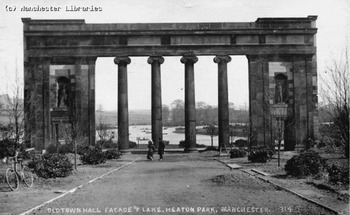
The didactic nature of the public park was refined further with the proposal to move the Greek classical façade of the old Manchester Town Hall (built 1822–25) to one of the city's municipal parks in 1912. A campaign to support the saving of the colonnade was undertaken by some prominent individuals such as the bishop of Salford Louis Casartelli, the artist Sir Lawrence Alma-Tadema and Middleton architect Edgar Wood. Despite the decline in interest in the Gothic Revival style at this time, feelings were still mixed about the historical significance and relevance of classical styles of architecture. A rediscovery of the English Baroque tradition of Wren and Vanbrugh during the Edwardian period did not result in a widespread return to classical style per se.Footnote 65 However, both the Victorians and Edwardians did retain a strong sense of affinity with the history and culture of ancient Greece.Footnote 66 This can be explained, in part, by the Greeks’ association with the birth of democracy, an ideal still cherished in the early years of the twentieth century.Footnote 67 The links between the façade and the old town hall therefore had even more resonance for the civic authorities and helps to explain their desire both to preserve and display it.
In May 1912, the committee resolved to erect the colonnade at Heaton Park (Figure 2). Half of the estimated £2,000 cost of relocating the façade was to be met by the corporation and the other half by public subscription. The symbolic nature of this decision cannot be underestimated. Stobart has argued that town halls have functioned as important symbols of municipal authority.Footnote 68 The use of a classical façade of a former town hall in this manner served as a reminder of the civic history of Manchester. It re-emphasized the public ownership of the park and the civic vision of those instrumental in its purchase. The façade was to act as a potent symbol of the history of the city and those who served it and created it. Relocating the façade to the park moved a part of Manchester's civic history into what had previously been a privately owned space developed by generations of one aristocratic family.
The Old Manchester town hall façade at Heaton Park, 1912 Source: © (Manchester Libraries, Information and Archives) Courtesy of Manchester Libraries, Information and Archives, Manchester City Council.

The decision to locate the façade at Heaton Park may also have been influenced by the existence there of another classical building, Heaton Hall, the family seat of the earls of Wilton, designed by James Wyatt in 1772.Footnote 69 Initially overlooked by the new owners of the park and used for catering purposes, the hall's significance as a building in its own right had gradually been recognized and it was in use as a branch of Manchester City Art Gallery since 1906. The stylistic similarity between the façade and the colonnaded garden or south front of Heaton Hall is striking and raises questions about the decision to locate the façade so far from the Hall (Figure 3). Attitudes to Heaton Hall were not consistent, however, with the official handbook to Manchester's parks of 1915 describing it as ‘with few architectural pretensions’.Footnote 70 This suggests that an appreciation of classical architecture was, as yet, not widely accepted.
Heaton Hall, garden front, 1905 Source: © (Manchester Libraries, Information and Archives) Courtesy of Manchester Libraries, Information and Archives, Manchester City Council.

The removal of the town hall façade to Heaton Park was both an attempt to preserve an element of Manchester's civic and architectural history and to connect the park visitors directly to their own history and that of their city. A newer form of park history was emerging that could co-exist with the park's original history but that had a different meaning for its visitors and served not only to legitimate the municipal owners, but all of the people of the city.Footnote 71
A desire to preserve the past (even the relatively recent past represented by the façade) had begun to gather pace during the Victorian era and this continued into the Edwardian period. During the same time as the debate about the preservation of the old town hall colonnade, Lord Curzon purchased the fifteenth-century Tattershall Castle in Lincolnshire which was to be restored and opened to the public.Footnote 72 A sense of national pride in Britain's heritage was beginning to establish itself, accompanied by the idea that the past was worth preserving for more than mere aesthetic reasons. The National Trust had been established in 1893 and acquired its first property, four and a half acres of cliffland, in Wales in 1895.Footnote 73
The original town hall building itself was not considered for preservation in its entirety and the transfer of the façade to Heaton Park meant a loss of its original context. Nevertheless, it meant that the colonnade was preserved for the public and its consequent visibility gave any passer-by the opportunity to gain an immediate impression of the past.Footnote 74 Linking park visitors so strongly to a reminder of the city's past can be interpreted as an attempt to make people feel like custodians of their own civic history. However, it must be acknowledged that this attempt was not entirely successful. A letter to the Manchester Guardian in 1913 from W. Vaughan Best questioned the purpose of the façade and asked if it was intended to demonstrate ‘the ineffectiveness of a product of good art when it is divorced from the utility for which it was designed’; while the Parks and Cemeteries Committee received a letter in 1915 from W.H. Harrap of Salford who had noted ‘people gazing at this and wondering what it is’.Footnote 75 Such public amnesia rendered the façade a mere civic folly, a landscape adornment without any evident purpose.
The Edwardian period gave rise to an increasing tendency to conceive of poverty as a national problem characterized by the need for physical efficiency.Footnote 76 There had been much concern about the poor physical condition of army recruits from the industrial cities during the Boer war. This had led to an acknowledgment that the people of Britain were an important national resource who needed to be nurtured and encouraged towards the peak of physical fitness.Footnote 77 The provision of facilities for physical exercise in municipally owned parks was a consequence of this perception of the need to maintain levels of physical fitness among the population. Exercise facilities in public parks were not exclusively an Edwardian idea – the three original public parks in Manchester and Salford all had gymnasia (Peel Park had archery butts). The provision of this kind of equipment was an acknowledgment that parks were not simply open spaces for polite perambulations, but had a more pragmatic purpose. It has been argued that the Victorians tended to see leisure time as a contrast to idleness and as a valuable entity that should not be wasted.Footnote 78 This idea was further developed in the Edwardian era with the expansion and development of certain areas in parks devoted to particular sports – for instance, bowling greens, tennis courts and the boating lake in Heaton Park. This spatial zoning of the park indicates the commitment to and popularity of sporting activities and the desire of the park authorities to encourage this.
The Edwardian period produced a new understanding of social democracy that emphasized the idea of the community and good citizenship.Footnote 79 This vision of democracy was defined by the harmony between nature and the individual and one that worked to idealize the past and improve on the present. The idea reached its artistic high point in the garden city movement of Raymond Unwin, Barry Parker and Ebenezer Howard during the early years of the twentieth century. The garden city was specifically designed to merge the country and the city and to encourage communal activities such as tennis and bowling. Here, amenities were a right not a privilege and their proper use was a cornerstone of good citizenship.Footnote 80 Such an idealization of the past and an attempt to improve the present can be seen in the Edwardian developments in Heaton Park – the relocation of the old town hall façade and the provision of amenities dedicated to particular sporting activities. This progression from Victorian moralism to Edwardian pragmatism was, perhaps, a logical one which resulted in the beginnings of a practical approach to town and urban planning.Footnote 81 Proposals were already under discussion for suburbs laid out according to garden city principles in Alkrington and Fairfield in Manchester in 1912.Footnote 82
The early decades of the twentieth century were suffused with ideas of active citizenship, which included a commitment to good physical and moral health.Footnote 83 Trade unions, co-operatives and friendly societies all provided opportunities and models of good citizenship but this could also be extended to the role of public parks at this time. A healthy citizenry contributed to a healthy nation and formed the building block of a well-ordered society.Footnote 84 It has been argued that it was the city councils themselves that operated as the personification of citizenship through their closeness to the communities which they served.Footnote 85 The purchase of Heaton Park by Manchester City Council signified more than the transition of a piece of land from a private, aristocratic owner to a municipal body. It represented a shift in the ways in which parks were viewed and used in an urban environment, from attempts to impose ideas about rational recreation on to the working classes to an emphasis on community and a shared social responsibility for public amenities.
The environment of a public park could offer the opportunity to develop not just physical health, but a sense of public spiritedness and civic identity. This can be seen in the use of public parks by the Boy Scout movement, one of whose primary aims was the development of citizenship skills.Footnote 86 Local scout troops used the larger Manchester parks for camping and some parks, such as Heaton Park, had designated areas set aside for this purpose.Footnote 87 These activities were connected to emergent ideas about citizenship and collective responsibility for one's surroundings – a substantial move away from the Victorian idea of parks as patrolled by park-keepers and attendants who bore sole responsibility for the park's upkeep and maintenance.
In part, many of the decisions about how to develop Manchester's public parks were a reflection of a broadening definition of public health, away from specific matters such as sanitation and slum removal and towards issues such as recreation and physical fitness.Footnote 88 This manifested itself in organizations like the Manchester Physical Health Culture Society, established in 1902 for the purpose of promoting outdoor sports and physical development.Footnote 89 Public parks offered a location where the city and the citizen could thus develop in tandem – to ’become a self-governing member of a self-governed community’.Footnote 90 The relative freedom of the park, both in terms of access and the combination of many diverse possibilities for its usage, sought to celebrate the twentieth-century citizen as an active participant in the urban environment. This view was echoed by a later general superintendent of Manchester parks, W.W. Pettigrew, in his influential text Municipal Parks: Layout, Management and Administration. He argued that ‘broad-minded, far-seeing public authorities appreciate the fact that the real assets derived from the provision of all past-times in their parks are not monetary in character, but are the enhanced health and happiness of the community’.Footnote 91 This emphasis on the community and the explicit link between health and well-being marks a transition from the Victorian middle-class moral imperialism of rational recreation to a more general concern with the health of the population as a whole.
The Edwardian park offered both continuity and a breach with its Victorian forebear. With increasing amounts of free time available for leisure, the citizens took full advantage of the municipal park but those who benefited most had both the recreational skills and the access to the spaces. The working classes remained on the periphery and the needs of particular groups of users such as women were yet to be fully met or even recognized. Parks continued to function as social arenas where models of good behaviour and citizenship could be observed and imitated. The restrictive atmosphere of the Victorian park gradually eased as responsibility for moral and physical rectitude passed from the park-keeper to the individual visitor. The effect of this was a transfer of emphasis from the passive strollers (whose needs were still accommodated) to the active users whose various recreational needs could be served simultaneously. A new type of diverse cityscape was now capable of serving a new kind of citizen – one whose demands for public leisure facilities were only beginning.
Conclusion
Heaton Park's history cannot be solely accounted for by an examination of the social and political factors in its development. Its transformation from a private, rural estate into a public recreational space necessitates a more thorough approach that acknowledges the competing interests not just of the city council, but of its visitors and of commentators like the local press. A new appreciation is needed of the connections between physical space, urban history and local political agendas.
There has been an over-emphasis on the Victorian park at the expense of later Edwardian advances, and too much emphasis on rational recreation and social control which offer a limited view of the practical usage of parks. The concept of rational recreation does not allow for unintended uses made of these parks for meetings and games and offers no prospect of the visitor's individual enjoyment of the space. While Edwardian public parks were an evolution of those which originated in the Victorian period, they also developed their own character and established new ways for some people to spend their increasing amounts of leisure time.
Heaton Park shared many similarities with other Manchester parks and the Parks and Cemeteries Committee had benefited from their earlier experiences in park development, prior to the acquisition of Heaton Park. The 60 acre Alexandra Park, to the south of the city, had been acquired from Lord Egerton. From its inception, the park had a mixture of horticultural displays and avenues for promenading in addition to sporting amenities such as a children's gym with swings and seesaws, a boating lake and tea rooms.Footnote 92 Philips Park had the first free municipal open-air swimming baths in the country, opened in 1891, while most parks provided tennis and bowling greens and bandstands. Many of these amenities were an important source of revenue, although they rarely recouped the cost of their provision.Footnote 93 Later parks followed the pattern established at Heaton Park and invested heavily in sporting amenities. Platt Fields Park to the south of the city, acquired in 1908, set aside 40 of its 80 acres for cricket and football, as well as tennis and bowling greens.Footnote 94
Unlike other cities such as Cardiff, Manchester had to purchase land for public parks and did not receive any substantial amounts of donated land until the Simon family presented the city with the 250 acres of Wythenshawe Park in 1926. This demonstrates the long-term investment made in the parks and the commitment to their upkeep. While Redford has accused Manchester City Council of an opportunistic approach to civic improvement and of lacking a more unified plan, the evidence from parks and recreation grounds demonstrates that they were highly regarded and carefully managed.Footnote 95
Heaton Park's status as a former aristocratic estate is also noteworthy. Many urban parks were developed from donated land or paid for by public subscription. Hugh Prince failed to differentiate between estates or private parks which subsequently became public spaces, and public parks which were created from scratch.Footnote 96 Taylor has recognized that almost all of these once-private landscapes were originally designed as an immediate and insistent revelation of personal political power.Footnote 97 However, she does not develop this point to accommodate parks which were previously part of aristocratic estates and which were then acquired by public bodies. Nor does she discuss the implications of a change from private to public ownership and the subsequent opening of the space to visitors. The symbolic significance of former landed estates like Heaton Park was altered from representing the political, social and economic power of the aristocracy to that of the municipal authority. Offer has suggested that local councils now had ‘levels of power, patronage and prestige’, all aspects of the social position previously enjoyed by the local aristocracy.Footnote 98 This was certainly evident in Manchester, with its lack of a resident aristocracy and relatively unconstrained urban development from the 1830s. While the landscape of the park was now more accessible to the public, it remained a space that could only be experienced by whose who had easy access to it.
Nonetheless, the park was a powerful symbol of the new Edwardian active citizenship and the enthusiasm with which people embraced and used the new park demonstrates the close correlation between civic pride and the individual citizen. While Beaven and Griffiths have identified this period as one in which the idea of the individual urban citizen was on the wane to be replaced by the imperial citizen, this article has shown that the municipal park provided an ideal space in which to continue to develop local citizenship skills and values.Footnote 99 These could be experienced in multiple ways and could be contested by groups or individuals but they were no less significant for that. While Heaton Park did not live up to the ideals of a people's park, it continued to be successful as a recreation space and contributed to the territorial enlargement of the city of Manchester, a fact that should not be overlooked. The addition of Heaton Park consolidated that expansion and sent a clear message to surrounding townships like Prestwich and Middleton of Manchester's territorial ambitions. In that sense, it is illustrative of the civic pride of Manchester and its city council at this time and represents the first real flourish of the Edwardian municipal public park in the city.