Introduction
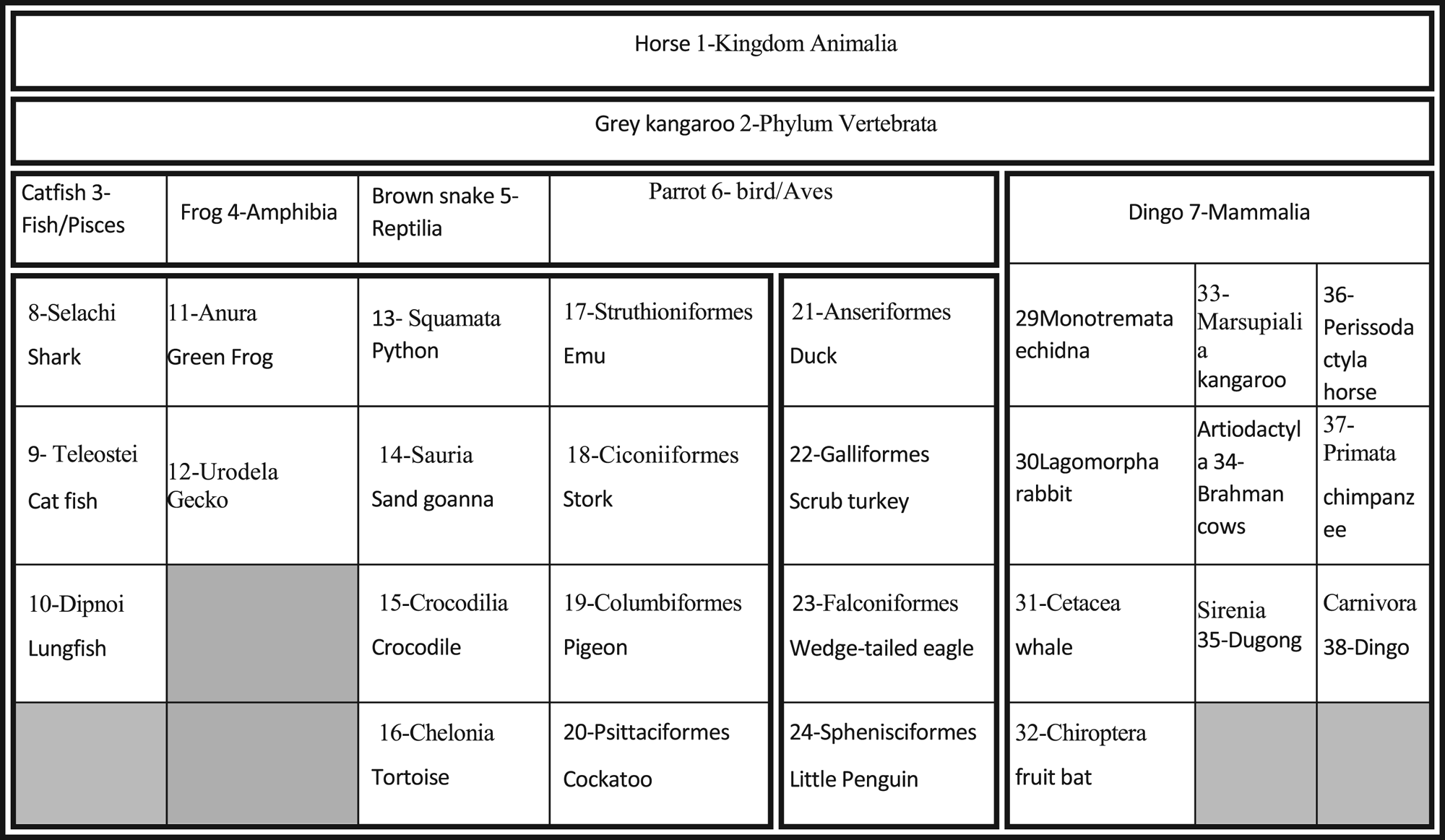
We have been grappling with the following question for two decades, in Aboriginal cross-cultural science education: How can teachers help Aboriginal secondary school students cross-cultural borders between local Aboriginal and Eurocentric knowledge traditions? The predominant and customary Western zoology lexicon and curriculum is also called Euro-American or Eurocentric Knowledge. In this paper, we will use the latter term. The overlay ‘Montessori teacher’ was also attached to this essential question that was taken up by this Montessori study's Action Research (AR). Firstly, the zoology intervention included an initial Short-beaked echidna study [Tachyglossus aculeatus aculeatus, Shaw, 1792, order Monotremata, monotreme (Echidna, n.d.)] which is a local icon known in Koora (pseudonym) as The little Porky, Bolinga or Budburra (Rioux et al., Reference Rioux, Ewing and Cooper2017). The articulation of the Porky's skeleton uncovered the concept Vertebrata, for the adolescent student participants. Then a collection of Koora animal stories gathered by the students aimed at studying the local animal classification. The Elder participants were well-known storytellers and were queried for actual local animal stories. The aim of this work was to convert the data animal stories into appropriate materials such as vertebrate photo cards to be used by students to perform vertebrate classificatory tasks. These authentically known vertebrate photo cards, extracted from local animal stories, were closer to the reality and experiences of the students. Figure 1 presents an overall view of the Linnaean classificatory system used in Koora with the adolescent student participants.
Modified Montessori materials: Koora style First Classification of Animal Kingdom Chart (only pictures of the vertebrates).

Literature review
Indigenous people worldwide are educationally disadvantaged (Beresford et al., Reference Beresford, Partington and Gower2012). Krause et al. (Reference Krause, Bocher and Duchesne2006) state that Indigenous people:
Experience poorer educational outcomes than their non-Indigenous counterparts in terms of achievement, participation, attendance and experience of school. This is true of Native Americans, the Inuit in Canada, Maori in New Zealand, and Aboriginal people and Torres Strait Islanders in Australia. (p. 341)
Hyde et al. (Reference Hyde, Carpenter and Conway2010) claim that in Australia, there are considerable differences between Indigenous and non-Indigenous youths when it comes to educational opportunities and outcomes:
The overwhelming majority of Indigenous students attend school until Year 9 but the number drops off significantly in senior secondary. Only 33% go on to complete Year 10. This is a major concern in terms of literacy, numeracy and school attendance for governments and educational institutions across the country. (p. 339)
Those living in remote communities across Australia have living standards as deprived as those of some of the most disadvantaged people in Third World countries (Novak, Reference Novak2006; Beresford et al., Reference Beresford, Partington and Gower2012). The term Fourth World is used to describe the world of Indigenous people living in a First World country. A study conducted by the Organisation for Economic Co-operation and Development (OECD) has demonstrated that Australia is falling behind other industrialised countries in closing the ever-increasing gap in academic attainments of its best and poorest students, the latter of whom are primarily Indigenous Australians (Artelt et al., Reference Artelt, Baumert, Julius-McElvary and Peschar2003). National reports have acknowledged repeatedly that Indigenous Australians are educationally disadvantaged and participate less in education compared to the rest of the population (Commonwealth of Australia, 1994, 1995, 2002; Hughes, Reference Hughes1998; Beresford et al., Reference Beresford, Partington and Gower2012; Perso, Reference Perso2012).
In terms of achievement gap, school attendance and completion rates for Indigenous Australians increased between 2006 and 2011; however, results from the 2012 Programme for International Student Assessment (PISA) reveal that Australia's Indigenous 15-year-olds remain around two-and-a-half years behind their non-Indigenous peers (ACER, 2013; ACER, 2014b). Many Indigenous students come to school with layers of disadvantage such as lack of access to educational resources, quiet spaces to work, books, school bags, adequate food and sleep. They are more likely to attend schools in which there are many other low socioeconomic students, and the effects of attending such schools have been shown to have a huge impact on student achievement (ACER, 2013). In a supposedly egalitarian society like Australia, it is expected that all students have the same opportunities. Yet, ‘Indigenous peoples of Australia do not have equal outcomes in terms of achievement and participation in education, which suggests that opportunities are not equally available to all’ (Krause et al., Reference Krause, Bocher and Duchesne2006, p. 313).
Curriculum
Perso (Reference Perso2012) defines curriculum as a ‘broad concept that includes knowledge and content, delivery and teaching, assessment and even reporting to parents… It is the intended and planned learning proposed by the system, school and classroom teacher’ (p. 31). Many avenues do exist to aid the classroom curriculum situation in order to engage Indigenous students. The curriculum has to be supported by parents and carers of Aboriginal and Torres Strait Islander students who want to see: teachers who are culturally sensitive and aware, Indigenous staff who connect and relate to the entire community, and a curriculum that contains the local cultural history and heritage (ACER, 2014a). Michie et al. (Reference Michie, Anlezark and Uibo1998) suggest that: ‘there have been many attempts to engage students in an Indigenous perspective of science, although not always celebrating the role of Indigenous peoples’ (p. 7).
A culturally responsive curriculum also supports a developing sense of identity. Inclusion of Indigenous perspectives in the curriculum, closer to the experiences of the students, is a positive strategy listed by Groome and Hamilton (Reference Groome and Hamilton1995) to support Indigenous students. They discovered that ‘providing a curriculum and resource which supports and encourages the developing sense of identity and establishing Aboriginal Studies as a major curriculum area within the school would support the needs of adolescents’ (p. ix). Therefore, a local Indigenous curriculum, voiced by the local people, more in tune with the Koora region and with local identity and sense of belonging to the Indigenous family should engage students authentically.
Culturally responsive teaching
Culturally responsive teaching is defined as improving Aboriginal students' learning through more appropriate teaching approaches (McKinley, Reference McKinley2005) to make them feel comfortable and safe so they come to know their own identity (Ledoux, Reference Ledoux2006). Some say that it cannot be approached as a recipe or series of steps that someone can follow to be an astute pedagogue (Ledoux, Reference Ledoux2006). Montessori researchers in Aboriginal Australia have been interested in the Montessori Method being administered in culturally responsive ways for many decades (Brown, Reference Brown2016; Holmes, Reference Holmes2016). Teachers' desire is to cater to the aspirations of their students in ways that maximise their learning (Perso, Reference Perso2012). The conflation of various worldviews in the Montessori classroom and how its customary Eurocentric zoology knowledge co-exists with Aboriginal cultures worldwide is described below. Montessori in cultural contexts utilises a simple formula and a form of co-existence model explained by Miller (personal communication):
The non-Aboriginal teacher uses the Montessori principles to present materials and new information while being guided by local Aboriginal culture as to what and how to present to help students acquire the knowledge, skills and understanding that will help them become successful members of their culture and community. Montessori-based teaching and learning approach gives Aboriginal students the opportunity to begin with what is familiar or what is part of a Queensland Aboriginal community-based students' culture and relates the introduced non-Aboriginal information to that culture. (Dr Jean Miller, personal communication, 2010)
Usually in schools, Eurocentric science does not allow for a range of differing views and cultural aspects to be expressed and valued. If education is not culturally responsive, it becomes irrelevant (Brayboy and Castagno, Reference Brayboy and Castagno2008). A science curriculum profusely based on Western culture may negatively impact on students' Aboriginal cultural beliefs and consequently affect levels of educational achievement. Perso (Reference Perso2012) claims that ‘it is clear that when students can make connections to the curriculum through what they know, their culture and their experiences, they are more engaged and learn better’ (p. 42). The technical Linnaean nomenclature in zoology and the specialised phrases used in schools may hamper Aboriginal engagement and participation and, because of this, the students display limited interest or participation beyond secondary school (Milroy, Reference Milroy2013). Linkson (Reference Linkson1999) declares that the dilemma for science educators is that ‘teaching science to Indigenous students can diminish or even demolish the faith they have in their Indigenous cultural beliefs’ (p. 41).
Culturally responsive teaching means that Aboriginal culture, materials and values of the students need to be sufficiently reinforced by the non-Aboriginal teachers during the science lessons. Schott (Reference Schott2005) discusses her pedagogy and her experiences in Koora and reflect on the students' local reality: ‘experiences should reflect real-life situations to enable the students to see relevance in what they are learning’ (p. 50). The process of crossing cultural borders for student participants (or border crossing) at the interface between two knowledge production systems requires integration of the students' background knowledge from culture, from the environment and from peer group interaction into school science.
Theoretical frameworks
Constructivist theory of teaching and learning in Koora
Contemporary science education theory suggests that students construct their own understandings of scientific phenomena. On the topic of constructivism and Montessori, Rinke et al. (Reference Rinke, Gimbel and Haskell2013) state that ‘recent decades of educational research have pointed sciences education toward constructivist and social constructivist approaches to teaching and learning’ (p. 1517). In an Australian Aboriginal perspective, the personal and social-cultural learning theory assumes that learning is a complex process involving the individual and social cultural tools and communities of learners (King, Reference King2012). Cultural self-identity to learning is directly related to (integrated with) the constructivism of learning. Self-identity can be understood from many points of view. The idea of a complex domain defined in a practical way is followed as who we are, where we have been, where we are going and who we want to become (G. Aikenhead, personal communication, June 2015). This research, initially with the little Porky (T. aculeatus), and the collection of local Aboriginal Koora stories, was conducted within the domain of culture (Rioux et al., Reference Rioux, Ewing and Cooper2017). The work with the Koora knowledge traditions and Elders preceded the delivery of the Eurocentric Linnaean knowledge tradition and exemplified a social-cultural learning theory. This paradigm informs the reader that this AR has a broad scheme in science education research. The little Porky (T. aculeatus) articulation of its skeleton and collection of animal stories (Rioux et al., Reference Rioux, Ewing and Cooper2017) exemplify a social-cultural theory in action and combines Aboriginal applications of the ideas and non-Aboriginal ideas on classificatory systems.
The Montessori technique of the lesson: three-staged lesson
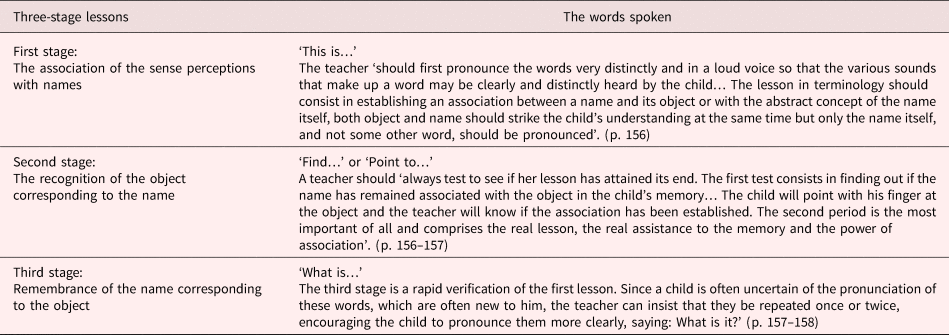
In the Montessori science classroom, the technique of the lesson (three-staged lesson or three-period lesson) is always used for helping the child learn scientific vocabulary and for the teaching of the zoology Linnaean pyramidal arrangement. The term period here is understood as a stage or sequence, and is neither time nor schedule related. The teacher presents information first and the students do the questioning via the Montessori technique. It exists to assist students to learn the technical terminology of a particular topic of study such as zoology.
Montessori (Reference Montessori1967) clarifies the ‘technique of the lesson’: (a) First-staged-lesson: The association of the sense perceptions with names, (b) Second-staged lesson: The recognition of the object corresponding to the name, and (c) Third-staged lesson: Remembrance of the name corresponding to the object (pp. 156–158). De Los Santos (Reference De Los Santos1989) synthesises the three stages in this fashion: (a) ‘This is…’—the teacher introduces a concept, an object or a card by giving the child the exact terminology; (b) ‘Find or point to…’—when the child has successfully accomplished this task, the teacher enters the third stage; and (c) ‘What is this?’—the third stage is used only when the teacher thinks the student can answer successfully. Miller (2006) notes that, during the second stage of the lesson, if the child is not successful in pointing to the named object, the teacher realises that he/she has not spent enough time on the first stage of the lesson. Similarly, during the third stage of the lesson, if the child cannot give the name of the object, the teacher realises that he/she has not spent enough time on the second stage of the lesson (J. Miller, personal communication, June 2006). For example, the teacher would present around three to five picture labels, depending on the age of the students or their ability and also depending on the complexity of the concept introduced. The three stages may be accomplished in one sitting or over the course of several sittings. Table 1 presents an explanation of the technique of the lesson according to Maria Montessori.
Presentation of didactic materials: three-staged lessons (Montessori, Reference Montessori1967)

Indigenist Research Framework
In this study, the Indigenist Research Framework (IRF) allows for the production of collaboration and genuine partnerships between Aboriginal and non-Aboriginal people, i.e. adolescent students and the first author (Rioux). There are three key principles informing this framework, but for the purpose of this paper, we focus on only two, leaving out political integrity: (a) resistance as the emancipatory imperative and (b) privileging Aboriginal voice. According to Rigney (Reference Rigney1999, p. 116), ‘Indigenist research is research undertaken as part of the struggle of Aboriginal Australians for recognition for self-determination’; this framework emerged from ‘the long history of oppression of Aboriginal Australians which began after the invasion of Australia in 1788’. In terms of Koora, the research site, an IRF represents a struggle for self-determination that draws on the past subjugation of the local Koora people since early settlement. It seeks to address concretely how local Aboriginal Knowledge can be partnered with the Western Linnaean zoology curriculum in ways that can work towards improving the educational outcomes of students. Rigney (Reference Rigney1999, p. 117) privileges the voices of local Aboriginal people and claims that ‘Indigenist research focuses on the lived, historical experiences, ideas, traditions, dreams, interests, aspirations and struggles of Aboriginal Australians. It is Aboriginal Australians who are the primary subjects of Indigenist research’. In the Koora study, the discussion circles, Porky hunting (T. aculeatus) and the collection of local animal stories (Rioux et al., Reference Rioux, Ewing and Cooper2017) are about being part of the local Aboriginal family and who they belong to. In this study, Elders, Bolinga High School (BHS) Aboriginal staff and student adolescent participants are all agents of transmission of Aboriginal culture because their voices were privileged in the science classroom and out bush.
Research design
AR was the selected methodological approach and provided the basis for the analysis used in the study. Creswell (Reference Creswell2015) defines AR designs as systematic procedures done by teachers to gather information and ‘improve the practice of education by studying issues or problems they face’ (p. 579). Teachers reflect on these initial concerns and ‘collect and analyse data, and implement changes based on their findings’ (Creswell, Reference Creswell2015, p. 579). Kemmis and McTaggart (Reference Kemmis, McTaggart, Denzin and Lincoln2000) contend that AR best happens by spiralling through a four-step cycle of planning, acting, observing/collecting and reflecting/reviewing (and then revising the plan for another cycle). This four-step format was used to evaluate the 75 Aboriginal and Western zoology lessons contained in the Montessori Contextualised Zoology (MCZ) Program. For each zoology lesson was designed by planning what was to be achieved, followed by a list of actions to be undertaken. This was followed by a larger section of observations which examined the events that occurred when each action was undertaken, and finally, the reflections evaluated the outcomes of the observations and prepared for the next cycle of lessons.
Research context: BHS and community
The research site was an independent Aboriginal high school in a remote Queensland community of approximately 1000 inhabitants. The student population at BHS during the research was composed of 100% Aboriginal enrolment led by five non-Aboriginal teachers (from 2004 until Rioux's departure in December 2011). BHS is unique because the high school is a council run educational facility and a co-educational, non-denominational Aboriginal community school. It is an independent Aboriginal secondary school provided by the Bolinga Aboriginal Corporation for Education (BACE). BHS student population fluctuates from year to year and from the school enrolment, as of February 2007, the total BHS student population for the State Government Census for non-State schools was 97. In 2009, according to the BHS records (Rioux, Reference Rioux2015), 67% of attendance and 91 enrolments were recorded. These were consistent data compared to previous and following years spent at the school.
Participant selection
The study involved Aboriginal participants all belonging to the Queensland Aboriginal family known as ‘Murris’. There were two sets of participants: (a) 12 Aboriginal students who volunteered to participate, all living locally in Koora and aged between 13 and 15 years old (six males and six females), and (b) seven gatekeepers (or seven Aboriginal BHS staff: two School Liaison Officers, two Aboriginal Education Workers or Teacher-Assistants, two Administrative Staff and one Culture Teacher).
Data collection strategy: classroom observations
In this study, classroom observations were considered a critical data collection method during the teaching and learning of the Linnaean structure of the zoology taxonomy and its language complexities. Liamputtong (Reference Liamputtong2013) describes observations in qualitative research as ‘the process of collecting data by looking rather than listening’ (p. 389) in order to gather in-depth understandings in situ of behaviour. Observations were paramount to the AR zoology study in order for me to take time to understand the zoology taught and to support student participants when learning the Linnaean concepts and foreign language.
Thematic analysis
Liamputtong (Reference Liamputtong2013) describes a common type of analysis in qualitative research called thematic analysis as ‘a method for identifying, analysing and reporting patterns (themes) within the data’ (p. 249). It is perceived as a foundational method for qualitative analysis. Thematic analysis in this study entailed searching data sets to identify the themes and patterns of meaning, as suggested by Braun and Clarke (Reference Braun and Clarke2006). Firstly, we (a) read through each transcript of lessons' observations and tried to make sense of the interview data or classroom observations, (b) examined the transcripts or field notes and made sense of what was being said by the participants as a group, and (c) searched across the data set to find repeated patterns of meaning, as proposed by Liamputtong (Reference Liamputtong2009).
Coding in qualitative data analysis was critical and we followed a five-step process for thematic analysis: (1) coding: tagging chunks of data with a label and name, (2) looking for meaning and interesting points, (3) re-reading the data, naming codes and making notes about themes that emerge, (4) reviewing and grouping the recurring themes and, (5) looking for tentative concepts and viewing possible linkages relating to existing literature and Montessori Method.
Ethics
Ethics approval to conduct this study was granted by the Queensland University of Technology Human Research Ethics Committee (0700000967). Participant consent was sought in written form using university ethics-approved participant information and consent forms.
Results and discussion
Aboriginal cross-cultural science education research has generally focussed on the domains of policy, curriculum, teaching resources and teachers' pedagogies. This work has explored far beyond these conventional research topics by giving high priority to the educational experiences of Aboriginal students. We viewed students' accounts of their local experiences and it enabled an understanding of how they accessed and learned to become members of communities of learners (Rioux et al., Reference Rioux, Ewing and Cooper2017). The method further supported a sense of belonging to the Queensland Aboriginal (Murri) family for student participants because the vertebrates on the First Classification of Animal Kingdom (FCoAK) Charts originated from the local animal stories.
In this study, the Montessori three-staged lessons were allied to self-identity enhancement or formation (personal and socio-cultural constructivist theory of learning). The three-staged lesson broke down the Linnaean concepts in manageable pieces. Visual animal classificatory materials were used to develop and extend students' faunal knowledge. This work in Koora defined Montessori's constructivist coherence via the curriculum and viewed it as both bush informal (Aboriginal) and Latin naming formal (Eurocentric). Whenever it was possible, holistic views were given first (e.g. FCoAK Chart), whilst details seen in relation to the whole (orders of the vertebrates seen in the pyramidal Linnaean taxonomical viewpoint). The content of all areas began with basic information (e.g. Kingdom Animalia label) and scaffolding ideas ever expanding (Grazzini, Reference Grazzini1995) such as the orders of the vertebrates. This was the idea of a constructivist approach in Koora. This paper argues that zoology learning in the classroom can be significantly enhanced via the Montessori technique of the lesson and explicit guidance in the Eurocentric culture of school science. This paper focuses on the use of the Montessori technique of the lesson to interweave Aboriginal knowledge with Eurocentric Linnaean constructs and the culture of school science. This following section presents the three-staged lesson, which we have termed: (1) micro-sequence, (2) macro-sequence and (3) culturally responsive practices. The following sections are written in first person by the first author (Rioux).
Micro-sequence: Montessori technique of the lesson
The method of teaching the Linnaean zoology content consisted of the three-staged lesson or the technique of the lesson or what I (Rioux) called micro-sequence. This was a ‘metronomic’ testament of regularity within the Linnaean teaching delivery in Koora. Depending on each student, I presented between three and five name and animal photo card labels. The micro-sequence meant to me a routine presentation of one single piece of material inside one lesson (‘This is…’, ‘Point to…’ and ‘What is…’). For instance, during the First-staged lesson of the Linnaean section, I stated: ‘This is the name and animal photo card labels for the class of vertebrate bird/Aves in Latin’. The Second-staged lesson: ‘Can you find the class of vertebrate bird/Aves? or can you point to the label Aves? Or which label represents the class bird? Or place the bird name label with the animal photo card [Point to…? Where is…?]’. The Third-staged lesson: ‘What is the name of this class of vertebrate? Do you remember what this label is? Can you tell what this picture is?’ The teacher asks: ‘What is this?’ pointing to the photo of a parrot, for example. If the child is ready to do so, he will reply with the proper word: ‘parrot family—class of vertebrate bird-Aves in Latin, Vertebrata’.
The three-staged lesson allowed students to know what to expect well in advance in terms of the lesson style of presentation. It reassured them and offered direction because of procedural repetition. I always endeavoured to navigate the foreign content of the Linnaean system with visual materials. The maxim ‘Teach by teaching, not by correcting’ alluded to the micro-sequence as this was progressively teaching the Linnaean arrangement by building up zoology knowledge ‘constructively’ with loose labels. I utilised a similar repetitive micro-sequence to present classificatory notions for all 31 animal photo cards.
Macro-sequence: Linnaean teaching and technique of the lesson
Because my people were forbidden to teach their Aboriginal curriculum, back then, today we speak with violence, anger and greediness. Today, we reflect the old ways of the colonial time. Aboriginal people don't do things that way. The way out of this is to teach our children about the land. Teach them the Aboriginal and the non-Aboriginal curriculum. Teaching the land means teaching our culture. The land has eyes and ears. Land was there watching you when you were born, when you opened your eyes for the first time and it watched you move. That's why you should treat the land with respect. The stories of the land you were born are very important because the land is your Mother!
Uncle Wallace, Aboriginal Elder in Koora
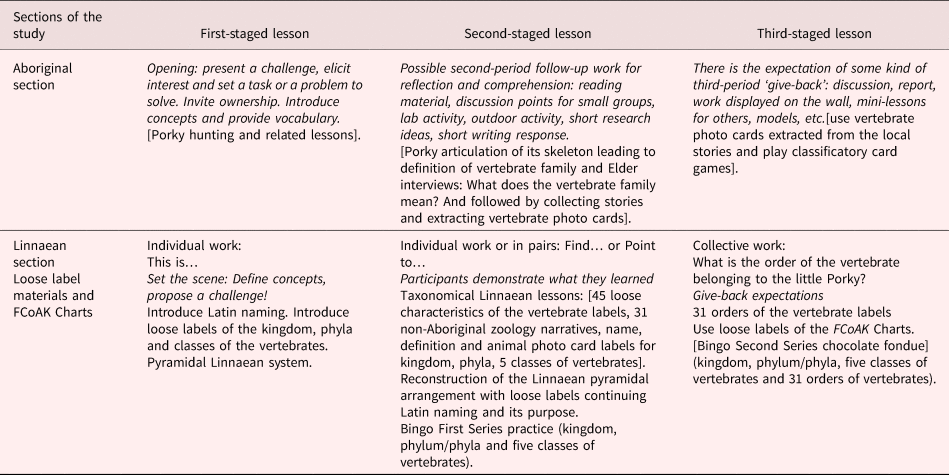
In contrast, I called macro-sequence or multiple lessons that operated within the delivery of the entire study, including Aboriginal and Eurocentric knowledge traditions. The First-staged lesson of the macro-sequence did set the scene and connected with BHS Aboriginal staff and to the aspirations of the community (Porky hunting in Rioux et al., Reference Rioux, Ewing and Cooper2017); the Second-staged lesson allowed the students to experiment and perform an articulation of the Short-beaked echidna's skeleton (T. aculeatus) and collect local narratives; and the Third-staged lesson had a ‘give-back’ expectation. Table 2 below displays an overall macro-sequence or three-staged lesson for both Aboriginal (informal and unhurried transmission) and Linnaean sections of the MCZ Program (formal, intellectual and remembrance training). Early on in the study, there was a sense of informal and unhurried transmission from the Aboriginal knowledge tradition that was social, emotional, intellectual and spiritual at subconscious level or subtly at the ‘sowing of the seeds’ level as opposed to a distinctively intellectual and Linnaean classificatory ‘remembrance training’.
Macro-sequence: comparison of aboriginal and non-aboriginal (three-staged lesson)

The information in Table 2 below briefly deconstructs the macro-sequence in multiple three-staged lessons. The table describes two macro-sequences with three-staged lessons each: (a) the informal Koora Aboriginal materials: Porky hunting (T. aculeatus), (b) articulation or reconstruction of its skeleton, (c) Koora animal stories (see Rioux et al., Reference Rioux, Ewing and Cooper2017), and (d) the more formal and clinical delivery style of the non-Aboriginal zoology Linnaean transmission. In summary, the Aboriginal communal and social materials from the Koora Nations were related to meaning and understanding of the local identity whereas the three-staged lessons of the Linnaean section and didactic zoology content referred to the Linnaean identity because the technique taught targeted zoology content (e.g. ‘This is the class of the Short-beaked echidna, Porky vertebrate Mammalia, mammal label…’).
Culturally responsive practices
(a) Culturally responsive practice: unhurried meandering sequence of the three-staged lesson
The zoology lessons followed a culturally responsive and ‘unhurried’ sequence during the Linnaean section. An unhurried element of the Aboriginal culture that we needed to consider was that displaying good manners meant to be sensitive to ‘unhurried manners’ during an informal conversation with BHS Aboriginal staff, students and Elders in order to build or strengthen relationships. Learning in unhurried fashion was like traveling on a meandering river. We argue for the necessity of following a pedagogical sinuous path in Koora. A parallel can be drawn, as there exists a metaphor between unhurried manners, unhurried lesson sequences, unhurried deliveries and the local Spirit Protector (the local Creator of the landscape and waterways, also called Rainbow Serpent by Aboriginal People Australia-wide). In Koora, the Rainbow Serpent is called by the local people Moonda Gudda. We could have initiated the research on day 1 introducing the unknown Eurocentric science classificatory exercises and presented the non-Aboriginal FCoAK Charts with the Linnaean way of classifying the vertebrate world. However, Aboriginal staff and I selected an unhurried extension. For instance, we deliberately prepared the vertebrate terrain for the Linnaean language and this implied a process where an informal style of lesson delivery first prevailed. We consciously kept all loose label lessons (figures 2–6) as a conversation with the participants rather than a question–answer routine. Lessons were more collaborative rather than talking at/to participants reconstructing the Linnaean arrangement with loose labels. This prolonged sinuous path was necessary in order to diffuse tension caused by the Linnaean language complexities. On the topic of tension between student, content and teacher, Miller (2007) acknowledges that careful considerations should apply when faced with a type of contamination, she calls ‘the oppositional pattern’. She stated that it is too frequent in teaching, thus the reason for removing oneself from a teaching situation. Miller alluded to the three-staged lessons when introducing didactic materials. For instance the request: ‘Show me…where the card koel is [or storm bird from the cuckoo family]’ should be avoided and replaced with the instruction ‘Point to or Find the koel card’ (Dr J. Miller, personal communication, June 2007).
(b) Culturally responsive practice: loose labels and Eurocentric sequence disorder and order
In regard to the reconstruction of the Linnaean taxonomical systems, one result revealed an interesting sequence in the non-Aboriginal (Eurocentric) zoology teaching materials that I developed: an unhurried sequence from ‘disorder to order’. By contrast, what I discovered in the collaboratively developed ‘Aboriginal animal study’ teaching materials was an absence of any structured sequence (Rioux et al., Reference Rioux, Ewing and Cooper2017), which to a non-Aboriginal (Eurocentric) mind probably looked like disorder (chaos). Aboriginal worldviews celebrate disorder. Chaos is taught as an ontological fact by most Aboriginal Elders (Dr Glen Aikenhead, personal communication, 2015). This helps explain the challenge I faced when teaching the Linnaean Latin zoology structure to Aboriginal students who find science's search for order in nature to be strangely foreign and/or irrelevant to their own ontological stance of celebrating the mystery within nature's disorder. This result reveals a significant finding of the research into Aboriginal students' learning Eurocentric zoology. The project was able to entice Aboriginal students into an engagement with the highly ordered Linnaean classification of vertebrates. I first metaphorically describe this process as I arranged for Koora's iconic Porky (T. aculeatus) to urge students to cross the cultural bridge between ‘Aboriginal Land’: (Porky and Koora narratives) and non-Aboriginal territory: (Linnaean knowledge tradition). This indeed is a significant result of the research because this culture-based tension between chaos and order was overcome by culturally responsive teaching materials.
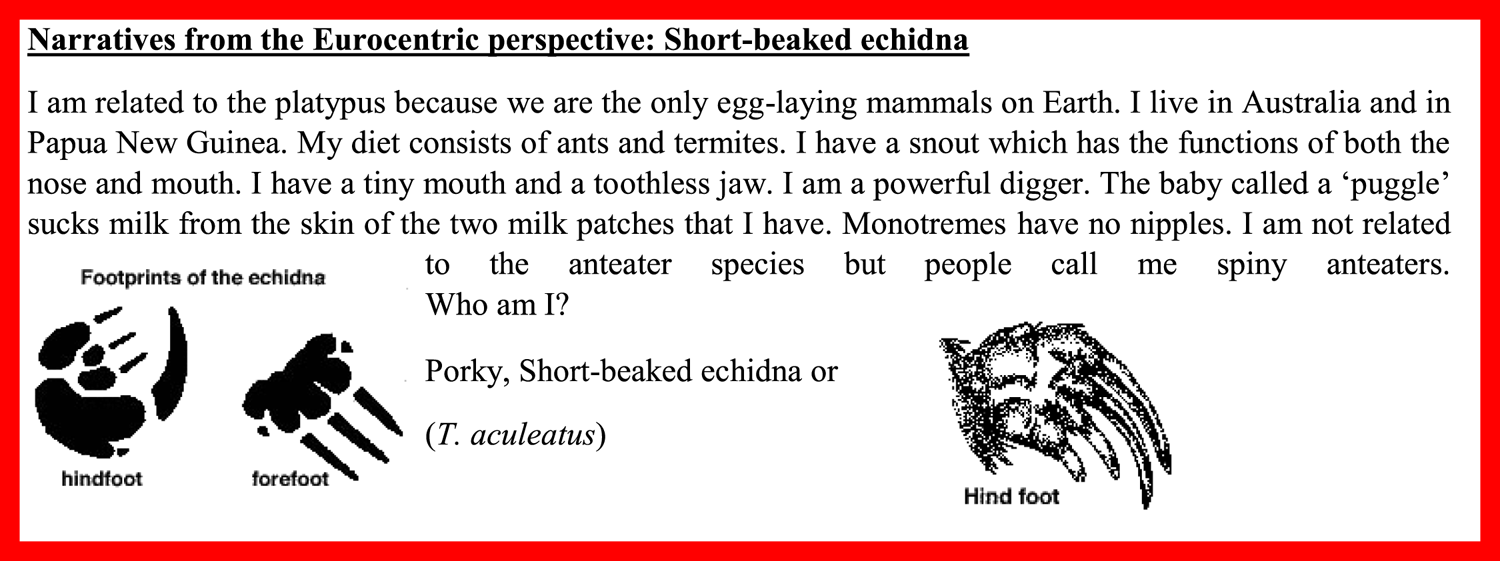
Non-Aboriginal zoology narrative: Who am I game; Short-beaked echidna (T. aculeatus).

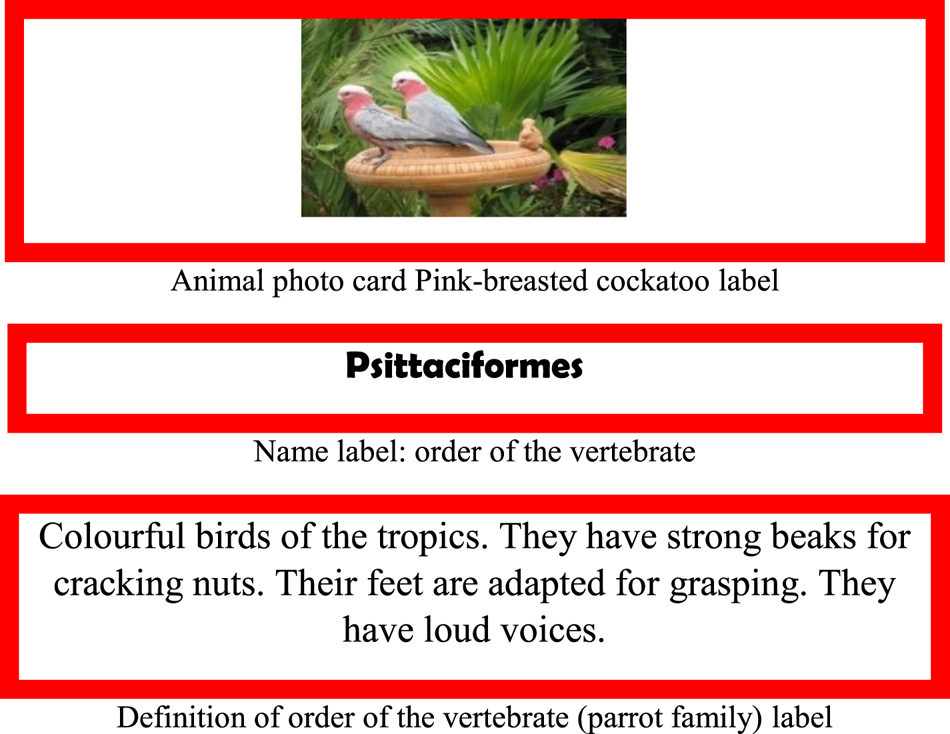
Sample of the characteristic of classes of vertebrate: bird Aves label.

Bingo First Series: bingo card kingdom, phyla and classes of vertebrates.

Example of three types of labels: order of the vertebrates Psittaciformes.

Bingo Second Series: bingo card orders of the vertebrates.

The following is an example of an unhurried culturally responsive lesson sequence that occurred during the Linnaean section. A sequence from disorder to order was weaved into our story that originated from a taxonomical mayhem and loose labels to a tidy presentation or more categorised vertebrate view and ordered Latin classificatory system. This work was engineered by the technique of the lesson.
(c) Culturally responsive practice: repetition, loose labels and freedom
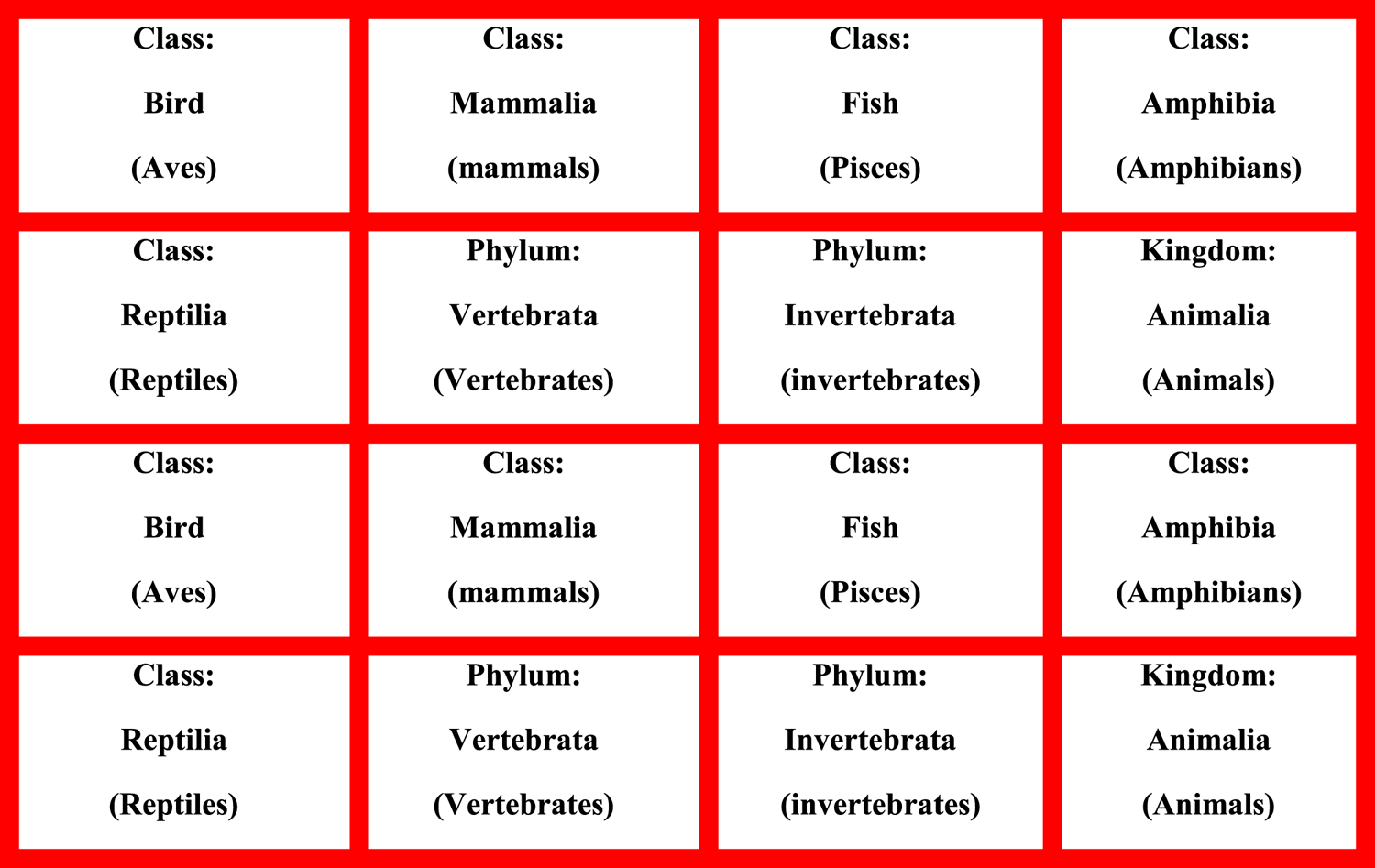
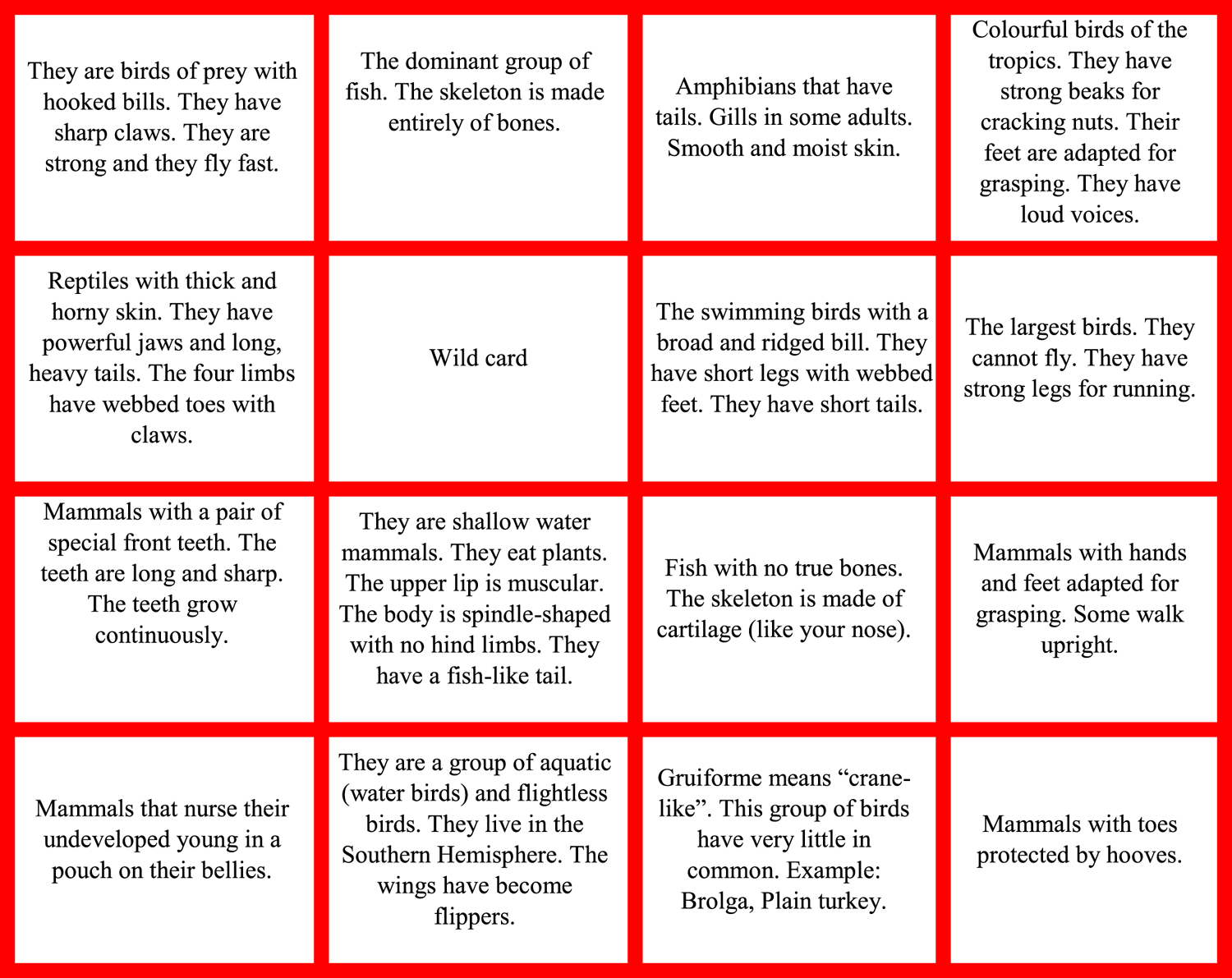
A culturally responsive pedagogy for Aboriginal adolescent students in Koora required the provision and sustenance of exemplary practices such as unhurried repetition, freedom and reconstruction with loose labels. We created a new series of 31 vertebrate narrative labels (sample figure 2; Who am I? game). Corresponding name and animal photo card labels accompanied the 31 narrative labels. These enticing non-Aboriginal narratives engaged the adolescent participants because the information on the cards contained surprising ‘unfamiliar’ facts about ‘familiar’ local species (local vertebrates extracted from the Koora animal narratives from their Elders). Unhurried repetition of taxonomical lexicon was one of the key pedagogical practices selected to support adolescent participants, to engage them and avoid embarrassment of students not knowing the answer. These thoughtful narratives presented a challenging number of unknown science words per sentence, a sufficient number of sentences per animal story card and enough new zoology lexicon contained on each card to challenge the adolescent students. The attracting Linnaean loose label materials were always framed with a bright red border and always deposited on a red velvet mat to first delimit an area of work for students so they stood out, and secondly, the red mat represented the blood of the vertebrates.
The freedom was an integral part of every lesson. Students had the freedom to engage with the materials on the shelves of the classroom at any moment of the day. All participants were first individually exposed to the zoology Linnaean language with the loose labels, according to their interest of the moment. The enactment of the Montessori freedom principle and the next series of 45 loose characteristics of vertebrate label materials were also engineered for repetition, from the technique of the lesson (micro-sequence). A series of red-coloured loose labels presented characteristic labels as well as 31 animal photo cards from the kingdom, phyla and five classes of vertebrate labels. The deliberate reconstruction of the pyramidal Linnaean structure was always first demonstrated to students with the principle in mind of ‘teach by teaching, not by correcting’. These zoology loose characteristic labels of the five classes of vertebrates (figure 3 sample) progressively scaffolded and organised new knowledge for the participants, from disorder to order.
(d) Culturally responsive practice: Bingo First and Second Series
Bingo First Series described the Linnaean language and taxonomical concepts of the FCoAK Charts. This activity was intended to reinforce the names and concepts in Latin (and Standard Australian English––SAE) of kingdom, phyla, five classes of vertebrates, names of 31 animal photo cards and also to strengthen some of the characteristics of the five classes of vertebrates. The bingo was to develop a positive outlook towards learning the Linnaean vocabulary. Sixteen vertebrate photos were printed on each individual bingo boards (figure 4). The photo cards selected for the making of the bingo boards were a miniature replica of the 31 photos on the FCoAK Charts. Unhurried repetition, freedom and series of labels contained in the Bingo First Series were conducted as reinforcement of the foreign concepts. The aesthetically pleasing to the eyes Bingo First Series (figure 4) enticed participants to further engage with the classificatory constructs. Prior repetition with loose narrative labels and pyramidal reconstruction of taxonomical concepts with the characteristic labels reinforced the participants' convictions about the Linnaean arrangement and success rate was augmented.
The Linnaean teaching further extended from kingdom, phyla and classes to the orders of the vertebrates always building up students' knowledge. I presented five loose names, animal photo card and definition of orders of the vertebrate labels at a time for a total of 31 labels (see sample in figure 5). The students slowly became more and more confident and familiar with all animal photo cards of the orders of the vertebrates because of unhurried repetition. This Linnaean pyramidal reorganising with a variety of loose labels ordered the taxonomical concepts for the students and crystallised the Linnaean view.
Bingo Second Series chocolate fondue structured the work with the loose labels and the same 31 orders of the vertebrates. This lesson not only brought fruit, melting chocolate and Linnaean zoology constructs but also synthesised the entire Linnaean classificatory section (figure 6). Once more, as in Bingo First Series, 16 Latin words or 16 vertebrate photo cards were printed per bingo board. The Latin taxonomical names and definition labels were repetitively called out by the gatekeepers during Bingo Second Series. Participants reluctantly pronounced the orders' names but were asking questions: ‘Is brush turkey (Galliformes)? Is Galliformes the same as storm bird? no, storm bird (Koel) is Cuculiformes’. After a few rounds of playing Bingo Second Series, an attempt was finally made by student Kalila (pseudonym) to read out loud one Latin taxonomic name of the orders of vertebrates. The participant said: ‘This is Primata’? and then we added the English corresponding word ‘Primate’. Subsequently, the same student initiated more Latin trials: Columbiformes (pigeon family), Falconiformes (wedge-tailed eagle family) and Sirenia (dugong family).
Fortunately, the build-up lessons strengthened students' confidence in the non-Aboriginal way of classifying vertebrates because all students proudly succeeded in naming and recognising all 31 orders of the vertebrates. The 12 student participants even invited students from other classrooms to display their newly acquired skills. The success of the Bingo Second Series rested on the prevalent presence of seven BHS staff, as they consistently supported students with repetition of lexicon. The deliberate ordered built-in language contained inside the materials and the repetition were pillars that dissipated the embarrassment factor. The social loose labels and bingo materials offered opportunities for: (1) working individually, in pair and presenting collective challenges, (2) developing concentration, and (3) choosing work and having the freedom to select this work or not, and working with whomever, wherever they wished. The bingo materials were self-correcting because the FCoAK Charts (figure 1) always remained available to the participants, as they were sitting close by for verification of their answers; therefore raising their independence level and served the adolescents as a controlled chart throughout the Eurocentric section of the study.
Conclusion
This paper demonstrated the unique and highly significant findings in terms of the Montessori technique (or the three-staged lessons) and the FCoAK Chart. The materials generated interest in learning Eurocentric science knowledge. This article explored and evaluated the Montessori method of teaching non-Aboriginal zoology with didactic materials (FCoAK Charts) assisted by the technique of the lesson. The ‘remote’ Linnaean materials created may be summed up as materialised abstractions because they helped students visualise the abstract pyramidal ideas of Mr Linnaeus. The Linnaean vertebrate classificatory constructs and surrounding Latin language were preceded by the more practical Aboriginal views and understanding of nature (ways of living). The overall lessons delivered to the participants over the course of the programme connected theory and practice because privileging of local Aboriginal knowledge and animal language gave rise to meaningful and contextualised Linnaean lessons and culturally responsive practices. Repetition, freedom and unhurried inclusion of foreign science knowledges strengthened students' Aboriginal personal identity as well as identities as science learners.
Students can be successful if a culturally responsive pedagogy in the classroom is presented to them. In Koora, there usually exists a clash of different science perspectives and worldviews between Aboriginal students and their non-Aboriginal teachers. There are a gap and a mismatch between the teachers' practices in classrooms and the home cultures of Aboriginal students. According to BHS Aboriginal staff, the teaching of the local Aboriginal curriculum has the potential to prevent this mismatch, as reviewed in Rioux et al. (Reference Rioux, Ewing and Cooper2017). It was natural for us, the BHS Aboriginal staff and I, to combine the local Aboriginal context because it resonated strongly with us as a means to produce an engaging series of zoology lessons. We believed that the classroom should be viewed as a context for bringing together both curricula and knowledge traditions: the teaching and learning of Aboriginal knowledge and the Linnaean zoology. This paper emphasised the importance of engagement for the construction of learner in terms of Eurocentric Linnaean zoology identity and respect for foreign-to-them zoology knowledge. Recognising the need for Aboriginal students to learn, engage and participate in zoology learning, a series of recommendations emerged from the data collected and analysed in the MCZ Program. There was strong evidence to indicate three exemplary culturally responsive practices.
Recommendations for Aboriginal students and science education
• Presenting the technique of the lesson inside the Linnaean section of the study enhanced the engagement and enthusiasm for students in learning the foreign-to-them zoology.
• Using an influx of flexibility and freedom was culturally responsive. Offering students the freedom to perform an activity in their own time until satisfied, positively influenced their engagement, participation and sustained their zoology interest for extended periods of time. Freedom and trust in the adolescent student to individually select work or work with a peer, and the trust that the participants will learn. Practicing and repeating an exercise with the materials in their own time until satisfied was well considered for mastery of concepts at their own pace.
• Presenting and repeating the Linnaean taxonomy with a variety of loose labels and charts was powerful. Ordering and sequencing from simple to more complex reconstruction was also powerful. We presented Linnaeus' ideas from a generic view of the vertebrate world (kingdom, phyla, five classes), that is, from a disordered pile of name, definition, characteristic and 31 loose animal photo cards to a more ordered and specific one (adding the orders of the vertebrate labels in pyramidal fashion).
These recommendations should be foremost in classrooms where sustained engagement and participation in learning is the focus.
Author ORCIDs
Joel Rioux, 0000-0002-4792-2067.
Acknowledgements
Joel Rioux wishes to acknowledge both his doctoral study supervisors for their relentless work as well as the Queensland Aboriginal community members, Bolinga High School Aboriginal staff, and especially the Aboriginal students from which this research emerged.
Joël Rioux currently lectures at the Batchelor Institute of Indigenous Tertiary Education in the Northern Territory. He has implemented the Montessori method with remote Aboriginal students for 8 years.
Bronwyn Ewing is a Senior Lecturer in the School of Teacher Education and Leadership at the Queensland University of Technology. She takes a transdisciplinary approach to research to integrate disciplines.
Tom Cooper is a Professor of Mathematics Education and Director of the YuMi Deadly Centre in the School of Teacher Education and Leadership at the Queensland University of Technology.